
Penalty Relief
Business Penalty Abatement Letter: Template and How to Write One That Works (2026)
The short answer: a business penalty abatement letter is a written request asking the IRS to remove penalties on a business return — 941, 940, 1120, 1120-S, or 1065 — based on First-Time Abate or reasonable cause. Send it to the address on your penalty notice, with your EIN, each penalty and period named, and proof attached.
You're looking at a notice — maybe a CP162, a CP215, or a 941 penalty breakdown — where the penalties are almost as big as the tax itself, and the IRS is now moving on the business bank account. A business penalty abatement letter is the tool that attacks the penalty portion directly, and it costs nothing to send. This page gives you the full copy-and-adapt template, the two legal arguments the IRS actually accepts, and the order to make them in — an order most owners get wrong.
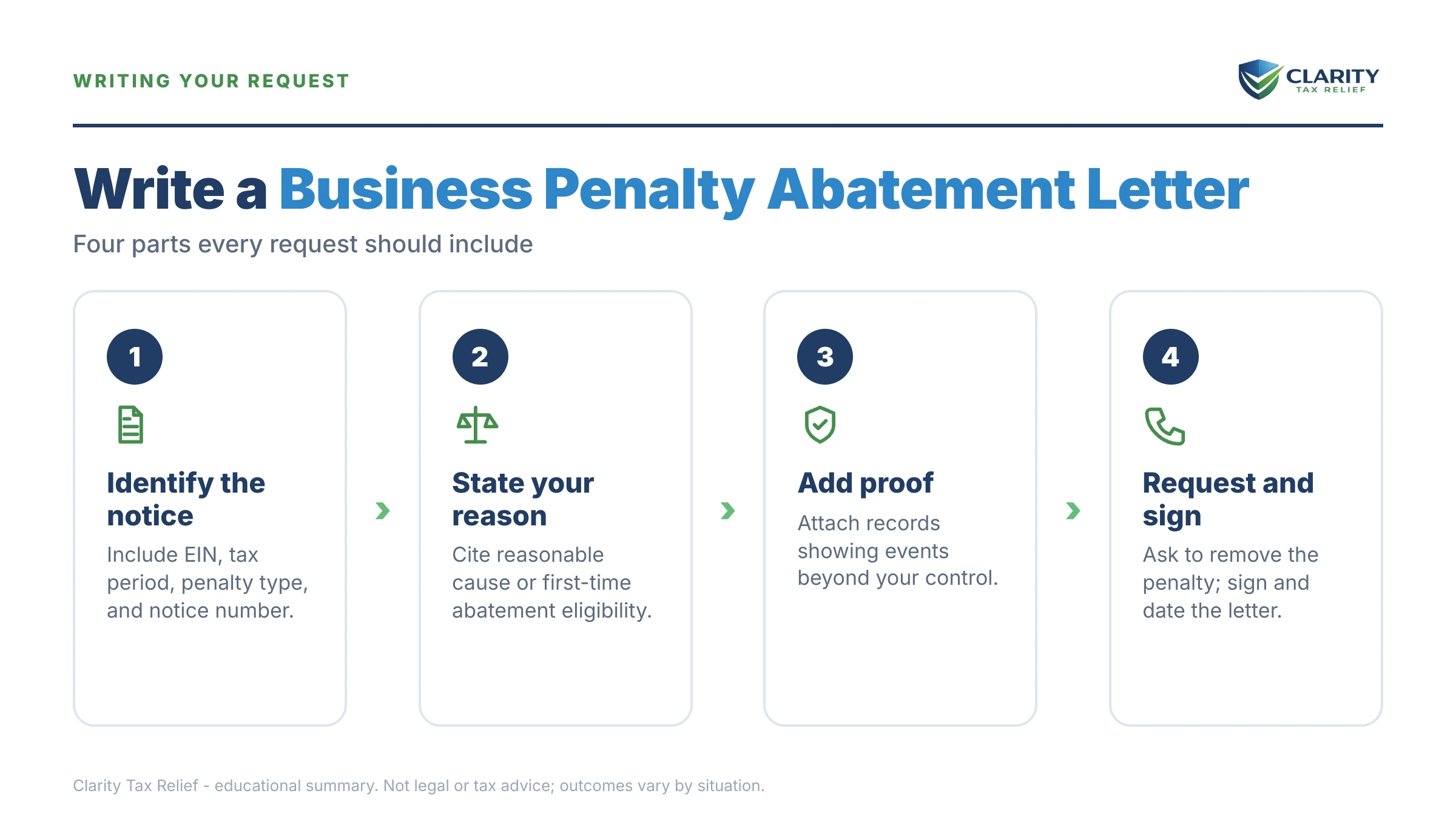
The image below shows you exactly what a strong abatement request looks like on the page and where each required element sits — most denials happen because one of those elements is missing, not because the facts were weak.
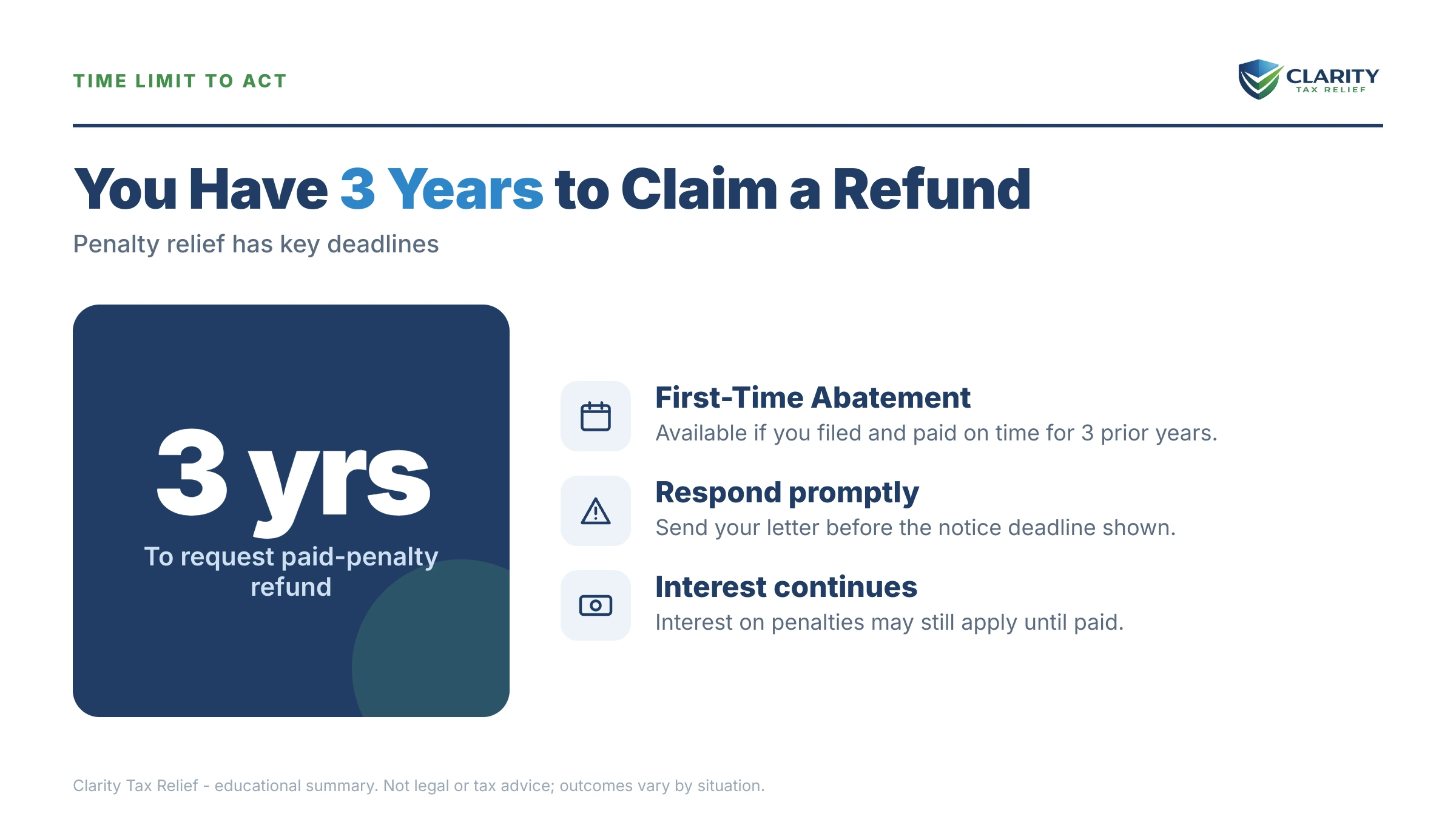
⏱ The real clocks: the failure-to-pay penalty adds another 0.5% of the unpaid tax every month until you act, and if you already paid the penalties, your refund-claim window under Form 843 generally closes at the later of 3 years from filing or 2 years from payment. If your notice threatens a levy, the response date printed on that notice controls — the abatement letter does not pause it.
Why the IRS penalized your business — and why a letter can undo it
Nearly all business penalties are assessed by computer, with no human judgment applied — which is exactly why a written request can reverse them. The system sees a 941 filed late, a deposit made after its due date, or an 1120-S filed past the extension, and it stamps on the penalty automatically. Nobody asked whether you were in a hospital bed that quarter. The abatement letter is how those facts get in front of a person.
Business penalties also stack in ways personal penalties don't. A single bad year can trigger the failure-to-file penalty (5% per month of unpaid tax, capped at 25%), the failure-to-pay penalty (0.5% per month), and — for employers — the federal tax deposit penalty at 2%, 5%, 10%, or 15% depending on how late the deposits were. S-corps and partnerships get hit differently: the CP162 notice charges a per-owner, per-month late-filing penalty even when the return shows zero tax due.
Because these are automated assessments against events, not judgments about your conduct, the law gives you two standing arguments to remove them: a clean-history credit called First-Time Abate, and a facts-and-circumstances argument called reasonable cause. The full math on how these penalties compound lives in our guide to how big IRS penalties get — this page is about getting them off your account.
What happens if you ignore business penalties
An unanswered business penalty doesn't sit still — it compounds, escalates toward a levy, and eventually locks you out of getting the money back. The sequence runs in stages:
- Assessment. The penalty posts and a notice arrives — CP161 or CP163 for balance-due penalties, CP162 for S-corp/partnership late filing, CP215 for civil penalties. Interest starts accruing on the penalty itself immediately, on top of interest on the tax.
- Monthly growth. The failure-to-pay penalty adds 0.5% of the unpaid tax each month, and each quarter's IRS interest rate compounds daily on the whole balance — tax, penalties, and prior interest.
- Intent to levy. A CP504B notice arrives, letting the IRS take the business's state tax refund and signaling that a federal tax lien and account levy are next.
- Enforcement. After the final notice window closes, the IRS can levy the business bank account (a 21-day hold before funds leave) and accounts receivable. For payroll debt, the trust-fund portion can also be assessed against owners personally.
- The recovery door closes. If you pay under levy pressure and wait too long, the refund-claim window expires — abatable penalties become permanently unrecoverable.
In 2026 this runs on autopilot more than ever: the IRS workforce shrank roughly 27% in 2025, but the notice and levy systems are automated and never stopped. The practical effect is a machine that escalates on schedule while abatement letters wait longer in the queue — a reason to send yours now, not a reason to skip it.
Penalties stacking while the IRS moves on your business account?
Send us the notice. An experienced tax professional will tell you — free — whether First-Time Abate or reasonable cause fits your facts, and what to do about the levy threat while the request is pending.
First-Time Abate vs. reasonable cause: which argument goes in your letter
First-Time Abate removes qualifying business penalties automatically if the business filed all required returns and had no penalties in the prior three years — no excuse or documents needed. Reasonable cause is the argument for everything else: you must show an event outside your control prevented compliance despite ordinary business care, with dates and proof.
Two things most template pages get wrong. First, the order matters: if you have real reasonable cause facts, lead with them and ask the IRS to apply First-Time Abate only if reasonable cause is denied. FTA is a once-per-clean-window credit — burning it on penalties you could have won on the facts leaves you unprotected the next time a quarter slips. Second, "my accountant dropped the ball" usually fails on its own: under the Supreme Court's Boyle decision, relying on an agent to file on time is not reasonable cause. Reliance arguments work only when they're about substantive advice, not about who was supposed to hit the deadline.
One quieter path for small partnerships: Rev. Proc. 84-35 relief can remove the 1065 late-filing penalty for partnerships with 10 or fewer partners when every partner reported their share timely on their own returns. If that describes you, cite it by name in the letter. And note what's coming: starting summer 2026, the IRS is rolling out the Automatic Exemption from Penalty (AEP), which applies first-time-style relief automatically with no request — but it doesn't reach reasonable-cause-only penalties, and it doesn't fix penalties already sitting on your account today.
| Business penalty | Where you see it | First-Time Abate? | Reasonable cause? |
|---|---|---|---|
| Failure to file (5%/month, caps at 25%) | CP161; late 941, 1120 | Yes, if prior 3 years clean | Yes |
| Failure to pay (0.5%/month) | CP161, CP163 | Yes | Yes |
| Failure to deposit (2/5/10/15%) | CP276B, 941 penalty notices | Yes | Yes |
| S-corp / partnership late filing (per owner, per month) | CP162 | Yes | Yes; Rev. Proc. 84-35 for small partnerships |
| Accuracy-related (20%) | CP215, exam changes | No | Yes, but harder — usually argued in exam or appeal |
| Information-return penalties (late W-2s/1099s) | CP215 | No | Yes, written request only |
Your options: costs and timelines for each abatement route
Every route to business penalty abatement is free — the only costs are postage, time, and the risk of using the wrong one. Here's how they compare in 2026 conditions:
| Route | Out-of-pocket cost | Typical timeline | Best when |
|---|---|---|---|
| Phone request (FTA) | $0 | Sometimes decided on the call; long 2026 hold times | Clean 3-year history and a single, straightforward penalty |
| Written abatement letter | Certified postage only | Typically several weeks to a few months | Reasonable cause facts that need documents, or multiple periods |
| Form 843 penalty abatement request (refund claim) | $0 | Often several months | Penalty already paid — must be inside the 3-year/2-year window |
| Appeal after denial | $0 | Adds months, but reverses many automated denials | Strong facts rejected by first-round software review |
| Professional representation | Fees vary by case | Runs the letter, follow-up, and appeal on your behalf | Levy in motion, payroll/trust-fund exposure, or large multi-period penalties |
How much penalty relief is realistic at your balance
The right amount of effort scales with the penalty balance, because the IRS's own scrutiny scales with it too. A rough map by band:
| Penalty balance | Realistic approach | Why |
|---|---|---|
| Under $1,000 | Phone FTA request, or a short letter | Small, single-period penalties with a clean history are the easiest automated grants |
| $1,000 – $5,000 | Written letter — FTA or reasonable cause, with proof attached | Worth documenting properly; a CP162 with several owners lands here fast |
| $5,000 – $25,000 | Documented reasonable cause letter; appeal any denial | First-round software denials are common at this size; the appeal is where facts win |
| Over $25,000 | Professional review before anything is sent | Usually multiple periods and, on payroll debt, personal trust-fund exposure — the letter's wording can matter later |
Worked example: $11,300 in business penalties on one bad year
Say your single-member LLC — you rent your shop space, so there's no property to borrow against — fell behind on payroll during your hospitalization, and the notices now show $11,300 in penalties on top of the tax. A realistic hypothetical breakdown:
- Failure-to-deposit: $78,000 in 941 deposits made more than 15 days late × 10% = $7,800
- Failure-to-file: two 941s filed over five months late with $10,400 unpaid × the 25% cap = $2,600
- Failure-to-pay: $10,400 × 0.5% × roughly 17 months ≈ $900
Total: $7,800 + $2,600 + $900 = $11,300 — and interest has been compounding on all of it. A reasonable cause letter citing the hospitalization dates, with medical records attached and proof the business caught up on deposits once you recovered, targets the entire $11,300 plus the interest charged on those penalties. The $10,400 of tax and its own interest remain — but a balance of roughly $10,400 instead of $22,000-plus is the difference between an affordable monthly plan and a levy on the operating account. You can estimate your own numbers with our IRS Penalty & Interest Calculator, and if the debt is payroll-based, pair the letter with a business payroll tax payment plan so collection stops while the abatement request is pending.
How to write and send a business penalty abatement letter, step by step
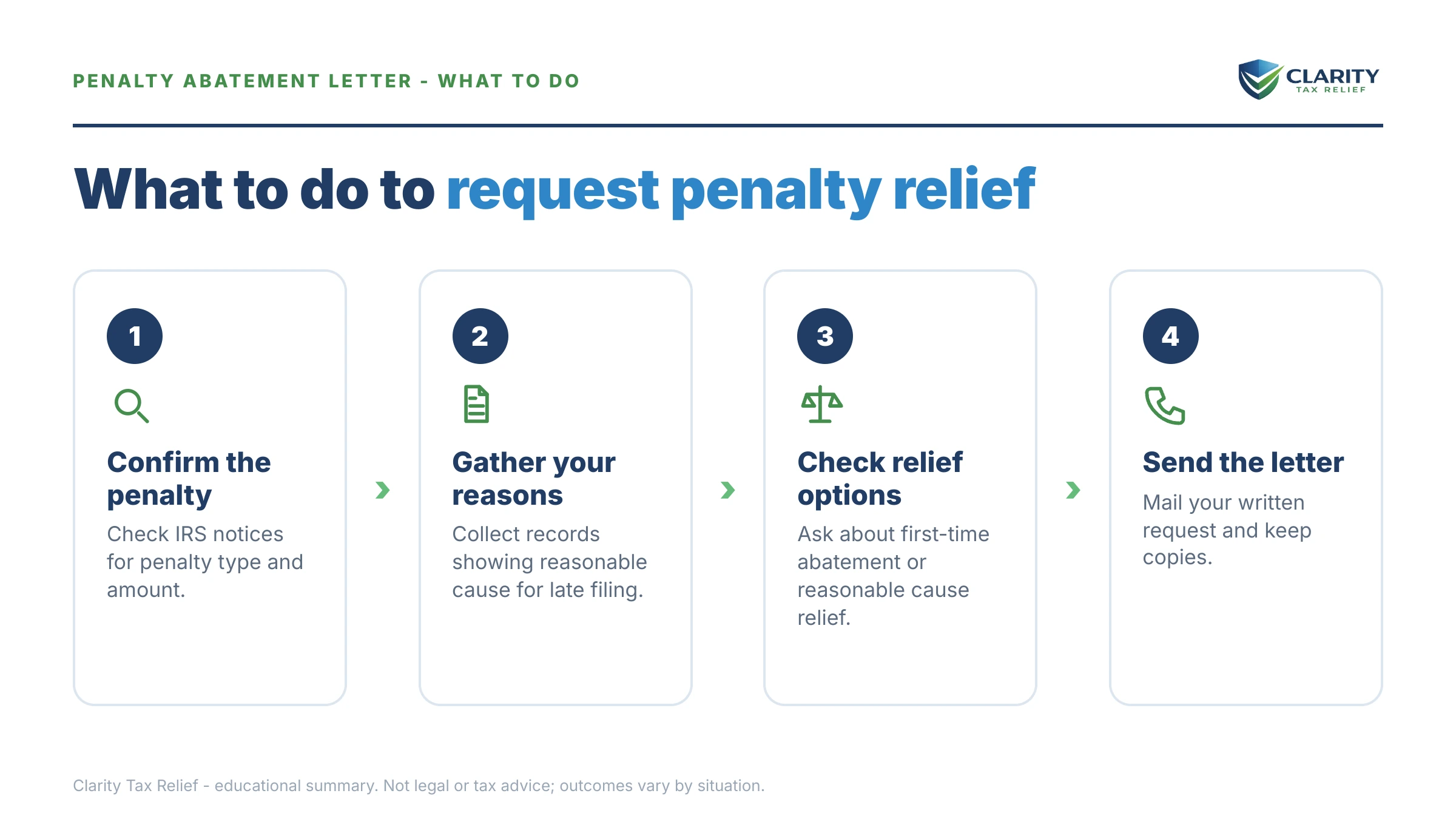
- Pull the penalty details. Find the notice number, tax form, tax period(s), and each penalty type and dollar amount on your notice — or pull the business account transcript if you've lost the letter. Your request must name every penalty and period you want removed.
- Check First-Time Abate eligibility. Confirm the business filed all required returns and had no penalties in the three years before the penalized period. If that's true, FTA removes qualifying penalties without any excuse or documents.
- Choose your argument in the right order. If you have genuine reasonable cause facts, lead with them and ask the IRS to apply First-Time Abate only if reasonable cause is denied — that preserves your one clean-history credit for a future slip.
- Draft the letter from the template. State the request, the grounds, the specific dates of the event that prevented compliance, and the steps showing ordinary business care — including what you've done since to get compliant.
- Attach proof and mail it certified. Enclose copies (never originals) of hospital records, insurance or disaster claims, correspondence, and filed returns. Mail to the address on your penalty notice, certified with return receipt.
- Calendar the follow-up. If you've heard nothing in about 60 days, call the number on the notice with your mailing receipt. If denied, file an appeal by the deadline printed on the denial letter — many first-round denials are reversed on appeal.
The business penalty abatement letter template (copy and adapt)
The strongest letters run one page plus enclosures — the image above shows how the pieces sit on the page. Replace every bracket, delete any paragraph that doesn't apply, and keep the facts specific: exact dates beat adjectives every time.
[Date]
Internal Revenue Service
[Exact address printed on your penalty notice]Re: Request for Penalty Abatement
Taxpayer: [Legal business name]
EIN: [XX-XXXXXXX]
Tax form: [Form 941 / 1120-S / 1065 / 1120 / 940]
Tax period(s): [e.g., Q2 2025 and Q3 2025]
Notice number and date: [e.g., CP162 dated ______]To Whom It May Concern:
On behalf of [business name], I am requesting abatement of the following penalties assessed for the period(s) above: [name each penalty and amount — e.g., failure-to-deposit penalty of $7,800; failure-to-file penalty of $2,600; failure-to-pay penalty of $900]. I also request removal of the interest that accrued on these penalties.
[Reasonable cause paragraph — lead with this if you have the facts:] The failure to [file / pay / deposit] on time was due to circumstances beyond the business's control. On [date], [describe the event with specifics: the owner/responsible officer was hospitalized from ___ to ___; a fire on ___ destroyed the business's records; the flood declared a disaster on ___ shut down operations]. During this period, no one else at the business had the authority or information to complete these obligations. The business exercised ordinary business care and prudence: [describe what was done — deposits were current before the event; a bookkeeper was engaged on ___; all missing returns were filed on ___ and deposits have been made on time since ___].
[FTA fallback paragraph — include if eligible:] If reasonable cause is not granted, I request First-Time Abatement. The business filed all required returns and had no penalties for the three tax years preceding the period(s) at issue.
Enclosed are copies of: [list — e.g., hospital admission and discharge records; the insurance claim; the filed returns; proof of on-time deposits since ___]. Please send a written response to the address below. If you require anything further, I can be reached at [phone].
Sincerely,
[Name], [Title — e.g., Owner / President / Member]
[Business name]
[Address] · [Phone]Enclosures: [count]
Three drafting rules that decide outcomes. Match the dates: the event you describe must overlap the periods penalized — a January hospitalization doesn't explain a Q3 deadline. Show the recovery: the IRS reads "compliant once the event ended" as proof the event was the cause. Ask for the interest on the penalties explicitly — it comes off with the penalty, but only the interest tied to the penalty; interest on the tax itself needs a separate IRS interest abatement argument and only applies when IRS error or delay caused it. If you're adapting this for a personal 1040 penalty instead, use the first-time penalty abatement letter sample built for individual accounts — the grounds overlap but the identifiers and penalty types differ.
Already paid the penalties? Don't use a letter at all — file the refund claim route described in penalty abatement after paying before the 3-year/2-year window closes.
When you can handle this yourself — and when help changes the outcome
Most single-period business penalty requests are genuinely DIY. If the business has a clean three-year history and one late return or one bad quarter of deposits, a phone call or the template above is all First-Time Abate requires — no professional needed. The same goes for a small-partnership CP162 where Rev. Proc. 84-35 plainly applies: cite it, attach the partners' filing proof, done.
Experienced help changes outcomes in four situations. A levy is already in motion — the abatement letter won't stop it, and the collection response has its own deadlines that outrank the letter. Multiple periods or multiple penalty types — sequencing FTA and reasonable cause across periods (see first time abatement multiple years) determines how much actually comes off. Payroll debt with trust-fund exposure — what you write about who was responsible and when can surface later in a Trust Fund Recovery Penalty investigation, so the letter's wording deserves care; the specifics live in our 941 penalty abatement guide. A denial you plan to fight — the penalty abatement appeal is where judgment beats software, and presentation matters most there.
If your penalties span several periods or a levy notice has already arrived, a free review of the notices before you mail anything — the 2-minute form or (888) 825-7779 — can keep one letter from complicating the bigger case.
One more boundary: this template is for IRS penalties. State penalties run on separate statutes with different standards — California owners should start with FTB penalty abatement, which has its own rules and its own one-time relief program. Never assume an IRS threshold or window applies to a state agency.
Terms on your notice, decoded
- Reasonable cause — the legal standard for excusing a penalty: an event outside your control prevented compliance despite ordinary business care.
- Ordinary business care and prudence — the behavior the IRS expects to see around the event: you were compliant before, you fixed things after, and the gap maps to the event.
- First-Time Abate (FTA) — administrative removal of failure-to-file, failure-to-pay, and deposit penalties based purely on a clean prior three years.
- AEP (Automatic Exemption from Penalty) — the automatic replacement for FTA rolling out starting summer 2026; no request needed, but it doesn't reach reasonable-cause-only penalties.
- Failure-to-deposit penalty — the employer deposit penalty tiered at 2%, 5%, 10%, or 15% by how late the payroll deposits were.
- RCA (Reasonable Cause Assistant) — the IRS software that scores many written requests before a person reads them; it's why weak-looking letters with strong facts get denied first, then win on appeal.
- Form 843 — the claim form used to recover penalties you already paid, subject to the 3-year/2-year window.
For the wider set of what qualifies and what doesn't — disasters, records destroyed, embezzlement by an employee — see reasonable cause examples, and for how this letter fits into the full business relief toolkit across 941, 1120, and 1065 penalties, the parent guide is business penalty abatement.
Business penalty abatement letter questions, answered
What is a business penalty abatement letter?
It's a written request asking the IRS to remove penalties assessed against a business return — 941, 940, 1120, 1120-S, or 1065 — based on First-Time Abate or reasonable cause. It identifies the business by EIN, names each penalty and period, states the legal grounds, and attaches proof. It goes to the address printed on your penalty notice, not a generic IRS address.
Where do I send a business penalty abatement letter?
Send it to the IRS address printed on the penalty notice you received — CP162, CP161, CP215, or the 941 penalty notice. That address routes your request to the campus that assessed the penalty, which is faster than any generic address. Send it certified mail with return receipt so you can prove the date it arrived, and keep a complete copy.
Can I request business penalty abatement over the phone?
Often, yes — for First-Time Abate on straightforward failure-to-file, failure-to-pay, and deposit penalties, calling the number on your notice can sometimes get a decision on the call. Reasonable cause requests almost always need to be in writing because the IRS wants dates and documents. In 2026, expect long hold times: IRS staffing fell roughly 27% in 2025, so a certified letter is the more reliable record either way.
Does first-time abatement apply to business penalties like the 941 or 1120-S late-filing penalty?
Yes. First-Time Abate covers the business failure-to-file, failure-to-pay, and failure-to-deposit penalties — including the per-owner, per-month late-filing penalties on 1120-S and 1065 returns — if the business filed all required returns and had no penalties in the prior three years. It does not cover the 20% accuracy-related penalty or information-return penalties like late W-2s and 1099s; those need a reasonable cause argument.
What counts as reasonable cause for a business?
Events outside your control that prevented compliance despite ordinary business care: serious illness or death of the owner or the person responsible for filing, fire or natural disaster, records destroyed or unavailable, or reliance on incorrect written IRS advice. What generally does not work: "my accountant forgot to file" — under the Supreme Court's Boyle decision, relying on an agent to file on time is not reasonable cause by itself.
Will penalty abatement remove the interest too?
Partially. When the IRS abates a penalty, it also removes the interest that accrued on that penalty — often 10–20% more relief on older assessments. Interest on the underlying tax stays, because the law only allows the IRS to abate that interest when its own error or delay caused it, a separate request under IRC §6404. Ask for "the penalty and associated interest" explicitly in your letter.
How long does the IRS take to answer a penalty abatement letter?
Typically several weeks to a few months, and 2026 processing is slower than usual because of the workforce reduction. Phone FTA requests are sometimes decided on the call; written reasonable cause requests take longer because a person has to weigh your facts. If you've heard nothing after about 60 days, call the number on your notice with your certified-mail receipt in hand to confirm the letter is in the queue.
What if my business penalty abatement letter is denied?
You can appeal — and you should if your facts are strong, because first-round denials are often generated by the IRS's automated Reasonable Cause Assistant software rather than a person reading your evidence. The denial letter states your appeal deadline and how to request review by the IRS Independent Office of Appeals; miss that printed date and you lose the easy path. Appeals officers apply judgment the software can't.
Can I get business penalties back that I already paid?
Yes, through a refund claim on Form 843 — but only inside the window: generally the later of three years from when the return was filed or two years from when you paid the penalty. After that, even a winning argument recovers nothing. If you paid to stop a levy and the penalties were abatable, file the 843 promptly rather than waiting to see if the IRS notices on its own.
Does a pending abatement request stop an IRS levy?
No. An abatement letter attacks the amount you owe; it does not pause collection on the balance. If you've received an intent-to-levy notice like a CP504B or a final notice, you must deal with collection separately — a payment plan, a Collection Due Process hearing request, or a hardship release — while the abatement request works through the system. Never assume the letter alone protects your bank account.
Your next 24 hours
- Find the penalty breakdown on your notice — the notice number, tax form, period(s), and each penalty's name and dollar amount. That's the skeleton of your letter, and it tells you whether FTA or reasonable cause is the right argument.
- Gather your evidence — the notice, the returns for the penalized periods, proof of the prior three years' clean compliance, and dated documentation of whatever prevented filing or paying (medical records, disaster claims, correspondence).
- Get the free case review — the 2-minute form or (888) 825-7779. Penalties and interest post monthly until the request is granted, and if a levy notice has arrived, the collection response has to move in parallel with the letter — an experienced tax professional can map both in one call.
The IRS's own overview of relief criteria is at IRS.gov penalty relief, the refund-claim form and instructions are at About Form 843, and if your request stalls for months with collection still moving, the Taxpayer Advocate Service exists for exactly that kind of stuck case.
This guide is general information, not tax or legal advice for your specific situation. Eligibility for IRS programs depends on individual facts and circumstances; no outcome is guaranteed.