
IRS Penalty Relief
Automatic Exemption from Penalty (AEP) 2026: The New IRS Rule Replacing First-Time Abate
The short answer: the Automatic Exemption from Penalty (AEP) is the IRS's 2026 replacement for First-Time Abate, rolling out starting this summer. Qualifying penalties — the kind first-time relief has always covered, like failure-to-file and failure-to-pay — are removed automatically, with no request needed. AEP does not erase the underlying tax or the interest on it.
You've heard the IRS is about to start removing penalties automatically — no phone calls, no letters, no forms. If you're carrying a tax balance with penalties stacked on top, especially on a fixed income where every month of accrual hurts, the real question is simple: will yours come off, and when? Some will. This guide covers exactly which ones — and what to do about the rest of the balance, which AEP does not touch.
⏱ The real clock: there is no AEP application deadline, because there is no application. But the failure-to-pay penalty adds 0.5% of the unpaid tax every month the balance sits open, and interest compounds on top. Automatic relief clears what has already accrued — it does not stop new penalties from building on a balance you leave unresolved.

What is the Automatic Exemption from Penalty (AEP) in 2026?
The Automatic Exemption from Penalty (AEP) is the IRS program that begins replacing First-Time Abate (FTA) in summer 2026, applying qualifying penalty relief automatically instead of requiring taxpayers to ask for it.
For decades, first-time penalty abatement was relief you had to know existed. If your compliance record was clean for the prior three years, the IRS would remove certain penalties — but only if you called or wrote and requested it. Taxpayers who never heard of the program simply paid penalties they didn't have to pay.
AEP flips the default. Under the new approach, the IRS screens accounts and applies qualifying relief on its own — no request required. The change also fits the agency's 2026 reality: with the workforce cut roughly 27% in 2025, per TIGTA reports, the IRS is pushing routine decisions to automated systems, and penalty relief that once required a phone agent is exactly the kind of decision being automated.
Two honest caveats before you celebrate. First, the IRS has not published every operational detail of AEP — how fast relief posts, which tax periods get swept first, or whether it reaches backward to penalties you already paid. Second, "automatic" describes the design, not a guarantee for your account. During the rollout, the traditional request paths still work, and you should use them if your penalty doesn't come off on its own.
| Feature | First-Time Abate (the old process) | AEP (rolling out summer 2026) |
|---|---|---|
| How relief starts | You must call or write to request it | Applied automatically by the IRS |
| What you had to know | That the program existed at all | Nothing — but you should verify it posted |
| Eligibility standard | Clean compliance for the prior 3 years, all returns filed | Expect the same clean-record test |
| What it removes | Eligible penalties plus the interest charged on them | Same |
| What stays | The tax and the interest on the tax | Same — AEP is penalty relief only |
Why your account has penalties in the first place
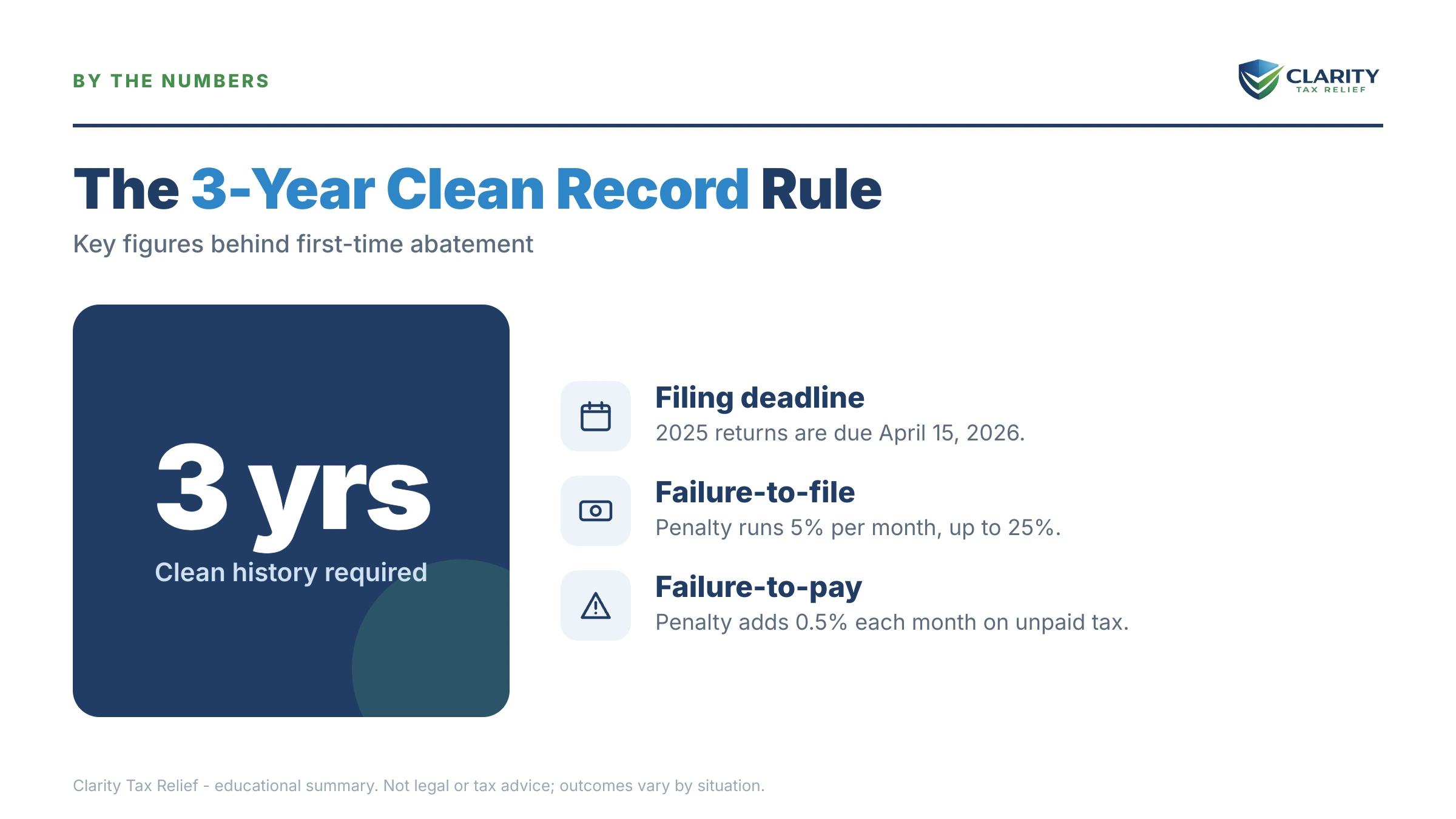
The failure-to-file penalty runs 5% of the unpaid tax per month — ten times the 0.5% monthly failure-to-pay penalty — and both build until they hit their caps.
Most penalty balances that AEP could reach come from one of three ordinary events: a return filed late, a return filed on time with a balance you couldn't pay, or a payroll deposit a business missed. None of them require wrongdoing — just a bad year. The full penalty math, including how the two penalties interact when both apply, is in our guide to how much IRS penalties on back taxes really cost.
Interest is the quieter problem. It compounds daily on the tax and on the penalties, so a penalty that sits on your account for two years costs more than its face amount. You can estimate what your own penalties and interest add up to with our IRS Penalty & Interest Calculator — knowing the number is the first step to knowing what relief is worth.
Which penalties the automatic exemption covers — and which it won't touch
Expect AEP to reach the same three penalties First-Time Abate covered: failure-to-file, failure-to-pay, and failure-to-deposit.
The IRS has not released a final expanded list for AEP, so the safe planning assumption is that coverage mirrors First-Time Abate — the three penalties above, for taxpayers with a clean prior three years. Everything first-time relief never touched should be assumed outside AEP unless the IRS announces otherwise:
- The 20% accuracy-related penalty. This attaches to understatements found in exams and CP2000 matching, and it has always required a reasonable-cause defense or an appeal — see our guide to the accuracy related penalty irs rules.
- The estimated-tax underpayment penalty. First-time relief never covered it, and nothing announced changes that. It has its own relief door: Form 2210 exceptions, including an estimated tax penalty waiver that can apply if you retired after reaching age 62 or became disabled — a path many retirees miss. The current rate mechanics are in our estimated tax penalty rate 2026 guide.
- Fraud penalties. Never eligible for first-time relief; not expected under AEP.
- Penalties outside the income-tax system. Information-reporting and foreign-account penalties — like the exposure covered in our didn't file fbar penalty guide — run on entirely separate rules.
Two structural limits carry over from FTA as well. First-time relief applied to a single qualifying period, not a stack of years — if you have penalties across multiple years, only the earliest typically qualifies for the first-time break, and the rest need a different argument, as explained in first time abatement multiple years. And for businesses, an automatic screen fixes one clean slip, not a pattern: multi-quarter payroll penalty problems still run through the reasonable-cause process in our 941 penalty abatement guide.
| Penalty | How big it gets | First-time / AEP relief? |
|---|---|---|
| Failure-to-file | 5% of unpaid tax per month, up to 25% | Yes — the core covered penalty |
| Failure-to-pay | 0.5% per month, up to 25% | Yes |
| Failure-to-deposit (payroll) | Tiered 2%–15% of the deposit | Yes, for businesses with clean histories |
| Estimated-tax underpayment | Interest-rate based, varies by quarter | No — use Form 2210 exceptions/waivers |
| Accuracy-related | 20% of the understatement | No — reasonable cause or appeal |
| Civil fraud | 75% of the underpayment | No |
What happens if you ignore the penalties and the balance underneath
Penalty relief never stops collection — the unpaid tax underneath keeps moving through the IRS notice sequence whether or not the penalties come off.
This is the mistake we expect AEP to create at scale in 2026: taxpayers hear "automatic exemption" and stop paying attention to the balance. The collection machine doesn't. Here is the sequence an unresolved balance follows, stage by stage:
- Accrual. The failure-to-pay penalty adds 0.5% every month and interest compounds daily — the balance grows even while penalty relief is pending.
- Balance-due notices. A CP14 first bill (typically about 21 days to respond, or 10 business days when the balance is $100,000 or more), then reminder notices, each one automated.
- CP504 — Notice of Intent to Levy. The IRS can seize your state tax refund under IRC §6331(d).
- LT11 / Letter 1058 — Final Notice. A 30-day clock starts, along with your Collection Due Process rights. After it runs, bank levies and wage levies become legal.
- Levy on federal payments. For retirees, this is the one that matters most: through the Federal Payment Levy Program, the IRS can take up to 15% of your Social Security benefit — continuously, until the debt is resolved. Details in can the irs garnish social security.
Every step in that list is issued by automated systems. The 2025 staffing cuts made the IRS harder to reach on the phone — they did not slow the notices down.
Penalties stacking on a balance you can't pay?
Send us your latest notice or transcript. An experienced tax professional will confirm which penalties qualify for automatic relief, which need a request, and the cheapest realistic path for the balance underneath — free and confidential.
Your options for the tax underneath — AEP only clears penalties
Removing penalties shrinks the balance, but the failure-to-pay penalty starts rebuilding on any tax that stays unpaid — so the second half of the job is resolving the balance itself.
Which option is realistic depends mostly on how much you owe after relief:
| Balance after relief | Realistic options | Cost & conditions |
|---|---|---|
| Any amount, payable within 180 days | Short-term payment plan | $0 setup; interest and penalties continue until paid |
| Under $10,000 | Guaranteed installment agreement | Must be granted if basic conditions are met; setup fee applies |
| $10,000–$25,000 | Streamlined installment agreement, set up online | No detailed financial disclosure; up to 72 months |
| $25,000–$50,000 | Streamlined agreement with direct debit | Direct debit required at the top of the band; up to 72 months online |
| Over $50,000 | Financial-disclosure agreement, CNC, or OIC | Form 433 financials; more scrutiny, more options |
| Any amount, genuine hardship | Currently Not Collectible or Offer in Compromise | CNC: free, debt remains. OIC: $205 fee and 20% down on lump-sum offers, both waived with low-income certification (AGI ≤ 250% of poverty); per IRS data, the IRS accepted roughly 1 in 5 offers in FY2024 |
Three notes for readers on fixed incomes. A streamlined installment agreement under $25,000 is the lowest-friction option — no financial disclosure, set up online. If even a modest monthly payment would leave you unable to cover housing, food, and medicine, Currently Not Collectible status pauses collection entirely while the debt remains. And an Offer in Compromise is real but means-tested — it fits only when your income and assets genuinely can't cover the debt, which is exactly the math the IRS runs for many Social Security-only households. Setup details for all plans are on the IRS payment plans page.
A worked example: $19,700 on a fixed income
Say you're retired, living on Social Security and a small pension. In 2024 you pulled $85,000 from your 401(k) to replace a roof, the withholding fell short, and you filed on time owing $17,000 you couldn't pay. Sixteen months later, your account looks like this (hypothetical figures, rounded):
- Tax: $17,000
- Failure-to-pay penalty: 0.5% × 16 months = 8% of $17,000 = $1,360
- Interest on the tax and penalty: roughly $1,340
- Total: about $19,700
Now apply AEP-style relief. If your prior three years are clean, the $1,360 failure-to-pay penalty qualifies for first-time relief — and the interest that was charged on that penalty (roughly $70 here) comes off with it. Your balance drops to about $18,270. The interest on the $17,000 of tax stays, because no program removes statutory interest on tax you actually owe.
One timing point that matters: the failure-to-pay penalty keeps accruing on unpaid tax even after past months are abated. Relief applied while the balance is open clears what has accrued so far — which is why pairing relief with a payment plan (or full payment) is what actually stops the meter.
At $18,270, you're under the $25,000 streamlined line: a 72-month online agreement works out to roughly $255 a month at the minimum, before the interest that continues to accrue — paying more than the minimum shortens the plan and cuts the interest cost. If $255 would break a Social Security budget, hardship status is the honest alternative to a plan you'll default on. More on the fixed-income tradeoffs in our guide for those who are retired and owe back taxes.
How to get penalty relief under AEP in 2026, step by step
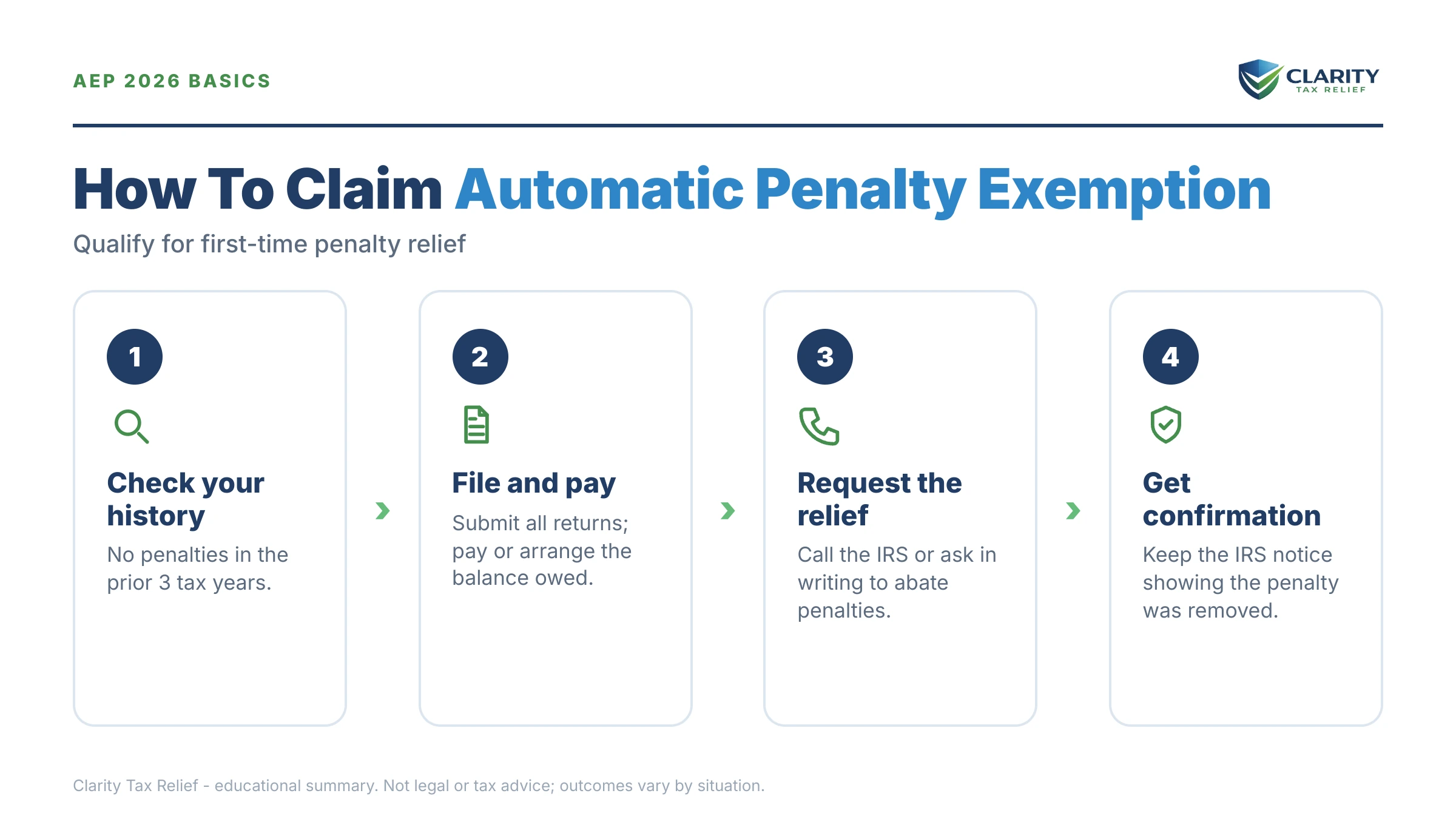
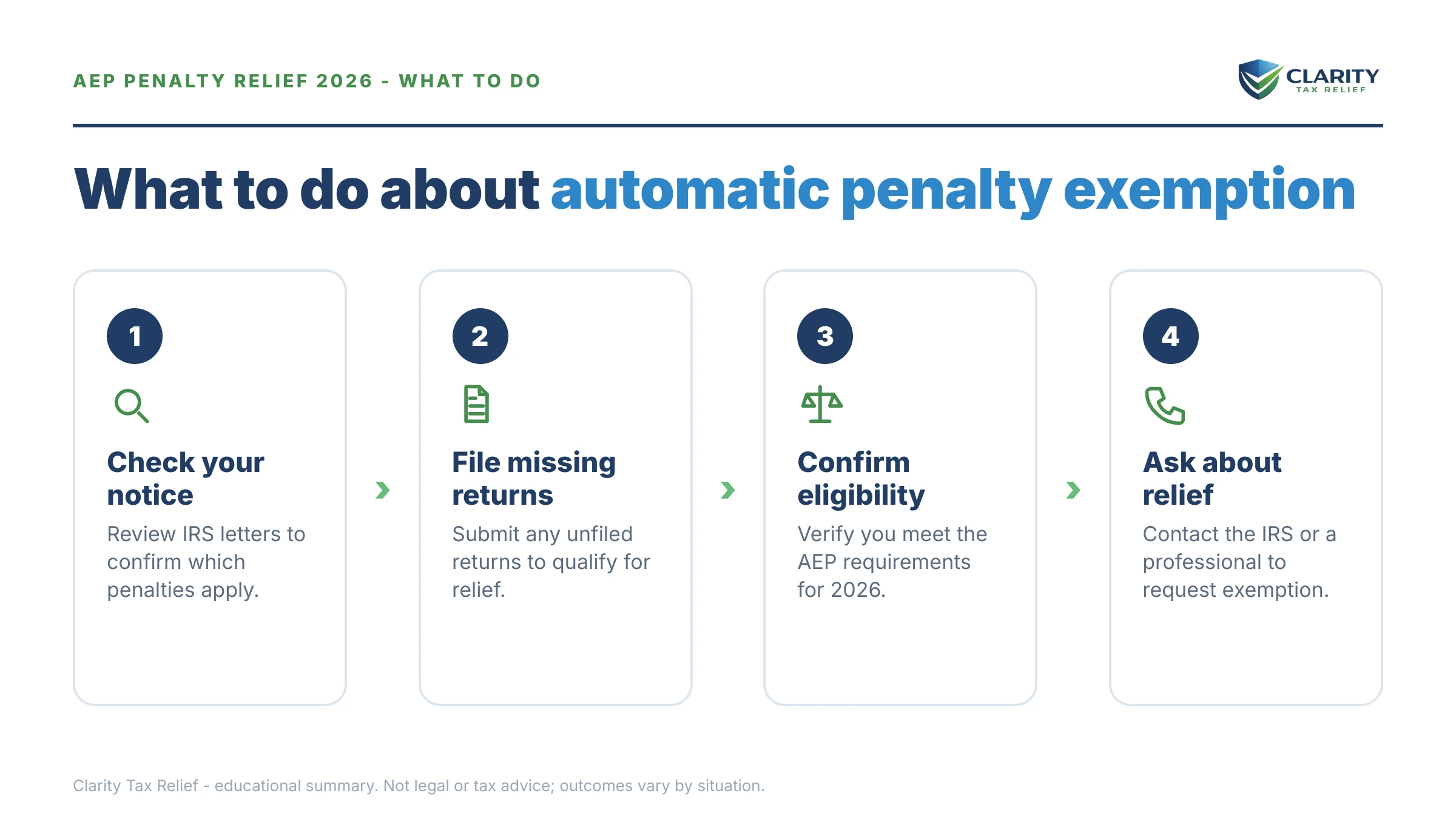
- Pull your IRS account transcript. Check whether the penalty is still posted for the year in question or whether an abatement has already been applied — relief shows as its own line on the transcript.
- Confirm your three-year compliance history. First-Time Abate required no penalties in the prior three years and all required returns filed; expect AEP's automatic screen to apply the same clean-record test.
- Request relief directly if nothing posts. Call the number on your most recent IRS notice or file Form 843 — automatic does not mean instant, and a direct request protects you during the rollout.
- Resolve the underlying balance. Set up a payment plan, hardship status, or full payment so the failure-to-pay penalty stops rebuilding on the unpaid tax.
- Claim a refund for penalties you already paid. File Form 843 — generally within two years of paying the penalty or three years of filing the return, whichever is later.
On the transcript, a manually processed abatement typically posts as code 780, while penalty reversals appear as their own reduction lines against the original penalty codes. If you're filing a written request or a refund claim, our Form 843 penalty abatement request walkthrough covers what to attach and where to send it.
When you can handle this yourself — and when experienced help changes the outcome
Most single-year, clean-history penalty situations do not need professional help in 2026 — that's the entire point of AEP.
Handle it yourself if: you have one year with a failure-to-file or failure-to-pay penalty, your prior three years are clean, and you can either pay the balance within 180 days or set up a streamlined plan online. Verify the relief posts, set up the plan, done.
Experienced help changes the outcome when the automatic screen can't reach your problem: penalties across multiple years, where only one period gets the first-time break and the rest need documented reasonable cause; accuracy-related or fraud penalties, which require an actual defense; business payroll penalty patterns, where the exposure can become personal; a levy already in motion against your bank account or Social Security; or a balance large enough that the choice between a payment plan, CNC, and an Offer in Compromise turns on financial analysis, not a phone call. In those cases, the order you fix things — returns first, penalties second, the balance last — often changes the total you pay.
Not sure which side of that line you're on? A free review of your transcript and notices will tell you whether your penalties qualify for automatic relief before you spend anything pursuing more.
Terms on your account, decoded
- Abatement — the IRS's word for removing a penalty (or the interest charged on it) from your account.
- First-Time Abate (FTA) — the request-based penalty relief program AEP is replacing, available to taxpayers with a clean prior three years.
- AEP (Automatic Exemption from Penalty) — the 2026 successor to FTA, under which qualifying relief is applied automatically with no request.
- Reasonable cause — the fallback relief standard for penalties AEP won't reach: showing that circumstances beyond your control (illness, disaster, death in the family) caused the failure.
- Failure-to-pay penalty — 0.5% of unpaid tax per month, capped at 25%; the penalty most retirees on a payment shortfall are actually looking at.
- Statutory interest — interest set by law that compounds on unpaid tax until it's paid; no penalty-relief program removes it.
Automatic Exemption from Penalty: your questions, answered
What is the Automatic Exemption from Penalty (AEP)?
AEP is the IRS's replacement for First-Time Abate, rolling out starting in summer 2026. Instead of making you call or write to request first-time penalty relief, the IRS applies qualifying relief automatically based on your account history. You still owe the underlying tax and the interest on it — AEP removes eligible penalties, nothing more.
Do I need to apply for the AEP in 2026?
No — the defining feature of AEP is that no request is needed; the IRS applies qualifying relief on its own. That said, the rollout is new and IRS staffing is thin, so verify the penalty actually comes off your account transcript. If it doesn't, request relief directly by calling the number on your notice or filing Form 843 rather than waiting.
When does the Automatic Exemption from Penalty start?
The IRS has said AEP begins rolling out in summer 2026, replacing the First-Time Abate request process. Exact processing dates for individual accounts have not been published, so don't assume a specific month for your penalty. If your account still shows a penalty you believe qualifies, you can still pursue relief the traditional way — automatic relief doesn't cancel your right to ask.
Which penalties does AEP cover?
Expect coverage similar to First-Time Abate: failure-to-file, failure-to-pay, and failure-to-deposit penalties for taxpayers with a clean prior three years. The IRS has not published a final expanded list, so treat anything beyond those three as unconfirmed. Penalties first-time relief never touched — the 20% accuracy-related penalty, the estimated-tax penalty, and fraud penalties — should be assumed outside AEP unless the IRS says otherwise.
Does AEP remove interest too?
No. Interest on the unpaid tax is set by law and keeps compounding until the balance is paid. When a penalty is removed, the interest that was charged on that penalty comes off with it — but the interest on the tax itself stays. Interest relief is a separate, narrow program mostly limited to IRS errors and delays.
Does AEP apply to the estimated tax penalty?
Almost certainly not. First-Time Abate never covered the estimated-tax underpayment penalty, and nothing announced about AEP suggests that changes. That penalty has its own relief path — Form 2210 exceptions, including a waiver that can apply if you retired after reaching age 62 or became disabled. If most of your penalty is an underpayment penalty, AEP is the wrong door; the Form 2210 waiver is the right one.
I already paid my penalty — can I get it back under AEP?
Possibly, but don't count on automation reaching backward. If you paid a penalty you believe qualified for first-time relief, file Form 843 to claim a refund — generally within two years of paying it or three years of filing the return, whichever is later. The IRS has not said AEP will automatically refund previously paid penalties, so an affirmative claim is the safe move.
Is First-Time Abatement gone now?
It's being phased out, not erased overnight. AEP begins replacing the FTA request process in summer 2026, but the underlying standard — a clean compliance history for the prior three years — carries forward. During the transition, if your penalty qualifies and hasn't been removed automatically, you can and should still request first-time relief the traditional way.
Does AEP cover business and payroll penalties?
Failure-to-deposit penalties on payroll taxes were covered by First-Time Abate, so expect them within AEP's scope for businesses with clean histories. Larger payroll problems — repeated missed deposits across quarters, or trust-fund exposure — need reasonable-cause arguments and often professional help, because an automatic first-time screen won't fix a multi-quarter pattern.
Will my state remove penalties automatically too?
No — AEP is a federal IRS change only. States run their own penalty-relief programs with their own standards; California's FTB, for example, has its own abatement process and a 20-year collection statute under R&TC §19255. Never assume an IRS relief program applies to a state balance — check with the state agency or a professional who works both sides.
Your Next 24 Hours
- Find the penalty lines. On your latest notice or your IRS online account, locate the breakdown between tax, penalties, and interest — that split determines exactly how much AEP-style relief is worth to you.
- Gather three years of history. Your last three filed returns, every IRS notice you've received, and your income documents (SSA-1099, pension statements, 1099-Rs) — the clean-record test and any payment-plan decision both run on these.
- Get the free case review. Use the 2-minute form or call (888) 825-7779. Penalties and interest keep accruing on an open balance every month — the sooner the penalties come off and the balance has a plan, the less this costs. If the IRS stalls on a valid relief request, the Taxpayer Advocate Service is the independent backstop.
This guide is general information, not tax or legal advice for your specific situation. Eligibility for IRS programs depends on individual facts and circumstances; no outcome is guaranteed.