
IRS Transcript Codes
Code 780 on Your IRS Transcript: The Offer in Compromise Acceptance Code (2026)
The short answer: code 780 on an IRS transcript means the IRS formally accepted your offer in compromise — the account is marked "compromised." It posts after your acceptance letter arrives and locks in the settlement. Your obligations start now: finish every offer payment on schedule and stay fully compliant for five years, or the original balance returns.
You've been pulling this transcript every week since code 480 posted, and today there's finally a new line: 780, dated a few days after the letter that said your offer was accepted. The word "compromised" reads like something went wrong. It didn't — this is the entry you spent a year waiting for, and what you do over the next five years decides whether it sticks.
A code 780 transcript entry is rare company: the IRS accepted roughly 1 in 5 offers in FY2024, so most people who apply never see this code. The image below shows exactly what the entry looks like on a real account transcript and where to find the posting date that starts your obligations — that date matters more than any other number on the page.
⏱ The clock that matters: any remaining offer payments are due on the schedule in your acceptance letter — lump-sum offers must be finished within 5 months of acceptance — and your five-year compliance period starts now. Miss a payment or fall out of filing compliance and the IRS can revoke the compromise and reinstate the full original balance.
What a code 780 transcript entry actually means
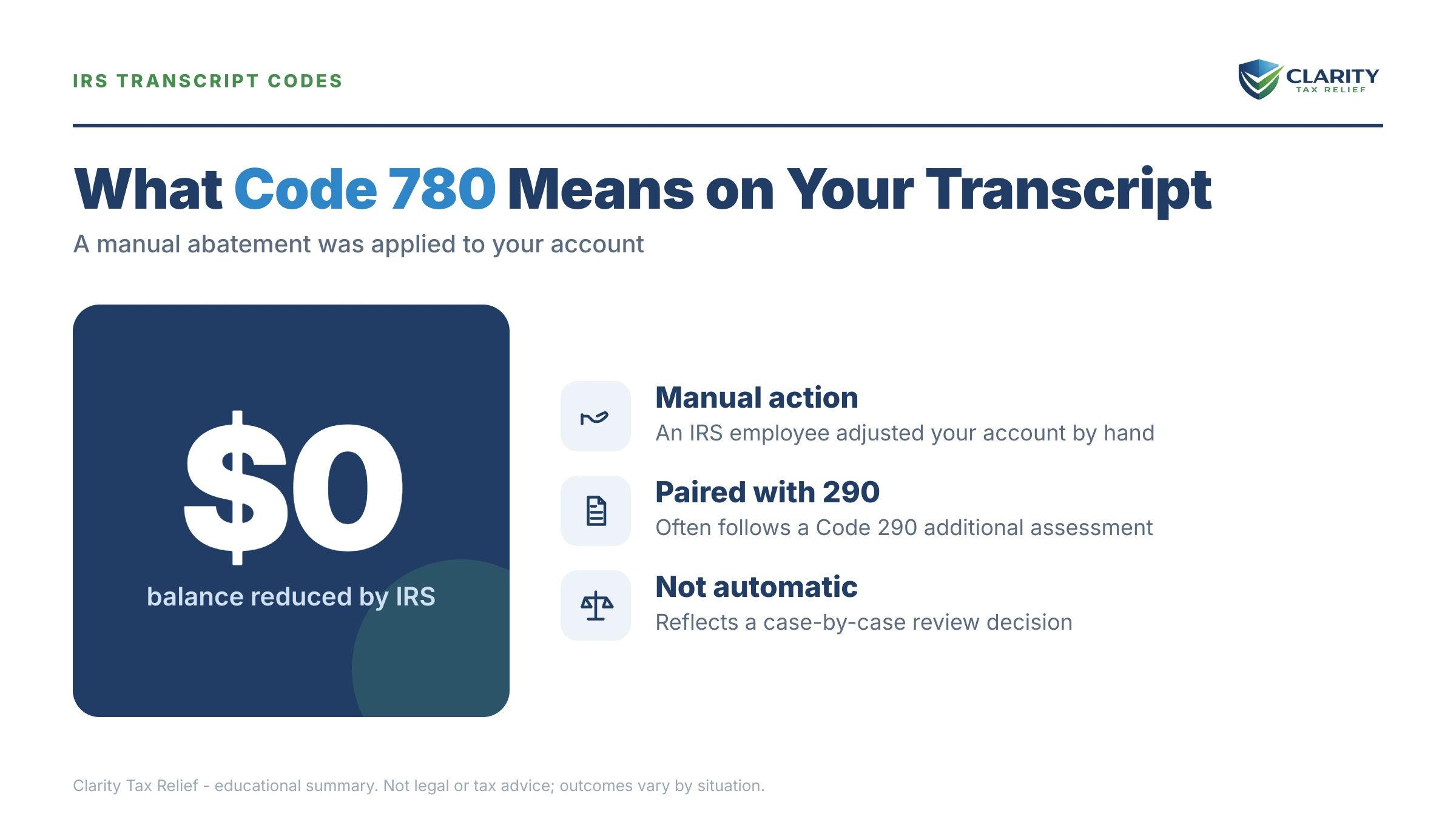
Transaction code 780 marks an IRS account as "compromised" — it posts when the IRS formally accepts an offer in compromise on that tax period. On the transcript, the line typically reads "Master file account compromised," and one 780 should appear on every tax year your offer covered, not just one.
Code 780 doesn't erase the balance by itself. It flags the account so the automated collection system stops treating the full assessed debt — the original code 150 irs transcript assessment plus everything stacked on top of it — as collectible. The actual write-off comes later: once you complete every term of the offer, the IRS abates the remaining tax, penalties, and interest, and you'll see adjustment entries removing those amounts from the account.
If transcript layouts are new to you, our hub guide on how to read irs account transcript covers columns, dates, and cycle formats. This page covers only what's unique to 780: the acceptance, the payments still owed, and the ways an accepted offer can still fall apart.
Why code 780 posted to your account
Code 780 posts for exactly one reason: an authorized IRS official signed off on the Form 656 offer you (or your representative) submitted. Before this, your transcript showed code 480 transcript — offer pending — while an offer examiner reviewed your finances. The acceptance letter comes first by mail; 780 follows on the transcript, usually within a few weeks.
There's a second, less common path: if the IRS fails to decide an offer within 2 years of receiving it, the offer is deemed accepted by law. With the IRS workforce down roughly 27% since the 2025 cuts, offers are sitting longer — a handful of taxpayers now reach acceptance simply because the clock ran out.
Either way, the amount the IRS agreed to take was driven by its math, not negotiation charm: your asset equity plus a slice of your future income. That figure — reasonable collection potential — is what your worked example below walks through.
Code 780 vs. the other offer in compromise transcript codes
The 48x and 78x codes tell the whole life story of an offer, from filing to completion — or default. Here's the full map:
| Code | What it means | What to do |
|---|---|---|
| 480 | Offer pending; collection generally on hold | Wait it out — stay filed and current on this year's taxes while it's reviewed |
| 481 | Offer rejected | You have 30 days to appeal with Form 13711, or restructure and refile — see code 481 transcript |
| 482 | Offer withdrawn | Collection resumes; line up a fallback (payment plan, hardship status) fast |
| 780 | Offer accepted; account marked compromised | Finish payments on schedule; your five-year compliance period starts |
| 781 | Accepted offer defaulted | Act immediately — ask the offer unit about curing or reinstating before full collection resumes |
| 782 | Code 780 posted in error, reversed | Call the offer unit and confirm your offer's real status in writing |
| 788 | All offer terms completed | Watch for the balance adjustments and the lien release that follow |
What happens if you break the offer terms
An accepted offer is conditional — the IRS can revoke it, and code 781 is what revocation looks like on a transcript. The default sequence runs in a fixed order:
- The trigger. You miss a scheduled offer payment, file a required return late, or leave a new tax balance unpaid during the five-year compliance period.
- The cure letter. The IRS typically mails a warning giving you a chance to fix the problem before the offer is formally defaulted. This letter is your last cheap exit — respond to it.
- Default. No cure, and the offer is revoked. Code 781 posts, and the compromise is gone.
- Reinstatement of the debt. The original liability — minus payments you made — returns to the account, with penalties and interest. Worse, the time your offer spent pending paused the 10-year collection statute, so the IRS now has longer to collect than it did before you applied.
- Collection resumes. The notice stream restarts where it left off, back on the path toward liens and levies — with none of the leverage you had while the offer protected you.
Defaulting is the single most expensive mistake a taxpayer with a 780 can make: you lose the settlement, keep none of the discount, and face a longer collection window than the one you escaped.
Code 780 posted — but something's off?
A payment about to slip, a 781 or 782 you can't explain, or periods missing the 780 entry — get your transcript and offer terms reviewed free before a fixable problem becomes a defaulted settlement. An experienced tax professional will tell you exactly where your offer stands.
Your remaining costs and timeline after code 780
What you still owe after acceptance depends entirely on which payment option you chose on Form 656. Your acceptance letter restates the schedule — this table shows how the two structures play out:
| Offer type | Paid before acceptance | Still owed after 780 | Deadline |
|---|---|---|---|
| Lump sum | $205 application fee + 20% of the offer (both waived with low-income certification) | The remaining 80% of your offer | Up to 5 installments within 5 months of acceptance |
| Periodic payment | $205 fee + the monthly payments made during IRS review (waived if low-income certified) | The rest of your proposed monthly schedule | Monthly until paid — no more than 24 months from the offer date |
| Both types | — | Five straight years of tax compliance | Every required return filed and paid on time, through year five |
Two more things resolve on their own timelines. Refunds: for offers accepted since late 2021, the IRS generally no longer keeps your refund for the calendar year of acceptance — details and exceptions are in our guide on whether the IRS will keep my refund after an offer in compromise. Liens: a filed federal tax lien stays in place until the offer terms are complete, then the IRS must release it within 30 days of the liability being satisfied — here's how long for the IRS to release a tax lien if yours lags.
A worked example: what code 780 does to a $68,500 balance
Say you run a small business with a handful of employees and owed the IRS $68,500 on your personal account — $54,000 in income tax from two brutal years, plus $14,500 in penalties and interest that stacked up as code 276 transcript and code 196 transcript entries while the balance sat.
The IRS didn't accept your offer because you asked nicely. It accepted because your reasonable collection potential (RCP) — the most it could realistically ever collect — came out below the debt. In this hypothetical:
- Asset equity: $11,200 (used business equipment at quick-sale value, plus a small bank cushion above operating needs)
- Future income: $600/month of disposable income × 12 (the lump-sum multiplier) = $7,200
- RCP: $11,200 + $7,200 = $18,400
You offered $18,400 lump sum, sending the $205 fee and a 20% down payment of $3,680 with Form 656. Fourteen months later the acceptance letter arrived, and code 780 posted. What remains: $18,400 − $3,680 = $14,720, payable in up to five installments within five months — about $2,944 each. Complete them, and roughly $50,100 of the original $68,500 (plus everything that accrued since) is abated off the account. You can rough out your own numbers with our Offer in Compromise Calculator — it estimates; the IRS's own math controls.
One owner-specific trap: the five-year compliance rule doesn't care that your business is separate paperwork. If your quarterly estimates slip or your payroll deposits fall behind and a new balance lands in your name, the offer can default. And if your business still owes 941s that weren't part of the deal, that debt is untouched — trust-fund payroll debt follows much stricter rules, covered in our guide to a business offer in compromise payroll case.
How to respond to code 780, step by step
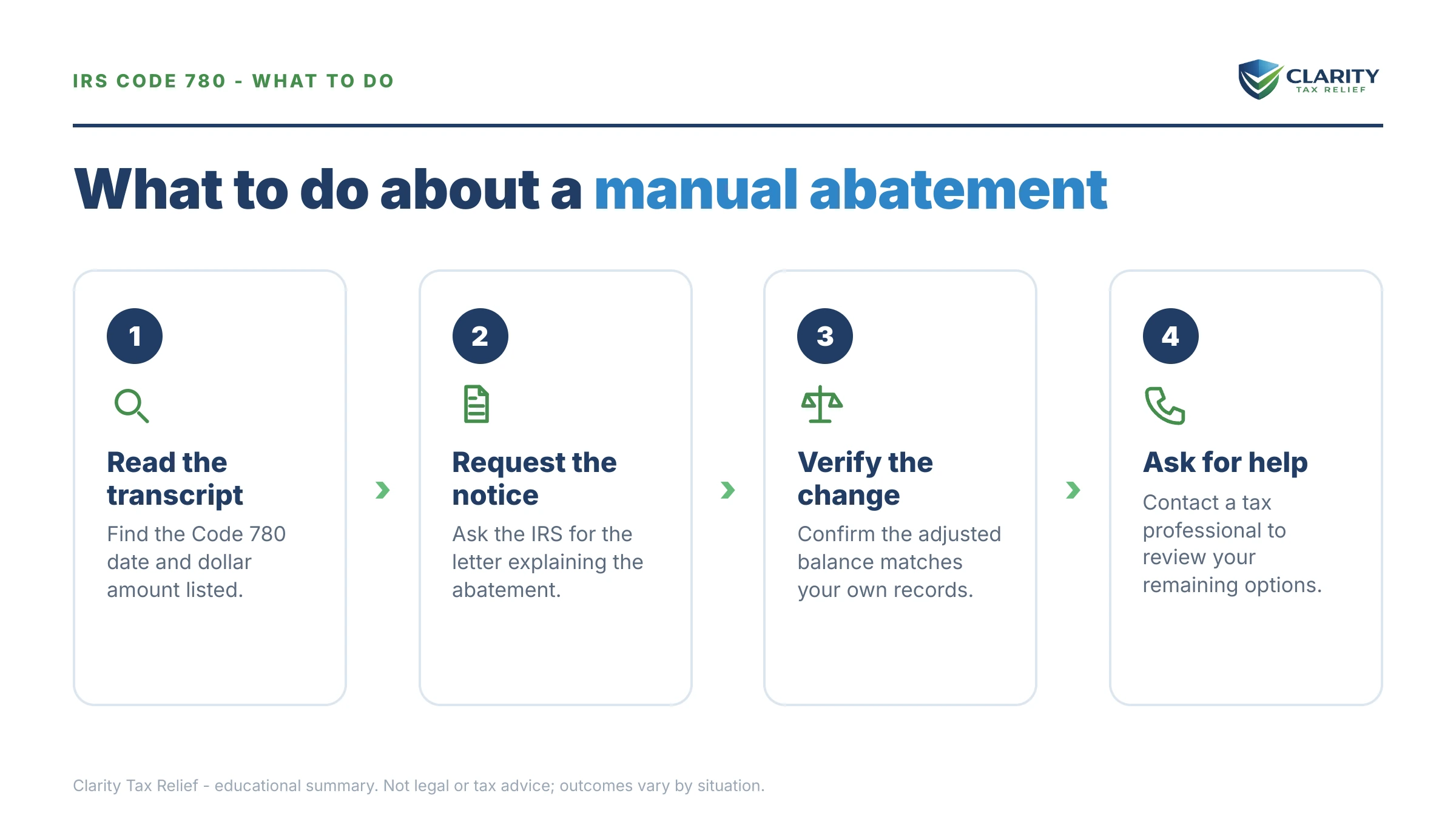
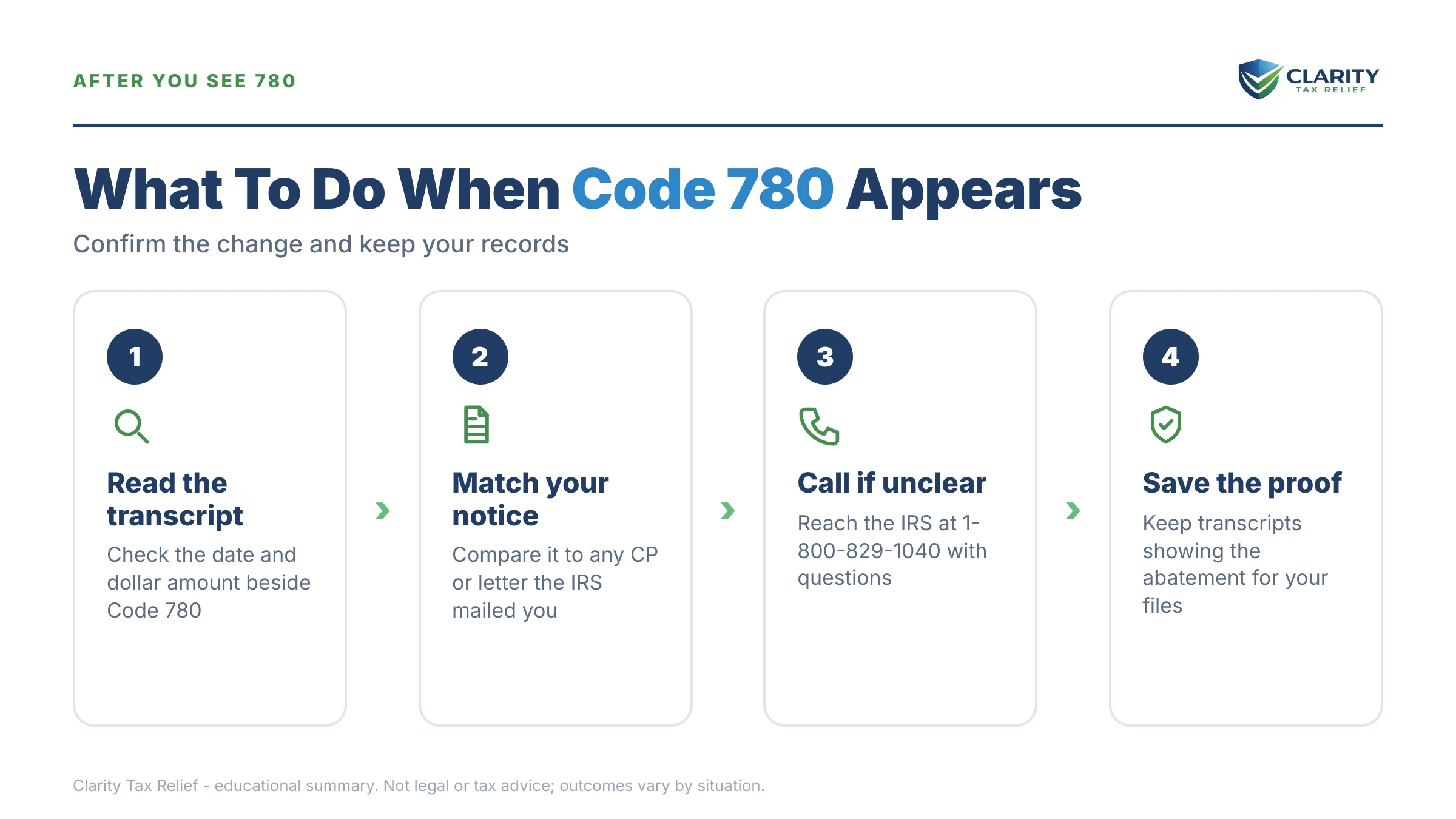
- Match the dates. Pull a fresh account transcript and confirm the code 780 posting appears on every tax period your offer covered, with a date that lines up with your acceptance letter.
- Calendar every remaining payment. Write down each offer installment and its due date from your acceptance letter, pay each one early if you can, and keep proof of every payment.
- Fix next year's taxes now. Adjust your withholding or quarterly estimates today so you never file a return with a balance you can't pay during the compliance period.
- File everything on time for five years. Every required return — personal and business — must be filed and paid on time through the fifth year after acceptance; one unresolved slip can default the deal.
- Store the paperwork permanently. Keep the acceptance letter, your Form 656, and all payment proofs together; they are your defense if the IRS ever questions the terms of the compromise.
When you can handle this yourself — and when help changes the outcome
Most people who see code 780 need no professional help at all. If the 780 posted on every period, your payments are on schedule, and your current-year taxes are squared away, your only job is discipline: pay, file, repeat, for five years. Don't pay anyone to watch a calendar for you.
Experienced help earns its cost in four specific situations: a default warning letter has arrived and you need the cure handled before 781 posts; a 781 already posted and you're negotiating reinstatement; the offer settled your personal debt but the business still owes payroll taxes the IRS is pursuing separately; or 780 posted on some periods but not others, leaving part of your debt still in active collection. Each of those is a live fight with real money at stake, and the order you move in matters.
If your problem is purely stuck processing — an acceptance letter but no transcript movement for months — the Taxpayer Advocate Service exists for exactly that, free.
Terms on your transcript, decoded
- Compromised: the IRS agreed to accept less than the full assessed liability to settle the account — the legal meaning behind the 780 entry.
- Abatement: the removal of assessed tax, penalties, or interest from an account; after your offer terms are complete, the remaining balance is abated.
- Default (code 781): revocation of an accepted offer for a missed payment or compliance failure — the original debt comes back.
- Five-year compliance period: the condition attached to every accepted offer — all required returns filed and paid on time for five years after acceptance.
- Reasonable Collection Potential (RCP): the IRS's formula for the most it could collect from you — asset equity plus a multiple of monthly disposable income — which sets the minimum acceptable offer.
- CSED: the Collection Statute Expiration Date, 10 years from assessment; the time your offer spent pending paused this clock, extending it.
The IRS's own program page, Offer in Compromise at IRS.gov, covers the official terms, and remaining offer payments can be made through IRS.gov/payments.
Code 780 questions, answered
What does code 780 mean on my IRS transcript?
Code 780 means the IRS accepted your offer in compromise and marked the account "compromised." It posts to each tax period included in your offer, usually within a few weeks of the date on your acceptance letter. It is not the final entry — the remaining balance is adjusted off the account after you complete every offer term.
How long after my offer is accepted does code 780 post?
Typically within a few weeks of the date on your acceptance letter, though processing times vary — especially with IRS staffing down roughly 27% since 2025. If more than a couple of months have passed and code 780 still hasn't posted on every period in your offer, call the number on your acceptance letter and ask the offer unit to confirm each period was updated.
Does code 780 mean my tax debt is gone?
Not yet. Code 780 means the settlement is accepted, but the debt is only fully resolved after you pay the entire offer amount on schedule and stay compliant — filed and paid on time — for five years. Break either condition and the IRS can default the offer and reinstate the original balance, minus what you already paid.
Can code 780 be reversed?
Yes, two ways. Code 781 posts when the IRS defaults your accepted offer — usually for a missed offer payment or a compliance failure during the five-year period — and the original liability comes back. Code 782 reverses a 780 that posted in error. If either code appears and you don't know why, pull a fresh transcript and call the offer unit immediately.
Will the IRS keep my tax refund after code 780?
For offers accepted since late 2021, the IRS generally no longer keeps your refund for the calendar year in which the offer is accepted — a change from the old policy. Refunds the IRS already offset while your offer was pending stay applied to the old balance, and they do not count toward your offer amount.
Does code 780 release the federal tax lien?
No — acceptance alone doesn't release a lien; completing the offer does. Once you've paid the full offer amount and satisfied every term, the IRS is required to release the lien within 30 days of the liability being satisfied. If a lien is still on record months after your last offer payment, request the release in writing.
What happens if I miss a payment after code 780 posts?
Contact the offer unit before assuming the deal is dead. The IRS typically sends a letter giving you a chance to cure a missed offer payment or a compliance slip before it formally defaults the offer. If you ignore that letter, code 781 posts, the compromise is revoked, and the full original balance — minus payments made — returns to active collection.
I have code 480 but no 780 — what does that mean?
Code 480 means your offer is still pending; 780 only posts if it is accepted. Offers commonly take many months to work, and the IRS accepted roughly 1 in 5 offers in FY2024, so a long wait is normal. One rule in your favor: if the IRS fails to make a decision within 2 years of receiving your offer, it is deemed accepted by law.
Your next 24 hours
- Find the 780 posting date on your account transcript and confirm it appears on every tax period listed in your acceptance letter — flag any period where it's missing.
- Gather the offer file: your acceptance letter, Form 656, proof of every payment made so far, and the due dates for what's left. This one folder protects a five-figure settlement.
- If anything doesn't match — a missing 780, a payment dispute, an unexplained 781 or 782 — get a free case review before the account drifts back toward collection, where interest and penalties resume growing. Use the 2-minute form or call (888) 825-7779.
This guide is general information, not tax or legal advice for your specific situation. Eligibility for IRS programs depends on individual facts and circumstances; no outcome is guaranteed.