
IRS Transcript Codes
Code 276 on Your IRS Transcript: The Failure-to-Pay Penalty, Explained (2026)
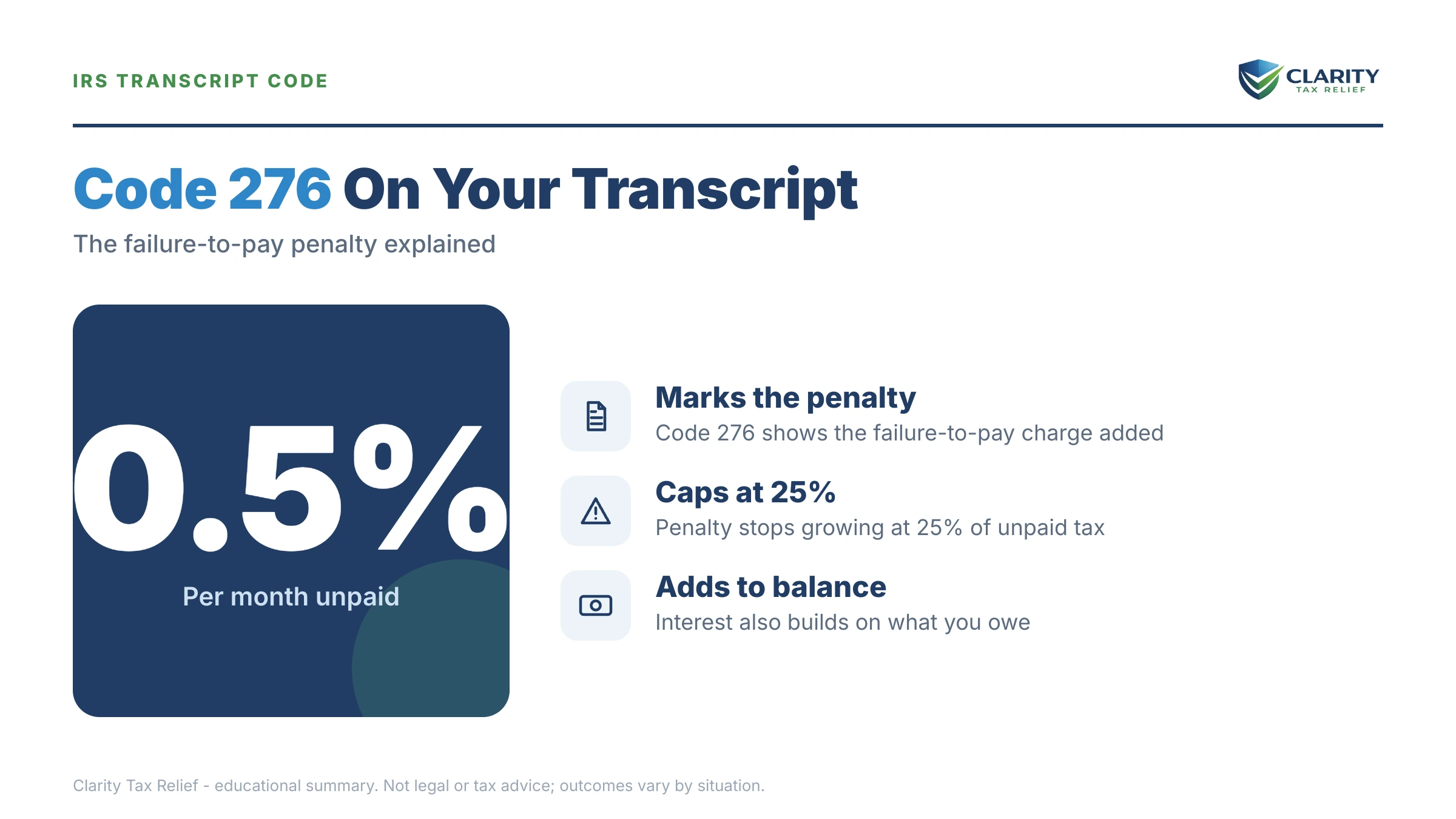
The short answer: code 276 on an IRS transcript means the failure-to-pay penalty was charged to your account — 0.5% of your unpaid tax for each month or part of a month the balance goes unpaid, capped at 25%. It is computer-generated, usually posts alongside interest code 196, and can often be reduced or removed.
You logged into your IRS account, scrolled the transactions, and found a code 276 transcript entry — maybe three or four of them — each labeled "Penalty for late payment of tax" with its own date and dollar amount. That line isn't a flag or an investigation. It's a meter, and it's running on your unpaid balance right now. The good news: this is one of the few IRS charges with a built-in dial you can turn down — and, in many cases, a path to erase it entirely.
The image below shows exactly where a 276 entry sits on a real account transcript and how to read the date and amount printed next to it.
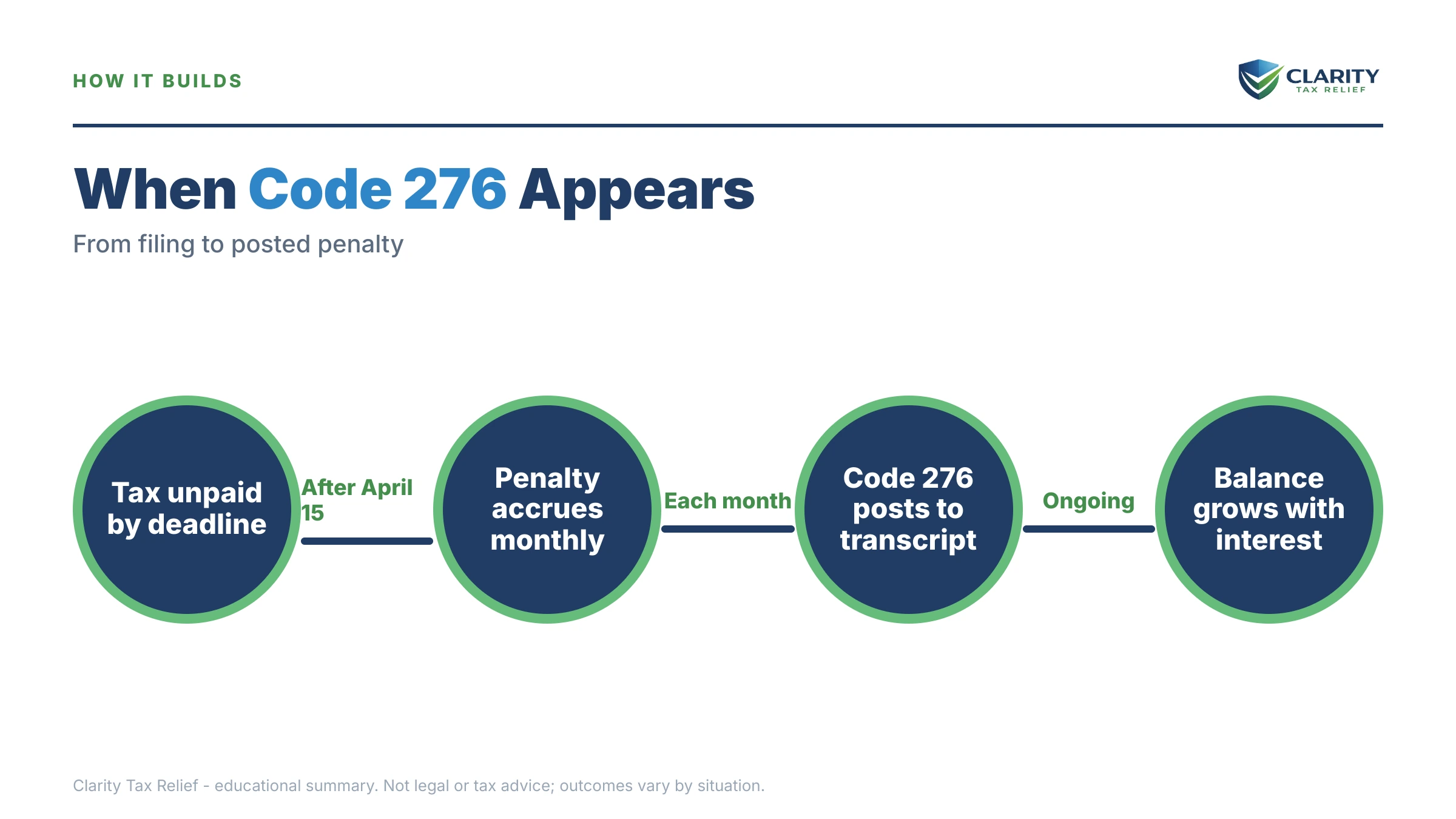
⏱ The clock that matters: there's no response deadline printed next to code 276 — but the penalty behind it grows every single month. The failure-to-pay penalty adds 0.5% of your unpaid tax per month (or part of a month) until it hits its 25% lifetime cap, and interest compounds daily on top of it.
What code 276 on your transcript means
Transaction code 276 is the IRS computer assessing the failure-to-pay penalty against a tax year with an unpaid balance. It's not a human decision and not an audit signal — the Master File calculates it automatically whenever it recomputes your account, which usually happens when a new notice goes out. That's why the date next to a 276 often matches a letter that landed in your mailbox around the same time (that letter typically shows on the transcript as a code 971 — notice issued entry, though on this page we'll stay focused on the penalty itself).
Three details on the entry tell you most of what you need to know:
- The amount is the penalty that accrued since the last computation — not your whole penalty. Add up every 276 on the year to see the true total.
- The date is the assessment date, usually tied to a notice cycle. It is not a deadline.
- The repetition is normal. Each time the IRS recalculates the account, a fresh 276 posts. The entries stop only when the tax is paid or the penalty reaches its cap.
One cousin worth knowing: code 270 is the same failure-to-pay penalty assessed manually by an IRS employee instead of the computer. And the codes you actually want to see are 271 or 277 — reversals that mean the penalty was reduced or removed. If transcript reading in general is new to you, our guide to how to read an IRS account transcript covers the layout, cycle dates, and column meanings; this page covers only what's unique to 276.
| Code | What it means | What to do |
|---|---|---|
| 150 | Your return posted and the original tax was assessed | Verify the amount matches the return you filed — see code 150 on an IRS transcript |
| 196 | Interest charged on the unpaid balance | Interest is rarely waivable; shrink it by paying down tax — see code 196 transcript |
| 270 | Failure-to-pay penalty, manually assessed | Same penalty as 276, added by an employee instead of the computer |
| 276 | Failure-to-pay penalty, computer-assessed | Cut the rate with a payment plan, then request abatement |
| 271 / 277 | Failure-to-pay penalty reduced or removed | Good news — confirm the credit matches what you requested |
| 290 | Additional tax assessed | More tax means more 276 penalty — see code 290 on an IRS transcript |
| 291 | Tax reduced | The 276 penalty should recompute downward too — see code 291 on an IRS transcript |
The three penalty rates hiding behind code 276
The failure-to-pay penalty charges one of three monthly rates depending on where your account stands — and you control which one applies. The default is 0.5% of the unpaid tax per month. Get an approved installment agreement in place (on a return you filed on time) and the rate drops to 0.25%. Ignore the balance until the IRS issues a final notice of intent to levy, and the rate doubles to 1% per month starting 10 days after that notice.
| Your situation | Monthly rate | On a $76,400 balance |
|---|---|---|
| Default — balance unpaid, no arrangement | 0.5% | $382 per month |
| Approved installment agreement (timely-filed return) | 0.25% | $191 per month |
| 10+ days after a final intent-to-levy notice | 1% | $764 per month |
| Lifetime cap | 25% of the unpaid tax | $19,100 total |
One more wrinkle if you also filed late: in months where both penalties apply, the failure-to-file penalty (5% per month) is reduced by the failure-to-pay penalty, so the failure-to-file portion drops to 4.5% and the combined hit runs 5% — not 5.5%. The failure-to-file penalty is ten times harsher than the failure-to-pay penalty at its usual full rate, which is exactly why filing on time matters even when you can't pay; the full comparison is in our guide to the failure-to-file penalty vs failure-to-pay.
Say you owe $76,400: the code 276 math, worked out
Here's a clearly hypothetical example. Say you're a W-2 employee filing single, and a big bonus plus underwithheld stock income left you with $76,400 in unpaid tax for one year. The 276 meter runs like this:
- Default rate: 0.5% × $76,400 = $382 every month. After 12 months, your 276 entries total roughly $4,584 — before a dollar of interest.
- On an installment agreement: the rate falls to 0.25%, or $191 per month — the same year of penalties costs about $2,292 instead. The agreement literally cuts the meter in half.
- After a final levy notice: the rate jumps to 1%, or $764 per month. Waiting past that notice doubles the damage.
- At the cap: the penalty stops at 25% — $19,100 — which the default rate reaches after about 50 months. Interest (your code 196 entries) never caps and compounds daily on the tax, the penalties, and prior interest.
You can estimate your own numbers — penalty plus interest, by month — with our Penalty & Interest Calculator.
Two practical notes at this dollar level. First, $76,400 sits above the $50,000 ceiling for a streamlined online installment agreement, so you'd either provide financial disclosure or pay the balance down below $50,000 to qualify — the tradeoffs are covered in our guide to an IRS payment plan over $50,000. Second, it also sits above the $66,000 threshold for passport certification in 2026: if collection reaches the lien or levy stage, the debt can be certified as seriously delinquent and your passport denied or revoked — details in passport revoked for tax debt.
What happens if you ignore the balance behind code 276
Code 276 itself never escalates — but the unpaid balance generating it moves through the IRS collection sequence automatically. Each stage below typically shows up on your transcript as a code 971 entry dated near the letter:
- CP14 — first bill. Typically about 21 days to pay before the sequence continues. Your first 276 usually posts around this notice.
- CP501 / CP503 — reminders. Still just bills, but a fresh 276 and 196 post with each recomputation.
- CP504 — intent to levy. The IRS can now seize your state tax refund, and a federal tax lien becomes realistic. At $76,400, lien filing also opens the door to passport certification.
- LT11 / Letter 1058 — final notice. A 30-day clock starts on wage garnishment and bank levies, along with your Collection Due Process appeal rights. Ten days after this notice, the 276 rate doubles to 1% per month — $764 monthly in our example.
- Levy. Wages garnished continuously; bank funds held 21 days, then sent to the IRS. The penalty and interest keep posting through all of it.
In 2026, with the IRS workforce down roughly 27%, it's tempting to assume nobody's watching. The opposite is true for this sequence: the notices, penalty recomputations, and levies are all automated. The humans got harder to reach; the machine posting your 276 entries did not.
Watching 276 entries stack up on your transcript?
Every month at the default rate adds hundreds more to a balance like this. An experienced tax professional will review your transcript free, total what the penalties have actually cost you, and map the fastest path to cut the rate — and often remove the penalty entirely.
Your options for the balance behind code 276
Every resolution path below changes what the 276 meter charges — some slow it, some stop it, and abatement claws money back.
| Option | Upfront cost | Effect on the 276 penalty |
|---|---|---|
| Pay in full | None | Penalty stops immediately; interest stops accruing once the balance is zero |
| Short-term plan (up to 180 days) | $0 setup | Buys time and stops escalation; penalty and interest continue while you pay |
| Long-term installment agreement | Setup fee varies (lowest with direct debit; waived for low-income taxpayers) | Rate drops to 0.25%/month on timely-filed returns; above $50,000, financial disclosure is usually required |
| Penalty abatement (first-time, reasonable cause, or AEP) | Free to request | Removes or refunds the penalty; interest charged on the abated penalty comes off too |
| Currently Not Collectible | Free; requires hardship financials | Pauses collection, but penalty and interest keep accruing |
| Offer in Compromise | $205 fee, 20% down on lump-sum offers (both waived with low-income certification) | If accepted, resolves tax, penalties, and interest together — but the IRS accepted roughly 1 in 5 offers in FY2024, and eligibility is strictly means-tested |
For a single-year W-2 balance like our example, the realistic short list is almost always an installment agreement plus a penalty-abatement request. The IRS's own payment options live at IRS.gov/payments.
Can the code 276 penalty be removed? Often, yes
The failure-to-pay penalty is among the most frequently abated charges the IRS assesses. Four paths, in order of ease:
- First-time penalty abatement. If the prior three years were clean — no penalties, all returns filed, payments current — the IRS can remove the failure-to-pay penalty on request, often in a single phone call. On our $76,400 example a year in, that's roughly $4,584 back.
- Automatic Exemption from Penalty (AEP). Beginning in summer 2026, the IRS is replacing first-time abatement with an automatic exemption that applies with no request at all. If your transcript qualifies, relief may post on its own — see how the automatic exemption from penalty (AEP) works and who it covers.
- Reasonable cause. Serious illness, disaster, a death in the family, or another event genuinely beyond your control can support abatement for the affected months. Documentation carries the request; a written statement or Form 843 makes the case formally. The IRS explains the penalty and its relief standards at its failure-to-pay penalty page.
- Abatement after paying. Already paid the penalty? You can still claim it back on Form 843, generally within the refund statute window.
What success looks like: a code 271 credit posts to the transcript for the abated amount, the interest that was charged on that penalty comes off with it, and the balance recalculates. What abatement won't touch: the interest on the underlying tax itself (your code 196 entries) — that's waivable only when the IRS caused an error or unreasonable delay.
How to respond to code 276, step by step
- Pull your account transcript for every balance year. Download it free from the IRS Get Transcript tool and list each code 276 entry's date and amount so you know exactly what the penalty has cost so far.
- Verify the tax behind the penalty. Check that the code 150 (and any code 290) amounts match your return; if the underlying tax is wrong, fixing it shrinks every 276 entry along with it.
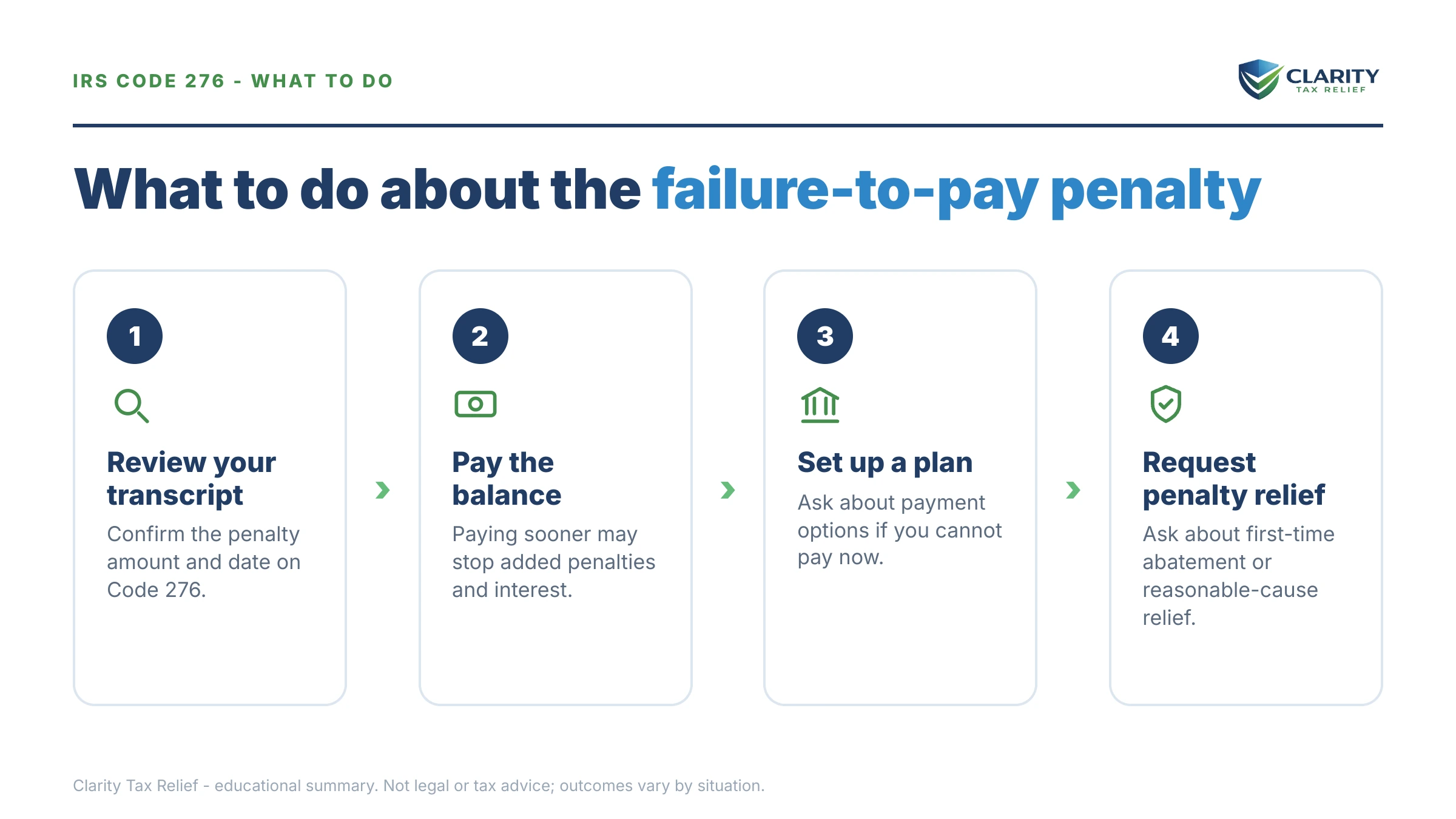
- Set up a payment arrangement. An approved installment agreement cuts the penalty rate in half to 0.25% per month and keeps the account out of levy territory while you pay.
- Request penalty abatement. Ask for first-time abatement by phone or file Form 843 with a reasonable-cause explanation; you can request abatement even after the penalty has been paid.
- Watch your transcript for code 271. A 271 credit confirms the abatement posted; verify the amount and the recalculated balance before you consider the matter closed.
When you can handle code 276 yourself
Plenty of people don't need help with this code. If the balance behind your 276 entries is one you agree with, you can pay within 180 days, and your prior three years are clean, the whole fix is a payment plan plus a first-time abatement phone call — no professional required.
Experienced help changes the outcome when the situation is layered: a balance over $50,000 (where the agreement requires financial disclosure and the numbers you submit shape everything after), multiple years each carrying their own penalty stack, a reasonable-cause case that needs to be documented and argued rather than just requested, a 276 sitting next to a code 971 for a CP504 or LT11 (meaning levy authority is near), or a dispute about the underlying tax itself. In those cases the order of operations — fix the tax, then the penalties, then the payment terms — often determines whether you overpay by thousands.
Terms on your transcript, decoded
- Assessed: officially recorded on the IRS's books as a legal debt — the moment a 276 posts, that penalty amount is owed.
- Abatement: the removal or reduction of a penalty; on a transcript it appears as a code 271 or 277 credit.
- Statutory additions: the penalties and interest the law stacks on top of the tax itself — your 276 and 196 entries combined.
- "As of" date: the projection date the transcript uses to compute your balance — a calculation point, not a deadline.
- CSED: the Collection Statute Expiration Date — the IRS generally has 10 years from assessment to collect, though appeals, offers, and bankruptcy pause the clock.
Code 276 questions, answered
What does code 276 mean on an IRS transcript?
Code 276 means the IRS charged the failure-to-pay penalty to your account — 0.5% of the unpaid tax for each month or partial month the balance goes unpaid, capped at 25%. It is a computer-generated charge, not an audit flag. The date beside it usually matches a notice the IRS mailed, and it almost always posts alongside code 196, the interest charge.
Why does code 276 appear multiple times on my transcript?
Repeating 276 entries are normal. The IRS recomputes the failure-to-pay penalty every time it recalculates your account — typically when it issues a new notice — and each recomputation posts as a fresh 276 with the penalty that accrued since the last one. The entries stop multiplying only when the tax is paid, the penalty reaches its 25% cap, or the balance is otherwise resolved.
Is code 276 on my transcript bad news?
It confirms you have an unpaid balance that is growing, but it is not enforcement by itself — no levy or garnishment happens because a 276 posted. The real risk is the collection sequence running behind it: the same balance that generates 276 entries eventually generates a CP504 and a final intent-to-levy notice, and at that point the penalty rate doubles to 1% per month.
Can the code 276 penalty be removed?
Often, yes — the failure-to-pay penalty is one of the most commonly abated IRS charges. First-time abatement applies if your prior three years were clean, reasonable cause applies for events like serious illness or disaster, and starting in summer 2026 the IRS's Automatic Exemption from Penalty applies some relief with no request at all. A successful abatement posts to your transcript as a code 271 credit.
What is the difference between code 276 and code 196?
Code 276 is the failure-to-pay penalty; code 196 is interest. They usually post together because both grow from the same unpaid balance, but they follow different rules. The 276 penalty can often be abated for cause or under first-time abatement. Interest under code 196 generally cannot be waived unless the IRS caused an error or delay — though abating a penalty also removes the interest that was charged on it.
Does code 276 mean the IRS is about to levy me?
No — code 276 is a bookkeeping entry, not a levy trigger. But the balance behind it moves through the IRS collection sequence on its own schedule, and each mailed warning shows up on your transcript as a code 971. If you see a 971 dated near a CP504 or LT11 letter, levy authority is close: an LT11 starts a 30-day clock before the IRS can garnish wages or levy bank accounts.
Does the failure-to-pay penalty ever stop growing?
Yes — it caps at 25% of the unpaid tax. On a $76,400 balance that means the 276 entries stop at $19,100, which takes about 50 months at the default 0.5% rate. Interest does not cap, though: code 196 charges keep compounding daily on the tax, penalties, and prior interest until the balance is paid or the collection statute expires.
Your next 24 hours
- Total your 276 entries. On the account transcript for each balance year, add up every code 276 amount and note the most recent date — that's what the penalty has actually cost you so far.
- Gather three things: the transcript(s), your last filed return for the year(s) involved, and a quick snapshot of your monthly income and expenses. That's everything needed to pick a payment arrangement and screen for abatement.
- Get a free transcript review. Use the 2-minute form or call (888) 825-7779. There's no notice deadline on a 276 — but at the default rate a balance like $76,400 adds another $382 in penalty every month it waits, plus daily interest.
This guide is general information, not tax or legal advice for your specific situation. Eligibility for IRS programs depends on individual facts and circumstances; no outcome is guaranteed.