
IRS Transcript Codes
Code 971 on Your IRS Transcript: What "Notice Issued" Means and What to Do (2026)
The short answer: code 971 on an IRS transcript means the IRS issued you a notice or letter — or logged another action on your account — on the date shown beside the code. It is not a bill or an audit by itself. The codes posted around the 971 tell you which letter is coming and what it will ask.
You filed your Schedule C return, logged in to check on things, and there it is on your account transcript: 971 — Notice issued — $0.00, with a date. No letter in your mailbox yet, and no hint of what the notice actually says. That gap — the transcript knows before you do — is exactly why this code rattles people, and exactly why it's decodable.
Here's the key most guides miss: the 971 line itself carries almost no information — its neighbors carry all of it. A 971 next to an 846 refund issued is usually good news. A 971 next to a code 570 account hold means your refund is parked while the IRS asks for something. The image below shows you exactly where the 971 line sits on a real account transcript and which fields to read first, so you can run the same decode on yours.
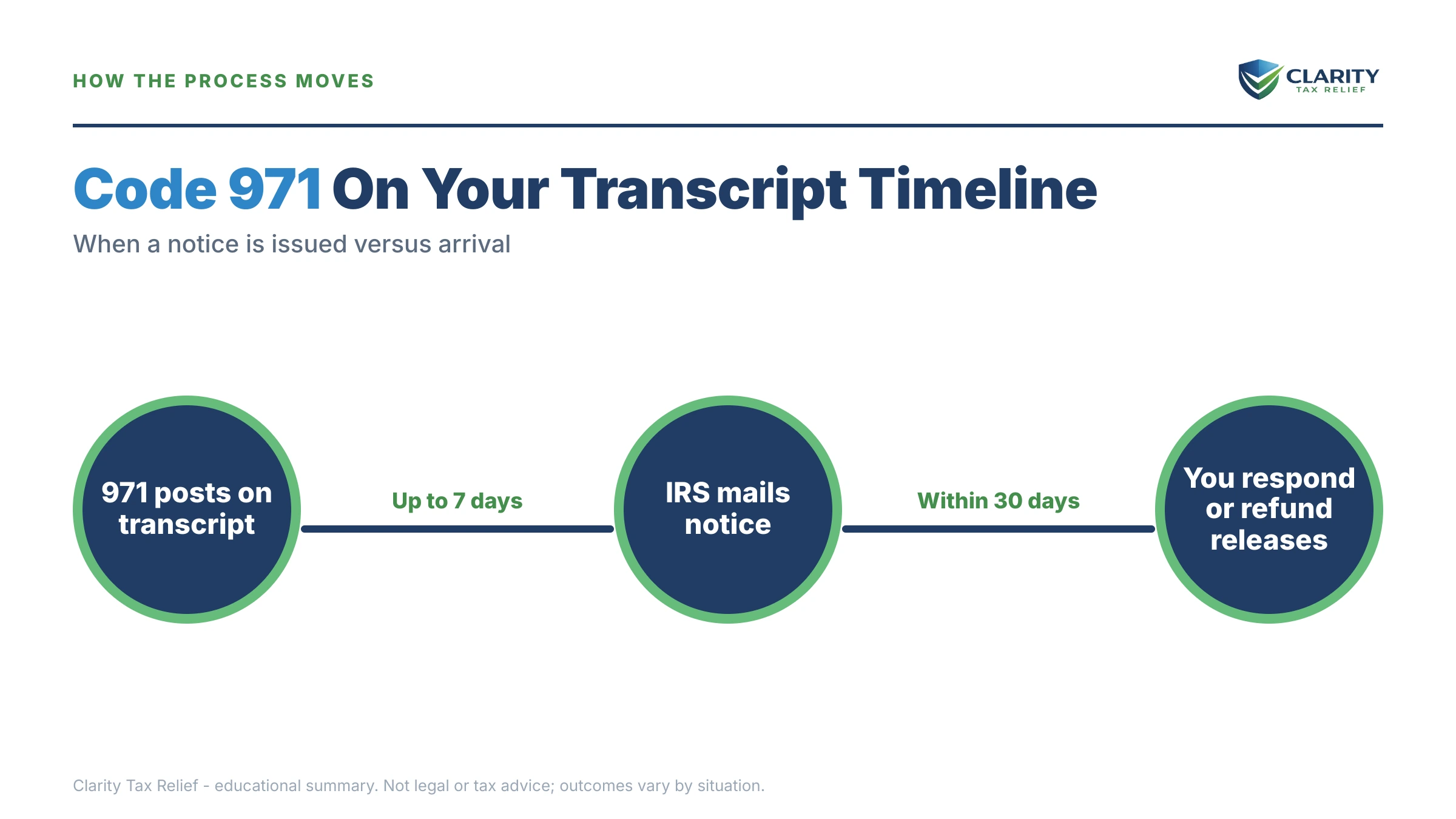
⏱ The real clock: code 971 has no deadline of its own — the letter it announces does. The date beside code 971 is when the IRS generated that notice; the paper copy typically arrives a week or two later, and any response window runs from the date printed on the letter, not from the transcript. If the notice involves a balance due, interest and penalties keep accruing while you wait for the mail.
Why code 971 is on your IRS transcript
Transaction code 971 posts to your IRS account transcript whenever the IRS issues correspondence or records a significant miscellaneous action on your account. It is one of the most common codes in the entire system — the IRS's internal log entry that says "something happened here, and we probably mailed the taxpayer about it."
Internally, every 971 carries a hidden action code that specifies exactly what happened — there are well over a hundred of them, covering everything from "review letter sent" to "amended return forwarded for processing" to "installment agreement pending." The transcript you download doesn't display that action code. That's why the identical line — "971 Notice issued $0.00" — can mean a refund-review letter for one taxpayer and a payment-plan acknowledgment for another.
For a self-employed filer, the most common triggers behind a 971 are:
- Income matching. The 1099-NEC and 1099-K forms your clients and platforms filed don't line up with your Schedule C as the IRS reads it — this often shows up alongside code 922, the underreporter review, and leads to a CP2000.
- Refund review. The IRS is verifying income, withholding, or credits before releasing your refund — usually paired with a 570 hold.
- Identity verification. The return tripped identity filters and a 5071C-type letter is coming; nothing processes until you verify.
- A change to your return. The IRS adjusted something — a math error, an estimated-payment mismatch — and the 971 logs the letter explaining it.
- Collection activity. On a balance-due account, each bill and collection letter in the sequence gets its own 971.
- Something you sent in. Amended returns, penalty-abatement requests, and innocent spouse claims all generate 971 entries acknowledging receipt.
One thing a 971 is not: an audit flag. The audit indicator is code 420 on your transcript (or 424 for an exam request). If neither appears, nobody has opened an examination. And if transcript reading is new to you entirely, our guide on how to read an IRS account transcript covers the layout — this page stays focused on the 971 line itself.
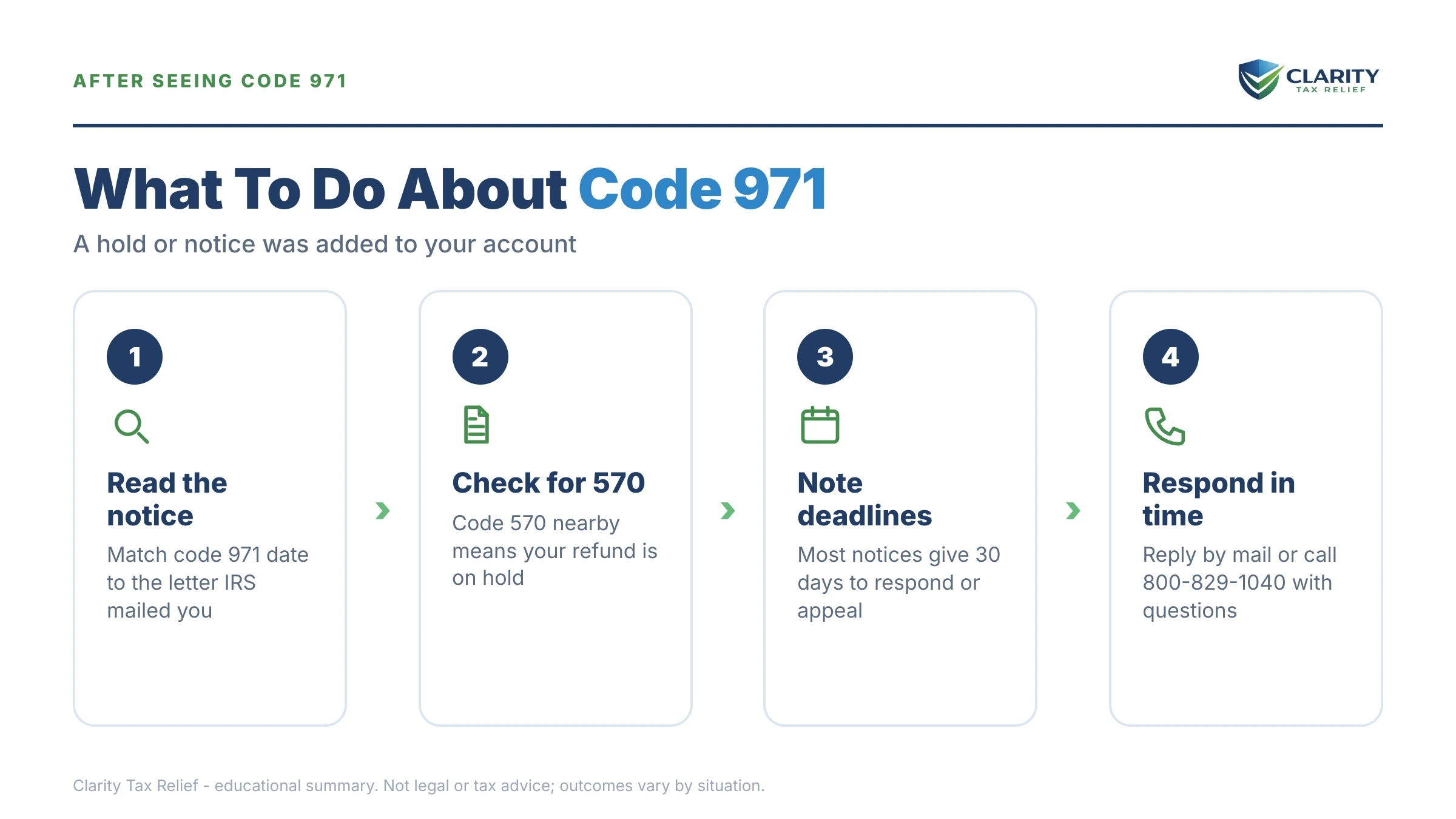
How to decode code 971 on your IRS transcript
You can usually identify the notice behind a code 971 before the letter arrives by reading three things: the date, the surrounding codes, and your IRS online account. Start with the fields on the 971 line itself:
| What you see | What it actually means |
|---|---|
| The date beside 971 | The day the IRS generated the notice or logged the action — not your deadline. Mail typically follows within a week or two. |
| $0.00 in the amount column | Normal. Code 971 tracks an action, not money. Dollar changes post under other codes (290, 846, 766). |
| "Notice issued" description | A letter was generated. Some transcripts also print the notice number (e.g., "Notice issued CP 0005") — if yours does, you already have your answer. |
| Multiple 971 lines | Each one logs a separate notice or action. Read them in date order — the newest reflects where your case stands now. |
| A 972 after the 971 | Code 972 reverses a 971 — the earlier action or notice was cancelled or superseded. |
Next, check the Notices and Letters section of your IRS online account — many notices post there digitally days before the paper version arrives. That single step converts a mystery code into a readable document. While you're there, note your account balance and any holds; the transcript's "as of" date is a projection, not a deadline, and it confuses more people than the 971 does.
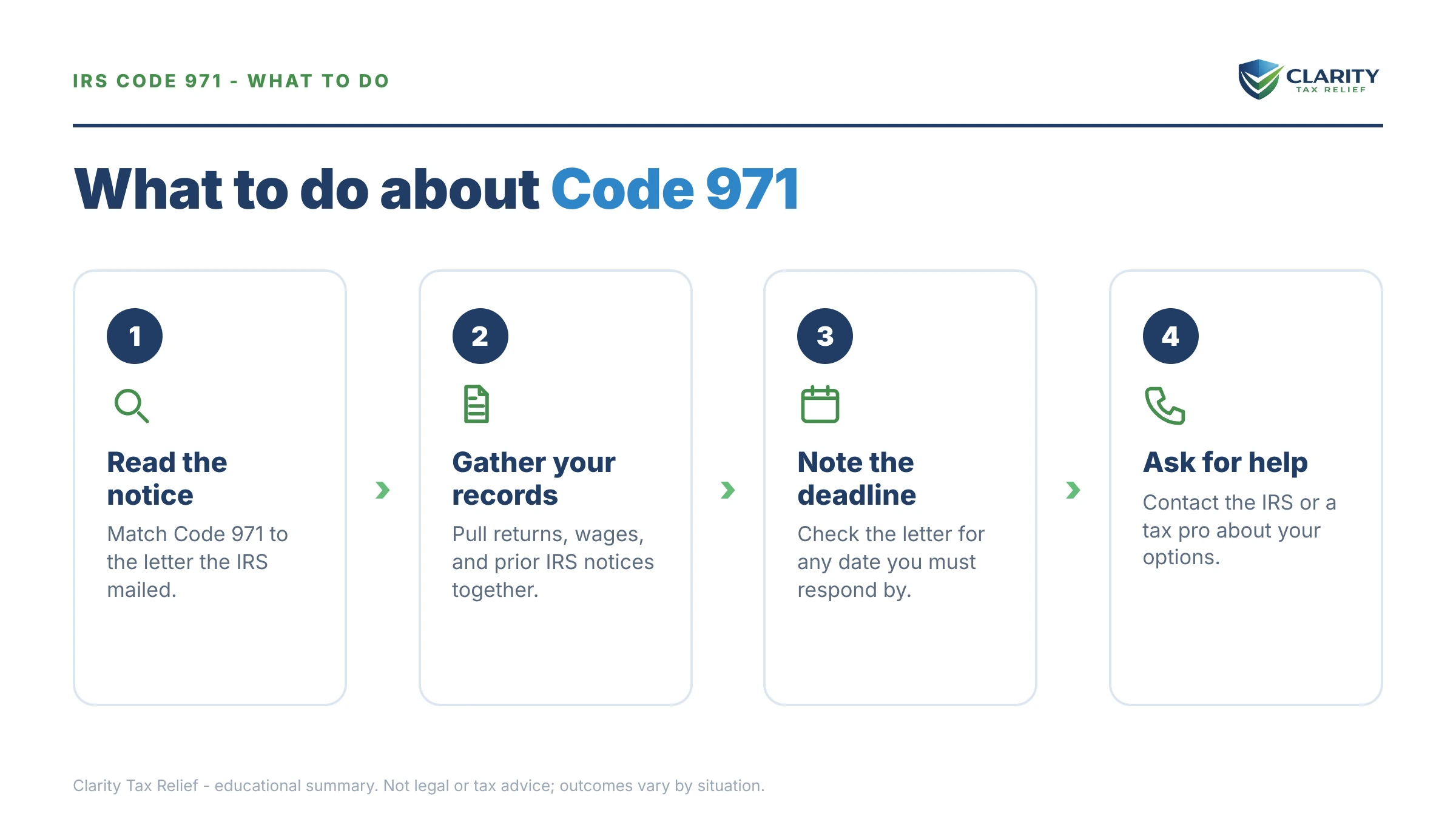
Code 971 with 570, 846, 290, and other codes: the pairings
The codes posted around a 971 predict which letter is coming with surprising accuracy. Use this table to place yours:
| Codes together | What it usually means | Your move |
|---|---|---|
| 570 + 971 | Your refund or account is on hold, and a letter is coming that explains why or asks for documents. | Read our full guide to 570 and 971 codes on a transcript; respond to the letter fast — the hold outlasts your patience, not the reverse. |
| 971 + 846 | The IRS adjusted something and issued your refund; the letter explains the changed amount. | Compare the deposit to the refund you claimed. If it's short, the letter says why — and how to dispute. |
| 971 + 290 | Additional tax was assessed and the letter (often a CP21A, CP22A, or CP14) bills you for it. | Verify the assessment against your return before paying; arrange payment by the letter's date if it's correct. |
| 922 + 971 | The underreporter unit found an income mismatch; a CP2000 proposing more tax is likely on its way. | Pull your 1099s and Schedule C now — you'll want the reconciliation ready when the notice lands. |
| 976/977 + 971 | Your amended return was received and logged; the 971 tracks correspondence about it. | Patience plus monitoring — see codes 976/977 on a transcript for the processing sequence. |
| 971 + 420 or 424 | An examination is open or requested, and the 971 logs the exam correspondence. | This is the one pairing where professional help before responding is usually worth it. |
| 971 alone, $0.00 | A standalone notice or administrative action — anything from an address change confirmation to a balance reminder. | Check your online account's notices section; if nothing posts and no letter comes, it was likely internal. |
One timing detail matters on the 570 pairing: a 971 dated after the 570 usually means a human reviewed the hold and is mailing you something; same-date 570/971 lines are usually one automated process that often resolves on its own. Neither is a verdict — but the after-dated 971 is the one that typically needs a response from you.
What happens if you ignore the notice behind code 971
Ignoring the letter behind a code 971 leads to one of two outcomes: a refund that stays frozen indefinitely, or a balance that rolls into the IRS's automated collection sequence. Which path you're on depends on which kind of notice it is.
If it's a refund-side notice (review, verification, documents requested): nothing violent happens — and that's the trap. The refund simply never releases. Identity-verification letters are the starkest version: until you verify, the return doesn't process at all. Document-request letters ignored long enough can end with the IRS disallowing the credit or refund and adjusting your return — converting a delay into a debt.
If it's a balance-due notice, each ignored letter generates the next 971 on your transcript, and each successive notice carries more enforcement power:
- CP14 — the first bill, typically giving about 21 days to pay or arrange payment. Your transcript logs a 971 the day it's generated.
- CP501 / CP503 — reminder bills, each a new 971 line, each with more penalties and interest baked in.
- CP504 — Notice of Intent to Levy under IRC §6331(d). The IRS can now seize your state tax refund, and a federal tax lien becomes a realistic next step.
- LT11 / Letter 1058 — the final notice. It starts a 30-day clock and your Collection Due Process rights; after it expires, the IRS can levy bank accounts and, for a sole proprietor, the payments your clients owe you.
In 2026 this automation cuts both ways. The IRS workforce shrank roughly 27% in 2025, so reaching a human to fix a wrong notice is harder than ever — but the systems generating notices, holds, and levies never stopped. The 971 entries stack up whether or not anyone at the IRS ever reads your file.
Staring at a 971 and don't know which letter is coming?
Send us your transcript — or the letter, once it lands. An experienced tax professional will decode the codes, identify the notice, and map your options before the next automated entry posts. Free, confidential, no pressure.
Your options once the 971 letter arrives
Every notice behind a code 971 comes with a built-in playbook — what it asks, how long you have, and what a good response looks like. These are the letters we see behind 971 entries most often:
| Notice | What it says | Response window |
|---|---|---|
| CP05 | Your refund is under review while the IRS verifies income, withholding, or credits. | Usually no response required — the letter states its own review timeframe. Respond only if it asks for documents. |
| 5071C | Verify your identity before the IRS processes your return. | No fixed deadline, but nothing moves until you verify — do it the day the letter arrives. |
| CP2000 | Reported income doesn't match your return; the IRS proposes additional tax. | Respond by the date printed on the notice — generally about 30 days. Silence is treated as agreement. |
| CP12 / CP21A | The IRS changed your return — your refund or balance is different than you filed. | Dispute by the date printed on the notice if you disagree; no action needed if the change is right. |
| CP14 | First bill for a balance due, with penalties and interest itemized. | Typically about 21 days from the notice date before the next notice escalates. |
| CP521 | Reminder that an installment agreement payment is due. | Pay by the due date on the notice — missed payments can default the whole agreement. |
If the letter turns out to be a bill you can't pay in full, the resolution menu is the same one that applies to any IRS balance — short-term plans up to 180 days at $0 setup, streamlined installment agreements up to 72 months for balances under $50,000, hardship status, penalty relief — and our walkthrough on setting up an IRS payment plan online covers the mechanics. What's specific to the 971 is sequencing: never set up payment on a proposed amount you haven't verified. A CP2000 behind a 971 is a proposal, not an assessment — dispute first, pay second.
A worked example: code 971, a CP2000, and a $7,400 proposed bill
Say you're a sole proprietor and your transcript shows a 922 in the fall, then a 971 dated three weeks later. The letter arrives: a CP2000 proposing $7,400 in additional tax because the $48,000 gross on your 1099-K was matched against your return and the IRS's computer thinks it wasn't reported. This is entirely hypothetical, but the math is the math:
- If the IRS is wrong — say you reported that income on Schedule C but the 1099-K's gross figure double-counts refunds and processing fees you properly netted out — a response letter with a line-item reconciliation can cut the proposed $7,400 to a fraction, or to zero. This outcome is common in 1099-K cases, and it's why silence is the worst answer: no response converts the full proposal into an assessed debt.
- If the IRS is right and you agree: the $7,400 may come with a 20% accuracy-related penalty — $7,400 × 20% = $1,480 — bringing the total to roughly $8,880 before interest. (Whether that penalty applies is itself contestable; see our guide to the accuracy-related penalty.)
- If you agree but can't pay: a streamlined 72-month plan on $8,880 works out to about $8,880 ÷ 72 ≈ $124 a month as a floor, while interest and the 0.5%-per-month failure-to-pay penalty — roughly $44 a month on that balance at the start — keep accruing until it's gone. Paying within 180 days on a short-term plan costs nothing to set up and avoids years of accrual. You can estimate how penalties and interest stack on your own numbers with our penalty and interest calculator.
Notice what decided the outcome in every branch: not the 971, but how fast and how precisely you answered the letter behind it.
How to respond to code 971, step by step
- Pull your full account transcript. Note every code and date around the 971 line — the neighboring codes, not the 971 itself, tell you what kind of letter is coming.
- Check your IRS online account. Many notices appear under the Notices and Letters section days before the paper copy arrives in the mail.
- Identify the notice type. Match the surrounding codes — 570, 922, 290, 977, or 846 — to the pairing table above to predict which letter it is.
- Find the deadline on the letter itself. The response window runs from the date printed on the notice, never from the transcript date.
- Respond by the printed date. Verify your identity, send the requested documents, dispute the proposed change, or arrange payment — whatever the specific notice directs.
- Recheck your transcript after responding. A 571, 846, or new 290 shows whether the IRS released, refunded, or assessed — and tells you your next move.
When you can handle a code 971 yourself
Most code 971 situations resolve without professional help, and it would be dishonest to tell you otherwise. You can confidently handle it yourself when:
- The 971 pairs with an 846 and your refund arrived — read the letter, file it, done.
- It's an identity-verification letter — the online or phone verification takes minutes and no professional can do it for you anyway.
- It's a CP05-style review with no document request — the correct move is monitoring, not paying someone to wait with you.
- It's a bill you agree with that you can pay in full or on a simple plan under $50,000 — the online payment-plan tools handle it.
Experienced help changes the outcome in a narrower set of cases: a CP2000 dispute where self-employment records need reconstructing, a 971 sitting next to a 420 exam indicator, multiple 971s stacking on a balance-due account that's marching toward a CP504 or LT11, several unfiled years complicating the picture, or a proposed assessment large enough that the penalty fight matters. In those cases the difference between a precise response and a hopeful one is usually measured in thousands of dollars.
If your transcript shows 971s stacking next to collection codes and the letters are getting sharper, a free transcript review with an experienced tax professional at (888) 825-7779 can map the fastest path before the next notice posts.
Terms on your transcript, decoded
- Transaction code (TC): the three-digit codes the IRS master file uses to log every event on your account — code 150 for the filed return, 971 for notices and actions.
- Action code: the hidden sub-code attached to every 971 that specifies exactly which notice or action it represents — visible to the IRS, not on your downloaded transcript.
- Notice issued: the standard description printed beside code 971, meaning a letter was generated on the listed date.
- Code 972: the reversal code — it cancels a prior 971, meaning the earlier action or notice no longer applies.
- "As of" date: a projected balance-calculation date near the top of your transcript — not a deadline and not related to your 971.
- Freeze/hold: what a code 570 does — stops your refund or account activity until a 571 or 572 releases it.
Code 971 questions, answered
Is code 971 on my IRS transcript bad?
Not by itself. Code 971 is a neutral marker meaning the IRS issued a notice or recorded an account action. Whether it's good, bad, or routine depends on the letter behind it — anything from a refund-adjustment explanation to a balance-due bill. The codes posted around the 971 (570, 846, 290) usually tell you which it is before the mail arrives.
What does the date next to code 971 mean?
It's the date the IRS generated the notice or recorded the action — not your response deadline. The paper letter usually reaches your mailbox a week or two after that date. Your deadline, if any, is printed on the letter itself, and the clock runs from the date on the letter, not from the transcript.
Why does code 971 show $0.00?
Because 971 tracks an action, not money. The IRS uses it to log that a notice went out or a claim was recorded, so the amount field is almost always zero. Any dollar change tied to the same event posts under a separate code — for example, code 290 for additional tax assessed or code 846 for a refund issued.
Is code 971 the same as Publication 971?
No, and the mix-up is common. Transaction code 971 is a transcript entry meaning a notice or account action was recorded. Publication 971 is an IRS booklet about innocent spouse relief. Seeing code 971 on your transcript has nothing to do with innocent spouse relief unless you actually filed Form 8857 — in which case a 971 can log that the claim was received.
How long after code 971 will I get my refund?
There's no fixed timeline — it depends on why the notice went out. If the 971 posted with a 570 hold, your refund waits until a 571 or 572 releases the hold and an 846 posts with your refund date. Simple verification issues can clear within a few weeks of responding; document reviews and income-matching cases often take months.
Can code 971 post without me ever receiving a letter?
Yes. Some 971 entries log internal actions — a duplicate return notation or a claim forwarded for review — that don't generate mail. Letters also go missing when the IRS has an old address on file. Check the notices section of your IRS online account; if nothing appears there within a few weeks and no other codes post, the 971 was likely administrative.
Does code 971 mean I'm being audited?
No. The audit indicator on an account transcript is code 420 (or 424 for an exam request). A 971 can accompany audit correspondence, but by itself it just means a notice was issued. If you see 971 without a 420 or 424, you're most likely looking at a review, adjustment, or verification letter — not an examination.
What does it mean when codes 570 and 971 have the same date?
Same-date 570 and 971 usually means the hold and the notice were generated together by the same automated process — often a systemic adjustment the IRS resolves on its own. A 971 dated after the 570 more often means a reviewer looked at the hold and is sending a letter asking you for something or explaining a change to your return.
Can I have more than one code 971 on my transcript?
Yes, and it's common in active cases. Each 971 logs a separate notice or action, so a balance-due account can show one 971 for each collection letter, plus entries for things like a pending installment agreement. Read them in date order alongside the codes around them; the newest 971 reflects where your case stands right now.
Your next 24 hours
- Write down the 971's date and its neighbors. Pull your account transcript and list, in date order, every code around the 971 — 570, 922, 290, 846, 977 — plus the date beside each. That short list is the whole diagnosis.
- Gather your paper trail. Your filed return, every 1099 you received, and any IRS letters from the past year — plus your IRS online account login (create one at IRS.gov if you haven't; the notices section often beats the mail by days).
- Get the codes read by someone who reads them daily. Book a free case review at the 2-minute form or call (888) 825-7779. If your 971 hides a frozen refund, every week of silence extends the freeze; if it hides a balance, interest and penalties accrue while the next automated notice queues up.
Primary sources: pull your own transcript free at the IRS's Get Transcript page; pay or set up a plan at IRS.gov/payments; and if a 971-related freeze is causing financial hardship the IRS won't resolve, the Taxpayer Advocate Service is an independent, free escalation path.
This guide is general information, not tax or legal advice for your specific situation. Eligibility for IRS programs depends on individual facts and circumstances; no outcome is guaranteed.