
IRS Transcript Codes
846 Refund Issued Date on Your IRS Transcript: What It Means and When Your Money Arrives (2026)
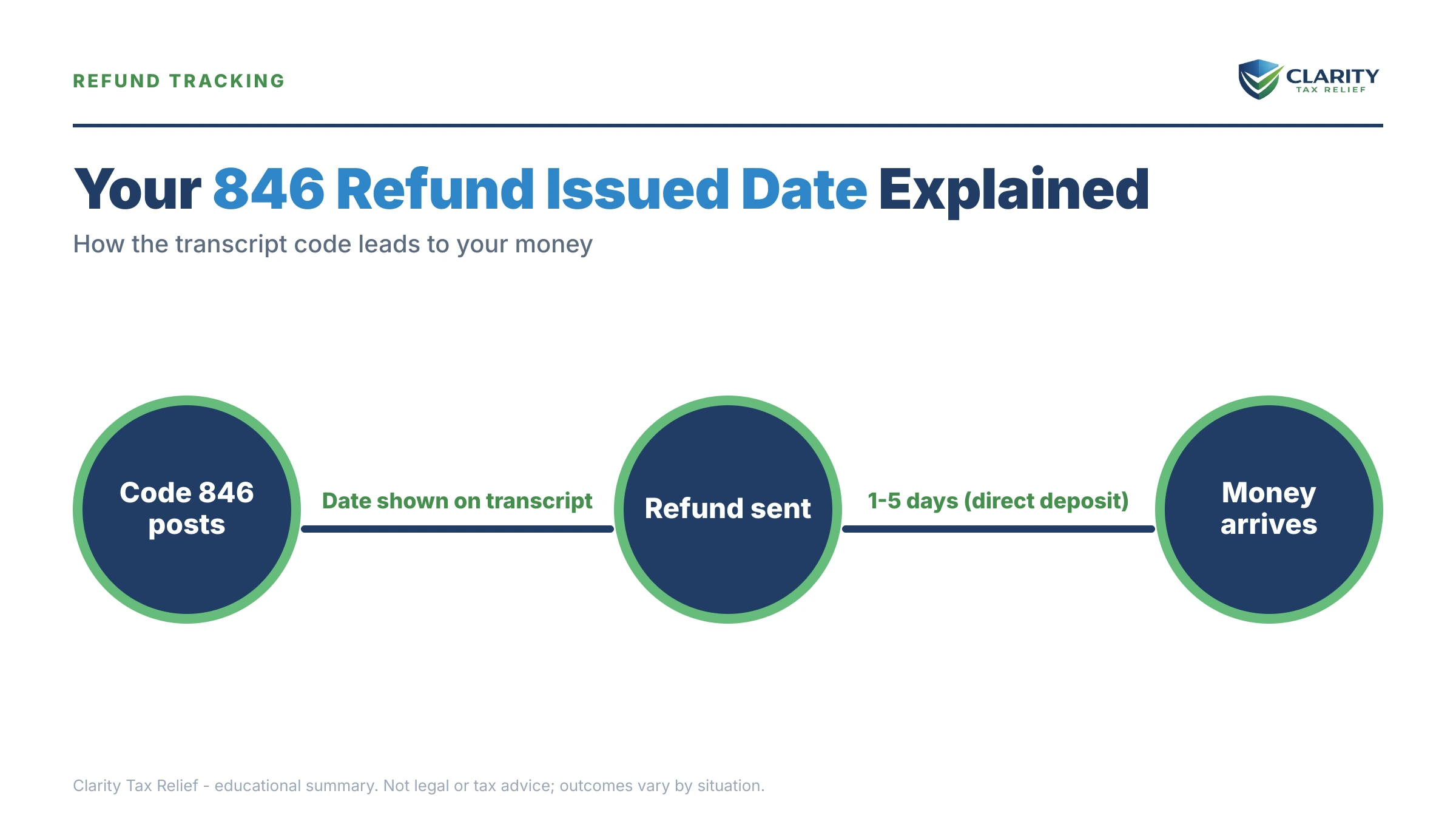
The short answer: the 846 refund issued date on your IRS transcript is the day the IRS releases your refund — not always the day it arrives. Direct deposits typically land between the 846 date and about five business days later; paper checks are mailed around that date and can take several weeks.
You've been pulling up your account transcript before work all week, and this morning a new line finally posted: 846 — Refund Issued, a date, a dollar amount. Then the second look: the date is next week, and the amount isn't quite what your return said. Both of those things have specific, checkable explanations — and this page walks you through each one.
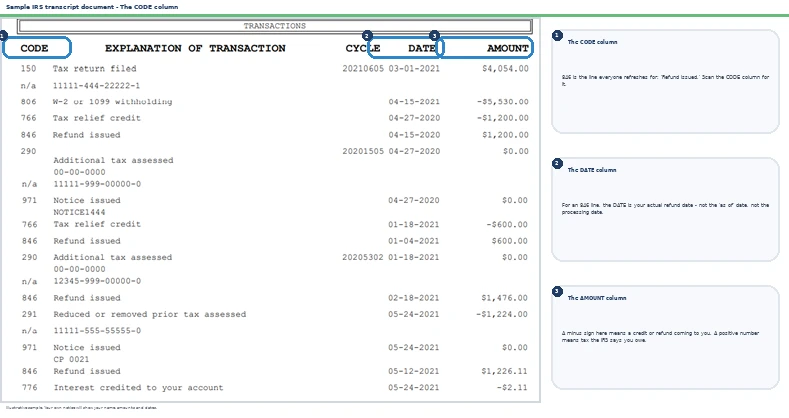
The image below shows you exactly where the 846 line sits on a real account transcript and how to read the date and amount printed beside it — worth a look before you go any further, because two other numbers on that same page (your cycle code and the codes just above 846) answer most of the questions people bring to this code.
⏱ The real clock: the date beside code 846 is the day the IRS releases the money. Direct deposits typically arrive within 1–5 business days of the 846 date; paper checks are mailed around that date and typically take one to four weeks. Don't treat the refund as missing — or start a trace — until those windows have passed.
Why code 846 appeared on your transcript
Code 846 is the final transaction the IRS posts before refund money moves — it means processing is finished and your refund is approved and released. Nothing on your account is still under review for that year's refund. Every hold had to clear before this line could post.
That's what makes 846 different from every hopeful signal that came before it. An accepted e-file, a "still processing" bar, even credit codes posting — none of those commit the IRS to anything. 846 is the only transcript code that means money is actually moving. That said, in uncommon cases a refund can still be reversed (code 841, e.g. a rejected direct deposit) or reduced by an offset (code 898) after 846 posts.
If your transcript previously showed a code 570 account hold or a code 810 refund freeze, seeing 846 means those were formally released (you'll see a 571 or 811 line above it). And if you claimed the Earned Income Tax Credit or Additional Child Tax Credit, the law itself delayed your 846 — the PATH Act refund delay bars the IRS from releasing those refunds before mid-February, no matter how early you filed.
How to read the 846 line — and the codes around it
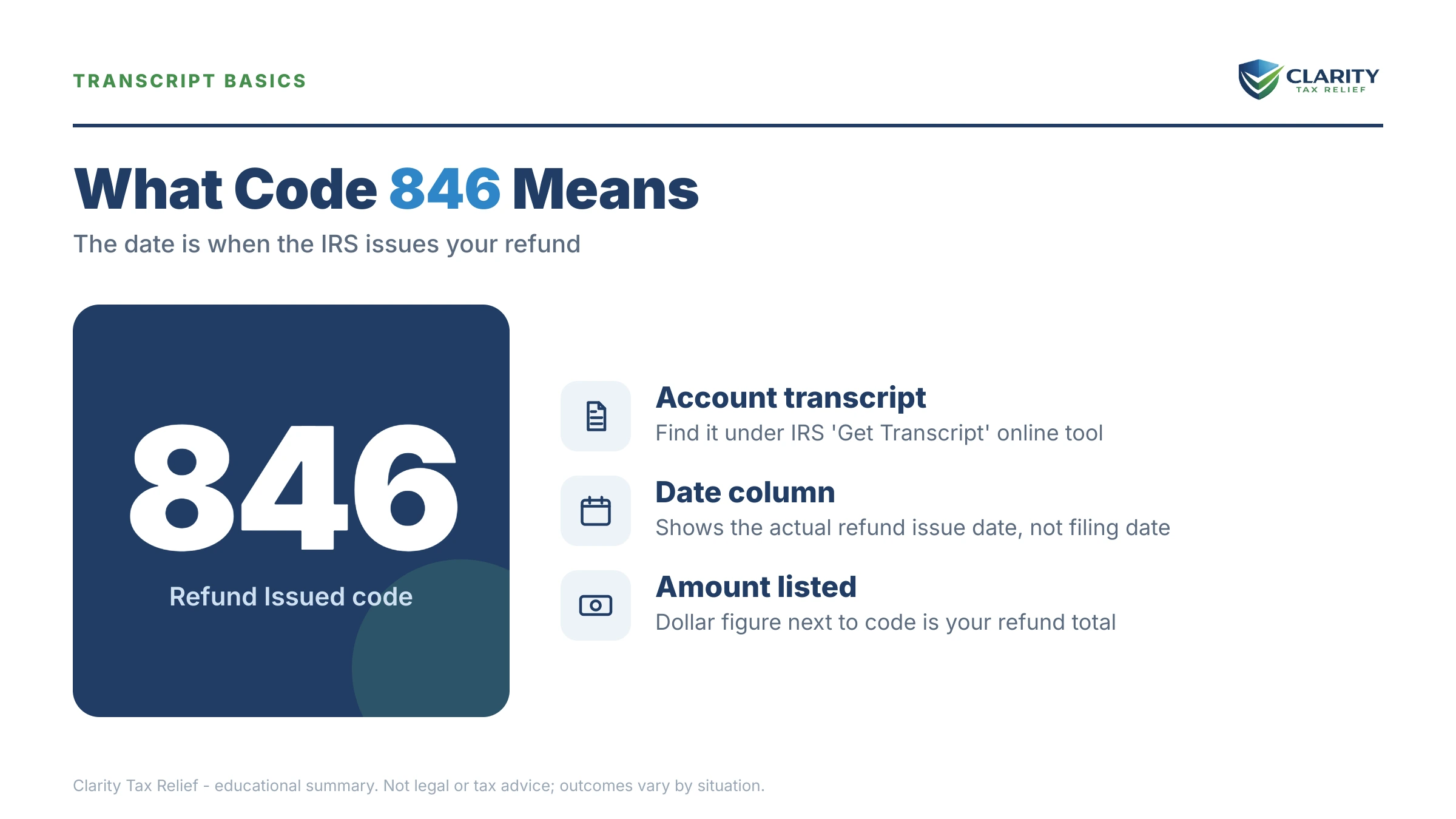
On an account transcript, code 846 appears in the Transactions section with the words "Refund Issued," a date on the same line, and a dollar amount. Two details matter more than anything else on the page:
- The date is the scheduled release date — the day the IRS transmits your direct deposit to the banking system or prints your check. It is a real, reliable date, but it's the start of delivery, not the finish.
- The amount is your actual refund — after any offsets, adjustments, or added interest. When it doesn't match your return, the explanation is almost always sitting in the codes directly above it.
Here's how the lines you're most likely to see around an 846 fit together (the annotated transcript image on this page shows where each of these sits):
| Code | What it means | What to do |
|---|---|---|
| 150 | Return filed; tax assessed. The baseline line for the year. | Nothing — this is normal on every processed return. |
| 806 | Your W-2/1099 withholding credited to the account. | Confirm it matches your actual withholding. |
| 766 / 768 | Refundable credits (child tax credit, EITC, etc.) posted. | Nothing — these feed into the refund total. |
| 570 | Refund hold — something is being verified before release. | Wait for 571 (release) or a notice; no 846 until then. |
| 810 | Hard refund freeze — often identity or credit verification. | Respond to any verification letter; needs an 811 to lift. |
| 971 | A notice was issued explaining a change or request. | Read the letter — it usually explains a changed amount. |
| 898 | Part of your refund offset to a non-IRS debt. | See our code 898 offset guide; call 800-304-3107 to identify the debt. |
| 826 | Refund applied to another tax year you owe the IRS. | See the code 826 guide; the underlying balance may be resolvable. |
| 846 | Refund issued — released on the date shown. | Match the amount to your return; wait out the delivery window. |
| 841 | Refund cancelled — a deposit bounced or a check was returned. | Watch for a mailed check and a follow-up notice; verify your address. |
When your money actually arrives after the 846 refund issued date
A direct-deposit refund typically arrives between the 846 date and about five business days after it — the exact day depends on your bank, not the IRS. Some banks post the deposit the same day the IRS releases it; others hold it until the official settlement date. Paper checks are on an entirely different clock, because they travel by mail.
The delivery method printed on your return controls the timeline more than the 846 date does. Here's the realistic window for each path, and the point at which waiting stops being the right move:
| Delivery method | Typical arrival after the 846 date | When to act if it hasn't arrived |
|---|---|---|
| Direct deposit | Same day to ~5 business days | After 5 business days: confirm with your bank, then ask the IRS to start a refund trace. |
| Paper check (requested) | Typically 1–4 weeks by mail | After about 4 weeks: request a refund trace (Form 3911). |
| Deposit rejected → check reissued | Adds several weeks; watch for code 841 and a CP53 notice | Verify your mailing address with the IRS immediately. |
| Fully offset (no 846, or 846 for $0 remainder) | No money arrives; a letter names the agency paid | Call the Treasury Offset Program line at 800-304-3107. |
If the 846 date passes and no refund shows up
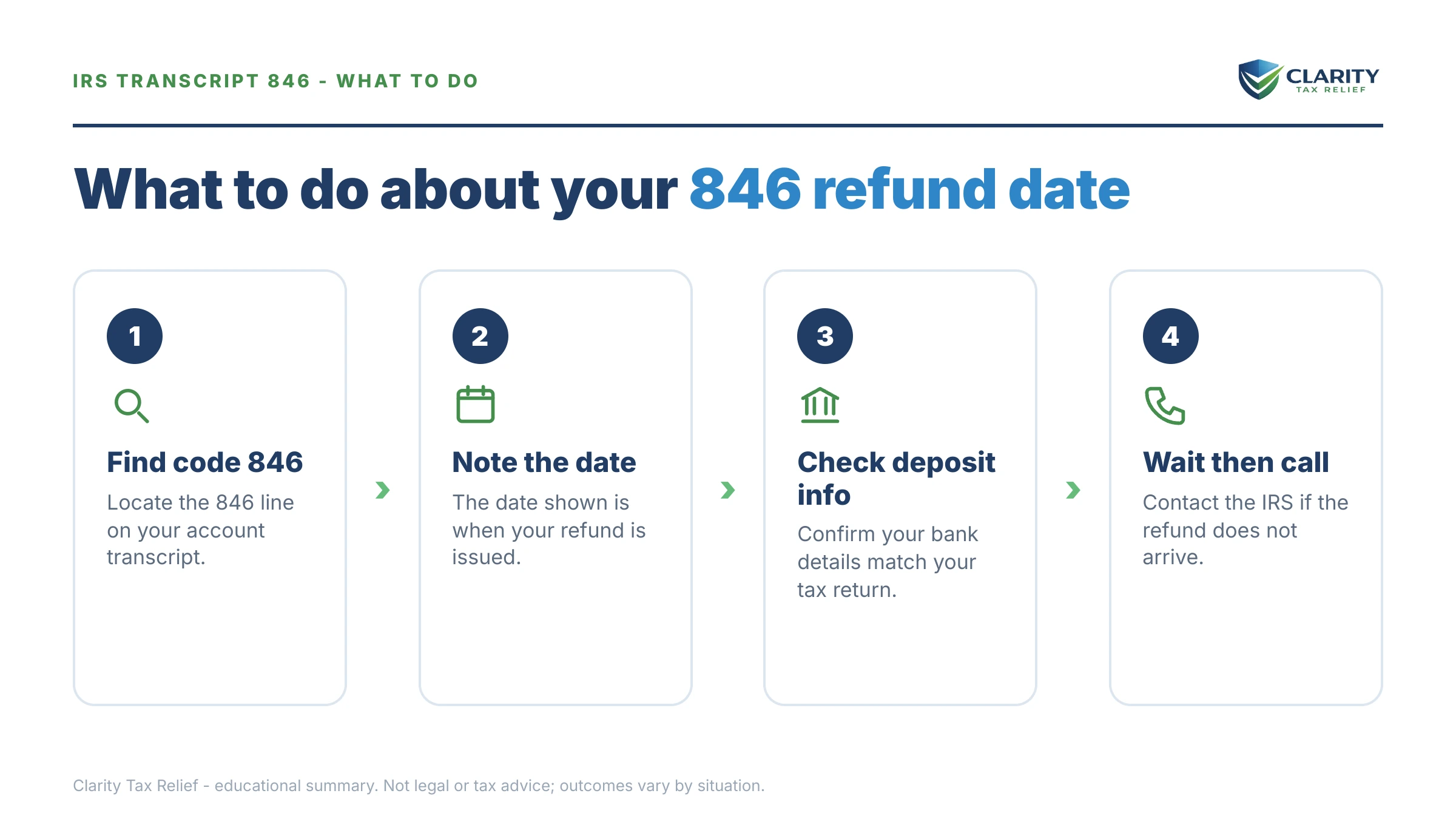
A missing refund after an 846 posts follows a predictable sequence, and each stage has its own fix. Here's the order things happen in when delivery goes wrong:
- Release day. On the 846 date, the IRS transmits your direct deposit to the banking system or prints and mails your check. From this point the delay is usually in delivery, not at the IRS.
- The deposit bounces. If the account number was wrong, closed, or not in your name, your bank returns the money. A code 841 (refund cancelled) may post, and the IRS automatically reissues a paper check to your address on file — often with a CP53 notice explaining the switch. This adds weeks, but the money isn't lost.
- The check goes missing. If a mailed check hasn't arrived after about four weeks, request a refund trace. Single filers can often start one by phone; on a joint return, both spouses generally must sign Form 3911 and mail or fax it in. If the check was cashed by someone else, the trace becomes a claims process with the Bureau of the Fiscal Service.
- The check sits uncashed. Treasury checks are generally void after a year. If yours expires in a drawer, the IRS sends a CP32A notice and you can request a replacement — the money doesn't disappear, but you have to ask for it again.
Through all of this, keep one thing straight: an 846 means the IRS's side is done. Calling the IRS to ask "where's my refund" before the delivery windows close won't speed anything up — the answer will be the same date you're already looking at.
Was your 846 smaller because the IRS kept part of your refund?
If codes 826 or 898 took a bite out of your refund for back taxes or another debt, that same balance will take next year's refund too — and interest and penalties keep accruing on it in the meantime. An experienced tax professional can review your transcript free and map out how to resolve the underlying debt.
Why the 846 amount is smaller than you expected
When the 846 amount doesn't match line 35a of your Form 1040, the difference was taken before release — and the codes above the 846 line show exactly where it went. There are three usual suspects:
- Code 898 — offset to a non-IRS debt. The Treasury Offset Program intercepts refunds for past-due child support, defaulted federal student loans, state income tax debts, and certain other government debts. The 898 line shows the exact amount taken.
- Code 826 — applied to another IRS year. If you owe federal tax for any prior year, the IRS applies your refund to that balance first, automatically, every year until it's paid. Our guide on whether the IRS will take your refund every year covers how to break that cycle.
- A return adjustment. A code 971 paired with a math-error or adjustment notice (like a CP12) means the IRS changed a number on your return before computing the refund. The letter explains the change and your appeal window.
One happier mismatch: the 846 can be larger than your return. When the IRS takes more than 45 days past the filing deadline to issue a refund, it generally adds interest, which posts as a separate credit line and rides along with the 846.
A worked example: the $27,500 joint refund that came back short
Say you and your spouse filed jointly and expected $27,500 back — a big year of over-withholding after a job change. Your transcript shows the math like this:
- Code 150 (tax assessed): $9,400
- Code 806 (withholding): $35,200
- Code 766 (credit): $1,700
- Expected refund: $35,200 + $1,700 − $9,400 = $27,500 ✓ — matches line 35a
- Code 898 (offset): −$4,850 — one spouse's defaulted federal student loan, taken through the Treasury Offset Program
- Code 846 (refund issued): $22,650
The critical detail for a married couple: only one spouse owed that loan, but the offset came out of the joint refund. The non-liable spouse can file Form 8379, the injured spouse allocation, to recover their share of the $4,850 based on their own income, withholding, and credits — and it can be filed even after the offset has already happened. In this example, if the non-liable spouse contributed most of the $35,200 in withholding, most of the offset may be recoverable.
How to respond to code 846, step by step
- Find the 846 line — open your account transcript for the correct tax year and locate code 846 in the Transactions section; note both the date and the dollar amount beside it.
- Compare the amount to your return — check the 846 amount against line 35a of your Form 1040. If they match, you're done comparing. If the 846 is smaller, look at the codes just above it (898, 826, or 971) to see exactly what was taken and why.
- Confirm your delivery method — verify the bank account and routing number you put on the return. If you requested a check, or your bank information was wrong, the refund arrives by mail to your address on file — which adds weeks.
- Wait out the delivery window — give a direct deposit up to about five business days past the 846 date, and a paper check about four weeks, before treating the refund as missing.
- Act if it's late or short — for a late refund, check with your bank first, then start an IRS refund trace (Form 3911 for joint filers). For an offset you dispute, call the Treasury Offset Program at 800-304-3107, and file Form 8379 if a joint refund was taken for one spouse's separate debt.
When you can handle this yourself — and when help changes the outcome
Most people who see code 846 need exactly zero professional help. If your 846 amount matches your return and the delivery window hasn't passed, the correct move is to wait — no call, no fee, no service can make an already-released refund move faster. The same goes for a bounced deposit that's being reissued as a check, or a simple refund trace: those are free, DIY processes.
Experienced help changes the outcome in a narrower set of situations:
- The IRS keeps taking your refund for back taxes. A code 826 this year means one next year too, until the balance is resolved. Setting up the right resolution — a payment plan, hardship status, or (when the math genuinely supports it) an offer — is covered in our guide to how to settle tax debt yourself, and a professional review is worth it when the balance spans multiple years or the amount is disputed.
- A joint refund was taken for a debt that isn't yours. Injured-spouse allocations are winnable but detail-heavy — the split of income, withholding, and credits determines what comes back, and community-property states use different rules.
- 846 never posts because a freeze won't lift. An 810 that's been sitting for months, or a 570 tied to an exam referral, is a different problem than a slow refund — that's a case, not a wait.
You can pull your own transcript any time through your IRS online account at IRS.gov's Get Transcript page, and check official refund status at IRS.gov/refunds. If a delayed refund is causing genuine financial hardship — an eviction, a utility shutoff — the Taxpayer Advocate Service can intervene at no cost.
Terms on your transcript, decoded
- Refund issued (846): the final refund posting — the IRS has approved the amount shown and released it on the date shown.
- Cycle code: the eight-digit number near code 150 that tells you which weekly or daily batch your account updates in — it predicts when new codes like 846 can appear.
- "As of" date: a bookkeeping date the IRS uses to compute interest and penalties to a point in time — it is not your refund date and moves around routinely.
- Refund offset (TOP): the Treasury Offset Program's interception of a refund to pay child support, student loans, state tax, or other government debts before the money reaches you.
- Refund trace (Form 3911): the formal process for locating a released refund that never arrived — required in writing, with both signatures, for joint returns.
846 refund issued date: your questions, answered
Is the 846 date the exact day I get my refund?
No — the 846 date is the day the IRS releases the money, not the day it lands. Direct deposits typically arrive between the 846 date and about five business days later, depending on your bank. Paper checks are mailed around that date and can take several weeks. If the 846 date falls on a weekend or holiday, expect the deposit on the next business day or later.
Does code 846 mean my refund is fully approved?
Yes — 846 is the final posting in refund processing, and it is more reliable than the Where's My Refund tool. Every hold on your account had to clear before it could post. The rare exception is code 841, which posts if a bank rejects the deposit or a check is returned; in that case the IRS reissues the refund as a paper check to your address on file.
Why is my 846 amount less than the refund on my tax return?
Because the 846 amount is what is left after the IRS applied offsets and adjustments. Look at the codes just above it: 898 means part went to a non-IRS debt like child support or student loans, 826 means it was applied to another tax year you owe, and a 971 with a math-error notice means the IRS changed your return. Each of those codes shows the exact dollar amount it took.
Can my refund still be taken after code 846 posts?
Almost never — offsets to IRS debts and most Treasury Offset Program debts are applied before 846 posts, so the 846 amount already reflects them. If the Bureau of the Fiscal Service intercepts any portion for a non-IRS debt, you will get a letter naming the agency that received it. You can check for offsets yourself by calling the Treasury Offset Program line at 800-304-3107.
What day do transcripts update with code 846?
It depends on your cycle code — the eight-digit number near code 150. Accounts ending in 05 are typically weekly and tend to update overnight into Friday morning; other endings update on other days of the week. There is no set clock, so checking once per update cycle tells you as much as refreshing hourly.
My transcript shows 846 but Where's My Refund still says processing — which is right?
Trust the transcript. Code 846 comes straight from the IRS master file, while Where's My Refund is a simplified status tool that often lags the transcript by a day or more. If 846 has posted with a date and amount, your refund is released regardless of what the tool says. The tool usually catches up to an approved status within a few days.
How long after code 570 or 810 resolves will 846 post?
The hold has to be formally reversed first — code 571 releases a 570 hold, and code 811 releases an 810 freeze. Once the release code posts, 846 often follows within one to three weekly transcript cycles, but there is no fixed timeline, especially if the hold involved identity verification or an exam. If a release code posted weeks ago with no 846, that is worth a call to the IRS or a professional review.
Does the IRS pay interest on a late refund?
Generally yes, when the IRS issues your refund more than 45 days after the filing deadline (or after it received your return, if you filed late). The interest posts as a separate credit line on your transcript and is added to the 846 amount, which is why some refunds come in larger than the return showed. That interest is taxable income on next year's return — the IRS will send a 1099-INT if it is $10 or more.
Your next 24 hours
- Screenshot the 846 line. Note the date and the exact dollar amount — that's the release date your delivery window counts from, and the number every other check starts with.
- Pull your Form 1040 and compare. Match the 846 amount against line 35a. If it's short, write down the code (898, 826, or 971) and amount that explains the difference — that tells you which fix applies.
- If the IRS kept part of your refund for a tax debt, get it reviewed free. That balance will intercept every future refund and keeps growing with interest and penalties until it's resolved. Call (888) 825-7779 or use the 2-minute form for a free, no-pressure transcript review.
This guide is general information, not tax or legal advice for your specific situation. Eligibility for IRS programs depends on individual facts and circumstances; no outcome is guaranteed.