
IRS Transcript Codes
Code 570 on IRS Transcript: What the Hold Means and How to Clear It (2026)
The short answer: code 570 on an IRS transcript means "additional account action pending" — the IRS has paused your account and frozen any refund while it reviews something on your return. It is a hold, not a bill and not an audit. Many holds release on their own; some need you to answer a letter first.
You probably weren't browsing your transcript for fun. Maybe your refund is late, or your loan officer asked for IRS records for a refinance — and there it is: 570 Additional account action pending, $0.00, next to a date that already passed. Nothing on the page explains what it's waiting for. This guide does: what posted the hold, what releases it, and when the line actually needs something from you.
The image below shows exactly what a code 570 line looks like on a real account transcript and where to find the codes around it that explain the hold.
⏱ The real clock: a code 570 prints no deadline — but any letter that follows it does. If a code 971 posts after your 570, a notice is on its way, and the response date printed on that letter becomes your deadline. Miss it and the IRS resolves the issue without your input.
What code 570 on an IRS transcript means
Code 570 on an IRS transcript is a hold that stops your refund and pauses account activity for that tax year until the IRS releases it with a code 571 or 572. In IRS terms, it's a freeze on that year's account "module" — the return posted (code 150), but something stopped the money from moving.
Three details on the 570 line matter:
- The amount. Most 570s show $0.00 — which means no tax has been added to your account. The hold is procedural. A dollar amount instead means a pending adjustment is being processed.
- The date. That's a processing date — roughly when the hold posted in the IRS's weekly cycle. It is not your deadline and not a release date.
- What's around it. The codes above and below the 570 usually explain it. A code 971 right after means a letter was generated. A code 810 refund freeze is a different, harder freeze with its own release path.
Code 570 appears on your account transcript, not your return transcript. If transcript layouts are new to you, our guide on how to read IRS account transcript covers the format; this page covers only the 570 itself. And if your first fear was an exam, see is code 570 an audit — the short answer is no.
| Code | What it means | What to do |
|---|---|---|
| 150 | Return filed and posted; shows your total tax | Nothing — this is normal processing |
| 806 | Withholding credited from your W-2s/1099s | Confirm it matches your actual forms |
| 570 | Additional account action pending — refund held | You are here; read on |
| 971 | Notice issued — a letter is coming | Watch the mail; respond by the printed date |
| 571 / 572 | Hold resolved or reversed — the 570 is released | Nothing — a refund date usually follows |
| 420 | Return routed to examination (audit indicator) | Wait for the exam letter; get help if complex |
| 810 | Hard refund freeze — separate from 570 | Often needs identity verification; needs 811 to release |
| 846 | Refund issued, with the actual payment date | Nothing — this is the finish line |
Why the IRS placed a code 570 hold on your account
Most code 570 holds come from automated matching — something on your return didn't line up with what employers, banks, or the IRS's own systems reported. The two most common triggers are withholding that doesn't match employer filings and reviews of refundable credits. The usual suspects:
- Withholding mismatch. The withholding you claimed (code 806) doesn't match the W-2s and 1099s on file — often because an employer filed late or with an error, not because you did anything wrong.
- Refundable-credit review. Returns claiming the Earned Income Tax Credit or Additional Child Tax Credit get extra screening, including the early-season PATH Act hold on those refunds.
- Identity verification. The return tripped an identity filter and the IRS wants you to confirm it's really yours before releasing money.
- Duplicate or amended filings. A second return or an amendment posted to the same year, and the account is frozen while the IRS reconciles them.
- Injured spouse or offset review. A Form 8379 claim or a question about whether your refund should be applied elsewhere pauses everything while it's worked.
A 2026 reality check: the IRS workforce shrank roughly 27% in 2025, so anything that needs a human — wage-match corrections, document reviews — moves slower than the automated systems that placed the hold. The freeze posts instantly; the release often waits in a queue.
What happens if you ignore a code 570
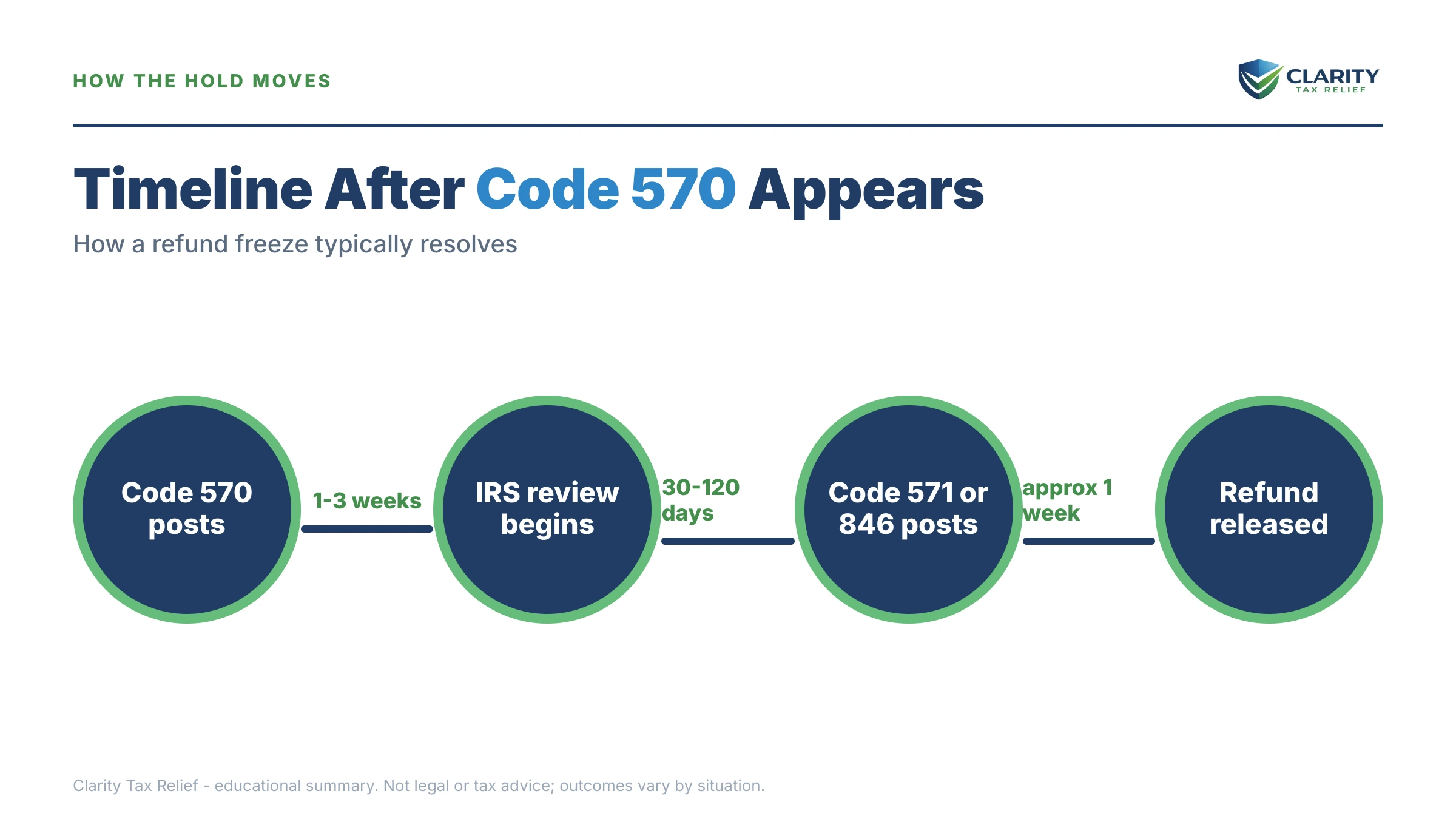
A code 570 never expires on its own — it either releases, or it hardens into an adjustment, an exam referral, or a deeper freeze. The sequence runs in stages:
- The hold posts (570). Your refund is frozen. Nothing has been mailed yet, and many holds at this stage resolve without you.
- A notice generates (971). If the review needs your input, a 971 posts and a letter is queued to your address on file.
- The letter arrives. A CP05, 4464C, 5071C, CP05A, or Letter 12C — some ask for nothing, others ask for documents or identity verification by a printed date.
- No response: the IRS decides without you. That can mean an adjustment — a code 290 additional tax assessed that shrinks or erases your refund — a referral to examination (code 420), or an 810 freeze layered on top.
- Resolution. On the good path, a 571 releases the hold and an 846 posts with your new refund date.
If a letter asks for something and you don't answer, the IRS resolves the issue on its own terms — and undoing an adjustment after the fact takes far longer than answering the letter would have.
Code 570 sitting on your transcript right now?
Send us the transcript. An experienced tax professional will read every code on it, tell you exactly why the hold posted, and map the fastest path to release — free, confidential, no pressure. Delay only keeps your refund frozen longer.
Your options while the hold is in place
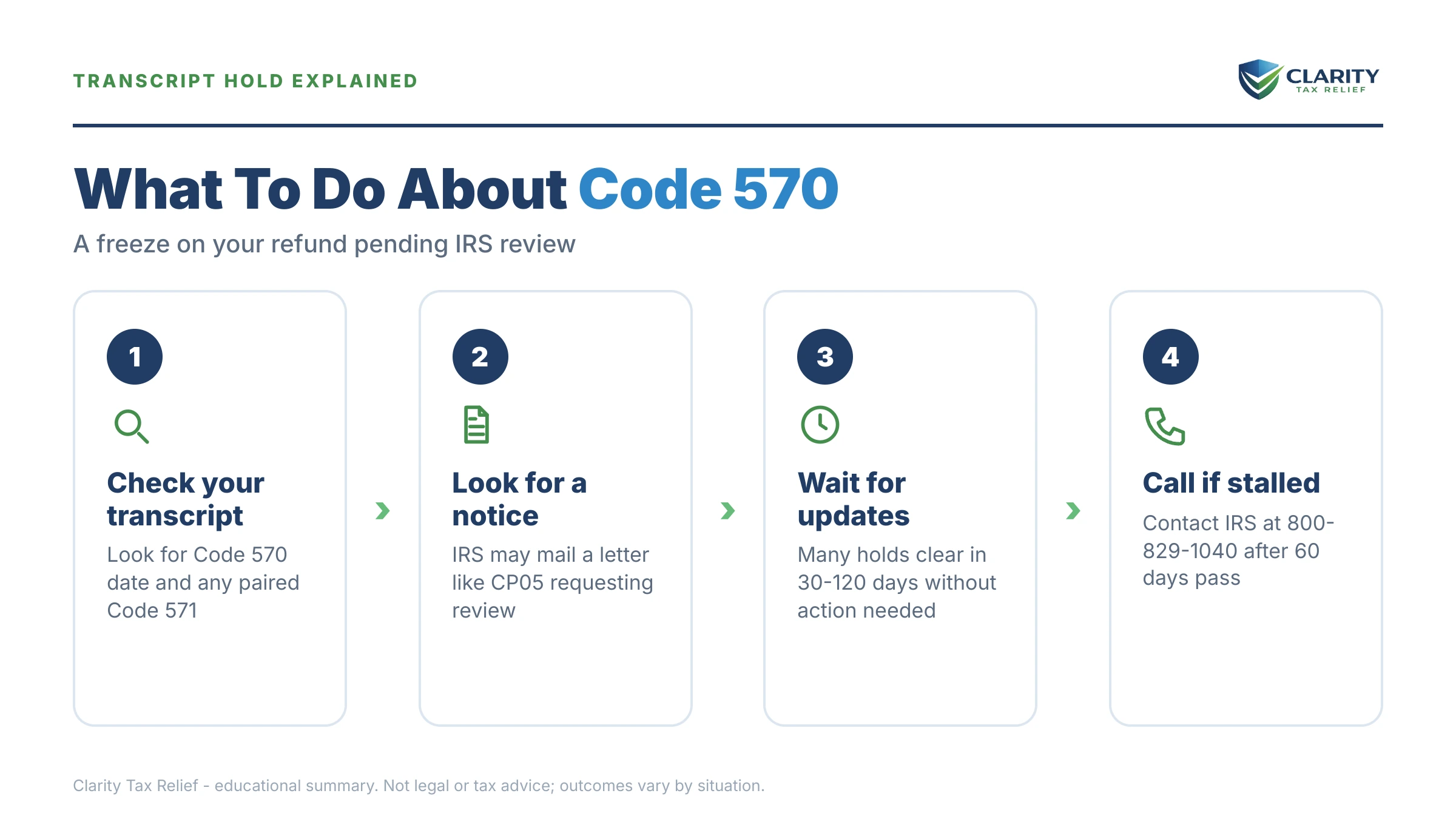
What you should do about a code 570 depends on one thing: whether a code 971 and a letter have followed it.
- 570 alone, no 971, posted recently: wait and watch. Transcripts update weekly, and many systemic holds release within a few cycles without any contact from you.
- 570 followed by 971: a letter is coming — the pairing changes your job from waiting to responding. Our guide to 570 and 971 codes on transcript covers that combination in detail.
- Letter asks you to verify identity: do it the day the letter arrives. Nothing on the account moves until you do.
- Roughly 60 days with no letter and no movement: call the IRS. At that point a phone contact can surface a stalled wage-match or a letter that never mailed.
- The frozen refund is causing genuine hardship: the Taxpayer Advocate Service can intervene — that's what Form 911 exists for.
| Letter | Why it follows a 570 | Your move |
|---|---|---|
| CP05 | Refund under review — the IRS is verifying income, withholding, or credits | Usually nothing to send; keep your W-2s and 1099s handy and watch the transcript |
| CP05A | The review needs proof of your income or withholding | Send the requested documents by the date printed on the letter |
| 4464C | Return pulled for income verification before the refund releases | Typically no response required; the letter states its own review window — don't refile |
| 5071C | The IRS needs you to confirm your identity before processing continues | Verify online or by phone the day it arrives — nothing moves until you do |
| Letter 12C | Something is missing from your return — a form, schedule, or signature | Reply with the missing item by the printed date so processing can restart |
Code 570 and your refinance: what your lender sees
A code 570 can stall a mortgage refinance, because lenders verify your returns straight from the IRS — and an unresolved hold shows up in that pull. Underwriters typically request transcripts with Form 4506-C, and a return year that hasn't finished processing can become a loan condition.
Here's a clearly hypothetical example with the math. Say your 2025 return shows $41,800 of total tax — that's the figure next to code 150 — and code 806 shows $47,350 of withholding. The account math is $47,350 − $41,800 = $5,550 expected refund. Then a 570 posts at $0.00. Two things happen at once: your $5,550 is frozen, and when your lender pulls transcripts mid-underwriting, the 2025 year shows an open, unresolved review instead of a clean, completed record.
That does not mean you owe $41,800 — the $41,800 was paid through withholding, which is exactly why a refund exists. But an underwriter can't guess that from a hold code, so the file stalls while everyone waits for the IRS. A code 570 with $0.00 means the IRS is not claiming you owe anything — and your underwriter needs to hear that with documentation, not assurances.
The practical fix: give your loan officer your full signed return, your e-file acceptance confirmation, your W-2s, and any IRS letter you've received. Then watch the transcript weekly, and the day a 571 posts, send the updated transcript. If a rate lock is expiring and the hold is the only thing in the way, that's a situation where professional help pushing the release matters — more on that below.
How to respond to code 570, step by step
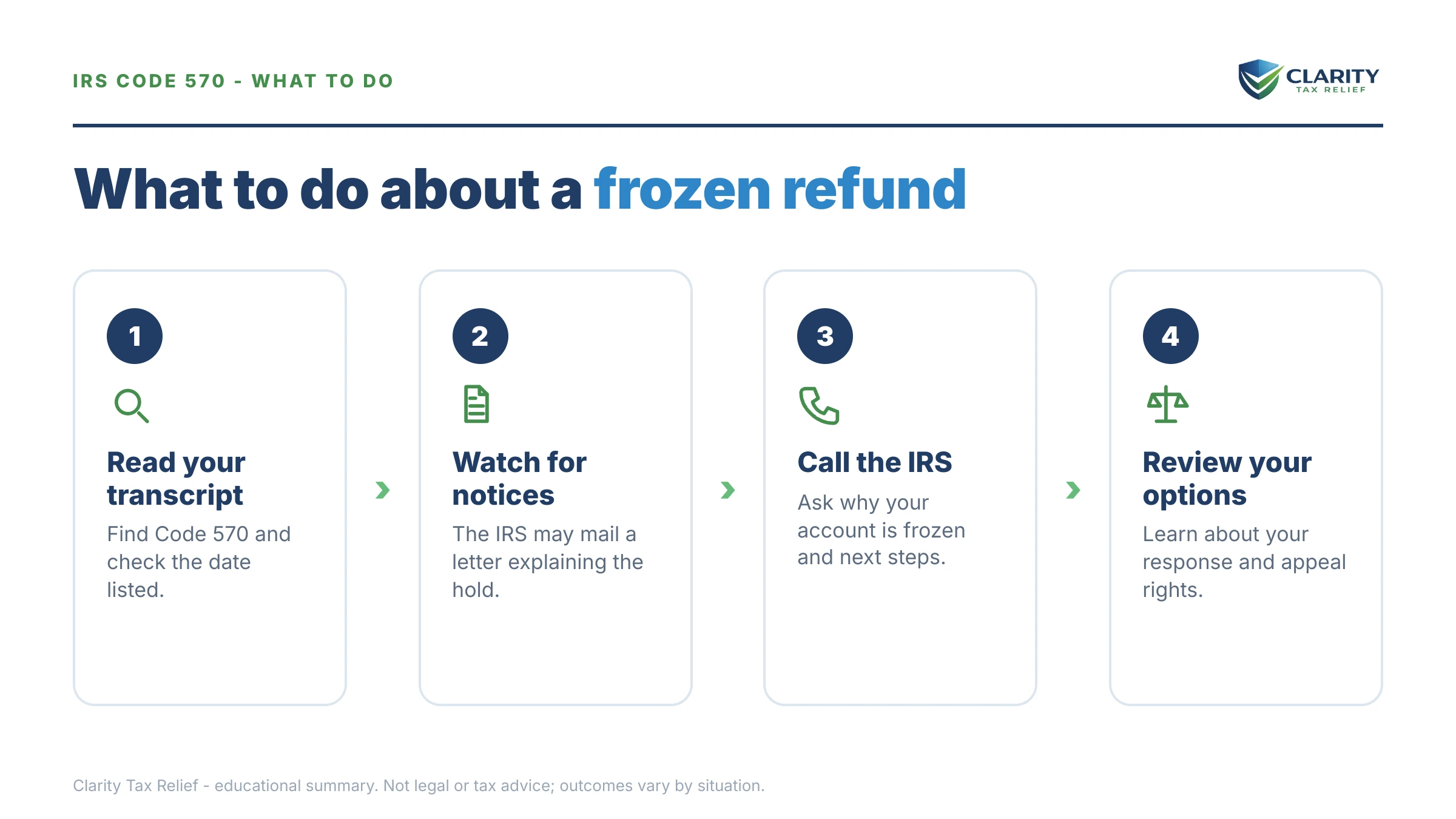
- Pull your account transcript. Read every line around the 570 — the codes above and below it tell you what triggered the hold.
- Check for a code 971. If one posted after the 570, a letter is coming — watch your mail closely for the next two weeks.
- Answer any letter by its printed date. Send exactly the documents it asks for — no more, no less — and keep copies of everything.
- Track weekly transcript updates. You're watching for code 571 (hold released) followed by code 846 with a new refund date.
- Escalate if nothing moves. Call the IRS after about 60 days with no letter or movement, and contact the Taxpayer Advocate Service (Form 911) if the delay is causing real financial hardship.
When you can handle a code 570 yourself — and when help changes the outcome
Most people can clear a code 570 on their own, because the hold usually needs patience or one well-aimed response — not representation. Handle it yourself when the 570 is recent with no 971 behind it, when the letter is a no-action CP05 or 4464C, or when all the IRS wants is identity verification you can complete online.
Experienced help changes the outcome in a narrower set of situations: the hold sits on top of unfiled years or multiple frozen tax years; the letter proposes a change to your return you disagree with; an 810 freeze or a code 420 exam referral has posted alongside the 570; or — like the refinance scenario above — a real-world deadline means every week of delay costs money, and you need someone who knows which IRS unit actually owns the hold. If a frozen refund is creating hardship, the Taxpayer Advocate Service is a free, independent escalation path worth knowing about either way.
Terms on your transcript, decoded
- Additional Account Action Pending: the official label for code 570 — IRS shorthand for "something is unresolved, so nothing pays out."
- "As of" date: a bookkeeping date the IRS uses to compute interest and penalties to a point in time — see our guide to the as of date irs transcript meaning; it is not your refund date.
- Cycle code: the eight-digit number showing which weekly processing batch your account updates in.
- TC 571 / 572: the release codes — 571 resolves the 570, 572 reverses it; either one unfreezes the account.
- Master File: the IRS's central account database where all of these transaction codes post.
Code 570 questions, answered
How long does code 570 last on an IRS transcript?
There is no fixed timeline — a code 570 lasts until the IRS resolves whatever triggered it, shown by a code 571 or 572 posting. Many systemic holds release within a few weekly transcript cycles. Holds waiting on identity verification or wage-match corrections take longer, and a hold where you ignored a letter can sit indefinitely until you respond.
Does code 570 on my transcript mean I'm being audited?
No. Code 570 is a processing hold, not an examination. An audit shows up as code 420 (and sometimes 424) on your transcript, along with an opening letter in the mail. Most 570 holds come from automated matching or verification checks and end with your refund released — often without the IRS changing your return at all.
What does the date next to code 570 mean?
The date beside code 570 is an IRS processing date — roughly when the hold posted to your account in the weekly cycle. It is not a deadline for you, and it is not the date the hold will lift. The only date that ever demands action from you is the response date printed on a letter, if one arrives.
Why does my code 570 show $0.00?
A $0.00 next to code 570 means the IRS has not added any tax to your account — the hold is procedural, pausing your refund while something is verified. If a dollar amount appears instead, the IRS is holding your account while it processes a pending adjustment, which could change your refund or create a balance.
What is the difference between code 570 and code 810?
Code 570 is a general account hold that usually releases on its own once a review finishes. Code 810 is a harder refund freeze, often tied to identity checks or questionable-credit reviews, and it requires a specific code 811 to release. An 810 is more likely to demand action from you — typically identity verification — before anything moves.
Will I still get my refund if my transcript shows code 570?
In most cases, yes — once the hold releases with a code 571, a code 846 posts with your new refund date. If the review changes your return, the refund may arrive smaller (or a balance may result), shown by adjustment codes like 290 or 291. The 570 itself doesn't take your refund; it delays it while the IRS decides.
Should I call the IRS about a code 570?
Not in the first few weeks — phone agents usually can't release a hold that's still inside its normal review window, and 2026 wait times are long. Call when roughly 60 days have passed with no letter and no transcript movement, or when a code 971 posted but the promised letter never arrived. If the delay is causing financial hardship, the Taxpayer Advocate Service can intervene.
Can code 570 delay my mortgage or refinance?
It can. Lenders verify your tax returns directly with the IRS using Form 4506-C, and an account transcript with an unresolved hold can trigger underwriting conditions or stall closing. The fix is documentation: give your loan officer your full return, proof of e-filing, and your W-2s, then supply the updated transcript as soon as code 571 posts.
Your next 24 hours
- Pull a fresh account transcript from IRS.gov's Get Transcript tool and note three things: the date on the 570 line, its dollar amount, and whether a code 971 sits below it.
- Gather your paper trail — a copy of the return for that year, your W-2s and 1099s, your e-file acceptance confirmation, and any IRS letter that has arrived.
- Get the transcript read professionally, free. Especially if a letter is asking for documents, a 971 has posted, or a refinance is waiting on this account — call (888) 825-7779 or use the 2-minute form before the hold decides your timeline for you.
This guide is general information, not tax or legal advice for your specific situation. Eligibility for IRS programs depends on individual facts and circumstances; no outcome is guaranteed.