
IRS Transcript Codes
Code 290 IRS Transcript: What "Additional Tax Assessed" Means in 2026
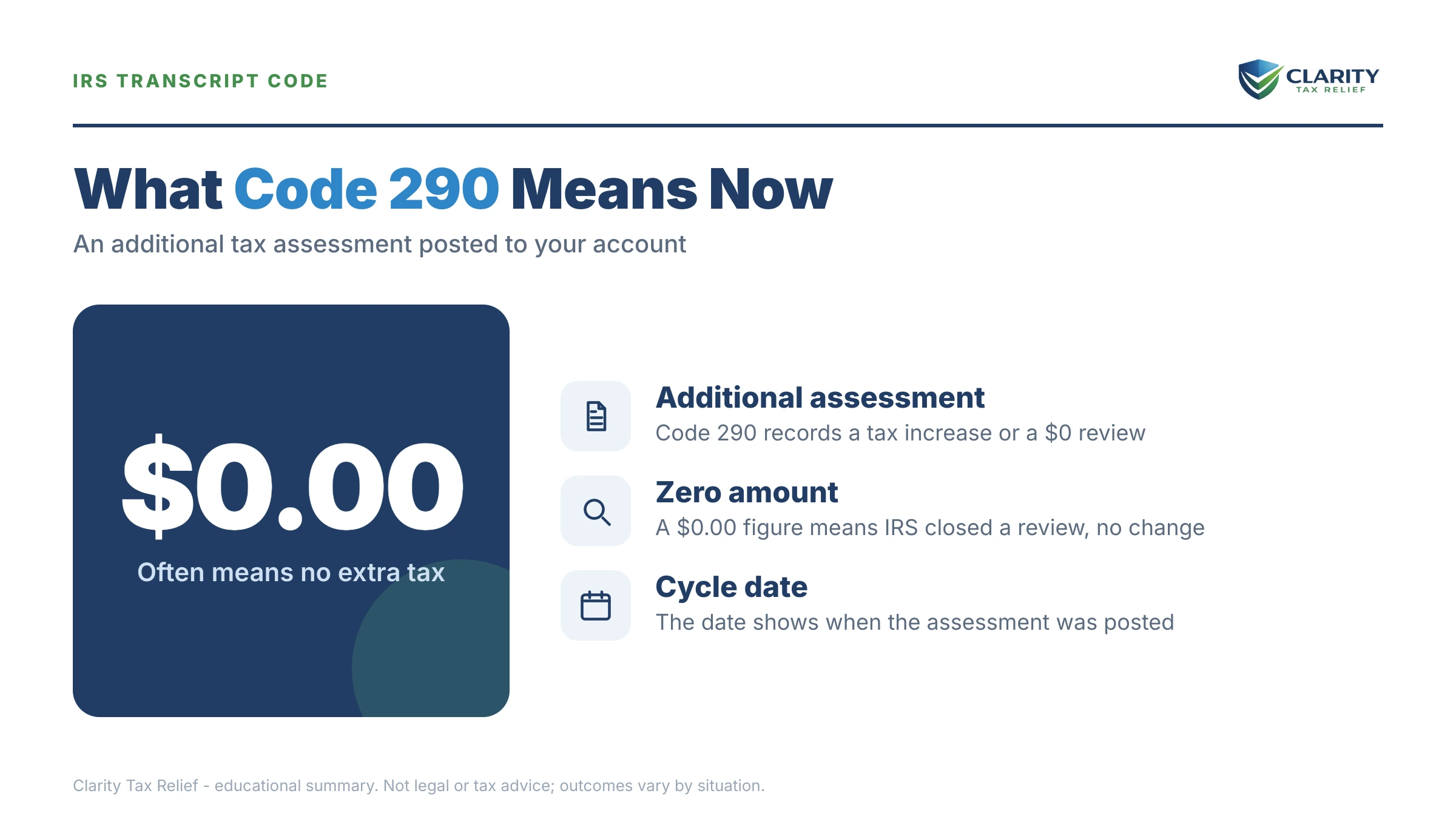
The short answer: code 290 on an IRS transcript means "Additional Tax Assessed." With a dollar amount, the IRS added tax to your account — usually after a CP2000, an audit, or an amended return. With $0.00, no tax was added; the IRS simply closed a review. The date beside it is the assessment date.
You were scrolling your account transcript — maybe checking on a delayed refund, maybe tracking a CP2000 you answered months ago — and a new line appeared: "290 Additional tax assessed." A code 290 IRS transcript entry is the moment an IRS review stops being a question and becomes an official number, and in 2026 that number is either the best line on the page ($0.00) or the start of a bill.
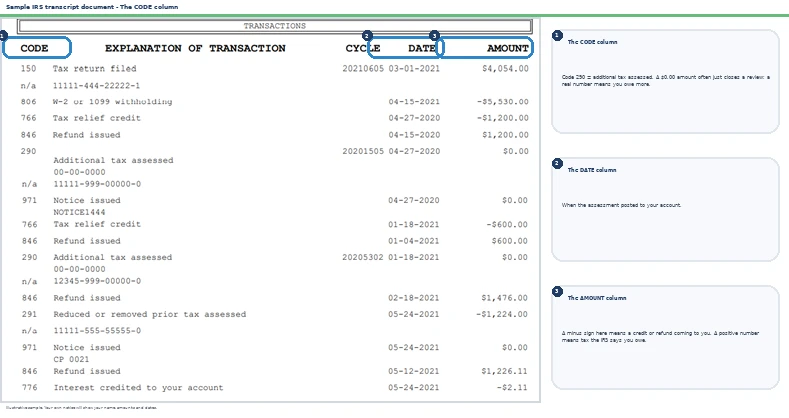
Which one you're looking at changes everything you do next. This guide walks through both versions, what the date beside the code legally controls, how to challenge a 290 that's wrong, and how to handle one that's right. The image below shows exactly where the 290 line sits on a real account transcript and how to read the amount and date beside it.
⏱ The real clock: a transcript never prints your deadline. A code 290 with a dollar amount starts interest running from the assessment date and queues a mailed notice with its own pay-by date — the date printed on that notice is the one that controls. The assessment date also starts the 10-year collection statute for that amount.
Code 290 IRS transcript entries: $0.00 vs. a dollar amount
Code 290 is the transaction the IRS uses to make an assessment official — and a $0.00 entry and a dollar-amount entry are nearly opposite events. Your account transcript is a ledger: code 150 records the tax from the return you filed, and a 290 records tax the IRS added after that. (If transcript layout is new to you, our guide on how to read an IRS account transcript covers the full ledger in one place — this page stays focused on the 290 line itself.)
A 290 for $0.00 is a closing entry. The IRS opened some kind of review — a refund hold, an underreporter screen, an identity or income check — and needed a formal transaction to close it. Zero dollars means the review ended with no change to your tax. If your refund was stuck behind a code 570 on your IRS transcript, a $0.00 290 is frequently the entry that releases it.
A 290 with a dollar amount is a new debt. The IRS has formally assessed that much additional tax against you, interest began accruing as of the date on the line, and the collection machinery now treats it like any unpaid balance. You'll usually see companion entries nearby: code 196 for interest assessed, code 276 for the failure-to-pay penalty, and a 971 marking the letter that explains it all.
One more orientation point: 290 has a mirror image. Code 291 on an IRS transcript is "tax reduced" — it's what posts when an assessment is abated, which is why a wrong 290 is worth fighting rather than just absorbing.
Why a code 290 posted to your account
Most dollar-amount 290s come from a document-matching or correction process, not from a human deciding to bill you. The transcript codes around the 290 usually tell you which process it was — the image below shows what these entries look like in sequence on an actual transcript.
| What you see | What it means | What to do |
|---|---|---|
| 290 · $0.00, standing alone | A review closed with no tax added | Nothing required; if a refund is pending, watch for code 846 on upcoming updates |
| 290 · $0.00 after a 570 hold | The account hold was resolved without change | Refund processing typically resumes on the next weekly cycles |
| 290 · amount, after code 922 | An underreporter (CP2000) case was finalized as an assessment | Pull the CP2000 and compare line by line; request reconsideration if the income was reported or nontaxable |
| 290 · amount, after 420/424 | An examination adjustment was assessed | Check the audit letters for your appeal window; audit reconsideration is possible after assessment |
| 290 · amount, with a 971 nearby | Tax assessed and an explanation notice mailed | Match the 971 date to the letter, verify the math, then pay or dispute |
| 290 · amount, after 976/977 | Your amended return processed with additional tax | Confirm the amount matches the 1040-X you filed; question anything you didn't report yourself |
The single most common source of a surprise dollar-amount 290 is the Automated Underreporter program — the computer that matches W-2s and 1099s against your return. If a code 922 underreporter review appears earlier in the year's history and you never resolved the CP2000 notice that followed, the 290 is that proposed amount becoming real. On a joint return, this often traces to one spouse's income — a side 1099, a brokerage form, a retirement distribution — that the other spouse never saw. The assessment binds you both: on a married-filing-jointly account, each spouse is fully liable for the whole 290 amount, though innocent spouse relief may exist where one spouse hid the income.
Two other patterns worth naming. A 290 after a code 420 IRS transcript entry is an audit result being booked — and audits have their own appeal windows that a transcript won't show you. And a 290 following codes 976/977 is simply your own amended return posting; the only question there is whether the figure matches what you filed.
The date beside your 290 matters more than you think
The date on a code 290 line is the legal assessment date — the day the debt officially exists. Three separate clocks hang on it. First, interest is computed to that date and compounds after it, so the transcript figure is a snapshot that grows daily. Second, the failure-to-pay penalty (0.5% per month, capped by statute) starts stacking on any unpaid portion. Third, the assessment date starts the 10-year collection statute (CSED) for that specific amount — separate from the CSED on the original code 150 tax. A 2022 tax year with a 290 assessed in 2026 is collectible on that added amount until roughly 2036, longer if tolling events pause the clock.
Don't panic if the date is in the future. Transcripts post on weekly cycles, and a 290's date is routinely one to three weeks ahead of the day it first appears. It's the effective date of the assessment, not a deadline you're already missing.
What happens if you ignore a code 290 balance
A code 290 balance you ignore enters the same automated collection sequence as any unpaid tax bill — and the interest meter started on the assessment date, not the day you noticed the entry. The order of what follows is predictable:
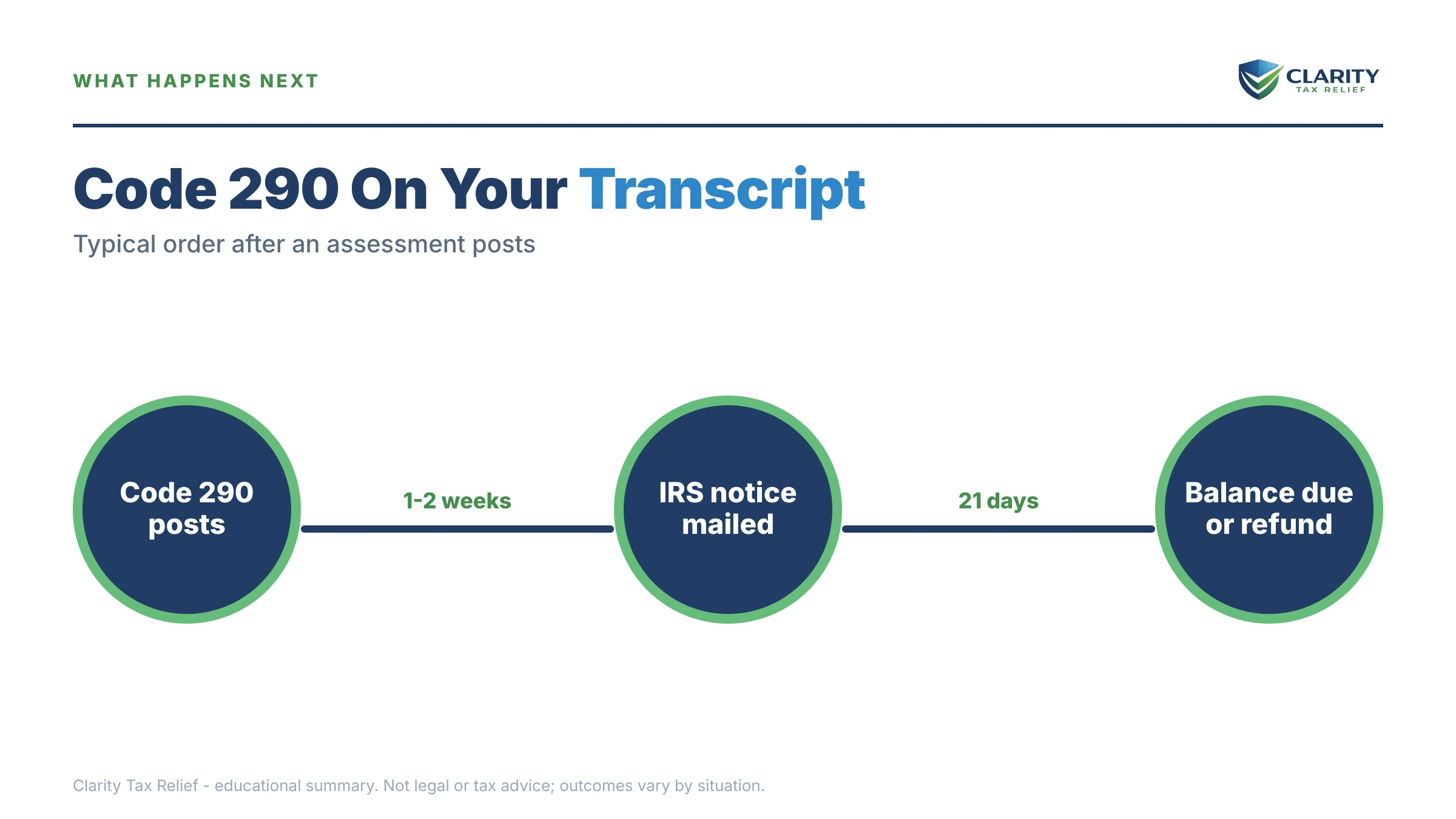
- The 971 notice arrives — usually a CP21A or CP22A explaining the change, with a pay-by date. This is the cheapest moment to act.
- Reminder bills follow — CP501 and CP503 restate the balance, now larger, as interest and the monthly failure-to-pay penalty accrue.
- CP504 — Notice of Intent to Levy — the IRS can now seize your state tax refund under IRC §6331(d). Despite the name, this is not the final notice.
- LT11 / Letter 1058 — Final Notice — a 30-day clock starts on your Collection Due Process rights (requested with Form 12153). After it runs, the IRS can levy bank accounts and garnish wages.
- Enforcement — a bank levy freezes funds for 21 days before they're sent to the IRS; a wage levy is continuous until released.
In 2026 no human needs to touch your file for any of this to happen. The IRS workforce shrank roughly 27% in 2025, which makes disputing a wrong 290 slower — but the notice and levy systems are automated and never paused. The practical takeaway cuts both ways: act early if the 290 is right, and start the paper trail early if it's wrong, because fixes now take longer than escalations do.
A code 290 just added tax you didn't expect?
Send us your transcript. An experienced tax professional will confirm whether the assessment is even correct, then map the cheapest way to resolve it — while the interest on it is still small. Free, confidential, no pressure.
Your options when code 290 adds tax you can't pay
A code 290 balance under $50,000 can generally be put on an IRS payment plan online for up to 72 months, without submitting financial statements. That's the workhorse option — but it's one of several, and the first question is always whether the assessment is even right.
- Dispute it. A CP2000-based 290 can be reopened through underreporter reconsideration if you can document that the matched income was already reported, was nontaxable, or belongs to someone else. An exam-based 290 goes through audit reconsideration. A plain error — wrong year, doubled income, missed basis — is fixed with Form 1040-X. A win posts as a code 291 reducing the balance.
- Pay in full. Stops interest and penalty accrual immediately. If you can raise the money within six months, a short-term plan (up to 180 days, $0 setup fee) buys the time without a formal agreement.
- Monthly installment agreement. Balances of $50,000 or less qualify for an online agreement of up to 72 months; interest and the failure-to-pay penalty continue while you pay, so faster is always cheaper. Here's how to set up an IRS payment plan online step by step.
- Penalty relief. If the 290 dragged an accuracy penalty or failure-to-pay penalties with it and your prior three years are clean, first-time penalty abatement can strip qualifying penalties — and starting summer 2026, the IRS's Automatic Exemption from Penalty (AEP) applies similar relief automatically, with no request needed. You can estimate what penalties and interest are adding with our IRS penalty & interest calculator.
- Hardship or settlement. If paying anything would leave you unable to cover basic living expenses, Currently Not Collectible status pauses collection (the debt and interest remain). An Offer in Compromise — settling for less than the balance — is real but means-tested; the IRS accepted roughly 1 in 5 offers in FY2024, so it fits only when your income and assets genuinely can't cover the debt before the CSED.
A worked example: a $27,500 code 290 on a joint account
Say you and your spouse filed jointly, and one spouse's consulting 1099 never made it onto the return. The Automated Underreporter catches the mismatch, the CP2000 goes unanswered during a move, and a year later the transcript shows a 290 assessing $22,000 in additional tax, plus a 20% accuracy-related penalty of $4,400, plus about $1,100 of interest computed to the assessment date — $27,500 total.
Both spouses now owe the full $27,500, regardless of whose income triggered it. Because the balance is under $50,000, a 72-month online agreement is available: $27,500 ÷ 72 ≈ $382/month as a base figure — though interest and the 0.5%/month failure-to-pay penalty keep accruing, so paying $500–$600/month retires it years sooner and materially cheaper. And before agreeing to any of it, check the return: if $8,000 of that 1099 income was actually reported on a Schedule C under the business name, reconsideration with the matching records could knock the tax, the 20% penalty on it, and the related interest off the account with a code 291. This is a hypothetical, but it's the exact anatomy of most 290 cases we see: part payable, part disputable.
What notice follows a code 290 — and the clocks each one sets
Every dollar-amount 290 produces mail, and the transcript's code 971 — notice issued entry tells you when it went out. Here's the sequence and what each stage controls:
| Stage | What it says | The clock it sets |
|---|---|---|
| 971 posts on transcript | A notice was mailed on that date | The mailed letter's printed date starts its response window |
| CP21A / CP22A notice | The IRS changed your return; balance due | The pay-by date printed on the notice — pay or arrange by then |
| CP501 / CP503 | Reminder bills for the unpaid assessment | No enforcement yet, but interest plus 0.5%/month penalty accrue |
| CP504 | Intent to levy under IRC §6331(d) | State tax refund can be seized; not the final notice |
| LT11 / Letter 1058 | Final Notice of Intent to Levy | 30 days to request a Collection Due Process hearing (Form 12153) before levy |
How to respond to code 290, step by step
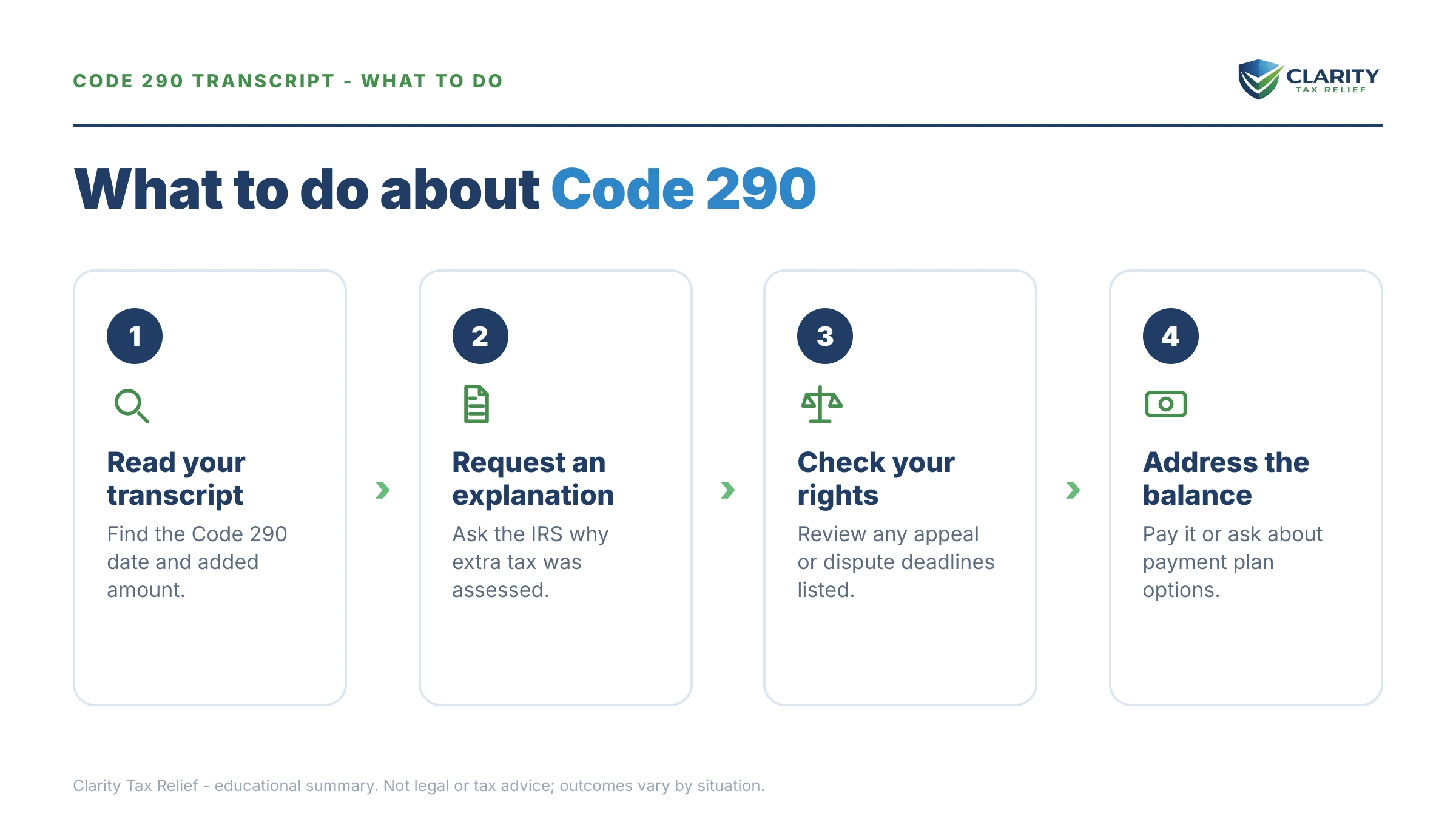
- Read the 290 line — note whether the amount is $0.00 or a dollar figure, and write down the date beside it.
- Find the paired 971 entry and match its date to the IRS letter it represents — the letter names the reason for the assessment.
- Verify the assessment against your own records — the filed return, W-2s, and 1099s for that year — before you pay anything.
- Dispute it in writing if it's wrong: underreporter or audit reconsideration with documentation, or Form 1040-X for a straightforward error.
- Arrange payment before the notice's pay-by date if it's right — pay in full at IRS.gov/payments or set up a payment plan online to stop escalation.
When you can handle this yourself
Most code 290 situations don't need professional help, and it's worth being plain about which ones. A $0.00 290 requires nothing from you — it's the IRS closing its own file. A dollar-amount 290 you recognize and agree with — say, your own amended return posting, or 1099 income you genuinely forgot — paired with a balance you can pay within 180 days or cover on a simple online plan, is a do-it-yourself fix. So is a straightforward first-time abatement request on a clean three-year history.
Experienced help changes outcomes in a narrower set of cases: you don't recognize the income behind the assessment (possible identity mixup or a payer's reporting error), the 290 sits on top of multiple unresolved years, exam codes and appeal deadlines are in play, the assessment traces to a spouse's hidden income on a joint return, or a CP504/LT11 has already arrived and the dispute has to run alongside a levy defense. In those cases the order of operations — dispute, penalties, then payment terms — determines what you ultimately pay, and it's easy to get backwards alone. If a dispute stalls and it's causing hardship, the Taxpayer Advocate Service is a free, independent escalation path inside the IRS.
Terms on your transcript, decoded
- Assessment — the formal act of recording a tax debt on the IRS's books; until assessed, an amount is only proposed.
- Assessment date — the date beside the 290; interest is computed to it and the collection statute runs from it.
- CSED — Collection Statute Expiration Date; generally 10 years after each assessment, pausable by offers, bankruptcy, and appeals.
- AUR — Automated Underreporter, the document-matching program behind CP2000 notices and most surprise 290s.
- Abatement — a reduction or removal of assessed tax or penalties; on a transcript it appears as code 291 (tax) or related credit entries.
- Cycle date — the weekly IRS processing batch a transaction posted in, which is why 290 dates often sit a couple of weeks in the future.
Code 290 questions, answered
Is code 290 with $0.00 good or bad?
Usually it's neutral-to-good news. A 290 for $0.00 means the IRS reviewed something on your account and added no tax — it often closes out a code 570 hold or an underreporter screen. If a refund was frozen, watch for code 846 in the following weekly updates. The exception: a $0.00 290 paired with a 971 notice can mean an explanation letter is coming, so read that letter when it arrives.
Does code 290 mean I'm being audited?
No. Code 290 is an assessment, not an audit indicator — a full examination shows as code 420 on your transcript. Most 290s with dollar amounts come from the Automated Underreporter program (a CP2000 mismatch), a math-error correction, or the processing of an amended return. If your transcript shows 420 or 424 alongside the 290, exam activity is involved and the rules for disputing it are different.
Why does my code 290 have a future date?
Transcript dates run on the IRS's weekly processing cycles, so the date beside a 290 is often one to three weeks ahead of the day you first see the entry. That date is the official assessment date: interest is computed to it, and the balance becomes legally collectible on it. It is not a deadline for you — the deadline that matters is the pay-by date on the notice that follows.
Can I dispute a code 290 assessment?
Yes, but the route depends on how it was assessed. A CP2000 assessment can be reopened through underreporter reconsideration with documents proving the income was reported or nontaxable; an audit assessment goes through audit reconsideration; a plain error can be fixed with an amended return. A successful challenge posts to your transcript as code 291, tax reduced. Keep making arrangements on the balance while you dispute — interest doesn't pause.
Does code 290 start the 10-year collection statute?
Yes. Each assessment gets its own CSED — the IRS generally has 10 years from the date beside the 290 to collect that amount. That means a 290 posted in 2026 can be collected into 2036 even if the tax year itself is much older. Events like a pending Offer in Compromise, bankruptcy, or certain appeals pause the clock, so the real expiration date is often later than a simple 10-year count.
Will code 290 delay or reduce my refund?
It can do either. A $0.00 290 usually clears the way — many refund holds end with a $0.00 290 followed by code 846. A 290 with a dollar amount is applied against any refund on the account first; if the assessment exceeds the refund, the refund disappears and a balance-due notice follows for the difference.
What notice comes after code 290 posts?
Look for a code 971 entry near the 290 — that's the notice going out. If the IRS changed your return, expect a CP21A or CP22A explaining the adjustment and showing a pay-by date. If the 290 finalizes a CP2000 you didn't answer, the letter recaps the underreporter case. If nothing is paid by the notice date, the standard balance-due sequence (CP501, CP503, CP504, LT11) follows.
Your next 24 hours
- Pin down the 290. On your transcript (pull a fresh one at IRS.gov Get Transcript), write down the 290's amount and date, and note any 971, 196, or 276 entries around it.
- Gather the paper. The IRS letter that matches the 971 date, your filed return for that year, and every W-2 and 1099 you received — that's everything needed to verify or dispute the assessment.
- Get it reviewed free. Interest on a 290 accrues daily from the assessment date, so the balance only moves one direction while you wait. Use the 2-minute form or call (888) 825-7779 and an experienced tax professional will tell you whether yours is a pay-it, plan-it, or fight-it case.
This guide is general information, not tax or legal advice for your specific situation. Eligibility for IRS programs depends on individual facts and circumstances; no outcome is guaranteed.