
IRS Transcript Codes
Code 291 on Your IRS Transcript: The IRS Reduced Your Tax (2026)
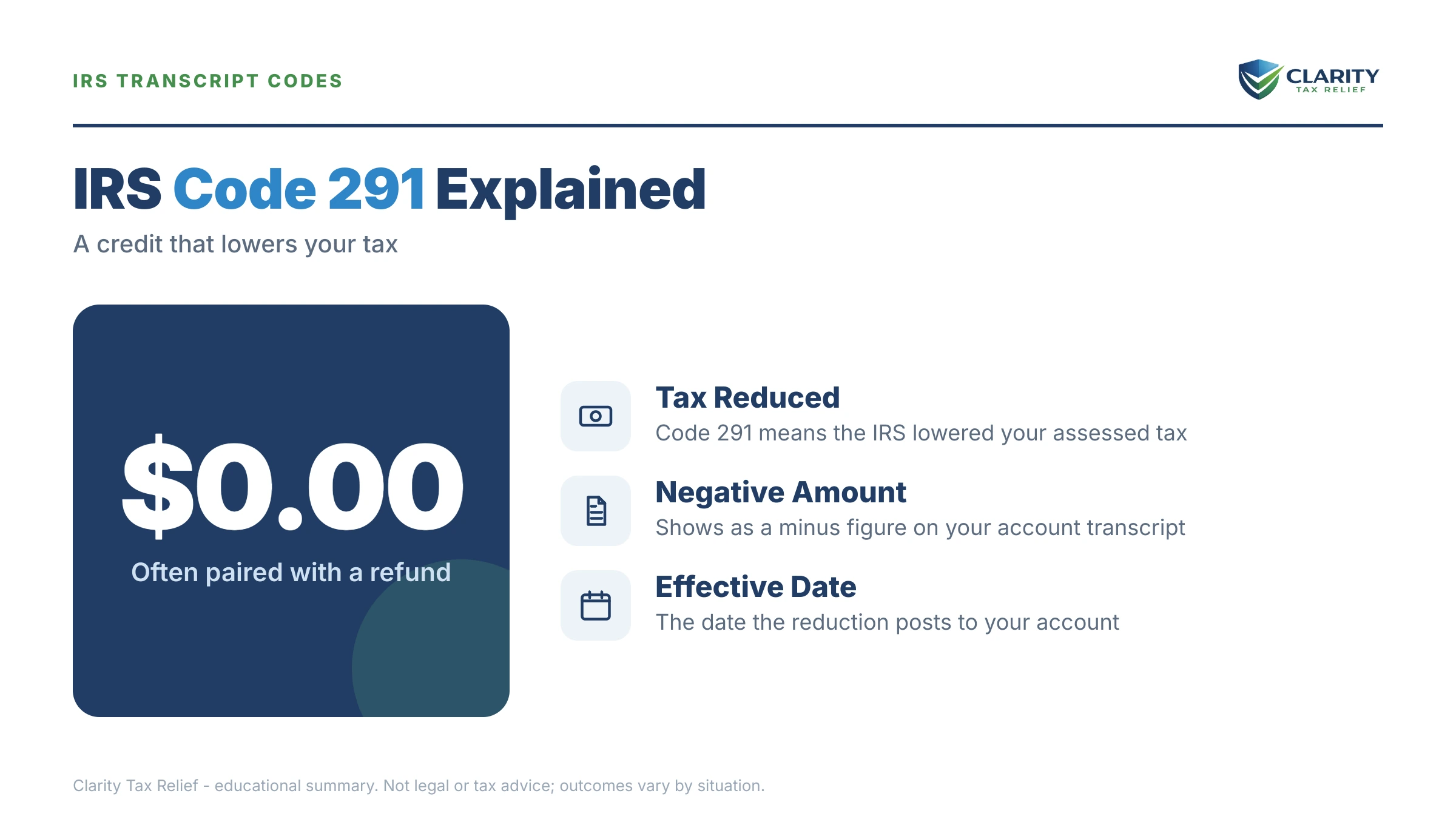
The short answer: code 291 on an IRS transcript means the IRS abated — reduced — tax it previously assessed. It always posts as a negative amount and works in your favor. If the reduction leaves your account overpaid, a refund (code 846) usually follows; if a balance remains, you still owe it.
You pulled up your account transcript to check on an amended return or a disputed notice, and there it is: a 291 line with a minus sign next to a dollar figure. Unlike most transcript codes people search at midnight, this one is good news — the IRS just took tax off your account. The questions that matter now are how much came off, why, and whether money is coming back to you or a smaller bill is still waiting.
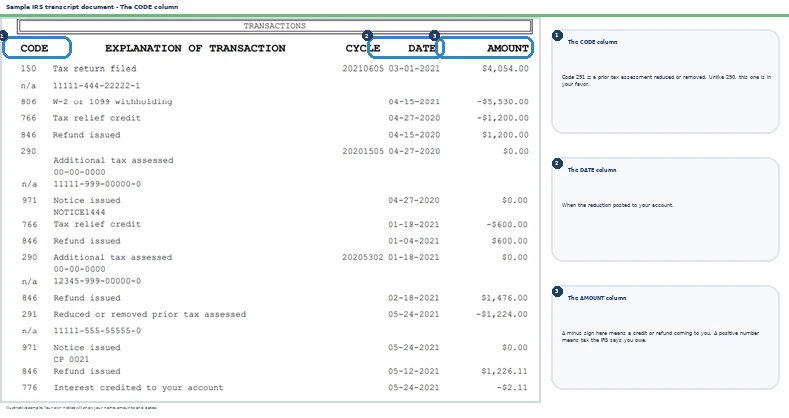
Everything you need is on that one line and the lines around it. The image below shows you exactly what a 291 entry looks like on a real account transcript and where to look for the amount, the date, and the codes that travel with it.
If transcript layout is still new to you — the code column, the date column, the running signs — our guide on how to read IRS account transcript covers the basics in five minutes. This page covers what's specific to 291: what triggered it, what posts next, and what to do with whatever balance is left.
⏱ The clock that matters: code 291 itself has no deadline — but if a balance remains after the reduction, interest compounds daily and the 0.5% monthly failure-to-pay penalty keeps accruing on what's left until you pay it or put it into a resolution program.
Why code 291 posted to your IRS transcript
Code 291 is the IRS's transaction code for "abatement of prior tax assessment" — it can only post if tax was assessed first. That's why you'll almost always find an earlier positive assessment above it: the original code 150 IRS transcript line from your return, or a later code 290 IRS transcript line where the IRS added tax. The 291 reverses some or all of that earlier number.
In practice, five situations produce a 291:
- Your amended return was accepted. A Form 1040-X first posts as code 977 irs transcript (or 976), and when processing finishes, the 291 posts for the tax reduction the IRS agreed to.
- You won a notice dispute. If you answered a CP2000 or math-error notice with documentation and the IRS agreed, the 291 backs out the proposed or assessed tax — fully or partially.
- An exam adjustment was reversed. After an audit closes — often flagged earlier by a code 420 irs transcript line — a successful appeal or audit reconsideration posts as a 291.
- The IRS corrected its own error. Duplicate assessments, misapplied adjustments, and processing mistakes get unwound with a 291.
- A substitute-for-return assessment was replaced. If the IRS filed a return for you and you later filed your own showing less tax, the difference comes off as a 291.
One thing a 291 is not: a credit or a payment. It doesn't mean money was received — it means the underlying tax liability itself got smaller. Payments and credits post under different codes (806, 766, 610), and the distinction matters when you total up what you actually still owe.
The codes that post around a 291 — and what each one tells you
A 291 almost never travels alone; the lines around it tell you whether a refund, a notice, or a remaining bill comes next. When tax comes off, the IRS's system also recomputes the interest and failure-to-pay penalty that were charged on it, so you'll often see companion abatement lines (such as 197 for interest and 277 for penalty) posting the same cycle.
| Code | What it means | What to do |
|---|---|---|
| 290 (positive) | Tax the IRS added earlier — usually the assessment your 291 is reversing | Compare the two amounts: a 291 smaller than the 290 means only part of the assessment was removed |
| 976 / 977 | Your amended return was received and is being processed | If the 291 already posted, the amendment was accepted; the dollar figure is the IRS's answer |
| 971 | A notice explaining the adjustment was generated — usually a CP21B notice (refund) or CP21A (balance due) | Wait for the letter and match its figures to the transcript before paying or spending anything |
| 846 | Refund issued — the reduction left your account overpaid | The date on the 846 refund issued date line is when the money actually goes out |
| 570 | A hold is pausing the account before anything is released | If code 570 on irs transcript sits below your 291 with no 846, the refund is under review — don't count on a date yet |
What happens after code 291 posts
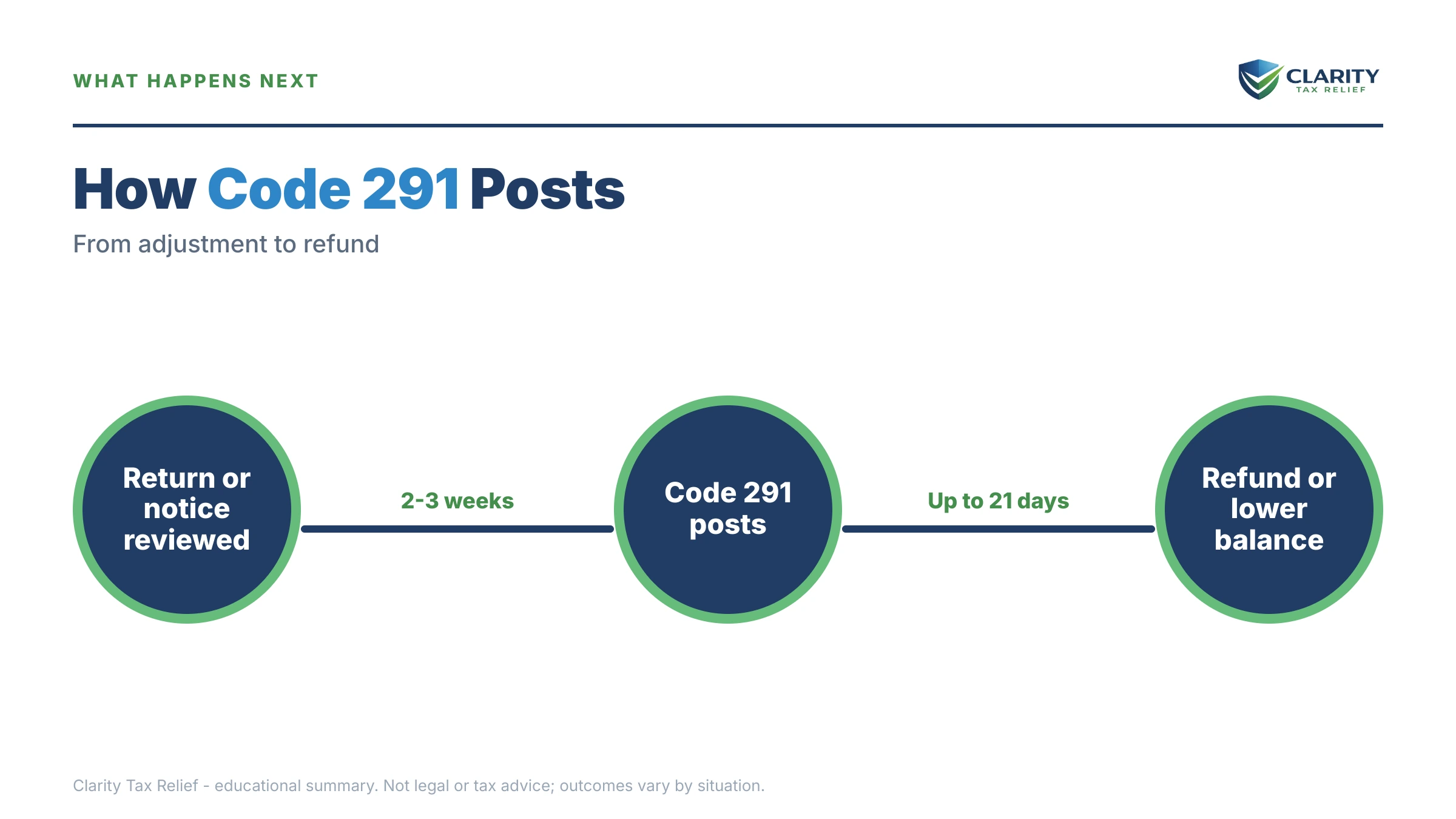
A code 291 sets off a short, automated chain: recomputation, a notice, and then either a refund or a smaller bill. Here's the sequence, in the order it moves:
- Penalties and interest recompute. Interest and the failure-to-pay penalty charged on the abated tax come off automatically — you don't need to request it. Check that the companion abatement lines actually posted; occasionally they lag the 291 by a cycle.
- A notice is generated. A 971 line posts, and a CP21-series letter follows in the mail: CP21B if you're getting money back, CP21A if a balance remains, CP21C if the account now sits at zero.
- If you're overpaid, a refund is scheduled. An 846 posts with the payout date — unless the overpayment is first offset to another tax year or debt you owe.
- If a balance remains, collections resumes on it. The CP21A functions as a bill. Ignore it and the standard notice sequence follows — CP501 and CP503 reminders, then CP504 (intent to levy your state refund), then LT11, the final notice that opens a 30-day window before wage and bank levies become possible.
That last point is the trap in an otherwise good-news code. A partial 291 feels like a win — and it is — but the leftover balance is now a confirmed, final assessment. The IRS's automated collection system treats it exactly like any other debt, and in 2026 that system runs at full speed even while the humans who might answer your call are down roughly 27% from staffing cuts.
Got a 291 but the numbers don't add up?
Send us your transcript. An experienced tax professional will decode every line — what came off, what's still owed, and whether more of the assessment should have been abated. Free, confidential, no pressure. Interest keeps accruing on any remaining balance while you wait, so it's worth knowing where you stand now.
If a balance remains after the 291: your realistic options
Whatever survives the reduction is now a final balance the IRS expects you to resolve, and your options depend mostly on its size. For most W-2 taxpayers the fastest route is a payment plan — here's how to set up irs payment plan online in about 20 minutes — but the thresholds matter:
| Remaining balance | Realistic options | What it takes |
|---|---|---|
| $0 or overpaid | Nothing to resolve — wait for the 846 refund line | Confirm no 570 hold or offset code is sitting below your 291 |
| Under $10,000 | Guaranteed installment agreement, or a short-term plan (up to 180 days, $0 setup) | Filed all required returns; full pay within the plan term |
| $10,000–$25,000 | Streamlined installment agreement online, up to 72 months | No financial disclosure required; interest and penalties continue |
| $25,001–$50,000 | Streamlined agreement — direct debit typically required at the upper end | Set up online; direct debit lowers the setup fee and default risk |
| Over $50,000 | Non-streamlined agreement, Offer in Compromise, or hardship (CNC) status if you qualify | Full financial disclosure (Form 433 series); eligibility is means-tested |
Two more levers can shrink the number itself. If the failure-to-pay or late-filing penalties on the remaining balance weren't fully abated with the tax, first-time abatement may remove them if your prior three years are clean — and starting summer 2026, the IRS's new Automatic Exemption from Penalty (AEP) applies qualifying relief automatically, no request needed. And if you believe more of the assessment was wrong, a further amended return or audit reconsideration can produce a second 291. You can estimate what the penalties and interest on your leftover balance are costing you each month with our IRS Penalty & Interest Calculator.
A worked example: $41,800 assessed, 291 posted — what's actually left
Say you're a single W-2 employee and a CP2000 review of unreported brokerage sales pushed your account to $41,800 — original tax from your 150 line, a 290 assessment for the "missing" stock proceeds, plus penalties and interest. You send in the cost-basis records the broker never reported, and the IRS agrees the real gain was far smaller. This is hypothetical, but the math is how it actually works:
- 291 posts: −$14,200 of the assessed tax comes off.
- Companion abatements post: roughly −$3,600 of the penalty and interest that had been charged on that $14,200 comes off with it (the exact figure depends on how long it accrued).
- New balance: $41,800 − $14,200 − $3,600 = $24,000.
At $24,000 you're under the $25,000 streamlined threshold, so you could set up a 72-month online plan at roughly $334/month ($24,000 ÷ 72) — knowing interest and the 0.5% monthly penalty keep accruing, so paying faster than the minimum saves real money. For a fuller map of options at that balance level, see owe irs 25000. The mistake to avoid: celebrating the $14,200 reduction and ignoring the CP21A that bills you for the $24,000 — that's how a good outcome turns into a levy notice a few cycles later.
How to respond to code 291, step by step
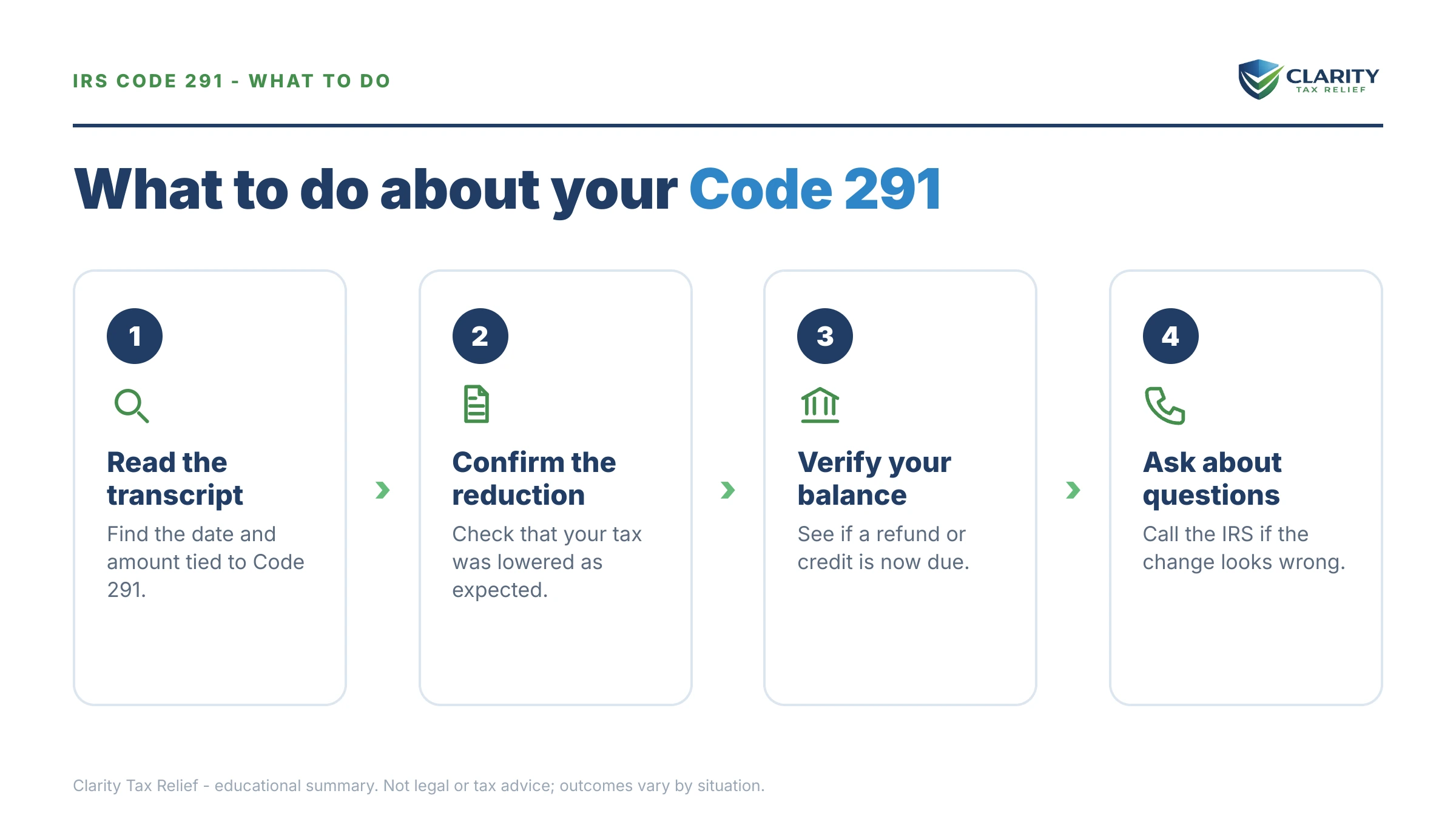
- Read the 291 line — confirm the amount is negative and note the posting date next to it. That date, not the day you spotted it, is when the reduction took effect.
- Total the module balance — add every positive line (150, 290, penalties, interest) and subtract every negative one (291, 806, 766) for that tax year, then confirm against the balance in your IRS online account.
- Watch for the follow-up codes — an 846 means a refund is scheduled; a 971 means a CP21-series notice is on the way explaining the adjustment.
- Match the notice to the transcript — when the CP21 letter arrives, verify its figures equal the 291 amount and your recomputed balance. If they don't match, call the number on the notice before paying anything.
- Resolve any balance that remains — pay it, or set up a payment plan before the collection notice sequence starts. The reduced balance is now final unless you appeal or dispute it.
When you can handle a code 291 yourself
Most of the time, a 291 needs monitoring, not professional help. If the reduction matches what you asked for on your amended return or notice response, and either a refund is coming or the leftover balance is one you can pay in full or put on a simple streamlined plan, you can handle every step yourself through your IRS online account.
Experienced help changes the outcome in a narrower set of situations: the 291 only partially reversed a 290 and you believe the rest is wrong too; the remaining balance is over $50,000 or spans multiple tax years; penalties weren't abated alongside the tax and you have grounds for relief; or collection notices are already arriving on the leftover amount while the paperwork is still in motion. In those cases, the order you fix things in — dispute first, penalties second, payment plan last — genuinely changes what you end up paying.
Terms on your transcript, decoded
- Abatement — the IRS's word for removing tax, penalty, or interest it previously charged; code 291 is a tax abatement.
- Assessment — the formal recording of a tax debt on your account; only assessed amounts can be collected, and only assessed amounts can be abated.
- Module balance — the running total of one tax year's account: all positive lines minus all negative lines.
- Overpayment — what exists when the negative lines outweigh the positive ones; it's refunded (846) or offset to other debts.
- "As of" date — the projection date the transcript's interest and penalty figures are computed to; see our guide to the as of date irs transcript meaning.
- Audit reconsideration — the process for reopening a closed exam assessment with new documentation; a successful one posts as a 291.
Code 291 questions, answered
What does code 291 mean on an IRS transcript?
Code 291 means the IRS abated — reduced — tax it previously assessed on your account. It always posts with a negative dollar amount, and that amount is subtracted from what you owe for that tax year. It usually appears after the IRS accepts an amended return, agrees with your response to a notice, or corrects an assessment from an audit or CP2000 review.
Is code 291 a refund?
Not by itself. Code 291 reduces the tax on your account, but a refund only goes out if that reduction leaves your account overpaid. When it does, code 846 posts with the refund date. If you still owe money after the 291, there is no refund — the reduction just shrinks the balance you need to resolve.
Why is the amount next to code 291 negative?
On an account transcript, negative numbers are money in your favor and positive numbers are money you owe. Code 291 is an abatement, so it always carries a minus sign — for example, −$14,200 means the IRS removed $14,200 of previously assessed tax. Add all the positive and negative lines together to get your true balance for that year.
How long after code 291 will I get my refund?
If the 291 creates an overpayment, the refund is typically scheduled within a few weeks — watch for code 846, which shows the exact date the money goes out. There is no fixed statutory window, and reductions from amended returns often take longer to release than automated corrections. If no 846 has posted several weeks after your 291, check your IRS online account for a hold code like 570.
What is the difference between code 290 and code 291?
They are mirror images. Code 290 adds tax to your account and posts as a positive amount; code 291 removes previously assessed tax and posts as a negative amount. It's common to see both on the same transcript: a 290 posts when the IRS assesses extra tax after a review, and a 291 posts later if you successfully dispute part or all of it.
Does code 291 mean my audit or CP2000 case is over?
Usually it means the IRS has processed a decision in your favor, but confirm before you relax. Look for a 971 notice-issued line and read the CP21-series letter that follows — it states the adjustment and your new balance. If the 291 only reverses part of the assessment, the remaining balance is final and enters normal collections unless you pay it or resolve it.
What notice comes after code 291?
Most code 291 adjustments trigger a CP21-series notice. CP21B says the change produced a refund; CP21A says a balance remains and you still owe; CP21C says the change zeroed out your account. The 971 line on your transcript shows the date the notice was generated — the letter itself typically arrives in the mail within a few weeks of that date.
Can code 291 appear after I file an amended return?
Yes — that's one of the most common triggers. An amended return first posts as code 976 or 977, and when the IRS finishes processing it, a 291 posts for any tax reduction it accepted. In 2026, amended returns are moving slowly because of IRS staffing cuts, so months can pass between the 977 line and the 291.
Your next 24 hours
- Pull the full picture: on your transcript, find the 291 line and every line dated after it — especially an 846 (refund scheduled), a 971 (notice coming), or a 570 (hold). You can retrieve current transcripts free at IRS.gov Get Transcript.
- Gather three documents: the return (or 1040-X) for that year, any notice or exam paperwork that led to the adjustment, and the CP21 letter if it has arrived — you'll need them to verify the math or dispute it.
- Get the leftover balance reviewed free: if the 291 didn't zero your account, interest and penalties are still compounding on what remains. Call (888) 825-7779 or use the 2-minute form and an experienced tax professional will map the cheapest path to done.
If a balance remains and you want to resolve it directly, the IRS's official options are laid out at IRS payment plans and installment agreements, and free independent help is available through the Taxpayer Advocate Service if the adjustment itself is stuck or wrong.
This guide is general information, not tax or legal advice for your specific situation. Eligibility for IRS programs depends on individual facts and circumstances; no outcome is guaranteed.