
IRS Transcripts
The "As Of" Date on Your IRS Transcript: What It Means and Why It Changes (2026)
The short answer: the "as of" date on an IRS transcript is the date through which the IRS has projected your account balance — including penalties and interest. It usually sits two to four weeks in the future, it is not your refund date, and it is not a deadline for anything.
You logged in to check your account transcript, and the very first date on the page hasn't happened yet. Now you're wondering whether that future date is when your refund lands, when the IRS comes after your balance, or when something you can't see gets decided. It's none of those — and once you know what the date actually controls, the rest of the transcript gets much easier to read.
The as-of date is the anchor point for one calculation: what your account is worth — balance, accrued interest, accrued penalties — through a specific day. The image below shows exactly what this section of an account transcript looks like and where to look, so you can match every line to your own.
⏱ The real clock: the as-of date itself is not a deadline. But if your transcript shows a balance due, the failure-to-pay penalty adds 0.5% every month (capped at 25% of the unpaid tax) and interest compounds daily until you pay or set up an arrangement. The clock that matters is the accrual, not the date at the top of the page.
What the "as of" date on an IRS transcript actually means
The as-of date is the date your transcript's balance, accrued interest, and accrued penalty figures are computed through — a projection date, nothing more. The IRS Master File doesn't just record what you owed yesterday; it calculates forward so that the number printed on the transcript stays accurate for a short window into the future.
That's why the top of an account transcript reads like a payoff quote: an account balance, then an "ACCRUED INTEREST" line and an "ACCRUED PENALTY" line, each computed "as of" a date. Together they answer one question — if this account settled on that date, what would the number be?
What the as-of date does not do: it doesn't schedule your refund, it doesn't mark a review, and it doesn't start or end any enforcement action. If you want the full anatomy of the document around it — the header, the filing-status block, the transaction table — the walkthrough on how to read an IRS account transcript covers the whole page; this article stays on the one date everyone misreads.
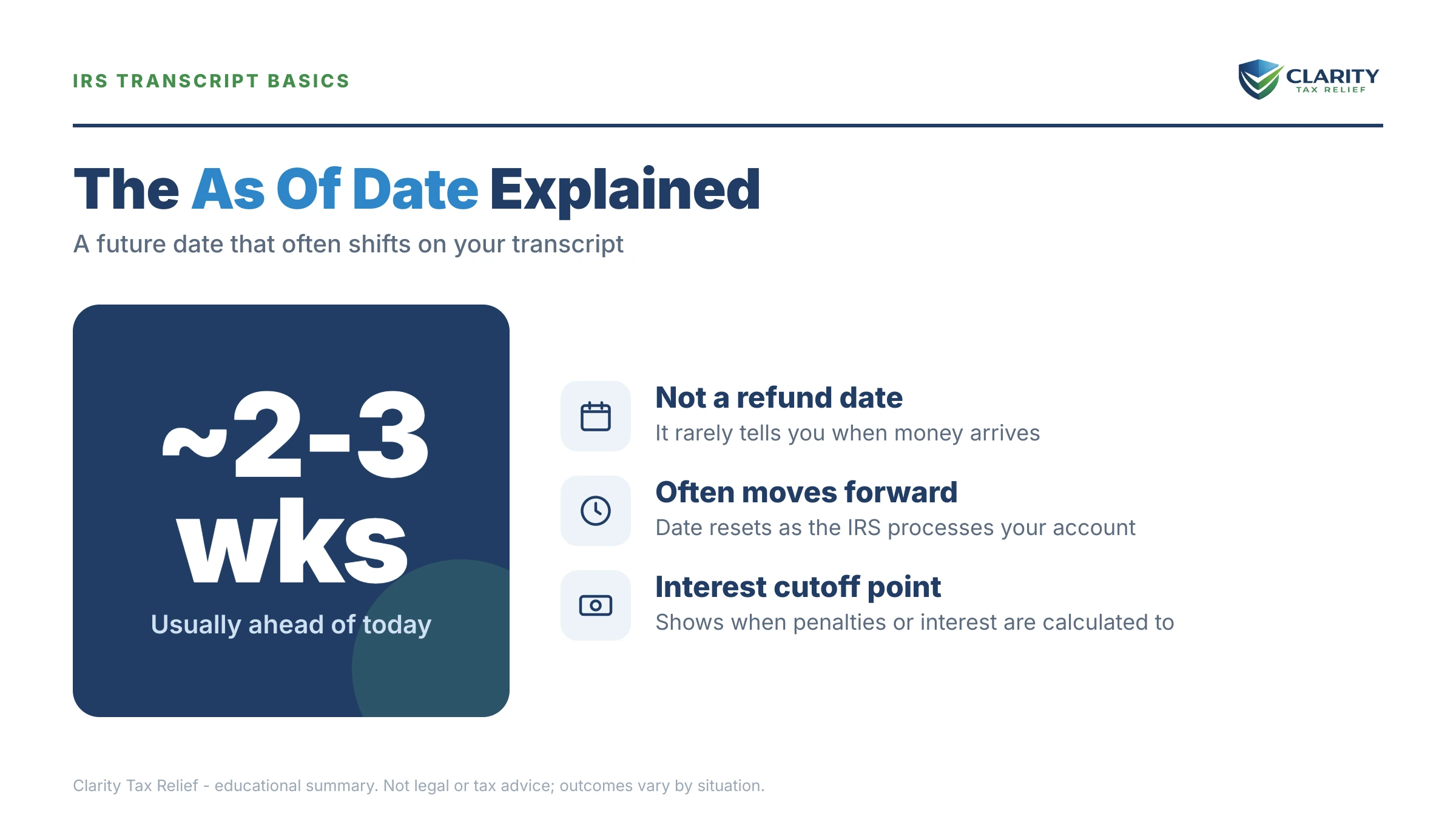
Why your as-of date is in the future — and why it moves
An as-of date typically lands two to four weeks ahead of the day the transcript is generated, on virtually every account. The system projects accruals to a near-future settlement date so a taxpayer who mails a check this week doesn't underpay by a few days of interest. A future date is the design working, not a flag on your file.
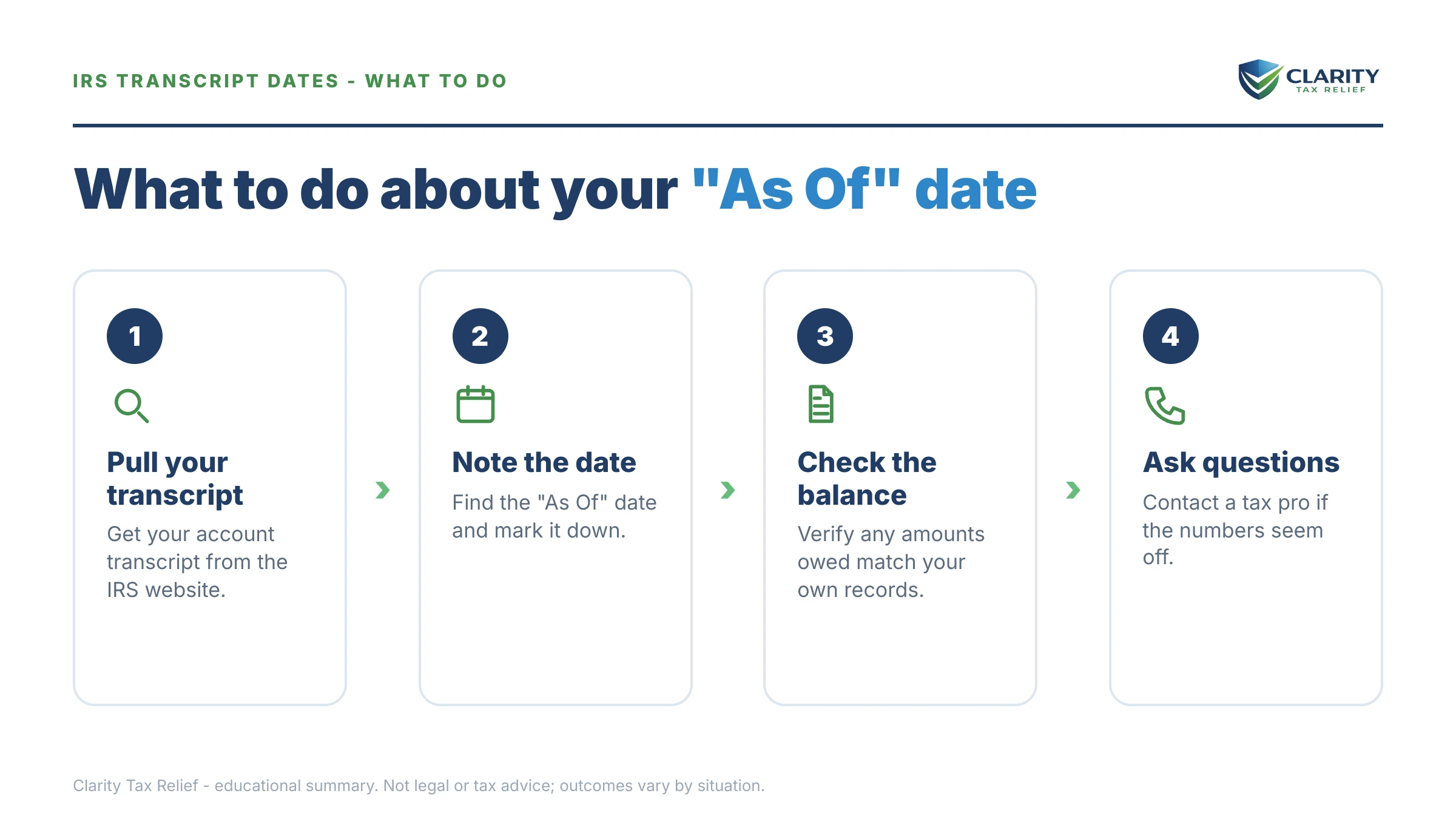
The date moves whenever the account recalculates. Common triggers:
- A payment or credit posts — the balance changed, so the projection reruns.
- A hold is placed or released — a code 570 on an IRS transcript freezes activity, and its release recalculates everything downstream.
- A penalty or interest charge posts — codes 276 and 196 each force a new computation.
- An adjustment lands — a code 290 on an IRS transcript (additional tax assessed) resets the balance the date is projecting.
- The file rolls to a new weekly cycle — no news at all, just the calendar advancing.
Transcript-watchers on forums treat a jumping as-of date as a secret signal. It isn't. The signal lives in the transaction codes below it — the date only tells you the computer did math again. If your date moved and you want to know what triggered it, check the codes, and check on the right day: transcripts refresh on a weekly schedule, explained in what day IRS transcripts update.
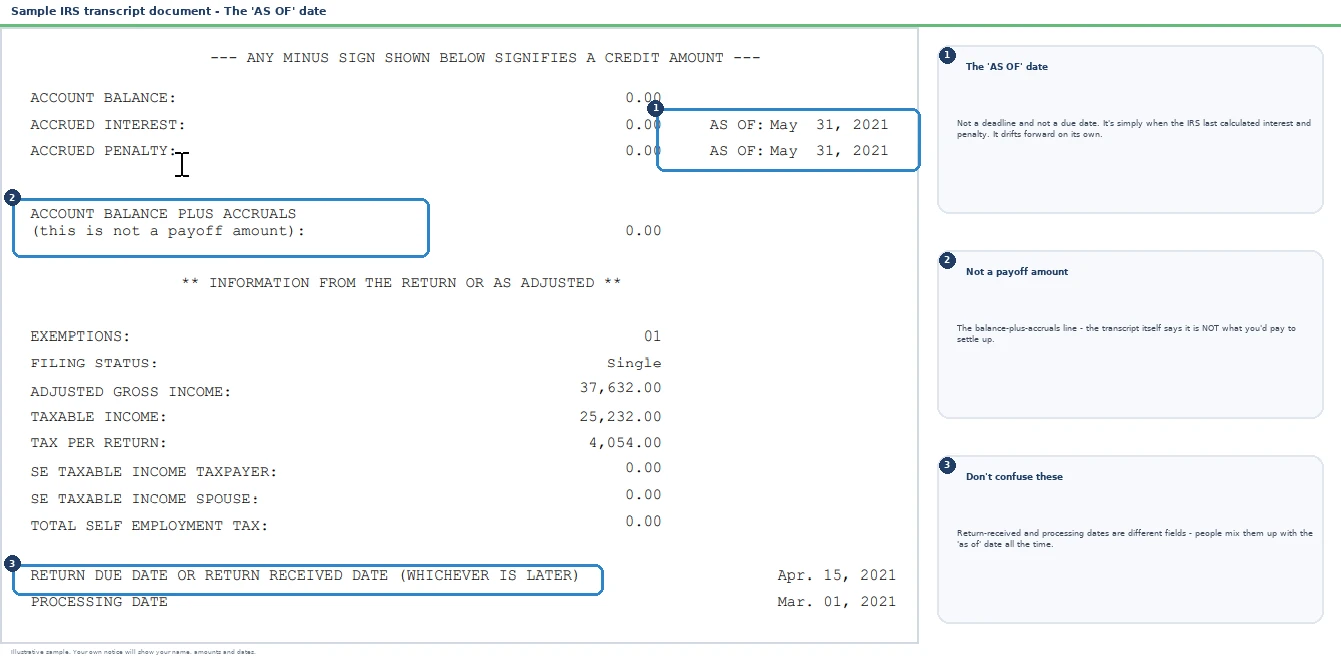
The as-of date vs. every other date on your transcript
An account transcript carries at least five different kinds of dates, and only one of them — the code 846 date — predicts a refund deposit. Confusing them is the single most common transcript-reading mistake, so here is each date and what it actually controls:
| Date on your transcript | What it actually means | What it controls |
|---|---|---|
| As-of date (top of page) | Date your balance, interest, and penalties are projected through | The accuracy window of your payoff figure — nothing else |
| Cycle code date (8 digits) | Which weekly Master File batch processed your account (see IRS cycle code meaning) | When your transcript updates each week |
| Processing date | Internal target date for the current processing action | IRS internal scheduling — not a promise to you |
| Code 150 date | The day your return posted and tax was assessed | Starts the 10-year collection clock (CSED) on that assessment |
| Code 846 date | The day your refund was issued | The only date that predicts your deposit |
| Date next to code 971 | The day a notice was generated to you | The response window printed on that letter |
If you're refund-watching, stop watching the as-of date entirely and watch for an 846 line — the 846 refund issued date is the one that matters. If you're balance-watching, the as-of date matters more than most people realize, which is where the math below comes in.
Codes that show up around your as-of date
The transaction codes beneath the as-of date carry the actual story of your account; the date only timestamps the math. These are the codes most likely to sit near a moving as-of date, and what each one asks of you:
| Code | What it means | What to do |
|---|---|---|
| 150 | Return filed, tax assessed (code 150 on an IRS transcript) | Confirm the figures match the return you filed |
| 806 | Withholding credited to the account | Verify it matches your W-2s and 1099s |
| 570 | Hold — activity frozen pending review | Usually wait; respond fast if a letter follows |
| 971 | Notice issued to you | Watch the mail — the letter carries the real instructions |
| 290 | Additional tax assessed | Compare to the related notice; you can dispute it |
| 196 / 276 | Interest charged / failure-to-pay penalty posted | These keep posting until the balance is resolved |
| 846 | Refund issued | The date beside it is your deposit date |
What the as-of date means when you owe: a $48,300 example
On a balance-due account, the as-of date turns your transcript into a payoff quote with an expiration window. Here's the math, on a clearly hypothetical scenario.
Say you and your spouse filed jointly and your account transcript shows a $48,300 balance for last year, with an as-of date 21 days out. Using an illustrative 7% annual interest rate, interest accrues at about $48,300 × 0.07 ÷ 365 ≈ $9.26 per day — roughly $194 over those 21 days. If a monthly failure-to-pay charge posts inside that window, add 0.5% of the unpaid tax, about $241.50. The transcript's projected figure through the as-of date lands near $48,735.
Three practical consequences follow:
- Pay by the as-of date and the printed number is your number. Pay after it and a small remainder survives — and keeps accruing. Always pull the exact payoff for your actual payment date from your online account.
- The balance grows about $500+ per month at these illustrative rates (penalty plus interest). You can estimate your own accrual with our IRS penalty and interest calculator, and the actual quarterly rate is tracked in IRS interest rates for 2026.
- This couple is close to a threshold that matters. The online long-term payment plan is capped at $50,000 in combined tax, penalties, and interest. At roughly $500+ of accruals a month, a $48,300 balance crosses $50,000 in about three months — after which the simple online setup is off the table and financial disclosure may be required. The as-of date is literally the countdown printed on the page.
Under the cap, a streamlined installment agreement spreads the balance over up to 72 months — $48,300 ÷ 72 ≈ $671 per month before ongoing accruals, set up online without a full financial statement.
What happens if you ignore a balance your transcript already shows
A balance on your account transcript means the IRS's automated collection stream is already queued, whether or not a letter has arrived yet. The sequence runs in order, and each stage removes options the previous one still allowed:
- CP14 — the first bill. A CP14 notice typically gives about 21 days to pay — 10 business days when the balance is $100,000 or more — before the next notice queues. Cheapest moment to act.
- CP501 / CP503 — reminders. Still just bills, arriving weeks apart, while codes 196 and 276 keep posting to your transcript.
- CP504 — intent to levy your state refund. Enforcement begins reaching real money, and a federal tax lien becomes a live possibility.
- LT11 / Letter 1058 — final notice. A 30-day clock starts, along with your Collection Due Process appeal rights. After it runs, wages and bank accounts are levy-eligible.
In 2026, IRS staffing is down sharply — but this sequence is generated by automated systems that never stopped running. The transcript is your early warning: you can see the balance and the accruals weeks before the first envelope arrives.
Balance showing on your transcript?
Every month of waiting adds another 0.5% penalty plus daily interest — and can push you past thresholds that close off the easiest fixes. Get your transcript reviewed free by an experienced tax professional: we'll decode every code and date and map your cheapest path out.
Your options if the transcript shows a balance
Every balance-due account has at least four resolution paths, and which one fits is decided by your numbers — not by the as-of date. Here's the field, with the threshold that governs each:
| Option | Fits when | Key threshold or cost |
|---|---|---|
| Pay in full | You can cover the payoff through the as-of date | Stops the 0.5% monthly penalty and daily interest immediately; get an exact payoff first |
| Short-term plan | You can pay within 180 days | $0 setup fee; interest and penalties continue until paid |
| Streamlined installment agreement | Combined balance ≤ $50,000 | Up to 72 months, set up online — details at the IRS payment plans page |
| Non-streamlined agreement | Balance above $50,000 | Financial disclosure (Form 433-F) usually required |
| Currently Not Collectible | Paying anything would leave you unable to cover basic living expenses | Collection paused; balance still accrues and can be reactivated |
| Offer in Compromise | Assets plus future income genuinely can't cover the debt | $205 fee (waived with low-income certification); the IRS accepted roughly 1 in 5 offers in FY2024 |
Married couples filing jointly should note one wrinkle: the balance is joint, so either spouse's wages or accounts can eventually be reached if the notice stream runs its course — resolving it together, early, is nearly always cheaper than untangling it later.
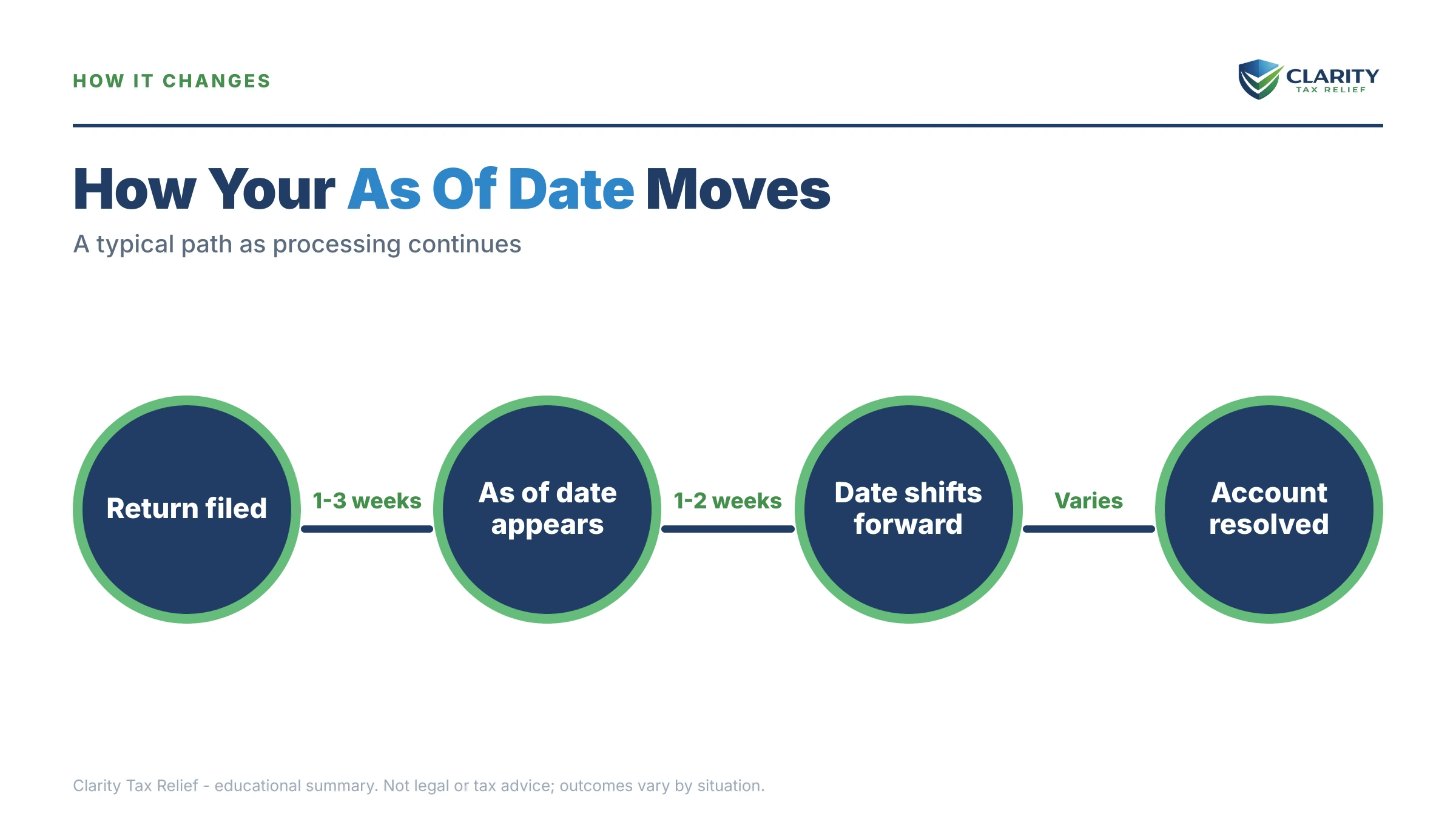
How to respond to your transcript's as-of date, step by step
- Pull your newest account transcript. Log into your IRS online account and download the account transcript for the exact tax year in question — not the return transcript.
- Read the top block. Note the as-of date, the account balance, and the accrued interest and accrued penalty lines beneath it — those three figures are one projected payoff, not three separate debts.
- Scan the transaction codes. Code 150 is your filed return, 570 is a hold, 971 is a notice, 846 is a refund. The codes — not the as-of date — tell you what is actually happening on the account.
- Get an exact payoff before paying in full. The printed balance is only good through the as-of date. Pull the payoff amount for your actual payment date from your IRS online account so you don't leave a small accruing remainder.
- Act on what the codes show. Set up a payment arrangement if a balance is due, respond to any letter tied to a 971, or simply wait out a routine hold — the as-of date itself requires no response.
- Recheck after the weekly update. Transcripts refresh on a weekly cycle tied to your cycle code. Check again after your update day instead of refreshing daily.
If you don't have online access yet, the setup path (and the mail-order fallback) is covered in how to get an IRS transcript online, or directly at the IRS's Get Transcript page.
When you can handle this yourself
Most as-of date questions need no professional at all. If your transcript shows a refund pending, a routine hold, or a balance you can pay within 180 days, you can read the page with the tables above, pay or set up a plan at IRS.gov/payments, and be done. A single-year balance under $50,000 with no other complications is a genuinely self-serve situation.
Experienced help changes the outcome in narrower cases: the transcript shows assessments you don't recognize (a 290 with no notice you can find), multiple years each carrying their own balance and as-of date, penalty stacks that may qualify for abatement before you agree to a payment plan, or a balance about to cross the $50,000 online-plan cap where sequencing decisions get expensive to un-make. In those situations, the order you fix things in — returns, penalties, then the balance — changes what you ultimately pay.
Terms on your transcript, decoded
- As of date — the date your balance, interest, and penalties are projected through; a payoff-accuracy window, not a deadline.
- Cycle code — the 8-digit number identifying which weekly processing batch your account runs in, which sets your update day.
- Processing date — an internal scheduling target for the current action; it routinely passes with nothing visible happening.
- Assessment — the formal recording of tax you owe (code 150 for a filed return, 290 for additions); each assessment starts its own 10-year collection clock.
- Accrued interest / accrued penalty — charges that have built up but not yet formally posted as transaction lines; computed through the as-of date.
- CSED — the Collection Statute Expiration Date, 10 years from assessment, after which the IRS generally can no longer collect (certain events pause the clock).
As-of date questions, answered
What does the "as of" date on my IRS transcript mean?
It's the date through which the IRS computer has projected your account balance, including accrued penalties and interest. If you owe, the balance shown is accurate through that date; if you're due a refund, the date is mostly a bookkeeping marker. It is not a deadline, a refund date, or a sign of any action against you.
Is the as-of date the day I'll get my refund?
No. Your refund date appears next to code 846, 'Refund issued' — that's the only date on the transcript that predicts your deposit. The as-of date usually sits two to four weeks in the future because the system projects balances forward. Watching it move tells you the account recalculated, not that a refund is scheduled.
Why is my as-of date in the future?
Because the IRS Master File projects your balance forward so a payoff figure stays accurate through a settlement window, the as-of date typically lands two to four weeks ahead of the day the transcript is generated. That's normal on virtually every account transcript. A future date on its own signals nothing good or bad about your return.
Why did the as-of date on my transcript change?
An as-of date changes whenever the IRS recalculates your account — a payment posts, a hold is placed or released, a penalty accrues, or the file simply rolls to a new weekly cycle. It's the most routine change a transcript can show. Look at the transaction codes below it for the actual news; the date itself carries none.
Does a changing as-of date mean I'm being audited?
No. Audit activity shows up as its own transaction codes — code 420 or code 424 — not as a moving as-of date. Millions of accounts get new as-of dates every weekly cycle with no exam involved. If neither 420 nor 424 appears on your transcript, the date change is routine recalculation.
Is the as-of date a payment deadline?
No — but it does affect your payoff amount. The balance printed on the transcript includes interest and penalties projected through the as-of date, so paying after that date leaves a small remainder that keeps accruing. Before sending a full payoff, get the exact figure for your actual payment date from your IRS online account.
Why do the accrued interest and accrued penalty lines show their own as-of dates?
Each accrual line carries the date its figure was computed through, and they normally match the date at the top of the transcript. When they differ, the account was usually caught mid-recalculation and the dates sync up on the next weekly update. A mismatch is a timing quirk, not an error you need to fix.
Your next 24 hours
- Find three things on your transcript: the as-of date at the top, the account balance, and any 570 or 971 lines below it. Those three tell you whether you're waiting, responding, or owing.
- Gather your side of the story: the return you filed for that year, proof of any payments you've made, and any IRS letters that have already arrived.
- If a balance is attached, get it reviewed free — the 2-minute form at claritytaxrelief.com/#consult or (888) 825-7779. Interest compounds daily and the failure-to-pay penalty posts monthly whether or not you act; the review costs nothing and tells you exactly which option your numbers support.
This guide is general information, not tax or legal advice for your specific situation. Eligibility for IRS programs depends on individual facts and circumstances; no outcome is guaranteed.