
IRS Penalties & Interest
IRS Interest Rates 2026: How the Quarterly Rates Work and What They Cost You
The short answer: IRS interest rates for 2026 are set quarterly. For individuals, the rate on unpaid taxes equals the federal short-term rate plus 3 percentage points, compounded daily. New rates take effect January 1, April 1, July 1, and October 1, and each new rate applies automatically to every existing balance.
You logged into your IRS online account — or opened this year's reminder notice — and the balance is bigger than it was three months ago, even though nobody assessed you any new tax. That's not a mistake. It's daily compounding at a rate that resets four times a year, and once you see exactly how the number is built, you can make it stop growing.
⏱ The real clock: there's no single deadline on IRS interest — it compounds every day, and the rate resets every quarter. On a $41,800 balance, interest plus the monthly late-payment penalty adds roughly $15 a day at recent rates. The only ways to slow the meter are shrinking the balance or removing the penalties feeding it.

How the IRS sets its quarterly interest rates for 2026
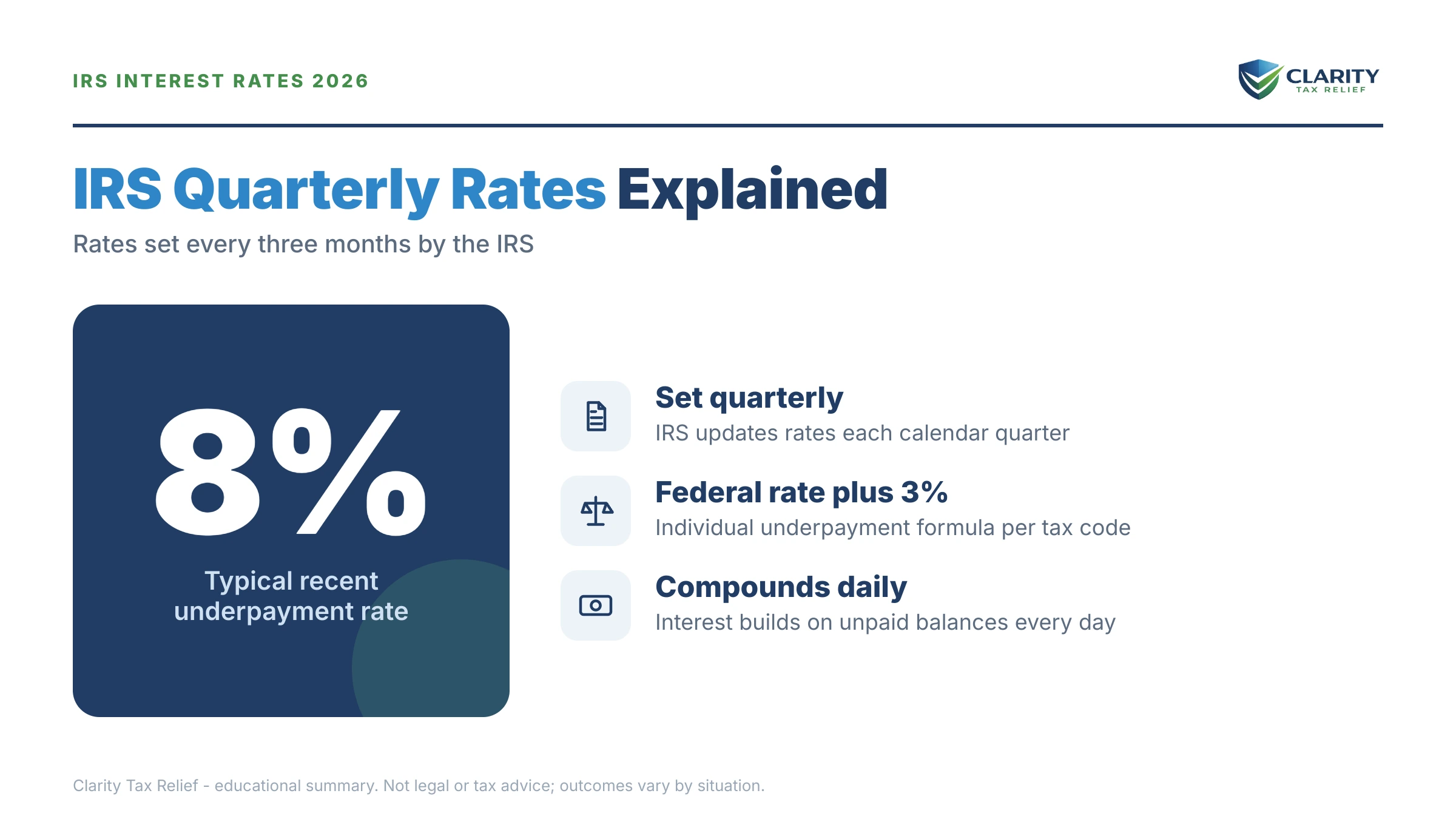
The IRS interest rate for individuals in 2026 equals the federal short-term rate plus 3 percentage points, recalculated every quarter under IRC §6621. Nobody at the IRS chooses your rate, and your credit score is irrelevant — the same rate applies to every individual taxpayer in the country.
The federal short-term rate comes from market yields on short-term U.S. government obligations, rounded to the nearest whole percent. The rate that takes effect each quarter is built from the short-term rate determined during the first month of the previous quarter — so the number that hits your balance on July 1 was locked in back in April.
The IRS publishes each quarter's rates in a revenue ruling and a news release, typically about a month before the quarter begins. In recent years, the individual rate has sat in the 7% to 8% range — a real borrowing cost, not a rounding error, on any balance you carry.
One formula, several rates. Individuals get one number; corporations get others:
| Rate | Formula | Who it hits |
|---|---|---|
| Individual underpayment | Federal short-term rate + 3 points | What you're charged on back taxes — the rate this article is about |
| Individual overpayment | Federal short-term rate + 3 points | What the IRS pays you on a late refund (same rate for individuals) |
| Corporate overpayment | Federal short-term rate + 2 points (only +0.5 on the portion over $10,000) | Refund interest paid to corporations |
| Large corporate underpayment | Federal short-term rate + 5 points | Certain large corporate tax deficiencies |
Notice the asymmetry for businesses: corporations pay a higher rate on debts than they earn on refunds. Individuals at least get symmetry — the rate you're charged is the rate you'd be paid.
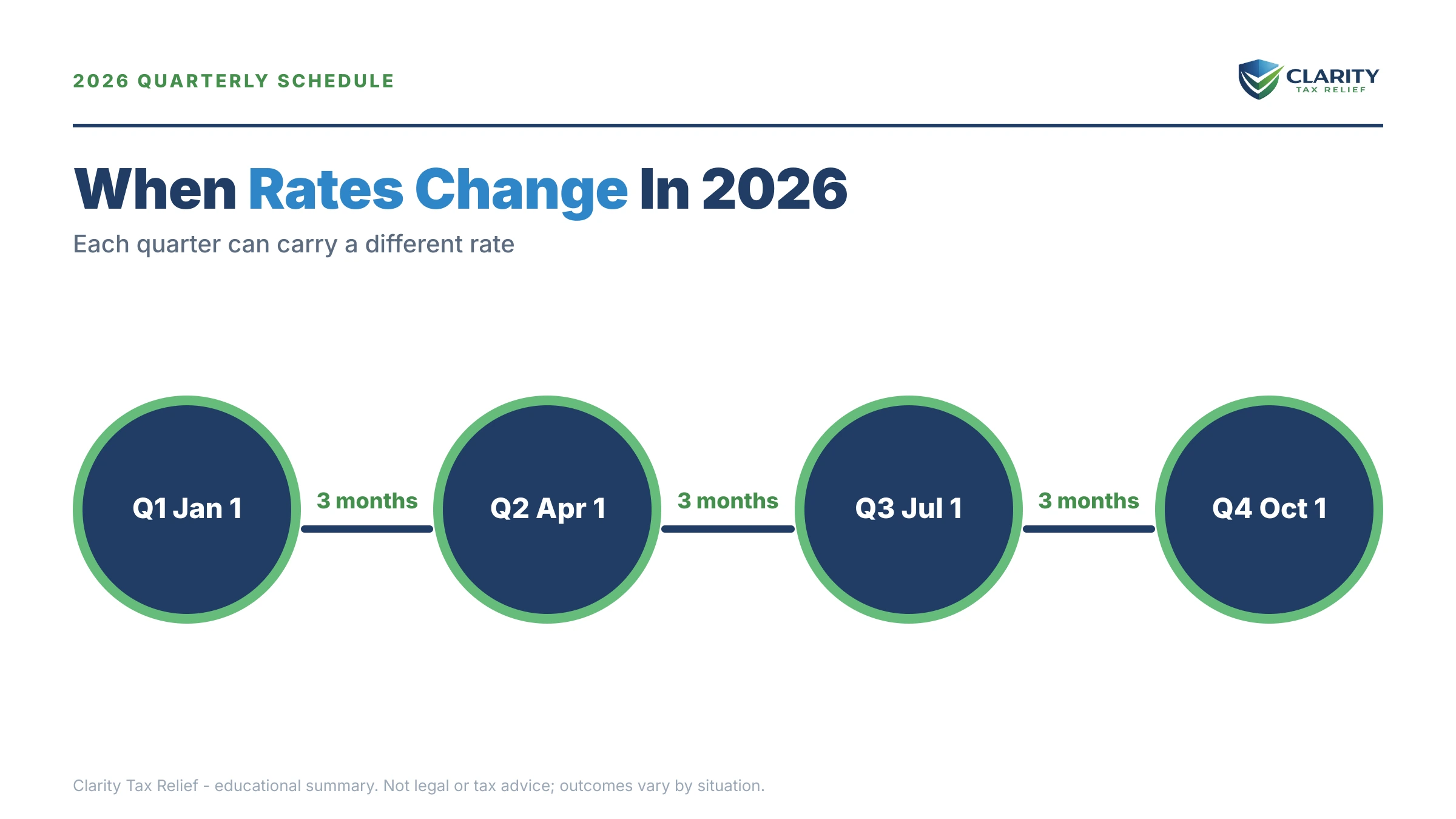
The 2026 quarterly rate calendar: when rates change
New IRS interest rates take effect on January 1, April 1, July 1, and October 1 every year. A rate change is automatic: no letter asks your permission, no agreement gets renegotiated, and the new rate applies to your entire remaining balance from the effective date forward.
| Quarter | Rate in effect | Typically announced |
|---|---|---|
| Q1 2026 | January 1 – March 31 | Late November – December 2025 |
| Q2 2026 | April 1 – June 30 | Late February – March 2026 |
| Q3 2026 | July 1 – September 30 | Late May – June 2026 |
| Q4 2026 | October 1 – December 31 | Late August – September 2026 |
If the rounded short-term rate doesn't move, the announcement simply carries the same rate forward — the IRS still publishes a ruling each quarter either way. The live figure for the current quarter is always posted on the IRS's own rates page, linked in the steps below, and it's printed on the interest line of any recent balance-due notice you've received.
One planning note for anyone with self-employment or side income: these are the same underpayment rates that drive the estimated-tax penalty, so the quarterly estimated tax deadlines 2026 and the estimated tax penalty rate 2026 move together with this calendar.
Why your IRS balance grows even when you pay nothing new
IRS interest starts running on the original due date of the return and compounds daily until the balance hits zero. Three mechanics make it grow faster than most people expect:
Interest compounds daily, not annually. Under IRC §6622, each day's interest gets added to the balance, and the next day's interest is computed on the new, slightly larger total. A stated 7% rate works out to roughly 7.25% effective over a full year. Our deeper dive on how IRS interest actually compounds walks through the day-by-day math.
Interest is charged on penalties, not just tax. The failure-to-pay penalty added each month becomes part of the base the next day's interest is calculated on. Interest stacks on penalties, and future interest stacks on past interest.
An extension doesn't stop it. Filing an extension moves your filing deadline, not your payment deadline — interest on any unpaid amount still runs from the original April due date.
On your account transcript, each interest charge posts as its own line — that's code 196 on your transcript, and it's why the balance in your online account rarely matches an older notice to the penny.
What happens if you let the interest clock run
IRS interest never caps, and the failure-to-pay penalty adds another 0.5% of the unpaid tax every month on top of it. Left alone, a balance grows on four overlapping cycles:
- Every day — interest compounds on the full balance: tax, penalties, and all previously charged interest.
- Every month — the failure-to-pay penalty adds 0.5% of the unpaid tax (it rises to 1% per month once the IRS issues its final intent-to-levy notice, and it caps at 25% total — interest itself never caps).
- Every quarter — the rate resets. If the new rate is higher, your entire balance accrues at the higher rate immediately; nothing about your old balance is grandfathered.
- Every year — the IRS mails an annual reminder restating the larger total, and the automated collection notice sequence keeps advancing in the background toward liens and levies.
Don't count on 2026 staffing chaos to slow any of this down. Interest and penalties are computed by software, and the collection notices are machine-issued — as we explain in the IRS is understaffed, but you still owe, the humans got harder to reach while the automated accrual never paused for a single day.
Watching your IRS balance grow every month?
Interest compounded on your balance again today, and it will again tomorrow. Send us your most recent notice or balance figure and an experienced tax professional will map the fastest way to stop the accrual — free, confidential, no pressure. Call (888) 825-7779 or use the 2-minute form.
Your options in 2026: what each one does to the interest
Every IRS resolution option treats interest differently — some cut the penalty feeding the balance, but only full payment stops interest entirely. The broader playbook for choosing among these lives in our guide to how to settle tax debt yourself; here's specifically what each option does to the meter:
| Option | What happens to interest | Who it fits |
|---|---|---|
| Pay in full | Interest stops the day the balance hits zero — the only option that fully stops it | Anyone who can raise the funds; always the cheapest path |
| Short-term plan (up to 180 days) | Interest and penalties continue, but enforcement stops; $0 setup fee | Balances you can clear within about six months |
| Installment agreement | Interest continues at the floating quarterly rate; failure-to-pay penalty drops from 0.5% to 0.25% per month | Up to 72 months online for balances of $50,000 or less |
| Offer in Compromise | Interest keeps accruing while the offer is reviewed; wiped only on the portion compromised if accepted | Means-tested — only when assets and income genuinely can't cover the debt (about 1 in 5 offers accepted in FY2024) |
| Currently Not Collectible | Collection pauses; interest and penalties keep growing the whole time | Genuine hardship where any payment would prevent basic living expenses |
| Penalty abatement (FTA / AEP) | Removes qualifying penalties — and erases the interest that accrued on them | First-time abatement needs a clean prior 3 years; AEP becomes automatic starting summer 2026 |
| Interest abatement (§6404) | Removes interest itself — but only interest caused by IRS error or delay | Narrow; requested on Form 843 with documentation of the IRS-caused delay |
Two of those rows deserve emphasis. First, an installment agreement's real value against interest is the penalty cut — halving the monthly failure-to-pay charge meaningfully lowers your total accrual rate. See IRS payment plan online, step by step for the setup walkthrough.
Second, interest itself is nearly untouchable. If a company promises to "negotiate your interest away," that's a red flag — the honest answer, covered in can IRS interest be waived, is that you attack the penalties instead and let the associated interest fall with them. The narrow IRS-delay exception is detailed in our guide to IRS interest abatement.
What IRS interest costs on $41,800: a worked example
At a 7% annual rate compounded daily, a $41,800 balance grows by about $3,000 of interest in a single year — before any penalty. Say you're a W-2 employee, filing single, who owes $41,800 from a prior year and does nothing for twelve months. Assume the individual rate holds at 7%, the low end of where recent quarters have sat:
- Interest: 7% compounded daily is roughly 7.25% effective — about $3,030 for the year ($41,800 × 0.0725).
- Failure-to-pay penalty: 0.5% of the unpaid tax per month ≈ $209/month — about $2,508 for the year.
- Total accrual: roughly $5,500 in one year — about $15 a day — pushing the balance to around $47,300 by this time next year.
Now run the same $41,800 through a 72-month installment agreement instead. The penalty drops to 0.25% per month (3% a year), so combined accrual falls to roughly 10% a year instead of about 13%. Amortized at that combined rate, retiring the debt in 72 months takes a payment of roughly $775 a month — and roughly $13,900 of that total is interest and penalties over the plan's life. These figures are illustrative, since the actual rate floats each quarter, but the shape holds: the plan converts a runaway balance into a fixed path, and because there's no prepayment penalty, every extra dollar shortens it — see paying off an IRS payment plan early for how much acceleration saves.
Want the math on your own numbers and years? You can estimate your accrual with our Penalty & Interest Calculator.
How to stop the interest clock, step by step
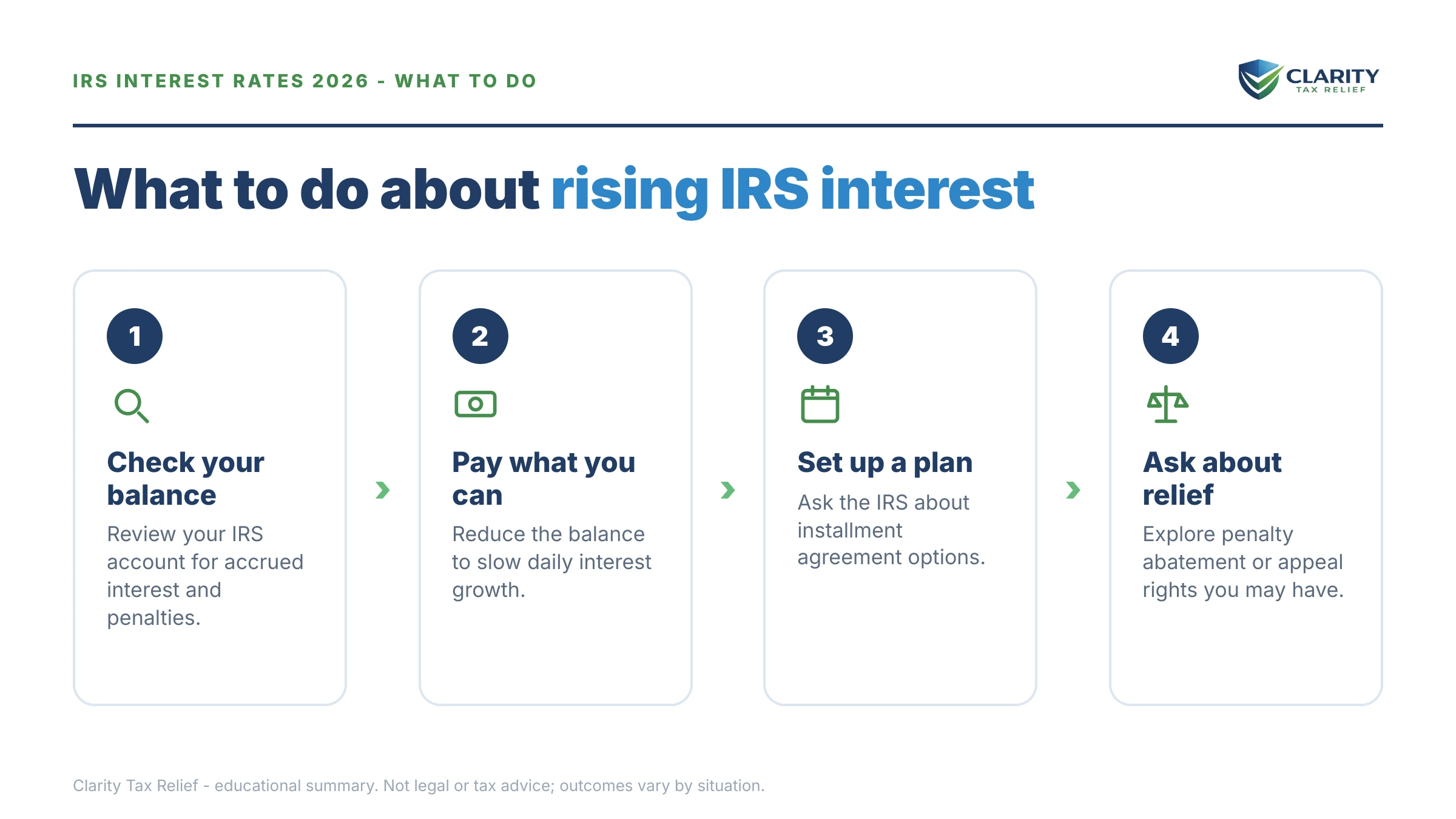
- Pull your current payoff figure — log into your IRS online account; it shows each year's balance with interest calculated through today, not the stale number printed on an old notice.
- File any unfiled returns first — the failure-to-file penalty runs 5% per month — ten times the late-payment penalty — and interest rides on top of it, so filing is the single biggest rate cut available.
- Pay whatever you can right now — every dollar paid today shrinks the base that compounds tomorrow; the IRS accepts partial payments anytime through its online payments portal.
- Set up an agreement before the next notice — a short-term plan (up to 180 days, no setup fee) or an installment agreement halves the monthly late-payment penalty and stops the collection sequence from advancing.
- Request penalty relief — first-time abatement — or the new Automatic Exemption from Penalty arriving in summer 2026 — removes qualifying penalties, and the interest charged on those penalties comes off with them.
The filing-versus-paying math behind step 2 is spelled out in failure-to-file vs. failure-to-pay penalties, and the relief options in step 5 are covered in our first-time penalty abatement guide and the new Automatic Exemption from Penalty (AEP) for 2026.
When you can handle this yourself
If you can pay your balance within 180 days, you can set up a short-term plan yourself online in minutes with no setup fee — no professional needed. The same goes for a single year's balance under $50,000 when you agree with the amount: the streamlined online agreement is designed for exactly your situation, and checking the current quarter's rate takes thirty seconds on the IRS's own page.
Experienced help changes outcomes in a narrower set of situations: multiple years of accruing balances where the payoff order matters, penalties stacked across years that need a coordinated abatement strategy, a balance large enough that the floating rate makes a 72-month plan unaffordable, or a levy notice already in the mail. In those cases, the sequencing — returns first, penalties second, balance last — often changes the total cost by thousands, because every penalty removed also removes its accrued interest.
Terms on your notice, decoded
- Federal short-term rate — the market-based rate on short-term U.S. government borrowing that anchors every IRS interest rate; the IRS adds 3 points to it for individuals.
- Compounded daily — each day's interest is added to your balance so the next day's interest is computed on a slightly larger total, making the effective rate higher than the stated one.
- Underpayment vs. overpayment rate — the rate you're charged on what you owe versus the rate the IRS pays you on a late refund; identical for individuals.
- Revenue ruling — the official IRS publication announcing each quarter's rates about a month before they take effect.
- Accrued interest — the interest that has built up on your account but wasn't in the last figure you saw; it posts to your transcript as code 196.
- Failure-to-pay penalty — the separate 0.5%-per-month charge that runs alongside interest; unlike interest, it caps at 25% and can be abated.
IRS interest rate questions, answered
What is the IRS interest rate for 2026?
For individuals, the 2026 rate equals the federal short-term rate plus 3 percentage points, compounded daily — and it can change every quarter. In recent years the individual rate has sat in the 7% to 8% range. Because the figure can move four times a year, check the IRS's quarterly interest rates page or the interest line on your most recent notice for the number applied to your balance right now.
How often do IRS interest rates change?
Up to four times a year. New rates take effect January 1, April 1, July 1, and October 1, and the IRS announces each one by revenue ruling roughly a month before the quarter starts. The new rate applies automatically to every existing balance — you don't get grandfathered into an old rate. If the underlying federal short-term rate hasn't moved enough to change the rounded figure, the rate simply carries over unchanged.
Does the IRS compound interest daily?
Yes. Under IRC Section 6622, each day's interest is added to your balance and the next day's interest is computed on that slightly larger total. Daily compounding makes the effective annual cost a bit higher than the stated rate — a stated 7% works out to roughly 7.25% over a full year. It also means interest accrues on penalties and on previously charged interest, not just on the original tax.
Does the interest rate on my IRS payment plan change every quarter?
Yes. An installment agreement does not lock in a rate — your remaining balance accrues interest at whatever the current quarterly rate is, so a rate hike raises your total payoff cost mid-plan. The offsetting benefit is that an approved agreement cuts the failure-to-pay penalty from 0.5% to 0.25% per month. There is no prepayment penalty, so paying the plan off early always saves money.
Can IRS interest be waived or removed?
Almost never on its own. The law only lets the IRS abate interest that was caused by its own error or unreasonable delay, requested under IRC Section 6404 using Form 843 — a narrow standard. The practical route for most people is removing penalties instead: first-time abatement, reasonable cause, or the new Automatic Exemption from Penalty starting in summer 2026. When a penalty comes off, the interest that was charged on that penalty comes off with it.
Does the IRS pay me interest on refunds at the same rate?
For individuals, yes — the overpayment rate equals the underpayment rate, the federal short-term rate plus 3 points. The catch is timing: the IRS generally owes refund interest only when it issues your refund more than 45 days after the filing deadline or after receiving your return, whichever is later. Any refund interest you receive is taxable income you must report the following year.
Is IRS interest charged on penalties too?
Yes. Interest accrues on penalties as well as on the unpaid tax — on the failure-to-file penalty it generally runs from the return's original due date, and on most other penalties from the date of the notice demanding payment. This stacking is why a balance grows faster than the stated rate alone suggests, and why getting a penalty removed also erases the interest that had accumulated on it.
Your next 24 hours
- Find your real number. Log into your IRS online account and note the current payoff for each year — that figure includes interest through today, unlike the amount on any notice you're holding.
- Gather three things: your most recent balance-due notice, your last filed return, and a rough picture of your monthly income and expenses — that's everything needed to price out each option above.
- Get the accrual stopped. Interest compounds on your balance again tomorrow morning either way — send us your numbers at the free case review form or call (888) 825-7779 and an experienced tax professional will map the cheapest path to zero.
Primary sources for the figures in this guide: the IRS posts each quarter's rates on its quarterly interest rates page, payment plan terms on its payment plans and installment agreements page, and all payment methods at IRS.gov/payments.
This guide is general information, not tax or legal advice for your specific situation. Eligibility for IRS programs depends on individual facts and circumstances; no outcome is guaranteed.