
Tax Deadlines
Quarterly Estimated Tax Deadlines 2026: All Four Dates and What to Do If You Missed One
The short answer: the quarterly estimated tax deadlines for 2026 are April 15, 2026; June 15, 2026; September 15, 2026; and January 15, 2027. None fall on a weekend or federal holiday, so nothing shifts this year, unless you're in a federally declared disaster area where the IRS has postponed deadlines — check the IRS disaster relief page for your county. Each missed installment starts accruing the underpayment penalty from its own due date.
You've been invoicing clients all year, the deposits look good, and nobody is withholding a dime from any of them. Now it's July, two of the four 2026 deadlines are already behind you, and you're not sure whether you were supposed to be sending the IRS money this whole time.
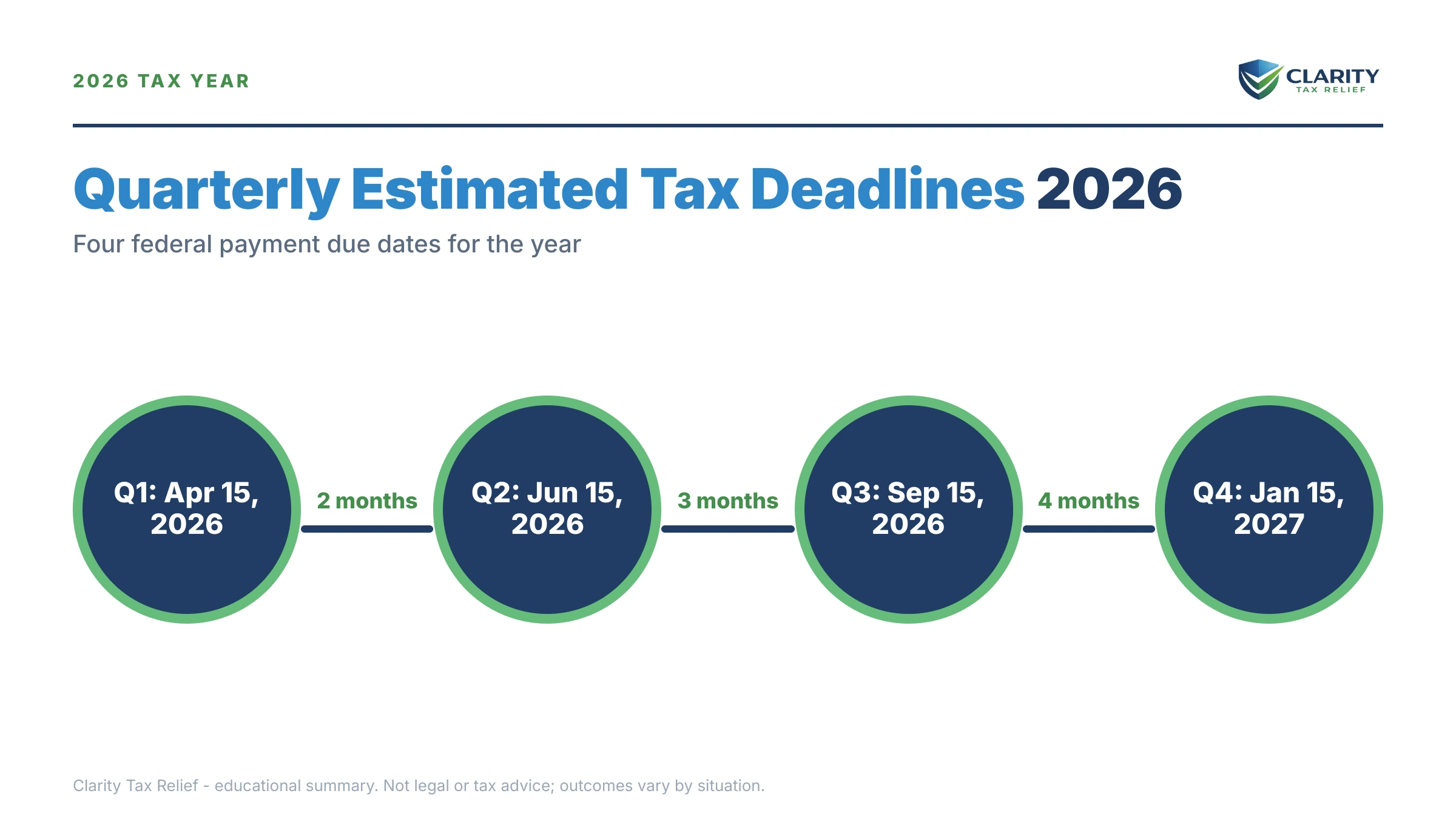
The good news: this is one of the cheapest tax problems there is to fix — if you fix it now instead of next April. The calendar image below lays out all four due dates and the income window each one covers, so you can see exactly where you stand as of today.
⏱ The next quarterly estimated tax deadline is September 15, 2026. It covers income you earned from June 1 through August 31, 2026. The final installment for 2026 income isn't due until January 15, 2027 — but a missed installment starts accruing penalty from its own due date, not from tax day.

Quarterly estimated tax deadlines 2026: the complete payment calendar
There are four estimated tax deadlines for 2026 income: April 15, June 15, and September 15, 2026, plus January 15, 2027. Because all four land on weekdays with no federal holidays in the way, no 2026 due date shifts — the printed dates are the real dates, unless you're in a federally declared disaster area where the IRS has postponed deadlines — check the IRS disaster relief page for your county.
| Installment | Income period covered | Due date |
|---|---|---|
| 1st (Q1) | January 1 – March 31, 2026 | Wednesday, April 15, 2026 |
| 2nd (Q2) | April 1 – May 31, 2026 | Monday, June 15, 2026 |
| 3rd (Q3) | June 1 – August 31, 2026 | Tuesday, September 15, 2026 |
| 4th (Q4) | September 1 – December 31, 2026 | Friday, January 15, 2027 |
Notice the trap in that table: the "quarters" aren't equal. The second installment covers only two months of income, while the fourth covers four. The dates are set by statute, and the short April-to-June gap is the one that catches new contractors most often.
One more calendar point that confuses people every year: the January 15, 2026 deadline that already passed was the fourth installment for 2025. Everything in the table above belongs to tax year 2026 — the return you'll file in spring 2027.
Who has to pay by these deadlines — and how much
You must make estimated payments for 2026 if you expect to owe at least $1,000 when you file and your withholding won't reach a safe harbor. For a full-time 1099 contractor, that threshold trips fast: with no employer withholding anything, even a modest profit generates both income tax and 15.3% self-employment tax with nothing prepaid against either.
If you're new to the system entirely — what counts as a "quarter," why withholding and estimates are treated differently — start with our primer on how quarterly estimated taxes work, then come back here for the 2026-specific calendar and math.
And don't wait for a form to tell you that you owe. Gig platforms and payment apps only issue a 1099-K above the reverted $20,000 / 200-transaction threshold in 2026, but the tax on your income is due on these four dates whether or not any paperwork ever arrives.
The IRS doesn't ask you to guess perfectly. It gives you "safe harbors" — pay one of these targets on schedule and no underpayment penalty applies, no matter what your final 2026 bill turns out to be:
| Your situation | Safe-harbor target | What it means |
|---|---|---|
| You'll owe under $1,000 at filing | None required | No penalty applies if your balance after withholding and credits is under $1,000 |
| 2025 AGI of $150,000 or less | 100% of 2025 total tax | Pay last year's tax in four equal installments and you're penalty-proof even if 2026 income soars |
| 2025 AGI over $150,000 ($75,000 if married filing separately) | 110% of 2025 total tax | Higher earners pay a 10% premium to use the prior-year harbor |
| 2026 income lower than 2025 | 90% of 2026 tax | Pay as you go on this year's actual numbers — cheaper, but you have to project accurately |
| Farmers & fishermen (two-thirds of gross income) | 66⅔% of 2026 tax | One payment due January 15, 2027 — or file and pay in full by March 1, 2027, and skip estimates entirely |
The prior-year harbor is the workhorse for most self-employed people because it turns a guessing game into one fixed number you can read straight off your 2025 return.
A worked example: $68,500 of 1099 income in 2026
Say you're a 1099 contractor expecting $68,500 in net profit for 2026 (after business expenses). This is a hypothetical — your numbers will differ — but the mechanics are the same for everyone.
Self-employment tax alone is $68,500 × 92.35% = $63,260, times 15.3% = about $9,679. Federal income tax stacks on top of that, and how much depends on your filing status, deductions, and household — which is exactly why the prior-year safe harbor is easier.
So use it. Say your 2025 Form 1040 showed total tax of $14,800 and your AGI was under $150,000. Your penalty-proof target for 2026 is 100% of that: $14,800 ÷ 4 = $3,700 per installment on each of the four dates in the table above.
Now say you missed the June 15 installment and pay it on September 15 instead. The penalty accrues on that $3,700 from June 15 to September 15 at the IRS's quarterly underpayment rate. At the rates of recent years — in the 7–8% annual range — three months late on $3,700 works out to roughly $65–$75. Annoying, not catastrophic. The catastrophic version is skipping all four installments and meeting a five-figure bill, plus penalty, next April.
One more wrinkle in your favor: if your income runs lower than $14,800 in tax would imply — say a slow year drops your projected 2026 tax to $11,000 — you can pay toward 90% of the current year ($9,900, or $2,475 per installment) instead. The safe harbor is whichever target is lower.
What happens if you miss a 2026 estimated tax deadline
A missed estimated payment doesn't trigger a letter next week — the cost builds silently and lands on your 2026 return. Here's the sequence, in order:
- The due date passes. The underpayment penalty starts accruing daily on that installment at the federal underpayment rate — see the current estimated tax penalty rate for 2026. It works like interest: the longer the gap, the bigger the number.
- Each further missed date stacks a new meter. Miss April, June, and September, and three separate installments are accruing at once, each from its own due date.
- You file your 2026 return in spring 2027. Form 2210 tallies the penalty installment by installment and adds it to your bill — even if you file on time and pay everything that day.
- If you don't compute it, the IRS does. Its systems calculate the penalty automatically and mail a bill — usually a CP30. This is machine work: even with the IRS workforce down roughly 27% since 2025, the automated notice stream never slowed.
- If you can't pay the April 2027 balance, the separate failure-to-pay penalty (0.5% per month) and interest stack on top, and the regular collection-notice sequence begins with a CP14.
You can estimate what your missed installments have cost so far with our IRS Penalty & Interest Calculator — it estimates, it doesn't promise, but it turns a vague worry into a number. For a deeper walkthrough of the math itself, see the penalty for not paying estimated taxes.
Estimated payments also generate their own small family of IRS letters. If one shows up, here's the decoder:
| Notice | What it means | What to do |
|---|---|---|
| CP23 | The estimated payments on your return don't match IRS records — balance due | Pull your payment confirmations and compare against your IRS Online Account; respond with proof or pay the corrected balance |
| CP24 | Same mismatch, but in your favor — your refund or credit changed | Verify the IRS's math and confirm where the overpayment went before spending it |
| CP30 | The IRS assessed the underpayment penalty on your return | Check the calculation against Form 2210 and request a waiver if an exception fits your facts |
| CP45 | The IRS couldn't apply your prior-year overpayment to your 2026 estimates | The credit you were counting on as your first installment didn't happen — replace it with a direct payment fast |
Behind on your 2026 estimated payments?
Whether you've missed one installment or you're staring at a prior-year balance stacking underneath this year's, get it reviewed free before the September 15, 2026 installment comes due. An experienced tax professional will map your safe harbor, your catch-up number, and your options — no pressure, no obligation.
Already behind? Your realistic options
A missed 2026 installment has four honest fixes, and none of them involve waiting until April. In rough order of usefulness:
- Pay the shortfall today. The penalty is computed day by day, per installment — every day earlier you pay is money saved. There's no application, no form; just send the payment and tag it to 2026 estimates.
- Use the withholding fix. If you (or a spouse on a joint return) have a W-2 job, withholding is treated as paid evenly through the year — even a big December withholding bump counts retroactively. It's the only tool that can erase penalty on quarters already missed, rather than just stopping the accrual.
- Annualize lumpy income. If most of your money arrives late in the year — seasonal work, a big Q4 contract — Schedule AI of Form 2210 matches each installment to when you actually earned, often shrinking or eliminating the penalty on the early quarters.
- Request a waiver where the rules allow. The penalty can be waived for casualty, disaster, or unusual circumstances, and in some cases for those who retired (after age 62) or became disabled during the year. Note the catch: first-time penalty abatement does not cover this penalty — the path runs through the Form 2210 estimated tax penalty waiver exceptions.
If missed quarterlies have already snowballed into a balance from a prior year, the playbook changes from "catch up" to "resolve" — payment plans, hardship status, and settlement all live in our guide to how to settle tax debt yourself. One critical interaction: if you're already on an IRS payment plan or have an Offer in Compromise in place, staying current on estimated payments is a condition of the deal — falling behind on 2026 quarterlies can default the agreement you worked to get.
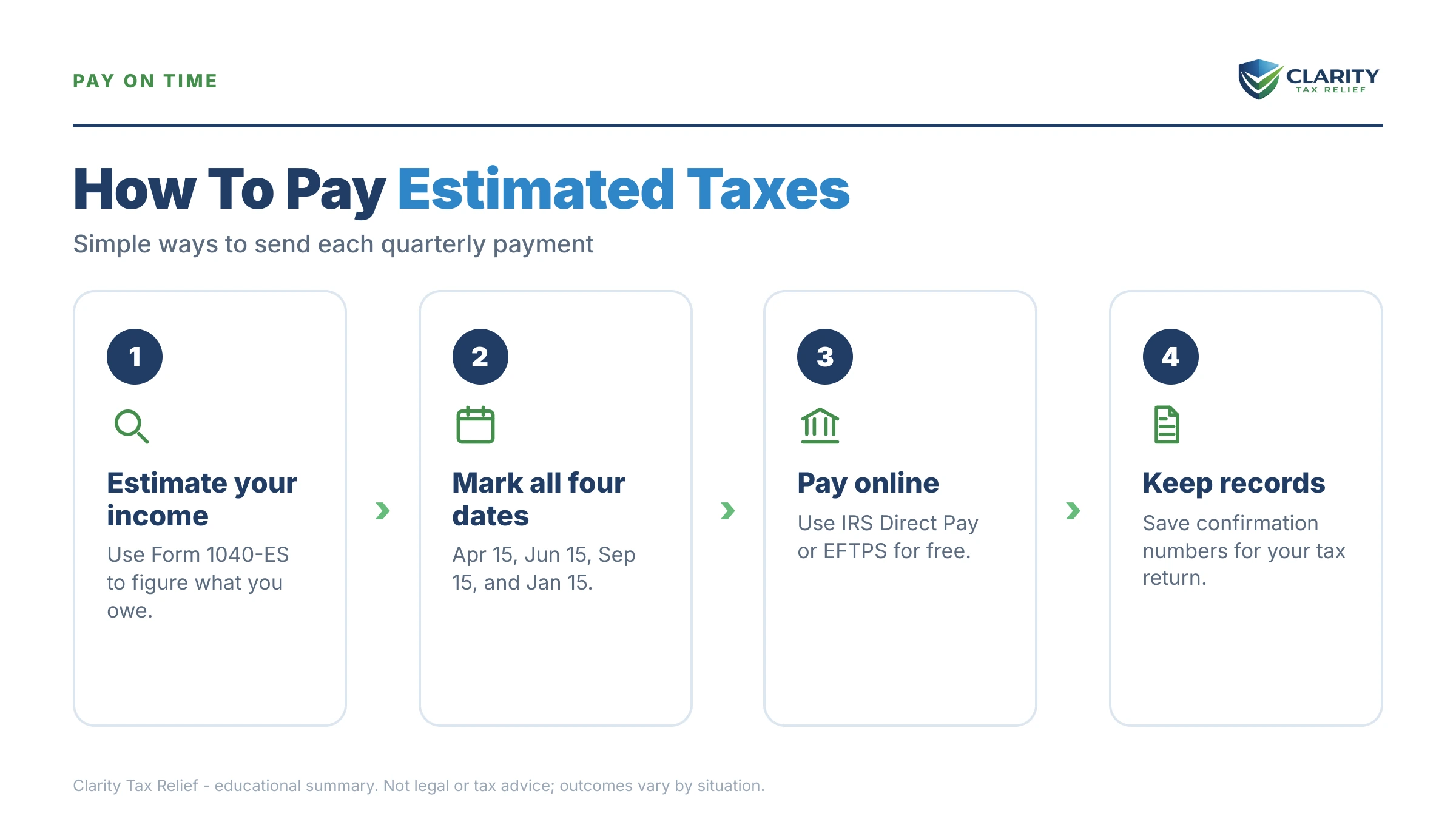
How to make your 2026 estimated tax payments, step by step
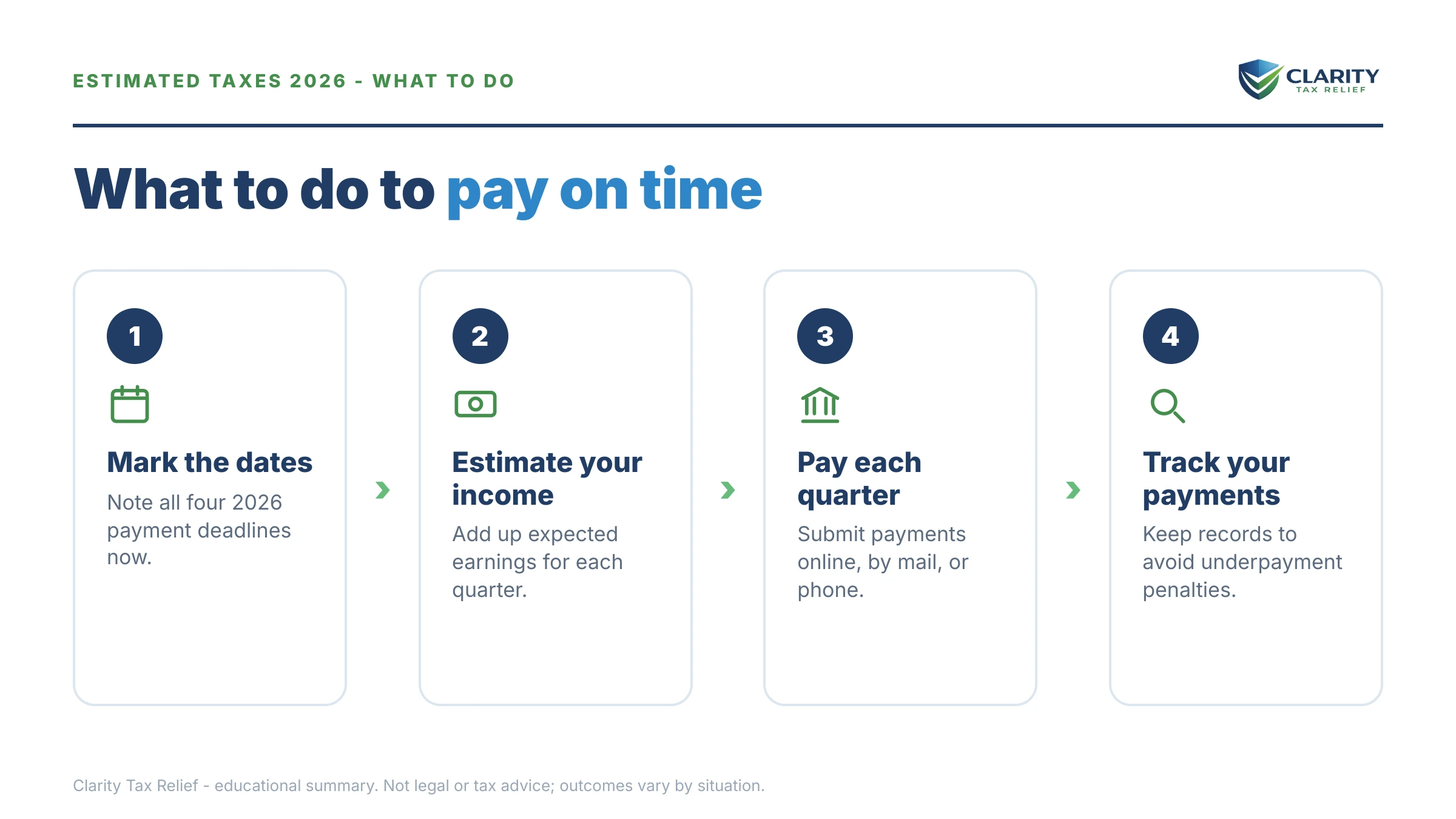
- Pull last year's total tax. Find the "total tax" line on your 2025 Form 1040 — that one number is the foundation of your safe harbor.
- Pick your safe-harbor target. Pay 100% of that 2025 figure (110% if your 2025 AGI topped $150,000), or 90% of your projected 2026 tax if this year's income is lower.
- Divide by four and calendar the dates. Split the target into equal installments due April 15, June 15, September 15, and January 15 — and set reminders a week before each.
- Pay electronically and save every confirmation. Use your IRS Online Account, IRS Direct Pay, or EFTPS, and make sure each payment is tagged as a 2026 estimated tax payment — misapplied payments cause CP23 headaches later.
- Re-run the numbers at each deadline. If income jumped or cratered mid-year, adjust the remaining installments — or switch to the annualized method on Form 2210 Schedule AI so each payment matches when you actually earned.
- Catch up immediately if you miss one. The penalty accrues daily from the missed due date, so a payment made a week late is cheaper than one made a month late.
All the electronic payment routes are listed on the IRS's own payments page — no vouchers or mailed checks required.
Situations that change the 2026 calendar
The four statutory dates hold for most filers, but four situations rewrite them:
- Federally declared disasters. When FEMA declares a disaster, the IRS postpones every tax deadline — estimated payments included — that falls inside the relief window for taxpayers in the covered counties. If you're in a declared area, check the current list before assuming the table above applies to you; our guide to the disaster relief tax deadline extensions for 2026 explains how the postponements work.
- Farmers and fishermen. If two-thirds of your gross income comes from farming or fishing, you get one installment (January 15, 2027) instead of four — or none at all if you file and pay in full by March 1, 2027.
- Corporations. C corporations pay their own estimated taxes on a different schedule keyed to their fiscal year, with no prior-year safe harbor for larger corporations. If your business owes at the entity level, don't map these individual dates onto it.
- State estimated taxes. States run their own calendars and their own penalties — several don't mirror the IRS's even 25% installments at all. California is the standout: the Franchise Tax Board front-loads its installment percentages and charges its own penalty, covered in our guide to the FTB estimated tax penalty. Paying the IRS on time doesn't protect you from your state.
When you can handle this yourself — and when to get help
Most estimated-tax problems are genuinely do-it-yourself. If you missed one 2026 installment and can pay it now, just pay it — the penalty on a single late quarter is usually tens of dollars, and no professional fee makes sense against that. Setting up the four payments in the first place takes one number off last year's return and twenty minutes online.
Experienced help changes the outcome in a narrower set of situations: multiple unfiled years hiding behind the current one, a prior-year balance already in the collection-notice sequence, an existing payment plan or offer that missed quarterlies could default, mixed W-2/1099 households where the withholding fix needs to be engineered precisely, or business income complicated enough that the annualized method is worth real money. In those cases, the order you fix things in — returns first, then penalties, then the balance — changes what you ultimately pay, and that sequencing is where a professional earns the fee.
Terms on Form 1040-ES and Form 2210, decoded
- Safe harbor — a payment target (like 100% of last year's tax) that makes you penalty-proof no matter what your final bill turns out to be.
- Underpayment penalty — the charge under IRC §6654 for paying too little too late during the year; it's computed like interest, not a flat fine.
- Installment — the IRS's word for each of the four required payments; the penalty is figured separately for each one.
- Total tax — the line on your Form 1040 that the prior-year safe harbor is built on; it includes self-employment tax, not just income tax.
- Annualized income installment method — the Schedule AI option on Form 1040-ES's companion, Form 2210, that matches each installment to when you actually earned the money.
- EFTPS — the Treasury's free Electronic Federal Tax Payment System, which lets you schedule all four installments in advance so a forgotten date can't hurt you.
The IRS's own reference for all of this lives at its estimated taxes page.
2026 estimated tax deadline questions, answered
What are the quarterly estimated tax due dates for 2026?
The four due dates for 2026 income are April 15, 2026, June 15, 2026, September 15, 2026, and January 15, 2027. None fall on a weekend or federal holiday, so no dates shift this year, unless you're in a federally declared disaster area where the IRS has postponed deadlines — check the IRS disaster relief page for your county. The January 15, 2026 deadline that already passed belonged to tax year 2025 — the four dates above cover money you earn during 2026.
What happens if I miss a quarterly estimated tax payment in 2026?
The underpayment penalty starts accruing on that installment from its due date, calculated like interest at the IRS's quarterly underpayment rate. The penalty runs separately for each installment, so paying the moment you notice stops that installment's meter — it just doesn't erase what already accrued. If you also have W-2 wages, raising withholding before December 31 can retroactively cure the shortfall, because withholding counts as paid evenly across the year.
Do I owe a penalty if I owe less than $1,000 at tax time?
No. If your balance due after withholding and refundable credits is under $1,000 when you file, the estimated-tax penalty doesn't apply at all. The threshold is per return, not per quarter, and married couples filing jointly share the single $1,000 limit — it doesn't double. You're also penalty-proof if you had zero tax liability last year as a U.S. citizen or resident with a full 12-month tax year.
Do I have to pay quarterly estimated taxes if I also have a W-2 job?
Only if your withholding won't reach one of the safe harbors on its own. Many people with side income skip the vouchers entirely by raising withholding at their day job, because withholding is treated as paid evenly through the year no matter when it actually comes out of your check. For that fix to work, the withholding has to actually reach the safe-harbor amount by December 31 — run the math before you rely on it.
Can I skip a quarter and pay double at the next deadline?
You can, but it isn't free. The penalty on the skipped installment accrues from its original due date until the day you pay, so doubling up in September stops the June meter without erasing what built up between June and September. On a few thousand dollars, one late quarter usually costs tens of dollars, not hundreds — the expensive mistake is letting all four installments run unpaid into April 2027.
Does filing a tax extension change the estimated tax deadlines?
No. An extension moves your filing deadline to October, not your payment deadlines — all four 2026 installment dates stay exactly where they are. The only things that move estimated tax deadlines are weekends, federal holidays, and federally declared disasters, where the IRS postpones every deadline in the covered window for affected taxpayers.
Why is the second estimated payment due in June instead of July?
Because the IRS 'quarters' aren't real calendar quarters. The second installment covers only April and May — two months of income — while the fourth covers September through December, four months. The dates are fixed by statute at April 15, June 15, September 15, and January 15, which is why self-employed people are so often blindsided by the short April-to-June gap.
Are the 2026 deadlines different for farmers and fishermen?
Yes. If at least two-thirds of your gross income comes from farming or fishing, you can make one estimated payment by January 15, 2027, instead of four — or skip estimated payments entirely by filing your 2026 return and paying in full by March 1, 2027. Your safe harbor is also lower: two-thirds of the current year's tax instead of the usual 90%.
Your next 24 hours
- Find one number: pull your 2025 Form 1040 and locate the "total tax" line. That figure sets your safe-harbor target for every remaining 2026 installment.
- Gather your year-to-date picture: your 2026 income so far, plus confirmations for any estimated payments you've already sent — your IRS Online Account shows exactly what the IRS has received and where it posted.
- If you're behind — or an older balance is stacking underneath this year's — get a free case review before the September 15, 2026 installment: use the 2-minute form or call (888) 825-7779. Twenty minutes of planning now beats untangling a penalty-loaded bill next April.
This guide is general information, not tax or legal advice for your specific situation. Eligibility for IRS programs depends on individual facts and circumstances; no outcome is guaranteed.