
Deadlines & Extensions
Disaster Relief Tax Deadline Extension 2026: What It Covers, Who Gets It, and What Happens When It Ends
The short answer: the disaster relief tax deadline extension 2026 rule is automatic — if FEMA declares your county a federal disaster area, the IRS postpones both filing and payment deadlines that fall inside the relief window, no form required. Your new deadline is the postponed date printed in the IRS announcement for your specific disaster.
Your county just made the news for all the wrong reasons — flood, fire, or storm — and somewhere in the cleanup you remembered the tax balance you haven't dealt with. Here's the part almost nobody tells you: the deadline you're worried about has probably already moved, without you filing anything. The real questions are what the postponement covers, what it quietly leaves out, and how to avoid the trap that catches most people the day it ends.
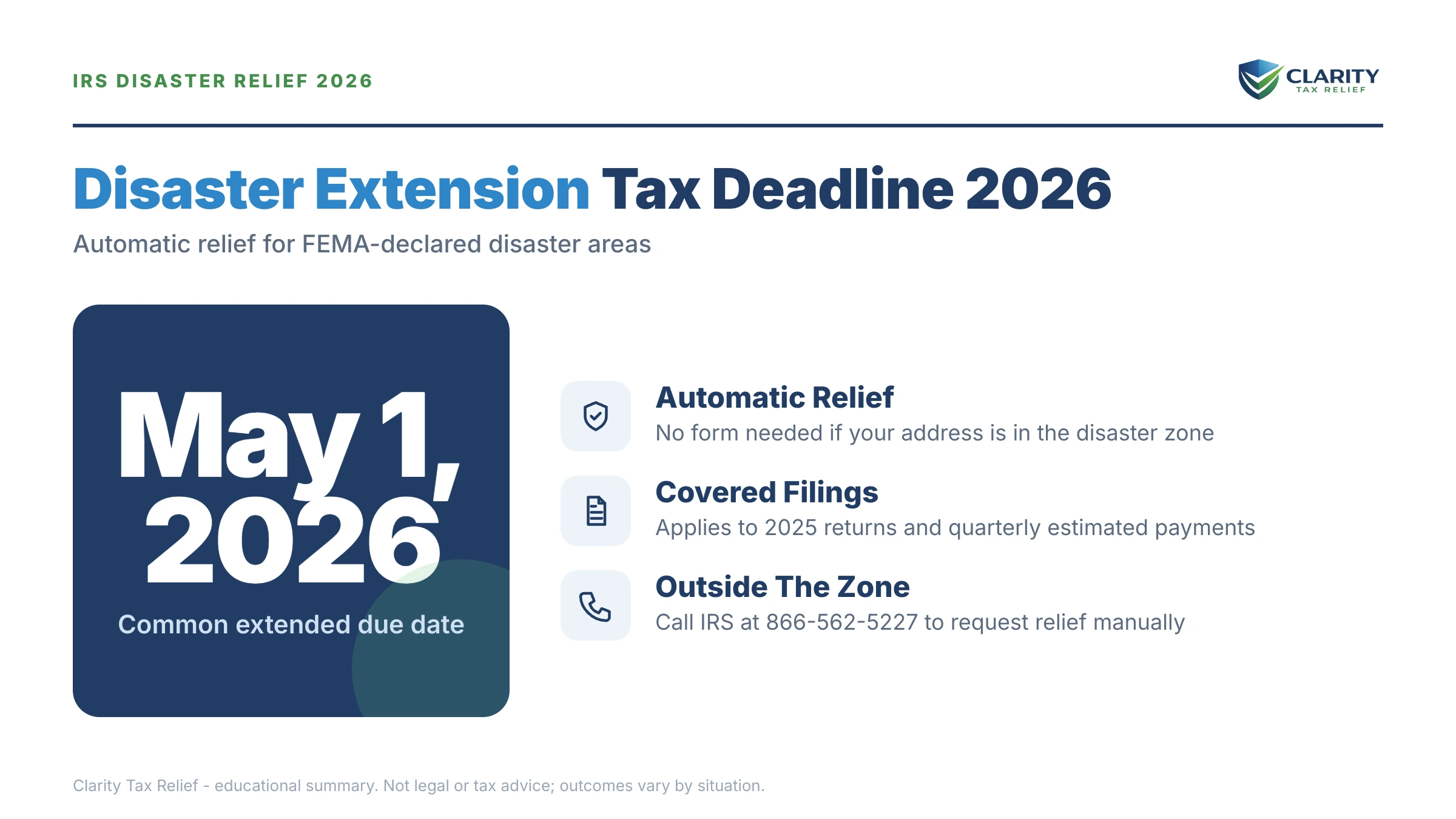
Unlike almost every other kind of tax extension, a disaster postponement moves the payment deadline too — the image below shows how the pieces of the 2026 deadline calendar fit together so you can see exactly where your dates land.
⏱ Your deadline: the postponed date printed in the IRS announcement for your specific disaster — find your state and county under "Tax relief in disaster situations" on IRS.gov. Every disaster gets its own date; there is no single national 2026 disaster deadline. Deadlines that fall inside your relief window are on hold until that date, and nothing accrues on them in the meantime.

How the disaster relief tax deadline extension works in 2026
A FEMA disaster declaration automatically postpones IRS filing and payment deadlines for every taxpayer whose address of record is in the declared area. The legal machinery is Internal Revenue Code Section 7508A: once FEMA issues a federal declaration, the IRS announces a relief window for the affected counties, and any federal tax deadline falling inside that window slides to the postponed date.
Three things make this different from an ordinary extension. First, it's automatic — the IRS applies it by county based on your address of record; you file nothing and call no one. Second, it covers payment, not just paperwork. A regular Form 4868 extension gives you time to file but not to pay — a distinction that surprises people every year (see does an extension give more time to pay). A disaster postponement moves both. Third, under Section 7508A the relief period is disregarded for penalties and interest on amounts due inside the window — the clock doesn't just slow down, it stops.
The postponement sweeps in more than your Form 1040. Quarterly estimated payments, prior-year IRA and HSA contribution deadlines, and many business return deadlines that fall inside the window all move to the same postponed date. Here's the full picture:
| Deadline type | Normal 2026 date | Under a disaster postponement |
|---|---|---|
| Form 1040 filing | April 15, 2026 | Moves to the postponed date; no failure-to-file penalty if you file by then |
| Balance-due payment on your 2025 return | April 15, 2026 | Moves to the postponed date; no failure-to-pay penalty or interest during the window |
| Quarterly estimated payments | April 15 / June 15 / Sept. 15, 2026 | Any payment due inside the window is payable by the postponed date instead |
| Extension filers (Form 4868) | File by October 15, 2026 | Filing moves if Oct. 15 falls in the window — but payment was already due April 15, so no payment relief unless the disaster hit before then |
| Prior-year IRA / HSA contributions | April 15, 2026 | Contribution deadline moves with the window when it covers April 15 |
| Payroll tax deposits | Semiweekly or monthly schedule | Relief is typically far shorter than filing relief — check the deposit dates named in your specific announcement |
Note the Form 4868 row — it's the single most misunderstood line in disaster relief. If you filed a regular extension in March and the disaster struck in July, your filing deadline may move past October 15, but your payment was legally due April 15, before the disaster existed. Interest and the late-payment penalty on that balance keep running. If that's your situation, our guide to the october 15 tax deadline can't pay problem walks through it, and missed october 15 tax deadline covers what happens if the extended filing date slips past you too.
Who qualifies automatically — and who has to ask
Anyone whose IRS address of record sits inside the FEMA-declared counties gets the postponement with zero action required. The IRS matches declarations against its address files and codes those accounts for relief. You don't apply, you don't attach a statement to your return, and you don't need to have suffered any actual property damage — living or running a business in the declared county is enough.
Four groups qualify but are not coded automatically, because their address of record is outside the mapped area:
- Taxpayers whose records are in the zone — your books, receipts, or documents needed to file sit inside the declared area even though you live elsewhere.
- Clients of preparers in the zone — in some declarations, taxpayers whose preparer is in the disaster area and unable to file for them can request the same relief.
- Relief workers — people affiliated with recognized government or philanthropic organizations assisting in the area.
- People who moved recently — if you live in the declared county but the IRS still has your old address on file, the automated coding will miss you.
If any of those describe you, call the IRS disaster hotline at 866-562-5227 and ask to be treated as an affected taxpayer. Don't wait for a penalty notice to force the conversation — with the IRS workforce cut roughly 27% in 2025, fixing an error after the fact takes far longer than flagging your account before one happens. Our guide to irs budget cuts 2026 explains why the automated systems keep running at full speed even while the phones don't.
What a 2026 disaster extension does NOT do
A disaster postponement moves deadlines — it does not erase, reduce, or pause tax debt you already owed before the disaster. This is where most of the pain we see comes from, so be clear-eyed about the limits:
- Prior-year balances keep accruing. If you owed the IRS from 2023 or 2024, that debt's interest compounds daily right through the relief window. The postponement only protects deadlines that fall inside the window.
- Existing installment agreements generally keep their due dates. If a storm wrecked your income, contact the IRS about your agreement rather than silently skipping payments — a skipped payment risks default and restarts collection.
- State deadlines don't move automatically. Many states conform to federal disaster relief, but some pick different dates or require a request. Check your state revenue agency before assuming your state return moved.
- Automated notices may still arrive. IRS computers sometimes bill penalties to disaster-area taxpayers in error. The relief is real even when the notice is wrong — call the number on the notice and cite your declaration.
One provision that can actually cut what you owe: if the disaster destroyed property that insurance didn't cover, you may be able to deduct the casualty loss on Form 4684 — and federally declared disaster losses come with a special election to claim them on your prior-year return, which can shrink the very balance you're staring at or speed up a refund. Recent legislation also changed how certain disaster losses are treated; see our guide to the one big beautiful bill tax changes before you decide which year to claim.
For the evergreen mechanics that apply in any year — how declarations work, how relief windows are set — our companion guide to the irs disaster relief deadline extension covers the program itself; this page is about the 2026 calendar and what to do when your window closes.
What happens when the postponed deadline passes
The day your postponed deadline passes unpaid, the normal IRS collection sequence starts as if the disaster never happened. Nothing about the declaration softens what comes next — it only delayed the starting gun:
- Postponed date passes — the return is now late and the balance unpaid. Failure-to-pay penalty (0.5% per month) begins, plus failure-to-file at 5% per month if you never filed — ten times worse, which is why you file even when you can't pay. Interest starts compounding.
- CP14 — the first bill arrives, giving you about 21 days before the sequence continues. See the full cp14 notice guide.
- CP501 / CP503 — reminder notices while the balance grows monthly.
- CP504 — Notice of Intent to Levy: the IRS can seize your state tax refund under IRC §6331(d), and a federal tax lien becomes a live possibility.
- LT11 / Letter 1058 — the final notice, starting a 30-day clock and your Collection Due Process rights (Form 12153). After it expires, wage levies (continuous) and bank levies (funds held 21 days, then gone) are on the table.
The strategic takeaway: a disaster window is not a snooze button — it's free planning time. Every month of postponement you spend arranging how you'll file and pay is a month the collection machine can't touch, at zero cost in penalties or interest. Waste it, and you re-enter the sequence with nothing gained.
Disaster window open, but the balance behind it unhandled?
Send us your IRS announcement and your numbers. An experienced tax professional will confirm your exact postponed date, check whether the relief was applied to your account, and map your payment options — free, before that date arrives.
Can't pay when the postponed deadline arrives? Your options
The IRS has several payment programs, and the disaster window is the ideal time to pick one — before penalties resume, not after. Which one fits depends on your balance, income, and assets:
| Option | Who it fits | Cost & key limits |
|---|---|---|
| Pay in full by the postponed date | Anyone who can gather the money during the window | $0 in penalties or interest — the postponement erases the entire gap |
| Short-term payment plan | Can pay in full within 180 days of the postponed date | $0 setup fee; interest and the 0.5%/month penalty accrue after the postponed date |
| Streamlined installment agreement | Balances up to $50,000; up to 72 months, set up online | Setup fee applies (lower with direct debit); accruals continue until paid |
| Currently Not Collectible | Paying anything would leave you unable to cover basic living costs — common after a disaster wipes out income | $0; collection pauses, debt and interest remain, IRS reviews periodically |
| Offer in Compromise | Assets plus future income genuinely can't cover the debt | $205 fee and 20% down on lump-sum offers (both waived with low-income certification); IRS accepted roughly 1 in 5 offers in FY2024 |
| Penalty relief | Penalties charged on amounts the relief didn't reach | $0; a federally declared disaster is classic reasonable cause, and clean-record filers may qualify for first-time abatement — being replaced by the automatic AEP starting summer 2026 |
Say you owe $27,500 — you're a single W-2 employee whose 2025 withholding fell badly short, and your county's March 2026 declaration postpones the April 15 deadline to a hypothetical November 2, 2026. If you pay by November 2, the postponement wipes the whole gap: without it, the same delay would cost roughly $137 a month in failure-to-pay penalty alone ($27,500 × 0.5% ≈ $137.50 — call it $900 over six and a half months), plus compounding interest on top. And if you hadn't filed at all with no relief in place, the failure-to-file penalty runs $1,375 a month until it caps at 25% — $6,875. You can estimate your own accrual either way with our IRS Penalty & Interest Calculator.
Now say November 2 arrives and you still can't pay the $27,500. Because the balance is under $50,000, a streamlined installment agreement is available online with no detailed financial disclosure: $27,500 ÷ 72 months ≈ $382 a month as a floor, realistically closer to $430–$470 once you build in the interest and penalties that resume after the postponed date. If you could scrape the money together within six months instead, the 180-day short-term plan costs nothing to set up and beats the monthly agreement on total cost. The full DIY playbook for choosing and setting up any of these lives in our guide to how to settle tax debt yourself.
One more move worth the window: if the disaster also derailed your 2026 quarterly payments, check which due dates fell inside your relief period against the quarterly estimated tax deadlines 2026 — swept-in quarters stack onto the same postponed date, and it's far better to discover that lump sum in August than the week it's due.
How to confirm and use your 2026 disaster extension, step by step
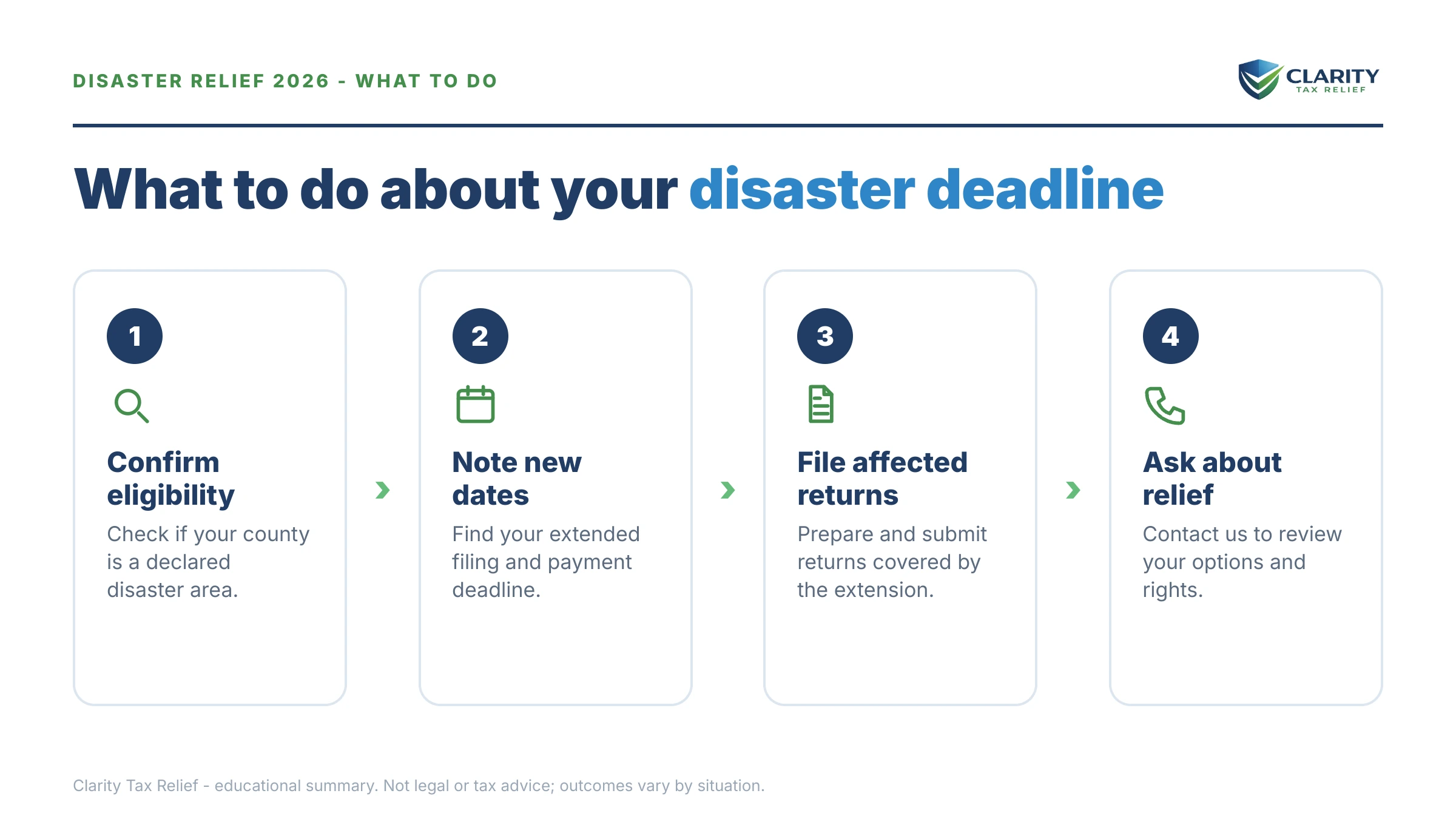
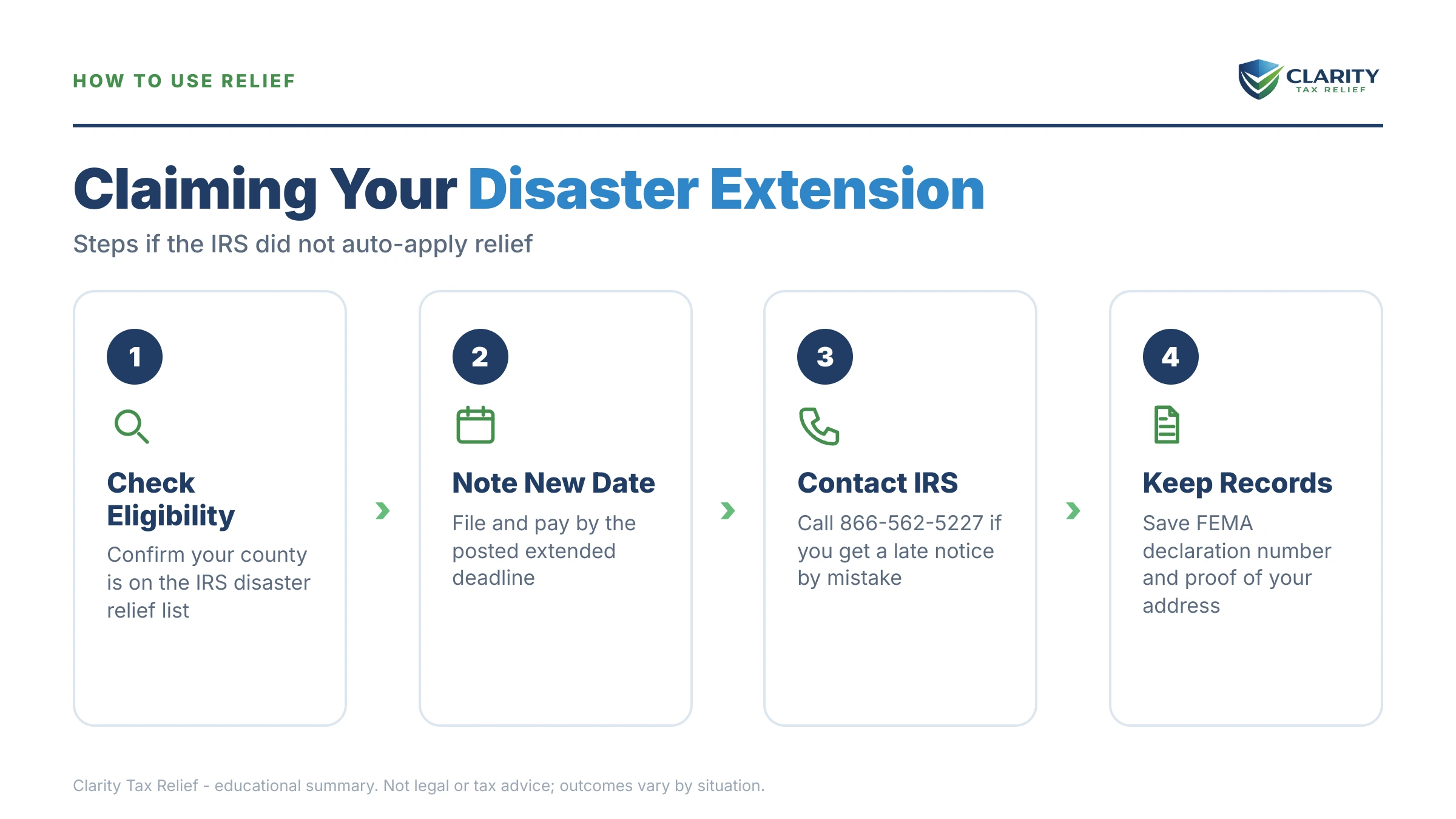
- Find your declaration — search your state on the IRS "Tax relief in disaster situations" page and confirm your county is listed in the announcement.
- Write down your postponed date — it's printed in the IRS news release for your disaster, and it's the only deadline that now matters.
- Skip the paperwork — relief is automatic if your address of record is in the declared area; call the IRS disaster hotline at 866-562-5227 if you qualify from outside it.
- Plan the payment now — the postponed date covers filing and paying, so line up how you'll cover the balance before it arrives, not after.
- Answer any penalty notice — if an automated notice charges penalties the relief should erase, call the number on the notice and cite your disaster declaration.
When your date arrives and you're paying in full, pay electronically at IRS.gov/payments so the payment posts to the right year immediately. For the FEMA side — housing assistance, individual assistance applications, declaration lookups by county — start at FEMA.gov.
When you can handle this yourself
Most disaster-extension situations need no professional help at all. If your county is on the IRS list, the relief applied automatically, and you can pay your balance by the postponed date — or set up a simple plan online — you're done. The same goes for a single erroneous penalty notice: one phone call citing the declaration usually resolves it, and if the penalty predates the disaster, reasonable cause penalty abatement is a request you can write yourself.
Experienced help changes the outcome in a narrower set of cases: you had prior-year debt already in collections when the disaster hit (the postponement never protected it, and a CP504 or LT11 clock may be running right now); the disaster gutted your income enough that hardship status or an Offer in Compromise is genuinely on the table and the math needs to be built correctly the first time; you have multiple unfiled years tangled up with the postponed one; or you're a business juggling payroll deposit relief that's shorter than your filing relief. In those situations, the sequencing — which year to file first, which penalty to challenge, which program to request — determines what you ultimately pay.
Terms in the IRS announcement, decoded
- Federally declared disaster — a disaster for which the President has issued a declaration through FEMA; only these trigger automatic IRS relief.
- Section 7508A — the tax-code provision letting the IRS disregard a period of up to a year for filing, paying, penalties, and interest after a declaration.
- Postponement period — the window in the IRS announcement, running from the disaster's start date to the postponed deadline; only deadlines falling inside it move.
- Affected taxpayer — anyone the relief covers: residents and businesses in the declared counties, plus qualifying outsiders like those with records in the zone.
- Address of record — the address the IRS has on file for you; it, not where you actually slept last night, controls whether relief applies automatically.
- Casualty loss — an uninsured loss from the disaster, deductible on Form 4684, with an election to claim federally declared disaster losses on the prior year's return.
Disaster deadline extension 2026: your questions, answered
Is the disaster tax deadline extension automatic in 2026?
Yes — if your address of record with the IRS is inside a FEMA-declared disaster area, the postponement applies automatically with no form or phone call. The IRS applies it by county based on the declaration. The main exception is taxpayers who qualify from outside the mapped area — such as those whose tax records are located inside it — who must call the IRS disaster hotline at 866-562-5227 to request the same relief.
Does a disaster extension give me more time to pay or just to file?
Both — and that's what makes it fundamentally different from a regular Form 4868 extension. A disaster postponement moves the payment deadline along with the filing deadline, so no failure-to-pay penalty or interest accrues on a balance that was originally due inside the relief window. One catch: if you filed a regular extension before the disaster, your payment was already due April 15, and the disaster relief doesn't reach back to cover it.
Does interest accrue during a disaster tax deadline extension?
Not on amounts that come due inside the postponement window. Under Section 7508A, the relief period is disregarded when the IRS calculates both penalties and interest, so a 2025 balance originally due April 15, 2026 accrues nothing until the postponed date. Interest does keep running on tax debt from earlier years — the postponement pauses new deadlines, not old balances.
What if I got an IRS penalty notice even though I'm in a disaster area?
Call the number on the notice, tell the representative you're in a federally declared disaster area, and ask for the penalty to be abated under the disaster relief. Automated IRS systems sometimes issue penalty notices to disaster-area taxpayers by mistake, especially with 2026 staffing down roughly 27%. Keep the notice, note the date of your call, and follow up in writing if the correction doesn't show in your online account.
I live outside the declared disaster area — can I still get the 2026 extension?
Possibly. Relief also extends to taxpayers whose necessary records are inside the declared area, to relief workers assisting there, and in some cases to taxpayers whose preparer is in the zone and cannot file for them. Because your address of record is outside the mapped counties, the IRS won't apply relief automatically — you must call the disaster hotline at 866-562-5227 and ask to be treated as an affected taxpayer.
Does a federal disaster extension change my state tax deadline?
Not automatically. States set their own deadlines, and while many conform to federal disaster relief after a declaration, some announce different dates or require a request. Never assume your state return and payment moved just because the IRS deadline did — check your state revenue agency's disaster-relief announcement, because a missed state deadline triggers that state's own penalties regardless of what the IRS postponed.
Does disaster relief help with tax debt I already owed before the disaster?
No — a disaster postponement moves deadlines that fall inside the relief window; it doesn't erase or pause balances assessed in earlier years. Interest keeps compounding on old debt, and an existing installment agreement's payments generally remain due unless you contact the IRS. If the disaster wrecked your finances, that hardship can support penalty abatement for reasonable cause or a currently-not-collectible request — but you have to ask.
Are 2026 quarterly estimated tax payments covered by a disaster postponement?
Yes, if the due date falls inside the relief window. A postponement running from March through November 2026, for example, would sweep in the April 15, June 15, and September 15 estimated payments, all payable by the postponed date without penalty. Payments that were due before the disaster struck aren't covered, and skipping swept-in quarters can leave a painfully large lump sum when the window closes — budget for it.
Your next 24 hours
- Find your date. Look up your state under "Tax relief in disaster situations" on IRS.gov, confirm your county is named, and write down the exact postponed deadline for your disaster.
- Gather your numbers. Pull your 2025 return (or the documents to finish it), any IRS notices you've received, and a rough picture of what you can realistically pay by that date.
- Get the plan set before the window closes. If the balance is more than you can cover — or you had older debt already in collections when the disaster hit — get a free case review at the form or (888) 825-7779. The postponement is free planning time; use it before penalties and interest switch back on.
This guide is general information, not tax or legal advice for your specific situation. Eligibility for IRS programs depends on individual facts and circumstances; no outcome is guaranteed.