
IRS News & Policy
IRS Budget Cuts 2026: What They Actually Mean for Your Tax Debt
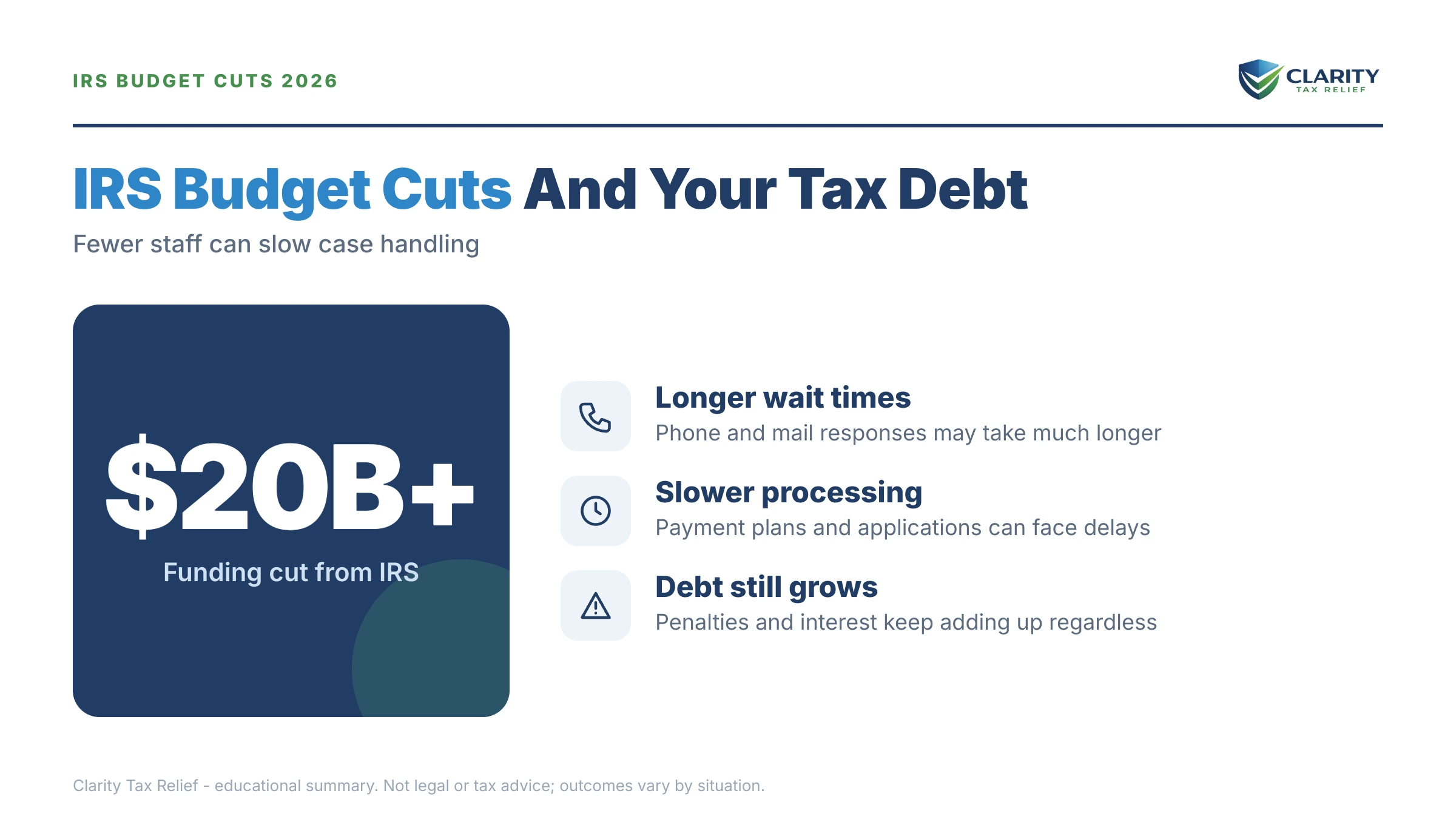
The short answer: the IRS budget cuts 2026 headlines are about people — the agency lost roughly 27% of its workforce in 2025 — but IRS collections are automated and never stopped. Notices, levies, refund offsets, and passport certification still fire on schedule. The cuts change how you resolve a tax debt, not whether you owe it.
You've read the layoff headlines, you owe the IRS money, and a quiet thought keeps surfacing: maybe your balance just slips through the cracks. It's a fair question — especially if that balance is standing between you and a mortgage refinance. Here's the honest map of what the cuts actually changed, and the one mistake they make more expensive.
⏱ The clock that never got cut: penalties and interest accrue every month regardless of IRS staffing. The failure-to-pay penalty adds 0.5% of your balance per month, and interest compounds daily on top — both are applied by computer, with no employee involved.
IRS budget cuts 2026: what changed — and what still runs on autopilot
The IRS lost roughly 27% of its workforce in 2025, but the systems that send collection notices and issue levies are automated and never paused. What shrank is the human layer: phone assistors, correspondence processors, appeals officers, and the staff who work cases by hand. What didn't shrink is the master file — the computer system that tracks every balance, generates every notice, and triggers enforcement when deadlines pass.
The squeeze also lands against a backdrop of policy change and a debt inventory that hasn't gotten smaller. The One Big Beautiful Bill tax changes reshuffled what many filers owe going forward, and the IRS back tax debt statistics show the pile of unresolved balances the automated system is still working through. Fewer humans plus the same automated pipeline means one practical reality: the parts of the IRS that help you got slower; the parts that collect from you didn't.
| IRS function | 2026 status | What it means for you |
|---|---|---|
| Live phone help | Sharply slower; long holds, dropped calls | Use your IRS online account instead of the 800 number |
| Paper mail, amended returns, correspondence | Backlogged | Anything mailed can sit for months; keep proof of mailing |
| Human-worked cases (appeals, offer reviews, revenue officers) | Fewer staff, slower movement | More time to prepare — but interest accrues while you wait |
| Automated notices (CP14 → CP504 → LT11) | Unchanged | The escalation sequence fires on schedule |
| Levies, refund offsets, and lien filings via automated systems | Unchanged | Bank and wage levies still issue with no human review of your file |
| Passport certification ($66,000+ in 2026) | Unchanged — automated | Seriously delinquent debt still gets certified to the State Department |
| The 10-year collection statute (CSED) | Keeps running | Time can work in your favor if the account is handled correctly |
If you've been dialing and getting nowhere, that's the cuts talking — our guide to what to do when you can't reach the IRS on the phone covers every workaround. And no, the layoffs don't make your account invisible: irs layoffs will i still get audited walks through why the matching computers keep flagging returns with no auditor involved.
What happens if you ignore a tax debt during the cuts
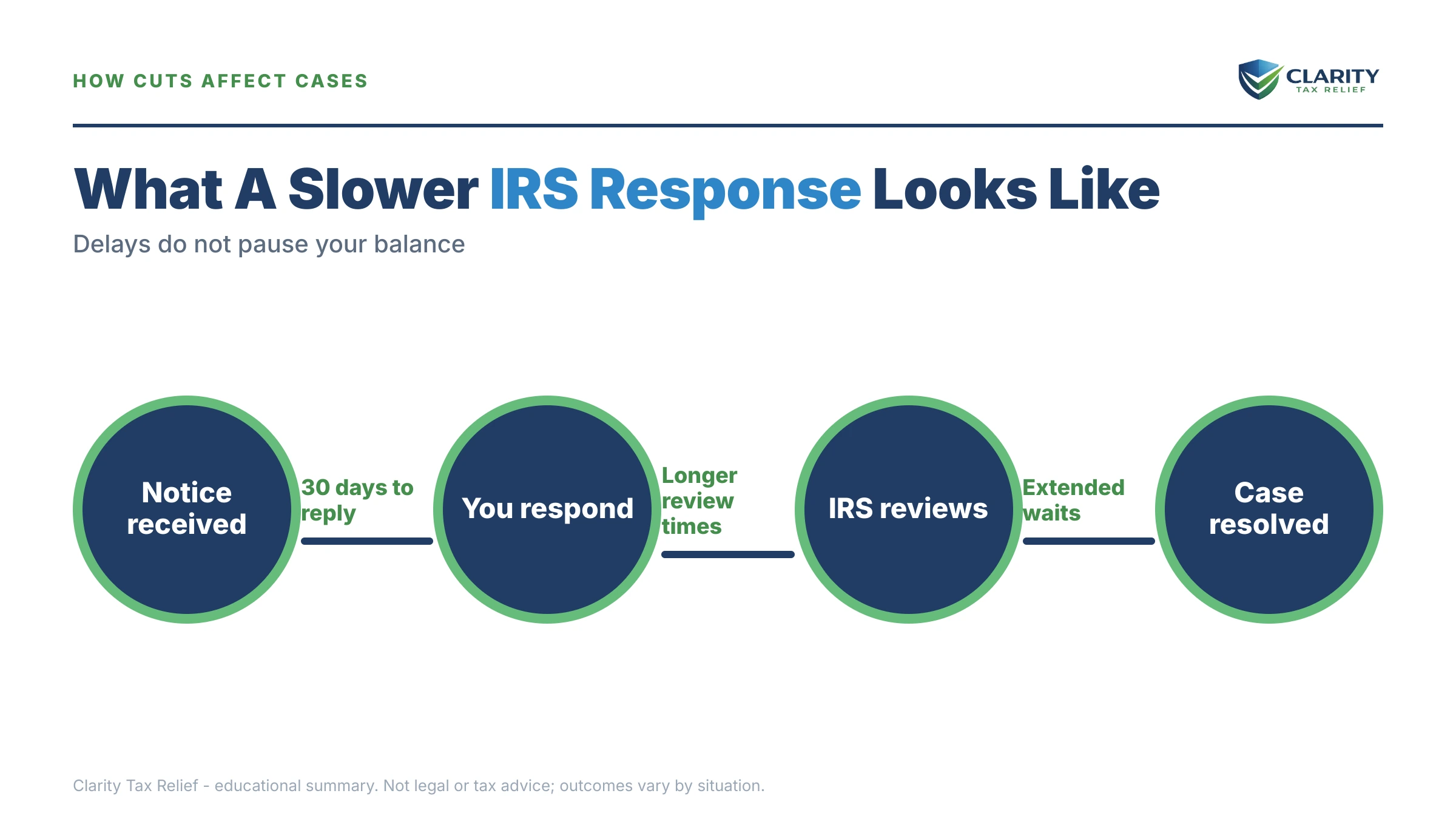
Ignoring a balance in 2026 triggers the same automated escalation it always has — the sequence runs without a single employee touching your file. Each stage adds interest and enforcement power, in this order:
- CP14 — the first bill, with roughly 21 days to pay (10 business days if the balance is $100,000 or more) before the system escalates.
- CP501 / CP503 — automated reminders while the balance grows monthly.
- CP504 — Notice of Intent to Levy under IRC §6331(d). The IRS can seize your state tax refund, and a federal tax lien becomes a live possibility.
- LT11 / Letter 1058 — the final notice. A 30-day clock starts, along with your Collection Due Process rights (requested on Form 12153). After it expires, enforcement can begin.
- Enforcement — a bank levy freezes funds for a 21-day hold before they leave; a wage levy is continuous until released; up to 15% of Social Security can be taken through the Federal Payment Levy Program; and once the debt tops $66,000, passport certification follows.
Every step on that list is machine-driven. The staffing cuts mean it's harder to reach a person to stop the sequence — not that the sequence stops on its own. If you're hoping understaffing equals amnesty, read irs understaffed do i still owe — short version: the robot still levies; only the helpers are gone.
Owe back taxes while the IRS is short-staffed?
The collection computers aren't waiting on hold, and neither should you. An experienced tax professional will review your balance and map your options free — before penalties and interest add another month to the bill.
Your resolution options in 2026, cuts and all
Every IRS resolution program survived the budget cuts — payment plans, hardship status, offers, and penalty relief all still exist and still work. What changed is the smart way to access them: online and self-directed beats phone and paper by months. (For the full walkthrough of each program, see how to settle tax debt yourself — this page focuses on what the cuts change about each one.)
| Option | Key eligibility threshold | 2026 note |
|---|---|---|
| Short-term payment plan | Can pay in full within 180 days | $0 setup; approves online the same day |
| Guaranteed installment agreement | Balance ≤ $10,000 (individual, conditions met) | Acceptance is required by law when you qualify — no human discretion needed |
| Streamlined installment agreement | ≤ $25,000 (or ≤ $50,000 with direct debit) | No detailed financial disclosure required |
| Long-term plan online | ≤ $50,000; up to 72 months | Fully self-service — the option least affected by the cuts |
| Currently Not Collectible | Hardship shown on Form 433-F | Pauses collection; debt and interest remain |
| Offer in Compromise | Assets plus future income genuinely below the debt | The IRS accepted roughly 1 in 5 offers in FY2024 — means-tested, never automatic |
| Penalty relief (FTA / AEP) | Clean compliance for the prior 3 years | AEP makes first-time relief automatic starting summer 2026 |
| Option | Upfront cost | Realistic timeline under 2026 staffing |
|---|---|---|
| Short-term plan (180 days) | $0 | Same day online |
| Long-term installment agreement | Reduced setup fee online (lowest with direct debit; waived or reimbursed for low-income filers) | Same day online; weeks to months if requested by mail or phone |
| Currently Not Collectible | $0 | Requires a financial review — faster when a complete Form 433-F is ready before you call |
| Offer in Compromise | $205 fee + 20% down on lump-sum offers (both waived with low-income certification, AGI ≤ 250% of poverty) | Often many months; auto-accepted if the IRS doesn't decide within 2 years, with narrow exceptions — a returned or rejected offer stops the clock, and time during court disputes does not count |
| Penalty abatement | $0 | Fastest by phone when you can get through; mailed requests sit in the backlog — or wait for automatic AEP relief |
One more thing the cuts did not touch: your state. State revenue agencies run on state budgets, and several are more aggressive than the IRS right now. If you owe both, state tax debt vs irs explains which balance to attack first — the answer is rarely "the one with the slower phone line."
Worked example: you owe $4,800 and want to refinance
Say you owe the IRS $4,800 from last year's return, and you're planning to refinance your mortgage this fall. Here's the honest math, staffing cuts included.
If you wait: the failure-to-pay penalty adds 0.5% per month — about $24 a month on $4,800 — plus daily compounding interest. Six months of waiting adds roughly $144 in penalties alone before interest, and your balance is still sitting on IRS records when the underwriter pulls your file.
If you act: at $4,800 you're comfortably under the $10,000 guaranteed installment agreement threshold, so a plan is essentially yours for the asking. Better yet, a short-term plan gives you up to 180 days with a $0 setup fee: $4,800 ÷ 6 = $800 a month for six months clears it before closing, with nothing left for a lender to question. Prefer smaller payments? A 24-month agreement runs about $200 a month plus accruing interest — but an open monthly obligation shows up in your debt-to-income math, and unresolved federal tax debt can complicate underwriting.
At this balance a federal tax lien filing is unlikely — the IRS files liens at its discretion, and small balances on an active agreement rarely trigger one — but "unlikely" is not "impossible." If one has already been filed, refinancing is still workable; see can i refinance with an irs lien for the subordination path lenders accept.
Where the 2026 cuts can actually work in your favor
Two features of the short-staffed IRS genuinely favor prepared taxpayers. First, an Offer in Compromise is automatically accepted if the IRS doesn't decide within 2 years — with narrow exceptions: a returned or rejected offer stops the clock, and time during court disputes does not count — and a slower agency makes that statutory clock more meaningful than it's been in decades. That's not a reason to file a frivolous offer (roughly 1 in 5 were accepted in FY2024), but it rewards complete, well-documented submissions.
Second, penalty relief is getting easier, not harder. First-Time Abate is being replaced by the automatic exemption from penalty aep 2026 starting this summer — qualifying penalties come off with no phone call and no letter, which neatly sidesteps the very phone lines the cuts gutted.
The catch on both: interest never pauses. Slower IRS processing means more months of daily compounding on whatever you ultimately owe. Before you decide waiting is a strategy, estimate what the delay itself costs with our Penalty & Interest Calculator.
How to handle tax debt during the 2026 IRS budget cuts, step by step
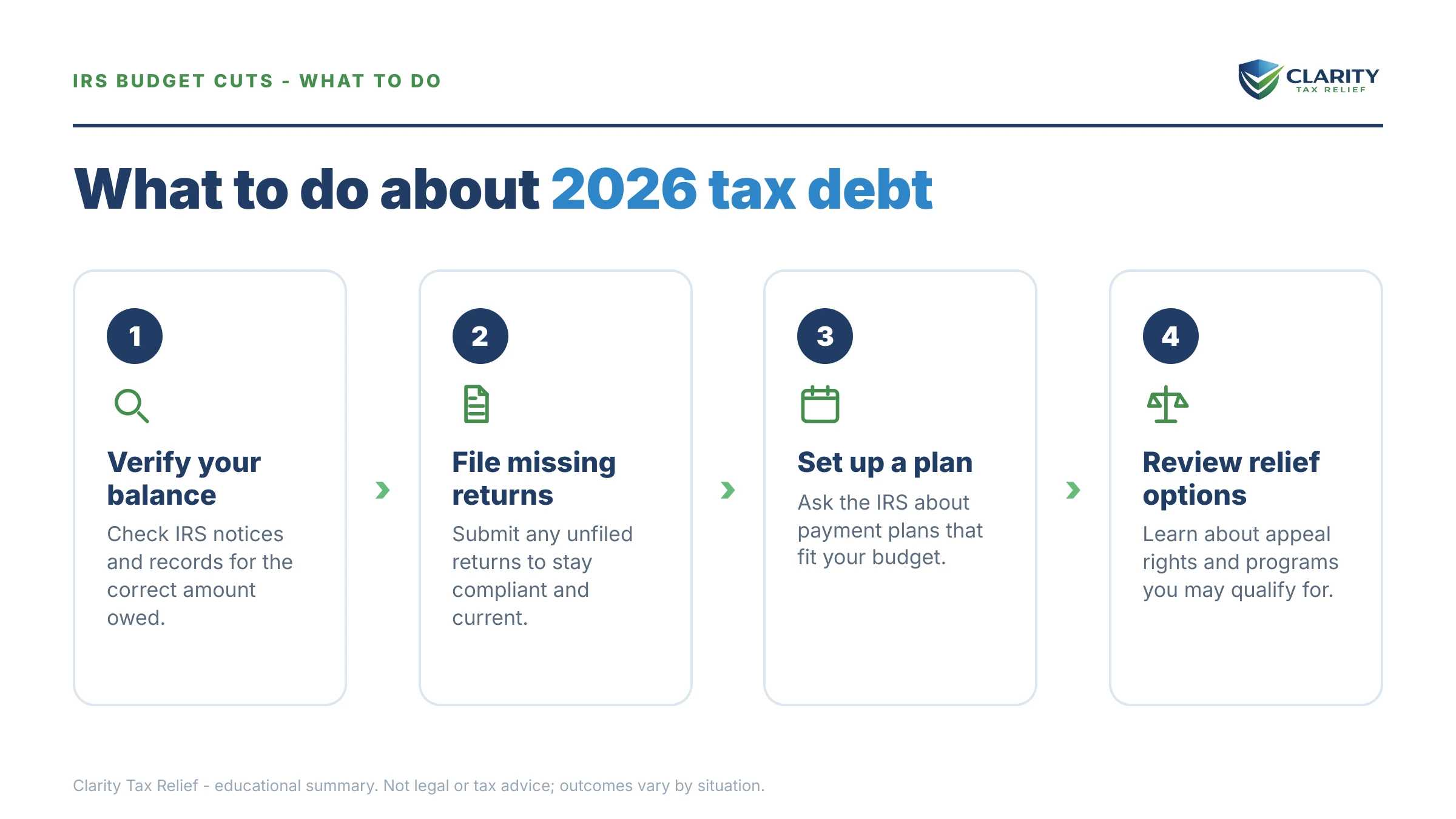
- Pull your real balance online. Log into your IRS online account for balances, notices, and payment history — skip the phone entirely.
- File any unfiled returns. The failure-to-file penalty runs 5% per month — ten times the 0.5% failure-to-pay penalty — so file even if you can't pay a dollar.
- Pick your resolution track. Match your balance and finances to an option in the tables above: payment plan, hardship status, offer, or penalty relief.
- Set it up online, not by mail. Online payment plans approve the same day; mailed forms enter a backlogged paper queue that can take months. Details are on the IRS payment plans page, and our walkthrough of how to set up irs payment plan online shows every screen.
- Save proof of everything. Keep confirmation numbers, screenshots, and certified-mail receipts — short-staffed processing is where paperwork gets lost.
When you can handle this yourself
Most people affected by the cuts don't need to hire anyone. If you agree with the balance, it's under $50,000, and a monthly payment fits your budget, the online payment plan tools work exactly as they did before the layoffs — set it up yourself in twenty minutes and you're done. Genuinely free help also still exists: Low Income Taxpayer Clinics and the Taxpayer Advocate Service survived the cuts, and our guide to free help with irs tax debt lists every no-cost option.
Experienced help changes outcomes when the cuts turn against you: a levy already in motion you can't get a human to release, multiple unfiled years, business or payroll debt, Offer in Compromise math, or a refinance closing date that can't wait out an IRS backlog. In those cases, a practitioner with dedicated IRS access channels does in days what hold music does in months.
Terms in the 2026 headlines, decoded
- ACS (Automated Collection System) — the IRS's computerized collection arm that issues notices, liens, and levies with no individual employee assigned to your case.
- CSED (Collection Statute Expiration Date) — the 10-year deadline from assessment for the IRS to collect, pausable by appeals, offers, and bankruptcy.
- NFTL (Notice of Federal Tax Lien) — a public filing that attaches the government's claim to your property, including the house you're trying to refinance.
- FPLP (Federal Payment Levy Program) — the automated program that can take up to 15% of federal payments such as Social Security.
- AEP (Automatic Exemption from Penalty) — the successor to First-Time Abate arriving summer 2026, granting qualifying penalty relief with no request needed.
IRS budget cuts 2026: your questions, answered
Did the 2026 IRS budget cuts stop collections?
No. Collection notices, refund offsets, lien filings, and levies are generated by the IRS's Automated Collection System, which was not cut. The workforce fell roughly 27% in 2025, which slowed the human side — phones, appeals, paper processing — but a bank levy or wage garnishment can still issue without any employee reviewing your file. Waiting for the IRS to "forget" only grows the balance.
Will the IRS forget my tax debt because of staffing cuts?
No. Your balance sits on the IRS master file and generates notices and interest automatically until it is paid, resolved, or the 10-year collection statute (CSED) expires. Staffing affects how fast a human answers you, not whether the debt exists. The CSED can also be paused by things like an Offer in Compromise or bankruptcy, so waiting it out rarely works the way people hope.
Are audits less likely because of the 2026 IRS cuts?
Fewer employees generally means fewer new human-worked field audits, but the document-matching programs that generate CP2000 underreporter notices are computerized and continue running. If the 1099s and W-2s reported under your Social Security number don't match your return, the computer flags the mismatch with no auditor involved. Automated proposed assessments are the more likely risk for most filers in 2026.
Is it harder to reach the IRS by phone in 2026?
Yes — hold times are long and calls drop, especially during filing season. Almost everything a collections caller needs, including balances, transcripts, and payment plans on debts up to $50,000, can be handled through your IRS online account with no wait. If a processing delay is causing you real financial harm, the Taxpayer Advocate Service exists specifically for cases the normal channels can't resolve.
Can the budget cuts actually help my tax debt case?
In narrow ways, yes. An Offer in Compromise is automatically accepted if the IRS doesn't decide on it within 2 years — with narrow exceptions: a returned or rejected offer stops the clock, and time during court disputes does not count — and slower processing raises the odds that clock matters. Starting summer 2026, the Automatic Exemption from Penalty (AEP) grants first-time penalty relief with no request needed. But interest accrues the entire time you wait — delay is never free.
Do the IRS budget cuts affect state tax collections?
No. State revenue agencies run on state budgets under their own rules. California's Franchise Tax Board, for example, has a 20-year collection statute and remains fully active, and New York's tax warrants still function as civil judgments. If you owe both a state and the IRS, don't assume federal slowdowns buy you time on the state side — deciding which debt to tackle first is its own strategy question.
Should I wait to set up a payment plan until the IRS catches up?
No — the opposite. Online payment plans approve the same day with no human involved, and an active agreement stops the automated escalation toward levies. Every month you wait adds a 0.5% failure-to-pay penalty plus daily compounding interest. The 2026 backlog hurts people who mail paper; it doesn't affect online setup at all.
Your next 24 hours
- Log into (or create) your IRS online account and write down your exact balance, the tax years involved, and the most recent notice issued on the account.
- Gather three things: your last filed return, any IRS letters you've received, and a rough picture of your monthly income and expenses.
- Get a free case review — the 2-minute form at claritytaxrelief.com/#consult or (888) 825-7779. There's no notice clock on this one, but penalties and interest are added by computer every month the balance sits — the short-staffed IRS charges you full price for waiting.
This guide is general information, not tax or legal advice for your specific situation. Eligibility for IRS programs depends on individual facts and circumstances; no outcome is guaranteed.