
Tax Debt Strategy
State Tax Debt vs IRS: Which to Resolve First in 2026
The short answer: resolve the agency with active enforcement first. If neither is levying yet, the state usually comes first — states escalate faster, garnish sooner, and offer fewer relief programs than the IRS. The exceptions: an IRS final notice (LT11) with its 30-day clock, or a federal balance near the $66,000 passport threshold.
Two envelopes, two agencies, one paycheck. You owe the IRS for the same years you owe your state, one of them is now threatening a levy, and every online guide talks about federal debt as if the state balance doesn't exist. The state tax debt vs IRS question isn't "which do I ignore" — it's sequencing: which arrangement to lock in first so neither machine takes money involuntarily.
The good news: both debts are resolvable, and the right order can lower your total monthly cost. The image below shows how the two collection tracks compare at a glance and where your situation sits on each one.
⏱ The real clock: there is no single deadline when two agencies bill you — but penalties and interest accrue on both balances every month, and most state agencies reach garnishment in a fraction of the time the IRS takes. If either side has sent a final notice, the date printed on that notice controls; find it before anything else.
Why you owe both the state and the IRS
One tax problem almost always produces two bills, because the IRS and your state tax the same income and share data with each other. Underwithheld wages, a 1099 year, an early retirement withdrawal, or an unfiled return hits both returns for the same year.
The sharing runs both ways. When the IRS adjusts your federal return — a CP2000, an audit — it reports the change to your state, which issues its own assessment months later. Fixing the federal balance does not make the state balance go away, and vice versa. If you resolve one and forget the other, the forgotten one keeps escalating on its own track.
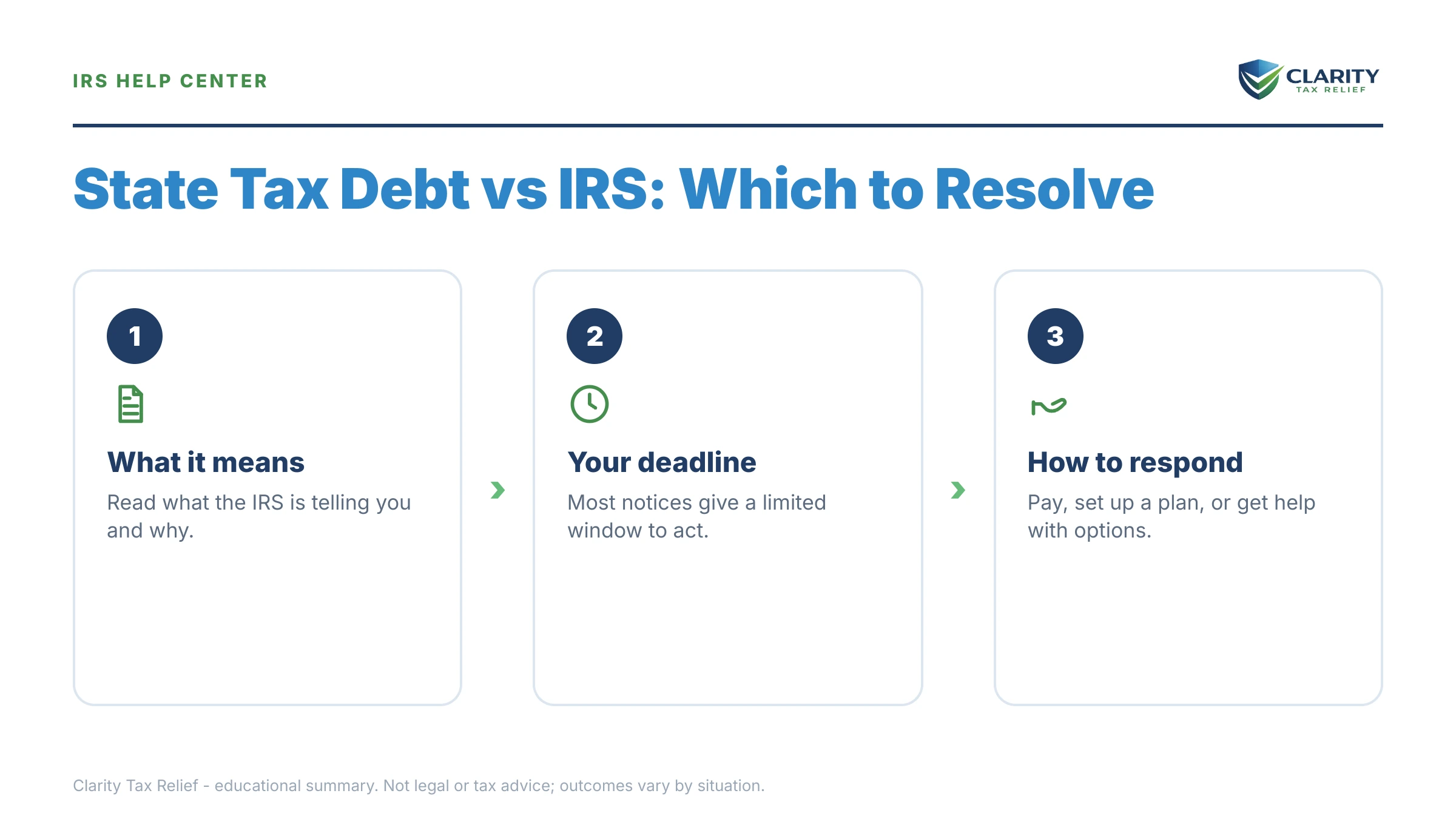
State tax debt vs IRS: how each agency collects
The IRS must send a final notice of intent to levy and wait 30 days before garnishing wages; many states can garnish with far less process and less warning. That single difference drives most of the "which first" answer — the IRS is bigger, but it telegraphs its punches. Your state usually doesn't.
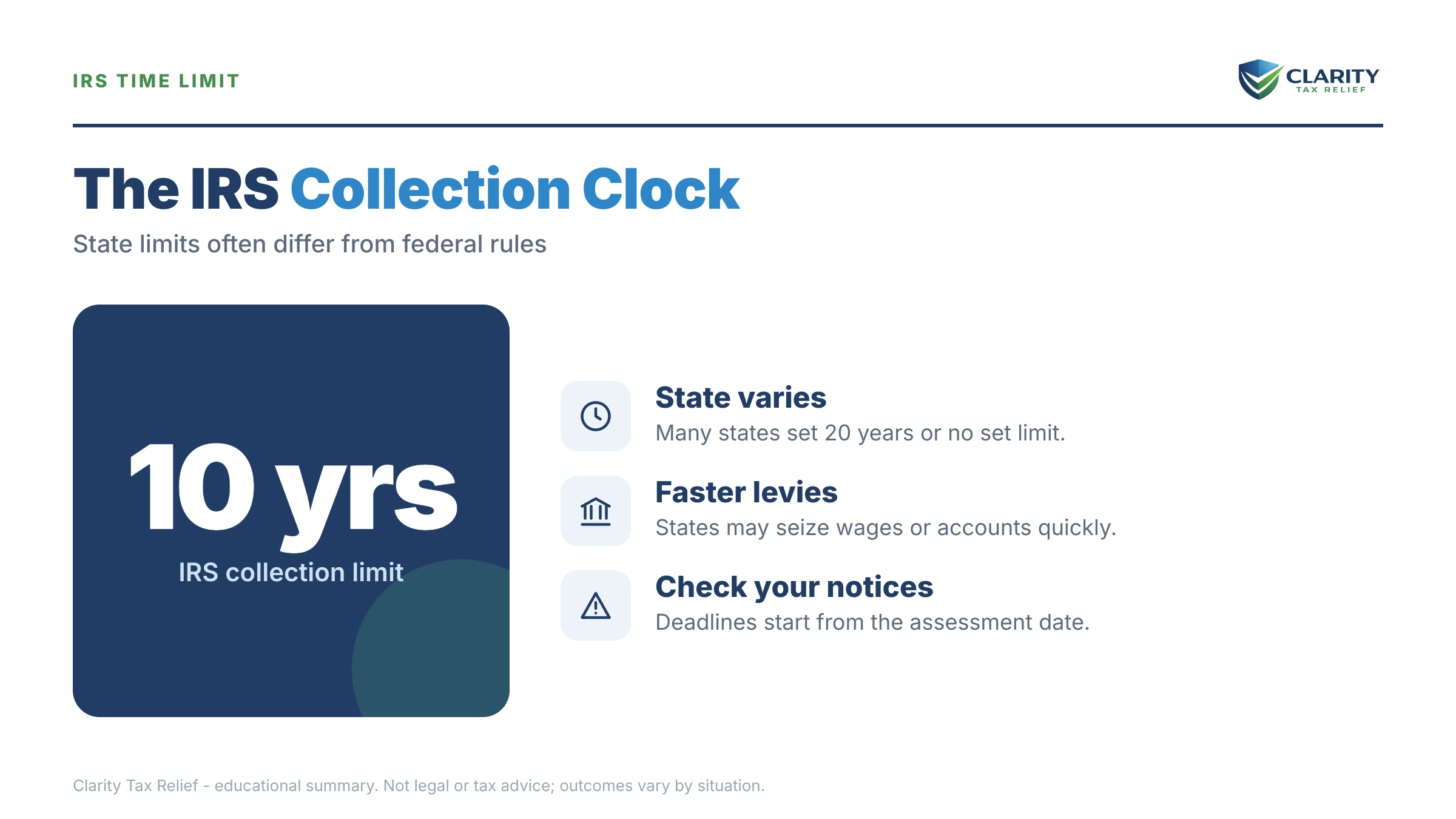
State tools can also be harsher in kind, not just speed. A NYS tax warrant is a civil judgment and a public-record lien the moment it's docketed. California's FTB has 20 years to collect under R&TC §19255 — double the IRS's 10 — and some states suspend professional or driver's licenses over unpaid tax. Meanwhile the IRS holds the heaviest long-run tools: continuous wage levies, a 15% cut of Social Security, and passport certification once your federal debt passes $66,000 in 2026.
| Enforcement area | IRS | State agencies (typical) |
|---|---|---|
| Time to collect | 10 years from assessment (CSED), pausable by appeals, OIC, or bankruptcy | Varies widely — California FTB gets 20 years; some states have no practical expiration |
| Warning before wage garnishment | Final notice (LT11/Letter 1058) plus a 30-day appeal window, by law | Often a single demand letter; garnishment can start much sooner |
| Bank levy | 21-day hold before funds leave the account | Hold periods vary by state; many move faster than the federal process |
| Licenses & travel | Passport certification at $66,000+ (2026 threshold) | Some states suspend driver's or professional licenses for unpaid tax |
| Public record | Notice of Federal Tax Lien (no longer on credit reports) | State liens and warrants; a NY tax warrant is a docketed civil judgment |
| Refund intercepts | Takes your state refund via SITLP after a CP504 | Takes your federal refund via the Treasury Offset Program |
Wondering what a federal levy alone would take from your check? You can estimate it with our IRS Wage Garnishment Calculator — then remember a state garnishment can stack on top of that number, because the two agencies don't coordinate.
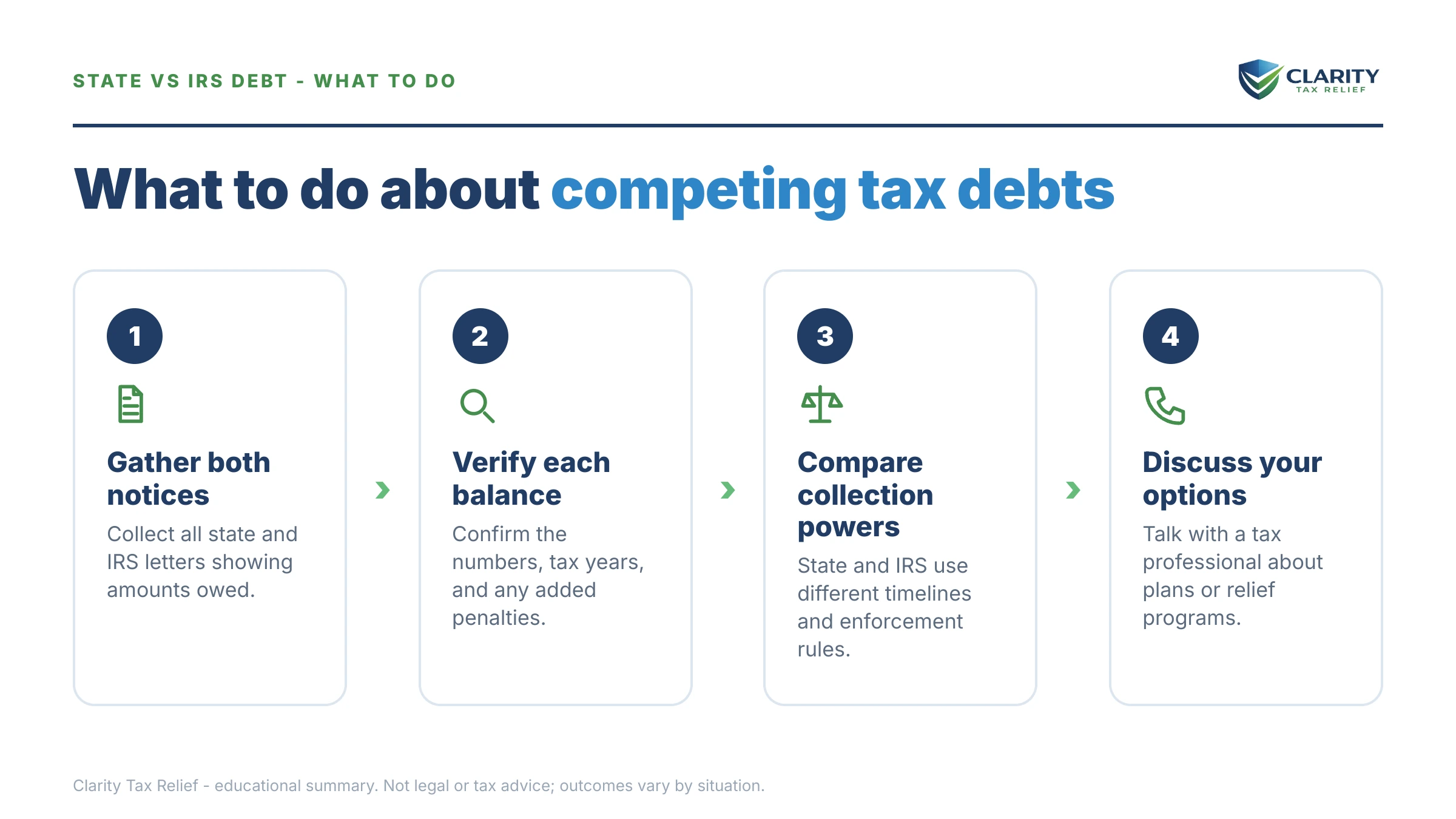
What happens if you ignore both balances
Two unresolved tax debts escalate on two independent, automated tracks — and the state track usually reaches your paycheck first. The sequence looks like this:
- Both agencies bill you. The IRS opens with a CP14 notice; your state sends its own balance-due letter. Penalties and interest are already running on both.
- The state escalates first. A demand letter, then a state lien or warrant, then garnishment or a bank levy — in many states this whole arc is compressed into a few months.
- The IRS sends reminders. CP501 and CP503 arrive while the federal failure-to-pay penalty (0.5% per month) and daily interest compound quietly.
- The IRS takes your state refund. A CP504 authorizes the State Income Tax Levy Program — so even the refund your state owes you gets routed to the IRS.
- The IRS goes final. An LT11 starts a 30-day clock; after it, federal wage and bank levies can begin, and at $66,000+ your passport can be certified for denial or revocation.
Don't count on staffing shortages to slow either track. Federal notices, liens, and levies are issued by automated systems that kept running through the 2025 workforce cuts, and state collection units were never cut at all.
Two agencies billing you — and one already moving to levy?
Send us both notices. An experienced tax professional will map the right resolution order for your exact balances — before the next paycheck gets touched. Free, confidential, no pressure.
Which to resolve first: the five priority rules
Active enforcement always outranks balance size when deciding which tax debt to resolve first. Work through these rules in order:
- Rule 1 — the levying agency goes first. A garnishment, bank levy, or docketed warrant is money leaving today. Stopping it is worth more than any optimization on the other side.
- Rule 2 — no enforcement yet? State first. States reach garnishment faster, their statutes often run longer, and their relief menus are thinner. Get the smaller, faster-moving creditor on a plan before it strikes.
- Rule 3 — the IRS jumps the line in three cases: you've received an LT11 or Letter 1058 (the 30-day CDP window is a right you lose), your federal balance is approaching the $66,000 passport threshold, or a revenue officer has been assigned to your case.
- Rule 4 — file everything first, both sides. The failure-to-file penalty (5% per month) is ten times the failure-to-pay penalty, and neither agency approves a plan with returns missing.
- Rule 5 — sequence for the IRS's own math. When the IRS reviews what you can pay, it can count a required state tax payment as an allowable expense. Setting the state plan first can legitimately lower what the IRS expects from you each month. The reverse is rarely true.
If your state is California, the calculus has its own quirks — the FTB's 20-year statute and DMV/license leverage change the math. See FTB vs IRS which first for the California-specific version of this decision, and California's 20-year collection statute for why waiting out the FTB almost never works.
Your resolution options on each balance
You will need two separate agreements — no program covers both agencies. The IRS menu is standardized nationwide; state menus vary, so treat the state column below as the pattern, then confirm with your state's agency. (For the full walkthrough of each federal program, see how to settle tax debt yourself.)
| Option | IRS eligibility (2026) | State availability |
|---|---|---|
| Short-term payment plan | Full pay within 180 days; $0 setup fee; interest and penalties continue | Most states offer short extensions, but windows are usually tighter |
| Guaranteed installment agreement | Balance ≤ $10,000, returns filed — approval is automatic by statute | No true state equivalent; small-balance plans are usually easy in practice |
| Streamlined installment agreement | ≤ $25,000 (or ≤ $50,000 with direct debit); up to 72 months, no financial statement | Most states cap plan length shorter and may still file a lien during the plan |
| Currently Not Collectible / hardship | Income doesn't cover IRS allowable living expenses; collection pauses, debt remains | Some states have a hardship status; many just delay rather than formally suspend |
| Offer in Compromise | $205 fee; 20% down on lump-sum offers (both waived with low-income certification); roughly 1 in 5 accepted in FY2024 | Varies — some states run their own OIC (e.g., the FTB); others have none |
| Penalty relief | First-Time Abate with 3 clean prior years; the automatic AEP program begins replacing it in summer 2026 | State abatement exists in many states but usually requires reasonable cause |
Worked example: $48,300 split across two agencies
Say you owe $48,300 total — $33,800 to the IRS and $14,500 to your state — you rent your home, and the state has just mailed a garnishment notice. This is hypothetical, but the math is how the sequencing decision actually plays out.
If you do nothing, the state garnishment lands first. Suppose your disposable pay is $3,200 a month and your state takes a flat share — often around 25%, depending on the state. That's roughly $800 a month, involuntarily, applied only to the state balance while the untouched $33,800 federal debt keeps compounding toward its own CP504 and LT11.
Now run the sequenced version:
- State first: before the garnishment takes effect, you request a state payment plan. Say the state approves $400 a month. The garnishment never starts, and you've cut the state's bite in half.
- IRS second: $33,800 is under the $50,000 streamlined ceiling, so you set up a direct-debit installment agreement online with no financial statement. Spread over the maximum 72 months, that's $33,800 ÷ 72 ≈ $470 a month as a floor — interest and the 0.5% monthly penalty keep accruing, so paying more than the minimum shortens the real payoff.
- Total: about $870 a month, chosen by you — versus $800 a month seized by the state plus a federal levy still coming.
One more renter-specific angle: with no home equity, your assets are thin, and if income barely clears the IRS's allowable-expense standards, the OIC or hardship math can genuinely work in your favor. That's a possibility to have evaluated, never a promise — the IRS accepted roughly 1 in 5 offers in FY2024, and state settlement programs are typically stricter.
| Combined balance | Federal-side move | State-side move & priority note |
|---|---|---|
| Under $10,000 | Guaranteed installment agreement if the IRS share is ≤ $10,000; setup is a phone call or online form | Small state plan; fully DIY territory — just don't let either notice sequence run |
| $10,000–$25,000 | Streamlined agreement online, no financials | State plan first if any demand letter has arrived; watch for a state lien filing |
| $25,000–$50,000 | Streamlined up to 72 months — direct debit generally required above $25,000 | State first unless the IRS has gone final; set the state payment before the IRS computes yours |
| $50,000–$100,000 | Above the streamlined ceiling: financial disclosure (Form 433 series) and negotiation; passport risk begins at $66,000 federal | Larger state balances often get assigned to a collector or outside agency — respond before that handoff |
| $100,000+ | Likely revenue-officer territory; representation changes outcomes here | Expect liens/warrants on the state side; coordinate both plans so neither defaults the other |
How to respond, step by step
- Pull both balances — log into your IRS online account for the federal figure, and get the state number from your most recent state notice or the state agency's online portal. Write both down with the tax years attached.
- Identify active enforcement — check whether either side has issued a garnishment, bank levy, tax warrant, or final notice of intent to levy. Whichever agency is already taking money — or is 30 days from being allowed to — goes first.
- File every unfiled return on both sides — neither the IRS nor any state will approve a payment arrangement while returns are missing, and the failure-to-file penalty (5% per month) is ten times the failure-to-pay penalty. File even if you can't pay a dollar.
- Stop the active levy first — usually the state's — contact the levying agency, request a payment plan or hardship release, and get the release confirmed in writing before the next pay date. A voluntary plan almost always costs less per month than an involuntary garnishment.
- Lock in the IRS arrangement before its notices escalate — with the state plan set, put the federal balance on a short-term plan (up to 180 days, $0 setup) or a streamlined installment agreement (up to 72 months for balances of $50,000 or less) before a CP504 or LT11 arrives.
- Protect both agreements going forward — fix your withholding or quarterly estimates so next year's return doesn't create a new balance — a fresh liability can default both plans at once and restart both collection machines.
Setup details for the federal side are on the IRS's own payment plans and installment agreements page; payments themselves go through IRS.gov/payments, never a third party.
When you can handle this yourself — and when help changes the outcome
Most two-agency situations under about $25,000 combined are genuinely DIY. If your returns are filed, neither side has gone final, and both balances fit standard plan thresholds, you can set up both agreements yourself in an afternoon — and there are real free help options for IRS debt, including Low Income Taxpayer Clinics and the Taxpayer Advocate Service (taxpayeradvocate.irs.gov) if you hit a wall.
Experienced help earns its cost in specific situations: a garnishment or bank levy already in motion on either side, multiple unfiled years across both agencies, a federal balance over $50,000 (where financial disclosure begins) or nearing $66,000 (passport), business or payroll tax in the mix, or any case where the sequencing between the two agencies — and the allowable-expense interplay — meaningfully changes your monthly cost. If your debts are old enough or deep enough that discharge is on the table, compare Chapter 7 vs 13 for tax debt before committing to years of payments.
Terms on your notices, decoded
- Tax warrant — a state's version of a judgment for unpaid tax; in New York it's docketed like a court judgment and becomes a public-record lien.
- CSED — Collection Statute Expiration Date: the IRS's 10-year deadline to collect, counted from assessment and pausable by appeals, an OIC, or bankruptcy. See the 10-year collection statute.
- SITLP — the State Income Tax Levy Program, through which the IRS seizes your state refund for a federal debt.
- Treasury Offset Program — the federal system states use to intercept your IRS refund for state tax debt; details in state refund taken for IRS debt.
- Levy vs. garnishment — a levy is a one-time or continuous seizure of property or pay; "garnishment" is the everyday word for a levy on wages. Both agencies can run one against you at the same time.
- Allowable expenses — the IRS's national and local living-cost standards that determine what you can afford to pay; a required state tax payment can count among them.
State tax debt vs IRS: your questions, answered
Should I pay my state taxes or the IRS first?
Resolve whichever agency has active enforcement — a garnishment, bank levy, or tax warrant — first, because that is the balance doing damage today. If neither side is levying yet, the state usually comes first: most states escalate faster than the IRS and offer fewer relief programs. The exceptions are an IRS final notice (LT11) with its 30-day clock, or a federal balance near the $66,000 passport-certification threshold.
Can the state and the IRS garnish my wages at the same time?
Yes. The two agencies do not coordinate, so a state garnishment and an IRS wage levy can hit the same paycheck simultaneously, and the combined bite can leave you unable to cover rent. Each garnishment has to be released separately — a payment plan or hardship finding with one agency does nothing to stop the other.
Does state tax debt expire like IRS debt does?
Not on the same schedule, and sometimes not at all. The IRS generally has 10 years from assessment to collect (the CSED). States set their own rules: California's FTB has 20 years under R&TC §19255, and some states have no practical expiration on assessed tax debt. Never build a plan around waiting out a state statute without confirming that state's actual rule.
Can the IRS take my state tax refund for federal taxes?
Yes. Under the State Income Tax Levy Program (SITLP), the IRS can seize your state refund once it issues a CP504 notice. It works in reverse too: states can intercept your federal refund through the Treasury Offset Program. When you owe both agencies, assume every refund on either side will be taken until both balances are resolved.
Do states offer an Offer in Compromise like the IRS?
Many do, but each state runs its own program with its own forms and standards — and some states have no settlement program at all. California's FTB, for example, has its own offer in compromise separate from the IRS's. Acceptance is means-tested everywhere: the IRS accepted roughly 1 in 5 offers in FY2024, and state programs are often stricter.
Which is worse: owing the state or owing the IRS?
In the short run, the state is usually the more dangerous creditor — faster escalation, garnishments that start sooner, license suspensions in some states, and tax warrants that work like court judgments. Over the long run, the IRS has heavier tools: continuous wage levies, a 15% Social Security levy, and passport certification above $66,000. That is why sequencing both debts, not ignoring either one, is the answer.
Can one payment plan cover both my state and IRS tax debt?
No — you need a separate agreement with each agency, each with its own application, terms, and default rules. There is one helpful interaction: when the IRS calculates what you can afford to pay, it can treat a required state tax payment as an allowable expense, which is a practical reason to lock in the state plan first in many cases.
Will bankruptcy wipe out both state and IRS tax debt?
Sometimes. Income taxes — federal and state — can be dischargeable in bankruptcy if they pass the age-based tests: the return was due more than 3 years ago, filed more than 2 years ago, and the tax was assessed more than 240 days ago. Trust-fund debts like withheld payroll tax or collected sales tax generally are not dischargeable on either side, and liens already filed can survive the discharge.
Your next 24 hours
- Find the enforcement status on each notice. Pull out the most recent letter from each agency and locate two things: the total balance and any phrase like "intent to levy," "final notice," "warrant," or "garnishment." That one check tells you which agency goes first.
- Gather your numbers. Last year's federal and state returns, both notices, and a rough monthly income-and-rent figure — that's everything needed to size both payment plans (and to test whether hardship or settlement math applies to you).
- Get both balances reviewed together — free. If a garnishment is already in motion or your combined debt tops $25,000, call (888) 825-7779 or use the 2-minute form. An experienced tax professional will sequence both agencies in one plan, while interest is still the only thing accruing.
This guide is general information, not tax or legal advice for your specific situation. Eligibility for IRS programs depends on individual facts and circumstances; no outcome is guaranteed.