
IRS Levies
State Income Tax Levy Program (SITLP): How the IRS Takes Your State Refund (2026)
The short answer: the State Income Tax Levy Program (SITLP) is the automated IRS program that seizes your state income tax refund and applies it to your federal tax debt. The IRS can do this after only a CP504 — before any final notice — and your appeal rights arrive afterward, on notice CP92, with a 30-day clock.
Your state refund was supposed to hit your bank account weeks ago. Instead, the state's "Where's My Refund" tool went quiet, and now an IRS letter says the money went to Washington. That's the state income tax levy program at work — and while the refund may be gone, the debt behind it is very fixable from here.
What makes SITLP different from every other IRS levy: it's one of the few seizures the law lets the IRS carry out before sending you a final notice of intent to levy. The warning was the pay-by date on your CP504 notice; the levy itself is announced afterward, on a CP92. The image below shows exactly what that post-levy notice looks like and where to find the one date that controls your appeal rights.
⏱ Your deadline: if you're holding a CP92 — the notice the IRS sends after levying your state refund — you have 30 days from the date printed on it to request a Collection Due Process hearing with Form 12153. That hearing is your one shot at independent review of this levy, including getting money returned in the right circumstances.
Why the state income tax levy program took your state refund
SITLP is an automated data match between the IRS and state tax agencies: when a state is about to pay a refund to someone with an unpaid federal tax debt, the state sends that refund to the IRS instead. No revenue officer reviewed your file. No human decided you were a target. A computer matched your Social Security number against the IRS's balance-due database, and your state's refund system did the rest.
The legal trigger is the CP504. That notice — "Notice of Intent to Levy" — satisfies IRC §6331(d), the advance-warning requirement, specifically for state refunds. Once the CP504's pay-by date passes, your state refund is fair game every filing season until the debt is resolved or the 10-year collection statute (the CSED) runs out.
Most states with a personal income tax participate in SITLP, along with some city tax agencies. If you live in a no-income-tax state like Florida or Texas, there's no state refund to intercept — which is why residents there skip this stage entirely and hear from the IRS through other channels, like the federal payment levy program instead.
SITLP vs. the Treasury Offset Program vs. FPLP — which one took your money?
Three separate government programs intercept payments, and they run in different directions — knowing which one hit you determines who you call.
- SITLP: the IRS takes your state refund for a federal tax debt. You'll get a CP92, and the IRS is who you deal with.
- Treasury Offset Program (TOP): the U.S. Treasury takes your federal refund for state tax debt, child support, or student loans. Different notice, different agency — see the Treasury Offset Program, explained.
- FPLP: a continuous 15% levy on federal payments like Social Security — a different program with its own notices.
If both your state and federal refunds vanished in the same season, you may be caught in two programs at once — a state refund taken for IRS debt and a federal refund offset can absolutely happen in the same year, each requiring its own response.
What happens if you ignore a SITLP levy
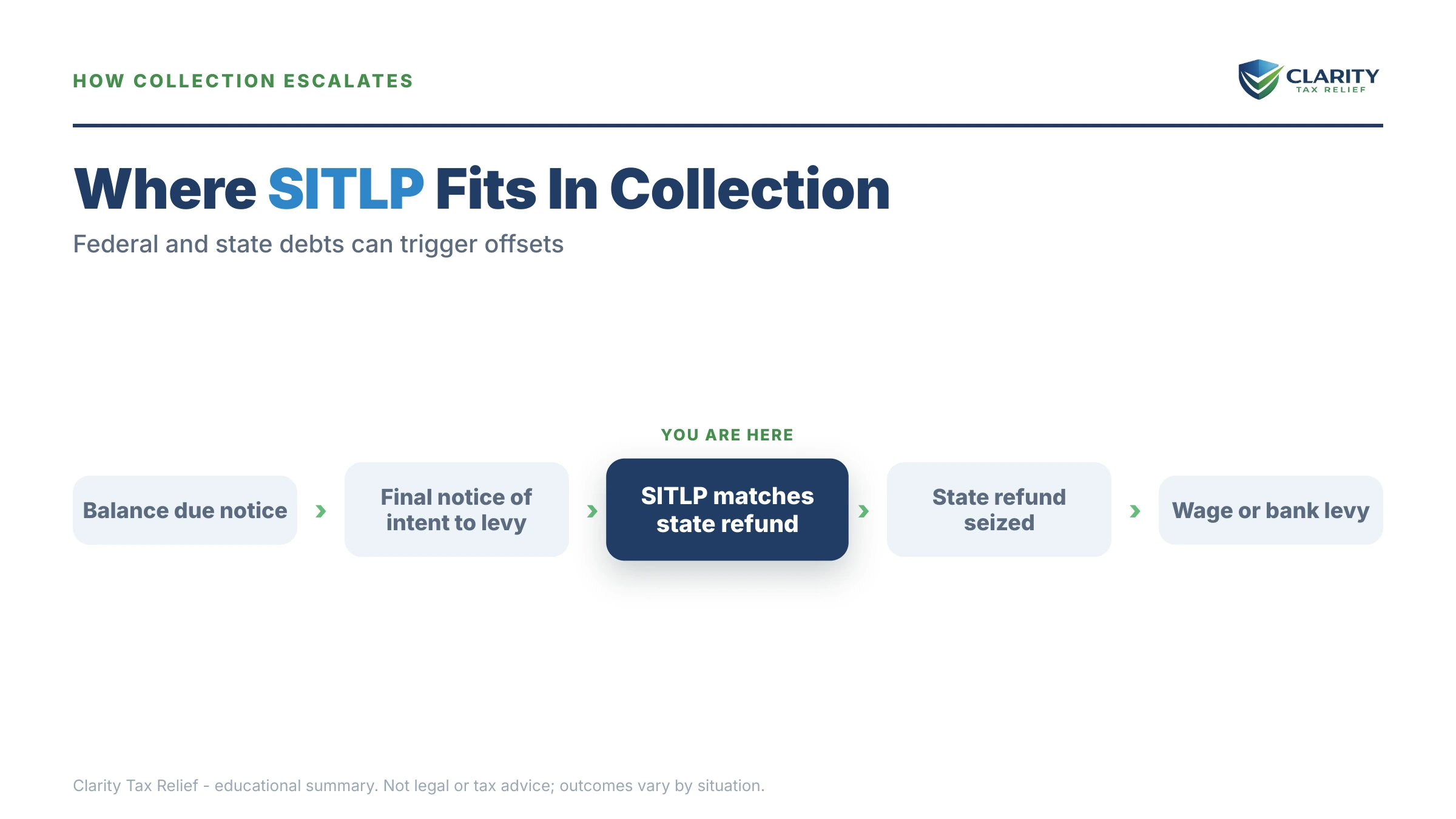
A SITLP intercept sits in the middle of the IRS collection sequence — it's a warning shot with money attached, and the stages after it reach your paycheck and bank account. Here's the order things move in if nothing changes:
- CP504 pay-by date passes — your account becomes SITLP-eligible, and the IRS can also file a federal tax lien on your record.
- State refund intercepted; CP92 arrives — you are here. The refund is applied to the oldest balance, and a 30-day Collection Due Process window opens.
- LT11 / Letter 1058 — the final notice of intent to levy. Thirty days after it, the IRS can reach wages, bank accounts, and most other assets — see our LT11 guide.
- Wage and bank levies — a wage levy is continuous until released; a bank levy freezes funds for a 21-day hold before they're sent to the IRS.
- Repeat interceptions — every future state refund keeps getting taken, year after year, until the balance is resolved. For debts that grow past $66,000 in 2026, passport certification enters the picture too.
Meanwhile the balance itself keeps climbing: the failure-to-pay penalty adds 0.5% per month, and interest compounds on top. In 2026, with IRS staffing down roughly 27%, getting a human on the phone to fix things is harder than ever — but the automated systems that run SITLP never furlough anyone. Waiting only means the machine takes the next step.
Your state refund is gone — the next levy doesn't have to happen
Send us your CP92 or CP504. An experienced tax professional will map exactly where you are in the collection sequence and which resolution fits — free, before the 30-day hearing window on your CP92 closes.
Your deadlines and rights at each SITLP stage
Each notice in the SITLP sequence carries a specific right — and a specific window to use it. This is the reference most readers screenshot:
| Notice | What it means | Your window | The right at stake |
|---|---|---|---|
| CP504 | Intent to levy your state refund under §6331(d); levy hasn't happened yet | The pay-by date printed on the notice | Resolve now and the state refund never gets taken; a lien filing also becomes possible after this date |
| CP92 | Your state refund was levied and applied to your federal balance | 30 days from the notice date | Collection Due Process hearing (Form 12153) — independent Appeals review, with Tax Court review preserved |
| LT11 / Letter 1058 | Final notice — wages, bank accounts, and other assets become reachable | 30 days from the notice date | Pre-levy CDP hearing; miss it and the IRS can levy without further warning |
Notice the asymmetry: for wages and bank accounts, the hearing comes before the levy. For state refunds, it comes after. Congress carved state refunds out as an exception, on the theory that a refund is money you weren't living on yet. That's cold comfort if you'd budgeted for it — which is exactly what the post-levy hearing exists to address.
Your options after a state refund levy
A SITLP intercept only ever pays part of the debt — your job now is to resolve the rest before the sequence reaches your paycheck. For a full walkthrough of how IRS levies work and every path to stopping them, our guide on how to stop IRS wage garnishment is the hub; here's how each option applies at this stage:
| Option | Who's eligible | What it does for you |
|---|---|---|
| Pay in full | Anyone | Stops penalties, interest, future intercepts, and the entire notice sequence immediately |
| Short-term plan (up to 180 days) | Balances you can clear within 180 days | $0 setup fee; enforcement pauses while interest and penalties continue |
| Guaranteed installment agreement | Owe $10,000 or less (tax), with a clean recent filing-and-payment history, and can pay within 3 years | The IRS must accept it — no financial disclosure, and new levies stop while it's active |
| Streamlined installment agreement | ≤ $25,000 (or ≤ $50,000 with direct debit) | Up to 72 months, set up online, no detailed financials; halts levy escalation |
| Currently Not Collectible | Paying anything would leave you unable to cover basic living expenses (proven on Form 433-F) | Pauses active collection; the debt remains and refund intercepts can still occur |
| Offer in Compromise | Means-tested — your assets plus future income genuinely can't cover the debt; $205 fee, 20% down on lump-sum offers (both waived with low-income certification) | Settles for less than owed when the math supports it — the IRS accepted roughly 1 in 5 offers in FY2024, so this is a qualification question, not a wish |
One caveat that surprises people: even on an active payment plan, the IRS keeps your federal refunds and applies them to the balance. New levies stop; refund offsets don't. If penalties make up a big slice of your balance, penalty relief can shrink it — first-time abatement applies if your prior three years are clean, and starting summer 2026 the new Automatic Exemption from Penalty begins granting the same relief without a request.
If the intercepted refund was money you needed for rent, utilities, or medical care, a separate track exists: the IRS can release or return levied funds when the levy creates genuine economic hardship. Our guide to a levy causing hardship covers exactly what to document and how to ask.
A worked example: $8,900 owed, one intercepted refund
Say you're a W-2 employee, filing single, and you owe the IRS $8,900 from a prior year. This spring the state approved you a $1,300 refund — SITLP intercepted it, and your CP92 shows $1,300 applied, leaving $7,600. Here's the honest math on each path (all figures hypothetical and rounded):
- Do nothing: the failure-to-pay penalty alone adds about $38/month (0.5% × $7,600), plus daily-compounding interest. Next year's state refund gets taken too, and the LT11 that opens the door to a wage levy is the next major notice in line. You can estimate how fast your own balance grows with our penalty and interest calculator.
- Guaranteed installment agreement: at $8,900 (and $7,600 after the intercept) you're under the $10,000 line. If your recent filing history is clean and you can pay within 3 years, the IRS must accept: $7,600 ÷ 36 ≈ $211/month, and no new levies while you pay.
- Streamlined agreement over 72 months: $7,600 ÷ 72 ≈ $106/month minimum — easier on the budget, but interest runs longer, so the total cost is higher. Paying extra whenever you can shortens both.
- Offer in Compromise: for a single W-2 earner with a steady paycheck and $7,600 owed, the IRS's collection-potential math usually shows it can collect in full through a payment plan — meaning an OIC likely isn't a fit here. It becomes realistic when income drops or the balance dwarfs what your finances could ever produce.
The quiet lesson in this example: that $1,300 refund existed because you over-withheld state tax all year. Trim your state withholding, and next year that money lands in your paychecks — where you can aim it at the IRS balance on your schedule instead of losing it to an automated intercept.
How to respond, step by step
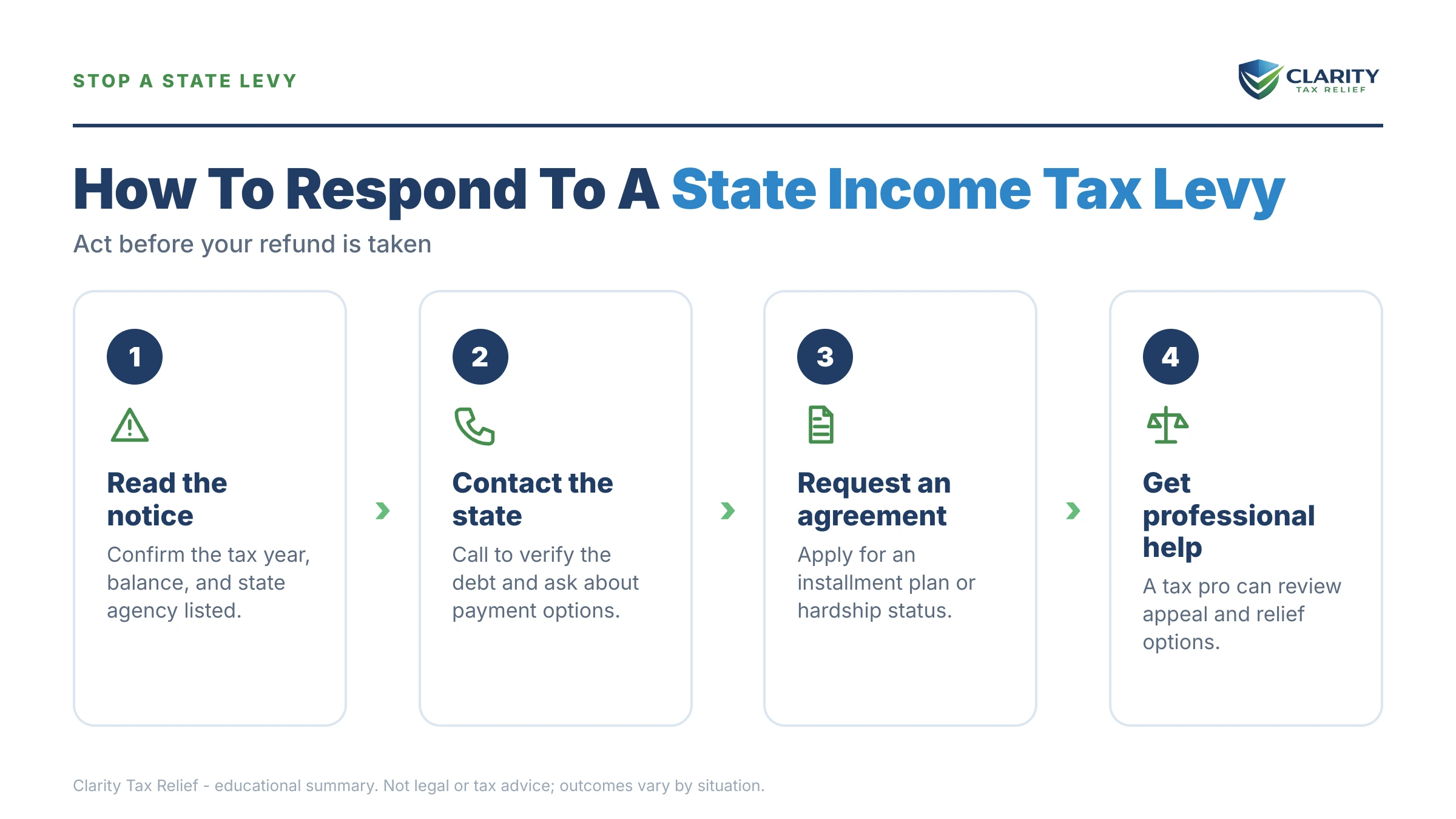
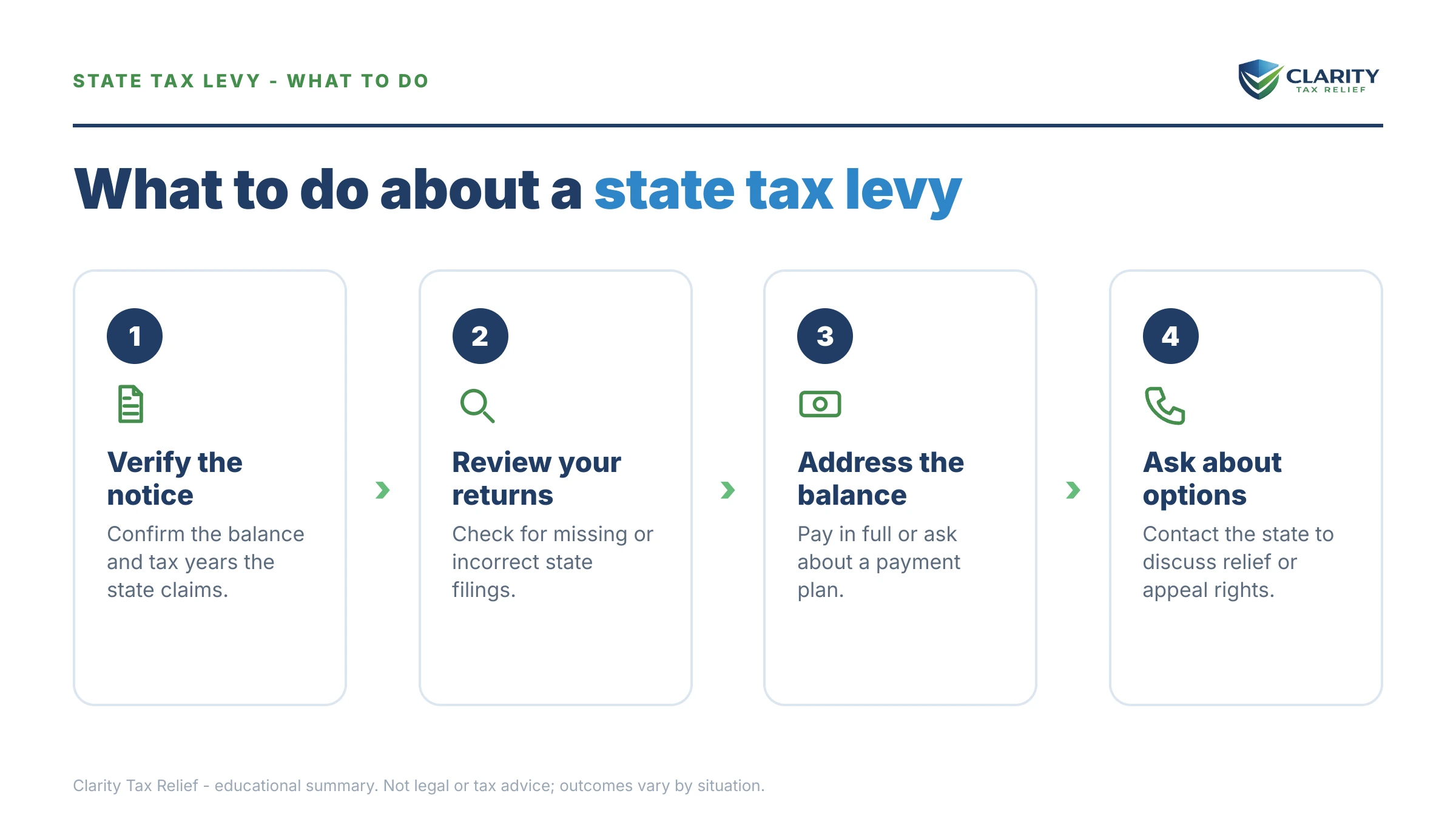
- Identify which notice you're holding. Check the code in the corner: a CP504 means the levy hasn't happened yet and you can still get ahead of it; a CP92 means your state refund is already gone and a 30-day appeal clock is running from the date printed on it.
- Verify the balance in your IRS online account. Log in at IRS.gov and confirm the tax years, the amount owed, and that the levied refund actually posted to your account. Levied money occasionally gets applied to the wrong year — catch it now.
- File Form 12153 within 30 days if you want a hearing. If you dispute the debt, the levy hit a non-liable spouse's share, or the seizure created a genuine hardship, request a Collection Due Process hearing before the CP92's 30-day deadline. Missing it forfeits your right to independent Appeals review of this levy.
- Put the remaining balance into a resolution before the next notice. Set up a payment plan online, request hardship status if you genuinely can't pay, or evaluate an Offer in Compromise if your finances qualify. An active agreement stops the escalation toward wage and bank levies.
- Adjust your state withholding so next year's refund stops feeding the debt. A big state refund means you over-withheld all year. Trim your state withholding to keep that money in your paycheck, and direct it at the IRS balance on your terms instead of losing it to next spring's automated intercept.
When you can handle this yourself — and when help changes the outcome
Most SITLP cases at this dollar level are genuinely do-it-yourself. If you agree you owe the money, the balance is under $10,000, and it's a single tax year, you can set up a guaranteed or streamlined agreement in your IRS online account in about twenty minutes — no professional required, and the escalation stops there.
Experienced help earns its cost in specific situations: an LT11 has already arrived and a wage or bank levy is imminent; the levied refund belonged partly to a non-liable spouse; you have multiple unfiled years (the IRS won't grant most agreements until returns are in); you dispute the underlying balance; or the debt is large enough that the choice between a payment plan, hardship status, and an offer involves real math with real money at stake. In those cases, the order you fix things in — returns first, then penalties, then the balance — changes what you ultimately pay.
Terms on your notice, decoded
- SITLP: the State Income Tax Levy Program — the automated IRS–state data match that redirects state refunds to federal tax debt.
- Levy vs. lien: a levy takes property (like this refund); a lien is a legal claim recorded against your property that secures the debt without taking anything yet.
- IRC §6331(d): the law requiring the IRS to warn you before levying — for state refunds, the CP504 is that warning.
- CP92: the notice confirming your state refund was levied, showing the amount taken and opening your 30-day hearing window — full details in our CP92 notice guide.
- CDP hearing: a Collection Due Process hearing — independent review by the IRS Office of Appeals, requested on Form 12153, with the right to go to Tax Court if you disagree with the result.
- CSED: the Collection Statute Expiration Date — the end of the IRS's 10-year window to collect, which certain actions (appeals, offers, bankruptcy) can pause and extend.
One more distinction worth knowing: SITLP is a federal program reaching state money. States run their own levy machinery against state debts — California's Franchise Tax Board, for instance, can execute an FTB bank levy under entirely separate state rules and timelines.
State income tax levy program questions, answered
Can I get my state refund back after a SITLP levy?
Sometimes, but not automatically. If you request a Collection Due Process hearing within 30 days of your CP92, Appeals can order levied money returned when the levy was premature, procedurally wrong, or hit the wrong person. The IRS can also return levied funds when the levy creates an economic hardship — but you must ask and prove it; the money doesn't come back on its own.
Can the IRS take my state refund without sending a final notice?
Yes. State tax refunds are one of the few things the IRS can levy before issuing a final notice of intent to levy. Once the CP504's pay-by date passes, your account can enter the State Income Tax Levy Program. Your Collection Due Process hearing rights arrive after the levy, on the CP92, with a 30-day window to use them.
Is the State Income Tax Levy Program the same as the Treasury Offset Program?
No — they run in opposite directions. Under SITLP, the IRS takes your state refund to pay a federal tax debt. Under the Treasury Offset Program, the U.S. Treasury takes your federal refund to pay state tax debt, child support, student loans, or other government debts. If a refund vanished, the notice you received tells you which program took it and who to contact.
Which states participate in the State Income Tax Levy Program?
Most states that collect a personal income tax participate, along with some city tax agencies. States with no income tax — like Florida, Texas, and Nevada — have no refund to intercept, so residents there never see a SITLP levy. Your CP92 names the exact state agency that sent your refund to the IRS, so you don't have to guess.
Will the IRS take my state refund every year until the debt is paid?
Yes — SITLP is automated and recurring, so every state refund you generate can be intercepted until the balance is resolved or the 10-year collection statute expires. The practical fix is twofold: put the debt into a resolution (payment plan, hardship status, or an accepted offer) and adjust your state withholding so you stop over-paying the state and creating a refund for the IRS to grab.
What if the levied state refund came from a joint return and the debt is only my spouse's?
You may be able to recover your share. When a jointly filed state refund is levied for one spouse's separate federal debt, the non-liable spouse can ask the IRS to return their portion of the refund. Act inside the 30-day CP92 window if you can — raising it in a Collection Due Process hearing preserves your rights — and gather proof of each spouse's income and withholding for that state return.
Does setting up a payment plan stop the State Income Tax Levy Program?
Generally yes for new levies — while an installment agreement is active and you're keeping up with payments, the IRS doesn't issue new levies, including SITLP intercepts. Two caveats: money already sent to the IRS before your agreement started usually stays applied to the balance, and the IRS will still keep federal refunds and apply them to your debt even while you're on a plan.
Your next 24 hours
- Find the notice code and date. Top corner of the letter: CP504 means the levy is still preventable; CP92 means it happened and your 30-day hearing clock started on the date printed there. Circle that date.
- Gather three things: the notice itself, your most recent federal and state returns, and a rough picture of your monthly income and bills — that's everything needed to know which resolution fits.
- Get a free case review — call (888) 825-7779 or use the 2-minute form. If you're inside the CP92's 30-day window, having the notice reviewed before it closes keeps every option, including the hearing, on the table.
For the IRS's own pages on the notices and programs covered here, see Understanding your CP504 notice and the IRS payment plans page. If a levy has created hardship and you can't get traction with the IRS directly, the Taxpayer Advocate Service is an independent avenue for help.
This guide is general information, not tax or legal advice for your specific situation. Eligibility for IRS programs depends on individual facts and circumstances; no outcome is guaranteed.