
IRS Levies
Federal Payment Levy Program: How the IRS's Continuous 15% Levy Works in 2026
The short answer: the Federal Payment Levy Program (FPLP) is the IRS's automated, continuous levy on federal payments — up to 15% of Social Security benefits and federal salaries, and up to 100% of federal contractor and Medicare payments — every payment cycle until the debt is resolved. It generally starts 30 days after a final notice: CP90, CP297, or CP91.
You run payroll every two weeks, and this month the math broke: a federal payment you were counting on — a contract invoice, a benefit deposit — arrived short or not at all, with nothing but a levy notation to explain it. That's the FPLP. It isn't a revenue officer who decided to squeeze you; it's a computer match between the IRS and the Treasury's payment system, which makes it relentless — but also predictable and fixable.
If a CP90, CP297, or CP91 arrived before the money stopped, the image below shows exactly what that final notice looks like and where to find the date that starts your appeal clock.
⏱ Your deadline: you generally have 30 days from your CP90, CP297, or CP91 final notice to request a Collection Due Process hearing before an FPLP levy on benefits like Social Security begins — but federal contractor payments and state tax refunds can be levied first under IRC 6330(f), with your CDP hearing rights arriving after the levy (CP90C/CP297C). If the levy is already running, there is no built-in end date — it continues every payment cycle until you act or the collection statute expires.
Why the federal payment levy program is taking your money
The FPLP is an automated matching program between the IRS and the Treasury's Bureau of the Fiscal Service, authorized by IRC §6331(h). The IRS transmits unresolved tax balances to the Fiscal Service, which compares your Social Security number or EIN against every outgoing federal payment file. When a match hits, a slice of your payment is redirected to your tax debt before the money ever reaches you.
Three things put you in the match pool: an assessed balance, a final levy notice already mailed, and no resolution on file — no payment plan, no hardship status, no pending offer. No human reviews the match. That's why the IRS's 2025 workforce cuts don't slow this down: the people answering phones got scarcer, but the computer transmitting levies never stopped.
For most individual balances, the notice that opened the door was a CP90 notice. Businesses — including payroll tax balances — typically get a CP297 notice. Social Security recipients get the CP91 Social Security levy notice. Each one starts the same 30-day clock; check the notice number in the upper corner of your letter against the image below to confirm which one you're holding.
What the FPLP can take — and what it can't
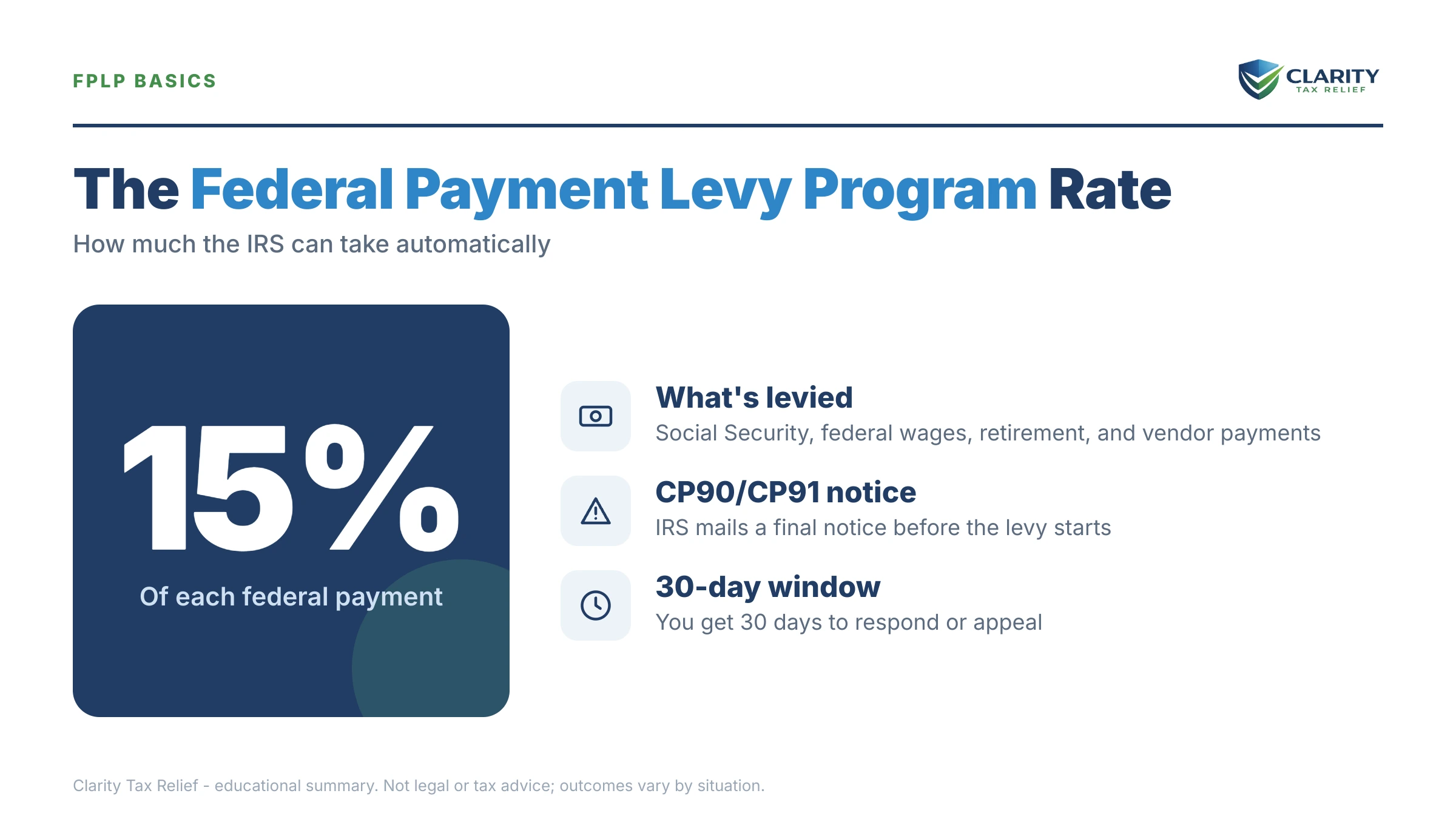
The FPLP takes up to 15% of most federal benefit and salary payments, and up to 100% of federal contractor, vendor, and Medicare provider payments. The percentage depends entirely on the payment type, not on your ability to pay — the program doesn't look at your budget before it withholds.
| Federal payment | Maximum FPLP levy |
|---|---|
| Social Security retirement & disability (OASDI) | Up to 15% of each monthly benefit |
| Federal employee salary | Up to 15% |
| Federal retirement (OPM) annuities | Up to 15% |
| Railroad Retirement Board benefits | Up to 15% |
| Federal contractor / vendor payments | Up to 100% of each payment |
| Medicare provider payments | Up to 100% of each payment |
| SSI, children's benefits, lump-sum death payments | Not levied through the FPLP |
Two protections are built in. SSI is never levied through this program. And the IRS applies a low-income filter that screens many Social Security recipients out of the levy when their income falls below thresholds tied to the federal poverty guidelines — helpful, but never something to rely on, because the underlying debt keeps growing either way. If Social Security is your situation, the IRS taking 15 percent of Social Security guide covers that path in detail.
Note what the 15% cap does not cover: a standard levy on private-employer wages uses a much harsher exempt-amount formula and can take far more than 15%. If your paycheck comes from a private employer, start with our hub on how to stop IRS wage garnishment, and estimate your own exposure with our IRS Wage Garnishment Calculator.
What happens if you ignore an FPLP levy
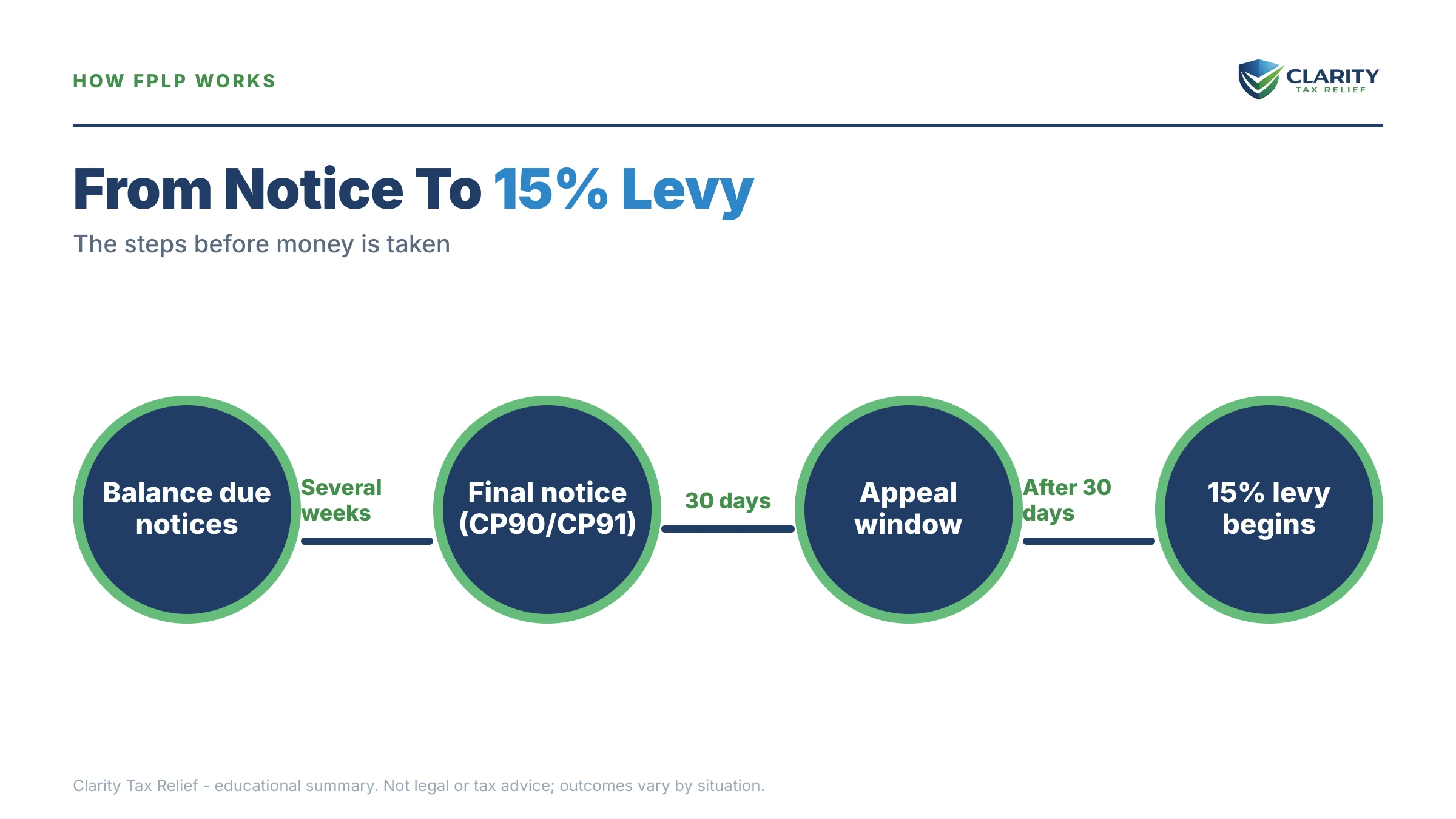
An FPLP levy is continuous: once attached, it takes its share of every federal payment you receive until the debt is resolved or the 10-year collection statute expires. There is no waiting it out. Here's the sequence, stage by stage:
- Balance assessed. The routine bills arrive — CP14 and reminder notices. This is the cheapest window to resolve; nothing is being taken yet.
- CP504. The IRS announces intent to levy your state tax refund, which it can seize through the state income tax levy program — the FPLP's state-refund sibling.
- Final notice: CP90, CP297, or CP91. Your 30-day Collection Due Process window opens. This is the last off-ramp before the machine takes over.
- Transmission to the Fiscal Service. After the 30 days pass with no response, your account enters the federal payment match file.
- Continuous withholding. 15% — or up to 100% for contractor and Medicare payments — comes out of every payment cycle. A federal tax lien, a bank levy, and an accounts-receivable levy can all stack on top; the FPLP doesn't replace them.
- It runs to the CSED. The levy continues until the balance is paid, you enter a qualifying resolution, or the collection statute expires — a clock that pauses for offers, bankruptcy, and appeals. See how long the IRS can collect back taxes.
Your rights shrink at each stage. This table shows what each notice gives you — and what you lose by letting the window close:
| What arrives | Your window | The right at stake |
|---|---|---|
| CP14 and reminder notices | The pay-by date printed on each notice (typically about 21 days) | Resolving before any enforcement power exists |
| CP504 | The date printed on the notice | Your state tax refund |
| CP90 / CP297 / CP91 final notice | 30 days from the notice date | A Collection Due Process hearing with Tax Court review (Form 12153) |
| After the 30 days pass | Generally up to 1 year from the notice date | An "equivalent hearing" — same conversation, but no Tax Court review and no levy pause |
| Federal contractor payments | May be levied before any hearing | CDP rights offered after the levy instead of before it |
FPLP notice in hand — or payments already being taken?
If a CP90, CP297, or CP91 arrived recently, the 30-day hearing window is running. Send us the notice and an experienced tax professional will map your fastest release path — free, confidential, no pressure.
How to stop the Federal Payment Levy Program: your options
The IRS releases an FPLP levy when you enter a resolution it recognizes — you don't have to pay in full to make the withholding stop. Which option fits depends on the size of the debt, whether it's personal or payroll tax, and what your finances can support:
| Option | Typical eligibility | Effect on the FPLP levy |
|---|---|---|
| Short-term payment plan | Can pay in full within 180 days; $0 setup fee | Levy generally released once the plan is in place |
| Streamlined installment agreement | Individuals owing $50,000 or less; up to 72 months, set up online | Levy generally released once the agreement is active |
| Business payroll tax payment plan (IBTF-Express) | In-business payroll debt of $25,000 or less, paid within 24 months | Levy generally released; keeps the business operating |
| Currently Not Collectible / levy causing hardship release | Allowable living or operating expenses meet or exceed income | Levy must be released when it creates economic hardship |
| Offer in Compromise | Means-tested; $205 fee and 20% down on lump-sum offers (both waived with low-income certification) | New levy action is generally barred while the offer is pending |
| CDP hearing (Form 12153) | Filed within 30 days of the final notice | Levy action on those periods paused while the hearing is pending |
Two honest caveats. Interest and penalties keep accruing under every option except full payment — a release stops the taking, not the growing. And the Offer in Compromise is real but narrow: per IRS data, the IRS accepted roughly 1 in 5 offers in FY2024, and only when the numbers genuinely show it can't collect more. The Form 12153 CDP hearing is often the smartest first move when the window is open, because it freezes levy action while you negotiate any of the other options from a position of protection.
Bankruptcy's automatic stay also halts an FPLP levy while the case is open, though whether the tax itself survives is a separate question — see does bankruptcy stop an IRS levy.
What $19,700 looks like under the FPLP: a worked example
Say you own a grounds-maintenance company with four employees and owe $19,700 in back payroll taxes from two rough quarters. You also hold a federal subcontract that pays about $8,000 a month. Once the FPLP matches your EIN, up to 100% of each contract payment can be taken: the first $8,000 is gone, the second $8,000 is gone, and most of the third payment goes too before the balance — still growing with penalties and interest — is satisfied. Three months of your federal revenue vanishes, and your own payroll is due in the middle of it.
Now the alternative: at $19,700, you're under the $25,000 IBTF-Express ceiling. Spread over 24 months, that's roughly $19,700 ÷ 24 ≈ $821 a month (plus accruing interest and penalties) — and the levy is generally released once the agreement is active, so the $8,000 invoices keep landing whole. Same debt, radically different cash flow. If the same $19,700 were levied from a $2,200 monthly Social Security benefit instead, the 15% take is $330 a month — about 60 months of levies at $19,700 ÷ $330, while the balance keeps compounding underneath. Either way, the levy is the slowest and most painful way this debt gets paid.
One more thing payroll debt carries that income tax doesn't: the trust-fund portion can be assessed against you personally, even if the business closes. If your balance is from Form 941, read 941 back taxes before you pick a resolution — the order you fix things in matters.
How to respond, step by step
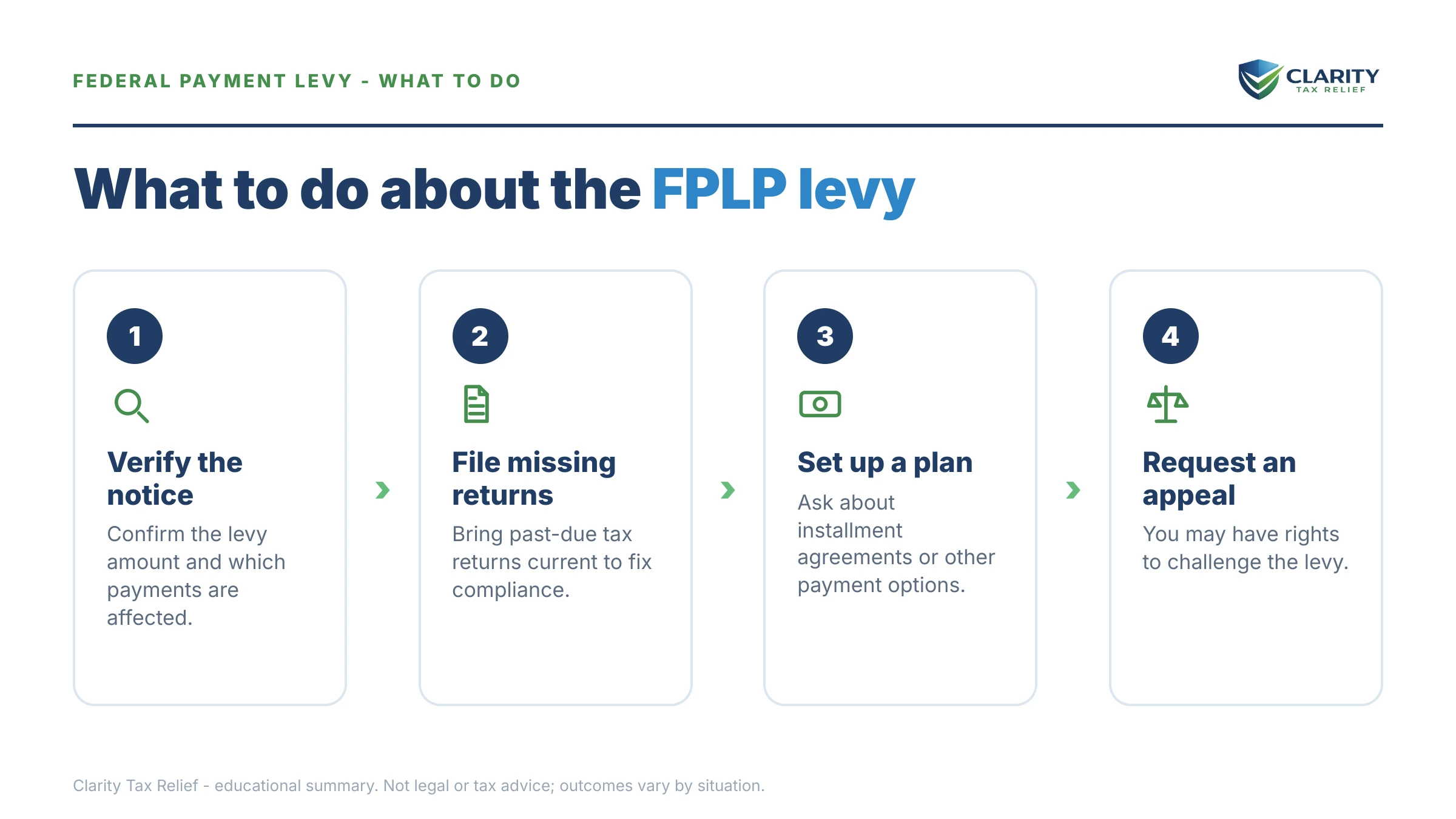
- Find your final notice. Locate the CP90, CP297, or CP91 and the date printed on it — the 30-day CDP clock runs from that date, not from the day you opened the envelope.
- Request a CDP hearing if the window is open. File Form 12153 within 30 days to pause levy action on those tax periods and preserve your right to Tax Court review.
- Verify the balance and file missing returns. Pull your IRS account, confirm the amount, and file any unfiled personal or payroll returns — the IRS won't approve a resolution while filing gaps remain.
- Choose and set up a resolution. Pick the payment plan, hardship status, or offer that matches your finances; each typically triggers a levy release once it's in place.
- Confirm the release in writing. The IRS transmits releases to the Bureau of the Fiscal Service — verify your next federal payment arrives whole and keep the release notice with your records.
When you can handle the FPLP yourself — and when help changes the outcome
You can likely resolve this on your own if the balance is accurate, it's personal income tax, and you can either pay within 180 days or qualify for a streamlined agreement online. Setting up a plan at the IRS payment plans page takes minutes, costs little, and generally gets the levy released without anyone's help. A 15% Social Security levy on a small, agreed balance is often a phone-and-paperwork fix.
Experienced help changes outcomes in a few specific situations. Payroll tax debt is one — the trust-fund penalty decision happens early, and how the business's payments are designated affects who owes what personally. Federal contractor levies are another: at 100% per payment, a release measured in weeks versus months can be the difference between making payroll and missing it. Add multiple unfiled years, a hardship release you need fast, or offer-in-compromise math, and the sequencing gets consequential. If money is being taken and you genuinely can't cover basics, the Taxpayer Advocate Service can also intervene at no cost when the levy creates significant hardship.
One comparison worth knowing: an FPLP hit on your federal payments and an IRS bank levy with its 21-day hold follow completely different rules — the bank levy is one-time with a short rescue window; the FPLP is continuous with no window at all. Don't apply the strategy for one to the other.
Terms on your notice, decoded
- Continuous levy — a levy that attaches once and keeps taking from every future payment, unlike a one-time levy that grabs only what exists on a single day.
- IRC §6331(h) — the statute that authorizes the FPLP and sets the 15% and 100% ceilings by payment type.
- Bureau of the Fiscal Service — the Treasury agency that actually disburses federal payments and executes the match; its site is fiscal.treasury.gov.
- Collection Due Process (CDP) — your statutory right to an independent Appeals hearing, requested on Form 12153 within 30 days of the final notice.
- CSED — the Collection Statute Expiration Date: 10 years from assessment, pausable by offers, bankruptcy, and appeals; the outer limit of how long the levy can run.
- Low-income filter — the IRS screen that excludes many lower-income Social Security recipients from the FPLP based on poverty-guideline thresholds.
If you're ready to act on the balance itself, every IRS payment method — direct pay, plans, and payoff — starts at IRS.gov/payments.
Federal Payment Levy Program questions, answered
How do I stop the Federal Payment Levy Program?
Get into a resolution the IRS recognizes: an installment agreement, Currently Not Collectible status, or a pending Offer in Compromise each typically triggers a levy release. If the levy is creating economic hardship — you can't cover basic living or business expenses — the IRS can release it on that basis alone. Requesting a timely CDP hearing after a CP90, CP297, or CP91 also puts levy action on hold for the periods under appeal.
Does the FPLP take Social Security benefits?
Yes — up to 15% of Social Security retirement and disability benefits, continuously, every month until the debt is resolved. SSI is never touched by the FPLP, and neither are children's benefits or lump-sum death payments. A low-income filter also screens out many recipients whose income falls below thresholds tied to the federal poverty guidelines, but you should never count on the filter instead of resolving the debt.
Can the IRS really take 100% of a payment under the FPLP?
Yes, for two categories: payments to federal contractors and vendors, and Medicare provider payments. Unlike the 15% cap on benefits and salaries, the law allows the IRS to take up to the full amount of these payments. For a business that depends on federal invoices, that can mean an entire month's receivable disappearing at once.
How long does an FPLP levy last?
It's continuous: once attached, it takes its share of every payment cycle until the debt is paid, you enter a qualifying resolution, or the 10-year collection statute (CSED) expires. It does not lapse on its own the way a one-time bank levy does. Note that the CSED can be extended by things like a pending offer, bankruptcy, or a CDP hearing.
Is the FPLP the same as the Treasury Offset Program?
No, though both run through the Treasury's Bureau of the Fiscal Service. The Treasury Offset Program intercepts your tax refund and certain payments for debts like student loans or child support. The FPLP is an IRS levy on ongoing federal payments to collect federal tax debt. You can be caught in both at once — a refund offset does not stop an FPLP levy, or vice versa.
Will I get a warning before the FPLP starts?
In most cases, yes. You'll receive a final notice — CP90 or CP297 for most payments, CP91 for Social Security — giving you 30 days to pay, resolve the balance, or request a Collection Due Process hearing. Federal contractor payments are the exception: the law allows the IRS to levy those first and offer the hearing afterward.
Can the IRS levy my bank account while the FPLP is running?
Yes. The FPLP doesn't replace other collection tools — it runs alongside them. The IRS can still file a federal tax lien, levy your bank account, and levy your accounts receivable while the FPLP takes its share of your federal payments. That's why an FPLP levy is a signal to resolve the whole account, not just wait out the withholding.
Your next 24 hours
- Find the notice number and date. Look at the top corner of your letter — CP90, CP297, or CP91 — and count 30 days from the printed date. Write that day down; it's the deadline that preserves your hearing rights.
- Gather three things: the notice itself, your most recent filed returns (personal and payroll, if you have employees), and a rough picture of the last three months of income and expenses. Every release path starts with these.
- Get a free case review. If your 30-day window is open, we'll help you protect it before it closes; if the levy is already taking payments, we'll map the fastest release route for your situation. Call (888) 825-7779 or use the 2-minute form.
This guide is general information, not tax or legal advice for your specific situation. Eligibility for IRS programs depends on individual facts and circumstances; no outcome is guaranteed.