
Business Tax Debt
Business Payroll Tax Payment Plan: IBTF-Express Rules, the $25,000 Line, and Your Personal Exposure (2026)
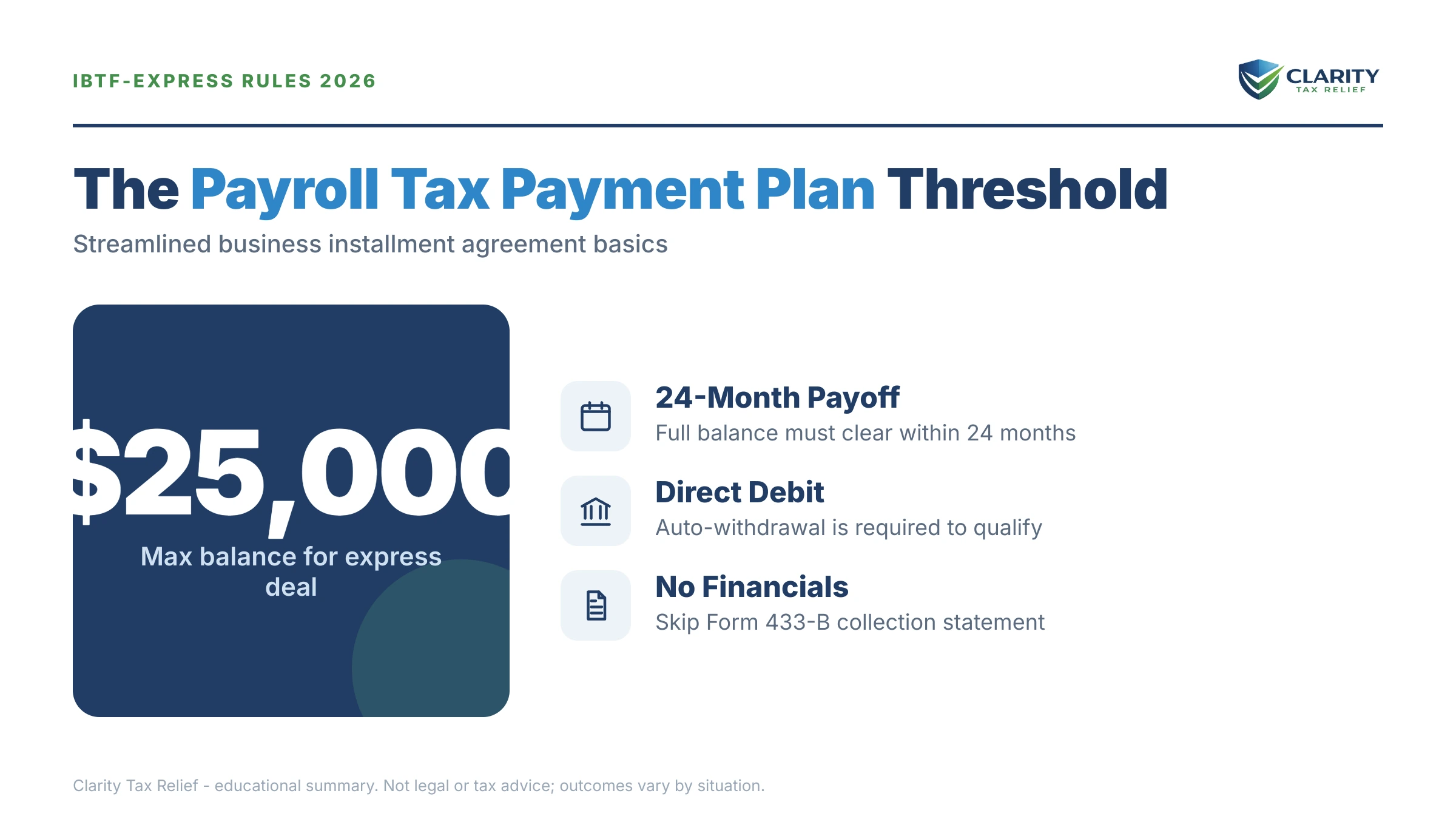
The short answer: an operating business can get an IRS business payroll tax payment plan — the In-Business Trust Fund Express installment agreement — if it owes $25,000 or less and can pay in full within 24 months, with no financial statement required. Above $25,000, expect Form 433-B financials and a Trust Fund Recovery Penalty review.
You made payroll. The withheld taxes didn't make it to the Treasury. Now the quarters are stacking up, the notices are getting sharper, and you're realizing this isn't the same as owing income tax — this debt can follow you, not just the business. The good news: the IRS built a payment plan specifically for operating businesses in exactly this spot, and if you move before a revenue officer does, you keep most of the control.
This guide covers the IBTF-Express rules line by line, what changes above $25,000, and how to keep a business debt from becoming a personal one. The image below shows exactly what the agreement paperwork looks like and where the terms that matter — the monthly amount, the debit authorization, the default triggers — appear.
⏱ The real clock: payroll tax debt has no quiet grace period. The federal tax deposit penalty hits its 10% tier just 16 days after a missed deposit, interest compounds daily, and if Letter 1153 arrives, you have 60 days to protest before the trust-fund portion is assessed against you personally.
Why the IRS treats payroll tax debt differently
Payroll taxes are the one debt the IRS considers stolen money rather than unpaid money — the withheld portion belonged to your employees and the government from the moment you cut the checks. That's why 941 back taxes get faster escalation, harsher penalties, and a personal-liability track that no income tax debt carries.
The withholding never legally belonged to the business. Employee income tax withholding and the employee share of Social Security and Medicare are called "trust fund" taxes because you held them in trust. Spending them on rent, fuel, or payroll itself — however understandable — is what the IRS calls "pyramiding" when it repeats quarter after quarter, and repeat pyramiding is the fastest route to a revenue officer at your door.
The penalty math is uniquely front-loaded. The federal tax deposit penalty doesn't wait for a return to be filed — it attaches to each late deposit on a tiered schedule, and it stacks on top of failure-to-file (5% per month on unfiled 941s) and failure-to-pay penalties. You can estimate what your quarters have accumulated with our Penalty & Interest Calculator.
| How late the deposit is | Penalty on the unpaid amount |
|---|---|
| 1–5 days | 2% |
| 6–15 days | 5% |
| More than 15 days | 10% |
| Still unpaid 10 days after the first IRS demand notice | 15% |
Two edge cases worth naming. If you're a sole proprietor, there's no entity between you and the debt at all — the payroll balance is simply yours. And if a payroll provider took your money and never sent it to the IRS, you are still liable for the tax itself, though the penalty picture changes; that situation needs its own handling and documentation from day one.
One more boundary: your state payroll agency runs on its own statutes and its own payment plans. Nothing in this article's federal thresholds — the $25,000 line, the 24 months — applies to a state assessment, so resolve the two tracks separately.
What happens if you ignore business payroll tax debt
Ignored payroll tax debt runs on two tracks at once: an automated notice sequence marching the business toward levy, and a personal track that can pin the trust-fund portion on you individually. Even with the IRS workforce down roughly 27% since 2025, both tracks are largely automated — the notices and levies never stopped issuing.
- CP161 — the first business balance-due bill for a quarter. A pay-by date is printed on it. No enforcement yet.
- CP163 — a reminder. Nothing new legally, but penalties and daily-compounding interest are stacking.
- CP504B — the business intent-to-levy notice. The IRS can now take the business's state tax refund and is one step from full levy power.
- LT11 / Letter 1058 / CP297 — the final notice of intent to levy. This starts a 30-day clock to request a Collection Due Process hearing on Form 12153. After it runs, the IRS can levy bank accounts, accounts receivable, and merchant deposits.
- Letter 1153 (the parallel personal track) — the Trust Fund Recovery Penalty proposal against you as an individual, with 60 days to protest.
- Levy — a bank levy freezes funds for 21 days before they're sent to the IRS; a receivables levy redirects your customers' payments straight to the Treasury, which can end a business's cash flow overnight.
| Notice | What it means | Your window |
|---|---|---|
| CP161 | First balance-due bill for a payroll quarter | The pay-by date printed on the notice |
| CP163 | Reminder — the balance is compounding | No rights lost yet, but the balance grows monthly |
| CP504B | Intent to levy; state refund can be seized | Act by the date on the notice |
| LT11 / Letter 1058 / CP297 | Final notice of intent to levy | 30 days to request a CDP hearing (Form 12153) |
| Letter 1153 | Trust Fund Recovery Penalty proposed against you personally | 60 days to protest |
| Levy | Bank (21-day hold), receivables, merchant accounts | Release requires an agreement or documented hardship |
Quarters piling up and notices getting sharper?
Get your payroll tax balance reviewed free before a revenue officer is assigned or the Trust Fund Recovery Penalty is proposed. Penalties and interest are accruing on every unpaid quarter while you wait — an experienced tax professional can map your fastest path to an agreement in one call.
Your business payroll tax payment plan options
An operating business with payroll tax debt has five realistic paths, and the $25,000 line decides how hard each one is. The general mechanics of applying are covered in our guide to setting up an IRS payment plan online — what's below is what's specific to trust-fund debt.
| Option | Who qualifies | Timeline | What it requires |
|---|---|---|---|
| Pay in full | Any business with the cash or credit | Immediate | Stops penalty growth and the notice sequence the day it posts |
| IBTF-Express installment agreement | Operating business owing $25,000 or less | Up to 24 months, or the collection statute if sooner | All 941s filed, current deposits on time, direct debit above $10,000 — no financial statement |
| Regular in-business agreement | Balances over $25,000 | Negotiated; often revenue-officer managed | Form 433-B financials; a Trust Fund Recovery Penalty review of responsible people is likely |
| Business Offer in Compromise | Business that genuinely cannot pay from assets and future income | Months to over a year under review | $205 fee and full disclosure; rarely accepted on trust-fund debt — see business offer in compromise payroll rules |
| Hardship / reported uncollectible | Documented inability to pay anything | Reviewed periodically | Full disclosure; the IRS still demands current deposits, and the debt keeps growing |
The IBTF-Express payroll tax installment agreement, rule by rule
The In-Business Trust Fund Express agreement is the only streamlined IRS payment plan built for a business that's still operating with payroll tax debt. Every requirement below has a reason behind it, and knowing the reasons helps you negotiate:
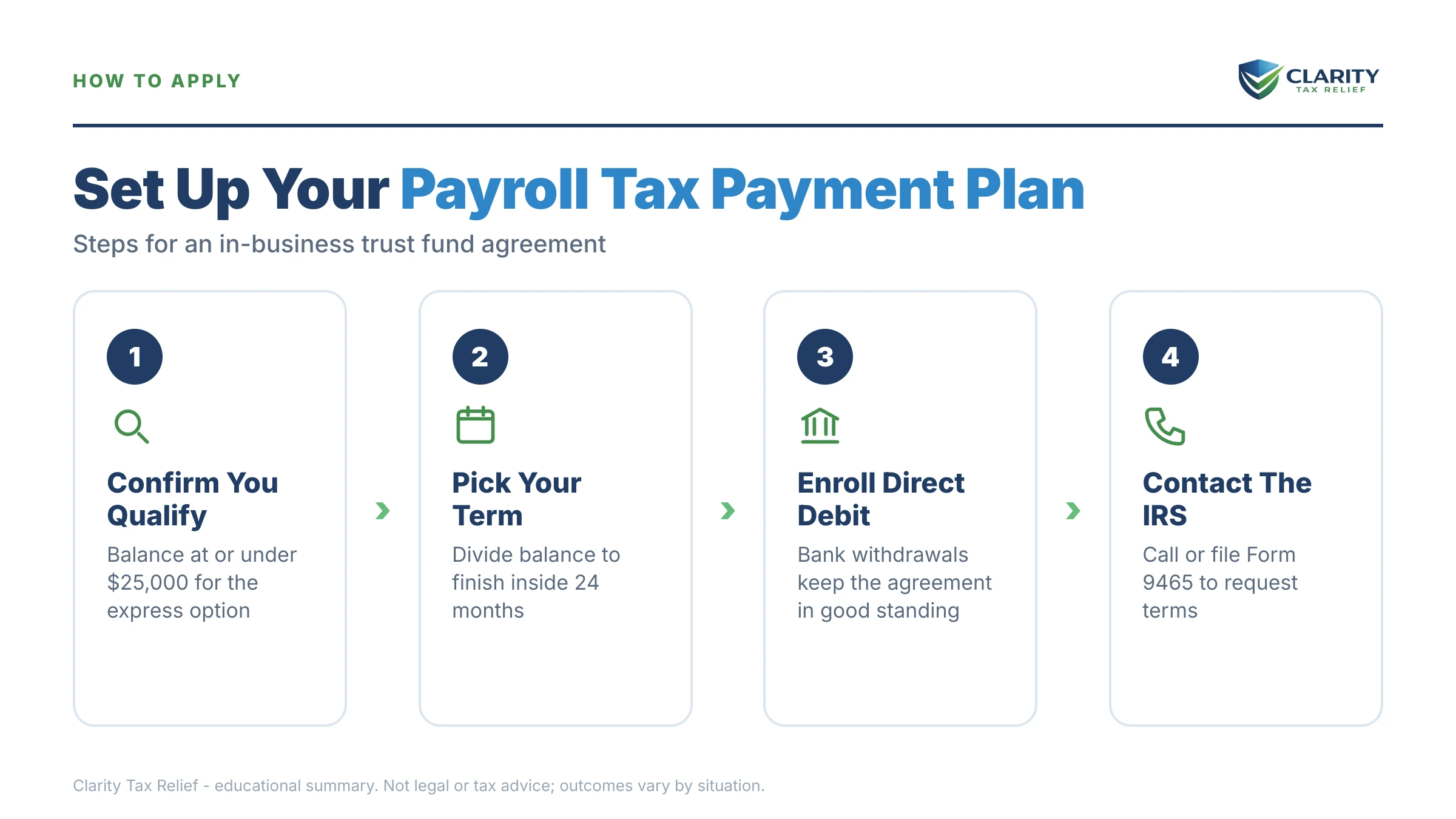
- Balance of $25,000 or less. That's the total across all quarters — tax, penalties, and interest combined, not just the tax. If you're close to the line, a targeted paydown before you apply can change your entire track (more on that in the worked example).
- Full payment within 24 months — or before the 10-year collection statute expires on the oldest quarter, whichever comes first.
- Direct debit required between $10,000 and $25,000. The IRS wants the payment automated because business agreements historically default on cash-flow hiccups; a direct debit installment agreement also removes the "forgot to mail it" default risk on your side.
- No Form 433-B. This is the whole prize. Skipping the financial statement means the IRS never inventories your receivables, equipment, and bank accounts — the exact map it would use to levy later.
- Filing and deposit compliance first. Every 941 filed, every current deposit on time. The IRS will not formalize any agreement while new debt is accruing.
Interest and the failure-to-pay penalty continue accruing during the agreement, so the true payoff runs slightly higher than balance-divided-by-24. Paying faster than the schedule is always allowed and always saves money.
Owe more than $25,000 in payroll taxes? The Form 433-B path
Above $25,000, a payroll tax agreement stops being a formula and becomes a negotiation. The IRS generally requires Form 433-B — the business collection information statement covering income, assets, receivables, and equipment — and larger trust-fund balances are the cases most likely to be assigned to a field revenue officer rather than the automated collection system.
Two things change when a revenue officer takes the file. First, the officer will typically make a Trust Fund Recovery Penalty determination — deciding who was personally responsible — before agreeing to payment terms. Second, the officer sets deadlines with real teeth: miss a document request and levy action can follow quickly.
The most valuable move above the line is often getting below it. If your balance is $28,000 and you can raise $3,500, paying down to $24,500 before you apply can convert a financials-and-officer negotiation into a 24-month Express agreement with no disclosure at all. That single decision routinely changes both the paperwork burden and the personal-liability posture of the case.
If the business has already shut its doors, the analysis flips — the entity's debt may go nowhere, but the trust-fund portion follows the people. See our guide to payroll tax debt after a business closes before assuming a dissolution ends anything.
The Trust Fund Recovery Penalty: how a business debt becomes yours
The Trust Fund Recovery Penalty lets the IRS assess the withheld portion of unpaid payroll taxes against individuals — personally, regardless of the LLC or corporation in between. Our full guide to the Trust Fund Recovery Penalty covers the defense side; here's what matters for the payment-plan decision:
- Who's exposed: any "responsible person" who had the duty and authority to pay the taxes and willfully didn't — owners, officers, and sometimes bookkeepers or anyone with check-signing authority. "Willful" doesn't mean malicious; paying other bills while knowing the taxes were unpaid usually satisfies it.
- What's assessed: only the trust-fund portion — employee withholding plus the employee share of Social Security and Medicare. The employer's matching share and most penalties stay with the business.
- How it arrives: often after a Form 4180 interview, where a revenue officer asks each potentially responsible person, on the record, who controlled the money. Then Letter 1153 proposes the assessment, opening a 60-day protest window.
Here's the honest connection to your payment plan: a business paying steadily on an IBTF-Express agreement is, in practice, the profile least likely to end in personal assessment, because the debt is retiring within 24 months. But no agreement legally prevents a TFRP assessment — the IRS can still assess to protect its position, particularly when the collection statute is running short on old quarters. Anyone promising a payment plan "blocks" the TFRP is overselling.
Worked example: a $31,200 payroll tax balance, two ways
Say you started as a solo gig courier, then formed an LLC, put two drivers on payroll, and grew fast — faster than your bookkeeping. Three years of quarterly 941s never got filed, and the deposit money kept the vans running instead. Once the missing returns are prepared, the balance comes to $31,200 in tax, penalties, and interest. (This is a hypothetical, not a client case.)
Path A — pay down to the Express line. You scrape together $6,300 from receivables and pay it toward the oldest quarters. New balance: $31,200 − $6,300 = $24,900, under the $25,000 ceiling. The Express math: $24,900 ÷ 24 = $1,037.50, so roughly $1,040/month by direct debit — a touch more in practice because interest keeps accruing. No Form 433-B, no asset inventory, and a 24-month runway with the pyramid stopped.
Path B — keep the $31,200 and negotiate. Now you're on the Form 433-B track: full financial disclosure, likely a revenue officer, and a TFRP determination. Suppose the trust-fund portion of the $31,200 works out to $18,500 — that $18,500 can be assessed against you personally, and it survives even if the LLC later dissolves. The monthly payment might land in a similar range, but the IRS ends up holding a map of your assets and a personal assessment in reserve.
Same debt, $6,300 apart, two very different amounts of leverage. This is why the first question in any payroll tax case is not "what can I pay monthly?" but "what does it take to get under $25,000?"
How to set up a business payroll tax payment plan, step by step
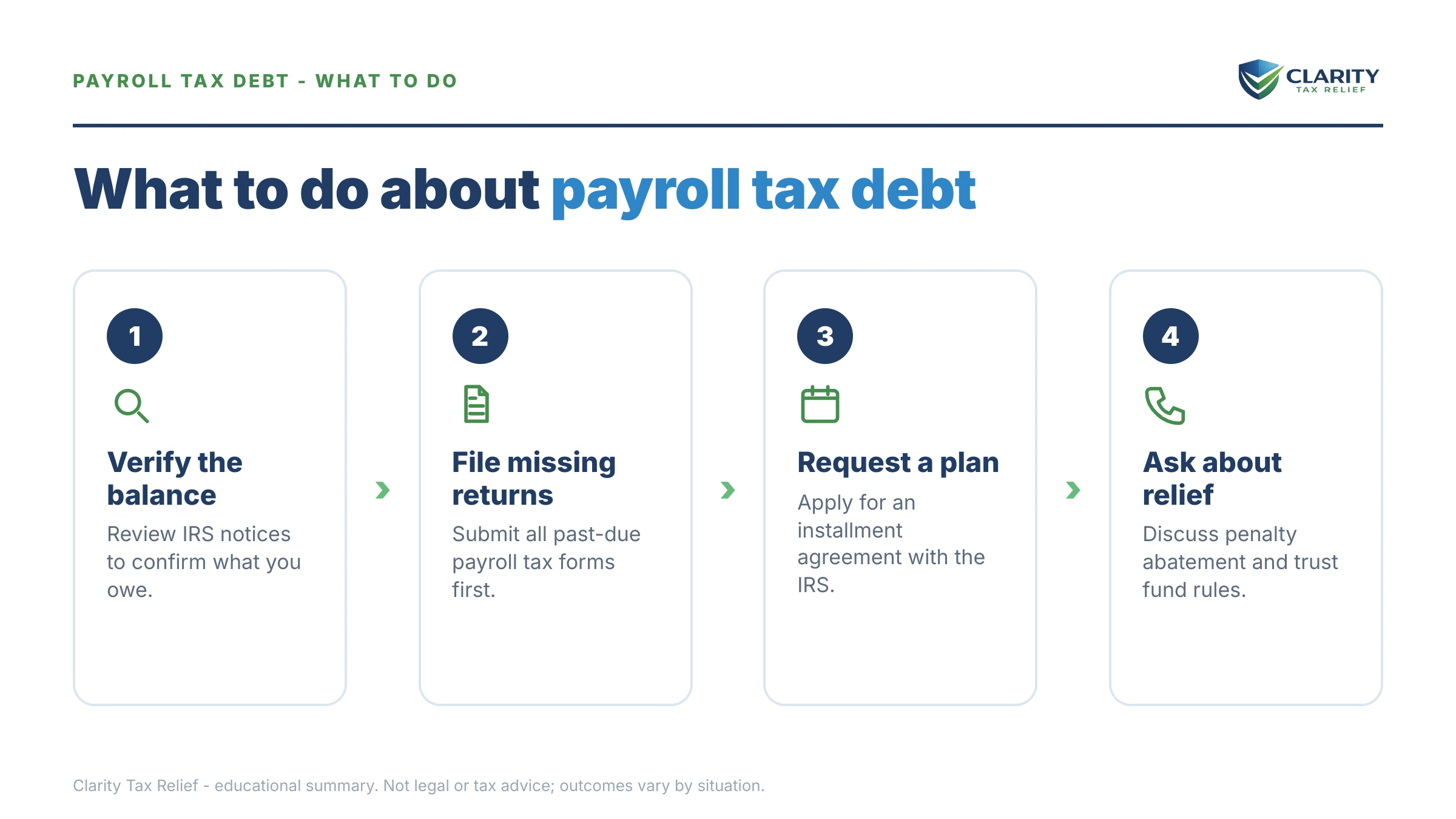
- File every missing Form 941. The IRS will not approve any payment plan while payroll returns are outstanding — the unfiled 941 returns come first, even if you can't pay a dime with them.
- Start making current deposits on time. The IRS must see that the shortfall has stopped before it will discuss the past — every new deposit made on time strengthens your case.
- Confirm the exact balance and periods. Call the number on your most recent notice or check your business tax account so you know precisely which quarters are owed and what each one costs.
- Request the right agreement for your balance. At $25,000 or less, ask for an IBTF-Express installment agreement; above that, prepare Form 433-B before you call so the conversation happens on your terms.
- Enroll in direct debit and sign the confirmation. Direct debit is required for balances between $10,000 and $25,000, and the IRS will send Form 433-D to lock in the terms — sign and return it promptly.
- Calendar every deposit and payment date. One missed federal tax deposit can default the whole agreement, so treat every deposit deadline like a payroll date.
When you can handle this yourself — and when you shouldn't
Plenty of payroll tax cases don't need professional help, and it's worth knowing honestly which side of the line you're on.
You can likely handle it yourself when: the total balance is at or under $25,000 and undisputed, every 941 is filed, current deposits are already back on schedule, and your cash flow comfortably covers roughly 1/24th of the balance each month. In that case, the Express agreement is close to a formula — request it, set up the debit, and stay compliant.
Experienced help changes outcomes when: a revenue officer has been assigned or has visited the business; a Form 4180 interview is scheduled (what you say there is on the record and shapes personal liability); Letter 1153 has arrived and the 60-day protest clock is running; the balance is over $25,000 and the paydown-vs-433-B decision needs real analysis; multiple years of 941s are unfiled and penalty relief could shrink the balance before any plan is set; or you're weighing whether to keep operating, sell, or wind down.
If a revenue officer is already calling or a Letter 1153 is sitting on your desk, don't walk into a Form 4180 interview alone — get a free payroll tax case review or call (888) 825-7779 before you answer questions on the record.
Terms on your payroll tax notices, decoded
- Trust fund taxes — the money withheld from employee paychecks (income tax plus the employee share of Social Security and Medicare); it legally belongs to the government from the moment it's withheld.
- Trust Fund Recovery Penalty (TFRP) — the IRC §6672 assessment that transfers the trust-fund portion of a business's debt to responsible individuals, personally.
- Responsible person — anyone with the duty and authority to collect and pay over payroll taxes; job titles matter less than who actually controlled the money.
- IBTF-Express — the In-Business Trust Fund Express installment agreement: $25,000 or less, paid within 24 months, no financial statement.
- Federal tax deposit (FTD) penalty — the tiered 2/5/10/15% penalty charged on each payroll deposit that's late or short.
- Pyramiding — accruing new payroll tax debt while old quarters remain unpaid; the pattern the IRS treats most severely, up to and including criminal referral in extreme repeat cases.
Business payroll tax payment plan FAQs
Can a business get an IRS payment plan for payroll taxes?
Yes. An operating business can request an In-Business Trust Fund Express installment agreement if it owes $25,000 or less in payroll taxes and can pay the balance within 24 months. No financial statement is required at that level, but every 941 must be filed and current deposits must be on time before the IRS will approve anything.
What is the IBTF-Express installment agreement?
IBTF-Express is the IRS's streamlined payment plan for operating businesses with trust-fund (payroll) tax debt. It covers balances of $25,000 or less, requires full payment within 24 months or before the collection statute expires, and requires direct debit when the balance is between $10,000 and $25,000. Its biggest advantage is skipping the Form 433-B financial disclosure that larger payroll debts trigger.
Does a payroll tax payment plan stop the Trust Fund Recovery Penalty?
Not automatically. The IRS can still investigate and assess the Trust Fund Recovery Penalty against responsible people even while a business is paying on an agreement, especially when the collection statute is running short. In practice, an IBTF-Express agreement that stays in good standing is often the path least likely to end in personal assessment — but no agreement legally bars it.
Do I have to be current on payroll deposits to qualify?
Yes. The IRS will not approve any in-business payroll tax agreement until all required Form 941 returns are filed and current federal tax deposits are being made on time. This is the single most common reason applications stall: the IRS insists the pyramid stop before it will address the past-due quarters.
What if my business owes more than $25,000 in payroll taxes?
Above $25,000, the IRS generally requires a Form 433-B financial statement, and the case is more likely to be assigned to a revenue officer who will also evaluate the Trust Fund Recovery Penalty. One legitimate strategy: if you can pay the balance down to $25,000 or less, you may qualify for IBTF-Express and skip the financial disclosure entirely.
Can I set up a business payroll tax payment plan online?
Sometimes. A business that owes $25,000 or less and can pay within 24 months may qualify to apply through the IRS Online Payment Agreement tool. If your situation includes unfiled 941s, a revenue officer assignment, or a balance above the online limit, you'll need to apply by phone or through the officer handling your case instead.
Am I personally liable for my business's payroll tax debt?
You can be, even with an LLC or corporation. The Trust Fund Recovery Penalty lets the IRS assess the withheld portion of payroll taxes — employee income tax withholding plus the employee share of Social Security and Medicare — against any 'responsible person' who willfully failed to pay it over. That can include owners, officers, bookkeepers, and anyone with check-signing authority.
What happens if I miss a payment on my payroll tax installment agreement?
A missed payment — or a missed current deposit — can default the entire agreement and put the business back in active collection, where bank and receivables levies become possible again. If you see a shortfall coming, contact the IRS before the payment date; modifying an agreement is far easier than reinstating a defaulted one.
Can payroll tax debt be settled for less than the full amount?
Rarely, and under strict conditions. An operating business can submit an Offer in Compromise on payroll debt, but the IRS scrutinizes trust-fund balances harder than any other debt and accepted roughly 1 in 5 offers overall in FY2024. For most operating businesses, a payment plan resolves the debt faster and with less risk than a long-shot offer.
Your next 24 hours
- Find the total and the quarters. Pull your most recent notice — a CP161 or CP504B lists each tax period and its balance — and note whether the combined total is above or below $25,000. That one number decides your entire track.
- Gather the paper. Filed and unfiled 941s, payroll records for the missing quarters, and the last three months of business bank statements — everything an agreement request will need.
- Get a free payroll tax case review. Use the 2-minute form or call (888) 825-7779 before the next deposit deadline adds a new quarter to the problem — penalties and interest are compounding on every unpaid period while the file sits.
Primary sources: the IRS's official payment plans and installment agreements page covers application channels and fees, IRS.gov/payments handles deposits and paydowns, and the Taxpayer Advocate Service can intervene when collection action threatens an operating business despite a pending agreement request.
This guide is general information, not tax or legal advice for your specific situation. Eligibility for IRS programs depends on individual facts and circumstances; no outcome is guaranteed.