
Business Tax Debt
Business Offer in Compromise for Payroll Taxes (2026): When You Can Settle 941 and Trust Fund Debt
The short answer: yes — the IRS can accept a business offer in compromise on payroll taxes, but the rules are the strictest of any offer type. The business must be current on federal tax deposits and filings, offer its full Reasonable Collection Potential, and the trust-fund portion can still be collected from owners personally unless it's addressed.
You kept the crew paid every Friday, and the 941 deposits were the corner you cut to do it. Now the quarters have stacked into a number the business can't write a check for, and you're searching whether a business offer in compromise on payroll tax debt is a real way out in 2026. It is — for a narrow slice of businesses — and this guide shows you exactly which slice, because payroll debt is not treated like income tax debt, and most of what's written about offers quietly ignores that.
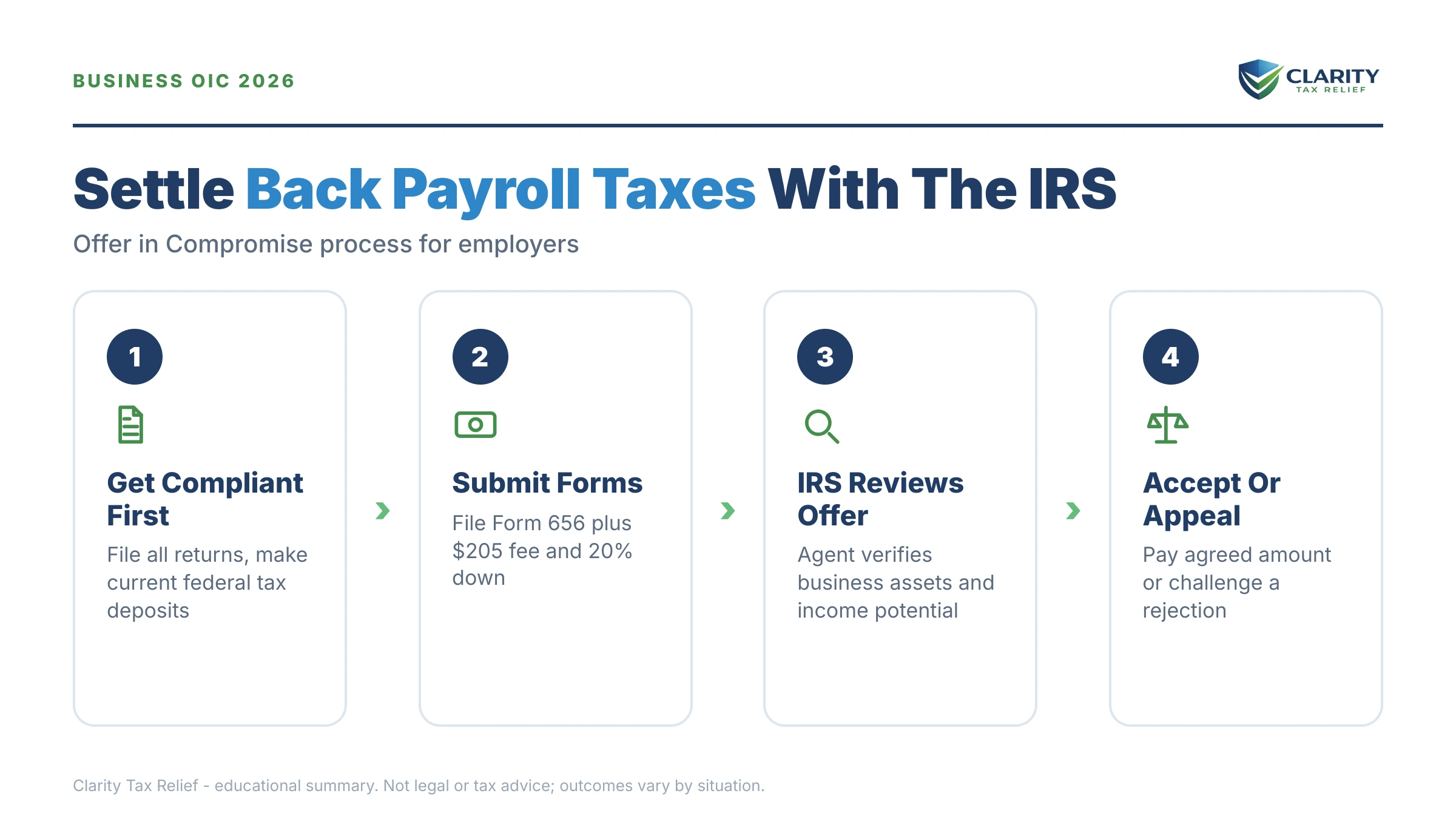
Two things make payroll offers different from every other settlement: the deposit-compliance gate that returns most applications unread, and the trust-fund split that lets the IRS chase you personally even after the business settles. Further down, the image shows exactly what the offer paperwork looks like and where the payroll-specific pieces sit, so you know what you're actually assembling.
⏱ Your clock: there's no application deadline for an offer itself — but every missed federal tax deposit adds penalties of up to 15% and can disqualify your offer. And if the IRS has sent you Letter 1153 proposing the Trust Fund Recovery Penalty, you have 60 days from its date to file a protest before the penalty is assessed against you personally.
Why a payroll tax offer in compromise plays by stricter rules
A business offer in compromise on payroll taxes is the hardest offer type the IRS accepts, because most of the debt is money withheld from employees' paychecks — money the government considers its own, held by you in trust. When you didn't deposit it, in the IRS's view the business spent government funds. That's why 941 debt gets faster escalation, personal liability for owners, and a settlement path with extra gates that income tax debt never faces.
The mechanics of any offer are the same everywhere on the tax code — you prove the IRS can never collect the full balance and offer what it could collect. That shared foundation is covered in our guide to how an offer in compromise works; this page covers only what changes when the debt is payroll. Three things change:
- A compliance gate: the IRS won't consider an offer from a business that isn't currently depositing and filing on time — typically the quarter you apply in plus the two before it. You have to prove the bleeding has stopped before it will discuss the wound.
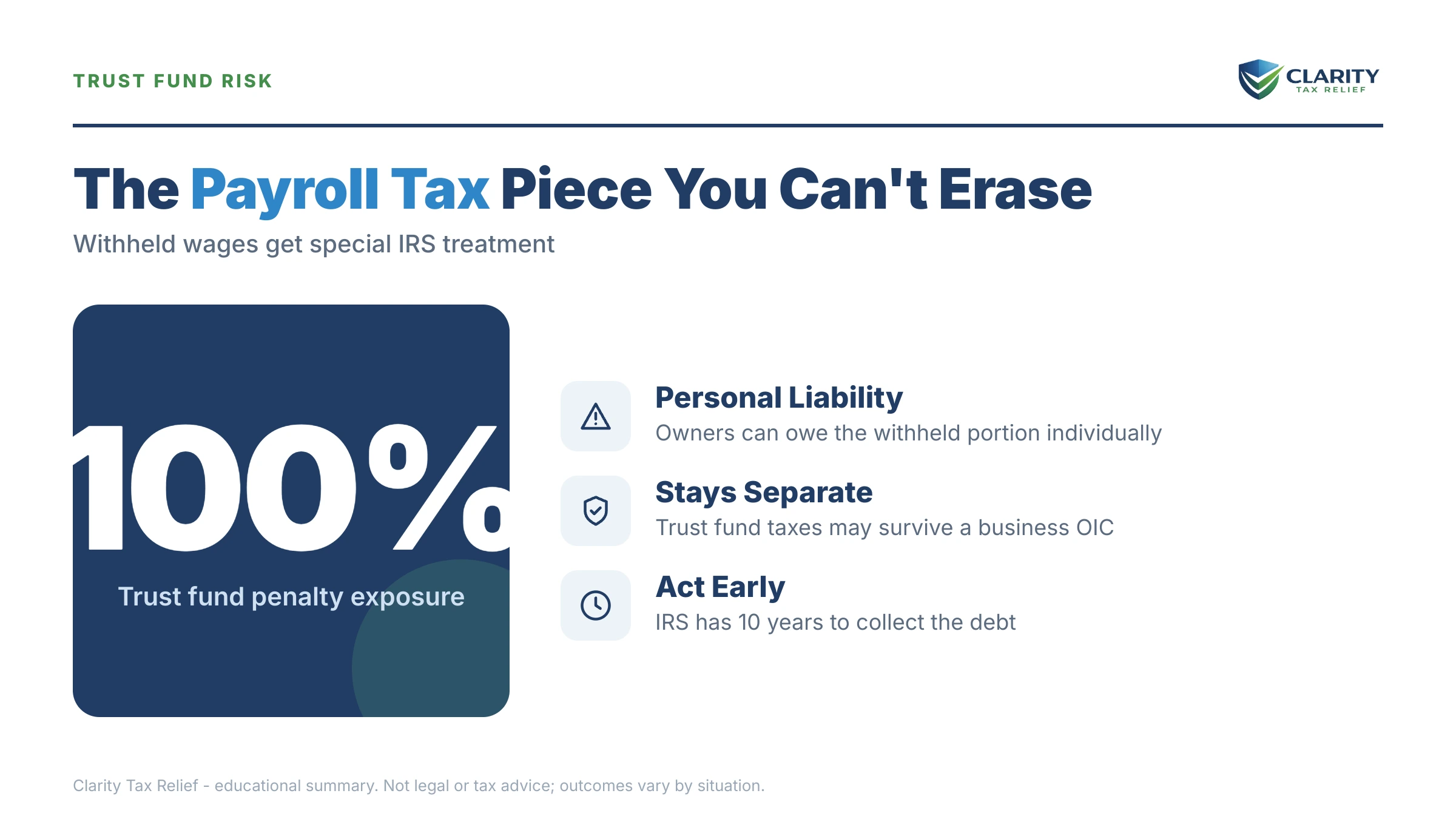
- The trust-fund split: the withheld portion of the debt can be assessed against you (and other "responsible persons") personally. A business offer generally can't be accepted until that personal exposure is addressed — paid, assessed, or resolved — because the IRS won't sign away its right to collect trust-fund money twice over.
- Going-concern value: for an operating business, the IRS values not just your equipment and bank account but your receivables and future business income. A company generating steady cash flow usually can't show the IRS will "never collect" — which is the entire legal basis of an offer.
The IRS accepted roughly 1 in 5 offers of all types in FY2024, and payroll offers from operating businesses sit at the hard end of that distribution. That's not a reason to give up — it's a reason to know your entity type, your trust-fund split, and your Reasonable Collection Potential before you spend a dollar applying. If you want the broader operating-business picture beyond payroll, see the companion guide to a business offer in compromise.
Trust fund vs. non-trust-fund: what the IRS can actually compromise
The trust-fund portion of a 941 balance — employee income tax withholding plus the employee share of Social Security and Medicare — can be collected from the business and from responsible individuals personally. The employer's matching share, the penalties, and the interest are "non-trust-fund" and stay with the business alone. This split decides whose offer you actually need to file.
| Piece of your 941 balance | Trust fund? | Who the IRS can collect it from |
|---|---|---|
| Federal income tax withheld from employees | Yes | The business AND responsible persons personally (via the TFRP) |
| Employee share of Social Security & Medicare | Yes | The business AND responsible persons personally (via the TFRP) |
| Employer's matching share of Social Security & Medicare | No | The business only |
| Failure-to-deposit penalties and interest | No | The business only |
Here's why the split matters so much in practice. If your business is a corporation or an LLC taxed as a corporation, the 941 debt belongs to the entity — but the IRS can assess the trust-fund slice against you personally through the Trust Fund Recovery Penalty. Settling the business's debt without addressing the TFRP leaves you personally exposed, which is exactly why the IRS generally requires the trust-fund portion to be resolved before it accepts a business offer.
If you're a sole proprietor or a single-member LLC taxed as a sole prop — the situation for many 1099 contractors who took on W-2 helpers — the entire payroll debt is already yours personally. No TFRP assessment is needed, and you can compromise the whole balance in a single personal offer on Form 433-A (OIC). Counterintuitively, that often makes settlement simpler for the smallest employers than for incorporated ones.
And if the business is already closed, the sequence flips: the IRS assesses the TFRP against responsible individuals and collection becomes personal. The full wind-down picture is in our guide to payroll tax debt after the business closed — but the short version is that a closed-business TFRP is often the most compromisable form this debt ever takes, because the going-concern value is gone and only your personal finances drive the math.
What happens if you ignore back payroll taxes
Unpaid payroll taxes escalate faster and hit harder than any other IRS debt, because the IRS treats withheld wages as government money the business already spent. The sequence is automated at the front end and personal at the back end:
- Balance-due notices (CP161, CP163) — the business's bills. Failure-to-deposit penalties tier up to 15% of each late deposit, on top of failure-to-pay penalties and compounding interest.
- CP504B — the business version of the intent-to-levy notice. The IRS positions itself to take the state refund and file a federal tax lien against business assets.
- Final notice of intent to levy (Letter 1058 / LT11) — starts a 30-day clock and your Collection Due Process rights. After it runs, the IRS can levy the business bank account and — uniquely damaging for contractors — serve levies on your accounts receivable, redirecting customer payments straight to the Treasury.
- Revenue officer assignment — payroll cases get human collectors, not just letters. Expect field contact, demands for current deposit proof, and Form 4180 interviews of everyone who signed checks or ran payroll.
- Letter 1153 — the TFRP proposal — the IRS names the responsible persons and proposes assessing the trust-fund portion against them personally. You have 60 days to protest; the details are in our Letter 1153 guide.
- Dual-track collection — once the TFRP is assessed, the IRS pursues the business and the individuals simultaneously: personal bank levies, wage levies, liens on homes. Continuing to run payroll without depositing ("pyramiding") is what pushes payroll cases toward criminal referral.
Every stage of that sequence also shrinks your offer leverage. An offer filed before receivable levies start is negotiated calmly; one filed after a revenue officer has your customer list is negotiated under fire. In 2026, with IRS staffing down roughly 27%, the human stages move unevenly — but the automated notices, penalties, and levy queues never slowed down.
Behind on 941s and weighing an offer?
Payroll debt is the one kind that follows you home. Get your 941 balance, trust-fund split, and personal TFRP exposure mapped free by an experienced tax professional — and if Letter 1153 has arrived, the 60-day protest window is already running.
Your options compared: business offer in compromise, payroll payment plans, and hardship status
An offer in compromise is one of five realistic paths for back payroll taxes — and for most operating businesses, it's not the fastest one. Match your balance and situation against the eligibility gates first:
| Option | Core eligibility | Best fit |
|---|---|---|
| Business offer in compromise (Form 656 + 433-B (OIC)) | All returns filed; deposits current for the current and prior two quarters; offer ≥ full Reasonable Collection Potential; trust-fund portion addressed | A business whose assets and realistic future income genuinely can't cover the debt |
| IBTF-Express installment agreement | Operating business owing $25,000 or less; full pay within 24 months (and before the CSED); direct debit required from $10,000–$25,000 | Getting protected fast without handing over full financials |
| Regular business installment agreement | Any balance; Form 433-B financial disclosure; must stay deposit-current | Balances above $25,000 with cash flow to support payments |
| Currently Not Collectible (hardship) | Financials show nothing left after essential operating expenses; deposits must still continue | A business in genuine distress buying time — the debt keeps growing |
| Personal OIC on an assessed TFRP | TFRP assessed against you; personal RCP below the assessed amount; personal filings current | Owners of closed businesses, or after the entity's debt is otherwise resolved |
And here's what each path actually costs and how long it runs:
| Option | Upfront cost | Typical timeline | What keeps accruing |
|---|---|---|---|
| Business OIC | $205 fee + 20% of the offer down (lump-sum offers) | Many months; auto-accepted if the IRS doesn't decide within 2 years | Interest until acceptance; collection paused; 10-year clock paused |
| IBTF-Express IA | Standard IA setup fee (lowest with direct debit) | Approval in days to weeks; paid within 24 months | Penalties and interest until paid off |
| Regular business IA | Standard IA setup fee | Weeks to set up; runs until paid or CSED | Penalties and interest until paid off |
| Currently Not Collectible | $0 | Weeks to establish; reviewed periodically | Penalties and interest the entire time; lien likely |
| Personal OIC on TFRP | $205 + 20% down — both waived with individual low-income certification | Many months; same 2-year auto-accept rule | Interest until acceptance; personal collection paused |
Two comparisons deserve their own reading before you commit. If the real question is offer versus simply waiting out hardship, the trade-offs are laid out in CNC vs offer in compromise. If bankruptcy is on the table, know this first: trust-fund payroll taxes survive bankruptcy — Chapter 7 won't discharge them and Chapter 11 or 13 requires paying them in full through the plan. The full decision framework is in bankruptcy or offer in compromise. And if you're leaning toward a payment plan instead of an offer, the payroll-specific rules — including IBTF-Express — are in our business payroll tax payment plan guide.
One state-side warning: this article is about federal 941 debt only. If you also owe state payroll or withholding taxes, your state agency runs its own program with its own rules — California's EDD, for example, assesses and collects independently of the IRS, and a federal offer does nothing to a state balance. Resolve them as separate cases.
How the IRS calculates a payroll tax offer: RCP, with real math
The IRS accepts a payroll tax offer only when it equals or exceeds your Reasonable Collection Potential — the quick-sale value of assets plus a multiple of monthly disposable income. For a business, "assets" includes equipment, vehicles, bank balances, and accounts receivable; "income" means what the operation clears after allowable expenses. The full formula lives in our guide to Reasonable Collection Potential; here's what it looks like on payroll debt.
Say you're a 1099 contractor — a sole proprietor doing jobs for general contractors, with two W-2 helpers — and three unpaid quarters of Form 941 have stacked up to $36,900. On the transcripts it splits roughly like this: $23,400 of trust-fund money (your employees' withholding and their FICA share), $8,100 of employer FICA match, and $5,400 of failure-to-deposit penalties and interest. Because you're a sole prop, all $36,900 is personally yours — no TFRP assessment needed, and one offer can cover it all.
Now the RCP math. Your work truck would quick-sale for $9,000 with a $4,500 loan against it — $4,500 in equity. Tools and equipment quick-sale at $3,000. Open receivables are $3,500, and the business account holds $500. Asset component: about $11,500. On income, you gross $6,400 a month and your allowable business and living expenses run $5,900, leaving $500 of monthly disposable income. A lump-sum offer multiplies that by 12: $6,000. Your RCP is roughly $11,500 + $6,000 = $17,500 — meaning an offer around $17,500 on a $36,900 debt is defensible, submitted with the $205 fee and a 20% down payment of $3,500, with the rest due within five months of acceptance. Choose the periodic-payment route instead and the income multiplier doubles to 24 months, pushing the number to about $23,500 paid monthly while the offer is reviewed.
Compare the alternative: full payment on an installment agreement at roughly $615 a month over five years — while penalties and interest keep compounding on the unpaid balance. That contrast is the entire offer decision, and it turns on whether your disposable income and asset numbers hold up under an examiner's scrutiny. You can rough out your own figures in a few minutes with our Offer in Compromise Calculator — it estimates, it doesn't promise, but it tells you whether the math is even in the neighborhood.
Two payroll-specific traps in the math. First, receivables count as assets — a contractor with $40,000 in open invoices will see the IRS treat that as collectable value, which alone can sink an offer. Second, if you drained business assets to pay other creditors while the taxes went unpaid, the IRS can add those "dissipated assets" back into your RCP as if you still had them. If your income is irregular — normal for contractors — the self-employment-specific averaging issues are covered in oic self employed.
How to apply for a payroll tax offer in compromise, step by step
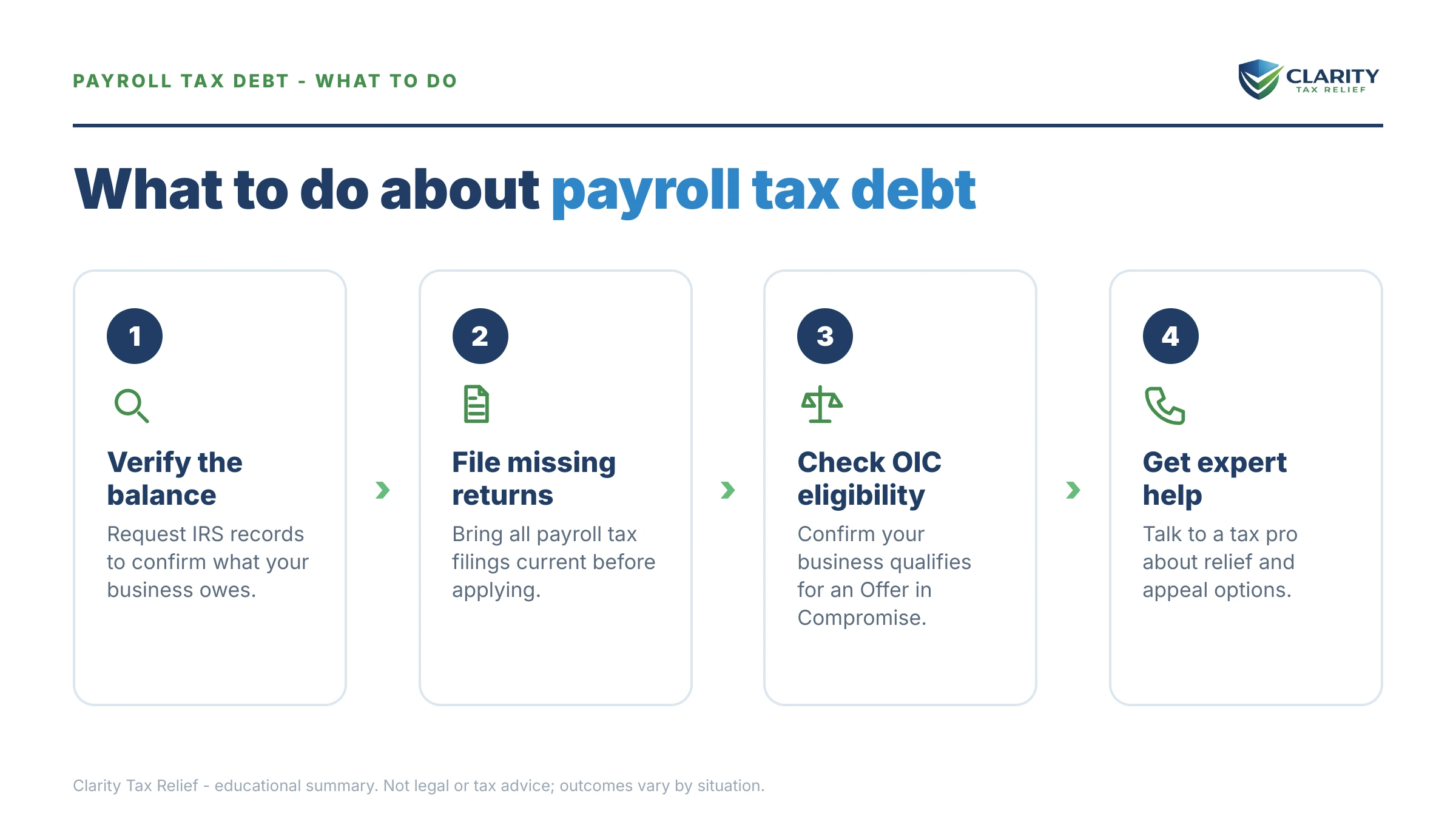
- Get compliant first: File every missing Form 941 and 940 and start making current federal tax deposits on time — the IRS returns offers from non-compliant businesses without reviewing them.
- Pull your IRS records: Request business account transcripts for each unpaid quarter to confirm the balance, the trust-fund split, and whether the TFRP has already been assessed.
- Build the financial package: Complete Form 433-B (OIC) for the business — or Form 433-A (OIC) if you're a sole proprietor — documenting every asset, receivable, and month of cash flow.
- Set the offer at your RCP: Calculate Reasonable Collection Potential from quick-sale asset values plus 12 or 24 months of disposable income, and offer at least that amount.
- Submit Form 656 and stay current: Send the offer with the $205 fee and required initial payment, then keep every deposit and filing on time for the entire review — one miss can sink the offer.
- Respond fast and appeal if needed: Answer the offer examiner's document requests by their deadlines, and if the offer is rejected, appeal within 30 days on Form 13711.
The offer form itself has more decision points than it looks — payment option elections, the liability periods you list, the entity boxes that control whose debt is being compromised. Our line-by-line Form 656 walkthrough covers them, and how long does an offer in compromise take sets honest expectations for the review timeline.
When you can handle this yourself — and when help changes the outcome
You do not need professional help for every payroll tax problem. If your business owes $25,000 or less, is still operating, and can pay within 24 months, the IBTF-Express installment agreement is designed to be set up directly — no financial statement, no examiner, protection in place within weeks. Likewise, if you're one quarter behind and can catch up within 180 days, a short-term arrangement plus a penalty abatement request (see 941 penalty abatement) may be all this ever needs to be.
Experienced help changes outcomes in four specific payroll situations. First, when a revenue officer is assigned — anything you or your bookkeeper says in a Form 4180 interview shapes who gets assessed personally, and preparation matters more than honesty alone. Second, when Letter 1153 arrives — the 60-day protest is a genuine legal defense window, and responsible-person status is more contestable than most owners assume. Third, when you're building the offer itself — quick-sale asset valuation, receivable treatment, and allowable-expense positions are where payroll offers are won or rejected, and a rejected offer hands the IRS your complete financial map. Fourth, when the business is closing or already closed — the order you wind things down in changes who owes what afterward, as our guide to 941 back taxes explains.
If your balance is in that harder territory — over $25,000, TFRP letters in the mail, or a revenue officer already calling — a free case review with an experienced tax professional will tell you whether an offer is realistic before you spend anything pursuing one: start the 2-minute form or call (888) 825-7779.
Terms on your payroll notices, decoded
- Trust fund taxes: the money withheld from employee paychecks — income tax plus their share of Social Security and Medicare — that you hold in trust for the government.
- Trust Fund Recovery Penalty (TFRP): the IRS's assessment of the trust-fund portion against individuals personally, dollar for dollar, separate from the business's debt.
- Responsible person: anyone with the duty and authority to collect and pay the withheld taxes — owners, officers, and sometimes bookkeepers or check-signers.
- Reasonable Collection Potential (RCP): the IRS's calculation of the most it could ever collect from you — quick-sale asset value plus a multiple of monthly disposable income — and the floor for any acceptable offer.
- Federal tax deposit (FTD): the scheduled payroll tax payments made through EFTPS during the quarter; missing them triggers tiered penalties up to 15% and breaks offer eligibility.
- IBTF-Express: the streamlined in-business trust fund installment agreement for balances of $25,000 or less, paid within 24 months, without full financial disclosure.
Business offer in compromise payroll questions, answered
Can a business really settle payroll taxes with an offer in compromise?
Yes, but acceptance is rare and heavily conditioned. The business must have filed every required return, stayed current on federal tax deposits for the current quarter and the two before it, and offer its full Reasonable Collection Potential. The IRS accepted roughly 1 in 5 offers of all types in FY2024, and payroll offers from operating businesses face extra scrutiny because the trust-fund portion can also be collected from owners personally.
Does a business offer in compromise wipe out my personal trust fund penalty?
No. The business's 941 liability and your personal Trust Fund Recovery Penalty are separate debts, and settling one does not automatically settle the other. The IRS generally addresses the TFRP against responsible persons before it will accept a business offer, so you may need a second, personal offer — or a TFRP defense — to close the matter completely.
Do I have to be current on payroll deposits before applying?
Yes — this is the gate most payroll offers fail at. The IRS expects timely federal tax deposits and filings for the quarter you apply in and typically the two quarters before it, and a missed deposit while the offer is pending can get it returned without a refund of your application fee. Get compliant first, then apply.
Can my business use the low-income OIC fee waiver?
No — the low-income certification that waives the $205 fee, the 20% down payment, and payments during review is available only to individuals with adjusted gross income at or below 250% of the federal poverty guidelines. A sole proprietor applies as an individual and may qualify; a corporation or an LLC taxed as a corporation cannot.
How long does a payroll tax offer in compromise take?
Most offers take several months to over a year, and payroll offers often run longer because an examiner must verify business assets, receivables, and the trust-fund split. By law, an offer the IRS doesn't decide within 2 years is automatically accepted — with narrow exceptions: a returned or rejected offer stops the clock, and time during court disputes does not count. Collection is generally paused while it's pending, but interest keeps accruing and the 10-year collection clock stops running.
What if my business already closed?
A closed business often has better settlement odds than an operating one. Once the business's assets are gone, the IRS assesses the Trust Fund Recovery Penalty against responsible individuals, and you can then compromise that personal liability through your own offer using Form 433-A (OIC). Your personal assets and income — not the defunct business's — drive the math.
Can the IRS levy my business while the offer is pending?
Generally no — levy action is suspended while a processable offer is under review. The trade-offs: you must keep every current deposit and filing on time or the offer gets returned, and the 10-year collection statute is paused, giving the IRS more time on the back end if the offer fails — the clock stays paused for an additional 30 days after a rejection, and for the entire time any appeal of the rejection is pending. Levies already served before you filed don't automatically release.
Is bankruptcy a better option than an offer for payroll taxes?
Usually not for the trust-fund portion, because withheld payroll taxes are priority debts that survive bankruptcy — Chapter 7 won't discharge them, and Chapter 11 or 13 requires paying them in full through the plan. Bankruptcy can still make sense for restructuring other debts around the tax. Compare the two paths carefully before filing either.
Who counts as a responsible person for payroll taxes?
Anyone with the duty and authority to collect, account for, and pay the withheld taxes — owners and officers, but also bookkeepers, controllers, and check-signers in some cases. The IRS pairs responsibility with willfulness: if you paid other creditors while knowing the taxes were unpaid, that's usually enough. The Form 4180 interview is where the IRS builds that case.
Your next 24 hours
- Find your quarters and your split. Pull the most recent IRS notice for each unpaid 941 quarter and note the total per quarter — and check whether any letter mentions the Trust Fund Recovery Penalty or is a Letter 1153, because that starts a 60-day clock.
- Gather the offer inputs. Last filed 941s and 940, current-quarter deposit records, business bank statements, a list of equipment and vehicles with loan balances, and your open receivables — these five items are the whole RCP calculation.
- Get the numbers reviewed free. An experienced tax professional can tell you in one call whether your payroll balance is offer territory, payment-plan territory, or a TFRP defense case — the 2-minute form or (888) 825-7779. Penalties and interest are accruing on every unpaid quarter either way; the review costs nothing.
Official program details are on the IRS's Offer in Compromise page, and payment options for staying deposit-current are at IRS.gov/payments. If IRS delays or errors are compounding your case, the independent Taxpayer Advocate Service can intervene at no cost.
This guide is general information, not tax or legal advice for your specific situation. Eligibility for IRS programs depends on individual facts and circumstances; no outcome is guaranteed.