
Business Tax Debt
Business Offer in Compromise: Can the IRS Settle Your Company's Tax Debt? (2026)
The short answer: a business offer in compromise lets an operating business settle IRS tax debt for less than the full balance when the IRS agrees it can't collect more. Businesses apply with Form 656 and Form 433-B (OIC), pay a $205 fee, and must be current on all filings and federal tax deposits.
Your company fell behind — maybe a few quarters of payroll deposits went to keeping the lights on instead of the Treasury — and the balance now has penalties stacked on top of tax. You've heard the IRS "settles" debt, and you're wondering whether that applies to a business, not just a person. It does, but the rules for a business offer are stricter than anything the radio ads describe, and payroll debt changes the math completely.
Everything the IRS decides about a business offer comes off one financial disclosure. The image below shows you exactly what that paperwork looks like and where the numbers that set your offer amount come from — so keep reading before you fill in a single box.
⏱ The clock that's actually running: there is no filing deadline for a business offer, but failure-to-pay penalties and interest accrue on the balance every month. And on payroll debt, the IRS can propose the Trust Fund Recovery Penalty against you personally at any point — once Letter 1153 arrives, you have only 60 days to protest before the debt follows you home.
What a business offer in compromise is — and whose debt it settles
A business offer in compromise is a written agreement in which the IRS accepts less than a business's full tax balance because the offer equals or exceeds everything the IRS could realistically collect from it. The general mechanics — doubt as to collectibility, the offer investigation, the acceptance letter — work the same as any offer, and we cover them in how an offer in compromise actually works. This page covers what's different when the taxpayer is a business.
The first difference is identity: a business OIC settles only the entity's own liability. Which entity you are decides which forms you file — and whether the offer even protects you personally.
| Your entity | Whose debt the offer settles | Forms you file |
|---|---|---|
| Sole proprietor / single-member LLC (disregarded) | You and the business are one taxpayer — one offer covers both | Form 656 + Form 433-A (OIC) |
| Partnership / multi-member LLC | The entity's liability only | Form 656 + Form 433-B (OIC) |
| Corporation (C or S) | The corporation's liability only — trust-fund penalty against officers is separate | Form 656 + Form 433-B (OIC) |
| Owner already assessed the TFRP personally | Your personal liability — requires its own offer | Separate Form 656 + Form 433-A (OIC) |
Notice the trap in rows two and three: a corporation's accepted offer does not settle what the IRS can assess against the people who ran it. If your debt is payroll tax, that split is the whole ballgame — more on it next.
Why the IRS treats a business OIC differently than a personal one
The IRS compromises business debt more reluctantly than personal debt, for three specific reasons.
1. Trust-fund money was never yours. The income tax and FICA withheld from employee paychecks is called trust-fund tax because the business held it in trust for the government. The IRS views compromising it as forgiving money taken from employees, and it rarely does so while it can still collect from anyone. Before deciding a business offer on payroll debt, the IRS typically identifies every "responsible person" and protects its ability to assert the trust fund recovery penalty against them. The narrow situations where trust-fund debt gets compromised anyway are covered in our business offer in compromise payroll guide.
2. An operating business must prove it won't re-offend. The IRS will not settle old quarters while new ones go unpaid — repeat non-deposit is called pyramiding, and it kills offers. To be processable, your business must have filed every required return and be current on this quarter's federal tax deposits. One missed deposit while the offer is pending can get it returned with no appeal rights.
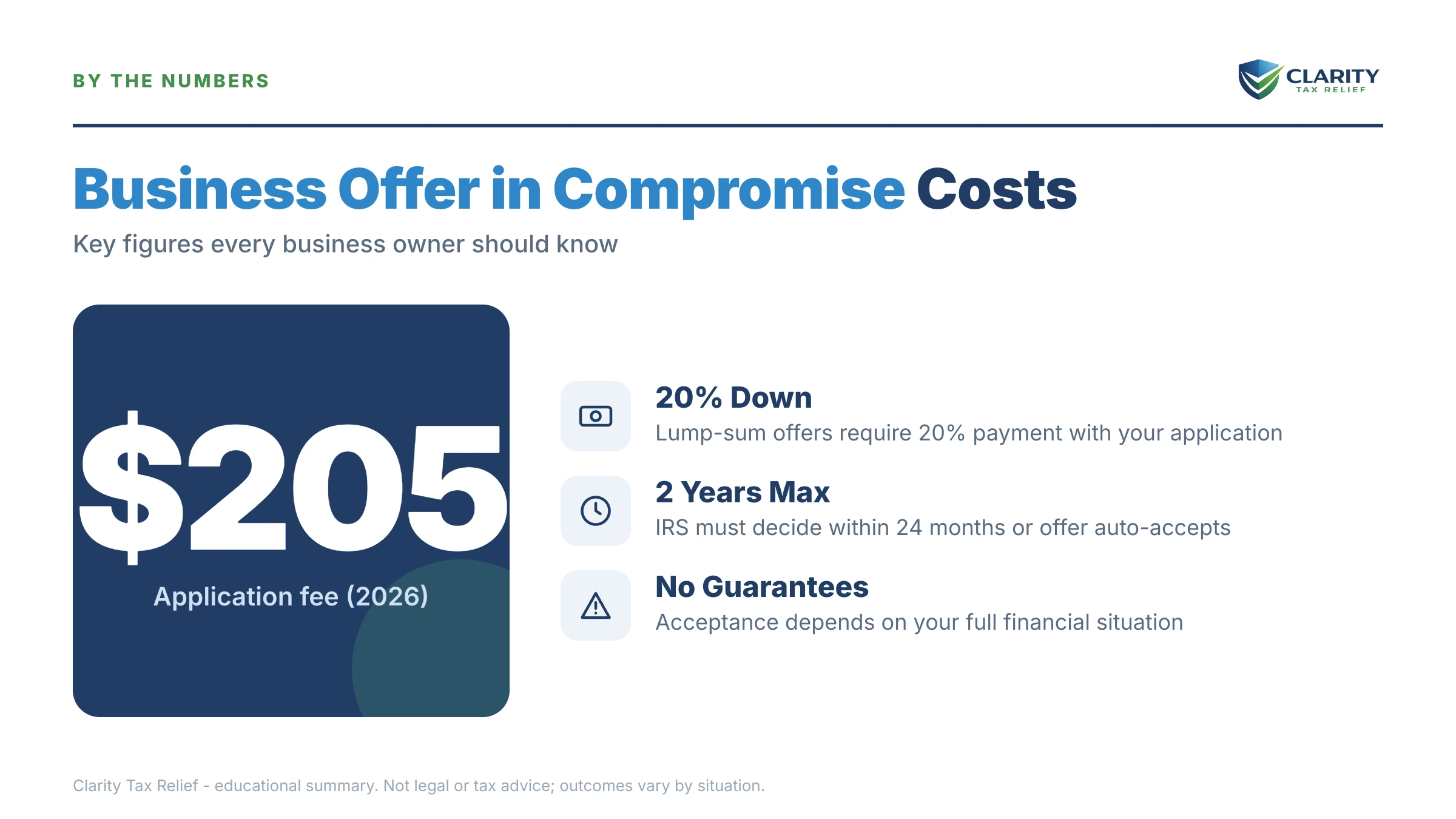
3. Businesses don't get the low-income breaks. Individuals with AGI at or below 250% of the federal poverty level can have the application fee, the 20% down payment, and payments-during-review waived. That certification is for individuals; a corporation, partnership, or multi-member LLC pays the $205 fee and the 20% down payment no matter how broke it is. Sole proprietors, who apply as individuals, may still qualify.
What happens if your business does nothing
Business tax debt escalates on two tracks at once: collection against the company, and personal assessment against the people behind it. Ignore the notices and both tracks advance in sequence:
- CP161 / CP163 — the business bill and its reminder. No enforcement yet, but penalties and interest compound monthly.
- CP504B — the business version of the intent-to-levy notice. The IRS can now take the company's state refund and is positioning to levy property. See the CP504B notice guide if this is what you're holding.
- LT11 / Letter 1058 / CP297 — final notice of intent to levy. A 30-day clock starts, along with your Collection Due Process rights (requested on Form 12153). After it runs, the IRS can levy bank accounts and accounts receivable.
- Levies land. A bank levy freezes funds for 21 days before the money leaves; an accounts-receivable levy tells your customers to pay the IRS instead of you, which can end a business faster than any seizure.
- The parallel track goes personal. On payroll debt, a revenue officer investigates responsible persons, then issues Letter 1153 proposing the TFRP against you individually — with a 60-day protest window. Once assessed, your house, wages, and personal accounts are in play.
In 2026 this matters more, not less: the IRS workforce shrank roughly 27% in 2025, so reaching a human is harder — but these notices are generated by automated systems that never stopped. The machine escalates whether anyone reads your file or not.
| Notice | What it means | Your window |
|---|---|---|
| CP161 / CP163 | First bill and reminder for a business balance due | The pay-by date printed on the notice |
| CP504B | Intent to levy — state refund can be taken; levy is next | Act before the date printed on the notice |
| LT11 / Letter 1058 / CP297 | Final notice of intent to levy | 30 days to request a CDP hearing (Form 12153) |
| Letter 1153 | TFRP proposed against you personally | 60 days to file a protest |
| Levy served | Bank funds held, or receivables redirected to the IRS | 21-day hold on bank funds before they're sent |
Behind on business taxes and weighing an offer?
Before the trust-fund penalty goes personal, find out whether your business is actually an OIC candidate — or whether a payment plan gets you there cheaper. An experienced tax professional will run your numbers free and tell you straight. Call (888) 825-7779 or use the 2-minute form.
Your options compared: business offer in compromise vs. everything else
An offer in compromise is one of five realistic paths for a business tax debt, and it is usually the slowest and most heavily vetted of them. Here's the full menu with real costs and timelines:
| Option | Upfront cost | Typical timeline | Best fit |
|---|---|---|---|
| Business offer in compromise | $205 fee + 20% of the offer (lump-sum) | Several months to 2 years to a decision | Business genuinely cannot pay the debt from assets and future income |
| IBTF-Express installment agreement | Setup fee only | Payroll balance paid within 24 months | Payroll debt of roughly $25,000 or less; no financial disclosure |
| Regular business installment agreement | Setup fee; financials usually required | Monthly payments up to the collection statute | Larger balances the business can service over time |
| Currently Not Collectible status | $0 | Until finances improve; reviewed periodically | Genuine hardship — debt remains and interest still accrues |
| Penalty abatement | $0 | Weeks to months | Reduces penalties, not tax — often stacked with another option |
A few notes the table can't hold. Payment plans are the workhorse: the details, thresholds, and financial-disclosure triggers live in our business IRS installment agreement guide, and the payroll-specific IBTF-Express rules are in business payroll tax payment plan. Hardship status is compared head-to-head with an offer in CNC vs offer in compromise. And if the business is insolvent enough that you're weighing court protection, read bankruptcy or offer in compromise before filing anything — trust-fund taxes survive bankruptcy, which changes that comparison for payroll debt.
How the IRS decides what your business can pay (Reasonable Collection Potential)
The IRS accepts a business offer only when it equals or beats the business's Reasonable Collection Potential — the total of asset equity plus collectible future income. There's no negotiation charm involved; it's arithmetic, and the full formula is dissected in our reasonable collection potential guide. For a business, the inputs are:
- Asset equity at quick-sale value. Equipment, vehicles, and inventory are generally counted at about 80% of fair market value, minus any loans against them. The IRS assumes a forced sale, not a patient one.
- Accounts receivable. What customers actually owe you and will actually pay — an aging report matters here, because 90-day-plus receivables can often be discounted.
- Bank balances. Cash on hand, largely as-is.
- Future income. Monthly business income minus allowable operating expenses, multiplied by 12 for a lump-sum offer or 24 for a periodic-payment offer. How the IRS builds that monthly number is covered in OIC future income.
Add those up and you have the floor for any acceptable offer. You can estimate your own number in a few minutes with our Offer in Compromise Calculator — it estimates, not guarantees, but it will tell you quickly whether an offer is even worth pursuing.
A worked example: $23,800 in payroll tax debt
Say your S-corporation owes $23,800 across three quarters of 941 taxes, penalties, and interest, and you're deciding between an offer and a payment plan. This is hypothetical — but the arithmetic is exactly what the IRS will run.
Scenario A — a functioning shop. Collectible receivables of $7,200. Equipment worth $15,000 at fair market: quick-sale value is $15,000 × 80% = $12,000, minus a $4,000 equipment loan = $8,000 equity. Bank balance $1,600. Monthly income of $18,000 against $17,400 in allowable operating expenses leaves $600/month of future income; on a lump-sum offer that's $600 × 12 = $7,200.
RCP = $7,200 + $8,000 + $1,600 + $7,200 = $24,600 — more than the $23,800 debt. The IRS concludes it can collect in full, and the offer is dead on arrival. The realistic move here is the IBTF-Express agreement instead: $23,800 sits under the roughly $25,000 payroll ceiling, and paying it within 24 months works out to about $992/month plus accruing interest — no financial disclosure, no $205 fee gambled, no 20% down payment forfeited.
Scenario B — the same debt, a thinner business. Most receivables are uncollectible ($1,200 realistic), the equipment is leased (no equity), the bank holds $1,600, and future income is still $600/month × 12 = $7,200. RCP = $1,200 + $1,600 + $7,200 = $10,000. Now an offer of $10,000 on a $23,800 debt is mathematically defensible: you'd send Form 656 with the $205 fee and a $2,000 down payment (20% of the offer), then pay the remaining $8,000 in up to five installments after acceptance.
One caveat even in Scenario B: because this is payroll debt, the IRS will look at asserting the trust-fund portion against you personally before or while it considers the corporate offer. Settling the entity without a plan for the TFRP is winning the battle and losing the war.
Forms, fees, and payment options for a business offer
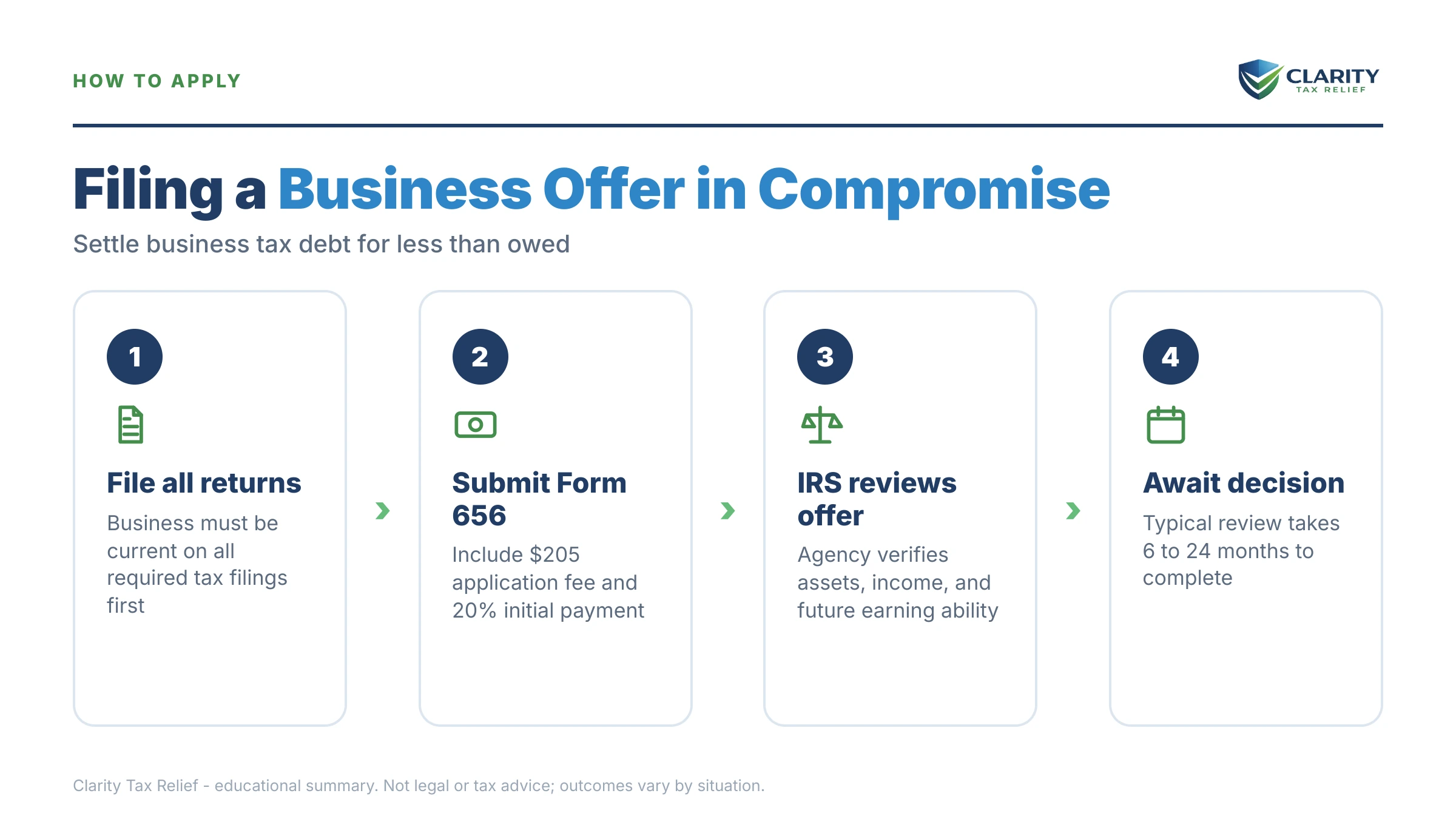
A complete business offer package is Form 656 plus Form 433-B (OIC), the financial disclosure the whole decision rests on. Line-by-line help with the offer form itself is in our Form 656 walkthrough. You'll choose one of two payment structures:
- Lump-sum cash offer: 20% down with the application, the balance in five or fewer payments after acceptance. Future income is multiplied by 12.
- Periodic-payment offer: monthly payments that start when you file and continue through review. Future income is multiplied by 24, so the required offer is larger — and missing a monthly payment while pending can sink it.
Once the offer posts, your account shows code 480, most new collection action pauses, and the 10-year collection statute stops running while the offer is reviewed. Expect the review to take months; complex business assets stretch it further, and the stage-by-stage timeline is in how long does an offer in compromise take. Two guardrails to know: an offer the IRS doesn't decide within 2 years is automatically accepted, and after acceptance the business must stay fully compliant for five years or the compromised debt comes back in full.
Keep expectations honest: the IRS accepted roughly 1 in 5 offers in FY2024, and business offers — especially payroll-based ones — face more scrutiny than the average. An offer is a math case you prove, not a discount you request.
How to apply for a business offer in compromise, step by step
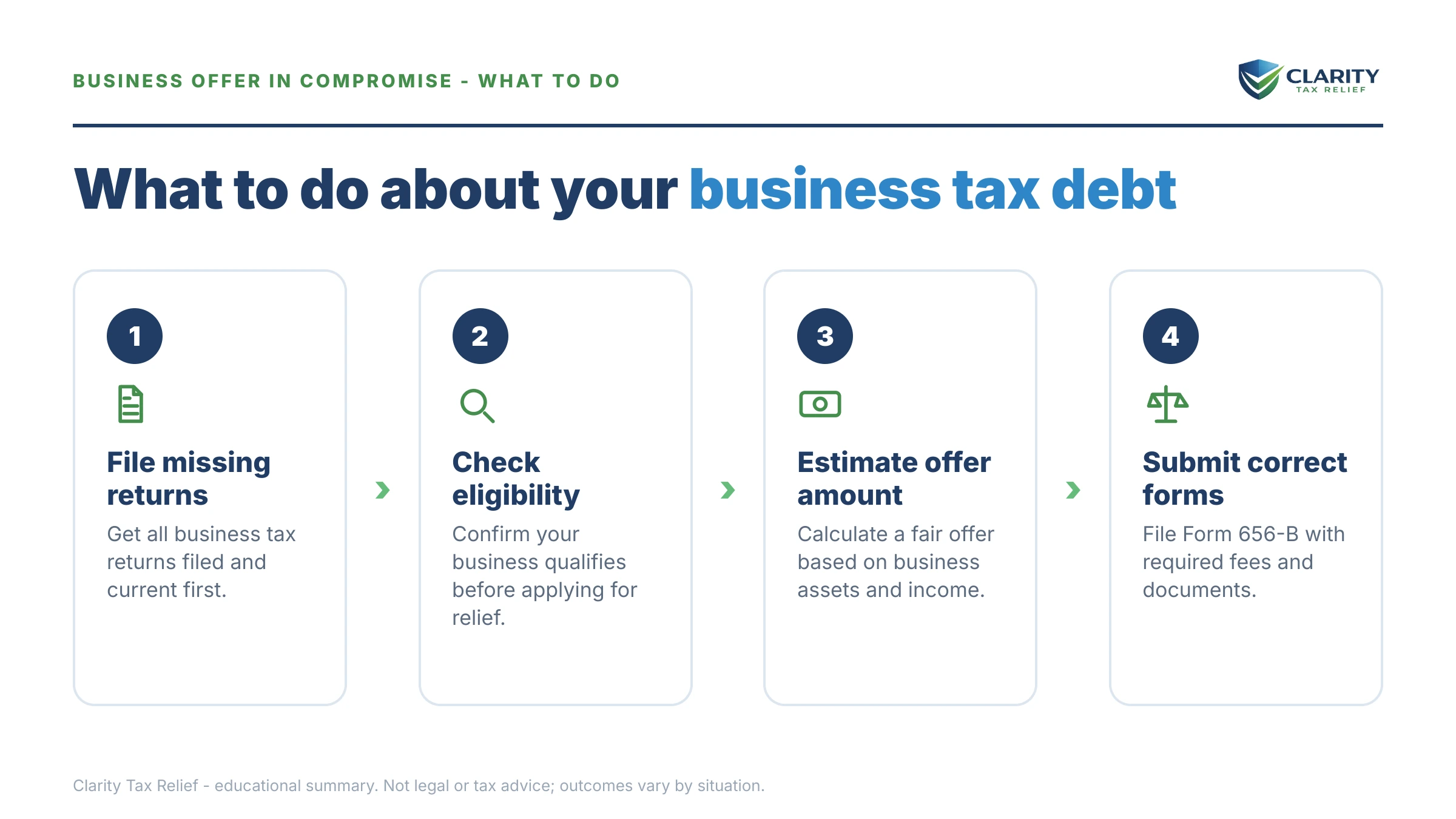
- Get the business fully compliant first. File every missing return and bring federal tax deposits current for the present quarter. The IRS returns offers from non-compliant businesses without reviewing them — and keeps the fee.
- Verify exactly what you owe, period by period. Pull business account transcripts or your most recent notice and separate tax from penalties and interest for each quarter. Offers built on wrong balances get returned.
- Run the Reasonable Collection Potential math before spending anything. Total your quick-sale asset equity plus 12 or 24 months of disposable business income. If that number meets or beats the debt, stop — pivot to a payment plan.
- File Form 656 with Form 433-B (OIC), the $205 fee, and your first payment. Attach three months of bank statements, an accounts receivable aging, asset and loan documentation, and profit-and-loss statements. Incomplete packages are the most common reason offers bounce.
- Stay compliant while the offer is pending. Keep every deposit and filing on time and keep making periodic payments if you chose that option. One missed deposit can end the offer with no appeal.
- Appeal a rejection inside the window on your letter. File Form 13711 within the deadline printed on the rejection — typically 30 days — or correct the numbers and pivot to another resolution. Our Form 13711 guide covers how appeals actually get offers reconsidered.
When you can handle this yourself — and when experienced help changes the outcome
Not every business tax debt needs professional help, and it would be dishonest to pretend otherwise. You can likely handle it yourself if:
- The balance is one the business can pay within 180 days — just pay it at IRS.gov/payments and stop the meter.
- Your payroll balance fits the IBTF-Express box (roughly $25,000 or less, payable in 24 months) — that setup is a form and a phone call, no financial disclosure required.
- You ran the RCP math and it clearly exceeds your debt — an offer isn't your path, and a straightforward installment agreement (see the IRS payment plans page) doesn't require representation.
Experienced help genuinely changes outcomes when the stakes and complexity rise: a revenue officer is already assigned, Letter 1153 has proposed the TFRP against you, a levy on your bank account or receivables is in motion, multiple years of business returns are unfiled, or the RCP math is close enough that valuation judgment calls — receivable collectibility, equipment quick-sale values, allowable expenses — decide whether the offer flies. Those are exactly the numbers a professional knows how to document and defend. If a rejected or mishandled offer would forfeit a five-figure down payment, the review is worth having before you file, not after. A free case review of your 941 balances and TFRP exposure costs nothing and tells you which side of that line you're on.
If the IRS itself is the obstacle — a pending offer lost in the system, or hardship the process is ignoring — the Taxpayer Advocate Service is an independent, free escalation path. And the IRS's own overview of the program lives at its offer in compromise page.
Terms on your offer paperwork, decoded
- Trust-fund taxes: the income tax and FICA withheld from employee paychecks — the government's money the business held in trust, and the portion the IRS fights hardest to collect.
- TFRP (Trust Fund Recovery Penalty): a personal assessment of the trust-fund portion against anyone who was responsible for paying it and willfully didn't — owners, officers, sometimes bookkeepers.
- RCP (Reasonable Collection Potential): the IRS's calculation of everything it could collect from your business — asset equity plus future income. Any acceptable offer must meet or beat it.
- Quick-sale value: the discounted value (generally about 80% of fair market) the IRS assigns business assets, on the theory of a forced sale.
- TC 480: the transcript code showing an offer is pending — the marker that collection is generally paused and the collection statute is tolled.
- Five-year compliance clause: the term in every accepted offer requiring on-time filing and payment for five years afterward; break it and the full original debt is reinstated.
Business offer in compromise questions, answered
Can a business qualify for an offer in compromise?
Yes — corporations, partnerships, and multi-member LLCs can apply using Form 656 and Form 433-B (OIC), while sole proprietors apply as individuals with Form 433-A (OIC). Approval depends entirely on the math: the IRS must conclude your offer equals or exceeds what it could collect from business assets and future income. In FY2024 the IRS accepted roughly 1 in 5 offers overall, and business offers face extra scrutiny.
Can an offer in compromise settle payroll tax debt?
It can, but the trust-fund portion — money withheld from employee paychecks — is the hardest debt the IRS ever compromises. Before accepting a business offer, the IRS typically determines who is personally liable for the Trust Fund Recovery Penalty, and a business OIC does not automatically erase that personal assessment. Payroll-heavy cases need a strategy that addresses both the business account and the owners' personal exposure at the same time.
How much does a business offer in compromise cost to file?
A $205 application fee plus, for a lump-sum offer, a nonrefundable down payment of 20% of the offer amount, both sent with Form 656. Businesses other than sole proprietors generally cannot use the low-income certification that waives these amounts for qualifying individuals. Professional preparation is a separate cost, and if the offer is rejected, the payments are applied to your tax balance rather than refunded.
How long does a business OIC take?
Most offers take several months to well over a year from filing to a decision, and business offers with equipment, inventory, and receivables to value often run longer. By law, an offer the IRS does not decide within 2 years is automatically accepted. Collection generally pauses while the offer is pending, but interest keeps accruing, and the 10-year collection clock is paused too.
Does filing a business OIC stop IRS levies?
Generally yes — while an offer is pending and processable, the IRS suspends most new levy action against the business, and transcript code 480 marks the account as offer-pending. It does not undo a levy already served, and a bank levy in motion still follows its 21-day hold unless released separately. If the IRS believes the offer was filed solely to delay collection, it can return the offer and resume enforcement.
Can my business keep operating during an offer in compromise?
Yes — an OIC exists for both closed and operating businesses, but an operating business must prove it can stay compliant going forward. That means on-time federal tax deposits and filings for every period while the offer is pending; a missed deposit can get the offer returned without appeal rights. The IRS will not settle old debt while new debt is accruing — a pattern it calls pyramiding.
What happens if my business offer in compromise is rejected?
You can appeal within the window printed on the rejection letter — typically 30 days — using Form 13711, and appeals overturn or renegotiate a meaningful share of rejections. You can also submit a new offer with corrected numbers, or pivot to an installment agreement. Fees and payments already sent are applied to your balance, not refunded, so it pays to get the math right the first time.
Does a business OIC wipe out the trust fund recovery penalty against me personally?
No — the business's offer settles only the business's liability. The Trust Fund Recovery Penalty is a separate personal assessment against owners, officers, and anyone else who controlled the money, and it survives a business OIC unless it is resolved on its own. Some owners end up needing a second, personal offer — or a defense against the TFRP assessment itself before it ever posts.
Should my business do an OIC or a payment plan?
Run the Reasonable Collection Potential math first: if your business assets plus future income exceed the balance, the IRS will reject an offer, and a payment plan is the realistic path. Payroll balances of roughly $25,000 or less can often use the streamlined IBTF-Express agreement without full financial disclosure. An OIC only wins when the business genuinely cannot pay the debt before the collection statute expires.
Your next 24 hours
- Find your exact balance, period by period. Pull it from your most recent notice (CP161 or CP504B) or your business account transcripts, and note how much of it is trust-fund payroll tax versus penalties and interest — that split decides your strategy.
- Gather the RCP inputs. Six months of business bank statements, an accounts-receivable aging report, an equipment list with loan balances, your latest profit-and-loss, and the last two years of filed business returns.
- Get the math checked before you spend a dime. Interest and penalties are accruing monthly, and TFRP exposure doesn't wait — send your numbers through the free case review form or call (888) 825-7779 and an experienced tax professional will tell you whether an offer, a payment plan, or a TFRP defense is the right first move.
This guide is general information, not tax or legal advice for your specific situation. Eligibility for IRS programs depends on individual facts and circumstances; no outcome is guaranteed.