
Business Tax Debt
Business IRS Installment Agreement: How to Qualify in 2026
The short answer: a business IRS installment agreement lets your company pay federal tax debt monthly instead of facing levy. Operating businesses owing $25,000 or less in payroll taxes can qualify for an In-Business Trust Fund Express plan — up to 24 months, no financial statement — while sole proprietors use individual plans of up to 72 months.
You kept the company running through everything this year — maybe even through a divorce that split your attention and your bank accounts — and somewhere in the middle of it, a quarter's payroll taxes didn't get paid. Now the balance is real, the notices have started, and payroll is still due Friday. That's fixable, and the map is shorter than you think: match your entity and your balance to the right plan, get compliant, and apply before the notice sequence escalates.
The agreement itself comes down to a short stack of paperwork. The image below shows exactly what those documents look like and where the terms that matter sit, so nothing on them surprises you when they arrive.
⏱ The real clock: penalties and interest accrue on a business tax balance every month until a payment plan is in place. And there's a second clock most owners miss — one late federal tax deposit this quarter can disqualify the plan you're applying for, because every business agreement requires current compliance.
Why an IRS payment plan for a business works differently
A business IRS installment agreement is generally capped at 24 months — one-third of the 72 months an individual can get — and when the debt is payroll tax, part of the balance can be assessed against you personally no matter what happens to the company.
Before anything else, pin down which "business" the IRS thinks you are, because entity type decides which rulebook applies:
- Sole proprietors and single-member LLCs. Your business income tax and self-employment tax are assessed to you personally, so you use the individual payment-plan system — longer terms, higher balance limits, faster online approval. The application mechanics are covered in our guide to how to set up an IRS payment plan online; this page covers what changes when the debtor is a business.
- Corporations and partnerships. Income tax owed on a Form 1120 or a partnership assessment sits on the business's own account, and the entity applies for its own agreement — generally up to 24 months for smaller balances.
- Any business with employees. Unpaid Form 941 payroll taxes are their own category. Part of that balance is money withheld from employees' paychecks — "trust fund" money the IRS never considered yours to spend — and it treats that as the most serious debt a business can carry. Our guide to 941 back taxes explains why.
That third lane is where most business payment-plan questions actually live, and it has a personal trap built in: the trust fund recovery penalty lets the IRS assess the withheld portion against owners, officers, and anyone who decided which bills got paid. A payment plan manages the company's balance. It does not, by itself, erase that personal exposure — more on how to shrink it below.
One more 2026 note: application mechanics and online thresholds have been shifting as the IRS automates more of collections. If you set up (or were denied) a plan in a prior year, check the IRS payment plan changes for 2026 before assuming the old rules still apply.
What happens if your business ignores the balance
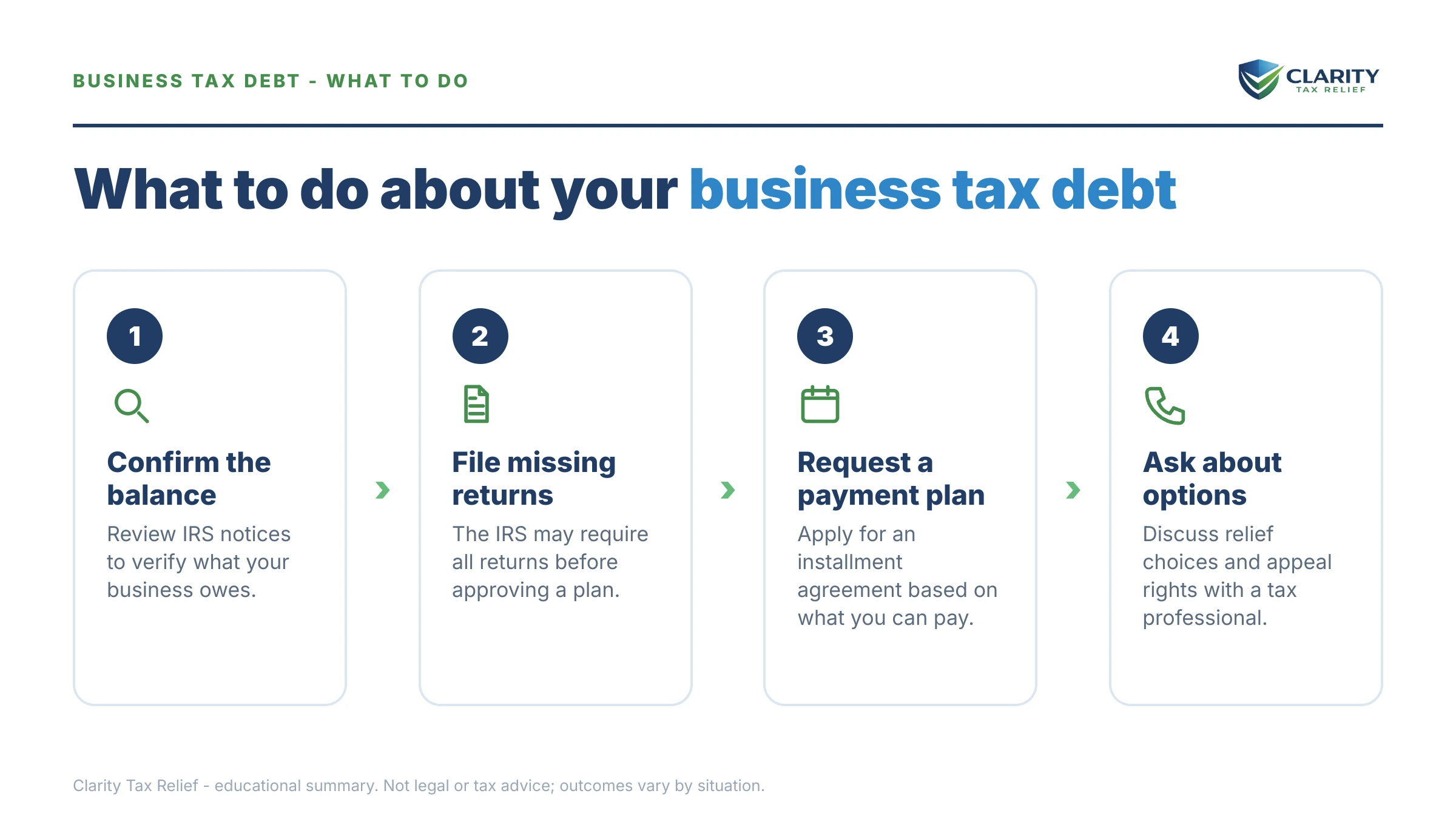
Business tax debt escalates from a routine CP161 bill to levy authority through a fixed, automated notice sequence — and payroll debt runs a second, personal track toward Letter 1153 at the same time.
- CP161 — the first business balance-due bill. No enforcement power yet; this is the cheapest moment to set up an agreement.
- CP163 — a reminder that the business balance remains unpaid, now larger, because penalties and interest compound monthly.
- CP504B — the business version of the intent-to-levy notice. The IRS can now seize the company's state tax refund and is positioning for stronger action.
- Final notice of intent to levy (LT11, Letter 1058, or CP297) — starts a 30-day clock and your Collection Due Process rights, requested on Form 12153. After those 30 days pass, levies become legal.
- Levy — the IRS can levy the business bank account (funds are held 21 days before they leave) and send levies directly to your customers for your accounts receivable, which cuts off cash flow at the source.
If the debt is payroll tax, the parallel track matters just as much: a revenue officer can investigate "responsible persons" and issue Letter 1153, proposing the trust fund penalty against you personally. You have 60 days to protest a Letter 1153 — and that clock runs whether or not the business is negotiating a plan.
Don't count on 2026 staffing chaos to slow any of this down. The IRS workforce shrank roughly 27% in 2025, which makes humans harder to reach — but the notices, liens, and levies come from automated systems that never stopped running.
| Notice | What it means | The power behind it |
|---|---|---|
| CP161 | First business balance-due bill | None yet — cheapest moment to act |
| CP163 | Reminder of the unpaid business balance | Balance growing monthly |
| CP504B | Intent to levy | State refund seizure; escalation queued |
| Letter 1153 (payroll debt) | Proposed trust fund penalty against you personally | 60 days to protest before personal assessment |
| LT11 / Letter 1058 / CP297 | Final notice of intent to levy | After 30 days: bank accounts, receivables, business assets |
Behind on 941s or watching the business notices stack up?
Get your business balance reviewed free before the sequence reaches levy authority — and before the trust-fund question becomes personal. An experienced tax professional will map your quarters, your thresholds, and the plan that actually fits.
Business IRS installment agreement options in 2026
Every business IRS installment agreement falls into one of six lanes, and two facts pick the lane: your entity type and your total balance when the agreement is established.
| Plan | Balance limit | Max term | Who it fits |
|---|---|---|---|
| Short-term payment plan | Full pay within 180 days | 180 days | Sole proprietors & single-member LLCs (tax assessed personally) |
| Guaranteed installment agreement | $10,000 or less | Up to 3 years | Sole proprietors with income tax debt |
| Streamlined individual agreement | $50,000 or less | Up to 72 months | Sole proprietors & SMLLC owners |
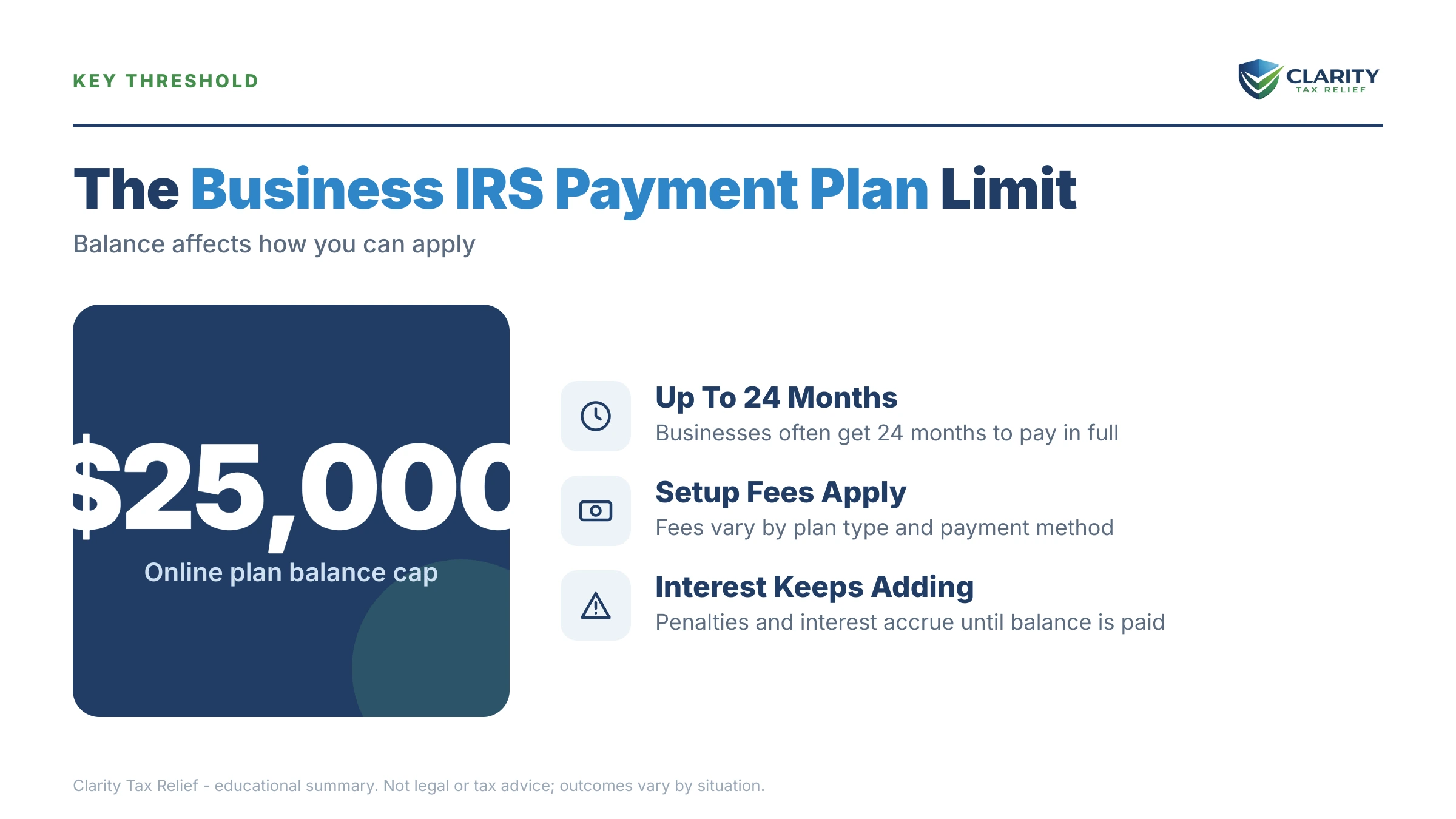
| Business online payment agreement | Generally $25,000 or less | Up to 24 months | Corporations & partnerships owing income tax |
| In-Business Trust Fund Express | $25,000 or less (direct debit required from $10,000) | Up to 24 months | Operating businesses with 941 payroll debt |
| Non-streamlined / negotiated agreement | No cap — Form 433-B required | Set by financial review | Any business above the thresholds |
A few notes the table can't hold. The guaranteed installment agreement and streamlined tiers only exist on the individual side, which is a genuine advantage of being a sole proprietor in this one narrow sense: a $40,000 balance that would demand full financial disclosure from a corporation goes through online in minutes for a Schedule C filer.
If even the negotiated terms don't fully pay the debt before the 10-year collection statute expires, the IRS can approve a partial payment installment agreement — real, but it requires full financials and periodic re-review. A business Offer in Compromise also exists for operating companies, but acceptance is rare and the math is strict; it's a candidate conversation, not a default plan.
| Option | Setup cost | Time to approval | Cost while it runs |
|---|---|---|---|
| Short-term plan (180 days) | $0 setup fee | Often same day online | Interest + late-payment penalty keep accruing |
| Streamlined individual plan (sole props) | Standard setup fee — lowest online with direct debit | Often same day online | Interest continues; failure-to-pay penalty generally halved |
| IBTF-Express (payroll ≤ $25,000) | Standard setup fee applies | Days — online, phone, or Form 9465 | Interest + reduced penalty; deposits must stay current |
| Negotiated plan with Form 433-B | Setup fee plus the cost of preparing full financials | Weeks to months, often with a revenue officer | Interest continues; lien filing more likely |
Setup fees vary by how you apply and how you pay — direct debit online is always the cheapest route, and low-income waivers exist on the individual side. The current tiers are broken down in our IRS payment plan setup fee guide.
The IBTF-Express plan: payroll debt of $25,000 or less
The In-Business Trust Fund Express installment agreement gives an operating business with $25,000 or less in payroll tax debt up to 24 months to pay — with no Form 433-B and no revenue officer digging through the company's finances.
The core terms: the balance must be $25,000 or less when the agreement is established, it must be fully paid within 24 months (or by the collection statute deadline, if that comes first), and balances between $10,000 and $25,000 must be paid by direct debit from the business account. Under $10,000, direct debit is optional — but smart, because it removes the single most common way these plans die: a forgotten payment.
Why "no Form 433-B" matters more than it sounds: that form makes you list every bank account, every receivable, and every customer who owes you money. Skipping it means the IRS gets paid without building a roadmap of exactly what to levy if things go wrong later. For a business under the threshold, the express plan isn't just faster — it's structurally safer.
The trade is strict compliance. Every 941 filed, every federal tax deposit made on time, for the full life of the plan. A late deposit isn't just a federal tax deposit penalty of up to 15% — it's new debt, and new debt defaults the agreement. For the deeper trust-fund-specific rules and how revenue officers handle these cases, see our full guide to the business payroll tax payment plan.
Owe more than $25,000? You're in Form 433-B territory
Above $25,000, a business installment agreement stops being a formality and becomes a negotiation built on Form 433-B, the business collection information statement.
That form discloses the company's bank balances, receivables, equipment, real estate, and monthly cash flow — and the IRS sets the payment from what that analysis says the business can afford, not from what feels survivable. Larger payroll cases usually get a revenue officer assigned, which means field contact, deadlines, and a live human deciding whether your numbers hold up.
Three strategic realities at this level:
- The pay-down play. Because thresholds are measured when the agreement is established, a business owing, say, $29,000 can sometimes pay $4,000 up front and qualify for the express plan instead of open-book disclosure. Whether that's wise depends entirely on whether draining that cash jeopardizes next quarter's deposits — cure the disease, don't feed it.
- The TFRP runs in parallel. At larger balances, the IRS often pursues the personal trust fund assessment while negotiating with the business. Getting a plan approved does not pause a Letter 1153 clock.
- Designated payments. Voluntary payments (not levied or offset funds) can typically be designated in writing to the trust-fund portion of the debt first — the fastest way to shrink the part that can follow you personally.
If the business is closing rather than continuing, the calculus changes completely: entity-level agreements end with the entity, but trust-fund liability shifts to the responsible people. That's a different playbook, and one worth getting advice on before you dissolve anything.
Worked example: $6,200 of payroll debt after a divorce
Say you run a small S-corp cleaning company with two part-time employees, and during a divorce year one quarter's 941 slipped — you now owe $6,200 in tax, penalties, and interest. Here's the hypothetical math:
- You qualify for IBTF-Express. $6,200 is under $25,000, so no Form 433-B, and under $10,000, so direct debit is optional (take it anyway).
- The minimum payment: $6,200 ÷ 24 months ≈ $259 per month.
- The faster option: at $530 per month, the balance clears in roughly 12 months — cutting the accrual window in half. Interest keeps compounding on the unpaid balance the whole time, and the failure-to-pay penalty continues at a reduced rate, so every extra month costs real money. You can estimate your own accrual with our Penalty & Interest Calculator.
- The compliance condition: this quarter's deposits must go out on time, every time, or the plan defaults and the sequence restarts — now with a track record against you.
One divorce-specific note: the IRS doesn't read divorce decrees. If the decree says your ex handles a jointly-created tax debt, the IRS can still collect from whoever is legally liable on its records — the business's payroll debt belongs to the business (and its responsible persons), full stop.
How to set up a business IRS installment agreement, step by step
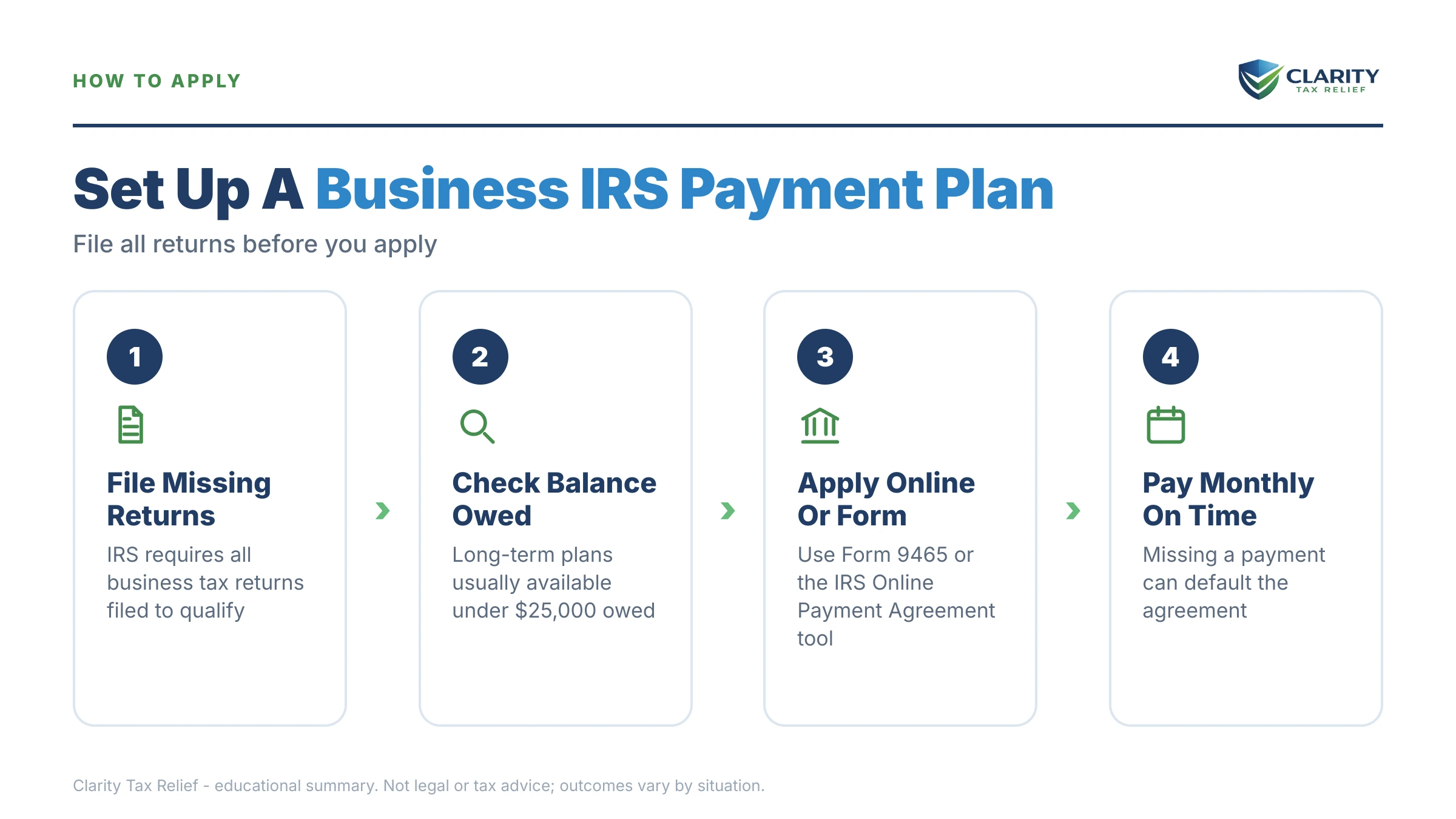
- File every required return. The IRS will not approve any business installment agreement while 941s, 940s, or income tax returns are missing. File them first, even if you cannot pay a dime with them.
- Get current on this quarter's deposits. Make every federal tax deposit and estimated payment on time starting now. Current compliance is the gate every plan sits behind, and one late deposit can sink the application.
- Pull your exact balance. Check your business tax account at IRS.gov or your latest notice for the assessed balance by quarter. The $25,000 and $10,000 thresholds are measured against the total when the agreement is established.
- Match your entity and balance to a plan and apply. Sole proprietors apply through the individual online system. Businesses with payroll debt of $25,000 or less request an In-Business Trust Fund Express agreement online, by phone, or with Form 9465.
- Sign, calendar, and protect the agreement. Watch for your confirmation — often Form 433-D for direct debit — calendar every payment date, and treat next quarter's deposits as untouchable, because new debt defaults the plan.
When you can handle this yourself
Plenty of business payment plans need no professional at all — and knowing which is which saves you money either way.
Handle it yourself when: you're a sole proprietor owing $50,000 or less with all returns filed (the online application takes minutes); the business owes income tax only, under $25,000, and is current on everything; or a single payroll quarter slipped and the total is well under $10,000. In those cases, apply directly, take direct debit, and move on.
Experienced help changes outcomes when: a revenue officer has been assigned or has visited; you've received Letter 1153 and the 60-day protest window is running; multiple quarters are unpaid (the IRS reads repeat non-deposit as pyramiding, its trigger for harshest enforcement); the balance is over $25,000 and Form 433-B strategy determines both your payment and what the IRS learns about your assets; or federal debt is stacked on top of state payroll or sales tax. If cost is the barrier, the Taxpayer Advocate Service can help when IRS processes themselves are causing harm.
Terms on your paperwork, decoded
- Trust fund taxes — the income tax and FICA withheld from employees' paychecks; the IRS treats it as money held in trust, never the business's to spend.
- Trust Fund Recovery Penalty (TFRP) — the personal assessment of that withheld portion against anyone who was responsible for paying it and willfully didn't.
- Federal tax deposit (FTD) — the scheduled payroll tax deposits a business must make between filings; late deposits draw a penalty of up to 15%.
- IBTF-Express — the In-Business Trust Fund Express installment agreement: 24 months, $25,000 or less, no financial statement.
- Form 433-B — the business collection information statement; full disclosure of accounts, receivables, and assets, required above the express thresholds.
- CSED — the Collection Statute Expiration Date: the IRS generally has 10 years from assessment to collect, and every agreement must fit inside that window.
If a revenue officer or the trust-fund math is already in the picture, have an experienced tax professional review your quarters before you sign anything — the free case review takes about two minutes to request.
Your IRS plan doesn't cover state payroll or sales tax
A federal installment agreement covers federal tax only — it does not touch state payroll tax, state sales tax, or state income tax, each of which is collected by a separate agency on its own rules and timelines. California businesses, for example, negotiate payroll tax separately with the EDD and sales tax with the CDTFA; see our guides to the EDD payment plan and the CDTFA payment plan. Never assume a state agency's thresholds or windows mirror the IRS's — they usually don't, and states are often the faster collector.
Business IRS installment agreement questions, answered
Can a business set up an installment agreement with the IRS?
Yes. An operating business that owes $25,000 or less in payroll taxes can request an In-Business Trust Fund Express installment agreement with up to 24 months to pay, and corporations or partnerships owing income tax have a similar 24-month online option. Sole proprietors use the individual system, which allows up to 72 months on balances of $50,000 or less. Every plan requires all returns filed and current tax deposits.
What is an In-Business Trust Fund Express installment agreement?
It is the IRS payment plan built for operating businesses with payroll tax debt of $25,000 or less. You get up to 24 months to pay in full, no Form 433-B financial statement is required, and balances between $10,000 and $25,000 must be paid by direct debit. You must stay current on all filings and federal tax deposits while the agreement runs.
How long can a business IRS payment plan last?
Most business installment agreements run up to 24 months — both the In-Business Trust Fund Express plan for payroll debt and the online option for business income tax. Sole proprietors and single-member LLC owners, whose tax is assessed personally, can stretch qualifying balances of $50,000 or less over up to 72 months. Larger, negotiated agreements are set by financial analysis and can run longer, up to the collection statute deadline.
Does a business payment plan stop the Trust Fund Recovery Penalty?
Not automatically. The trust fund portion of unpaid payroll taxes can still be assessed personally against owners, officers, and anyone who controlled which bills got paid, even while the business pays monthly. In practice, keeping a small express agreement current often keeps that file quiet, but a default or a growing balance can restart the investigation. If you have received Letter 1153, the 60-day protest clock runs regardless of any payment plan.
Can my business get an IRS payment plan owing more than $25,000?
Yes, but not through the express routes. Above $25,000 the IRS requires Form 433-B, a full business financial statement, and the terms come out of that analysis — often with a revenue officer assigned. Some businesses pay the balance down below $25,000 before the agreement is established so they qualify for the 24-month express plan instead; whether that is smart depends on your cash flow.
Do I have to be current on payroll deposits to qualify?
Yes. Current compliance is the non-negotiable gate for every business installment agreement: all required returns filed and all federal tax deposits for the current quarter made on time. The IRS will not formalize a plan for a business that is still adding new payroll debt, because that pattern — called pyramiding — is what triggers its harshest enforcement.
Will the IRS file a tax lien if my business is on a payment plan?
It can. A payment plan stops levies, but the IRS keeps the discretion to file a Notice of Federal Tax Lien to protect its position, and it is more likely to file one on larger balances or agreements not paid by direct debit. Smaller express agreements on direct debit are your best odds of avoiding a lien, though no plan guarantees one will not be filed.
What happens if my business misses a payment?
One missed payment does not instantly kill the agreement — the IRS typically sends a notice and allows a window to catch up before formally defaulting the plan with a CP523. A default reinstates full collection power, including bank and accounts receivable levies. Missing a federal tax deposit counts as new debt and can default the plan just as fast as a missed monthly payment.
Does interest stop while my business is on an IRS payment plan?
No. Interest accrues on the unpaid balance for the life of the agreement, and the failure-to-pay penalty continues as well — though it is generally cut in half while a formal installment agreement is in effect. That is why paying more than the minimum, or paying the plan off early, almost always saves real money on a business balance.
Two follow-ups worth reading before you commit: what happens when an IRS payment plan defaulted — so you know exactly what protects the agreement — and whether to pay off an IRS payment plan early, which usually saves more than owners expect. The official application terms are on the IRS's payment plans and installment agreements page, and payments themselves go only through IRS.gov/payments.
Your next 24 hours
- Find your exact assessed balance by quarter. It's on your latest CP161, CP163, or CP504B, or in your business tax account at IRS.gov — the $25,000 and $10,000 thresholds are measured against that total, so the precise number decides your options.
- Gather three things: your last filed 941s and business income return, proof of this quarter's deposits, and every IRS notice you've received. That's the whole file an application (or a professional review) needs.
- Book the free case review — the 2-minute form or (888) 825-7779. Every month a business balance sits without a plan, interest and penalties compound on top of it, and the notice sequence moves one step closer to levy authority.
This guide is general information, not tax or legal advice for your specific situation. Eligibility for IRS programs depends on individual facts and circumstances; no outcome is guaranteed.