
IRS Forms
Form 433-D: How to Fill Out and Return the IRS Installment Agreement Form (2026)
The short answer: Form 433-D is the IRS Installment Agreement form — the document that finalizes your monthly payment plan and, in most cases, authorizes direct debit from your bank account. You don't use it to request a plan (that's Form 9465); you sign and return it to lock in terms the IRS has already approved.
You worked out a payment plan — probably on a long hold with the IRS, maybe through a revenue officer — and now a two-page form titled "Installment Agreement" is asking for your bank routing number and a signature. Handing the IRS direct access to the account your Social Security check lands in feels risky. It's actually the step that turns a verbal promise into binding protection from levies, and getting it right the first time matters.
Form 433-D is short, but three of its blanks cause most processing delays: the tax-period boxes, the bank numbers, and the signature line. The visual guides below map the key facts, deadlines, and options, so keep them handy as you read.
⏱ Your real clock: return the signed Form 433-D by any date stated in the IRS letter that came with it. Until the IRS processes the signed form, your installment agreement is not final — interest and the monthly failure-to-pay penalty keep accruing, and the collection notice sequence stays live.
Why the IRS sent you Form 433-D
The IRS uses Form 433-D to finalize an installment agreement that has already been approved — it arrives after a decision, not before one. If this form is in your hands, someone at the IRS has already said yes to a payment plan. The form typically shows up through one of four doors:
- You set up a plan by phone. After you agree to terms with the IRS's Automated Collection System, the agent mails a 433-D so you can confirm the terms in writing and, usually, authorize direct debit.
- A revenue officer negotiated terms with you. On assigned cases, the officer hands or mails you the 433-D to execute the agreement you worked out.
- Your balance is between $25,000 and $50,000. At that level, a streamlined agreement — one that skips the full financial disclosure — generally requires direct debit or payroll deduction. Form 433-D is where your bank information goes.
- You're converting an existing check-payment plan to direct debit — often to lower the setup fee, to satisfy a lien-avoidance condition, or simply to stop mailing checks.
Note what the form is not: it is not a financial disclosure. Nobody is asking about your expenses or assets here. If the IRS wants that, it sends Form 433-F or 433-A — a distinction covered in the comparison table below, because the "433" family confuses almost everyone.
What happens if you don't return Form 433-D
An installment agreement isn't final until the IRS processes your signed Form 433-D — a phone conversation alone doesn't lock in your protection. If the form sits on your kitchen table, the automated system eventually treats your account as if no agreement exists, and the collection sequence resumes in order:
- The proposed agreement lapses. The terms you negotiated aren't held open indefinitely; an unreturned 433-D can mean starting the whole approval over — possibly on different terms.
- Balance-due notices resume. CP501 and CP503 reminders restart, each one adding another month of interest and failure-to-pay penalty to the balance.
- CP504 — Notice of Intent to Levy. The IRS can now seize your state tax refund, and a Notice of Federal Tax Lien becomes a live possibility.
- LT11 or Letter 1058 — Final Notice. This starts a 30-day clock, after which the IRS can levy bank accounts and — for retirees — take up to 15% of each Social Security payment through the Federal Payment Levy Program. An active installment agreement is precisely what prevents that. (More on that exposure in can the IRS garnish Social Security.)
- If the 433-D was converting an existing plan, failing to return it can default the plan itself, triggering a CP523 and putting you back at square one.
In 2026, with the IRS workforce down roughly 27%, the person you spoke to may never look at your file again — but the automated system that escalates unresolved balances never stopped running. The paperwork is what protects you, not the phone call.
Holding a Form 433-D you're not sure about?
Before you sign — or if the payment the IRS proposed doesn't fit your budget — have an experienced tax professional review the form and your notice free. Interest keeps accruing while the paperwork sits, and the terms are far easier to fix before you sign than after.
Form 433-D vs. Form 9465, 433-F, and 433-A: which form does what
Form 433-D is the only form in the 433 family that is an agreement rather than a financial disclosure. The IRS's installment-agreement paperwork splits into two jobs — asking for a plan and proving what you can pay — and 433-D does neither. It documents a plan that already exists. Here's the whole family in one place:
| Form | What it does | When you'd use it |
|---|---|---|
| 433-D | Finalizes an approved installment agreement; authorizes direct debit | After the IRS approves your plan by phone, letter, or revenue officer |
| 9465 | Requests an installment agreement | Asking for a plan by mail, often attached to a filed return |
| 433-F | Short financial statement (income, expenses, assets) | When ACS needs proof of what you can afford — bigger balances, lower payments, hardship |
| 433-A | Full financial statement | Revenue officer cases and Offer in Compromise applications |
| 2159 | Payroll deduction agreement | Payments taken from wages by your employer instead of your bank |
Two practical takeaways. First, if the IRS mailed you a 433-D, the hard part — approval — is behind you; don't reopen it by sending a 9465. Second, the choice between direct debit on the 433-D and payroll deduction on Form 2159 has real consequences for fees and default risk, compared side by side in our direct debit installment agreement guide. (If you're starting from zero with no agreement yet, the online route is usually faster than any paper form — see how to set up an IRS payment plan online.)
How to fill out Form 433-D, section by section
Form 433-D runs about a page of blanks plus a page of terms, and most rejections trace back to mismatched tax periods, bad bank numbers, or a missing signature. Some fields may arrive pre-filled by the IRS — verify those rather than assuming they're right. Work through it in this order:
| Section of Form 433-D | What to enter | Watch out for |
|---|---|---|
| Name, address, SSN(s) | Exactly as printed on the IRS letter that came with the form | A name or SSN mismatch can post the agreement to the wrong account |
| Phone and employer/bank name blocks | Current daytime phone; employer or financial institution names | Retirees: list your bank; leave employer blank rather than guessing |
| Kinds of taxes and tax periods | The tax form (usually 1040) and every year included in the plan | A year left off is a year not protected by the agreement |
| Amount owed and monthly payment | The balance and payment the IRS approved — "$___ on the ___ of each month" | Pick a payment date that lands after your income arrives |
| Increase/decrease boxes | Only if you agreed to a scheduled payment change (e.g., after a car loan ends) | These are binding — don't fill them in speculatively |
| Direct debit authorization | Routing and account numbers from the bottom of a check; attach a voided check | Transposed digits are the #1 processing delay; verify twice |
| Signature and date | Your signature — and your spouse's if the liability is joint | One missing signature on a joint balance sends the whole form back |
On payment-date strategy: if your Social Security deposit posts on the second Wednesday, don't schedule the debit for the first of the month. Set the payment date at least several days after your income reliably lands — a bounced direct debit doesn't just cost a bank fee, it puts your agreement on the path to default.
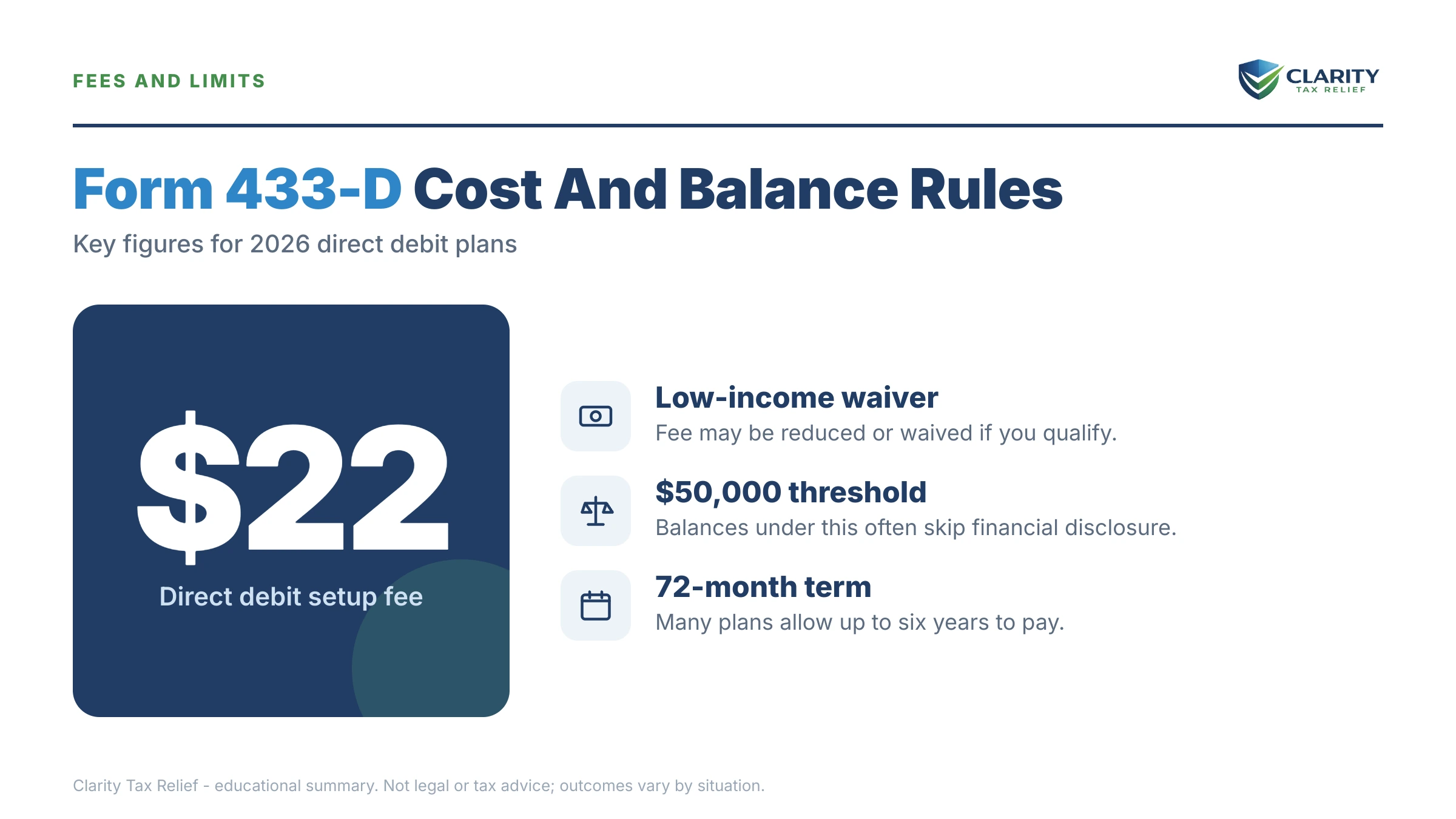
On fees: direct-debit agreements carry the lowest setup fee the IRS charges, and taxpayers with income at or below 250% of the federal poverty guidelines may qualify for a reduced fee — waived with direct debit, or reimbursed at completion otherwise. The current tiers are broken down in our IRS payment plan setup fee guide. The fee is typically added to your balance or taken from your first payment; you don't send a separate check.
A worked example: $19,700 on a fixed income
Say you owe $19,700 from a couple of lean years, and you're retired on Social Security. Because the balance is under $25,000, you fit the streamlined rules: no financial statement required, and direct debit on the 433-D is optional (though cheaper). The IRS generally wants a streamlined plan to pay the balance in full within 72 months — so here's the floor math:
$19,700 ÷ 72 months ≈ $274 per month — roughly the lowest payment the IRS will typically accept without asking for your financials, assuming your 10-year collection statute doesn't run out sooner. Interest continues on the shrinking balance, so the true payoff runs a bit past the raw division: expect the final months to adjust, or pay slightly more than $274 to stay ahead of the accrual. One quiet break helps: for returns filed on time, the failure-to-pay penalty drops from 0.5% to 0.25% per month while the agreement is in effect. You can estimate how much accrual adds over your payoff window with our Penalty & Interest Calculator.
Two retiree-specific notes. First, an active agreement is what keeps the Federal Payment Levy Program — the 15% Social Security levy — off your monthly check. Second, if $274 would genuinely crowd out food, medicine, or housing, don't sign a plan you'll default on. A Form 433-F walkthrough shows how the IRS measures what you can actually afford, and IRS hardship on Social Security covers when Currently Not Collectible status beats a payment plan entirely. A lower-than-streamlined payment is possible — it just requires the financial disclosure the streamlined route skips.
Different balance, different math: under $10,000 with clean filing history, you may fit the guaranteed installment agreement rules; above $50,000, financial disclosure becomes mandatory and the options change — see IRS payment plan over $50,000.
What you're agreeing to: the fine print on Form 433-D
Signing Form 433-D commits you to more than a monthly payment — the terms printed on the form are conditions, and breaking any of them can default the agreement. Before you sign, know that you're agreeing to:
- File every future return on time and pay every future year in full. A new balance on next year's return defaults the agreement just as surely as a missed payment. This is the condition retirees on withholding-free pension or IRA income trip over most.
- Give up your refunds while you owe. Any refund you're due gets applied to the balance — and it does not count as that month's payment. Details in will the IRS take your refund on a payment plan.
- Pay the setup fee, which the IRS adds to the agreement rather than billing separately.
- Provide updated financial information if the IRS asks during the life of the agreement.
- Accept that a Notice of Federal Tax Lien may still be filed in some cases. An agreement stops levies; it doesn't automatically prevent a lien, though direct debit agreements at certain balance levels can help you avoid or withdraw one.
None of this is a reason not to sign — these are the standard terms of every IRS installment agreement. It's a reason to sign a payment you can sustain and to fix your withholding or estimated payments now, so a future April doesn't undo everything.
After you send it in: the notices that follow
Once the IRS processes your signed Form 433-D, the mail you receive changes character — from collection threats to account maintenance. Here's the sequence, including what happens if things go wrong:
| Notice or event | When it typically arrives | What it means / what to do |
|---|---|---|
| Acceptance confirmation | Usually within a few weeks of processing | Your agreement is official — file it with your copy of the 433-D |
| CP521 | Monthly, if you pay by check (direct debit usually skips these) | A routine payment reminder, not a problem — pay by the date shown |
| Missed payment | Any month a payment fails or doesn't arrive | A cure window typically applies before formal default — act fast; see missed IRS payment plan payment |
| CP523 | After an uncured default (missed payments or a new balance) | Intent to terminate — generally 30 days to catch up or appeal before levy powers return |
| Annual balance statement | Once a year | Shows payments applied and remaining balance — check it against your records |
Keep an eye on your first one or two debits. If the money doesn't leave your account on the scheduled date, don't celebrate — call the IRS or check your online account, because an agreement that never activated offers no protection. And if your circumstances improve, paying extra or paying off early is always allowed with no prepayment penalty; if they worsen, you can lower your IRS monthly payment rather than defaulting.
How to complete and return Form 433-D, step by step
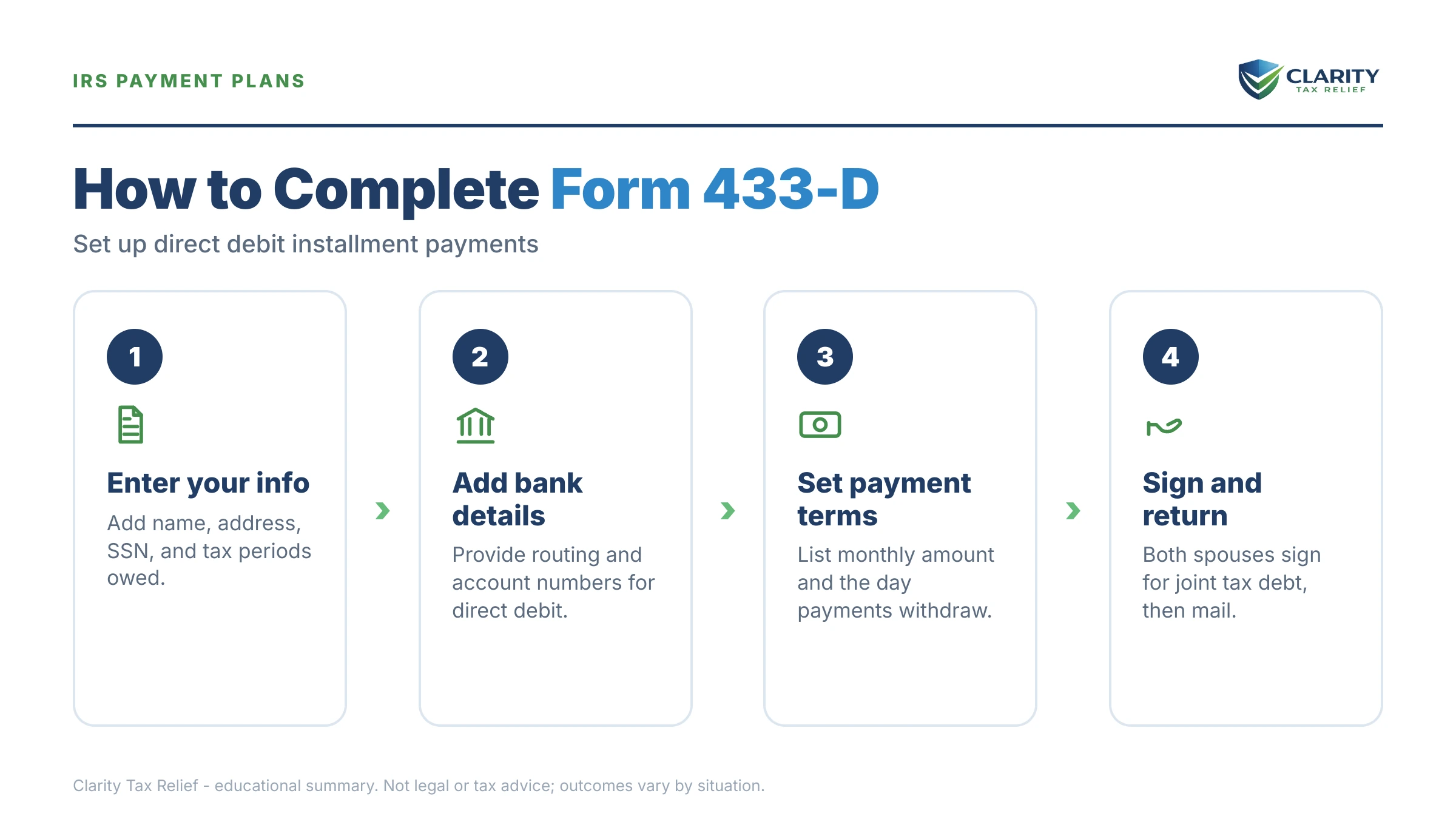
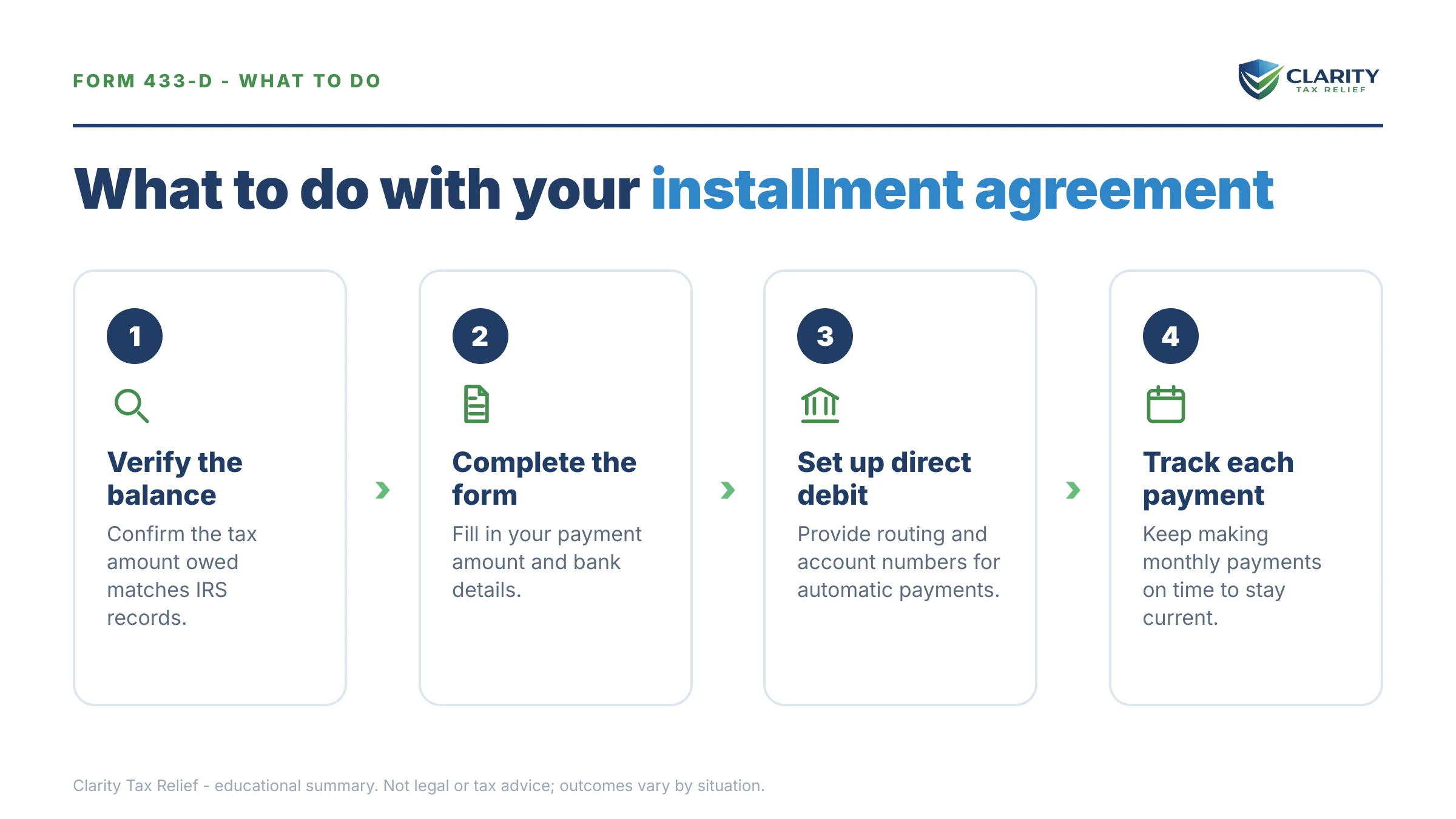
- Confirm the terms match what you agreed to. Check that the monthly payment, payment date, and tax periods printed on the form match the agreement you made by phone or letter before you sign anything.
- Fill in your identifying information exactly as it appears on your IRS notice. Enter your name, address, and Social Security number exactly as printed on the letter that came with the form so the agreement posts to the correct account.
- Add your bank routing and account numbers for direct debit. If you're setting up direct debit, copy the routing and account numbers from the bottom of a check and attach a voided check so the IRS can verify them.
- Sign and date the form — both spouses for a joint liability. An unsigned form, or a single signature on a joint balance, gets sent back — which delays your agreement while penalties and interest keep accruing.
- Return it to the address or fax number on your IRS letter and keep a copy. There is no single national mailing address for Form 433-D — send it where your letter or revenue officer directs, and keep a complete copy with proof of mailing.
- Keep making monthly payments while you wait for confirmation. Start paying the agreed amount by the chosen date each month even before the IRS confirms acceptance, so you never fall behind on day one.
When you can handle Form 433-D yourself
Most people who receive a Form 433-D can complete and return it without any professional help. If you agree with the balance, the monthly payment fits comfortably in your budget, the tax periods on the form are right, and you're under the $50,000 line — fill it in, sign it, mail it, done. This form was designed to be self-service, and paying someone to transcribe your routing number is money wasted.
Experienced help changes the outcome in specific situations: the proposed payment doesn't fit your real budget (the difference between a sustainable plan, a partial-pay arrangement, and hardship status is a financial-analysis question, not a form question); you have unfiled years that will default the agreement the moment they're assessed; a levy is already in motion or an LT11 clock is running; the balance is above $50,000 where full disclosure and negotiation come into play; or the debt is business or payroll tax, where personal liability rules raise the stakes. In those cases, what gets written on — or negotiated before — the 433-D determines what you pay for years.
If any of those describes you, it costs nothing to have your 433-D and notice reviewed before you sign — request a free case review or call (888) 825-7779 and get a straight answer about whether the terms in front of you are the terms you should accept.
Terms on your Form 433-D, decoded
- Direct debit installment agreement (DDIA): a payment plan where the IRS pulls the monthly payment straight from your bank account — lowest fee, lowest default risk.
- Streamlined installment agreement: a plan approved without a full financial statement — generally balances up to $25,000, or up to $50,000 with direct debit or payroll deduction.
- User fee: the one-time setup charge for an installment agreement, added to the agreement rather than billed separately; reduced or waived for qualifying low-income taxpayers.
- Default: breaking any condition of the agreement — a missed payment, an unfiled return, or a new unpaid balance — which lets the IRS terminate the plan.
- CSED (Collection Statute Expiration Date): the 10-year deadline on IRS collection of each assessment; your plan's length can't quietly outrun it without special terms.
- Notice of Federal Tax Lien: a public claim against your property securing the debt — separate from a levy, and possible even with an agreement in place, depending on your balance and payment method.
Form 433-D questions, answered
What is IRS Form 433-D used for?
Form 433-D is the document that finalizes an IRS installment agreement — it records your monthly payment amount, payment date, and tax periods, and it's how you authorize direct debit from your bank account. The IRS typically sends it after you've agreed to a plan by phone or through a revenue officer. You don't use it to ask for a plan; you sign it to lock one in.
What is the difference between Form 433-D and Form 9465?
Form 9465 is the request; Form 433-D is the agreement. You file Form 9465 to ask the IRS for a payment plan, usually with a tax return or by mail. Form 433-D comes into play after the IRS has said yes — it confirms the terms and collects your bank routing and account numbers for direct debit. Many taxpayers never touch a 9465 at all: they set the plan up by phone and only ever sign a 433-D.
Is Form 433-D the same as Form 433-A or Form 433-F?
No — despite the shared number, they do opposite jobs. Forms 433-A and 433-F are Collection Information Statements: financial disclosures listing your income, expenses, and assets so the IRS can decide what you can pay. Form 433-D is the agreement itself, signed after that decision is made. If the IRS asked for a 433-F, it's still evaluating you; if it sent a 433-D, it has already approved terms.
Where do I send Form 433-D?
Send it to the address or fax number printed on the IRS letter that came with the form — there is no single national mailing address for Form 433-D. If a revenue officer is handling your case, return it directly to that officer. Keep a complete copy plus proof of mailing or the fax confirmation, because a lost 433-D means the agreement was never finalized on the IRS side.
Do I have to set up direct debit on Form 433-D?
It depends on your balance. Under $25,000, direct debit is optional — though it carries the lowest setup fee and the lowest default risk. Between $25,000 and $50,000, the IRS generally requires direct debit (or payroll deduction) to qualify for a streamlined agreement without submitting a full financial statement. If you refuse direct debit at that level, expect to be asked for a Form 433-F instead.
Does interest stop once I sign Form 433-D?
No — interest continues to accrue on the unpaid balance for the life of the agreement, which is why paying more than the minimum saves real money. There is one break: for returns that were filed on time, the failure-to-pay penalty rate drops from 0.5% to 0.25% per month while an installment agreement is in effect. Enforcement stops; the meter does not.
Will the IRS still take my tax refund on a 433-D payment plan?
Yes. The terms printed on Form 433-D state that any federal (and often state) refund you're owed will be applied to your balance for as long as you owe. The offset doesn't replace your monthly payment — you still owe the full installment that month — but it does shrink the balance and shorten the payoff. Plan your withholding accordingly if you count on refunds.
What happens if I miss a payment on my Form 433-D agreement?
One missed payment doesn't instantly kill the agreement — the IRS typically allows a chance to catch up before formal default. If you don't cure it, the IRS mails a CP523 Notice of Intent to Terminate, which generally gives you 30 days to fix the problem or appeal before the agreement ends and levy powers return. Call before you miss a payment, not after; a payment you know you'll miss can often be rescheduled or the plan restructured.
Can I change my monthly payment amount after signing Form 433-D?
Yes — installment agreements can be revised if your circumstances change, and the form itself includes boxes for scheduled increases or decreases agreed to up front. To lower the payment later, you'll usually need to show updated finances, and a revision fee may apply. If even a reduced payment would leave you unable to cover basic living expenses, Currently Not Collectible status may fit better than a plan you'll default on.
Your next 24 hours
- Find three things on your paperwork: the monthly payment amount and date on the Form 433-D, the tax periods listed, and the return address or fax number on the IRS letter that came with it. Confirm all three match what you agreed to.
- Gather what you'll need to complete it: a voided check (or your routing and account numbers), the IRS notice, and your most recent filed return so the tax years line up.
- If anything doesn't add up — the payment strains your budget, a year is missing, or you're not sure you should be on this plan at all — get a free case review before you sign. Call (888) 825-7779 or use the 2-minute form; every month the form sits unsigned is another month of interest and penalty on the balance.
Official resources: the IRS's About Form 433-D, Installment Agreement page hosts the current form, and the IRS payment plans and installment agreements page covers program rules. Payments themselves can always be made at IRS.gov/payments.
This guide is general information, not tax or legal advice for your specific situation. Eligibility for IRS programs depends on individual facts and circumstances; no outcome is guaranteed.