
IRS Forms
Form 9465 Installment Agreement Request: How to Get an IRS Payment Plan in 2026
The short answer: a Form 9465 installment agreement request asks the IRS, on paper, for a monthly payment plan on back taxes. Most people who owe $50,000 or less can skip it and apply online for a lower fee — use Form 9465 when you're attaching the request to a return you're filing, or you owe too much to apply online.
You know roughly what you owe, you know you can't write one check for it, and somewhere — a forum, a tax preparer, the back of an IRS notice — you heard that "Form 9465" is how you ask for a payment plan. Now you're looking at a two-page form asking for bank routing numbers and wondering if you're about to sign up for something you can't undo. You're not. An installment agreement is the most common IRS resolution there is, and this form is one of three ways to request it — sometimes the right way, often the expensive way.
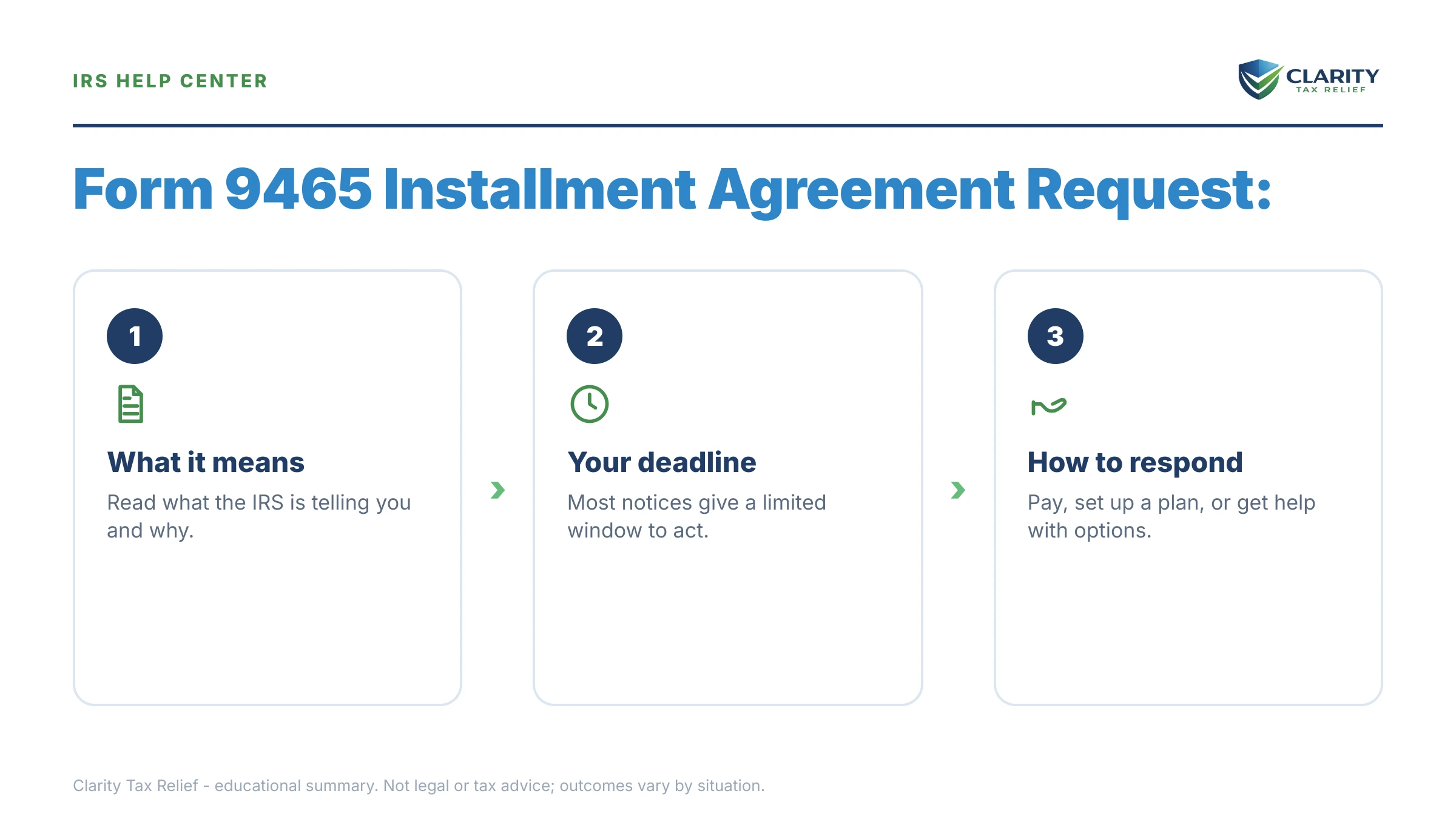
This guide covers exactly when Form 9465 beats the online tool, the balance thresholds that decide whether you owe the IRS financial disclosure, the 2026 fee tiers, and what to do when the form sits on top of unfiled returns. The image below shows exactly what Form 9465 looks like and where to look, so you can orient yourself before you fill in a single line.
⏱ The clock that matters: Form 9465 has no printed response deadline — the deadline is accrual. Until an agreement is in place, the failure-to-pay penalty adds 0.5% of your balance every month and interest compounds daily on top of it. Once an agreement is approved, that monthly penalty rate is cut in half for returns that were filed on time.

What a Form 9465 installment agreement request actually does
Form 9465 is the IRS's official paper request for a monthly installment agreement on individual tax debt. You propose a monthly payment amount and a due date between the 1st and the 28th; the IRS reviews the request and either approves it, asks for more information, or rejects it with a reason. Filing it is a request, not a contract — nothing is binding until the IRS sends its approval letter.
The form is short by IRS standards. Part I collects your identifying information, the total you owe, the payment you're proposing, and — if you choose direct debit — your bank routing and account numbers. Part II only applies in one specific band: balances between $25,001 and $50,000, where it asks a handful of financial questions (household size, income, employment) in place of a full financial statement. For a line-by-line walkthrough of every entry, see our Form 9465 instructions guide; this page is about whether and how to use the form at all.
One quiet benefit worth knowing before you file: a properly submitted installment agreement request generally suspends IRS levy action while it's pending, while the agreement is in effect, and for 30 days after any rejection. The trade-off is that the pending request also pauses the 10-year collection statute, giving the IRS more time on the back end.
Do you actually need Form 9465 — or is online better?
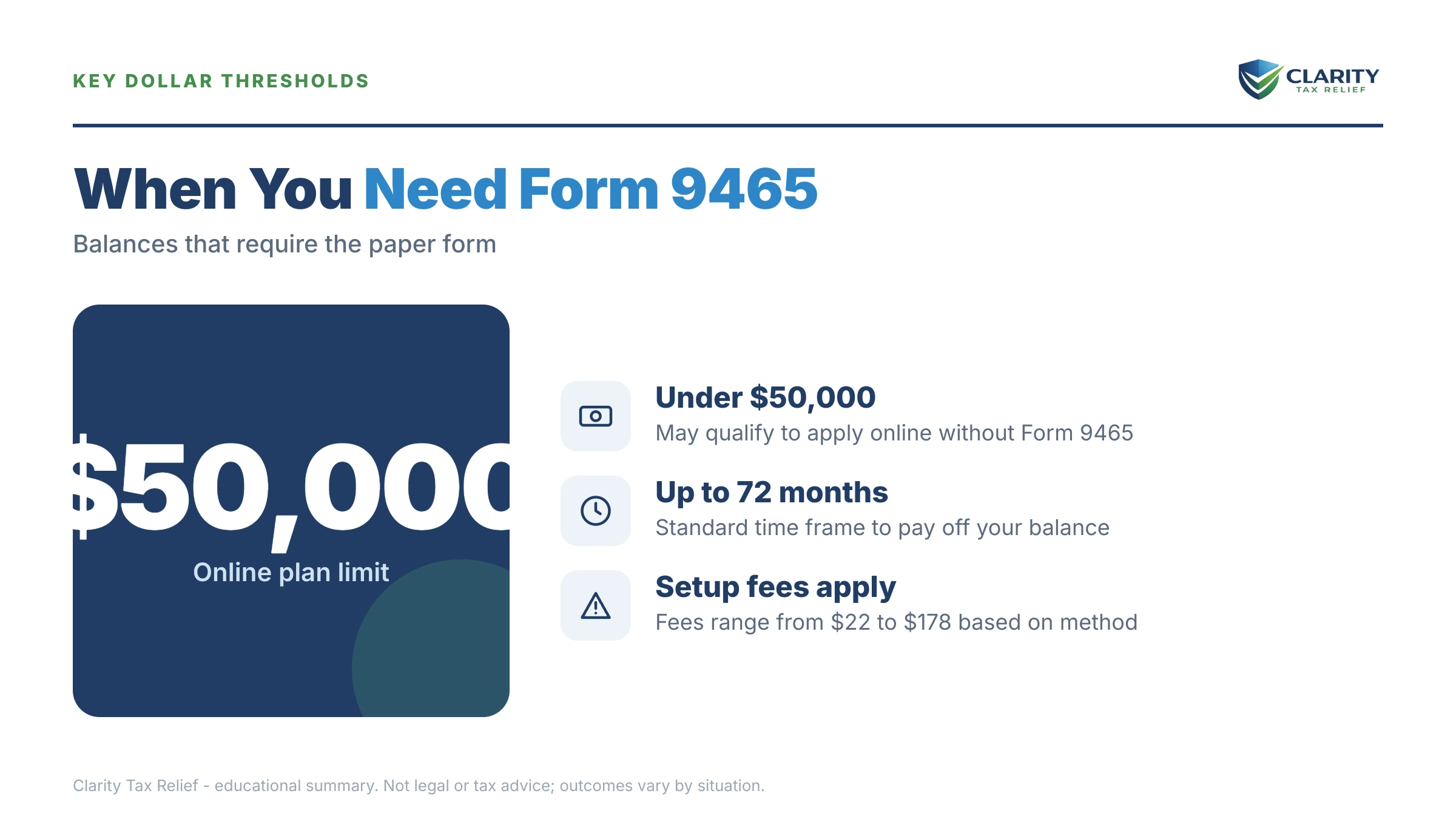
Most taxpayers who owe $50,000 or less do not need Form 9465 at all — the IRS Online Payment Agreement gives an immediate decision at a fraction of the setup fee. The paper form survives because three situations still genuinely call for it: you're filing a return (or a stack of back returns) and want the payment plan request to travel with it; you owe more than $50,000, where the online tool isn't available; or you can't get through the IRS's online identity verification.
Here's the decision in one view:
| Your situation | Best route | Why |
|---|---|---|
| Owe $50,000 or less, all returns already filed and processed | Online Payment Agreement | Immediate decision; lowest fees ($22–$69) |
| Filing a return — or back returns — with a balance due | Form 9465 attached to the return | The request travels with the return; one submission handles both |
| Owe $25,001–$50,000 | Online, or Form 9465 with Part II | Direct debit is required either way to skip full financial disclosure |
| Owe more than $50,000 | Form 9465 plus Form 433-F, by mail | The online tool isn't available; the IRS requires financials |
| Can't pass online ID verification, or no reliable internet | Form 9465 by mail, or a phone request | Paper is the fallback — it works, at a higher fee and slower pace |
If the online route fits you, our hub on how to set up an IRS payment plan online walks through that application screen by screen. Two situations where Form 9465 is the wrong form entirely: an open bankruptcy case, and a pending Offer in Compromise — both are handled through different channels, and the form's own instructions tell you not to file it in either case.
Unfiled returns first: the IRS won't approve a plan for a non-filer
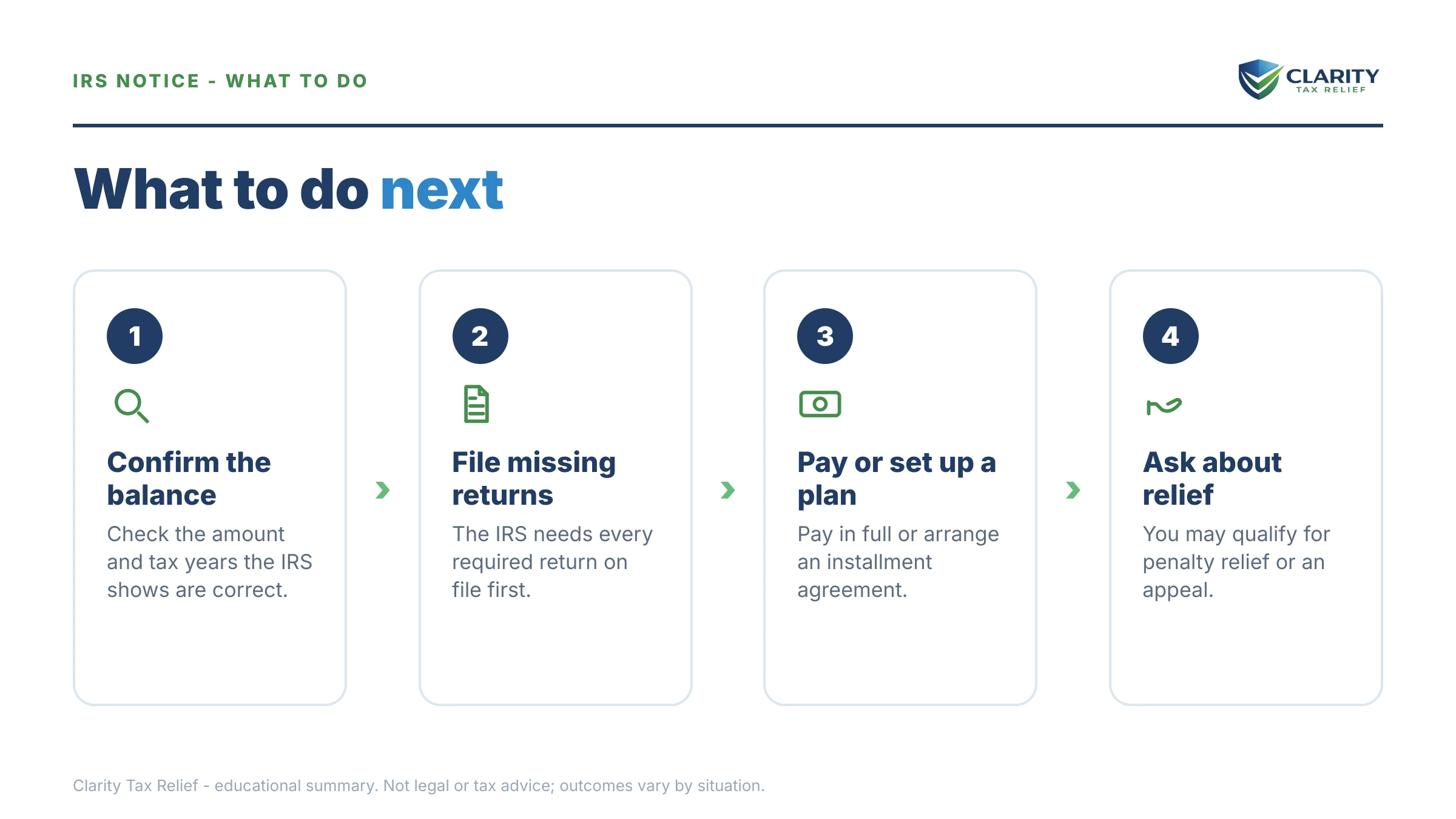
An installment agreement request from someone with unfiled required returns gets rejected — filing compliance comes before payment terms, every time. This trips up gig workers and 1099 earners more than anyone: no employer withholding meant no forced filing habit, and one skipped year quietly became two or three.
The fix is sequencing, and it works in your favor. File every missing year before, or together with, the Form 9465 — the form has a box to list additional tax years so a single agreement covers all of them. If you set up a plan on one year and a newly filed year gets assessed afterward, the new balance isn't automatically absorbed; you're usually renegotiating the whole agreement, sometimes at a new fee. If you're behind, start with our guide for people who haven't filed taxes in 3 years — the reconstruction steps there feed directly into the request you'll file here.
One more sequencing point for self-employed filers: an installment agreement requires you to stay current going forward. That means paying quarterly estimated taxes on this year's income while you pay down the old years. Miss the quarterlies, accrue a new balance, and the plan you worked to set up can default.
What happens if you never set up an agreement
An unpaid IRS balance with no agreement in place moves through an automated notice sequence that ends in levy power. The order is fixed; only the pace varies. With the IRS workforce down roughly 27% after the 2025 cuts, the humans are harder to reach — but the notice stream and the levies behind it are automated and never stopped.
- CP14 — the first bill. You typically have about 21 days from the notice date before the sequence advances. This is the cheapest moment to file your request.
- CP501 and CP503 — reminders. Still just bills, but each one arrives with more penalty and interest baked in.
- CP504 — intent to levy your state refund. The IRS can now take your state tax refund, and a federal tax lien becomes a live possibility.
- LT11 or Letter 1058 — final notice of intent to levy. A 30-day clock starts, along with your Collection Due Process appeal rights. After it runs, bank accounts and wages are fair game.
- Levy. A bank levy freezes funds for a 21-day hold before the money leaves; a wage levy is continuous until released. For 1099 workers, the IRS can also levy payments from the platforms and clients that pay you.
Two more consequences stack on for larger or older debts: balances above $66,000 (the 2026 threshold) can trigger passport certification, and any refund you're ever due gets swept toward the debt. A pending Form 9465 stops the levy machinery; nothing stops it while you're only thinking about filing one.
Owe more than you can pay — and not sure which route fits?
Send us your balance and your filing history. An experienced tax professional will map whether Form 9465, the online tool, or a different program entirely is your cheapest path — free, before another month of penalties and interest posts to your account.
The agreement types Form 9465 can request — and their thresholds
The balance you owe decides which installment agreement you're requesting and how much paperwork the IRS demands. Form 9465 is the vehicle for all of them; the thresholds below decide what rides along with it.
| Agreement type | Balance threshold | Financial disclosure | Key terms |
|---|---|---|---|
| Guaranteed installment agreement | $10,000 or less in tax | None | Full payoff within 3 years; clean filing/payment history required |
| Streamlined | Up to $25,000 | None | Up to 72 months; any payment method |
| Streamlined with direct debit | $25,001–$50,000 | Part II of Form 9465 only | Up to 72 months; direct debit required |
| Non-streamlined | Over $50,000 | Form 433-F, full financials | Payment set by ability to pay; lien filing likely |
| Partial-payment agreement | Any balance you can't fully pay before the CSED | Full financials, periodic re-review | Pays less than the full debt before the collection statute expires |
Each of these has its own deep dive: the guaranteed installment agreement under $10,000, the streamlined installment agreement under $50,000, the IRS payment plan over $50,000, and the partial payment installment agreement for balances the 72-month math can't reach. If you land in the over-$50,000 band, our Form 433-F walkthrough covers the financial statement the IRS will require alongside your 9465.
Note what's not on this table: business debt. Form 9465 is for individuals — including Schedule C self-employment tax on a personal 1040. An operating business with payroll or corporate balances follows the separate business IRS installment agreement rules, which are stricter and shorter.
What Form 9465 costs in 2026: fees, penalties, and interest
Filing Form 9465 by mail costs up to $178 in setup fees — as much as eight times the $22 online direct-debit fee for the identical agreement. The fee gap is the single biggest reason to check the online route before printing the form.
| How you apply | Direct debit | Other payment method | Typical wait for a decision |
|---|---|---|---|
| Online Payment Agreement | $22 | $69 | Immediate, on screen |
| Form 9465 by mail (or with a return) | $107 | $178 | About 30 days; longer at filing-season peak |
| Phone or in person | $107 | $178 | Sometimes same call; otherwise ~30 days |
| Low-income (AGI ≤ 250% of poverty guidelines), any method | Waived | $43, reimbursed on completion | Same as the method used |
The setup fee is the small number, though. The real cost of any installment agreement is accrual: interest compounds daily at the federal short-term rate plus 3%, and the failure-to-pay penalty continues monthly — at the reduced 0.25% rate during an approved agreement for returns filed on time, at the full 0.5% for late-filed years. Our guides to the IRS payment plan setup fee tiers and the installment agreement interest rate break both down; you can also estimate what your own balance will accrue with our Penalty & Interest Calculator.
Beyond the numbers, direct debit buys two things worth having: the lower fee tier, and dramatically fewer missed-payment defaults, since the payment leaves your account automatically. The trade-offs are covered in our direct debit installment agreement comparison — for balances over $25,000, it's not optional anyway.
A worked example: $27,500, three years unfiled, 1099 income
Say you're a gig worker who owes $27,500 across three years you're only now filing — for instance $8,000, $9,500, and $10,000 once tax, self-employment tax, and the late-filing penalties are assessed. Purely hypothetical, but the sequence is the one that matters:
- Filing comes first. All three returns go in; Form 9465 gets attached to the last one, listing all three years, so one agreement covers the whole balance from day one.
- The minimum payment: $27,500 ÷ 72 months ≈ $382 per month — the lowest payment the IRS will generally accept without a financial statement. Proposing a round $400 pays it down faster and leaves margin.
- Direct debit is mandatory here. Because $27,500 sits above the $25,000 line, the streamlined no-full-financials route requires Part II of the form plus bank routing and account numbers. Refusing direct debit at this balance means Form 433-F and full disclosure instead.
- The fee: $107 by mail with direct debit — and since the request is riding with paper returns, the online tool's $22 fee isn't realistically available until the returns are processed anyway.
- The accrual reality: before approval, the failure-to-pay penalty runs 0.5% of the balance — roughly $137 a month at the start — plus daily interest. Because these returns are late-filed, the usual cut to 0.25% during the agreement won't apply to these years, which makes paying faster than the minimum genuinely worth real money.
- Staying current: this year's gig income needs quarterly estimated payments on top of the $382–$400. That second monthly obligation is what most self-employed plan defaults trace back to — budget for both before you propose a number.
Could this person pay less than $382? Only by proving it — a lower proposal converts the request into a financial-disclosure case, where the IRS sets the payment from its allowable-expense standards. Sometimes that math comes out lower than the streamlined minimum; sometimes it comes out higher. That's a calculation worth running before you file, not after.
How to file Form 9465, step by step
- File every required return first — the IRS rejects installment agreement requests from non-filers, so get all missing years filed before — or together with — your Form 9465.
- Verify your full balance — pull your IRS online account or transcripts so the agreement covers every year you owe, not just the one in front of you.
- Set your monthly payment and date — divide the total by 72 for the lowest no-questions payment, then pick a monthly due date between the 1st and the 28th.
- Complete the form — everyone completes Part I; add Part II and your bank routing and account numbers for direct debit if you owe between $25,001 and $50,000.
- Attach it or mail it — clip Form 9465 to the front of the return you're filing, or mail it on its own to the address for your state in the form's instructions.
- Keep paying while you wait — send your proposed payment every month until the approval letter arrives; a pending request is not an approved agreement.
After you file: approval, Form 433-D, and staying out of default
Approval arrives as a letter — typically within about 30 days for a mailed request — spelling out your payment amount, due date, and the setup fee added to your first payment. If you requested direct debit by mail or phone rather than on the 9465 itself, the IRS often sends Form 433-D to capture your bank authorization and finalize the agreement. Sign and return it promptly; the agreement isn't fully wired until you do.
Once the plan is live, expect a rhythm: CP521 monthly payment reminders (unless you're on direct debit), an annual statement of the shrinking balance, and — this surprises people — any tax refund you're due still gets kept and applied to the debt. The refund offset doesn't count as your monthly payment; you still owe that too.
Default is the thing to guard against. Missing a payment, filing a future return late, or accruing a new unpaid balance can trigger a CP523 default notice, reinstatement fees, and the loss of levy protection. If money gets tight, call the IRS before the due date — payment amounts can often be renegotiated, and a short lapse handled proactively is far cheaper than a default. If it's already happened, our guide to what to do when an IRS payment plan defaulted covers the reinstatement path.
When you can handle Form 9465 yourself — and when help changes the outcome
Plenty of people should file this form with no professional help at all. If your returns are all filed, you agree with the balance, you owe $25,000 or less, and the balance-÷-72 payment fits your budget, Form 9465 — or better, the online application — is a fill-in-the-boxes task. The same goes for small balances you could clear inside 180 days: a short-term plan has no setup fee at all, and requesting one doesn't even require this form.
Experienced help earns its cost in specific situations: multiple unfiled years where the returns themselves determine how big the debt is before any plan is negotiated (reconstructed 1099 income, missed deductions, and mileage can move a balance by thousands); balances over $50,000 where Form 433-F disclosure sets your payment and every allowable-expense entry matters; an active levy or a final notice already in hand, where the sequencing of appeal rights and the agreement request is time-critical; and cases where the 72-month math simply doesn't work, which opens harder questions — partial-payment agreements, hardship status, or an Offer in Compromise — that deserve real analysis, not guesswork. Eligibility for every one of those is means-tested; the review tells you which door is actually open.
If your Form 9465 would sit on top of unfiled years or a balance the 72-month math can't reach, have an experienced tax professional map the file-then-request sequence for free before you mail anything — (888) 825-7779 or the 2-minute form.
Terms on Form 9465, decoded
- Installment agreement: a formal IRS arrangement to pay a tax debt in monthly payments instead of one lump sum.
- User fee: the one-time setup charge for the agreement, added to your first payment — $22 to $178 depending on how you apply and pay.
- Direct debit: automatic monthly withdrawal from your bank account; required for streamlined agreements above $25,000 and rewarded with the lowest fees.
- Streamlined agreement: a plan approved on thresholds alone — no financial statement — for balances up to $50,000 paid within 72 months.
- CSED: the Collection Statute Expiration Date — the end of the IRS's 10-year window to collect, which a pending agreement request pauses.
- Default: breaking the agreement's terms — a missed payment, a late future return, or a new unpaid balance — which restarts collection.
Form 9465 questions, answered
Can I file Form 9465 online?
No — Form 9465 is a paper form you mail or attach to a return, but most people who would file it can skip it entirely by using the IRS Online Payment Agreement instead. Online applications for balances of $50,000 or less get an immediate decision and the lowest setup fee ($22 with direct debit). Form 9465 makes sense mainly when you're filing a return with a balance due or you owe more than $50,000.
How long does the IRS take to approve Form 9465?
The IRS typically responds to a mailed Form 9465 within about 30 days, though requests attached to a return filed during the spring peak can take longer. While your request is pending, the IRS generally suspends levy action on the balance. Start making your proposed monthly payment immediately — waiting for the approval letter before paying only grows the balance.
What is the minimum monthly payment on Form 9465?
For most balances, divide what you owe by 72 — that's the smallest payment the IRS will generally accept without asking for financial disclosure. On $27,500, that works out to about $382 a month. You can propose less, but the IRS will then ask you to complete a Collection Information Statement such as Form 433-F to prove you genuinely can't pay more.
Do I need Form 433-F with Form 9465?
Only if you owe more than $50,000, or if you propose a monthly payment lower than your balance divided by 72. Between $25,001 and $50,000, you can skip full financials by completing Part II of Form 9465 and agreeing to direct debit. At $50,000 or below with a payment that clears the balance in 72 months, no financial statement is required at all.
Does filing Form 9465 stop IRS collection?
Generally yes, while it's pending: the IRS suspends most levy action while it considers an installment agreement request, while an approved agreement is in effect, and for 30 days after a rejection. Two caveats: the pending request also pauses the 10-year collection statute, so the IRS gets more time to collect, and nothing about the request stops penalties and interest from accruing.
How much does it cost to set up an installment agreement with Form 9465?
$107 with direct debit or $178 with any other payment method — versus $22 to $69 if you apply online instead. Low-income taxpayers (AGI at or below 250% of the federal poverty guidelines) pay a reduced $43 fee, which is waived entirely with direct debit or reimbursed when the agreement is completed. The fee is added to your first payment, not billed separately.
Can I file Form 9465 if I have unfiled tax returns?
Not successfully — the IRS requires you to be current on all required filings before it approves an installment agreement. If you have unfiled years, file those returns first, or attach Form 9465 to the last one you file, so the agreement can cover every year at once. Getting a plan approved and then having a new year assessed on top of it usually means renegotiating the whole agreement.
What happens if my Form 9465 request is rejected?
The IRS sends a letter explaining why — most often unfiled returns, a proposed payment that's too low, or a defaulted agreement within the past 12 months. You have 30 days from a rejection to appeal through the Collection Appeals Program, and levy action stays suspended during that window. Most rejections are fixable: correct the underlying problem and reapply.
Does an installment agreement stop penalties and interest?
No — interest keeps compounding daily at the federal short-term rate plus 3%, and the failure-to-pay penalty continues each month. The good news: for months an approved agreement is in effect, that penalty rate is cut in half, from 0.5% to 0.25% per month — but only for returns that were filed on time. Late-filed years keep the full 0.5% rate even on a plan.
Can my business use Form 9465?
Form 9465 is designed for individuals — including sole proprietors and people personally assessed for a defunct business's taxes. If the debt sits on your personal Form 1040, including Schedule C self-employment tax, Form 9465 is the right form. An operating business with payroll or corporate income tax debt uses a separate process with its own thresholds and stricter terms.
Your next 24 hours
- Pull your real balance. Log into your IRS online account and note the total across every year — the number Form 9465 must cover is the sum, not the last notice you opened.
- Gather the inputs. Your last filed return, any IRS notices, this year's income records, and — if you're above $25,000 — the bank routing and account numbers direct debit will require.
- Get the free case review. If there are unfiled years underneath the balance or the 72-month payment doesn't fit your budget, have an experienced tax professional map the sequence before you file — the 2-minute form or (888) 825-7779. Every month without an agreement adds another 0.5% penalty plus daily interest.
Primary sources: the IRS's official About Form 9465, Installment Agreement Request page and its payment plans and installment agreements overview, plus IRS.gov/payments for making payments while your request is pending.
This guide is general information, not tax or legal advice for your specific situation. Eligibility for IRS programs depends on individual facts and circumstances; no outcome is guaranteed.