
IRS Payment Plans
IRS Payment Plan Over $50,000: Your Options and Requirements in 2026
The short answer: yes — you can get an IRS payment plan over $50,000, just not through the standard online tool. Above $50,000, the IRS requires Form 9465 plus a Form 433-F financial statement, reviews your income and expenses, and usually weighs filing a federal tax lien. Paying the balance below $50,000 first can avoid all three.
You logged into your IRS online account, added the years together, and the total cleared $50,000 — and suddenly every article about the "easy online payment plan" quietly stops applying to you. If you're also planning a refinance, you're right to move carefully, because what the IRS files at this balance level can reach your closing. The problem is very solvable; it just has more moving parts than a smaller debt, and the order you handle them in matters.
This guide covers exactly what changes above the $50,000 line, what the IRS will ask you to disclose, and the one move that lets many people skip the whole financial-review process. The image below shows you exactly what the paperwork at this level looks like and which sections drive the monthly payment the IRS will accept.
⏱ The clock that's actually running: there's no single printed deadline on a balance over $50,000, but two clocks tick anyway. The failure-to-pay penalty adds 0.5% of your balance every month — about $315 a month on $63,000 — plus compounding interest. And once your total crosses $66,000, the IRS can certify your debt to the State Department and block your passport.
Why owing more than $50,000 changes your payment plan options
The $50,000 line is the IRS's cutoff between self-service and scrutiny: at $50,000 or below, a long-term payment plan takes minutes online with no financial questions; above it, the IRS reviews your finances before agreeing to anything.
The test runs against your combined assessed balance — tax, penalties, and interest, across every year — not just the original tax. That cuts both ways. A $47,000 debt can drift over the line while you deliberate, and a $53,000 debt is only a $3,001 pay-down away from qualifying for the simpler track.
Below the line, the rules are generous. A streamlined installment agreement gives you up to 72 months with no financial statement — any payment method up to $25,000, and direct debit required from $25,001 to $50,000. The mechanics of the online application itself are covered in our step-by-step guide to how to set up an IRS payment plan online; this page is about what happens when that tool won't take you.
| Total balance | What's available | What it takes |
|---|---|---|
| $10,000 or less | Guaranteed installment agreement — the IRS must accept it | Filed on time, compliant, and pays within 3 years |
| $25,000 or less | Streamlined plan, online, up to 72 months | No financial statement; any payment method |
| $25,001–$50,000 | Streamlined plan, online, up to 72 months | No financial statement; direct debit or payroll deduction required |
| $50,001 and up | Non-streamlined, financially verified agreement | Form 9465 + Form 433-F by phone or mail — not the online tool |
| $66,000 and up | Same as above, plus passport exposure | The IRS can certify the debt to the State Department in 2026 |
| $100,000 and up | Often assigned to a revenue officer with asset review | Financials scrutinized in detail; representation usually pays for itself |
If your balance is well into six figures, the process changes again — a revenue officer, deeper asset review, tighter terms. That tier has its own guide: IRS payment plan over $100k.
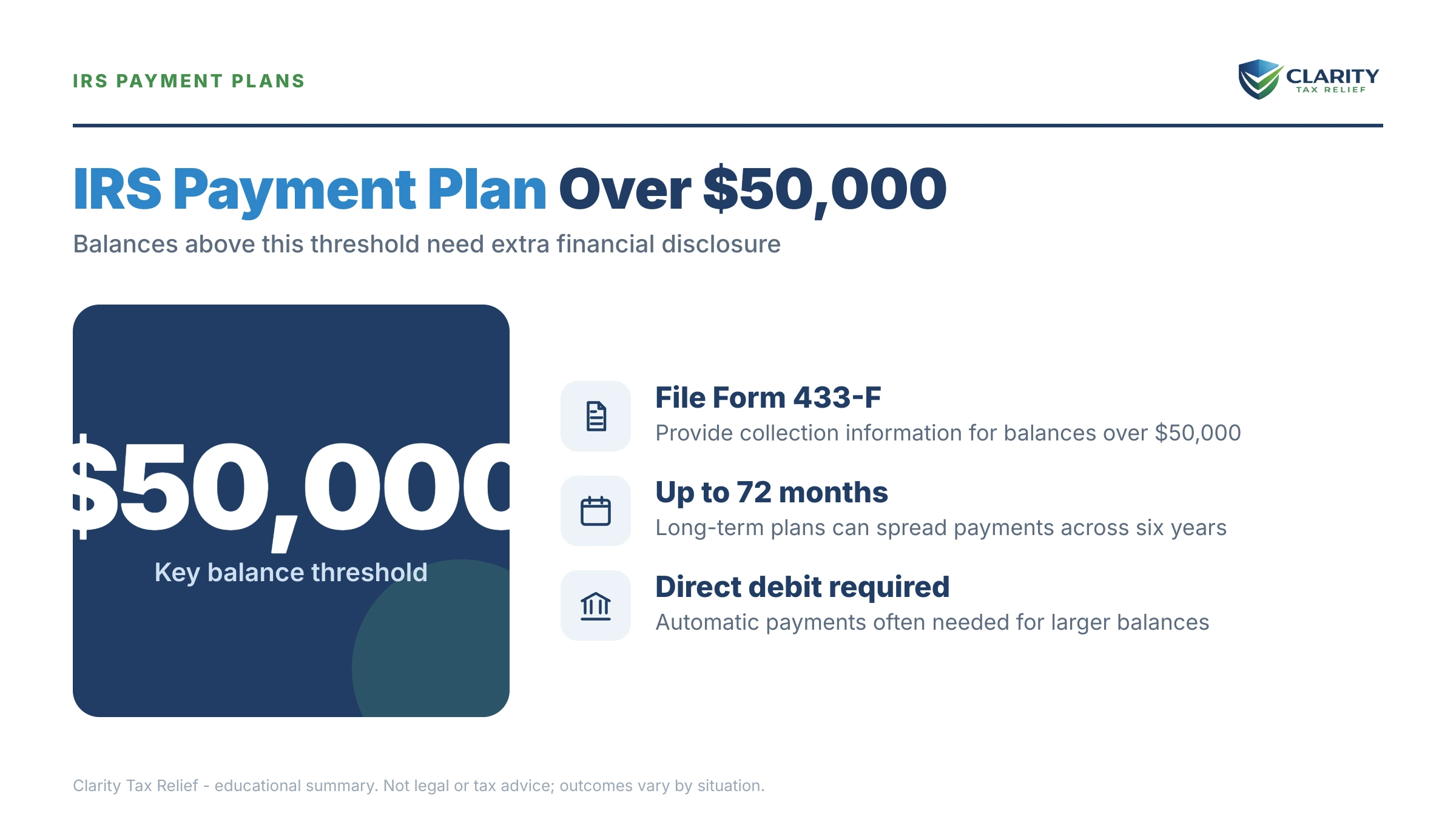
What the IRS requires for a payment plan over $50,000
Above $50,000, the IRS will not approve a long-term payment plan without seeing your finances — in practice, Form 9465 plus a Collection Information Statement. This is what the IRS calls a non-streamlined installment agreement: the monthly payment isn't a formula you pick, it's a number negotiated from your disclosed numbers.
The Collection Information Statement is usually Form 433-F if your case sits in the IRS's automated collection system, or the longer Form 433-A if a revenue officer has your file. Either way, it asks for your bank accounts, income, real estate, vehicles, retirement accounts, and monthly living expenses. The image in this guide shows what that disclosure looks like and where those figures land.
Here's the part that surprises people: the IRS sets your payment from its allowable-expense standards, not from your actual bills. If your housing, car, or lifestyle costs exceed the national and local standards for your county and family size, the IRS can disregard the excess and demand a payment you'd struggle to make. This is where the process stops being data entry and becomes negotiation.
Two more expectations come with the territory. The IRS strongly prefers — and often effectively requires — a direct debit installment agreement at this balance level. And approval includes a lien determination: a decision about whether to file a Notice of Federal Tax Lien against you while the plan runs. More on why that matters for your mortgage below.
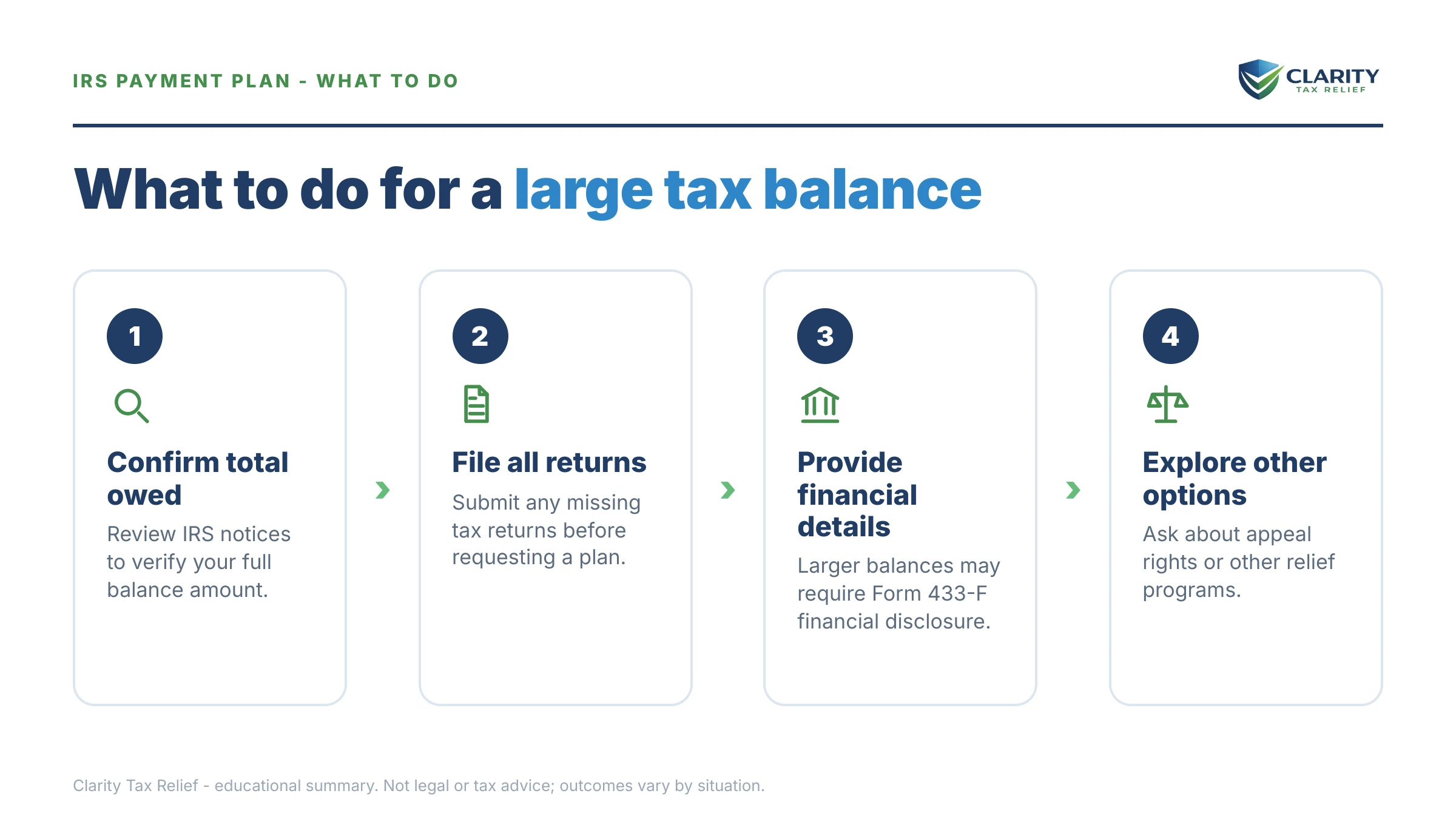
What happens if you wait
A balance over $50,000 moves through the same automated notice sequence as any tax debt — but every stage costs more and the enforcement tools bite harder at this size. The order is fixed:
- CP14 — the first bill, with roughly 21 days to respond before the sequence advances. Penalties and interest are already compounding.
- CP501 / CP503 — reminder notices. Still just bills, but on $60,000+ the monthly accrual alone can outrun what many people were planning to pay.
- CP504 — Notice of Intent to Levy. The IRS can now seize your state tax refund, and a federal tax lien filing becomes a live possibility.
- LT11 / Letter 1058 — Final Notice of Intent to Levy. A 30-day clock starts, along with your Collection Due Process appeal rights (Form 12153). After it runs, the IRS can levy bank accounts (funds are held 21 days before they're sent) and garnish wages continuously until the debt is resolved.
- Passport certification — once your balance crosses $66,000 (the 2026 threshold), the IRS can certify it as seriously delinquent, blocking passport renewal or issuance. Our guide to passport revocation for tax debt covers how to reverse it — but an approved installment agreement prevents it in the first place.
One 2026 reality worth naming: the IRS workforce shrank roughly 27% in 2025, so reaching a human to negotiate is harder than ever — but the notices, liens, and levies come from automated systems that never stopped running. Waiting doesn't buy mercy; it just moves you down the list above.
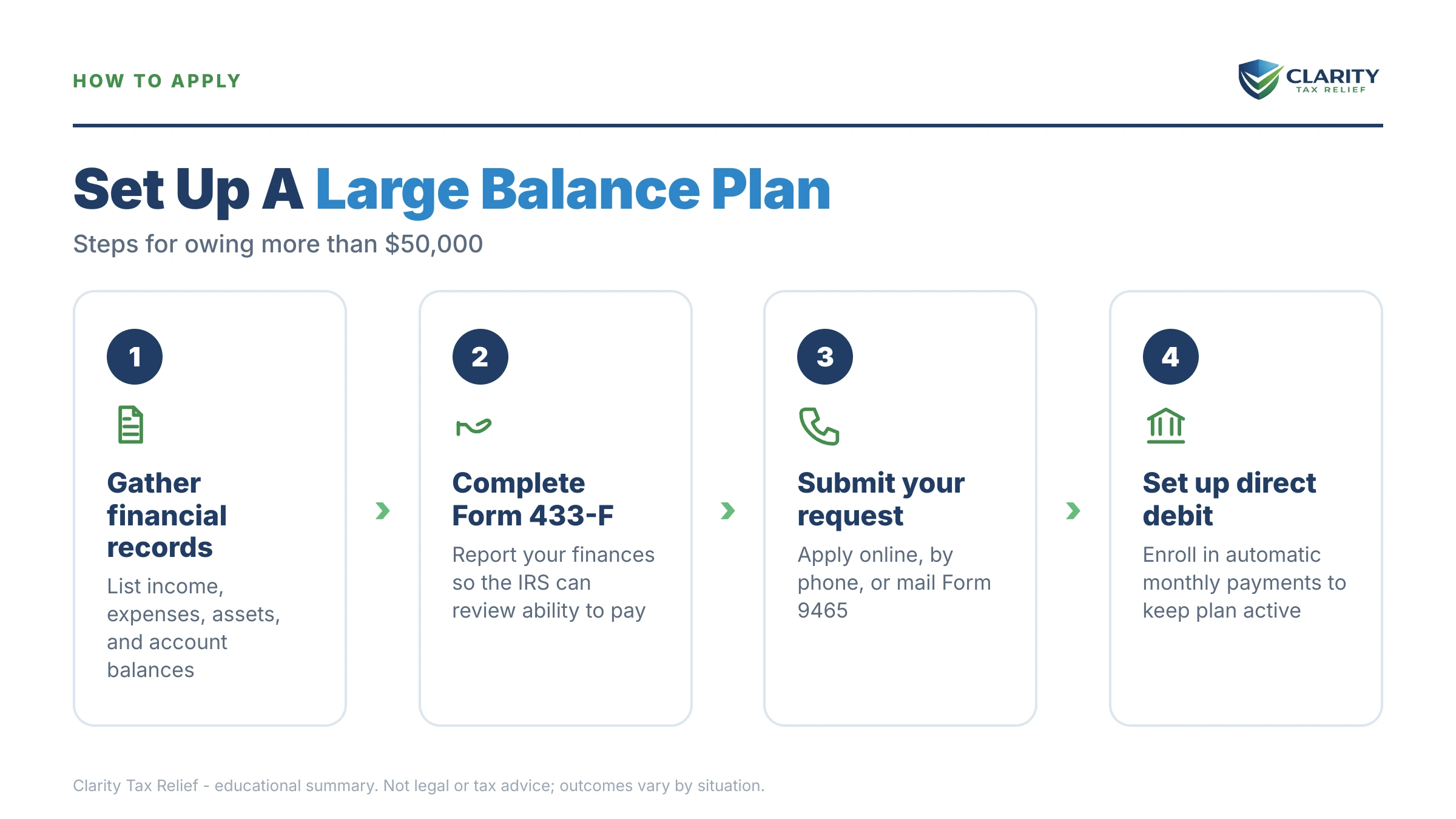
Owe more than $50,000 and worried about a lien?
Before you submit financials the IRS will hold you to, have an experienced tax professional review your balance, your equity, and which agreement leaves you best positioned — free and confidential. Penalties and interest are accruing monthly either way.
Your options when you owe the IRS more than $50,000
You have at least six realistic paths at this balance level, and the cheapest one is usually getting back under the line before you apply.
| Option | Upfront cost | Financial disclosure? | Typical timeline |
|---|---|---|---|
| Pay down below $50,000, then streamlined plan | The pay-down itself + a setup fee (lower with direct debit) | None | Online approval the same day once the new balance posts |
| Non-streamlined installment agreement | Setup fee (varies by method; low-income reductions apply) | Yes — Form 433-F (433-A with a revenue officer) | Weeks to months by phone or mail |
| Partial payment installment agreement | Setup fee | Yes — full review, repeated about every 2 years | Months to approve; lien typically filed |
| Offer in Compromise | $205 fee + 20% of the offer (both waived with low-income certification) | Yes — the most detailed review of all | Often the better part of a year or more; auto-accepted if the IRS doesn't decide within 2 years |
| Currently Not Collectible | $0 | Yes — hardship shown on Form 433-F | Pauses collection while it lasts; the balance keeps growing |
| Pay the IRS from home equity or at a refinance closing | Loan costs and interest | Your lender's underwriting instead | On the lender's timeline; IRS accrual stops at payoff |
The pay-down strategy. If savings, a 401(k) loan, or a family bridge can get your total to $49,999 or below, you convert a negotiated, disclosed, lien-reviewed process into a same-day online setup. Time it correctly: make the payment, wait for it to post, confirm the new balance in your online account, then apply. With direct debit, the IRS generally doesn't file a lien on a streamlined agreement — the single biggest win available to a homeowner at this level.
The non-streamlined agreement. If you can't get under the line, this is the default: full payment over time, with the monthly amount set by your 433-F numbers against the allowable-expense standards. Where your true expenses run over the standards — high-cost county, medical needs, court-ordered payments — documentation and advocacy decide whether the IRS honors them.
The partial-pay agreement. When even the standards-based payment can't retire the debt before the 10-year collection statute expires, a partial payment installment agreement pays what your finances allow and lets the rest die at the CSED. The trade-offs: the IRS typically files a lien, and it re-examines your finances roughly every two years, raising the payment if your income rises.
Offer in Compromise. Settling for less than you owe is real but strictly means-tested — the IRS accepted roughly 1 in 5 offers in FY2024, and a homeowner with meaningful equity usually has too much "reasonable collection potential" to qualify. It costs $205 plus 20% down on a lump-sum offer (both waived if your AGI is at or below 250% of the poverty level). Worth pricing out before you commit to five years of payments — but never assume it.
Currently Not Collectible. If paying anything would leave you unable to cover basic living expenses, collection can be paused. The debt remains, interest keeps accruing, and your refunds are still taken — it's shelter, not resolution.
Home equity or a refinance payoff. Sometimes the mortgage you're already planning is the fix: a cash-out refinance can pay the IRS at closing, replacing IRS interest and penalties with mortgage interest. Whether that beats an installment agreement depends on rates and how close a lien is to being filed — run both sets of numbers.
Whichever route you take, price the carrying cost first. Interest compounds and the late-payment penalty accrues monthly until the balance is zero — you can estimate what a given payoff speed really costs with our IRS Penalty & Interest Calculator. And know that while any plan runs, the IRS keeps your federal refunds — our guide to whether the IRS takes your refund on a payment plan explains how that offset works.
Worked example: a $63,000 balance with a refinance on the calendar
Say you owe $63,000 across two tax years, you own your home, and you're planning to refinance in about six months. Here's how the math plays out on the three most likely paths — a hypothetical, not a case study.
Path A — pay down to streamlined. You can pull together $13,100 from savings and a small 401(k) loan. $63,000 − $13,100 = $49,900. That balance qualifies for a streamlined direct-debit plan: $49,900 ÷ 72 = about $693 a month minimum, set up online with no financial statement, and with direct debit the IRS generally files no lien. Your refinance underwriter sees a payment plan, not a public-record lien — a far easier conversation.
Path B — non-streamlined at $63,000. No lump sum available, so you file Form 9465 with a 433-F. Suppose your take-home pay is $9,800 a month and the IRS's allowable-expense standards permit $8,300: the IRS will want around $1,500 a month — more than double Path A — and approval includes a lien determination that could put a Notice of Federal Tax Lien on record right as your loan application lands.
Path C — let the refinance pay the IRS. If your equity supports it, a cash-out refinance retires the whole $63,000 at closing. The urgency here is sequencing: at $63,000 you're only about ten months of penalties and interest from the $66,000 passport line, and a lien filed before your application changes your loan terms. Getting an agreement in place now, then paying it off at closing, protects both.
The tax lien problem when your mortgage is in play
A Notice of Federal Tax Lien is public record, attaches to your home, and surfaces in mortgage underwriting — and above $50,000, deciding whether to file one is part of how the IRS approves your plan.
The practical rules of thumb: streamlined direct-debit agreements at $50,000 or below generally avoid a lien filing; non-streamlined and partial-pay agreements frequently don't. If a lien is already on record, refinancing isn't impossible — our guide to refinancing with an IRS lien walks through it — but you'll usually need the IRS to agree to a lien subordination via Form 14134 so the new mortgage can take priority. That approval takes weeks and adds documents your lender will wait on.
The sequencing lesson is simple: resolve the IRS balance before you start the loan application, not during it. An agreement reached first controls whether a lien exists at all; a lien discovered mid-underwriting controls you.
How to set up an IRS payment plan over $50,000, step by step
- Pull your exact balance — log into your IRS online account and get the current payoff for every year, including penalties and interest. The $50,000 test runs against that combined total.
- Decide whether you can get below $50,000 — if savings, a 401(k) loan, or home equity can bridge the gap, a pay-down unlocks the streamlined online plan and usually keeps a lien off your record.
- Complete your financial statement — if you'll stay above $50,000, fill out Form 433-F honestly and completely before you call, with three months of pay stubs and bank statements at hand.
- Submit Form 9465 or call the IRS — mail the request with your Form 433-F attached, or call the number on your most recent notice and negotiate the monthly payment directly.
- Choose direct debit and confirm on Form 433-D — direct debit lowers the setup fee, prevents missed-payment defaults, and strengthens any future lien-relief request.
- Stay compliant going forward — file every return on time and keep withholding or estimated payments current, because a new unpaid balance defaults the agreement.
The IRS's own overview of plan types and current setup fees lives on its payment plans and installment agreements page, and every payment — pay-down, setup, monthly — goes only through IRS.gov/payments or to the United States Treasury, never to anyone who calls you. Once approved, the signed terms come back on Form 433-D; keep it with your loan documents, because lenders ask for it.
When you can handle this yourself
You don't need professional help for every balance over $50,000. Handle it yourself if you can pay the balance below $50,000 and set up a streamlined plan online; if you owe one year, agree with the amount, and your expenses fit comfortably inside the IRS standards; or if you simply want the standard financially verified agreement and have the patience for IRS hold times.
Experienced help tends to change the outcome in specific situations: a lien determination is coming while a refinance or sale is already in motion; your real expenses exceed the allowable standards and need to be documented and argued; multiple years are unfiled (nothing gets approved until they're in); the honest math points to a partial-pay agreement or an Offer in Compromise, where the presentation of your financials is the negotiation; or the debt is business or payroll tax, which follows different rules entirely. And if the payment the IRS demands would genuinely leave you unable to cover basics and you can't get traction, the Taxpayer Advocate Service exists for exactly that.
If a lien would derail a closing you already have scheduled, get your numbers reviewed before you submit anything — a free look from an experienced tax professional at the two-minute form or (888) 825-7779 can change which agreement you end up in.
What your account shows while the plan is pending
Your IRS account transcript records every stage of a large installment agreement in code form — checking it beats waiting on hold to ask what's happening.
| Code / notice | What it means | What to do |
|---|---|---|
| Code 971 | A notice was issued — often the installment-agreement approval or a related letter | Match it to the mail you received; confirm the terms are what you agreed to |
| Code 582 | A Notice of Federal Tax Lien was filed | If a refinance or sale is pending, move on subordination or payoff immediately |
| Code 583 | The lien was released or withdrawn | Keep the certificate; lenders and title companies will ask for it |
| Code 276 | Failure-to-pay penalty posted | Expected while a balance remains; the monthly rate typically drops to 0.25% on an active agreement for a timely-filed return |
| Code 196 | Interest assessed | Normal; extra payments beyond the minimum shrink it fastest |
| CP521 | Routine monthly payment reminder | Nothing, if you're on direct debit — just confirm the draft cleared |
| CP523 | Intent to terminate your agreement after a missed payment or new balance | Act inside the notice window — catch up or reinstate before it defaults |
Terms on your paperwork, decoded
- Streamlined installment agreement — a plan at $50,000 or below approved without a financial statement, up to 72 months.
- Non-streamlined (financially verified) agreement — the over-$50,000 plan, where the IRS reviews your disclosed finances and negotiates the payment.
- Collection Information Statement — the disclosure form (433-F or 433-A) listing your income, assets, and expenses; it is the raw material of every negotiation at this level.
- Allowable living expenses — the IRS's national and local expense standards; amounts you spend above them generally don't reduce the payment the IRS demands.
- Notice of Federal Tax Lien — a public filing that attaches the government's claim to your property, including your home; distinct from a levy, which actually takes assets.
- CSED — the Collection Statute Expiration Date, generally 10 years from assessment; partial-pay agreements are built around it, and certain events (appeals, offers, bankruptcy) pause the clock.
- Seriously delinquent tax debt — a balance over $66,000 (2026) that the IRS can certify to the State Department, blocking passport issuance or renewal; an approved agreement prevents or reverses it.
IRS payment plan over $50,000: common questions
Can I set up an IRS payment plan online if I owe more than $50,000?
No — the IRS Online Payment Agreement tool caps long-term plans at $50,000 in combined tax, penalties, and interest. Over that line you apply by phone or by mailing Form 9465, usually with a Form 433-F financial statement. Many people instead pay the balance down below $50,000 first, then set up a streamlined plan online in minutes.
Will the IRS file a tax lien if I owe over $50,000?
It becomes likely. On streamlined agreements of $50,000 or less with direct debit, the IRS generally doesn't file a Notice of Federal Tax Lien; above $50,000, a lien determination is part of the approval process. A lien is public record and can complicate a refinance or sale, which is one of the strongest reasons to get under the $50,000 line before applying if you can.
What is the monthly payment on a $60,000 IRS debt?
There's no fixed formula above $50,000 — your payment comes from the income and allowable-expense figures on Form 433-F, not from dividing the balance by 72. If you paid the balance down to $49,999 to qualify for a streamlined plan, the minimum would be roughly $695 per month over 72 months, with interest continuing to accrue until it's paid.
Can I pay my balance down below $50,000 to qualify for a streamlined plan?
Yes, and it's often the single smartest move at this balance level. The $50,000 test is your total assessed balance — tax, penalties, and interest combined — at the time you apply. Make the pay-down first, confirm the new balance in your IRS online account, then apply; you'll skip the financial disclosure and, with direct debit, usually avoid a lien filing.
Does owing the IRS more than $50,000 affect my passport?
Not at $50,000 — but the danger line is close. In 2026 the IRS certifies 'seriously delinquent tax debt' to the State Department at $66,000, which can block passport renewal or issuance. Getting into an installment agreement stops certification, which is one reason to set up a plan before penalties and interest push a $55,000–$60,000 balance past the threshold.
What forms do I need for an IRS payment plan over $50,000?
Form 9465 (Installment Agreement Request) plus a Collection Information Statement — Form 433-F if your case sits in the IRS's automated collection system, or Form 433-A if a revenue officer is assigned. If your agreement is approved with direct debit, the IRS confirms the terms on Form 433-D. Keep copies of everything you submit.
Do penalties and interest stop once I'm on a payment plan?
No — interest keeps compounding until the balance hits zero, so a payment plan is a financing arrangement, not a discount. The failure-to-pay penalty typically drops from 0.5% to 0.25% per month while an installment agreement is in effect for a return you filed on time. Paying more than the minimum whenever you can shortens the plan and cuts the total cost meaningfully.
Will the IRS take my tax refund while I'm on a payment plan over $50,000?
Yes. The IRS applies your federal refunds to the balance every year until it's paid, and the offset doesn't count as your monthly payment — you still owe the regular installment that month. Many people on large plans adjust their withholding so less is refunded and more stays in their paycheck to fund the plan.
What happens if I miss a payment on a large installment agreement?
One missed payment doesn't instantly kill the plan — the IRS typically sends a CP523 notice of intent to terminate, and you have a window to catch up or reinstate before the agreement defaults. But a defaulted agreement on a balance over $50,000 puts you back in levy territory and can trigger a lien filing, so call the IRS before you miss a payment, not after.
Can I refinance my house while on an IRS installment agreement?
Often, yes — many lenders will approve a refinance if you show the approved agreement and a history of on-time payments, and no federal tax lien has been filed. If a lien has been filed, you'll usually need a lien subordination (Form 14134) before the new mortgage can close, which adds weeks to your timeline. Plan the tax fix before you start the loan application.
Your next 24 hours
- Pull your exact total. Log into your IRS online account and write down the combined balance for every year — the $50,000 and $66,000 lines are measured against that total, not the number you remember from your return.
- Gather three things. Your last filed return, pay stubs (or profit-and-loss) for the past three months, and current bank statements — that's the core of Form 433-F, and it's also what a professional needs to price your options.
- Get a free case review. Before you submit financials or start a loan application, have an experienced tax professional check whether a pay-down, a streamlined plan, or a financially verified agreement leaves you better off — the two-minute form or (888) 825-7779. Interest and the monthly late-payment penalty are accruing either way; earlier is cheaper.
This guide is general information, not tax or legal advice for your specific situation. Eligibility for IRS programs depends on individual facts and circumstances; no outcome is guaranteed.