
IRS Collections
Passport Revoked for Tax Debt: The 2026 $66,000 Rule and How to Get It Back
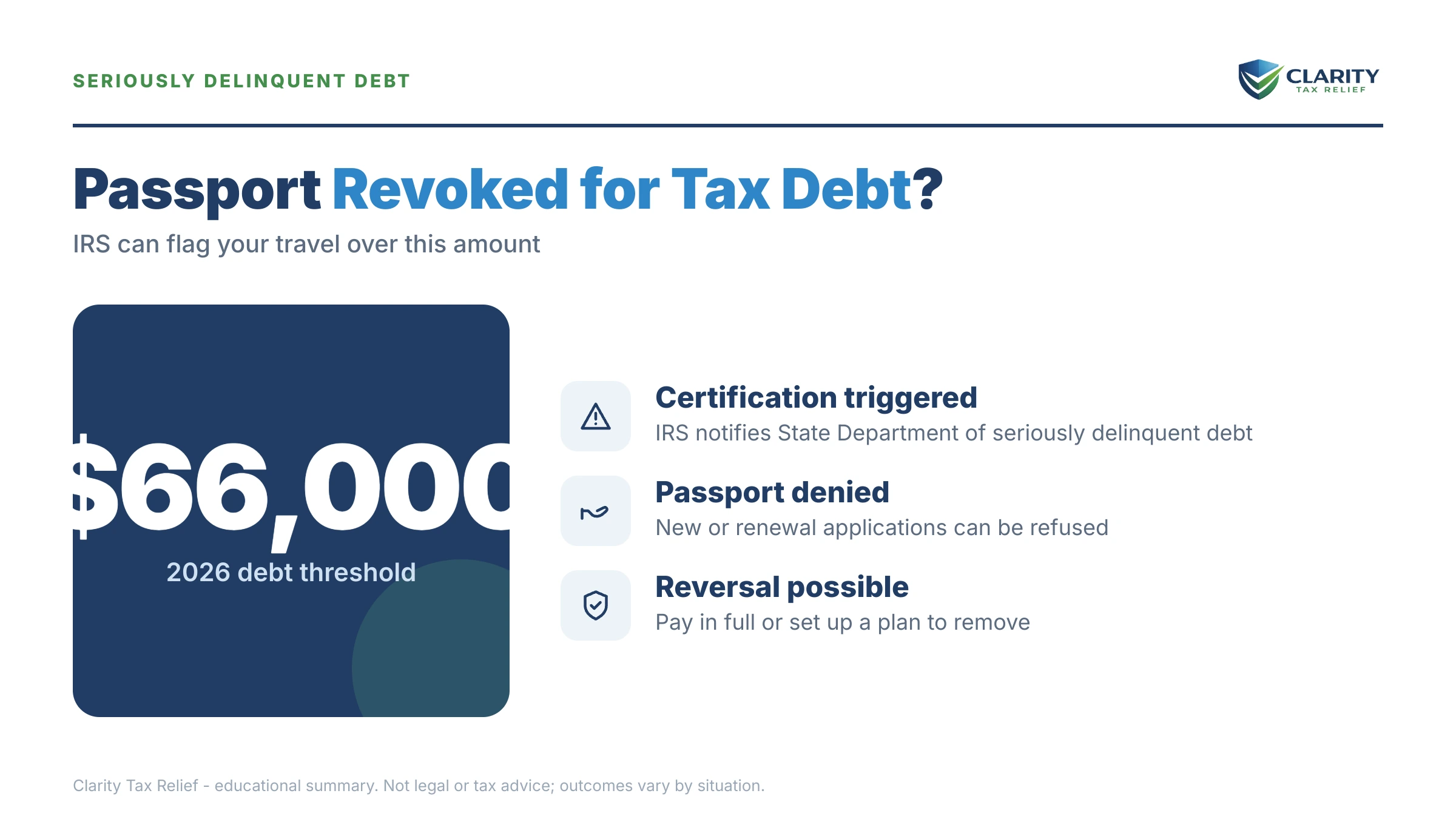
The short answer: the IRS can have your passport revoked or denied for tax debt when you owe more than $66,000 (the 2026 threshold, including penalties and interest) and a tax lien has been filed or a levy issued. Entering a payment plan, accepted offer, or other qualifying arrangement reverses the certification.
You planned the trip — a supplier visit, a trade show, a family vacation — and instead of a renewed passport you got a State Department letter saying your application is on hold because of a federal tax debt. Or a CP508C landed in your business mail between payroll runs. Either way, this is reversible, and the path back is mechanical once you see how the certification machine works.
Two documents drive everything here: the IRS's certification notice (CP508C) and, later, the revocation warning (Letter 6152). If a CP508C is what tipped you off, the image below shows exactly what that notice looks like and where to find the certified amount and tax years the IRS reported to the State Department.
Here's the fact most people miss, and it changes strategy completely: once you've been certified, paying the balance below $66,000 does not reverse it. Only full payment, an excluded status (like a payment plan), legal unenforceability, or proof of error takes you off the list. We'll walk through each path.
⏱ The clocks that matter: a CP508C has no printed response deadline, but a denied passport application is generally held open for only 90 days while you resolve the debt before you must reapply, and Letter 6152 — the revocation warning — typically asks you to call within 30 days. Interest and penalties keep accruing the entire time. Check the date printed on your own letter; it controls.
Why your passport was revoked (or denied) for tax debt: the 2026 certification rules
Under IRC §7345, the IRS must certify "seriously delinquent tax debt" to the State Department, which then denies passport applications and can revoke existing passports. The law came from the 2015 FAST Act, and in 2026 the process is almost entirely automated — no revenue officer decides whether your name goes on the list.
A debt is "seriously delinquent" only when all three of these are true:
- It's an assessed federal tax liability in your name — tax, penalties, and interest combined — not just an amount the IRS thinks you might owe.
- The total exceeds $66,000 for 2026 (the threshold is inflation-adjusted every year — the passport denial $66,000 threshold guide tracks how the figure has moved).
- The IRS has filed a Notice of Federal Tax Lien and your window to appeal it has lapsed, or issued a levy.
That third condition matters: if you were certified, you're already deep in the collection sequence — a lien is on record or a levy has gone out. When it happens, the IRS sends you notice CP508C by regular mail to your last known address (our CP508C notice guide decodes it line by line). If you've moved and never saw it, the certification still stands.
For a business owner, the "in your name" piece is the trap. Your corporation's own 941 balance doesn't count against your personal certification — but a Trust Fund Recovery Penalty assessed against you personally does, and trust-fund assessments routinely clear $66,000 on their own. Sole proprietors and single-member LLC owners whose employment taxes are assessed to them personally are exposed too. What doesn't count: FBAR penalties and child-support arrears (child support has its own separate federal passport-denial program).
Denied vs. revoked: what the State Department actually does
Denial of new applications and renewals is the common outcome; revocation of a passport you already hold is rarer and comes later. While you're certified, the State Department will not issue or renew a passport for you. Your existing passport usually remains valid until it's actually revoked — but relying on that is a gamble.
Revocation typically follows IRS Letter 6152, which warns that the IRS intends to recommend revocation — often because someone promised a resolution and didn't follow through. If you're overseas when revocation hits, the State Department may issue only a limited-validity passport good for a direct return to the United States. If you owe six figures and are planning a move, read owe the IRS and moving abroad before you book anything.
What happens if you ignore the certification
A passport certification never times out on its own — it ends only when the debt is resolved, excluded, or expires. Ignore it and the sequence runs like this:
- Certification + CP508C. Your name goes to the State Department; the IRS mails you notice. You are here.
- Application or renewal denied. The State Department generally holds your application about 90 days so you can resolve the debt — miss that window and you start over, fees included.
- Letter 6152. The IRS warns it will recommend revocation of the passport you already hold, typically asking you to call within 30 days.
- Revocation or limited passport. The State Department can revoke outright, or restrict a traveler abroad to return-only travel.
- Collection keeps running underneath. Certification requires a lien or levy already in motion — so bank levies, wage levies, and refund offsets continue on their own track while the passport hold sits on top.
One more 2026 reality: IRS staffing is down roughly 27% since the 2025 cuts, so un-certifying yourself takes human processing that's slower to reach — while the certification itself was automatic. The asymmetry is the whole reason to start before your travel date, not after.
Certified as seriously delinquent with travel on the calendar?
Send us your CP508C or the State Department denial letter. An experienced tax professional will map the fastest decertification path for your numbers — free, confidential, before the 90-day application hold runs out.
What reverses a passport certification — and what doesn't
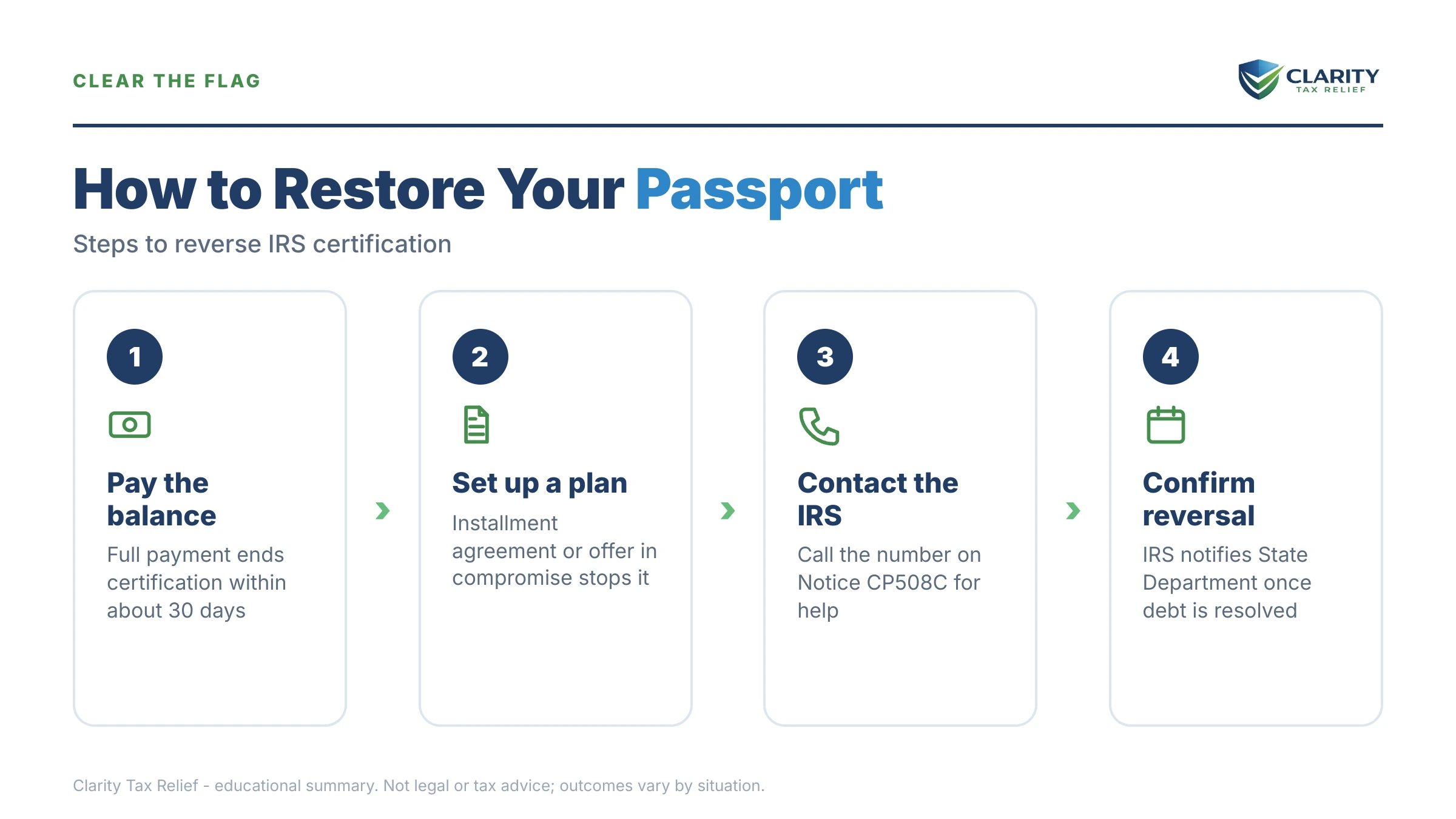
The IRS reverses a certification when the debt is fully paid, becomes legally unenforceable, was certified in error, or stops being "seriously delinquent" by entering an excluded category. The excluded categories are where most people find their exit, because they don't require paying $66,000+ at once. The general playbook for negotiating any of these on your own lives in our guide to how to settle tax debt yourself; here's how each one interacts with the passport rules specifically:
| Option | Basic eligibility | Effect on your passport |
|---|---|---|
| Pay in full | Anyone with the funds; note that paying below $66,000 is not enough once certified | Certification reversed; IRS generally notifies the State Department within 30 days and issues CP508R |
| Installment agreement | Up to 72 months online for balances ≤ $50,000; financial disclosure required above that | Statutorily excluded while payments stay current — certification must be reversed |
| Offer in Compromise | Means-tested; you must show the offer equals the most the IRS could collect ($205 fee, 20% down on lump-sum offers unless low-income certified) | Accepted offer being paid on time is excluded; a pending offer generally pauses certification too |
| Currently Not Collectible | Financial hardship shown on a Form 433 collection statement | The IRS generally decertifies hardship-CNC accounts, though the debt itself remains |
| Timely CDP hearing request | Form 12153 filed within the window on your lien or levy notice | Collection is suspended, which takes the debt out of "seriously delinquent" status |
| Innocent spouse request | Form 8857 pending on a joint liability | Excluded from certification while the request is under review |
| Bankruptcy | Open Chapter 7 or 13 case (automatic stay in effect) | Debt in bankruptcy isn't certified; existing certifications are reversed while the case is open |
Three strategy notes the table can't capture. First, an installment agreement is almost always the fastest exit, because it can often be set up in a single session — an accepted OIC takes months, though a pending one already pauses certification. Second, if part of the assessment is simply wrong — an SFR the IRS filed for you, missed deductions, a duplicated 1099 — amending a return to lower a tax debt can shrink or erase the liability itself, which beats negotiating over a number that shouldn't exist. Third, if bankruptcy is genuinely on the table for other reasons, the passport reversal is a side effect worth knowing about — the Chapter 7 vs 13 tax debt comparison covers which chapter fits which tax profile.
A worked example: $61,200, a payroll to run, and a renewal coming due
Say you own an S-corporation with four employees and owe $61,200 on your personal 1040s for two back years — under the $66,000 line, so you're not certifiable yet. Here's the math on doing nothing:
- The failure-to-pay penalty runs 0.5% per month: 0.5% × $61,200 = $306 a month, about $3,672 a year, before interest.
- Interest compounds on the full balance on top of that. Your gap to the threshold is only $66,000 − $61,200 = $4,800 — at that pace, penalties and interest alone can push you across the line in roughly a year, likely sooner. (You can estimate your own account's growth with our Penalty & Interest Calculator.)
- If the IRS has already filed a lien — common at this balance — crossing $66,000 makes you certifiable the moment the automated system runs its next match.
Now the fix. At $61,200 you're over the $50,000 online-plan ceiling, so a full-balance installment agreement means submitting financials — roughly $61,200 ÷ 72 ≈ $850 a month as a ballpark, plus continuing accruals (see IRS payment plan over $50,000 for how that process works). Alternatively, paying the balance down by $11,201 to $49,999 unlocks a streamlined direct-debit plan — about $50,000 ÷ 72 ≈ $695 a month — with no detailed financial disclosure. Either agreement keeps you off the certified list entirely, or reverses a certification that's already happened. An OIC is only realistic if your business equity, receivables, and future income genuinely can't cover the debt; the IRS accepted roughly 1 in 5 offers in FY2024, so treat it as math, not marketing.
One warning specific to employers: if any of your debt traces to unpaid 941s, the trust-fund portion can be assessed against you personally and stack on top of your 1040 balance — construction and other labor-heavy businesses hit this constantly (see construction payroll tax debt). A TFRP assessment can vault you past $66,000 overnight.
How much do you owe? Passport risk and realistic options by balance
Certification exposure changes sharply by amount band, and so do your resolution options:
| What you owe | Passport exposure | Realistic options |
|---|---|---|
| Under $10,000 | None — far below the threshold | Guaranteed installment agreement, or pay in full within 180 days at $0 setup |
| $10,000–$25,000 | None at this level, but liens become possible | Streamlined payment plan online, up to 72 months |
| $25,001–$50,000 | Below the threshold — keep it that way | Streamlined plan with direct debit; penalty abatement to slow the growth |
| $50,001–$65,999 | Not certifiable yet, but accruals can cross the line within a year or two | Plan with financial disclosure, or pay down below $50,000 for streamlined terms |
| $66,000 and up | Certifiable once a lien is filed or a levy issued | Installment agreement, OIC, CNC, or a timely CDP appeal — each reverses or blocks certification |
How to get your passport back, step by step
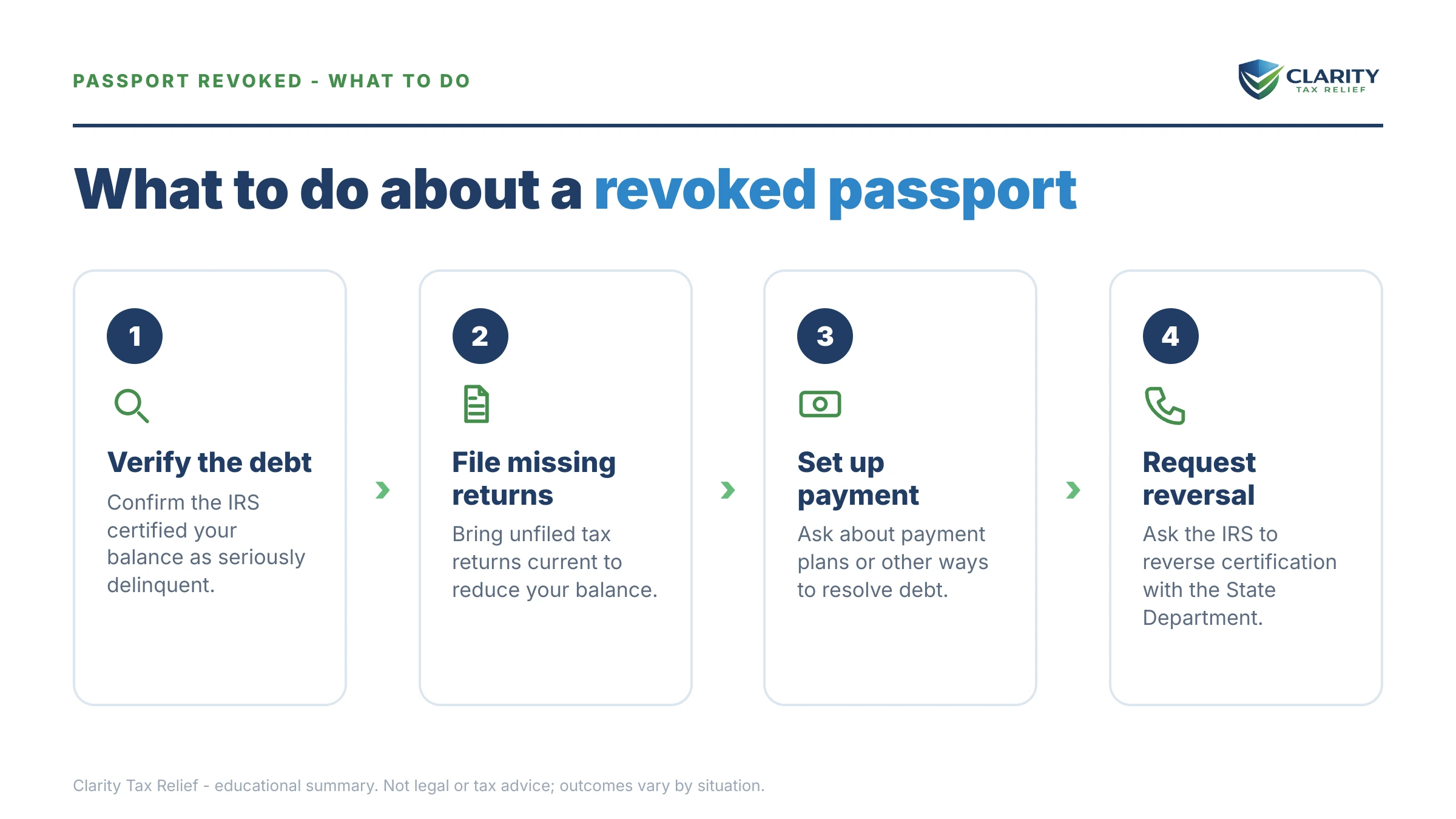
- Confirm you're actually certified. Read your CP508C or log into your IRS online account, and note the exact balance and tax years the IRS certified.
- Verify the debt is correct. Pull your account transcripts and check each assessment — dispute errors or an erroneous certification before paying anything.
- Choose your fastest exclusion path. Pick the arrangement you qualify for: an installment agreement, an Offer in Compromise, Currently Not Collectible status, or a timely CDP appeal.
- Get the arrangement in place before your travel date. Set it up, and if you have travel within about 45 days, call the number on your notice with proof of your itinerary to request expedited decertification.
- Confirm the reversal before you book or reapply. Wait for notice CP508R confirming decertification, then reapply or renew — don't buy nonrefundable tickets until the hold clears.
On step 3: if you received a lien or levy notice recently enough that your appeal window is still open, a timely Form 12153 CDP hearing request suspends collection and pulls the debt out of "seriously delinquent" status while your case is heard — a powerful move that most people miss. And if you truly can't pay anything, Currently Not Collectible status generally decertifies you even though the debt remains on the books.
When you can handle this yourself — and when to get help
You can likely handle decertification on your own if the debt is accurate, you owe under $50,000, and you have no imminent travel. Set up a plan at the IRS payment plans page, keep payments current, and wait for CP508R — no professional needed for that.
Experienced help changes outcomes in the harder configurations: a Trust Fund Recovery Penalty in the mix (the assessment itself is often contestable), balances over $50,000 where the financial disclosure determines your monthly payment, unfiled back years blocking any agreement, a Letter 6152 already in hand, or a trip booked inside the decertification timeline where the sequencing of expedite requests has to be exact. When the normal process is simply too slow for a documented, imminent trip, the Taxpayer Advocate Service can also intervene at no cost. The IRS's own rules for the program are laid out on its passport revocation and denial page.
Terms on your CP508C, decoded
- Seriously delinquent tax debt — an assessed federal tax liability over $66,000 (2026) where a lien has been filed with appeal rights lapsed, or a levy issued.
- Certification / decertification — the IRS reporting your debt to the State Department, and the reversal of that report once you resolve or exclude the debt.
- CP508C — the notice telling you your debt was certified; CP508R is its mirror image, confirming the reversal.
- Letter 6152 — the IRS's warning that it intends to recommend the State Department revoke the passport you already hold.
- CDP rights — your Collection Due Process appeal rights on a lien or levy notice; a timely request suspends collection and blocks certification.
- Notice of Federal Tax Lien — the public filing that protects the government's claim on your property, and one of the two triggers that makes a large debt certifiable.
Passport and tax debt questions, answered
How much tax debt do you have to owe to lose your passport?
The 2026 threshold is $66,000 in assessed tax, penalties, and interest combined — the figure is inflation-adjusted each year. Owing that much alone isn't enough: the IRS must also have filed a Notice of Federal Tax Lien (with your appeal window lapsed) or issued a levy. Both conditions together make the debt 'seriously delinquent' under IRC §7345.
Can the IRS take my passport if I'm on a payment plan?
No — debt being paid on time under an installment agreement is excluded from certification by statute, and if you were already certified, entering the agreement requires the IRS to reverse it. The catch is staying current: default on the plan and the account can be certified again. An accepted Offer in Compromise being paid on schedule gets the same protection.
How long does it take to get my passport back after I resolve the debt?
The IRS generally reverses the certification within 30 days of your resolution and notifies the State Department, which then releases the hold on your application. If you have proof of travel scheduled within about 45 days, call the number on your CP508C and ask for expedited decertification — the IRS can shorten the process when travel is imminent. Watch for notice CP508R confirming the reversal.
Can I still travel internationally while certified?
Usually yes, for now — certification blocks new applications and renewals, but your existing passport typically remains valid until the State Department actually revokes it. Revocation is a separate, later step that generally follows IRS Letter 6152. The risk is real, though: if revocation happens while you're abroad, the State Department may issue only a limited passport good for direct return to the U.S.
Does my business's payroll tax debt count toward the $66,000?
It depends on who the IRS assessed. Debt owed by your corporation or multi-member LLC in its own name doesn't count against your personal certification — but a Trust Fund Recovery Penalty assessed against you personally does, and it's often large enough to cross the threshold by itself. Sole proprietors are assessed personally, so their employment tax debt counts too.
What if my passport application was denied and I have a trip coming up?
Move immediately — the State Department generally holds a denied application open for 90 days so you can resolve the certification before reapplying. Get into a qualifying arrangement (payment plan, accepted offer, hardship status), then call the IRS with proof of travel within roughly 45 days to request expedited reversal. The Taxpayer Advocate Service can also intervene when travel is imminent and the normal timeline won't work.
What if the IRS certified me by mistake?
Call the number on your CP508C right away — erroneous certifications happen, for example when the debt was already in an excluded category or belongs to someone else. The IRS must reverse an erroneous certification and notify the State Department. If it won't, IRC §7345 gives you the right to sue in U.S. Tax Court or federal district court to have the certification determined erroneous.
Your next 24 hours
- Find the certified amount and tax years on your CP508C — or the resolution instructions on your State Department denial letter — so you know exactly what the IRS reported.
- Gather your last filed return, every IRS letter you've received, and a quick income-and-expense snapshot — that's everything needed to price a payment plan or test other options.
- Get a free case review — the form takes 2 minutes at claritytaxrelief.com/#consult, or call (888) 825-7779. If your application is in the 90-day hold or a trip is booked, the sequencing of the next two weeks decides whether you travel; and even with no trip planned, the balance grows every month you wait.
This guide is general information, not tax or legal advice for your specific situation. Eligibility for IRS programs depends on individual facts and circumstances; no outcome is guaranteed.