
Business Tax Debt
Construction Payroll Tax Debt: How to Resolve Back 941s in 2026
The short answer: construction payroll tax debt is the most dangerous debt a contractor can carry — the withheld share of every paycheck is trust-fund money the IRS can collect from owners and check-signers personally, even after the company closes. Resolution means current deposits, filed 941s, and the right payment agreement before the Trust Fund Recovery Penalty lands.
The draw from the general contractor landed six weeks late, payroll couldn't wait, and the money set aside for the 941 deposit went out the door on a Friday to keep your crews working. One bridged quarter became two, and now the IRS mail is addressed to the company — for now. This is fixable, and the order you fix it in matters more than the balance itself.
The image below shows exactly what this escalation path looks like from first missed deposit to personal assessment — and the point where the debt stops being a business problem and becomes yours.
⏱ Your clocks: there is no single deadline printed on payroll tax debt — until Letter 1153 arrives. Once it does, you have 60 days to protest the Trust Fund Recovery Penalty before it's assessed against you personally. Before that, the real clock is the failure-to-deposit penalty, which tiers up to 15% while interest compounds on every quarter.
Why construction companies fall behind on payroll taxes
Construction is the industry where the timing of cash and the timing of payroll are furthest apart. Your crews get paid every week or two; your money arrives when the GC funds a draw, releases retainage, or a pay-when-paid clause finally triggers — often weeks or months later. When those two clocks diverge, the 941 deposit account is the easiest place to borrow from, because nothing bad happens the first Friday you do it.
But that "loan" is the most expensive financing in the business. Each late deposit picks up a failure-to-deposit penalty of 2% to 15% depending on how late, the quarterly 941 back taxes pick up interest and a monthly late-payment penalty, and — unlike a supplier bill — the withheld portion never legally belonged to the company at all. It was your employees' income tax and FICA, held in trust for the Treasury.
Two construction-specific accelerants make it worse:
- Prevailing-wage work. Public jobs require certified payroll reports listing every worker, every hour, and every wage rate. That paper trail means the IRS doesn't have to reconstruct your payroll in an exam — your own filings document exactly what should have been withheld and deposited, and discrepancies between certified payroll and your 941s stand out.
- 1099 "subs" who work like employees. If workers you pay on 1099s use your tools, keep your hours, and take your direction, a reclassification can create back withholding and FICA for every open quarter at once. See the worker misclassification penalty guide — on prevailing-wage jobs, the certified payroll records make the reclassification case for the government.
Whose money it is — and why that changes everything
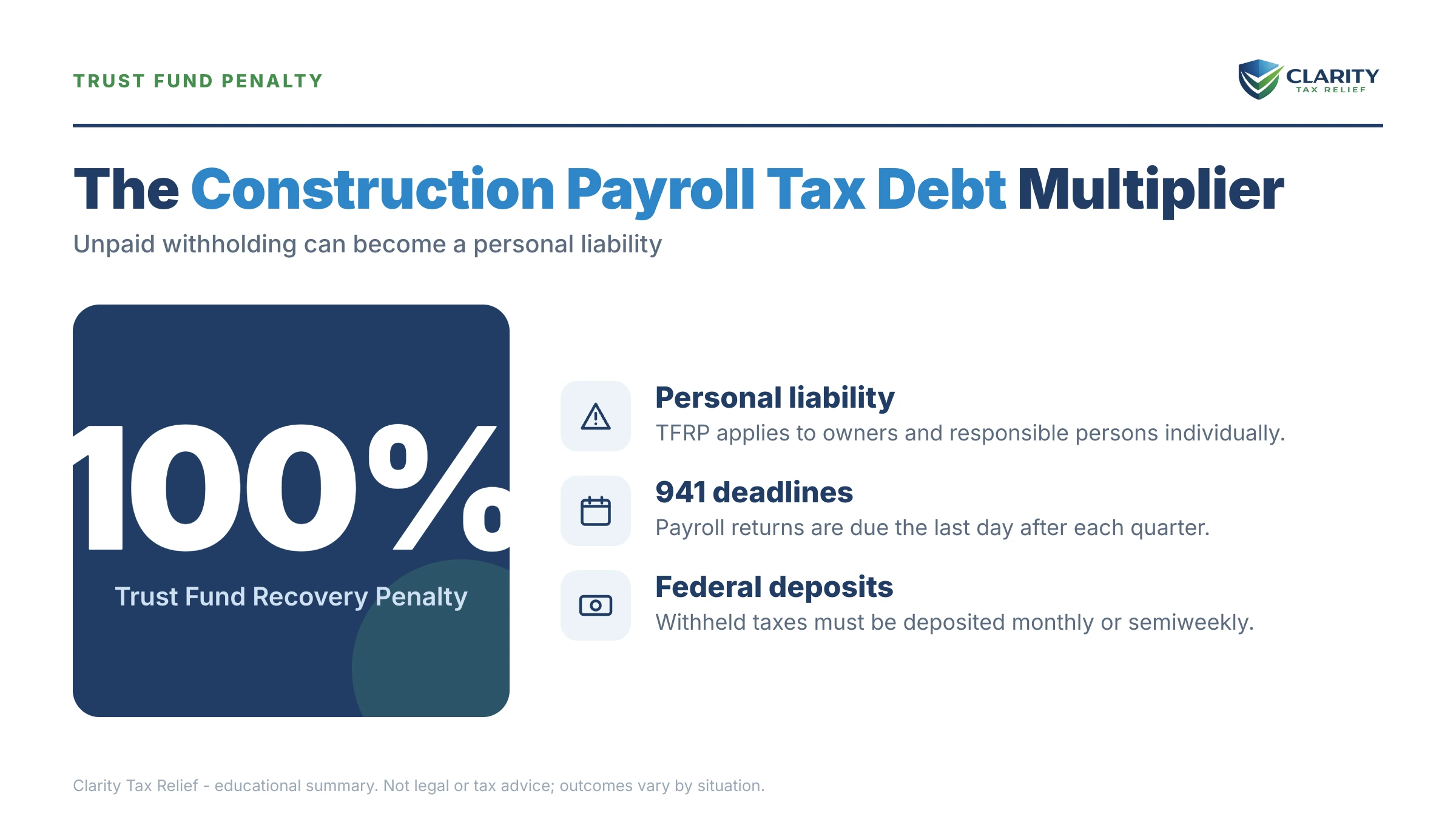
Roughly half of a typical 941 balance is "trust fund" money that the IRS can pursue from individuals, not just the company. The trust-fund portion is the federal income tax you withheld plus the employees' share of Social Security and Medicare. The employer's matching FICA, penalties, and interest are entity-level debt — but the withheld piece follows people.
Under the Trust Fund Recovery Penalty, the IRS can assess 100% of that withheld portion against every "responsible person" who willfully let it go unpaid: owners, officers, the office manager who runs payroll, a family member on the bank signature card. "Willful" doesn't require bad intent — paying the lumber yard or the fuel card while a 941 balance sat unpaid is enough. Incorporating didn't shield you from this; it's the one tax debt an LLC or corporation cannot contain.
What happens if you ignore construction payroll tax debt
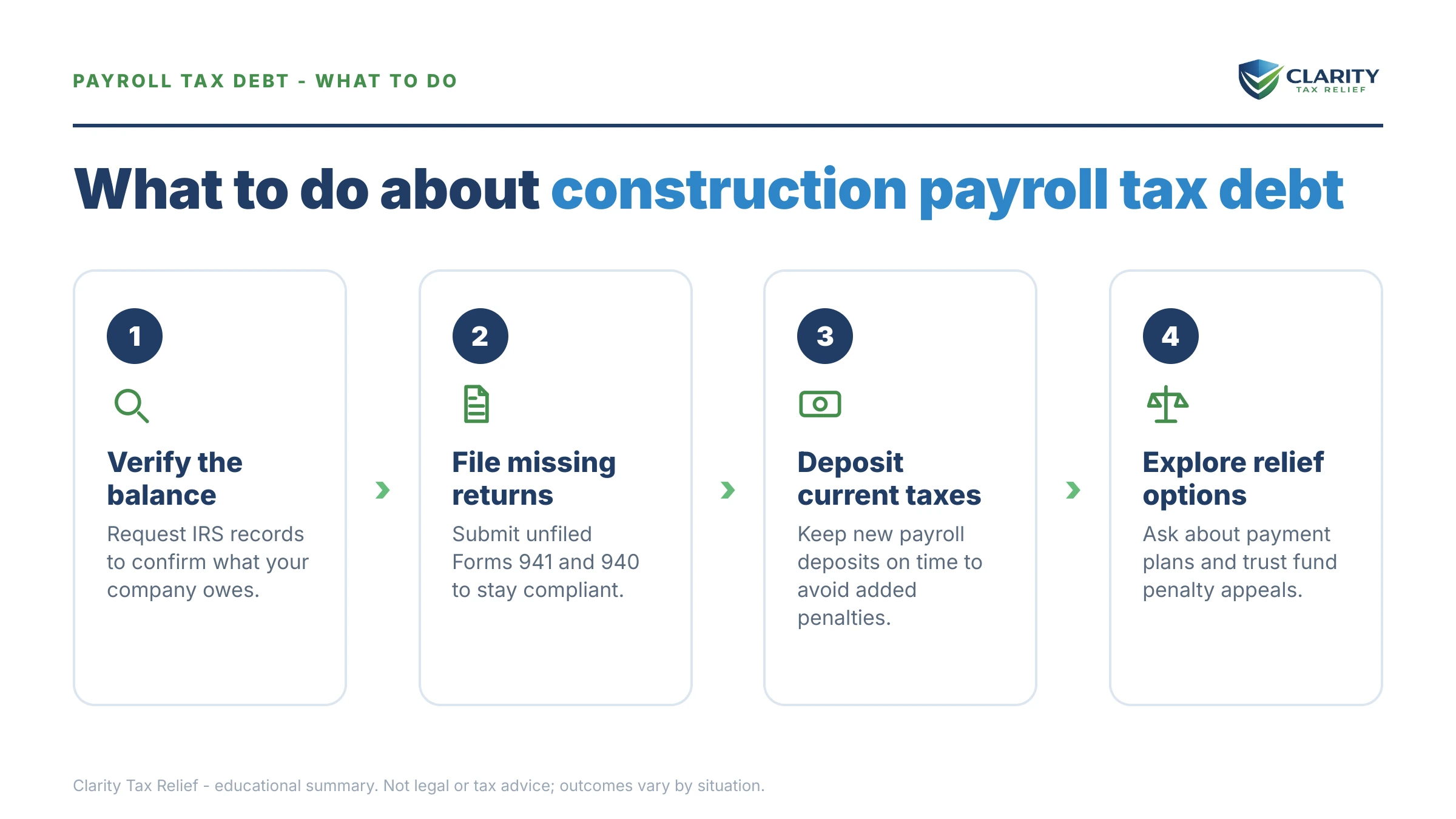
Payroll tax debt escalates on two tracks at once: an automated notice stream against the company, and a human investigation aimed at you. The sequence runs like this:
- Missed deposit. The failure-to-deposit penalty attaches — 2%, 5%, 10%, or 15% depending on how late — and interest starts.
- CP161. The first business bill for the quarter. No enforcement yet; this is the cheapest stage you will ever see.
- CP504B. The business intent-to-levy notice. The IRS can now take the company's state tax refund, and a federal tax lien — the one that quietly kills bonding capacity and public-bid eligibility — becomes likely.
- LT11 / Letter 1058. The final notice. After 30 days, the IRS can levy the business bank account (funds are held 21 days before they leave) and, more damaging for a sub, levy your accounts receivable — meaning the levy goes to the GC that owes your draws, and your customer learns about your tax problem from the IRS.
- Revenue officer assignment. Payroll cases get human attention even in 2026's short-staffed IRS. The RO's first questions establish who the responsible people are; expect a Form 4180 interview request. Repeat quarters of new non-payment — pyramiding payroll taxes — is what moves a case from collection toward seizure or criminal referral.
- Letter 1153, then personal assessment. The TFRP proposal gives each named person 60 days to protest. Miss it, and the trust-fund balance becomes a personal debt collectible from homes, wages, retirement income, and Social Security for 10 years.
The 2026 staffing cuts changed who answers the phone, not what the computers do. Notices, liens, and levies are automated — and employment-tax cases are the category the remaining revenue officers are told to work first.
Behind on 941s for your construction company?
Get your payroll tax case reviewed free before a revenue officer is assigned and the trust-fund investigation starts naming names. Deposit penalties tier up to 15% and interest compounds while you wait — a 20-minute call maps your exact options.
Your options for resolving construction company payroll tax debt
Every resolution path starts the same way: new deposits current, all 941s filed. The IRS will not negotiate any agreement while fresh withholding is still going unpaid — compliance is the ticket in the door. Note that the payment-plan thresholds you'll read about elsewhere (the $50,000 / 72-month online plan) apply to individuals; in-business payroll debt runs on its own rules, covered in depth in our business payroll tax payment plan guide.
| Option | Who it fits | What it requires | The catch |
|---|---|---|---|
| Pay in full | Small balances, one slipped quarter | Payment through IRS business channels | Penalties already assessed remain unless abated separately |
| In-Business Trust Fund Express agreement | Operating businesses owing (generally) $25,000 or less | Full pay within 24 months; direct debit typically required above $10,000; no full financial disclosure | One missed new deposit defaults the agreement |
| Regular in-business installment agreement | Balances above the express threshold | Form 433-B financials; usually revenue officer approval | IRS may push asset liquidation; the lien generally stays until resolved |
| Currently Not Collectible | Defunct companies; individuals assessed the TFRP with genuine hardship | Form 433 financials showing no ability to pay | Debt keeps growing; the IRS re-reviews periodically |
| Offer in Compromise | Rare — genuine long-term inability to pay | $205 fee; all filings and deposits current first | Roughly 1 in 5 offers accepted in FY2024; trust-fund debt draws extra scrutiny |
| Penalty abatement | First slip, or documented reasonable cause | Clean prior 3 years (FTA) or evidence: GC default, provider failure, disaster, illness | Removes penalties, not the tax itself |
On penalties specifically: a quarter that goes unfiled and unpaid can stack the failure-to-file penalty (5% per month, to 25%), the failure-to-pay penalty (0.5% per month), the deposit penalty (up to 15%), and compounding interest on all of it. You can estimate what's already accrued with our IRS Penalty & Interest Calculator, and the 941 penalty abatement guide covers which pieces are realistically removable. Starting in summer 2026, the new Automatic Exemption from Penalty (AEP) begins replacing first-time abatement for qualifying accounts — automatic, no request needed — so don't pay a first-offense penalty without checking whether it's already covered.
If the company is already gone, the analysis changes: entity-level debt often dies with it, while the trust-fund piece follows you. That split is the whole subject of payroll tax debt business closed. And if you never incorporated, there's no split at all — sole proprietor payroll tax debt is personal from day one.
The deadlines that decide your rights
Each notice in a payroll tax case carries a specific right that expires with it. This is the reference table to tape above your desk:
| Notice or event | Your window | The right at stake |
|---|---|---|
| CP161 — first business bill | The pay-by date printed on the notice | Cheapest stage: no enforcement yet, all options open |
| CP504B — intent to levy | The date printed on the notice | Last stop before final-notice territory; state refund can be taken and a lien becomes likely |
| LT11 / Letter 1058 — final notice | 30 days | Collection Due Process hearing via Form 12153; miss it and bank and receivable levies can begin |
| Form 4180 interview request | Before you attend | Your answers become the evidence for — or against — personal liability |
| Letter 1153 — TFRP proposal | 60 days | Your only pre-assessment chance to contest responsibility and willfulness |
Of these, the Letter 1153 window is the one people lose without realizing what it was. Once the 60 days pass, contesting the penalty means fighting an assessed debt instead of a proposed one — a much harder posture. The full protest playbook is in the Letter 1153 guide.
A worked example: a $4,800 trust-fund assessment on Social Security income
Say your son ran a small framing company that folded owing back 941s, and you — retired, living on a $1,900 monthly Social Security check — had signed payroll checks during the last rough year because you were on the bank account. The IRS works the case and identifies the trust-fund portion of one unpaid quarter: roughly $27,000 in crew wages, from which $2,735 in federal income tax and $2,065 in employee FICA were withheld but never deposited — $4,800 of trust-fund money. Letter 1153 arrives proposing that full $4,800 against you personally. (This is a hypothetical, not a client case.)
Here's the math that matters. If the assessment sticks and you do nothing, the Federal Payment Levy Program can take up to 15% of each Social Security payment: 15% × $1,900 = $285 a month, indefinitely, plus growing interest. Your realistic moves, in order:
- Protest within 60 days. Signing checks under someone else's direction, without authority to decide which bills got paid, is a genuine defense to "responsible person" status. This is the argument to make before assessment, not after.
- If liability sticks, pay it on your terms. $4,800 over 24 months is $200 a month — painful on $1,900 of income, but it stops the escalation and keeps the 15% levy off your check.
- If $200 a month isn't survivable, a financial statement showing your income against IRS living-expense standards can support currently-not-collectible status, which pauses collection while the debt (and the 10-year collection clock) runs.
The lesson generalizes: the trust-fund number on one modest quarter is small enough to resolve cleanly — and large enough to follow a retiree's Social Security for a decade if ignored.
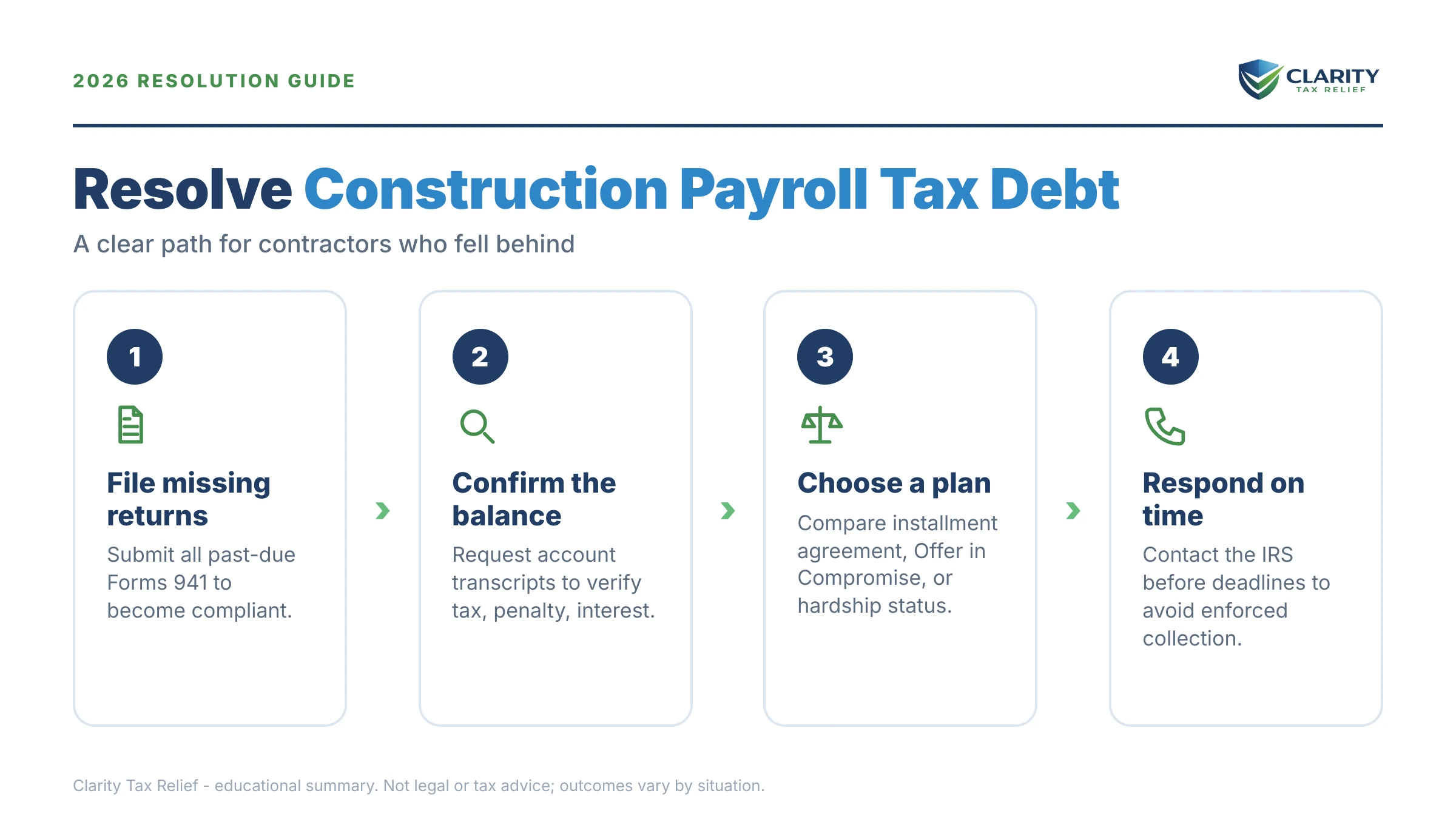
How to respond to construction payroll tax debt, step by step
- Get current on this quarter's deposits. Nothing else works until new withholding starts reaching the Treasury on schedule. Every IRS agreement requires current compliance, and resumed deposits are the single strongest signal that you're fixing the problem, not pyramiding it.
- File every unfiled Form 941. The failure-to-file penalty (5% per month, up to 25%) is 10 times the failure-to-pay penalty. File every missing quarter even if you can't send a dollar with it — filing also stops the IRS from building the numbers for you.
- Pull the exact numbers. Order business account transcripts and break each quarter into tax, penalties, and interest — and split the tax into trust-fund and non-trust-fund portions. That split determines what can follow you personally.
- Set up the agreement that fits your balance. Generally $25,000 or less can go through the streamlined In-Business Trust Fund Express route paid within 24 months; larger balances require Form 433-B financials and usually a revenue officer. Pick before the IRS picks for you.
- Respond to any TFRP contact in writing, on time. A Form 4180 interview request or Letter 1153 is about your personal liability, not the company's. Letter 1153 carries a 60-day protest window — answer it deliberately, ideally with representation, because your statements become the evidence.
- Request penalty abatement once you're compliant. Deposit and late-filing penalties can be reduced for reasonable cause — a GC's default, a failed payroll provider, disaster, or serious illness — and first-time abatement may apply if the prior three years were clean.
When you can handle this yourself — and when help changes the outcome
You can likely handle this alone if it's one slipped quarter, the total is under the express-agreement threshold, and you can get deposits current this month. The In-Business Trust Fund Express route was designed to be set up without financial disclosure, and a single late deposit after years of clean compliance is a strong abatement candidate. The general playbook for negotiating directly is in how to settle tax debt yourself.
Experienced help changes outcomes when a revenue officer is assigned, a Form 4180 interview is scheduled, multiple quarters have pyramided, a levy has reached your receivables or bonding is in jeopardy, or the "responsible person" label is landing on someone it shouldn't — a bookkeeper, a spouse, a retired parent on the signature card. Those are the moments where what gets said, and when, determines who owes the trust-fund money for the next ten years. Fleet operators juggling the same cash-flow squeeze plus fuel-tax exposure face a parallel version of this problem — see trucking company tax debt.
Terms on your notices, decoded
- Trust fund taxes: the withheld federal income tax plus the employees' share of Social Security and Medicare — money held in trust for the government, never the company's to spend.
- Responsible person: anyone with the status, duty, and authority to make sure withheld taxes got paid — a title isn't required, and there can be several at once.
- Willfulness: knowing the taxes were due and paying anyone else instead; no bad motive needed.
- Failure-to-deposit (FTD) penalty: the 2%/5%/10%/15% penalty tied to how late each payroll deposit arrives.
- Pyramiding: accruing new unpaid quarters while old ones sit — the pattern that turns a collection case into an enforcement priority.
- CSED: the collection statute expiration date — generally 10 years from assessment, with its own clock for a TFRP assessed against an individual.
Construction payroll tax questions, answered
Am I personally liable for my construction company's payroll taxes?
You can be, even if the company is an LLC or corporation. The IRS assesses the Trust Fund Recovery Penalty against any "responsible person" who willfully failed to pay over withheld taxes — owners, officers, bookkeepers, and anyone with check-signing authority. Willful just means you paid other bills, like suppliers or subs, while knowing the taxes were due. The penalty equals 100% of the withheld portion.
Can the IRS shut down my construction business over back payroll taxes?
Yes — payroll tax debt is the situation where the IRS will seize an operating business, though it starts with less drastic tools first. Levies on your business bank account and your receivables usually come before any seizure, and repeat quarters of non-payment (called pyramiding) are what push a revenue officer toward closure. Getting deposits current and into an agreement is what takes shutdown off the table.
Does payroll tax debt go away if I close the construction company?
No. The employer-level penalties may die with the entity, but the trust-fund portion — the money actually withheld from employee paychecks — follows the responsible individuals personally through the Trust Fund Recovery Penalty. The IRS then has 10 years from that personal assessment to collect it from your wages, accounts, and property. Closing can still be the right move; it just doesn't erase this piece.
Can construction payroll tax debt be settled with an Offer in Compromise?
It's possible but strict. An operating business must be current on all filings and deposits before the IRS will consider an offer, the application costs $205, and the IRS accepted roughly 1 in 5 offers in FY2024. Offers on trust-fund debt face extra scrutiny because the money was withheld from employees. Most operating contractors resolve payroll debt through an installment agreement instead.
How much is the penalty for a late payroll tax deposit?
The failure-to-deposit penalty tiers up fast: 2% if the deposit is 1 to 5 days late, 5% at 6 to 15 days, 10% beyond 15 days, and 15% if it's still unpaid more than 10 days after the IRS demands it. That's on top of interest and, if the Form 941 itself wasn't filed, a failure-to-file penalty of 5% per month up to 25%.
Can the IRS take my Social Security check for a trust fund penalty?
Yes. Once the Trust Fund Recovery Penalty is assessed against you personally, the Federal Payment Levy Program can take up to 15% of each Social Security payment until the debt is resolved. If that 15% would leave you unable to cover basic living expenses, you can ask for a hardship release or currently-not-collectible status — but you have to request it; the levy won't stop on its own.
Do 1099 subcontractors create payroll tax debt for a contractor?
They can. If the IRS or your state reclassifies workers you paid on 1099s as employees — because you controlled their hours, tools, or methods — you can be assessed back withholding, FICA, and penalties for every reclassified quarter. Prevailing-wage jobs raise the odds, since certified payroll records document exactly who worked and what they were paid. Section 530 relief can protect some contractors with a consistent, industry-standard practice.
Your next 24 hours
- Find the breakdown on your most recent notice: which quarters are open, the total per quarter, and — if a Letter 1153 has arrived — the date on it, because your 60-day protest window runs from that date.
- Gather your last four quarters of 941s (filed or not), payroll records, the notices themselves, and a list of everyone with signature authority on the business account.
- Get a free case review. Deposit penalties tier up and interest compounds on every open quarter while the trust-fund investigation moves — call (888) 825-7779 or use the 2-minute form and an experienced tax professional will map the fastest way to contain this before it becomes personal.
For the IRS's own reference material, see its overview of employment taxes for businesses and the official payment plans and installment agreements page. If enforcement is causing hardship the IRS won't address, the Taxpayer Advocate Service is an independent avenue.
This guide is general information, not tax or legal advice for your specific situation. Eligibility for IRS programs depends on individual facts and circumstances; no outcome is guaranteed.