
IRS Penalties
Worker Misclassification Penalty: What the IRS Charges in 2026 (and How to Cut It)
The short answer: the IRS worker misclassification penalty under IRC §3509 usually totals about 10.7% of the wages you paid a reclassified worker if you filed 1099s — roughly 13.7% if you didn't — plus FUTA, deposit penalties, and interest. Section 530 relief can eliminate it entirely, and the VCSP can shrink it to about 1% of one year's pay.
You paid your crew on 1099s because that's how everyone in your trade does it. Then the exam closed, the reclassification bill landed at $27,500, and the newest envelope threatens a levy on the same account that pays your rent. Here's the part the letter doesn't say: this penalty has more built-in escape routes than almost any other assessment the IRS makes — but each one has its own deadline.
Every stage of a classification case arrives as a specific document with a specific response window. The image below shows you exactly what this IRS classification paperwork looks like and where to look for the figures and dates that drive your bill.
⏱ Your deadline depends on the letter on top of your stack: typically 30 days to protest the exam report to Appeals, 90 days to petition the Tax Court after a Notice of Determination of Worker Classification, and 30 days to request a hearing after a Final Notice of Intent to Levy. Check the date printed on your notice — that date controls, and interest accrues the whole time.
Why the IRS hit you with a worker misclassification penalty
A worker misclassification penalty starts when the IRS decides that someone you paid on a 1099 was legally your employee. The decision rests on the common-law test — behavioral control (who directs how the work is done), financial control (who bears the expenses and risk), and the relationship of the parties (contracts, benefits, permanency). No single factor decides it.
Most cases begin with one of four triggers:
- A worker files Form SS-8 asking the IRS to rule on their status — often paired with Form 8919 so they pay only the employee share of Social Security and Medicare. If that's your situation from the worker's side, see paid on 1099 but treated like an employee (SS-8).
- A worker applies for unemployment or workers' comp, and the state exam that follows gets shared with the IRS.
- A 941 employment-tax exam opens for another reason and the examiner spots a room full of "contractors" doing employee work.
- Information-return mismatches — years of large 1099-NEC totals to the same individuals flag the account for review.
One SS-8 filing rarely stays about one worker. The exam that follows typically covers every worker in the same role, for every open year — which is how a single disgruntled contractor becomes a five-figure assessment — assuming the quarterly employment tax returns were actually filed; if no returns were filed, the assessment clock never starts running.
How the worker misclassification penalty is calculated
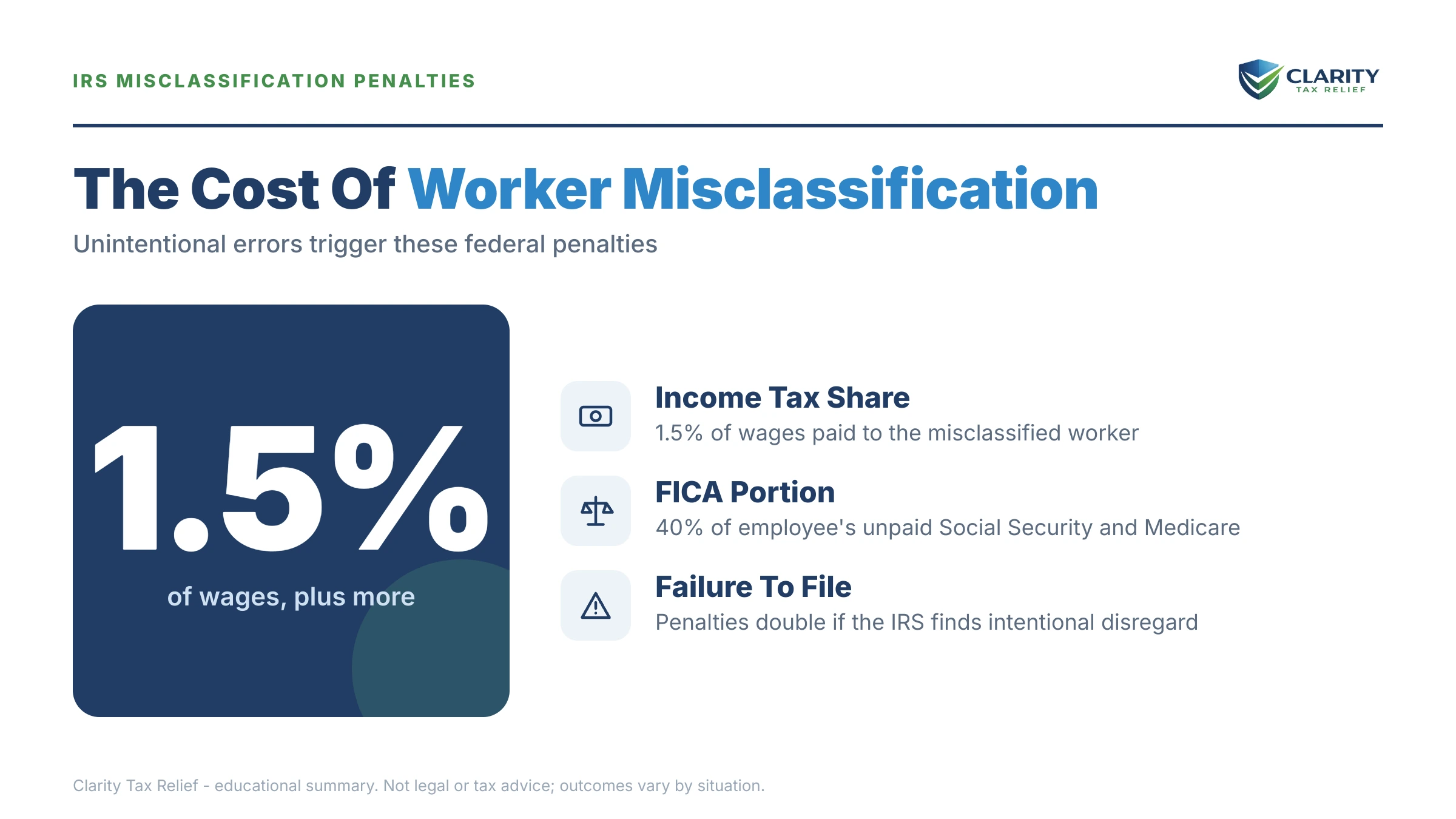
If the misclassification wasn't intentional, IRC §3509 caps your liability at reduced rates instead of the full payroll taxes you never withheld. The math has three pieces per year of reclassified pay:
- Federal income tax withholding: 1.5% of the wages paid (3% if you didn't file 1099s).
- Employee's share of FICA: 20% of the 7.65% employee rate — 1.53% of wages (doubled to 3.06% with no 1099s).
- Employer's share of FICA: the full 7.65% — §3509 gives no discount on your own share.
That's roughly 10.7% of every dollar of reclassified pay when 1099s were filed, and about 13.7% when they weren't. Section 3509 does not cover FUTA, so full federal unemployment tax on the first $7,000 per worker gets added, along with failure-to-deposit penalties and interest. One trade-off to know: when §3509 applies, you cannot further reduce the bill by proving the workers already paid their own income tax.
If the examiner finds intentional disregard — you knew these were employees and papered them as contractors anyway — the reduced rates vanish. You owe the full withholding amounts plus both FICA shares, offset only by Forms 4669/4670 showing the workers actually paid their tax, and the file can pick up a fraud referral. That's the line explored in our guide to the IRS civil fraud penalty. For how penalties and interest compound on any IRS balance, the math lives in our hub on how much IRS penalties on back taxes really cost — and you can estimate your own accrual with our penalty and interest calculator.
A worked example: how a $27,500 assessment happens
Say you run a three-person remodeling crew as a sole proprietor, paid the crew a combined $100,000 in each of the two years under exam, and filed 1099s every January. Under §3509, per year:
- Income tax withholding: 1.5% × $100,000 = $1,500
- Employee FICA share: 1.53% × $100,000 = $1,530
- Employer FICA share: 7.65% × $100,000 = $7,650
That's $10,680 per year — $21,360 across both years. Add FUTA on the first $7,000 per worker, failure-to-deposit penalties, and interest running back to the original due dates, and the assessment lands around $27,500. Had you never filed the 1099s, the doubled rates would put the tax alone near $27,400 before a single penalty. And because you're a sole proprietor, this is your personal debt — the levy threat aims at the same checking account that pays your apartment rent. Renting cuts one risk (no home equity for the lien to sit on) but changes nothing about bank levies.
Now the contrast that makes the rest of this article matter: with a winning Section 530 argument, the federal employment-tax bill on those same facts is $0. Through the VCSP before the exam ever opened, it would have been about $1,068 — 10% of one year's §3509 figure.
What happens if you ignore a misclassification assessment
An unpaid misclassification assessment moves from exam report to bank levy through a fixed sequence of documents, and each letter you ignore permanently closes a door. Here is the sequence in order:
- SS-8 inquiry or exam opening letter — no tax assessed yet, but your written answers become the evidence file.
- Exam report (30-day letter) — the proposed reclassification with the §3509 figures. Don't respond, and you lose the free administrative appeal.
- Notice of Determination of Worker Classification — the formal determination. IRC §7436 gives you 90 days to petition the Tax Court; the IRS generally can't assess while a timely petition is pending. Let it lapse and the balance goes on the books.
- CP161 balance-due notice — the assessment is now official and interest compounds on the whole amount.
- CP504B notice — the business intent-to-levy warning; refund offsets begin and the final notice is queued.
- Letter 1058 / LT11 — the final notice. You have 30 days to request a Collection Due Process hearing via Form 12153 before levies can issue.
- Levy — bank accounts (funds held 21 days before they leave), accounts receivable, and — for sole proprietors — personal accounts and income.
The 2026 wrinkle: IRS staffing fell roughly 27% in 2025, so reaching a human to fix this takes longer than ever — but the notice-and-levy pipeline is automated and never paused. Waiting for the IRS to slow down is not a strategy.
| Stage / document | What it means | Your response window |
|---|---|---|
| Form SS-8 inquiry / exam opening | Status question raised or 941 exam opened; no tax yet | Reply by the date printed on the letter |
| Exam report ("30-day letter") | Proposed reclassification + §3509 figures | Typically 30 days to protest to Appeals |
| Notice of Determination of Worker Classification | Formal IRS determination under §7436 | 90 days to petition the Tax Court |
| CP161 | Balance assessed and billed | Pay or arrange by the notice date |
| CP504B | Intent to levy; refund offsets begin | Date printed on the notice |
| Letter 1058 / LT11 | Final notice of intent to levy | 30 days to request a CDP hearing (Form 12153) |
| Levy | Bank (21-day hold), receivables, sole-prop personal accounts | Immediate — release requires action |
Holding a misclassification assessment — or already at the levy stage?
Whether you're inside the 30-day protest window, the 90-day Tax Court window, or staring at a levy notice, the right move depends on which door is still open. Get your exam report or notice reviewed free by an experienced tax professional before the next window closes.
Your options: from full relief to payment plans
Section 530 relief can reduce a federal worker misclassification assessment to zero — and the examiner is required to tell you it exists. Which option fits depends on whether you're before, during, or after the exam:
| Option | What it costs | Who may qualify |
|---|---|---|
| Section 530 relief | $0 — full federal employment-tax relief | Reasonable basis + consistent treatment of similar workers + 1099s filed every year |
| IRC §3509 reduced rates | ≈10.7% of wages (≈13.7% with no 1099s) | Applies automatically when misclassification wasn't intentional |
| Classification Settlement Program (CSP) | 25%–100% of ONE year's §3509 liability | Under exam, filed 1099s, agree to reclassify going forward |
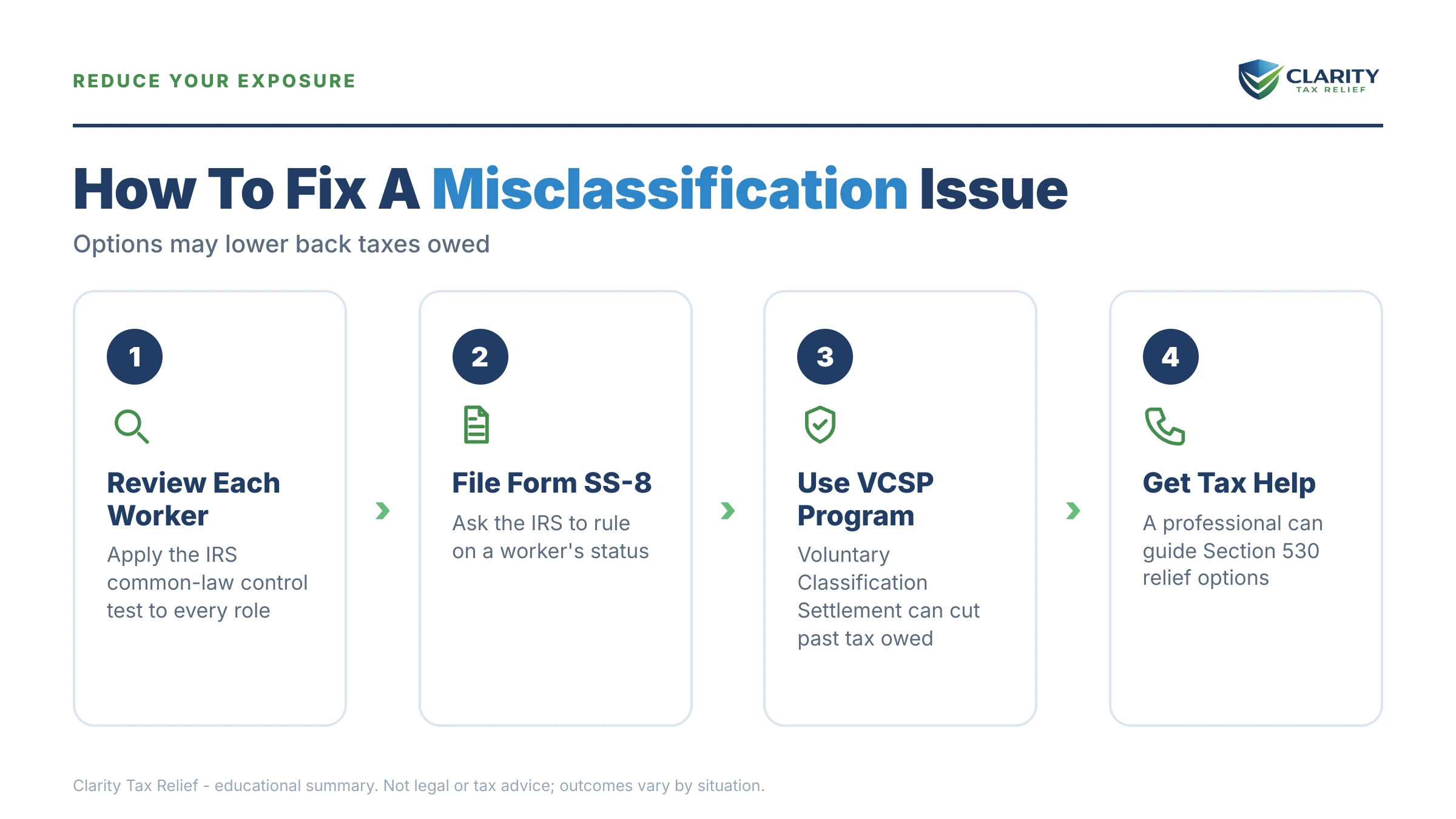
| VCSP (Form 8952) | 10% of one year's §3509 liability — about 1% of a year's pay | Not under exam; 1099s filed for prior 3 years; reclassify going forward |
| Appeals / Tax Court (§7436) | No fee for Appeals; modest Tax Court filing fee | Timely protest (typically 30 days) or petition (90 days) |
| Penalty abatement | Removes penalties, not the tax | Reasonable cause; clean-history relief on some penalties |
| Payment plan | Setup fee varies; interest continues | In-business agreements; terms depend on balance and financials |
Section 530 is the complete-relief path and it's unique to this penalty. You need all three legs: a reasonable basis for contractor treatment (a prior IRS audit that let it stand, published court precedent, advice of counsel, or a longstanding practice of a significant segment of your industry), consistent treatment of every similar worker, and 1099s filed for them each year. The 1099 requirement is why filing those forms in January quietly protects you years later.
The CSP operates mid-exam: if you meet the 1099-filing requirement but your Section 530 argument falls short, the examiner can close the whole multi-year case for one year's §3509 liability — sometimes just 25% of it — in exchange for treating the workers as employees going forward. On our example, that could turn $27,500 into $2,670–$10,680.
The VCSP is the pre-exam version: Form 8952, 10% of one year's §3509 amount, no interest, no penalties, no prior-year payroll audit on those workers. It closes the moment an employment-tax exam opens, which is why acting before the first letter matters so much.
Penalty abatement can strip the failure-to-deposit and late-payment additions even when the tax stands — see how to build the request in our IRS penalty abatement letter guide and the payroll-specific angles in 941 penalty abatement. Note that starting summer 2026, the IRS's new Automatic Exemption from Penalty (AEP) begins replacing first-time abatement for qualifying penalties — automatic, no request needed — so don't pay a penalty that may fall off on its own.
If the assessed balance simply can't be paid at once, a business IRS installment agreement stops enforcement while you pay monthly; interest and the 0.5%-per-month late-payment penalty keep accruing. Genuine hardship cases may qualify for currently-not-collectible status, and in rare cases where assets and income truly can't cover the debt, an offer in compromise — but the IRS accepted only about 1 in 5 offers in FY2024, so treat that as a math question, not a marketing promise.
How to respond to a worker misclassification penalty, step by step
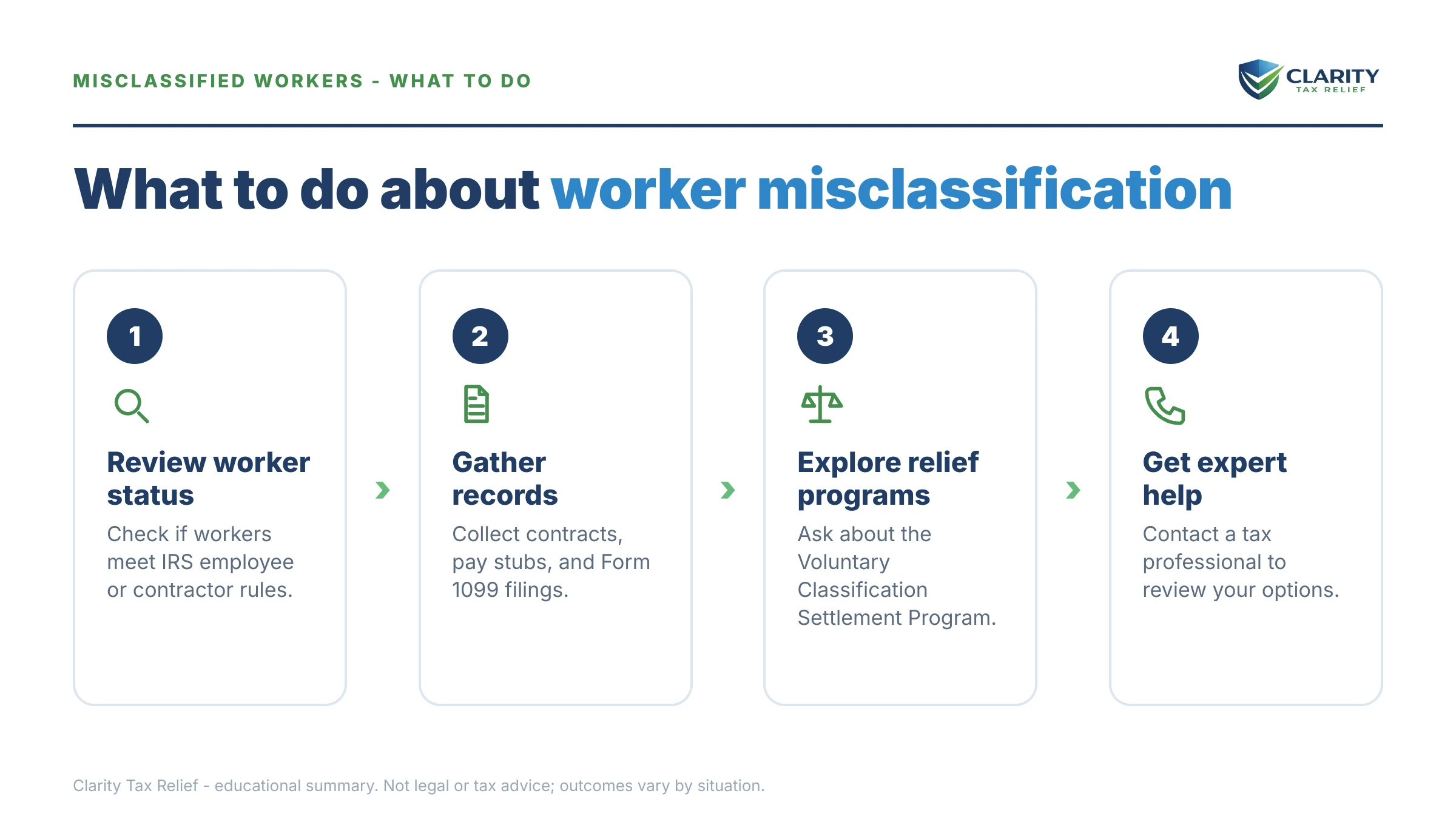
- Identify the letter you're holding. Match it to the stage table above — an SS-8 inquiry, an exam opening letter, a 30-day exam report, a Notice of Determination of Worker Classification, or a collection notice — because your response window is different at every stage.
- Gather your classification evidence. Pull the 1099s you filed, your contracts and invoices with the workers, and anything showing how similar businesses in your industry treat the same role — this is the raw material for Section 530 relief.
- Assert Section 530 and §3509 in writing. The examiner is required to consider Section 530 relief, but you carry the argument — put your reasonable-basis and consistency evidence in the record before you agree to anything.
- Use your appeal windows before they close. Protest the exam report to Appeals (typically 30 days) or petition the Tax Court within 90 days of a Notice of Determination of Worker Classification — the IRS generally cannot assess while a timely petition is pending.
- Resolve whatever balance remains. Set up a business payment plan, request penalty abatement, or get a free professional review of the numbers before the account reaches levy stage.
When you can handle this yourself — and when help changes the outcome
You can reasonably handle this alone when the exposure is small and the facts are clean: one worker, one year, you agree the classification was wrong, and the §3509 bill is something you can pay in full or within a 180-day short-term plan. Filing a VCSP application before any exam opens is also manageable paperwork for an organized owner.
Experienced help changes outcomes in four situations: a levy notice is already in motion and CDP rights need to be exercised correctly; multiple workers and multiple years are on the table, where CSP negotiation swings the bill by tens of thousands; you have a real Section 530 argument that needs to be documented and pressed, because examiners don't build your case for you; or the file has an intentional-disregard flavor, where what you say to the examiner matters as much as what you owe. One more structural risk worth understanding: if the business keeps running payroll wrong after the exam and withheld taxes go unpaid, owners and check-signers face the trust fund recovery penalty personally — the problem that turns a business debt into a lifetime one. Once payroll accounts fall behind more broadly, start with our guide to 941 back taxes.
State agencies charge their own misclassification penalties
A federal reclassification rarely stays federal — states assess back unemployment insurance, disability contributions, and their own penalties under their own tests. California's EDD applies the strict ABC test, which classifies workers as employees even when the IRS common-law test would not, and EDD assessments can carry personal liability for owners; see California EDD payroll tax for how those cases run. Federal and state agencies share exam data both directions, so resolving one side while ignoring the other usually just re-triggers the problem. Never assume a federal number, program, or deadline applies to a state assessment — each state runs its own rules, so verify directly with the named state agency.
Terms on your paperwork, decoded
- Section 530: a 1978 safe harbor (never codified into the tax code) that erases federal employment-tax liability for misclassification when you had a reasonable basis, treated workers consistently, and filed 1099s.
- IRC §3509: the reduced-rate formula for unintentional misclassification — 1.5% withholding plus 20% of the employee FICA share, doubled without 1099s.
- Form SS-8: the form either a worker or a business files asking the IRS to determine employment status (see the IRS's About Form SS-8 page).
- Notice of Determination of Worker Classification: the formal determination letter that starts your 90-day Tax Court window under IRC §7436.
- Reasonable basis: the evidence leg of Section 530 — a prior audit, court precedent, professional advice, or a significant industry practice supporting contractor treatment.
- Trust fund taxes: the income tax and employee FICA an employer withholds from real paychecks — the portion that can become a personal debt for owners when unpaid.
Worker misclassification penalty FAQs
How much is the IRS penalty for misclassifying employees as independent contractors?
Under IRC §3509, unintentional misclassification typically costs about 10.7% of the wages paid when you filed 1099s, and about 13.7% when you didn't — plus your full FUTA liability, deposit penalties, and interest. Intentional disregard removes the reduced rates entirely, so the same wages can generate a bill several times larger. The exact figure depends on the years examined and how many workers are reclassified.
What is Section 530 relief for worker misclassification?
Section 530 of the Revenue Act of 1978 wipes out the federal employment-tax assessment entirely if you meet three tests: you had a reasonable basis for treating the workers as contractors (an industry practice, a prior audit, or court precedent), you treated all similar workers consistently, and you filed 1099s for them every year. Miss any one test and Section 530 fails — but the examiner is required to tell you about it in a classification exam.
Can a worker filing Form SS-8 trigger penalties against my business?
Yes — an SS-8 determination that the worker is an employee doesn't assess tax by itself, but it routinely leads to an employment-tax exam covering every similar worker, not just the one who filed. Workers often file Form SS-8 with Form 8919 to escape self-employment tax, which puts your business on the IRS's radar. Respond to the SS-8 inquiry carefully; your answers become evidence in any later exam.
Am I personally liable for a worker misclassification penalty?
If you operate as a sole proprietor or single-member LLC, yes — the assessment is against you personally, and the IRS can levy personal bank accounts. If you run a corporation or multi-member LLC, the entity owes the reclassification assessment, but continuing to run payroll wrong after the exam can create personal exposure through the trust fund recovery penalty for withheld taxes that go unpaid.
Should I use the Voluntary Classification Settlement Program (VCSP)?
The VCSP is worth a serious look if you know your workers are misclassified but aren't under exam yet: you pay just 10% of one year's §3509 liability — roughly 1% of a year's payments — with no interest, no penalties, and no payroll audit of prior years on those workers. You must have filed 1099s for the past three years and agree to treat the workers as employees going forward. Once an exam opens, the door closes.
How far back can the IRS go on worker misclassification?
Generally three years per filed 941, with the clock treated as starting April 15 of the following calendar year. If you never filed employment tax returns for those workers, there is no statute of limitations at all, and fraud also removes the time limit. Most classification exams cover the open three-year window, which is why assessments typically span two to three years.
Do states charge their own worker misclassification penalties?
Yes, and states are often more aggressive than the IRS. State agencies assess back unemployment insurance, disability contributions, and their own penalties under their own tests — California's EDD applies the strict ABC test, which reclassifies workers the federal common-law test would leave alone. Federal and state agencies share data, so one exam frequently triggers the other.
Your next 24 hours
- Find the letter number and printed date on the newest IRS document in your stack — that one line tells you which window (30-day protest, 90-day petition, or 30-day CDP) is still open.
- Gather your evidence file: the 1099s you filed for the workers, your contracts or invoices, the exam report or notice itself, and your most recent business bank statements.
- Get a free case review — call (888) 825-7779 or use the 2-minute form at the top of this page. If a Letter 1058 or LT11 has arrived, do this today: the 30-day hearing window is the last stop before a levy, and interest is accruing either way.
For the IRS's own framework on classification, see Independent contractor or employee on IRS.gov, and if you're arranging payment on an assessed balance, official terms are at IRS payment plans.
This guide is general information, not tax or legal advice for your specific situation. Eligibility for IRS programs depends on individual facts and circumstances; no outcome is guaranteed.