
California Tax Problems
California EDD Payroll Tax Debt in 2026: Assessments, Personal Liability, and How to Respond
The short answer: California EDD payroll tax debt is money owed to the Employment Development Department for four payroll taxes — UI, ETT, SDI, and state income tax withholding. Most assessments follow a worker misclassification audit, you generally have 30 days to petition, and unpaid withheld taxes can become your personal debt under CUIC section 1735.
The envelope came from Sacramento, not the IRS — an EDD Notice of Assessment saying the business you and your spouse built owes payroll taxes on workers you always paid as contractors. That number at the bottom feels like a verdict. It isn't: it's an opening position, and the shortest, most valuable deadline in California tax collection is now running.
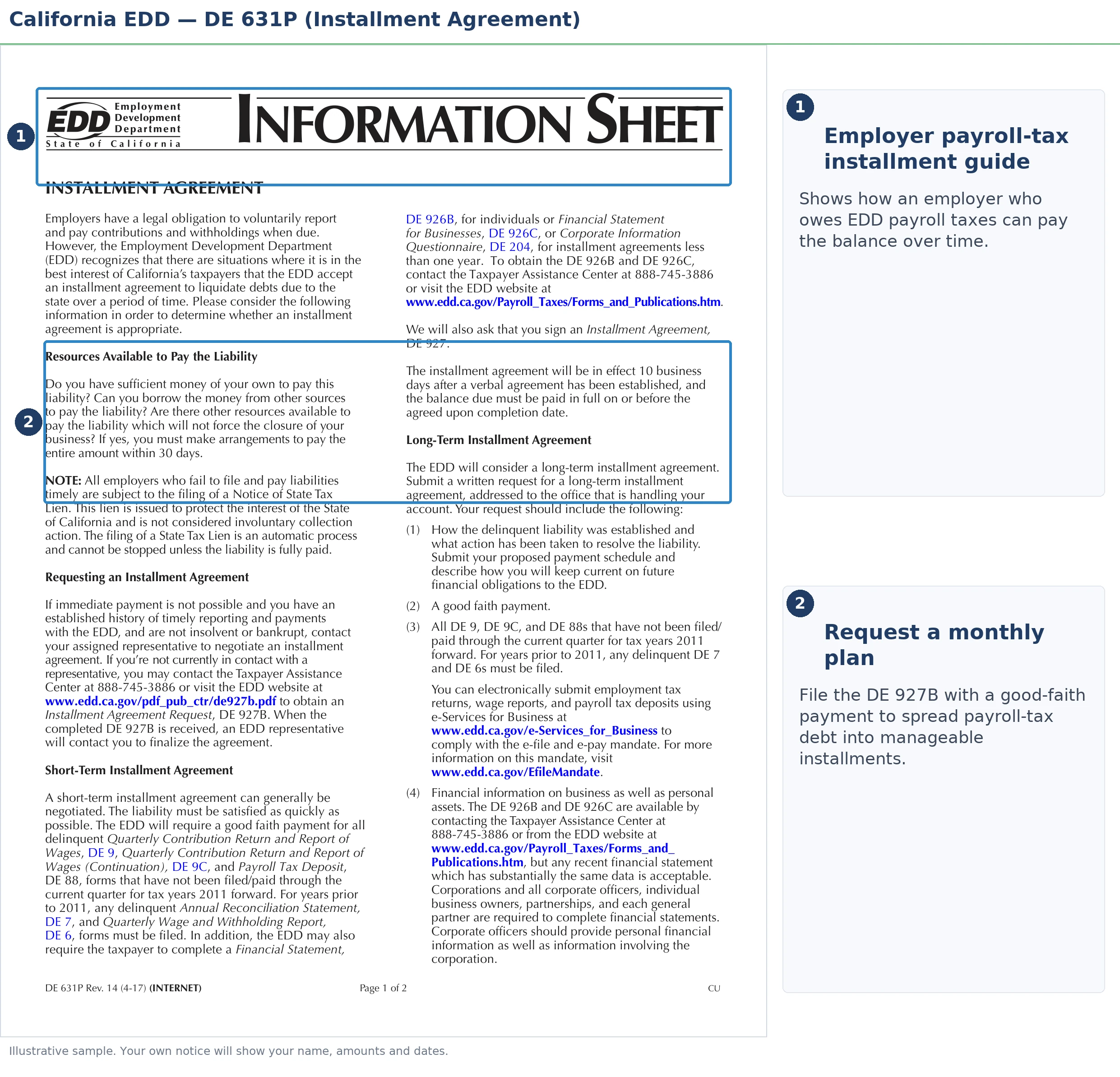
Two things on that assessment control everything — the total the EDD claims and the petition deadline that decides whether you get to fight it. The image below shows you exactly what an EDD assessment looks like and where each one sits.
⏱ Your deadline: you generally have 30 days from the date on an EDD Notice of Assessment to file a petition for reassessment with the CUIAB. The exact deadline printed on your notice controls. Miss it, and the assessment becomes final and collectible — no court hearing required.
Why you got a California EDD payroll tax assessment
The EDD collects four California payroll taxes — Unemployment Insurance, the Employment Training Tax, State Disability Insurance, and personal income tax withholding — and it assesses employers whenever an audit or a missed filing shows any of them unpaid.
By far the most frequent path to an assessment starts with a worker, not a form: a single unemployment claim filed by someone you paid on a 1099 shows the EDD a person claiming benefits with no reported wages. That mismatch routinely opens an EDD audit, the auditor applies California's ABC test to your whole workforce, and every reclassified worker adds tax, penalties, and interest to the bill.
The other common triggers are mechanical: quarterly DE 9 and DE 9C returns filed late or not at all, deposits that don't match reported wages, or withholding reported but never paid over. Whatever the trigger, the result arrives the same way — an EDD Notice of Assessment stating the quarters, the taxes, and your petition deadline.
| Tax | Who funds it | Why it matters if unpaid |
|---|---|---|
| Unemployment Insurance (UI) | Employer | An employer tax on wages — collectible from the business, and from responsible individuals if the entity willfully fails to pay. |
| Employment Training Tax (ETT) | Employer | Small on its own, but it rides along on every reclassified wage in a misclassification assessment. |
| State Disability Insurance (SDI) | Withheld from employees | Money that belonged to your workers. Withheld taxes get the least flexibility in any EDD resolution. |
| Personal income tax (PIT) withholding | Withheld from employees | Usually the largest slice of a misclassification assessment — and the core of personal liability under CUIC section 1735. |
What a $41,800 EDD assessment looks like: a worked example
A typical misclassification assessment is mostly tax the EDD says you should have withheld — and that composition shapes every option you have.
Say you and your spouse run a design-build company as an S corporation, filing jointly at home. The EDD audits three years after one of your four 1099 installers files for unemployment, reclassifies all four under the ABC test, and issues a Notice of Assessment for $41,800. A realistic breakdown:
- $28,300 in unpaid contributions and withholdings — PIT withholding on the reclassified wages is the biggest piece, plus SDI, UI, and ETT.
- $9,100 in penalties for the unreported wages and unpaid amounts.
- $4,400 in accrued interest across the audited quarters.
Now run the paths. A timely petition costs nothing and puts the whole $41,800 in front of an administrative law judge — and because assessments are built worker by worker, even a partial win matters: show that two of the four installers ran genuinely independent businesses, and the tax, penalty, and interest tied to their wages come off the bill. If the assessment stands and the company pays over time, $41,800 across 36 months is roughly $1,161 a month before continuing interest — real money, but survivable for an operating business. The path to avoid is the default one: do nothing, and the debt starts migrating from the corporation toward the two of you personally.
Personal liability: how business EDD debt becomes your debt
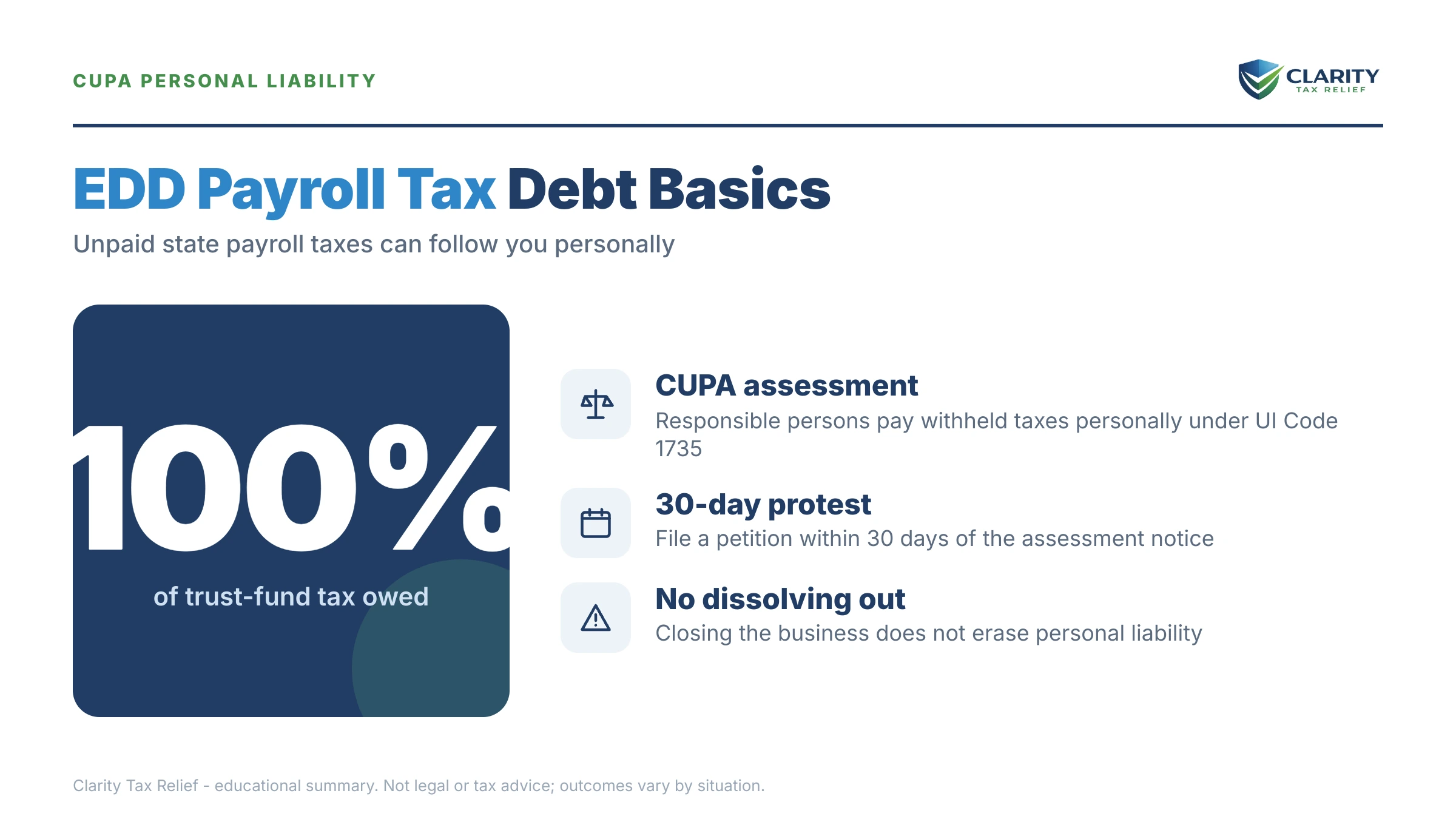
Under CUIC section 1735, the EDD can assess corporate payroll tax debt directly against the individuals who ran the business. The entity does not shield you: officers, majority stockholders, and any person who had charge of the business's affairs can be personally assessed when the company willfully fails to pay — and "willful" here mostly means you knew the taxes were due and paid other bills instead.
The EDD looks at conduct, not titles. Who signed checks, ran payroll, hired and fired, decided which creditors got paid — that person is the target, whether or not their name is on the incorporation papers. It works much like the federal trust fund recovery penalty, with one California twist that matters for married couples: because California is a community property state, a section 1735 assessment against one spouse can generally be collected from community assets — including the other spouse's earnings, even if that spouse never touched payroll.
A section 1735 assessment arrives as its own notice with its own short petition window. If your business can't pay and you had any role in its finances, the time to build the defense is before that notice issues, not after.
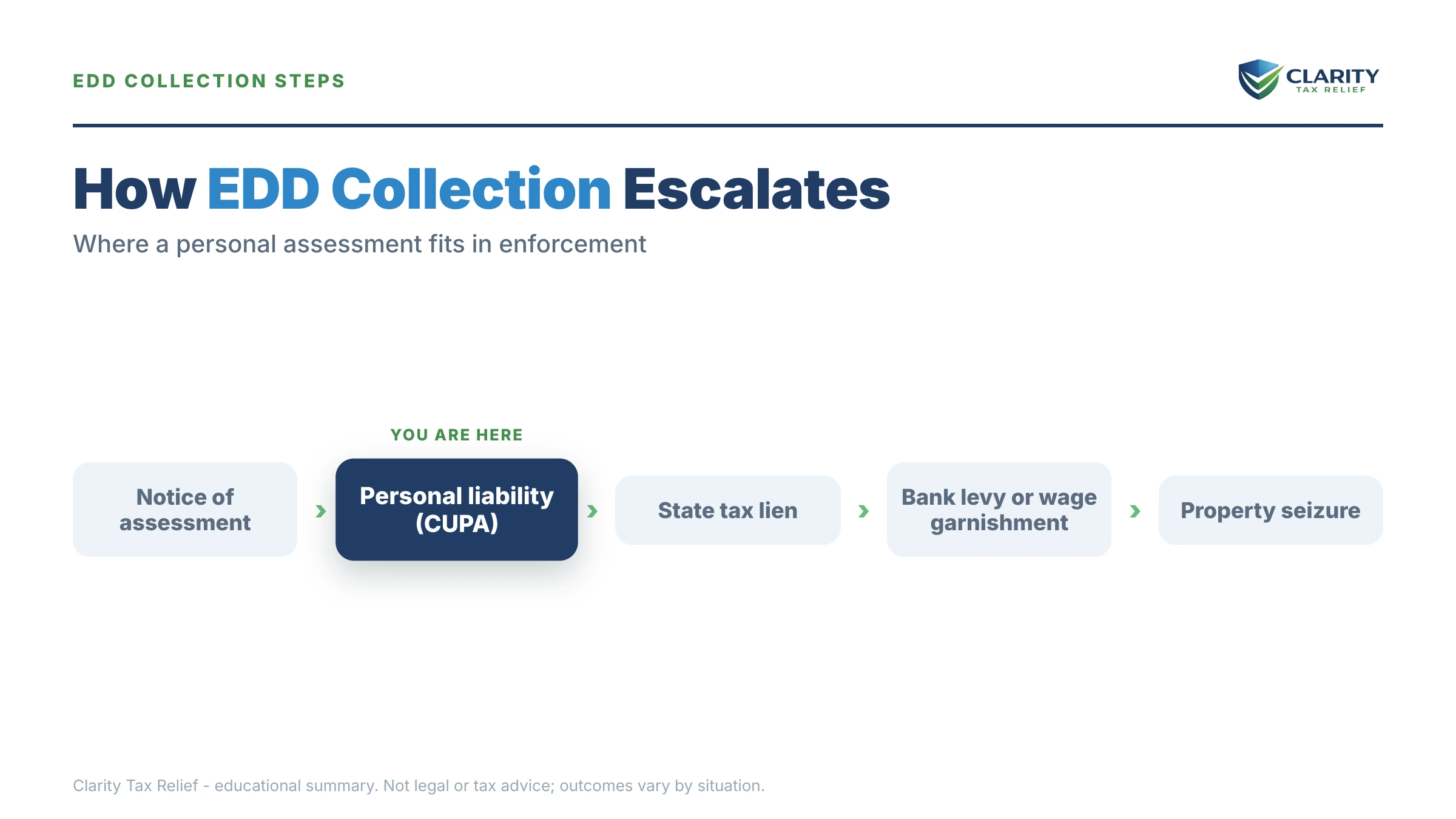
What happens if you ignore EDD payroll tax debt
Once an EDD assessment goes final, the department can lien, levy, and garnish administratively — without ever going to court. The sequence runs in stages, and each stage closes a door:
- The assessment goes final. Your petition window passes and you lose the right to a CUIAB hearing. From here, fighting the merits generally means paying first and pursuing a refund claim.
- Demand for payment. Statements arrive while penalties and interest keep compounding on the unpaid balance.
- State tax lien. The EDD records a lien that attaches to business and personal property, clouds real-estate title, and signals every lender that the state is ahead of them.
- Levies and earnings withholding orders. Bank accounts, accounts receivable, and wages become reachable — a receivables levy can cut off an operating company's cash flow overnight.
- Intercepts. State tax refunds and lottery winnings get grabbed through California's interagency intercept program.
- Personal assessment under section 1735. If the entity can't pay, the EDD moves the collectible portion onto the responsible individuals — and starts this same sequence against your personal assets.
| Stage | What the EDD can do | Your move / window |
|---|---|---|
| Audit opens | Examine payroll, 1099s, and worker classification for the covered quarters | Organize records; get representation before the classification interview, not after |
| Notice of Assessment | State the tax, penalties, and interest it intends to collect | Generally 30 days to petition the CUIAB — the date on your notice controls |
| Assessment final | Demand payment; penalties and interest continue | Negotiate an installment agreement before enforcement starts |
| Lien recorded | Attach business and personal property; alert lenders | Payment arrangements can head off escalation to levy |
| Levy / earnings withholding order | Take bank funds, receivables, and wages without a court order | Hardship and payment negotiations can release or reduce active levies |
| Section 1735 assessment | Move the debt onto responsible individuals personally | Its own short petition window — contest responsibility and willfulness immediately |
Holding an EDD assessment right now?
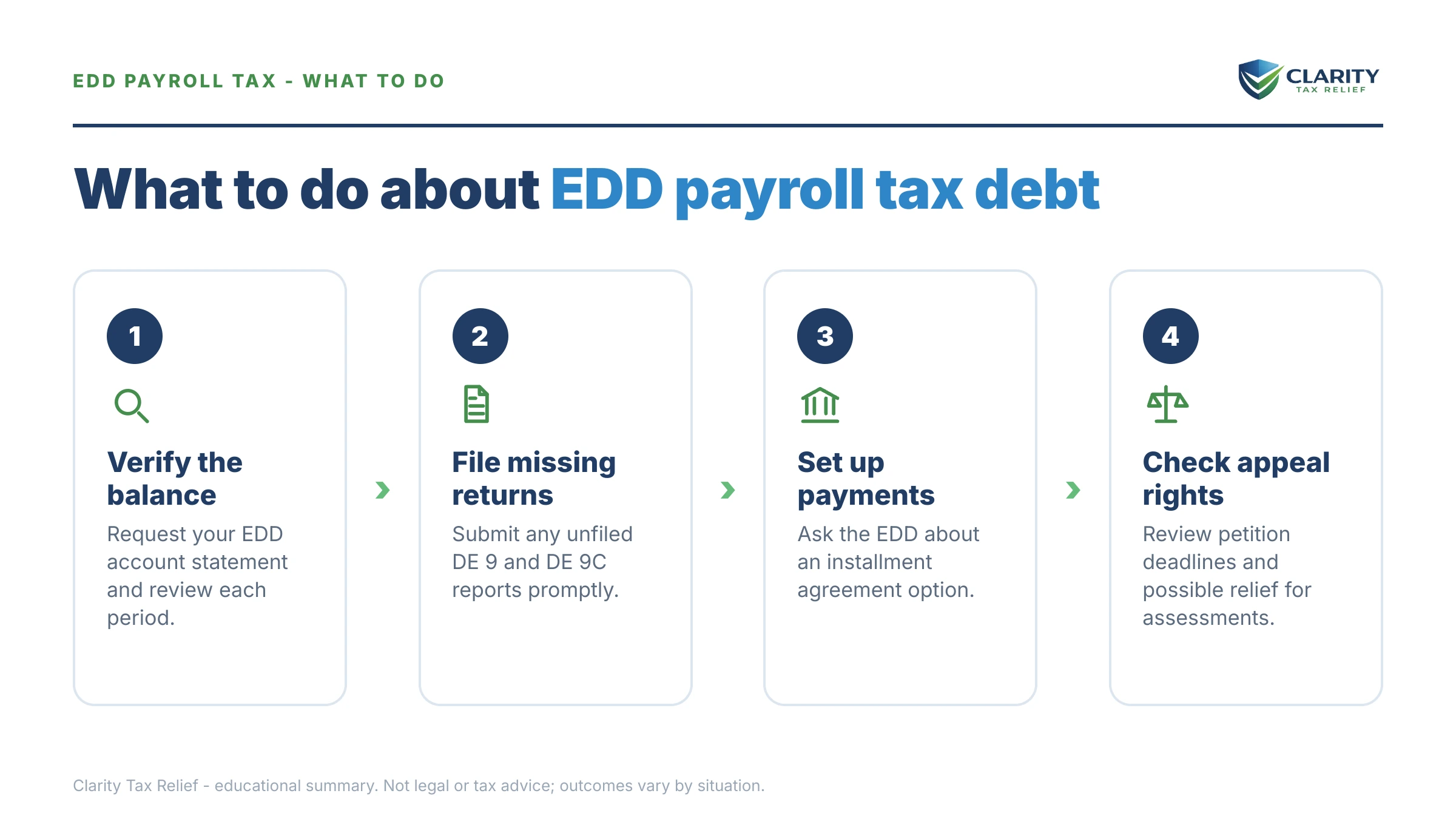
Your petition window is generally just 30 days from the notice date — and it's the cheapest point in this entire sequence to act. Send us the notice and an experienced tax professional will map your classification arguments, your payment options, and your personal exposure — free and confidential.
Your options for resolving EDD payroll tax debt
Every EDD resolution path runs through one fork: is the assessment still open to challenge, or is it final? A timely petition generally freezes collection while the case is pending — which is why the 30-day window is worth more than any program that comes after it.
| Option | Who it fits | Key limits |
|---|---|---|
| Petition for reassessment (CUIAB) | Anyone disputing classification, wage figures, or penalties — filed within the window on the notice | Generally 30 days from the notice date; free to file; collection generally holds while pending |
| Installment agreement | Businesses or individuals who agree with the debt but can't pay in full | Case-by-case approval; must stay current on all new deposits and filings; interest continues (see EDD payment plan) |
| Penalty relief for good cause | Employers whose late filing or payment stemmed from circumstances beyond their control | Relieves penalties only — the underlying tax and interest on it remain |
| Settlement (pending appeal) | Cases with a genuinely disputed petition before the CUIAB | Priced on litigation risk, not hardship — a weak case settles near full value |
| EDD Offer in Compromise | Generally inactive, out-of-business accounts (or applicants with no remaining controlling interest) who can't pay in full | Far narrower than the IRS version; withheld employee taxes get the least flexibility |
| Do nothing | No one | Lien, levy, earnings withholding orders — then personal assessment under section 1735 |
Two notes the option grid can't capture. First, the EDD has no formal equivalent of the IRS's currently-not-collectible status — hardship gets argued case by case, usually to release or soften an active levy rather than to pause the account. Second, resolution here is only one lane of a wider road: if you also owe the FTB or the IRS, the sequencing decision is covered in our guide to California tax debt relief.
How to respond to an EDD payroll tax assessment, step by step
- Find your petition deadline. Locate the date on your EDD Notice of Assessment. You generally have 30 days from that date to file a petition for reassessment with the CUIAB, and the deadline printed on your notice controls.
- Pull the records that decide the case. Gather your DE 9 and DE 9C filings, 1099s, contracts, invoices, and bank statements for every quarter the assessment covers.
- Petition if anything is wrong. If the worker classification, wage figures, or penalties are off, file a timely petition — it costs nothing and generally keeps collection on hold while the case is heard.
- Set up payment if the debt is right. Contact the EDD to arrange an installment agreement before the assessment goes final, and stay current on every new payroll deposit and filing while you pay.
- Address personal exposure early. If the business cannot pay, get experienced help before the EDD moves the debt onto you personally under CUIC section 1735 — the arguments are strongest before that assessment issues.
EDD vs. IRS vs. FTB: one payroll, three separate creditors
Resolving your EDD debt does nothing for the IRS or the Franchise Tax Board — California employers can owe all three agencies on the same wages, and each collects independently.
The federal side is the bigger dollar risk: the EDD and the IRS share audit information, so a state reclassification frequently surfaces as federal employment tax exposure on the same workers. If your quarters are also unpaid federally, start with our guides to 941 back taxes and the worker misclassification penalty — the federal ABC-test analog is different, and Section 530 relief has no California counterpart.
State-side, income tax balances belong to the FTB (see California FTB back taxes) and sales tax to the CDTFA (see California back sales tax). When you owe more than one agency, the order you resolve them in changes what you pay — the framework is in our hub on state tax debt vs IRS. The short version for payroll debt: withheld taxes, state or federal, always come first, because they're the ones that follow you personally.
When you can handle this yourself
Not every EDD balance needs professional help. If the assessment covers one late quarter you agree with, the amount is small, and the business can pay it or absorb a short installment plan while staying current, calling the EDD directly is a perfectly reasonable move. The same goes for a pure filing lapse — returns done, deposits made, just paperwork to true up.
Experienced help changes outcomes in four situations: a misclassification audit where the ABC-test arguments will decide tens of thousands of dollars; a section 1735 personal assessment or the threat of one; an operating business facing a lien or receivables levy that could kill its cash flow; and multi-agency exposure where the EDD assessment is about to echo at the IRS. In those cases, what you say in the first auditor interview or the petition often matters more than anything that happens later.
Terms on your EDD notice, decoded
- Notice of Assessment — the EDD's formal bill stating the quarters, taxes, penalties, and interest it intends to collect, plus your petition deadline.
- Petition for reassessment — your written appeal to the CUIAB disputing the assessment; timely filing generally keeps collection on hold.
- CUIAB — the California Unemployment Insurance Appeals Board, the independent body whose administrative law judges hear EDD disputes.
- Responsible person (CUIC 1735) — an officer, major stockholder, or anyone with charge of the business's affairs whom the EDD can assess personally for the entity's willful nonpayment.
- Earnings withholding order — the EDD's administrative wage garnishment, issued without a court judgment once an assessment is final.
- Withheld (trust-fund) taxes — SDI and PIT amounts taken from employee paychecks; because the money belonged to workers, these get the least flexibility in any resolution.
For the primary sources, the department's employer pages live at the EDD website, and petition procedures are published by the California Unemployment Insurance Appeals Board.
California EDD payroll tax questions, answered
What payroll taxes does the California EDD collect?
The EDD collects four payroll taxes: Unemployment Insurance (UI) and the Employment Training Tax (ETT), which employers fund, plus State Disability Insurance (SDI) and California personal income tax withholding, which come out of employee paychecks. The withheld portions are the dangerous ones — because that money belonged to your workers, the EDD pursues it hardest and can assess it against you personally if the business never pays.
Can the EDD hold me personally liable for my company's payroll tax debt?
Yes. Under CUIC section 1735, the EDD can assess officers, majority stockholders, and anyone who had charge of the business's affairs when the entity willfully failed to pay. A corporation or LLC does not shield you. The EDD looks at who signed checks, ran payroll, and decided which bills got paid — so bookkeepers and non-owner managers can be assessed too, not just the people on the incorporation papers.
How long do I have to appeal an EDD Notice of Assessment?
You generally have 30 days from the date on the notice to file a petition for reassessment with the California Unemployment Insurance Appeals Board, and the exact deadline printed on your notice controls. The CUIAB can extend the window for good cause, but never plan on it. Once the assessment is final, your realistic remaining path is usually paying the debt and then pursuing a refund claim.
Does the EDD offer payment plans for payroll tax debt?
Yes. The EDD approves installment agreements for employers who cannot pay an assessment in full, though approval is case-by-case rather than automatic like some IRS plans. Expect to stay completely current on new payroll tax deposits and filings while you pay — a new missed quarter can default the arrangement — and interest continues to accrue on the unpaid balance for the life of the plan.
Can the EDD levy my bank account or garnish wages?
Yes, and it does not need a court judgment first. Once an assessment is final, the EDD can record a state tax lien, levy business and personal bank accounts, seize accounts receivable, and issue earnings withholding orders against wages. It can also take state tax refunds and lottery winnings through California's interagency intercept program. Filing a timely petition before the assessment becomes final is what generally keeps all of this on hold.
Will an EDD audit trigger an IRS problem too?
It can. The EDD and the IRS share audit information, so a state reclassification of your 1099 workers often surfaces the same wages for federal employment tax purposes. The federal side has its own relief paths — including Section 530 relief for employers with a reasonable basis for contractor treatment — so it pays to address the IRS exposure proactively instead of waiting for a second assessment to arrive.
Does the EDD have an Offer in Compromise?
Yes, but it is far narrower than the IRS version. The EDD generally considers an offer only when the business is inactive and out of operation, or the applicant no longer has a controlling interest in it, and the applicant lacks the income and assets to pay in full. Amounts withheld from employee paychecks get much less flexibility than employer-funded contributions, so most operating businesses resolve EDD debt through payment plans instead.
Why did the EDD say my 1099 contractors are employees?
California applies the ABC test from AB 5, which presumes every worker is an employee unless the hiring business proves all three prongs: the worker is free from your control, performs work outside your usual course of business, and runs an independently established trade. Prong B sinks most cases — an installer working for an installation company fails it almost by definition — which is why EDD misclassification assessments are so common.
Your next 24 hours
- Find the petition deadline on your notice. It's printed on the Notice of Assessment near the assessment total — that date, generally 30 days from the notice date, decides whether you can still fight the numbers.
- Gather your payroll paper trail. DE 9 and DE 9C filings, 1099s, worker contracts, invoices, and bank statements for every quarter listed on the assessment — these decide both the ABC-test fight and any payment negotiation.
- Get the assessment reviewed free before the window closes. Use the 2-minute form or call (888) 825-7779 — an experienced tax professional will tell you whether to petition, pay, or both, while the petition right still exists.
This guide is general information, not tax or legal advice for your specific situation. Eligibility for IRS programs depends on individual facts and circumstances; no outcome is guaranteed.