
California Taxes
California Back Sales Tax: How the CDTFA Collects It and How to Resolve It (2026)
The short answer: California back sales tax is unpaid sales or use tax owed to the CDTFA — not the FTB or the IRS. You owe it even if you never charged customers a cent of tax. The CDTFA can assess up to eight years of unfiled periods, then lien, levy, and garnish. Payment plans and settlement options exist.
You've been selling on the side — online, at swap meets, out of your trunk between gig shifts — and a letter from an agency you've never heard of, the CDTFA, says you owed a seller's permit and years of sales tax returns you never filed. Nobody ever told you delivery apps and product sales play by different rules. This is fixable, and the order you fix it in matters more than the amount.
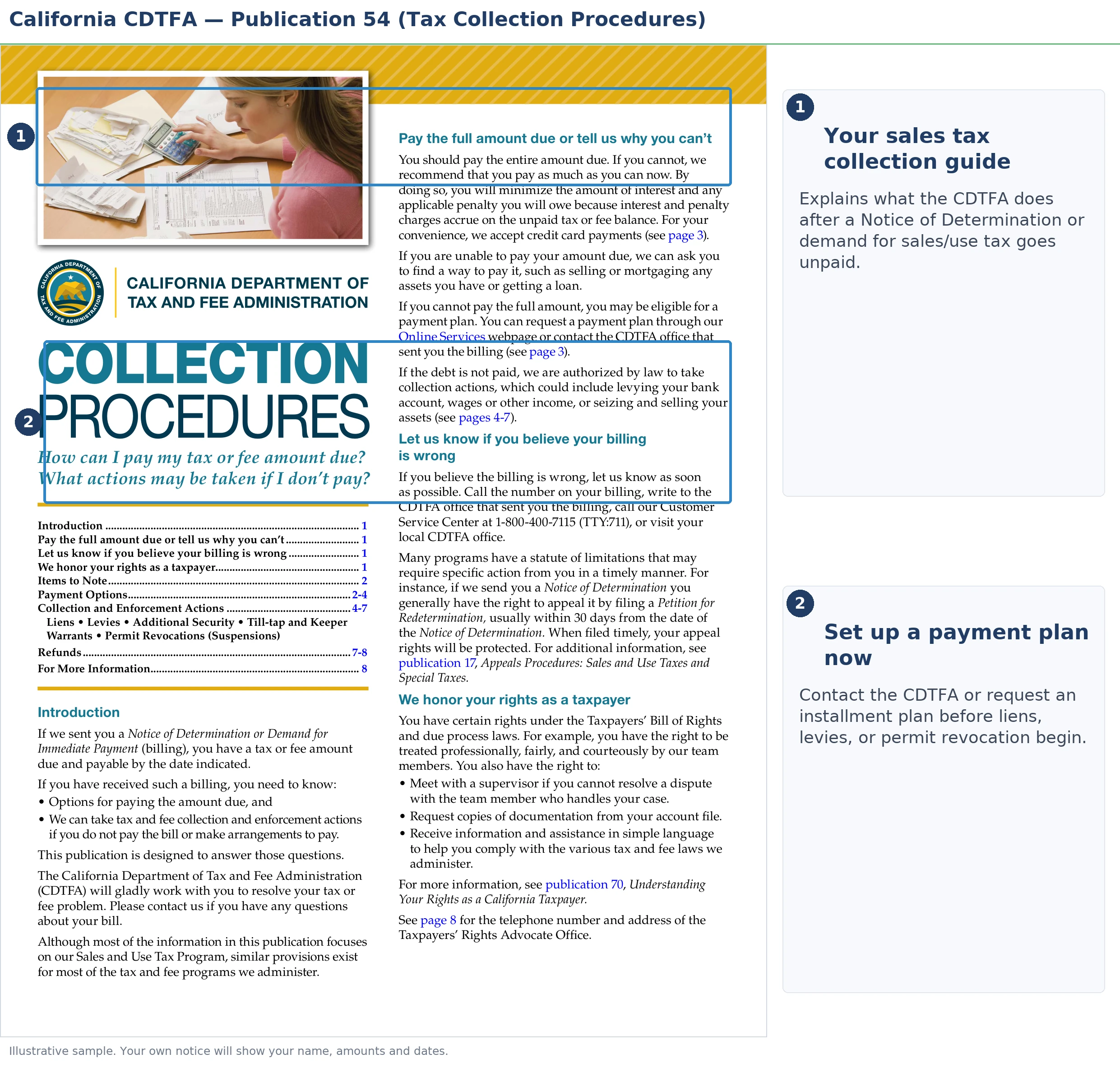
Three facts about California back sales tax shape everything below. First, the seller owes the tax whether or not the customer was ever charged it. Second, the CDTFA can reach back up to eight years when no return was filed. Third, if the CDTFA calculates your tax for you, its number is almost always higher than the truth — and you have a short window to fight it. The image below shows exactly what a CDTFA billing notice looks like and where to find the assessed amount and the date that starts your appeal clock.
⏱ The clock that matters: if you're holding a CDTFA Notice of Determination, you have 30 days from the date printed on it to file a petition for redetermination — after that, the assessment becomes final and collectible. No notice yet? The meter still runs: a 10% penalty applies to each late period and interest accrues monthly on every dollar, and additional penalties can stack in some cases — another 10% once a determination becomes final, 25% for fraud, or 40% if you knowingly collected sales tax reimbursement and failed to remit it.
Why you owe California back sales tax
California sales tax is owed by the seller — the CDTFA can bill you for every taxable sale you made, even if you never added tax to a single price. The California Department of Tax and Fee Administration handles sales and use tax; the FTB handles income tax. If your three unfiled years also skipped income tax returns, that's a separate problem covered in our California FTB back taxes guide — resolving one agency does nothing for the other.
Back sales tax in California usually traces to one of five triggers:
- You sold taxable goods without a seller's permit. Common for gig workers and side sellers — rideshare income needs no permit, but selling physical products in California does, from the first sale.
- You had a permit but stopped filing. The CDTFA expects a return for every period the permit is open, even zero-sales periods. Skipped quarters pile up penalties fast.
- A CDTFA audit found underreported sales. Cash sales, unreported platforms, or bad exemption paperwork surface in a CDTFA sales tax audit, and the result is a bill for prior periods.
- Pre-2019 online sales. Marketplaces have collected California tax for their sellers only since October 2019 under the Marketplace Facilitator Act. Earlier marketplace sales — and all direct sales through your own site or in person — are on you. Multistate sellers should also check their economic-nexus exposure in every other state they ship into.
- A business closed with unpaid sales tax. The liability doesn't dissolve with the entity — see closed business owe sales tax for how personal liability attaches.
The rate matters too. California's statewide base is 7.25%, but district taxes push combined rates above 10% in some cities — the CDTFA assesses at the rate where each sale happened, which is why sloppy estimates cut against you.
What happens if you ignore CDTFA back sales tax
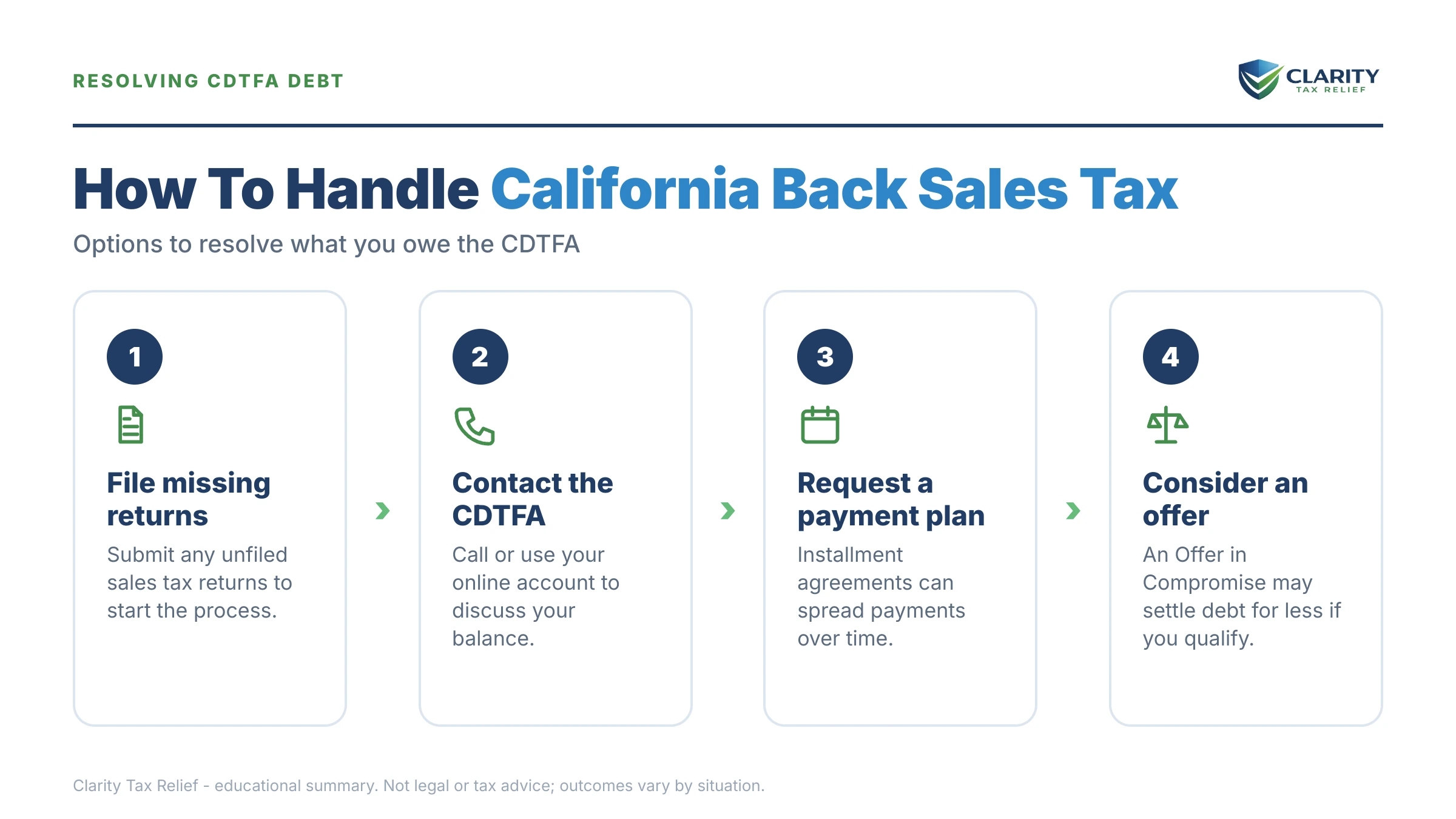
An unresolved CDTFA balance moves from billing notices to a recorded state tax lien, bank levies, wage garnishment, and the loss of your seller's permit. Sales tax gets harsher treatment than most tax debt because the state views it as money collected from customers in trust. The sequence runs in this order:
- Billing and demand notices. The balance appears with a 10% penalty and accruing interest. This is the cheapest stage to act — nothing is being seized yet.
- Notice of Determination. If you never filed, the CDTFA computes your tax for you — often from bank deposits, 1099-K data, or industry estimates — and the number typically overshoots reality. You have 30 days to file a petition for redetermination; our CDTFA Notice of Determination guide walks through the dispute process.
- Finality and a state tax lien. Once the assessment is final, the CDTFA can record a lien — a public record that attaches to your property and complicates credit, refinancing, and selling.
- Active collection. Bank levies, an earnings withholding order against your paycheck, and interception of state payments owed to you. If you also drive or deliver on 1099s, levies can reach those payment streams too.
- Permit action. The CDTFA can revoke your seller's permit or refuse to issue a new one while the debt stands — and selling taxable goods without a valid permit is illegal, which can end the business side of your income entirely.
- Personal assessment. If the debt belongs to a closed corporation or LLC, the CDTFA can issue a dual determination under Revenue and Taxation Code §6829 against the people who ran the money — converting a "business" debt into a personal one.
Note where a sole proprietor or gig seller starts on that ladder: there's no entity, so the debt is personal from day one. The lien and levy stages hit your own accounts, not a company's.
Three unfiled years of California sales tax?
Every month adds interest, and if you're inside a 30-day petition window, that deadline is real. Get your CDTFA back sales tax situation reviewed free — an experienced tax professional will map the unfiled periods, the true balance, and your best path in one call.
Your options for resolving back sales tax in California
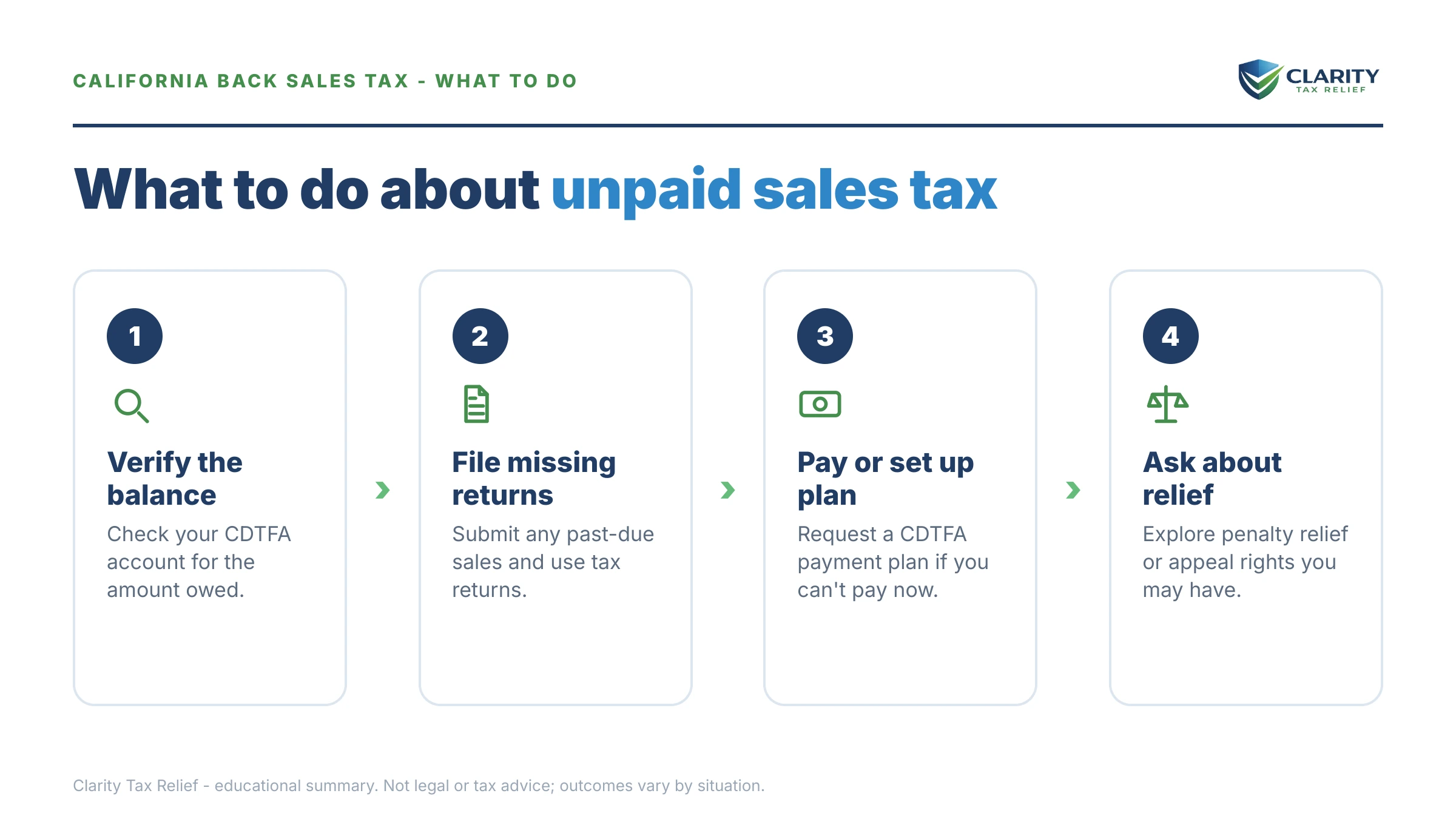
Every CDTFA back sales tax case resolves through one of five paths: full payment, a payment plan, a redetermination petition, an Offer in Compromise, or penalty relief — usually in combination with filing the missing returns first. Filing first isn't optional housekeeping: real returns replace the CDTFA's inflated estimates, and no plan or offer moves forward while periods are missing.
| Option | Best for | The catch |
|---|---|---|
| Pay in full | You can raise the money within weeks | Stops the bleeding fastest; ask about penalty relief afterward |
| CDTFA payment plan | Steady income and a balance you can retire in monthly payments | Interest keeps accruing; new returns must stay current or the plan defaults |
| Petition for redetermination | You disagree with an assessed amount and are inside the 30-day window | The deadline is strict — the assessment becomes final once it passes |
| CDTFA Offer in Compromise | The business is closed or the debt genuinely exceeds what you could ever pay | Means-tested and documentation-heavy; no formula, no guaranteed outcome |
| Penalty relief (reasonable cause) | A real, documentable reason returns or payments were late | Removes penalties only — the tax and interest remain |
| Hardship deferral | No current ability to pay anything | Collection may pause, but the debt and interest continue and the CDTFA revisits your finances |
Which combination is realistic depends heavily on the size of the balance:
| Balance owed to the CDTFA | Realistic options | What to watch |
|---|---|---|
| Under $5,000 | File the missing returns, pay in full or set up a short online plan | Usually DIY territory if the periods are undisputed |
| $5,000–$25,000 | Payment plan; petition anything estimated; request penalty relief | Estimated assessments inflate this band — file real returns before agreeing to any number |
| $25,000–$100,000 | Financial-statement payment plan; OIC if the business closed and assets are gone | Lien filing becomes likely; entity owners need a personal-liability review |
| Over $100,000 | Assigned collector, negotiated plan, professional representation | Levy and dual-determination exposure — get representation before your first interview |
Owe the IRS or the FTB at the same time? Sequencing matters — our guide to state tax debt vs IRS covers which creditor to stabilize first, and California tax debt relief covers the full menu across all three California agencies.
What $7,400 in back sales tax actually looks like
Say you're a gig worker who also sold custom phone accessories directly — your own site, swap meets, cash — for three years without a permit: roughly $30,000 a year in taxable sales at a combined 8.25% rate. That's about $2,475 per year, or roughly $7,400 in tax across the three years.
Add the 10% penalty (about $740) plus monthly interest on each period, and the bill lands somewhere north of $8,500 by the time it's assessed. On a 12-month CDTFA plan, that's roughly $700–$750 a month while interest continues — a longer term with a financial statement could cut the monthly figure meaningfully.
Now the counterfactual: if you never file and the CDTFA estimates from your bank deposits, your gig income can get swept into the "taxable sales" estimate. A $7,400 real liability can be billed as $20,000 or more. Filing accurate returns — even late, even without payment — is the single highest-value move in this scenario.
How to respond to California back sales tax, step by step
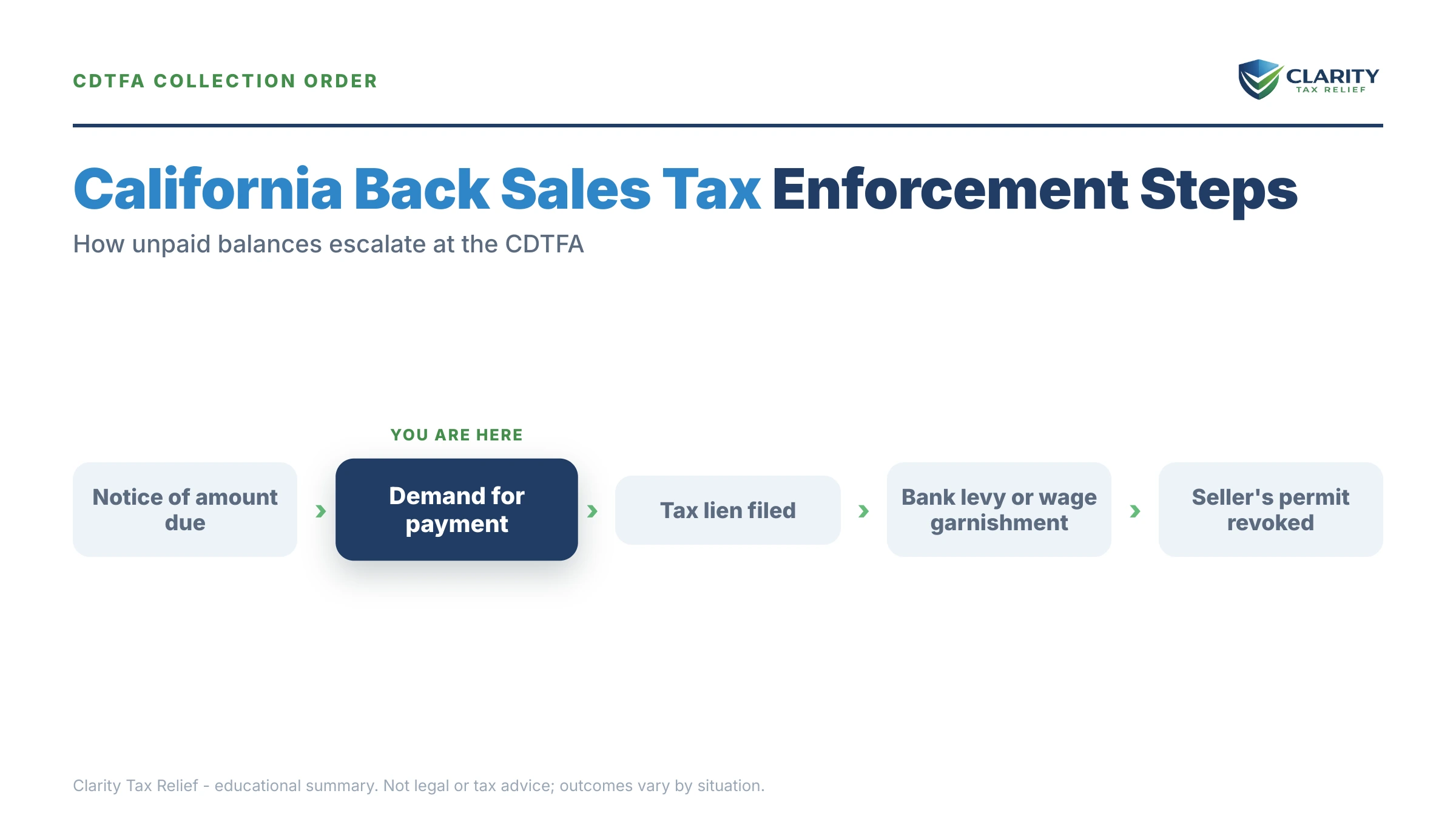
- Pull your CDTFA account records. Gather every notice you've received, log into your CDTFA online account if you have a permit, and list each unfiled period and each billed amount before you talk to anyone.
- File every missing sales tax return. Real returns based on your actual sales replace the CDTFA's estimates, which are almost always higher than what you truly owe.
- Dispute anything wrong within 30 days. If you hold a Notice of Determination you disagree with, file a petition for redetermination before the 30-day window closes — the assessment becomes final and collectible after that.
- Set up a payment arrangement you can keep. Pay in full if you can; otherwise request a CDTFA payment plan or, if your finances genuinely cannot cover the debt, ask about the CDTFA's Offer in Compromise program.
- Get experienced help if the stakes are high. A closed business, a levy in motion, personal-liability exposure, or a five-figure estimated assessment are all situations where experienced tax professionals change outcomes.
When you can handle this yourself
You can resolve a small, undisputed CDTFA balance yourself — filing the missing returns and setting up a plan online often takes an afternoon. If your records are clean, the total is under about $5,000, and no Notice of Determination is in play, DIY is the honest answer. Register for the permit, file the periods, pick a payment arrangement, and keep every confirmation.
Experienced help changes outcomes in four situations. An estimated assessment you disagree with — the 30-day petition is a formal process, and the difference between the CDTFA's estimate and your real number can be five figures. A closed business with trailing sales tax, where dual-determination exposure means the way you answer CDTFA questions determines whether the debt becomes personally yours. A levy or garnishment already in motion, where release negotiations are time-sensitive. And combined-agency debt — if the same three unfiled years created CDTFA, FTB, and IRS balances (and, if you had helpers, possibly California EDD payroll tax exposure), the resolution order across agencies is strategy, not paperwork.
Selling into other states too? California is often just the largest of several exposures, and every state runs its own registration and collection rules.
Terms on your CDTFA notice, decoded
- Seller's permit — the CDTFA registration every California seller of taxable goods must hold, from the first sale, even for a side business.
- Notice of Determination — the CDTFA's formal assessment of tax it says you owe; the document that starts your 30-day appeal window.
- Petition for redetermination — the written appeal that disputes a Notice of Determination before it becomes final.
- District tax — the local add-on rates that stack on the 7.25% statewide base, which is why your combined rate depends on where each sale occurred.
- Use tax — the mirror-image tax on taxable items you bought without paying California sales tax, such as out-of-state inventory or equipment.
- Dual determination — a personal assessment against the individuals who controlled a business's finances when an entity closes owing sales tax.
California back sales tax questions, answered
How far back can the CDTFA go for unfiled sales tax returns?
The CDTFA generally has three years to assess additional tax on a filed sales tax return, but that window stretches to eight years for periods where no return was filed. If you never registered for a seller's permit, every unfiled quarter inside that eight-year window is in play. Once an assessment becomes final, collection can continue for years through liens, levies, and garnishments — waiting does not make the debt expire quickly.
Do I still owe sales tax if I never collected it from my customers?
Yes. California law makes the seller liable for sales tax on taxable sales, whether or not you added it to the customer's price. If you sold $30,000 of taxable goods and never charged tax, the CDTFA treats that tax as owed out of your own pocket. The one silver lining: sellers who never separately collected tax generally avoid the harsher penalty reserved for those who collected tax from customers and kept it.
Can the CDTFA hold me personally liable for my LLC's sales tax?
It can, in specific situations. When a corporation or LLC closes or stops operating with unpaid sales tax, the CDTFA can issue a dual determination under Revenue and Taxation Code section 6829 against the people who controlled the money and willfully failed to pay — owners, officers, and sometimes managers. Sole proprietors and most gig sellers are personally liable automatically, because there is no entity standing between them and the debt.
Does the CDTFA offer payment plans for back sales tax?
Yes. The CDTFA offers installment payment agreements, and smaller balances can often be set up online without submitting detailed financial records. Larger balances or longer terms usually require a financial statement showing what you can realistically pay each month. Interest continues to accrue during the plan, and you must stay current on new returns — one missed filing can default the agreement.
Can I settle California back sales tax for less than I owe?
Sometimes, through the CDTFA's Offer in Compromise program — but eligibility is means-tested and strict. Offers are most realistic when the business that generated the liability has closed, you no longer have meaningful assets, and your income genuinely cannot cover the debt over time. There is no percentage formula and no guarantee; the CDTFA evaluates what it could realistically collect from you. Treat any promise of a specific settlement figure as a red flag.
Is CDTFA back sales tax the same as FTB back taxes?
No — they are different debts owed to different agencies. The FTB collects California personal and corporate income tax; the CDTFA collects sales and use tax. Each has its own notices, payment plans, penalties, and collection powers, and resolving one does nothing for the other. If you owe both, they must be handled separately — and three years of unfiled activity often creates an FTB problem and a CDTFA problem at the same time.
Didn't the marketplace collect sales tax on my online sales?
Since October 2019, California's Marketplace Facilitator Act makes platforms like Amazon, Etsy, and eBay collect and remit sales tax on your marketplace sales — so those periods are usually covered. But sales made before October 2019, and any direct sales through your own website, at fairs, swap meets, or in person, remain your responsibility. Mixed sellers often owe back sales tax only on the direct-sales slice of their revenue — which is exactly why filing real returns matters.
Your next 24 hours
- Find the controlling dates and amounts. Pull every CDTFA letter you have and note the notice date on any Notice of Determination — the 30-day petition window runs from that date, not from when you opened it.
- Gather your sales records. Bank statements, 1099-Ks, platform sales reports, and receipts for the unfiled years — these are what turn an inflated estimate into your real number.
- Get a free case review. Interest is compounding on every unfiled period whether or not a notice has arrived. Call (888) 825-7779 or use the 2-minute form and an experienced tax professional will map your CDTFA exposure and your options — free, confidential, no pressure.
Primary sources: the California Department of Tax and Fee Administration handles registration, returns, payment plans, and appeals for sales and use tax; California income tax matters run through the Franchise Tax Board.
This guide is general information, not tax or legal advice for your specific situation. Eligibility for IRS programs depends on individual facts and circumstances; no outcome is guaranteed.