
State Tax Debt
Does a Closed Business Owe Sales Tax? Why the Debt Follows You Personally (2026)
Does a closed business owe sales tax? Yes — closing or dissolving does not erase it. Sales tax is money you collected from customers in trust, so most states can assess the unpaid balance against you personally, even after the LLC is gone. Filing actual returns to replace inflated estimated assessments usually shrinks the debt fastest.
The permit's been surrendered, the LLC is dissolved, and you're back to earning your living on 1099s — yet a state envelope just told you the sales tax from that business is now your problem. Being billed for a company that no longer exists feels backwards. It isn't, and once you see why, the path out is surprisingly mechanical.
This guide covers why the debt survived the closure, how to find out what the number is really made of — states routinely bill closed businesses for far more than was ever collected — and every path to resolve it. If a personal-liability assessment has already arrived, the image below shows what these state notices typically look like and where to find the date that controls your response rights.
⏱ Your deadline: the response or appeal date printed on any personal-liability assessment or notice of determination you've received — miss it and the debt generally becomes final against you personally. No notice yet? The clock still runs: interest accrues monthly, and every unfiled period keeps generating new estimated assessments.
Why you still owe sales tax after the business closed
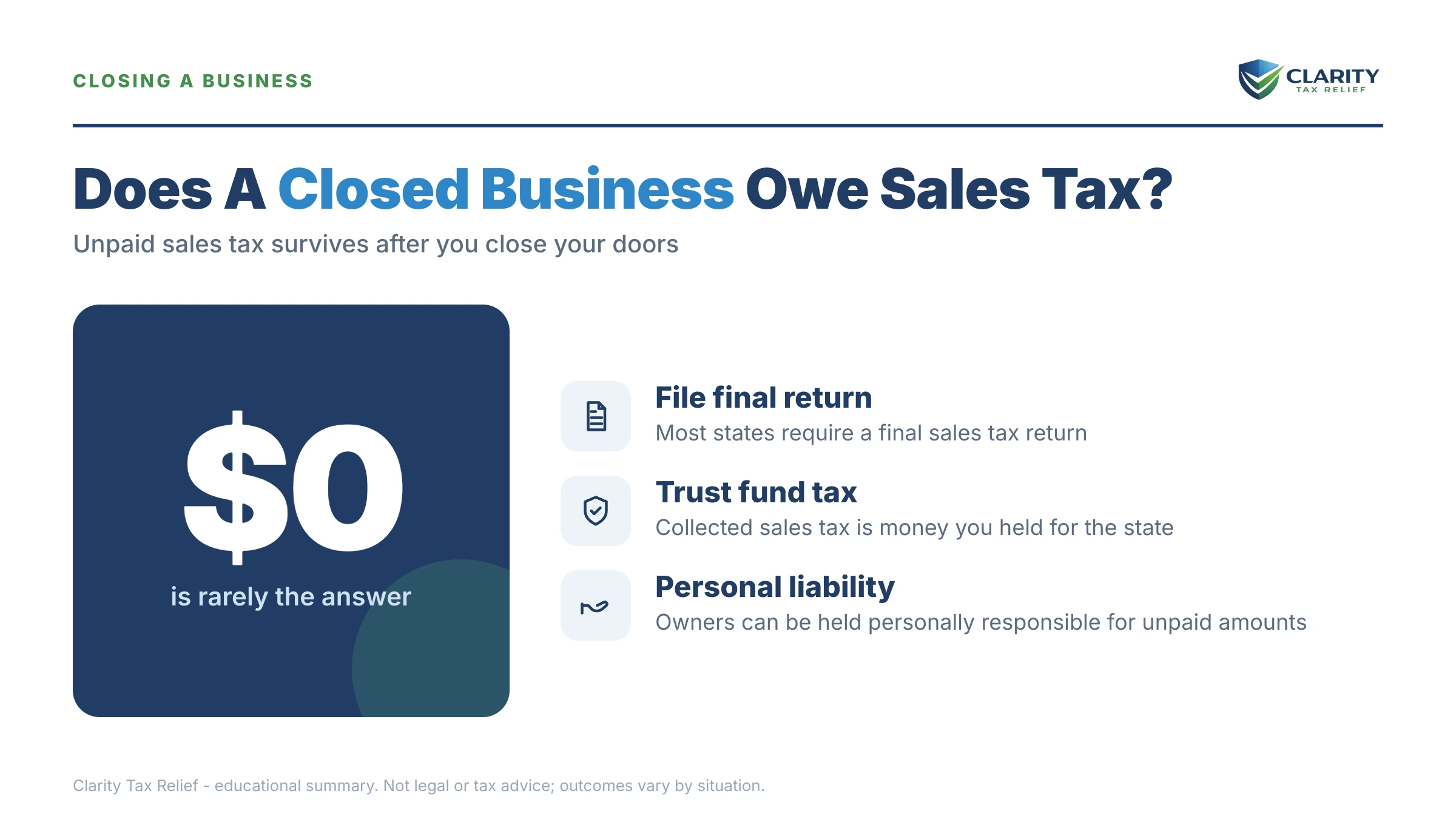
Sales tax is a trust-fund tax — your customers paid it to you, you held it for the state, and closing the business never changed who that money belonged to. That single fact drives everything else on this page.
A closed-business sales tax bill usually contains two very different kinds of debt. The first is collected-but-unremitted tax — trust-fund money the state treats as its own from the moment a customer handed it over. The second is the business's own obligations: penalties, interest, and use tax on things the business bought.
For the trust-fund portion, the LLC or corporate shield generally does not apply. Nearly every state can assess that money against "responsible persons" — owners, officers, and anyone with real authority over the checkbook: who signed checks, who filed the returns, who decided which bills got paid when cash was tight.
Worse, the account may still be alive. If you never filed a final return and cancelled the permit, most states treat the business as operating and keep issuing estimated bills every period — the balance grows even though you haven't sold a thing. State sales tax collections run on their own track; this page stays on what changes once the business is closed.
If the business also fell behind on 941 deposits, the federal side runs on a parallel track with its own personal-liability rules — see payroll tax debt business closed for that sequence.
Break down the balance before you pay a dollar of it
Most closed-business sales tax bills contain three layers — actual collected tax, penalties and interest, and estimated assessments for periods that were never filed — and only the first layer is fixed. The other two can often be reduced dramatically, on paper, before any negotiation happens.
Estimated assessments are the big one. When a registered business stops filing, states don't wait — they generate placeholder returns, usually built from your best prior quarters or industry averages, and deliberately skewed high so you'll be motivated to correct them. Filing the actual returns replaces the estimate, period by period — no hardship application, no settlement request, just paper.
A worked example (hypothetical). Say you closed your flooring-supply LLC in mid-2024 and now work as a 1099 installer. The state's bill is $54,600: eight unfiled quarters, estimated at $6,825 each (8 × $6,825 = $54,600), based on your busiest pre-closure quarter. Your bank records show you actually collected about $2,475 in sales tax per quarter in that stretch — $19,800 total (8 × $2,475). Filing eight actual returns replaces the $54,600 estimate with $19,800 in real tax, plus late-filing and late-payment penalties and interest — in many states landing somewhere in the high $20,000s (exact penalty rates vary by state). Still serious money. But it's roughly half the original bill, it's now a number a payment plan can handle on contractor income, and every dollar of the reduction came from filing, not negotiating.
How long does a closed business owe sales tax?
There is no universal expiration date on state sales tax debt — each state sets its own collection statute, and many run far longer than the federal 10-year rule. The IRS's 10-year collection statute (CSED) applies only to the IRS, not to states, so don't build a wait-it-out plan on it.
State liens and warrants are typically renewable, and in New York a tax warrant is docketed as a civil judgment — a public record that follows you. If your state's collection window matters to your strategy, get the figure from the state agency itself rather than a forum; the numbers vary widely and change.
Who the state can pursue — and the edge cases that change the answer
States can usually collect trust-fund sales tax from any responsible person, in full, without splitting it among the people involved. That creates several edge cases worth naming:
- Co-owners: liability is typically joint and several — the state can collect 100% from whichever former owner is easiest to find, and leave you to sort out contribution privately.
- Married: the assessment attaches to the responsible person, not the household — but a joint bank account can be levied for one spouse's assessed debt, and a spouse who signed returns or checks can be assessed too.
- You sold rather than closed: you remain liable for tax accrued during your ownership, and the buyer may face successor liability if no clearance certificate was obtained. Selling the business is not selling the debt.
- Online or multistate sellers: closing in your home state doesn't touch registrations or exposure in other states, where economic-nexus rules can leave obligations open.
- Restaurants and cash-heavy retail: these accounts often carry payroll and sales tax debt together, and states audit them differently; if federal payroll deposits slipped too, see payroll tax debt after a business closed.
- Managers and bookkeepers: non-owners are assessed less often, but control over the money — not the title on the org chart — is what states test.
What happens if you ignore closed-business sales tax debt
State sales tax collection is typically faster and blunter than IRS collection — states have fewer taxpayers to chase, and trust-fund debt sits at the top of their enforcement list. The sequence generally runs like this:
- Billing and demand notices — mailed to the business's last known address, which is often a storefront or registered agent you no longer check. Silence here reads as refusal.
- Estimated assessments stack up — every unfiled period gets a new, inflated placeholder bill while the account stays open.
- Personal-liability assessment — the state formally moves the trust-fund portion onto you (and any co-owners), with a response window printed on the notice. This is the single most important document in the whole sequence.
- Lien or tax warrant recorded — a public claim against everything you own. In New York this is a docketed civil judgment; see NYS tax warrant.
- Levies begin — bank accounts, state refund intercepts, and levies sent to the companies that pay you, including your 1099 clients. For a contractor, a levy letter landing on a client's desk can cost the relationship, not just the check.
- License holds and outside collectors — some states suspend professional or contractor licenses, publish delinquent-taxpayer lists, or hand the account to collection firms or the attorney general.
Two things make this sequence unforgiving: it's automated, and it doesn't care that the business is gone. The debt attached to you the day the state decided you were a responsible person.
Being billed personally for a business that's gone?
Get your closed-business sales tax assessment reviewed free — before the response date printed on it passes and the debt becomes final against you. An experienced tax professional will map which periods are inflated estimates, whether the personal assessment is contestable, and what resolving it should actually take on your current income.
Your options for resolving closed-business sales tax debt
Every state offers more paths than its notices advertise, and closed-business debt has one advantage: with no ongoing operations, there are no new liabilities piling up behind you once the account is closed. The general mechanics of negotiating with a tax agency — financial disclosure, hardship math, settlement offers — are covered in how to settle tax debt yourself; here's how each option applies to this specific situation.
| Option | Best for | Eligibility reality |
|---|---|---|
| File actual returns to replace estimates | Anyone with estimated assessments on the account | Always available — you need sales records, POS reports, or bank statements to support the figures |
| Pay in full | Balances you can clear without hardship | Stops penalty growth immediately; ask about a penalty waiver before you pay |
| State payment plan | Most closed-business balances | Nearly every state offers one; terms, down payments, and balance caps vary by state |
| Penalty waiver / abatement | First-time slips or documented reasonable cause | Discretionary in most states; interest usually cannot be waived |
| Hardship / deferred collection | No current ability to pay anything | Requires full financial disclosure; interest keeps accruing while collection pauses |
| Settlement (state OIC-style program) | Genuine long-term inability to ever pay in full | Applied most strictly to trust-fund tax; assets and income are examined closely |
| Appeal the personal-liability assessment | You weren't a responsible person, or the amount is wrong | Available only within the window printed on the assessment notice |
What each path costs and how long it takes varies by state, but the shape is consistent:
| Option | Typical out-of-pocket cost | Typical timeline |
|---|---|---|
| File actual returns | Preparation only (DIY or preparer fees) | Weeks for the state to process and rebill |
| Payment plan | Small or no setup fee in most states; interest continues | Often set up in days to weeks |
| Penalty waiver | Free to request | Weeks to a few months |
| Hardship status | Free to request; financial disclosure required | Weeks to months; reviewed periodically |
| Settlement program | Application fee and/or deposit in some states | Several months to a year or more |
| Appeal | Free to file; representation optional | Months, depending on the state's appeals docket |
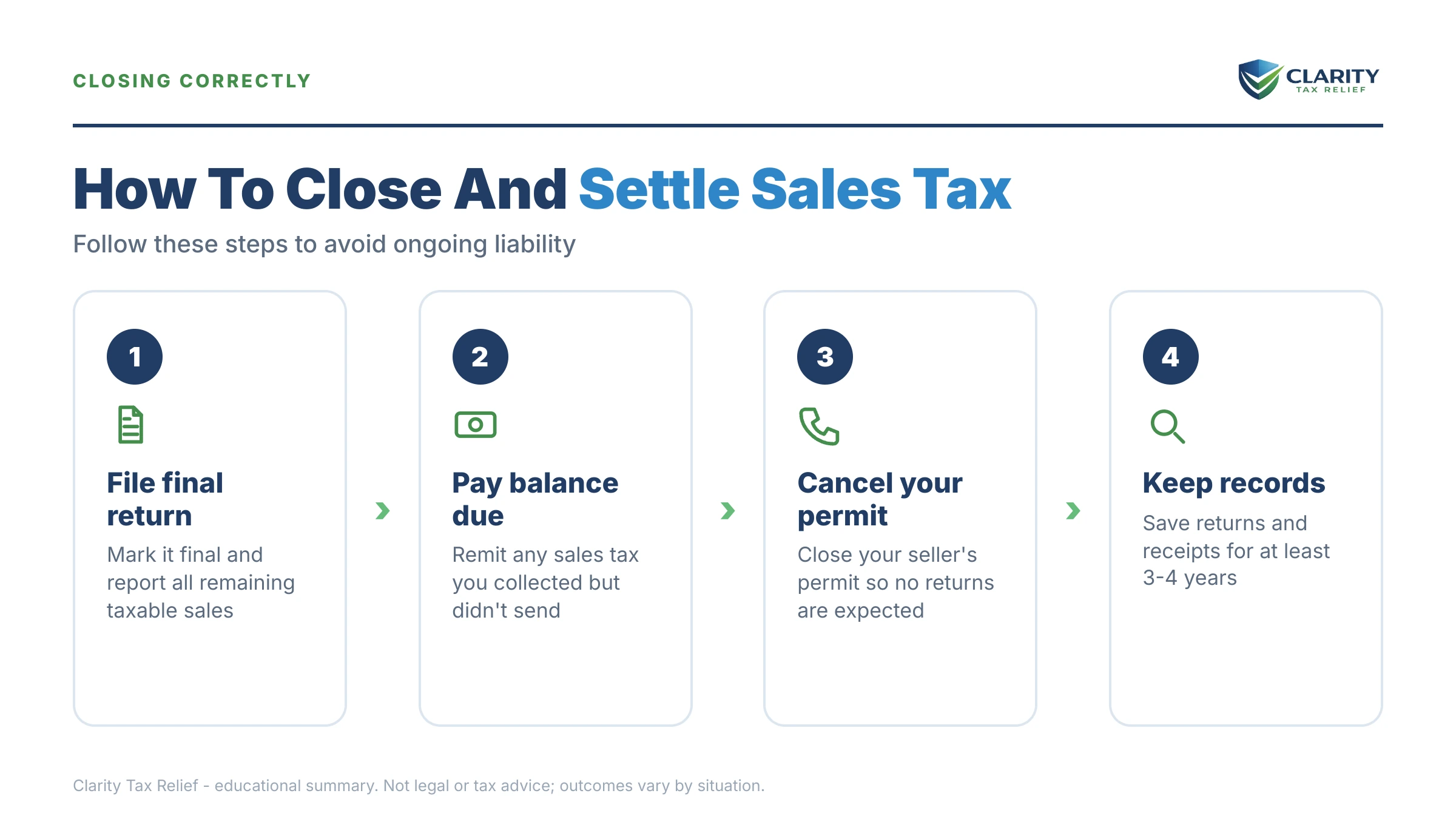
One sequencing rule matters more than any single option: file first, resolve second. A payment plan or settlement built on inflated estimated assessments locks in a number that was never real.
How to respond to closed-business sales tax debt, step by step
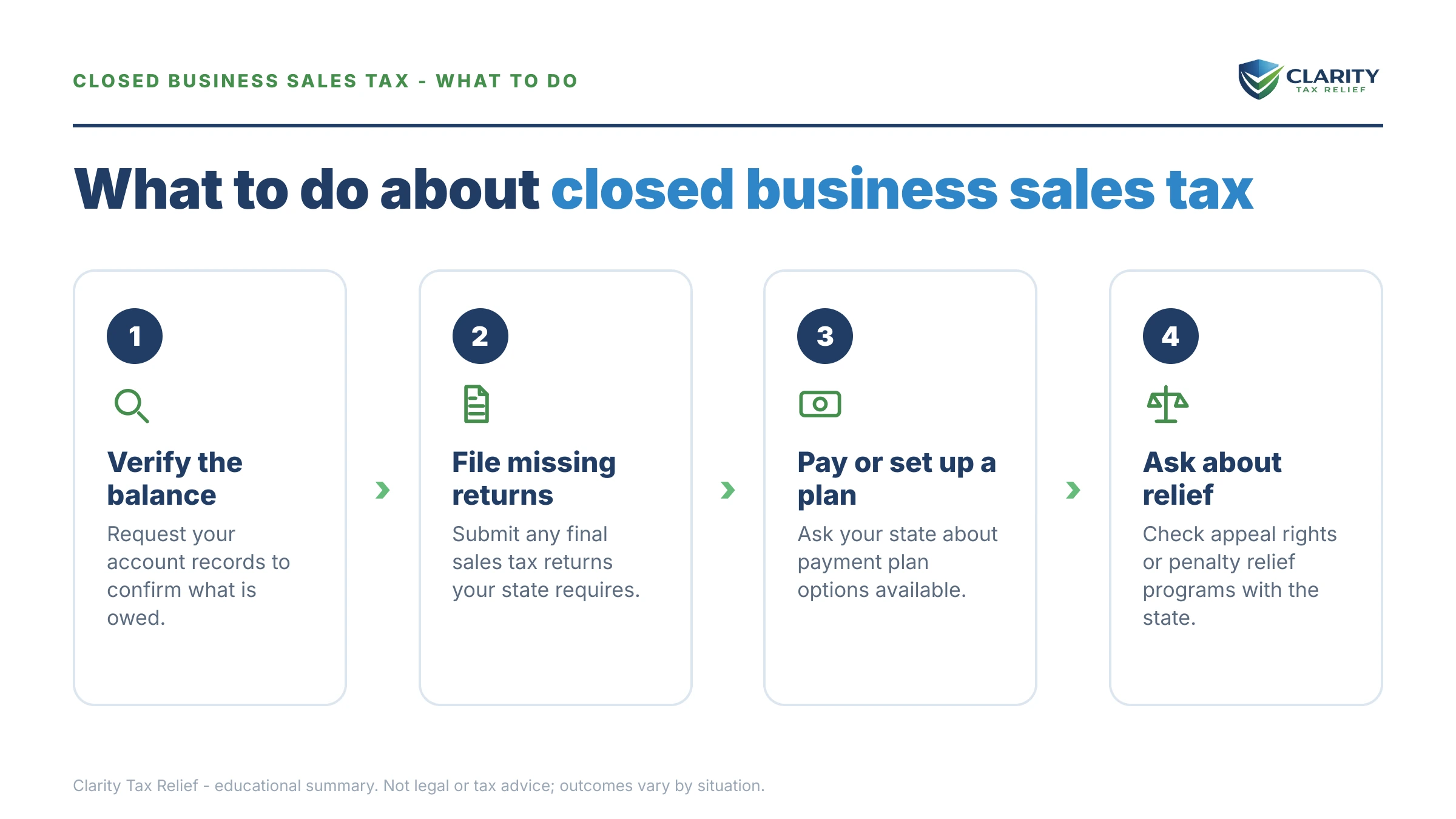
- Request your account statement. Contact your state's sales tax agency (or log into its online portal) and get a period-by-period breakdown of tax, penalties, interest, and which periods are estimated rather than filed.
- File actual returns for every open period. Replace estimated assessments with real figures from your sales records, point-of-sale reports, or bank statements — this is usually the largest single reduction available, with no negotiation required.
- File the final return and close the permit. Until the account is formally closed, many states keep generating a new estimated assessment every filing period — even with zero sales.
- Respond to any personal-liability assessment by its printed deadline. The response or appeal window printed on that notice is your one clean chance to contest whether you were a responsible person and whether the amount is right.
- Set up a resolution that fits your finances now. A state payment plan, hardship deferral, or settlement application should be built on your current 1099 income — not what the business used to make.
- Bring in experienced help if enforcement has started. A recorded lien or warrant, a bank levy, or a levy aimed at your contractor pay changes the order of operations — get the enforcement addressed first, then resolve the balance.
Which agency is actually collecting from you?
Sales tax is never an IRS debt — a different agency, with its own rules, plans, and timelines, holds your account, and applying IRS thresholds to it is a common and costly mistake. Here's who runs sales tax in some of the biggest states:
| State | Agency | What to know |
|---|---|---|
| California | California Department of Tax and Fee Administration | Separate from the FTB; runs its own installment program — see CDTFA payment plan |
| New York | Department of Taxation and Finance | Enforces with tax warrants — public civil judgments against you |
| Texas | Texas Comptroller of Public Accounts | Sales tax is a primary enforcement focus in a no-income-tax state — see Texas Comptroller tax debt |
| Florida | Florida Department of Revenue | Administers state and local sales and use tax; no state income tax to offset attention |
| Washington | Washington State Department of Revenue | Handles sales tax alongside the B&O gross-receipts tax |
If your balance came out of a state exam rather than unfiled returns, the playbook is different — start with our guide to defending a sales tax audit. And if you're closing a business right now and want to limit what follows you, the wind-down order in dissolve business owe irs applies to the state side too: final returns and account closures before articles of dissolution.
When you can handle this yourself — and when help changes the outcome
Plenty of closed-business sales tax cases are genuinely DIY. Handle it yourself when: every period is already filed and you agree with the number; the balance is small enough to pay or put on the state's standard online payment plan; or the only fix needed is filing a final return and closing the permit before estimates pile up. None of that requires paying anyone.
Experienced help earns its cost in a narrower set of situations: a personal-liability assessment naming you (the responsible-person question is fact-driven and winnable, but only inside the appeal window); a levy already aimed at your bank account or 1099 clients; multiple states involved; missing records that force period-by-period reconstruction; or a settlement application, where the financial presentation decides the result. If you're comparing firms for a business-side case, our buyer's guide to tax relief for small business covers what to ask before signing anything.
Terms on your state notice, decoded
- Trust-fund tax: money (like sales tax) you collected from someone else and held for the government — treated as the state's money from the moment you received it.
- Responsible person: anyone the state decides had the duty and authority to collect and remit the tax — ownership isn't required; control over the money is.
- Estimated assessment: a placeholder bill the state creates for a period you didn't file, usually deliberately high, and replaced when you file the actual return.
- Successor liability: a rule letting the state collect a seller's unpaid sales tax from the business's buyer, within limits set by state law.
- Tax warrant: some states' version of a lien — in New York it's docketed as a civil judgment and becomes public record.
- Tax clearance certificate: a state document confirming no sales tax is owed, typically requested when a business is sold or formally dissolved.
Closed-business sales tax FAQs
Do I still owe sales tax after closing my business?
Yes — closing the doors or dissolving the entity does not cancel sales tax that was collected or assessed. In fact, if you never filed a final return and cancelled the permit, most states keep the account open and keep issuing estimated bills as if you were still operating. Filing actual returns for every open period is the fastest first move.
Can the state come after me personally for my LLC's sales tax?
In nearly every state, yes. Sales tax you collected from customers is trust-fund money, and states can assess the collected-but-unremitted portion against responsible persons — owners, officers, and anyone who controlled which bills got paid. The liability shield that protects LLC owners from business lawsuits generally does not protect against trust-fund taxes.
Does dissolving the LLC or corporation erase the sales tax debt?
No. Dissolution ends the entity, not the tax — the state can still assess the trust-fund portion against the people who ran the business. Several states also expect tax clearance before or alongside formal dissolution; dissolving without closing the sales tax account can leave it open and generating new estimated assessments.
Can closed-business sales tax debt be discharged in bankruptcy?
The collected trust-fund portion generally cannot be discharged — courts treat money collected from customers as a priority debt that survives bankruptcy. Penalties, and tax the business owed on its own purchases, are sometimes treated differently depending on timing and chapter. Talk to a bankruptcy attorney before assuming any of it will go away.
What if the state's balance is an estimate and way too high?
File actual returns for every estimated period — replacing inflated placeholder assessments with real figures is usually the single largest reduction available, and it requires no negotiation. You'll need sales records, point-of-sale reports, or bank statements to support your numbers, because states can examine the returns you file.
Can the state garnish my 1099 income for old business sales tax?
Once the debt is assessed against you personally, yes. States can levy bank accounts, intercept state refunds, and send levies to companies that pay you — including 1099 clients — and some can hold professional or contractor licenses. Entering a payment arrangement typically stops new enforcement while you stay current on it.
Will the state settle sales tax debt for less than I owe?
Many states run settlement programs similar to the IRS Offer in Compromise, but they apply them strictly to trust-fund sales tax because the money was collected from customers. You may qualify if your assets and income genuinely cannot cover the balance, and the state verifies that with full financial disclosure. No settlement outcome is ever guaranteed.
What if I sold the business instead of closing it?
You generally remain liable for sales tax accrued during your ownership — selling doesn't transfer the debt away. The buyer can also be pulled in under successor liability if they didn't obtain a tax clearance certificate before the purchase, which is why states often hold part of the sale price. Which of you the state pursues first depends on state law and who is easier to collect from.
Your next 24 hours
- Find the response date. Pull the newest state notice and locate the printed response or appeal date, plus the list of periods being billed — that date controls your rights, and the period list tells you what's estimated.
- Gather your paper. Sales records or bank statements for the open periods, any sales tax returns you did file, your permit number, and the dissolution or closure paperwork.
- Get the assessment reviewed free. Call (888) 825-7779 or use the 2-minute form at the top of this page — an experienced tax professional will map which periods are inflated estimates, whether the personal assessment is contestable, and which resolution fits your 1099 income now. Interest accrues monthly until the account is addressed, so today's review beats next month's.
This guide is general information, not tax or legal advice for your specific situation. Eligibility for IRS programs depends on individual facts and circumstances; no outcome is guaranteed. State tax programs, statutes, and deadlines vary — confirm specifics with your state's tax agency.