
State Tax Audits
Sales Tax Audit: How to Defend a State Sales Tax Exam (2026)
The short answer: a sales tax audit is a state tax agency's exam of whether your business charged, collected, and paid over the right sales tax — usually across a three-to-four-year lookback. Respond by the date on the audit letter, challenge any extrapolated findings before assessment, and appeal within the window printed on the determination.
You ran the shop for years, sold off the fixtures, and settled into retirement on Social Security — and now a state auditor wants three years of sales records for a business that no longer exists. A sales tax audit doesn't care that you've closed the doors. It's routine, it's paperwork-driven, and it's very winnable if you engage early.
Here's what makes this exam different from anything the IRS sends: the auditor isn't just checking your math. They're testing whether the tax you collected from customers actually reached the state — and if records are thin, they'll estimate your sales and bill you on the estimate. The image below shows exactly what a state sales tax audit notice looks like and where to look for the two items that control everything: the audit period and your response date.
⏱ Your deadlines are printed on your letters. The audit engagement letter sets your response date, and once the state issues its assessment — often called a Notice of Determination — the appeal window printed on it is strict and typically short (commonly 30 to 60 days, depending on the state). Interest accrues on any assessed balance the entire time.
Why you got picked for a sales tax audit
States select sales tax audits by data-matching your reported sales against 1099-K totals, federal gross receipts, and industry ratios — and closing a business is itself one of the most common audit triggers. When you cancel a seller's permit, many states run a closeout review before the entity disappears.
The most common selection reasons:
- Closeout audits. You closed, sold, or retired from the business. The state wants a final reconciliation while records — and people — can still be found.
- Third-party mismatches. Your 1099-K card-processing totals or the gross receipts on your federal return exceed the sales reported on your sales tax returns. Computers flag this automatically.
- Exempt-sale ratios. You claimed a high percentage of nontaxable sales (resale, out-of-state, exempt organizations) compared with others in your industry.
- Cash-heavy industries. Restaurants, bars, salons, convenience stores, used-car lots, and contractors get audited at higher rates because cash sales are easy to underreport — the same logic behind a cash business audit at the federal level.
- Economic nexus. Online sellers get flagged when marketplace or shipping data shows sales into states where they never registered — the core problem covered in our guide to sales tax nexus back taxes.
- Referrals from other audits. State agencies share findings. In California, a CDTFA sales tax audit can cross-refer issues to the FTB or trigger an EDD audit of your payroll practices, and vice versa.
Being selected is not an accusation. But the burden in a sales tax audit runs against you: the state's numbers stand unless your records rebut them.
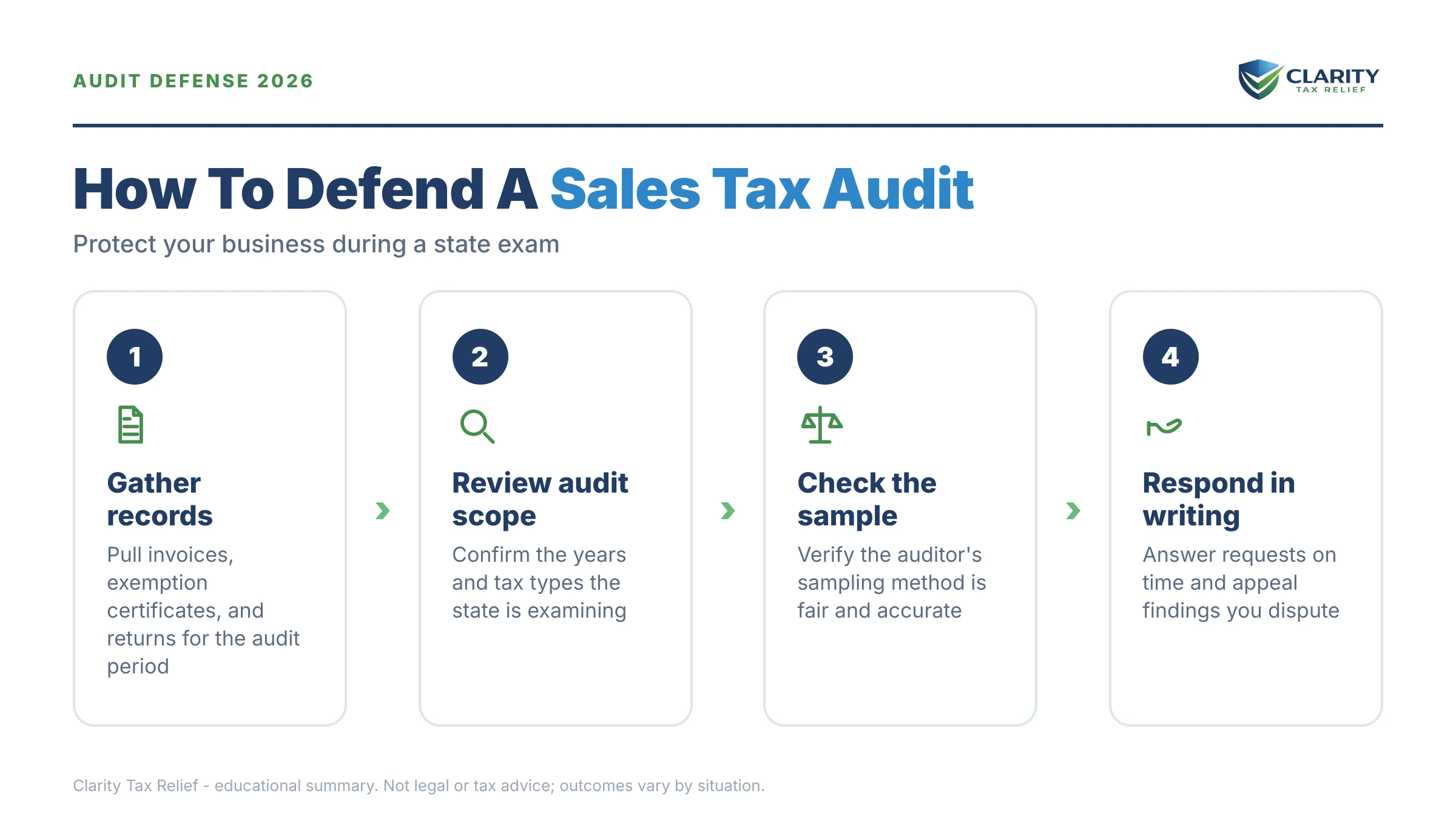
What a state sales tax audit actually tests
A sales tax auditor rarely reads every receipt — they test a sample period with indirect methods and project the result across the whole audit. That projection is the entire game: an error found in one sample quarter is multiplied across every quarter in the audit period.
The auditor is checking three things: whether all taxable sales were reported, whether claimed exempt sales are backed by valid certificates, and whether you paid use tax on items you bought tax-free but consumed yourself (supplies, equipment, inventory withdrawn for personal use).
| Audit method | What the auditor does | How to challenge it |
|---|---|---|
| Records reconciliation | Compares sales tax returns to federal returns, POS reports, and bank deposits | Explain legitimate gaps: sales tax included in deposits, loans, transfers, refunds |
| Resale & exemption certificate review | Demands a valid certificate for every nontaxable sale claimed | Collect missing certificates from customers now — many states accept them during the audit |
| Markup (mark-on) analysis | Applies an industry markup to your purchase invoices to estimate what sales "should" have been | Prove your actual markup: clearance sales, spoilage, theft, discounting, product mix |
| Bank deposit analysis | Treats total deposits as sales unless shown otherwise | Document non-sale deposits — transfers, refunds, loans, personal money |
| Observation test | Watches the register for a day or two and projects that volume across years | Show the observed days weren't representative (season, events, weather) |
| Sample-and-extrapolate | Audits a block of months in detail, then multiplies the error rate across the full period | Attack the sample's representativeness — one bad quarter should not define twelve |
Every one of these methods produces an estimate, and estimates carry assumptions you can contest. The businesses that get hurt worst are the ones that let the auditor's assumptions go unchallenged until after the assessment issues.
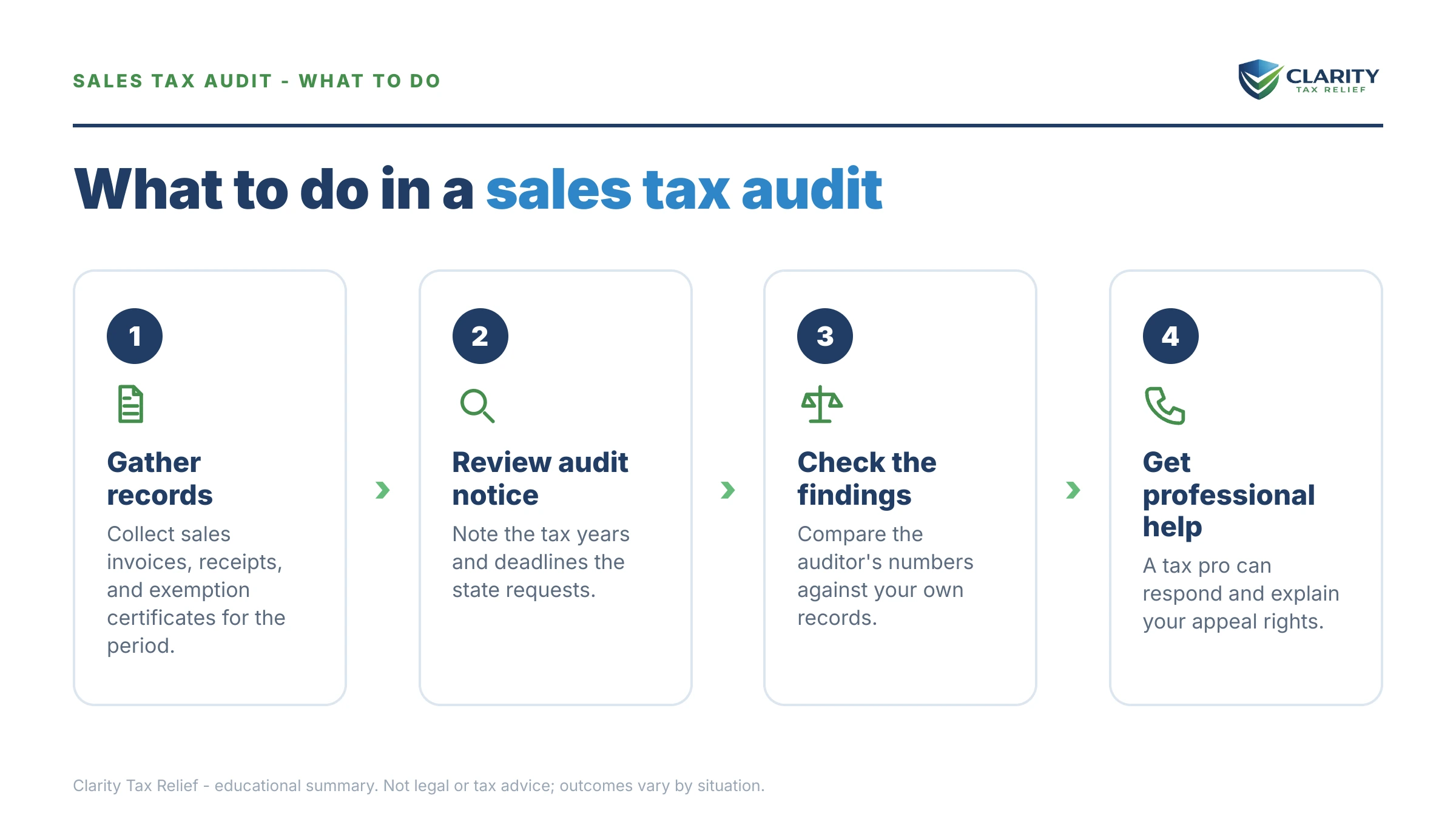
The sales tax audit timeline, from first letter to assessment
A sales tax audit moves through a fixed sequence of documents, and each one narrows your options if you let it pass. The single most important stage is the preliminary findings — the last point where you can change the numbers without a formal appeal.
| Stage | What arrives | Your window |
|---|---|---|
| 1. Engagement letter | Notice of audit, periods under exam, first records request | Response date printed on the letter |
| 2. Records requests | Lists of returns, invoices, certificates, bank statements needed | Deadlines set by the auditor — extensions are usually available if asked early |
| 3. Fieldwork & testing | Sample selection, markup tests, certificate review | Ongoing — this is where method challenges belong |
| 4. Preliminary findings / exit conference | Draft schedules showing proposed additional tax | Short window to rebut in writing before assessment |
| 5. Notice of Determination (or state equivalent) | The formal assessment: tax, penalties, interest | Appeal deadline printed on the notice — commonly 30–60 days by state |
| 6. Final assessment | Balance becomes fixed and collectible | Merits challenge is over; only payment terms remain |
If your audit is in California, the assessment document has its own rules and its own petition process — see our dedicated guide to the CDTFA Notice of Determination.
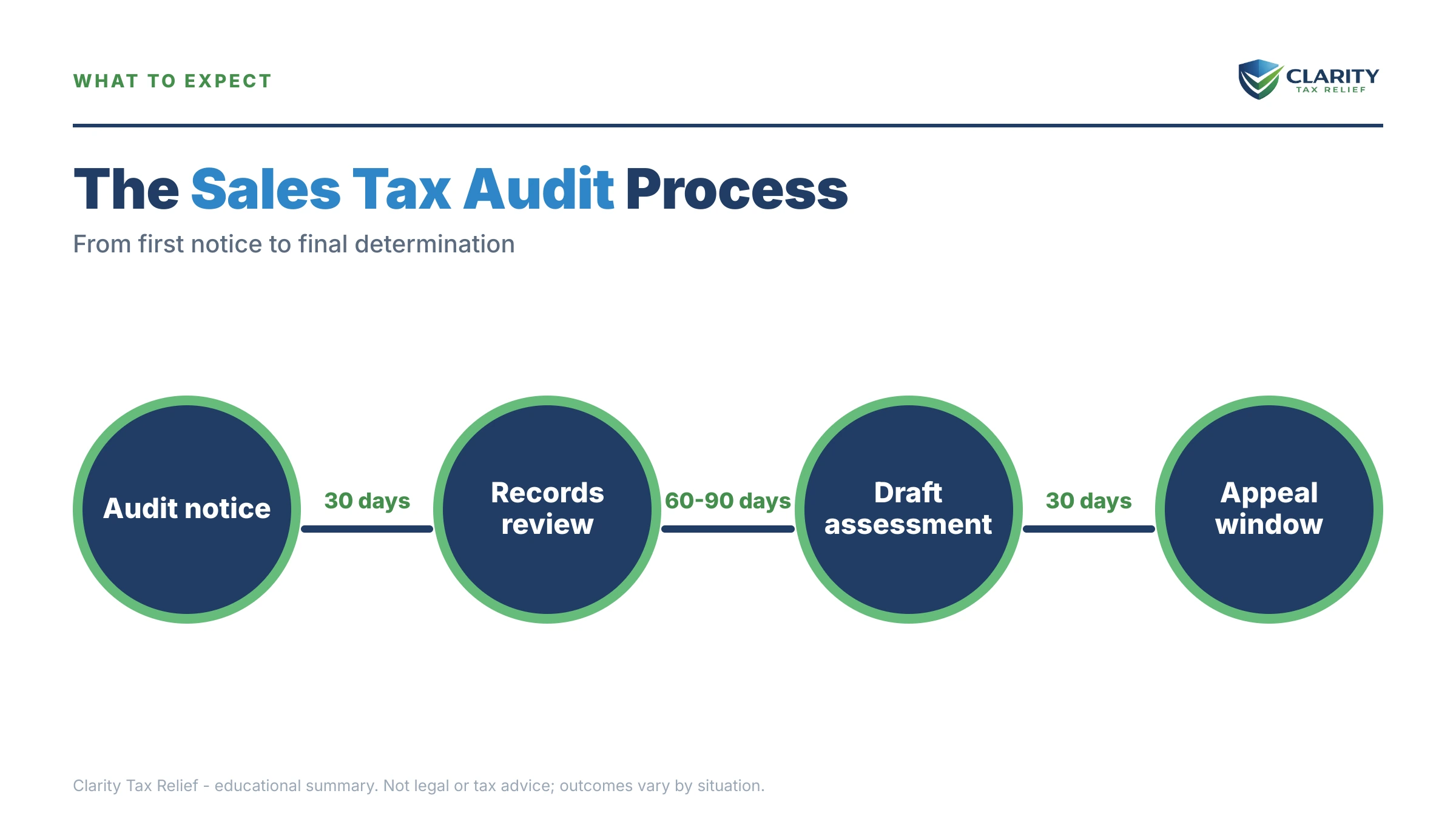
What happens if you ignore a sales tax audit
Ignoring a sales tax audit doesn't stall it — it hands the auditor a blank page to fill with the state's assumptions. Here is the sequence, in order:
- The audit proceeds without you. The auditor estimates your sales from supplier invoices, 1099-K data, and industry ratios — using the state's assumptions, not your records, and estimates run high by design.
- An estimated assessment issues. A Notice of Determination (or your state's equivalent) arrives with additional tax, penalties, and interest attached.
- The appeal window lapses. Once the deadline printed on the determination passes, the assessment becomes final. You can no longer argue the numbers are wrong — even if they provably are.
- Collections begin. States file liens fast, and levy bank accounts and receivables. In New York, the debt becomes a tax warrant — a public civil judgment against you.
- Your seller's permit is at risk. States can revoke the permit of a noncompliant business, and operating without one is illegal — for an active business, this is an existential threat, not a paperwork problem.
- The debt goes personal. Because sales tax was collected from customers in trust, states assess the unremitted portion against owners and officers individually — even after the entity dissolves. If your company is already shut down, read our guide on a closed business that owes sales tax.
Every stage on that list is easier to prevent than to reverse. The cheapest moment in a sales tax audit is right now, while the numbers are still drafts.
Holding a sales tax audit letter right now?
Send us a photo of it before your response date passes. An experienced tax professional will map the audit period, the deadlines, and the method the state is likely to use against your business — free, confidential, no pressure.
Your options after a sales tax audit assessment
An assessment is a proposal with a deadline, not a verdict — every state gives you at least one administrative appeal before the number becomes final. But understand the cost of time: most states will not pause interest while an appeal is pending, so a weak appeal filed just to delay can make things worse.
| Option | Best for | What to know |
|---|---|---|
| Agree and pay in full | Small, accurate adjustments you can afford | Stops interest immediately; ask about penalty relief before paying penalties |
| State payment plan | Correct assessments you can't pay at once | Every state offers installment terms; interest continues. California's version is the CDTFA payment plan |
| Petition / administrative appeal | Flawed samples, missing-certificate assessments, wrong methods | Must be filed within the window on the determination; pauses collection on the disputed amount in most states |
| Penalty relief | Reasonable cause: illness, disaster, reliance on bad advice, first slip | State standards vary; requested in writing, usually alongside the appeal |
| State settlement / offer in compromise | Assessments you genuinely cannot pay from income and assets | Means-tested and state-specific; closed businesses and fixed-income individuals are often the strongest candidates |
| Court refund action | Large, well-documented disputes after administrative appeals fail | Some states require paying the assessment first, then suing for refund — get advice before choosing this path |
Which option fits depends on two separate questions: is the number right, and can you pay it? Fight a wrong number through the appeal; resolve a right-but-unpayable number through payment terms, hardship programs, or settlement — the full menu is in our guide to sales tax debt help.
A worked example: fighting a $36,900 sales tax audit assessment
Say you're retired on Social Security and the state audits the gift shop you closed last year, assessing $36,900. Here's how a number like that gets built — and taken apart. This is a hypothetical, not a client case.
The auditor picks one sample quarter. Your purchase invoices show $48,000 in inventory bought for resale. Applying a 100% industry markup, the auditor says you "should" have sold $96,000 that quarter — but you reported $66,000. That's $30,000 of "unreported" taxable sales.
Then comes the extrapolation:
- $30,000 per quarter × 12 quarters in the audit period = $360,000 in projected unreported sales
- $360,000 × 8% tax rate = $28,800 additional tax
- 10% negligence penalty = $2,880
- Accrued interest across the periods ≈ $5,220
- Total assessment: $36,900
Now the defense. Suppose that sample quarter included your retirement clearance sale — weeks of inventory moved at or below cost, nothing like a 100% markup. Suppose $9,000 of the "missing" sales were to a dealer who held a valid resale certificate you can still obtain. Correct the sample, and the per-quarter gap might fall from $30,000 to $8,000.
Rerun the math: $8,000 × 12 quarters = $96,000 × 8% = $7,680 in tax — before you even argue penalties. A reasonable-cause request could address the $2,880 negligence penalty on top. Same audit, same records, roughly a quarter of the bill — because someone challenged the sample instead of the total.
And if the corrected number is still unpayable on a fixed income? Your Social Security benefit itself is generally protected from state tax levies under federal law, but a lien on your home and a levy on your bank account are not abstractions. Hardship-based payment terms or a state settlement program become the realistic endgame — argued from documented income and expenses, not fear.
How to respond to a sales tax audit, step by step
- Verify the notice and calendar the response date. Call the auditor using the number on your state agency's official website — not just the letter — to confirm the audit is real, then write down every date the letter sets.
- Gather your records before the first meeting. Pull sales tax returns, federal returns, purchase invoices, POS or register reports, bank statements, and every resale or exemption certificate for the audit period.
- Control the flow of information. Route all contact through one person (or your representative), answer questions in writing where possible, and never volunteer records or periods the auditor hasn't requested.
- Test the auditor's method, not just the number. Ask how the sample period was chosen and how findings were extrapolated; an unrepresentative sample is the most common flaw in a sales tax assessment.
- Respond to the preliminary findings in writing. Most states share a draft audit schedule before assessing; documented corrections at this stage are far cheaper than a formal appeal.
- Calendar the appeal window on any determination. Once a Notice of Determination (or your state's equivalent) arrives, the appeal deadline printed on it is strict; missing it makes the assessment final.
Sales tax audit vs. IRS audit: why this one is more dangerous
A sales tax audit is more dangerous than a comparable IRS exam because sales tax is trust-fund money — tax you collected from customers on the state's behalf. States treat a shortfall not as underpaid tax but as someone else's money that never arrived, and they collect accordingly: faster liens, permit revocation, and personal liability that pierces the LLC or corporate shield.
Federal audit lookback rules — typically three years, six for large understatements — are covered in our guide to how far back the IRS can audit. Don't assume those windows apply to your state: each state sets its own statutes, and unfiled sales tax periods generally have no lookback limit at all.
One more difference matters. If your registers show tax collected that was never remitted, the audit can carry criminal exposure underneath a civil surface. That's the classic eggshell audit pattern — and it's the one situation where you should have representation before you answer a single question.
When you can handle a sales tax audit yourself
Not every sales tax audit needs professional defense. You can reasonably handle it alone when your records are complete and organized, the audit is a routine closeout or short-period review, the proposed adjustment is small and clearly correct, and there's no gap between tax collected and tax remitted.
Get experienced help before the exit conference when any of these apply:
- The auditor is using a sample-and-extrapolate or markup method. The entire assessment turns on statistical arguments most owners have never made.
- Your business was cash-heavy — bank-deposit and observation methods are aggressive by default, and rebutting them takes reconstruction work.
- You're missing resale or exemption certificates. There are cure procedures, but they're deadline-driven and state-specific.
- The business is closed and the state is coming after you personally. Responsible-person assessments have their own defenses that must be raised early.
- Registers show tax collected that wasn't paid over. This is the fact pattern with criminal exposure underneath — representation first, explanations later.
- You sold into multiple states. One audit can trigger registrations, back filings, and assessments in others.
The honest rule: if the dispute is about documents you have, you can likely handle it. If it's about methods, estimates, or liability theories, experienced defense usually pays for itself many times over.
If your audit involves an extrapolated sample, a closed business, or a five-figure proposed assessment like the $36,900 example above, get your audit workpapers reviewed free or call (888) 825-7779 before the preliminary findings become a determination.
Terms on your audit papers, decoded
- Seller's permit: your state license to collect sales tax — revocable for noncompliance, and canceling it often triggers a closeout audit.
- Markup (mark-on) test: an estimate of your sales built by applying an industry profit margin to your purchase invoices.
- Resale certificate: the document a business customer gives you proving a sale was for resale and therefore nontaxable — no certificate, and the auditor treats the sale as taxable.
- Extrapolation: multiplying the error rate found in a sample period across the entire audit period.
- Notice of Determination: the formal assessment document in many states; the appeal deadline printed on it is the most important date in the whole audit.
- Responsible-person liability: the state's power to assess collected-but-unremitted sales tax against owners, officers, or others who controlled the money — personally, past any LLC or corporate shield.
- Use tax: the tax you owe on items bought tax-free (often under a resale certificate) but consumed by the business instead of resold.
Sales tax audit FAQs
How far back can a state sales tax audit go?
Most states audit three to four years of filed returns, mirroring their assessment statutes. If you never filed sales tax returns or the state suspects fraud, most states can open every unfiled period with no lookback limit. The exact window is set by your state's law, and the audit engagement letter states the periods under exam.
What triggers a sales tax audit?
Common triggers include closing your business or canceling a seller's permit, mismatches between your 1099-K totals or federal gross receipts and your sales tax returns, exempt-sale ratios that look high for your industry, and routine targeting of cash-heavy businesses. Online sellers also get flagged when economic nexus creates filing duties in states where they never registered.
What happens if you fail a sales tax audit?
You receive an assessment — typically the extra tax plus penalties and interest — through a document such as a Notice of Determination. You can appeal within the window printed on the notice; if you don't, the assessment becomes final and moves to collections, which can include liens, bank levies, and seller's-permit revocation. Failing the audit is not the end; missing the appeal deadline is the bigger problem.
Can a sales tax audit lead to criminal charges?
It's uncommon, but yes — because sales tax is money collected from customers, states can treat collecting tax and not remitting it as theft, not just a civil debt. Large gaps between what registers show collected and what was paid over are the classic danger pattern. If your audit has facts you're afraid of, get representation before answering questions, not after.
Am I personally liable for my LLC's or corporation's sales tax?
Often, yes. Most states impose responsible-person liability for collected-but-unremitted sales tax on owners, officers, and sometimes bookkeepers who controlled the money, and the corporate or LLC shield does not block it. That means a sales tax assessment against a closed or insolvent company can follow you personally, including into retirement.
Can the state audit my business after it closes?
Yes — closing is one of the most common audit triggers, because the state wants a final reconciliation before the entity disappears. The assessment can then be converted into a personal liability against the responsible individuals. Keep your sales records for at least the state's statute period after closing, usually three to four years.
What if I don't have records for the audit period?
The auditor will estimate your sales using indirect methods — purchase invoices from your suppliers, bank deposits, industry markup ratios — and those estimates almost always run high. You can fight back by reconstructing records: banks, suppliers, POS providers, and payment processors all keep data you can request. Missing records raise the assessment; they don't excuse the audit.
Can I negotiate a sales tax audit assessment?
Yes, at several stages. You can challenge the auditor's method before the assessment issues, file a petition or appeal after it issues, request penalty relief for reasonable cause, and — in many states — apply for a settlement or offer-in-compromise program if you genuinely can't pay. What you cannot do is negotiate after the appeal window closes; at that point you're limited to payment terms.
How long does a sales tax audit take?
Anywhere from a few months to well over a year, depending on the state's backlog, how complete your records are, and whether findings are disputed. Responding quickly and completely to record requests is the single biggest factor you control. Slow, partial responses stretch audits out and push auditors toward estimates.
Can a state take my Social Security for sales tax debt?
Social Security benefits are generally protected from state tax levies by federal law, so a state cannot garnish your monthly benefit the way the IRS can. However, once benefits sit in a bank account alongside other money, that account can be levied, and states can still file liens and intercept state refunds. If you're retired and facing a sales tax assessment, hardship-based payment terms are usually the realistic path.
Your next 24 hours
- Find two things on your letter: the audit period (which quarters or years are under exam) and the response or appeal date. Those two lines control everything else.
- Gather your paper trail: sales tax returns, federal returns for the same years, purchase invoices, bank statements, POS reports, and every resale or exemption certificate you can locate — even partial records shrink an estimate.
- Get the letter reviewed free before your response date: use the 2-minute form or call (888) 825-7779. Interest accrues on whatever the state ultimately assesses, and the audit's cheapest fixes all happen before the determination issues.
For state-specific rules, start with your agency's official site: the California Department of Tax and Fee Administration, the Texas Comptroller of Public Accounts, or the New York State Department of Taxation and Finance. If your audit crosses into Texas franchise or sales tax collections, see our guide to Texas Comptroller tax debt.
This guide is general information, not tax or legal advice for your specific situation. Eligibility for IRS programs depends on individual facts and circumstances; no outcome is guaranteed.