
State Tax Problems
Sales Tax Nexus Back Taxes: What Online Sellers Owe and How to Fix It (2026)
The short answer: sales tax nexus back taxes are uncollected state sales taxes you owe because your sales or inventory crossed a state's nexus threshold — often without you knowing. States can assess every unfiled period with no time limit, but a voluntary disclosure agreement typically caps the lookback at 3–4 years and waives penalties.
You run a real business — payroll every two weeks, inventory to manage, an online store that finally took off. Then a sales report, or a letter from a revenue department in a state you've never set foot in, told you the uncomfortable truth: you crossed nexus thresholds and you haven't been collecting. This is fixable, and the order you fix it in matters more than the amount.
⏱ The real clock: there is no 21- or 30-day window on this problem — there's something worse. In most states, the statute of limitations never starts running on a period with no filed return, so every unfiled quarter stays collectible indefinitely. And voluntary disclosure — the tool that caps your exposure — is only available before a state contacts you. If a nexus questionnaire is already in your hand, respond by the date printed on it; that door is closing for that state.
Why you owe sales tax nexus back taxes
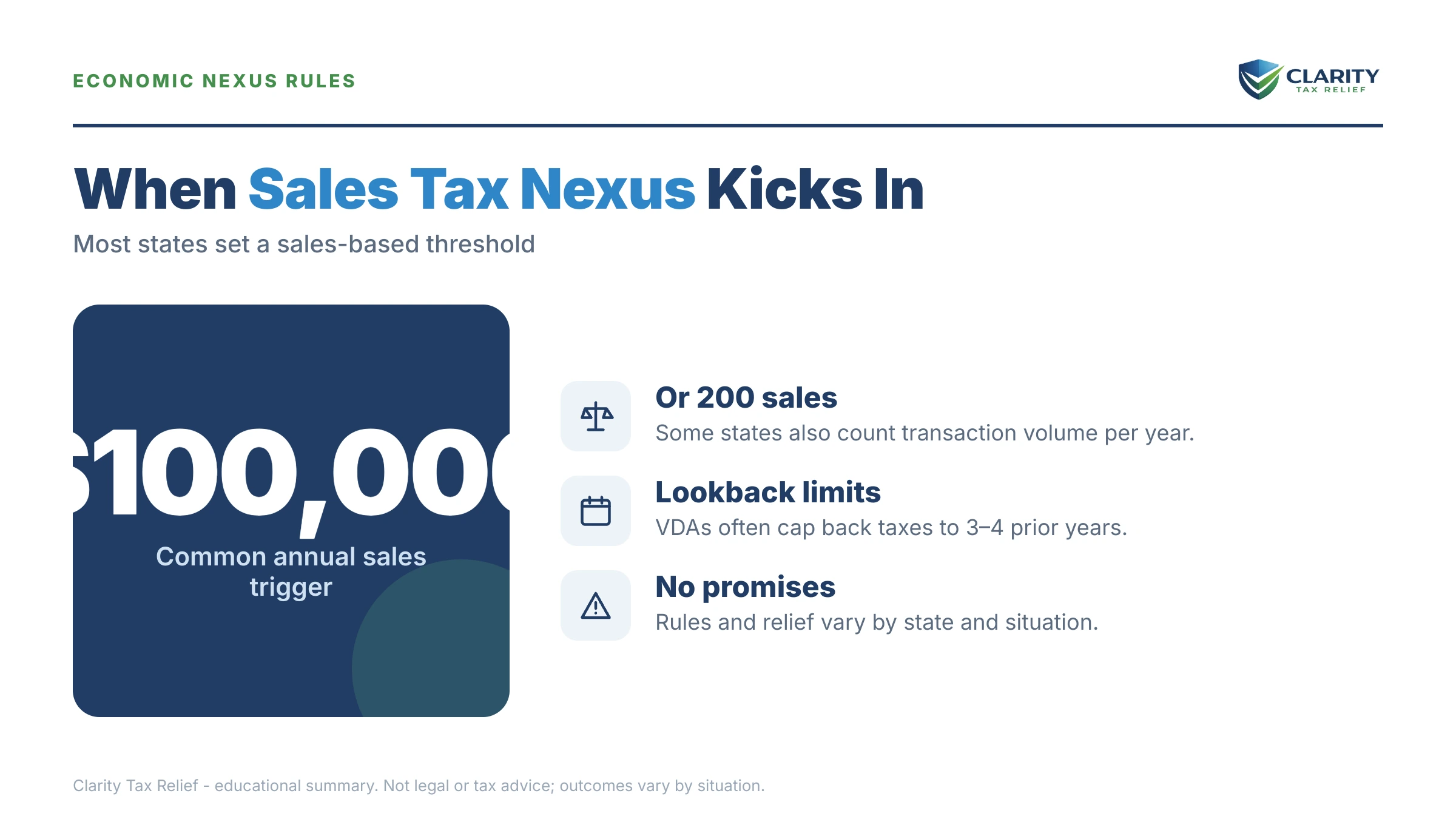
Sales tax nexus back taxes exist because South Dakota v. Wayfair (2018) let every state tax remote sellers who cross an economic threshold — most commonly $100,000 in annual sales into the state. Before Wayfair, states could only make you collect if you had a physical presence. After it, your sales volume alone creates the duty.
Every state with a statewide sales tax now has an economic nexus law. Most set the line at $100,000 per year; a handful of large states use $500,000, and many have repealed the old 200-transaction test. Cross the line, and your obligation to register and collect begins — whether or not you ever noticed.
Economic nexus is only half the trap. Physical nexus never went away: inventory sitting in a third-party warehouse — including Amazon FBA stock the platform moved between states without asking you — creates nexus in that state, usually with no dollar threshold at all. If FBA is part of your history, read our guide to Amazon FBA seller taxes, because your footprint is probably wider than your sales report shows.
Here's the gap that catches most sellers. Marketplace facilitator laws now require Amazon, Etsy, eBay, and Walmart Marketplace to collect and remit for you in every state with a sales tax. But those laws mostly phased in during 2019 and 2020 — earlier marketplace periods can still be open. And they never covered your direct channels: your own website and your Shopify store are yours to collect on. Our guide to Shopify seller taxes covers that channel's specific exposure.
One more thing makes this debt different from an income tax balance: sales tax is a trust tax. The state's view is that this was your customers' money, collected (or that should have been collected) on the state's behalf. States pursue trust taxes the way the IRS pursues 941 back taxes — and since you run payroll, you already know how unforgiving that category is.
| Nexus type | What creates it | What you owe the state |
|---|---|---|
| Physical nexus | Inventory in an in-state warehouse (including Amazon FBA), an employee, an office, or regular trade-show sales | Register, collect, and file from the first sale — usually no dollar threshold |
| Economic nexus | Crossing the state's sales threshold — most commonly $100,000 per year; a handful of large states use $500,000 | Register and collect once you cross; many states start the duty with the next transaction or the next quarter |
| Marketplace nexus | Selling through Amazon, Etsy, eBay, or Walmart Marketplace | The marketplace collects and remits for you — but some states still require you to register or file if you have other nexus |
| Legacy nexus (pre-Wayfair periods) | Click-through or affiliate relationships under older state laws | Matters only for old periods — which stay open if you never filed |
How states find online sellers who never registered
States find unregistered sellers through data, not luck — and the discovery process is automated. There is no revenue agent randomly browsing your store; there is a matching program comparing your name against records you can't hide.
The main feeds: 1099-K filings from payment processors (the federal 1099-K threshold reverted to $20,000, but states receive and mine that data), records demanded directly from marketplaces, Amazon's FBA inventory reports showing exactly which warehouses held your goods, and exemption-certificate trails uncovered when a state does a sales tax audit of one of your business customers.
States also share data with each other. That's why sellers who hear from one state often hear from three more within the year — the first state's finding gets passed along. And unlike the IRS, which cut its workforce roughly 27% in 2025, state revenue departments have kept their discovery programs running at full speed. Sales tax is how states fund themselves; they do not deprioritize it.
One quiet trigger worth knowing: registering for anything in a state — payroll withholding for a remote employee, a foreign LLC qualification, an income tax return — can prompt the state to cross-check whether you should also hold a sales tax permit.
What happens if you ignore nexus back taxes
Unfiled sales tax periods never close in most states, so ignoring nexus back taxes means the exposure compounds every single quarter until a state assesses it for you — on its numbers, not yours. The sequence runs in a predictable order, though each letter prints its own response deadline, and those deadlines vary by state:
- Nexus questionnaire. An innocuous-looking "business activity questionnaire" arrives. It isn't casual — your answers are evidence, and the state's contact generally ends your voluntary disclosure eligibility there.
- Demand to register and file. The state formally asserts nexus and gives you a printed deadline. Silence is treated as non-cooperation and fast-tracks what comes next.
- Estimated assessment. The state builds a bill from 1099-K and marketplace data — typically taxing all your sales, with no credit for exempt items or marketplace-collected tax unless you prove them — and stacks penalties and interest on top.
- Lien or tax warrant. The assessment becomes final and gets recorded. In New York, a tax warrant is a civil judgment and a public record; in most states, a recorded lien attaches to business assets and wrecks financing.
- Levy, garnishment, and permit action. Bank accounts and receivables get levied, and some states revoke seller permits or business registrations — making it illegal to keep selling until you comply.
- Responsible-person assessment. Because sales tax is a trust tax, the state moves the debt onto owners and officers personally. Your entity structure won't stop it — see LLC back taxes personal liability — and the liability even survives shutting the company down, as our guide to closed business owe sales tax explains.
| Stage | What typically arrives | What changes |
|---|---|---|
| 1. Discovery | Nexus questionnaire / business activity questionnaire | The state suspects nexus; voluntary disclosure is closing (or closed) for this state |
| 2. Demand | Notice to register and file, with a printed response deadline | Silence is treated as non-cooperation and accelerates assessment |
| 3. Estimated assessment | A bill built from 1099-K and marketplace data, penalties included | You must appeal by the printed deadline or the inflated figure becomes final |
| 4. Lien / tax warrant | Recorded lien; in New York, a warrant that is a civil judgment and public record | Business credit and financing take the hit; the debt attaches to assets |
| 5. Enforcement | Bank levy, receivables levy, seller-permit or registration revocation | The state can make it illegal to keep selling until you comply |
| 6. Personal assessment | Responsible-person assessment against owners and officers | The corporate shield is gone; the debt follows you personally |
Just discovered exposure in states you can't even count?
Get your multistate nexus exposure reviewed free — before a state's first letter takes voluntary disclosure off the table for good. An experienced tax professional will map which states matter, which don't, and the cheapest exit for each.
Your options for resolving multistate sales tax back taxes
A voluntary disclosure agreement is the single most valuable tool for nexus back taxes: it typically caps the lookback at 3–4 years and waives penalties, no matter how long the exposure has run. The general playbook for federal debt lives in our guide to how to settle tax debt yourself — but state sales tax runs on different rules in 45+ jurisdictions, and the options below are specific to it.
| Option | Best when | What it costs or saves | The catch |
|---|---|---|---|
| Voluntary disclosure agreement (VDA) | Material exposure in a state that hasn't contacted you | Lookback typically capped at 3–4 years; penalties waived; interest usually due | Must apply before the state reaches out; negotiated one state at a time |
| MTC multistate voluntary disclosure | Exposure across many states at once | One application covers multiple participating states on similar terms | Not every state participates, and terms vary |
| Register prospectively only | You crossed a threshold recently and back exposure is trivial | Cheapest short-term; no back liability addressed | Unfiled periods stay open indefinitely; registration asks when nexus began |
| Back-file + penalty waiver request | The state already contacted you, or you're already registered | Full lookback, but penalties may be reduced for reasonable cause | Waivers are discretionary and vary widely by state |
| State payment plan | The assessed balance is right but unpayable at once | Spreads payment; pauses enforcement while you comply | Often much shorter terms than the IRS's 72 months; interest keeps accruing |
| Amnesty program | A state announces a limited amnesty window | Penalties — sometimes interest — waived | Rare and short; you can't schedule your problem around one |
| Appeal the assessment | An estimated assessment overstates your sales | Cuts the bill to actual taxable direct sales | Strict printed deadline; miss it and the estimate becomes final |
Three details make VDAs the workhorse here. First, in most states your representative can apply anonymously — the state agrees to terms before learning your name, so you're never exposed by asking. Second, the penalty waiver is standard, not a favor you have to argue for. Third, the lookback cap converts an "open forever" liability into a fixed, calculable number you can actually plan around.
Prospective-only registration deserves a warning. Every state's registration application asks when you first had nexus. An honest answer flags your own back periods for the state to pursue; a false one turns a payment problem into a fraud problem. That's why sellers with years of material exposure should run the VDA before registering — sequence is everything.
State differences are real, and they cut both ways. California's sales tax is administered by the CDTFA, which runs its own disclosure and payment programs — see California back sales tax. Texas has no income tax but enforces sales and franchise tax through the Comptroller aggressively — see Texas Comptroller tax debt. Never assume one state's terms apply to another; each agency sets its own lookback, plan lengths, and appeal windows.
What $4,800 in one state really becomes: a worked example
Say your store crossed one state's $100,000 economic nexus threshold two years ago, and you never registered. Since then you've made $60,000 of taxable direct-channel sales into that state at a combined 8% rate: $60,000 × 8% = $4,800 in tax you should have collected. You didn't collect it — so it comes out of your own margin.
If the state finds you first, the math gets worse. Late-filing and late-payment penalties commonly add 25% or more — roughly $1,200 on this balance — plus interest on every unfiled period. Your $4,800 becomes something in the neighborhood of $6,200 and climbing, on the state's timetable, with an estimated assessment likely overstating it further.
If you come forward through a VDA instead, penalties are typically waived and the lookback is capped: you pay the $4,800 plus interest, register, and the problem is closed. On one state, the VDA saves you roughly $1,200. Now scale it: if the same pattern holds in four states, that's about $19,200 of base tax — and the gap between disclosing and getting caught is measured in thousands, before you count the states where a lookback cap cuts off older years entirely.
Because you run payroll, here's the frame that makes the stakes click: the state treats that $4,800 the way the IRS treats withheld payroll tax — as someone else's money you were holding in trust. It is the most aggressively collected category of tax debt there is, which is exactly why the voluntary paths are so generous to sellers who move first.
How to respond to sales tax nexus back taxes, step by step
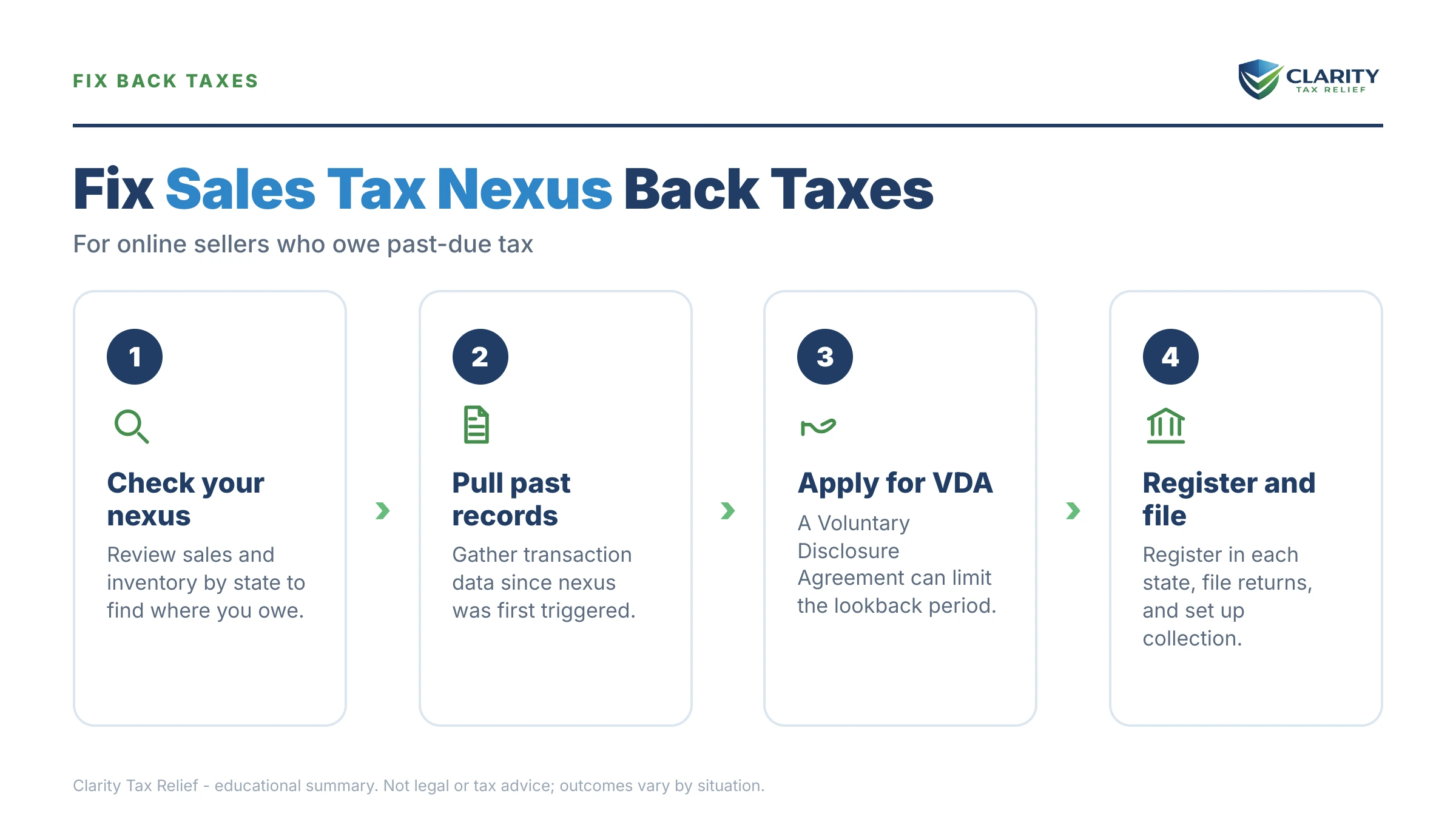
- Pull a sales-by-state report. Export gross and taxable sales by state, by year, from every channel — marketplace and direct — for at least the last four years.
- Map your nexus footprint. Flag every state where you crossed an economic threshold or held FBA inventory, and note the date nexus began in each.
- Separate marketplace from direct sales. Marketplace-collected sales usually come off your exposure; direct-channel sales stay on you.
- Quantify the exposure per state. Multiply direct taxable sales by each state's combined rate for every open period, then add estimated interest.
- Apply for voluntary disclosure before registering. In every material state that hasn't contacted you yet, a VDA caps the lookback and waives penalties.
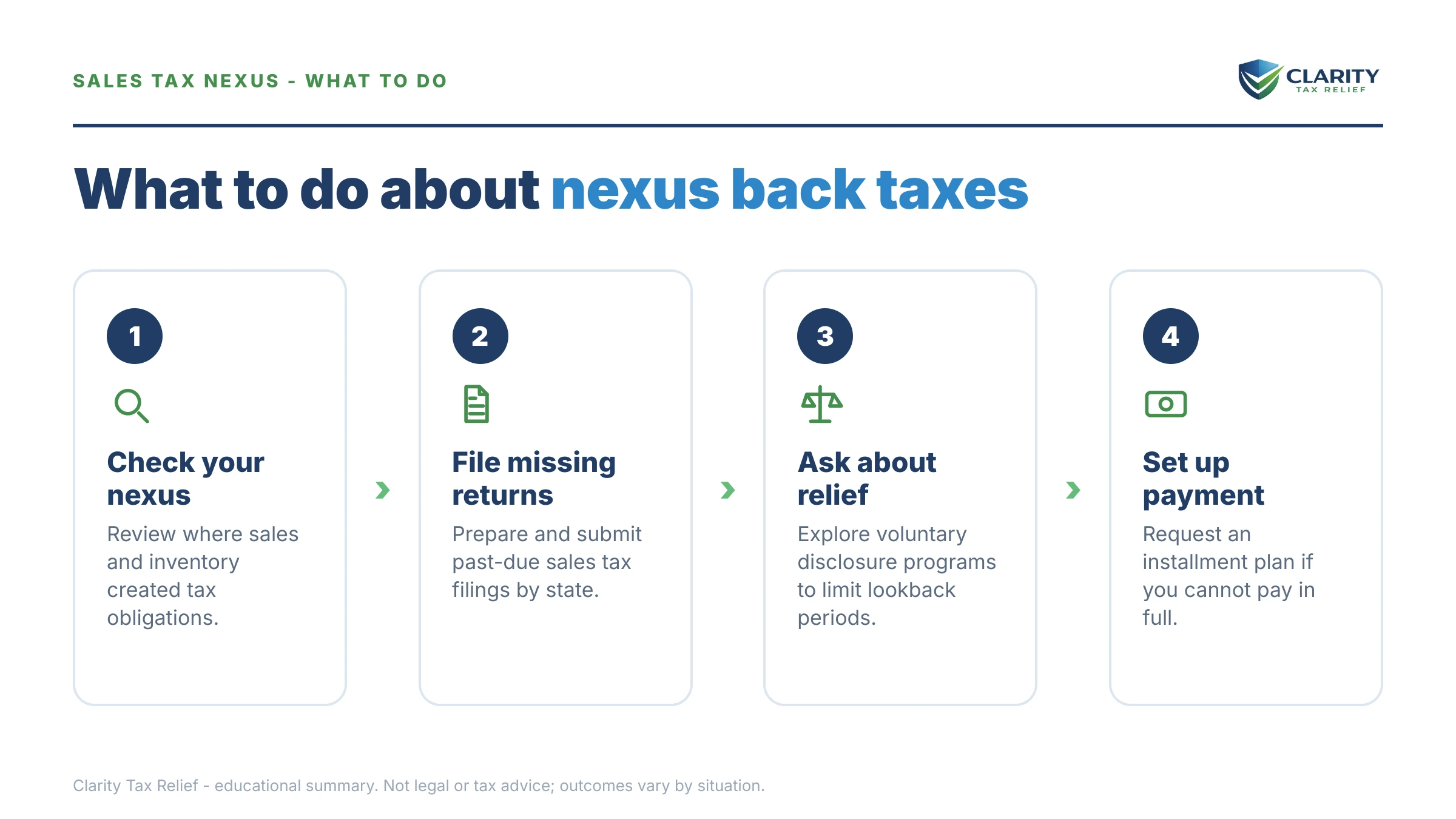
- Register, file, and resolve the rest. Set up collection going forward, then use payment plans or penalty waiver requests for whatever remains.
When you can handle nexus back taxes yourself
You can genuinely handle this alone when the problem is small and singular: one state, a threshold crossed within the last year or so, exposure in the low four figures, and no letter from the state yet. Register, back-file the handful of open periods, pay with a reasonable-cause penalty waiver request, and set up collection going forward. If nearly all your sales run through marketplaces that already collect, your remaining direct-channel exposure may be too small to justify professional fees at all.
Two free official resources help DIY sellers. The Streamlined Sales Tax Governing Board lets you register once for roughly two dozen member states, with certified providers that can handle filing for remote sellers at little or no cost. And the Multistate Tax Commission runs the National Nexus Program — the one-application multistate voluntary disclosure route in the options table above.
Experienced help changes the outcome in specific situations: exposure in several states at once (where VDA sequencing and anonymous negotiation matter), an FBA history you can't reconstruct, a nexus questionnaire already sitting on your desk, an estimated assessment with an appeal deadline running, or a responsible-person letter naming you personally. In those cases the negotiation itself — which years, which penalties, whose name goes on what — is where the money is won or lost. See our broader guide to sales tax debt help for what state negotiators actually respond to.
Terms on your state letter, decoded
- Nexus — the legal connection between your business and a state that obligates you to collect its sales tax.
- Economic nexus — nexus created by sales volume alone, with no physical presence, under post-Wayfair state laws.
- Marketplace facilitator — a platform (Amazon, Etsy, eBay, Walmart) legally required to collect and remit sales tax on your marketplace sales.
- Trust tax — tax collected from someone else (your customers) that you hold on the state's behalf, carrying personal liability if unremitted.
- Voluntary disclosure agreement (VDA) — a pre-contact deal that caps the lookback and waives penalties in exchange for coming forward.
- Lookback period — the number of past years a state will actually assess under a VDA, typically 3–4 instead of "everything."
- Responsible person — an owner, officer, or finance decision-maker a state can assess personally for the business's unpaid trust tax.
If your channel reports just revealed multistate exposure, a free case review with an experienced tax professional can map every state's cheapest exit before you register anywhere — call (888) 825-7779.
Sales tax nexus back taxes: FAQs
How far back can a state collect sales tax I never filed?
In most states, indefinitely — the statute of limitations on assessment never starts running for a period where no return was filed. States with typical 3- or 4-year audit windows can still reach back to your first sale if you never registered. A voluntary disclosure agreement is the main tool that caps this exposure, typically limiting the lookback to the most recent 3–4 years.
Am I personally liable for my LLC's or corporation's sales tax debt?
Usually, yes. Sales tax is a trust tax — money you collected (or should have collected) from customers on the state's behalf — and most states can assess owners, officers, and anyone who controlled the finances personally when the business doesn't pay. Forming an LLC or corporation does not shield you from trust-fund sales tax the way it can shield you from ordinary business debt.
Does Shopify collect and remit sales tax for me?
No. Shopify is software, not a marketplace facilitator — it can calculate tax at checkout, but registering, collecting, filing, and remitting are entirely your responsibility. Amazon, Etsy, eBay, and Walmart Marketplace are facilitators and now collect on your behalf in every state with a sales tax, but that only covers sales made through those platforms — your direct-channel sales stay on you.
What is economic nexus for sales tax?
Economic nexus means your sales volume alone — with no physical presence — obligates you to collect a state's sales tax. Since South Dakota v. Wayfair (2018), every state with a statewide sales tax has adopted a threshold, most commonly $100,000 in annual sales into the state; a handful of large states use $500,000, and many have dropped their old 200-transaction tests. Crossing the threshold starts your duty to register and collect.
What is a voluntary disclosure agreement (VDA)?
A VDA is a deal you strike with a state before it finds you: you come forward, register, and pay the back tax, and in exchange the state typically limits the lookback to 3–4 years and waives penalties (interest usually still applies). Most states let a representative apply anonymously, so you can see the terms before your name is disclosed. Once a state contacts you first, VDA eligibility is generally gone for that state.
How do states find online sellers who never registered?
Through data: 1099-K filings, records demanded from marketplaces and payment processors, Amazon FBA inventory reports showing where your goods were warehoused, exemption-certificate trails from audits of your business customers, and data-sharing agreements between states. Discovery is largely automated, which is why sellers often hear from three or four states within the same year.
Can I just register now and ignore the old periods?
It's risky. Registration applications ask when you first had nexus in the state — answer honestly and you've flagged your own back periods; answer falsely and you've converted a money problem into a fraud problem. Prospective-only registration is reasonable when you only recently crossed a threshold. If you've had nexus for years with material sales, a voluntary disclosure agreement is almost always the safer, cheaper route.
Can sales tax back taxes be discharged in bankruptcy?
Generally not the trust-fund portion. Tax you actually collected from customers is treated like withheld payroll tax — a priority, nondischargeable debt in most cases — and personal responsible-person assessments typically survive bankruptcy too. Bankruptcy can sometimes help with penalties or older self-assessed amounts, but it is rarely a clean exit from sales tax debt; payment agreements and VDAs usually cost less.
Do I still owe sales tax if I never collected it from my customers?
Yes. The legal duty to collect and remit sits on the seller, so uncollected tax comes out of your own margin — a state won't chase your customers for it. That's why the exposure hurts: on $60,000 of taxable sales at an 8% rate, you absorb $4,800 you never received. Some states allow limited relief where purchasers self-reported use tax, but proving that is difficult.
Your next 24 hours
- Check for state contact. If any state letter has arrived — a nexus questionnaire, a demand, an assessment — find the agency name and the printed response deadline. That single fact decides whether voluntary disclosure is still open in that state.
- Pull the numbers. Export sales by state for the last four years from every channel, download your marketplace tax reports and 1099-Ks, and grab your FBA inventory placement history if you sell on Amazon.
- Get the free case review. Before you register anywhere, have an experienced tax professional map your exposure state by state and sequence the VDAs — use the 2-minute form at claritytaxrelief.com/#consult or call (888) 825-7779. Unfiled periods stay open and interest keeps accruing until each state is closed out.
This guide is general information, not tax or legal advice for your specific situation. Eligibility for IRS programs depends on individual facts and circumstances; no outcome is guaranteed. State tax programs, thresholds, and deadlines vary by state — confirm specifics with the relevant state agency or an experienced tax professional.