
Small Business & E-Commerce Tax Debt
Shopify Seller Taxes in 2026: Back Taxes, 1099-K Debt, and How to Fix It
The short answer: Shopify seller taxes come down to net profit — you owe federal income tax plus 15.3% self-employment tax on what's left after expenses, with or without a 1099-K. For 2026, Shopify Payments reports sellers above $20,000 and 200 transactions, and the IRS matches every 1099-K against your return. Gaps become bills.
Your store is real — inventory stacked in the spare room, a part-time employee on payroll, Shopify deposits hitting the bank every Friday. Then a letter arrived saying the income you reported doesn't match what Shopify Payments told the IRS. That gap has a name, a predictable escalation path, and — right now — several cheap ways out.
Most Shopify tax debt starts with one document, and most sellers have never actually read it. The image below shows exactly what a Form 1099-K looks like and where to find the gross-payments figure the IRS is matching against your return — the single number this entire problem is built on.
⏱ The clock on Shopify back taxes runs monthly, not once. The failure-to-pay penalty adds 0.5% of the balance every month, and interest compounds daily on top of it. If you're holding an IRS notice, the date printed on it controls — a CP2000 typically gives 30 days to respond, a CP14 about 21 days to pay.
Why the IRS says you owe Shopify seller taxes
The IRS computer matches every Form 1099-K filed by Shopify Payments against the tax return under your Social Security number, and any unexplained gap becomes a proposed bill. No human picks your file. The Automated Underreporter system flags the mismatch, usually one to two years after the tax year in question — which is why sellers get 2024 letters in 2026.
Shopify sellers land in tax debt through three doors:
- You didn't report the 1099-K income. Maybe you thought the store was "too small to count," or the form went to an old address. The IRS has its copy either way, and the result is a CP2000 notice proposing tax on the full gross amount.
- You reported it but couldn't pay. No one withholds tax from Shopify payouts. A profitable year generates income tax plus 15.3% self-employment tax, and if you skipped quarterlies, the whole bill lands at once — the classic self-employment tax shock.
- You never filed at all. The IRS can eventually file a substitute return for you using the gross 1099-K figure with zero deductions — the most expensive possible version of your year.
Two Shopify-specific traps make the numbers worse. First, if buyers pay through both Shopify Payments and PayPal (or Afterpay, or another gateway), each processor files its own separate 1099-K — and a sloppy return can double-count or under-count against the IRS's combined total. Second, the 1099-K reports gross payments: refunds, chargebacks, shipping charges, and every fee Shopify clawed back are all inside that number. The federal threshold also whipsawed in recent years — the $600 rule was repealed and the 1099-K threshold for 2026 is back to $20,000 and 200 transactions — but any balance already assessed from a low-threshold year survives the reversion.
| Line on your books | Amount | Tax treatment |
|---|---|---|
| Gross payments on 1099-K (Box 1a) | $68,400 | The starting point the IRS matches — not your income |
| Customer refunds & chargebacks | −$4,100 | Never income; reported as returns and allowances |
| Shopify subscription + processing fees | −$2,900 | Deductible business expense |
| Shipping labels & postage | −$5,600 | Deductible business expense |
| Cost of goods sold (inventory) | −$27,300 | Deducted as COGS on Schedule C |
| Ad spend (Meta, Google, TikTok) | −$8,700 | Deductible business expense |
| Net profit — what's actually taxed | $19,800 | Subject to income tax + 15.3% SE tax |
That table is the heart of every CP2000 response for a Shopify seller: the IRS starts from $68,400, and your documentation walks it down to $19,800. If you can't find your records, the store's own data usually rescues you — Shopify's finance reports, processor statements, and supplier invoices can reconstruct most of a year. If even those are gone, there's a playbook for filing back taxes without records.
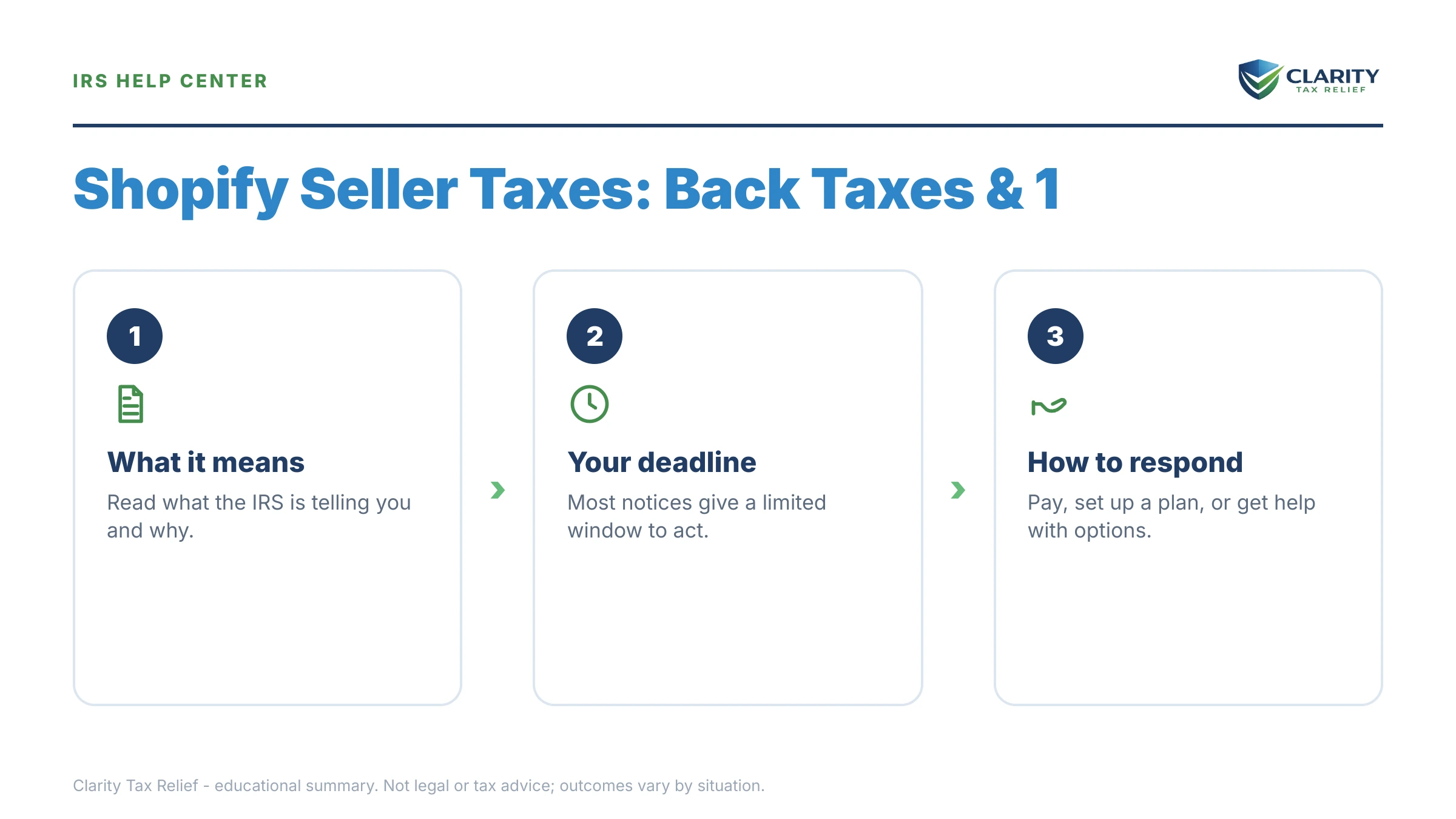
What a $4,800 Shopify tax debt actually costs
A $4,800 IRS balance grows by roughly $24 in penalties every month it sits, before interest. Here's a clearly hypothetical example with the arithmetic shown.
Say you run a Shopify apparel store with one part-time employee, and a CP2000 assessed $4,800 for tax year 2024 after the IRS matched a Shopify Payments 1099-K you left off your return. Your realistic paths:
- Do nothing for 12 months: the failure-to-pay penalty adds 0.5% × $4,800 = $24/month — $288 for the year — while interest compounds daily on top at the federal underpayment rate. You'd be drifting toward roughly $5,400 with nothing resolved and the notice sequence advancing underneath you.
- Short-term plan (up to 180 days): $0 setup fee. Six payments of $800 clears it, and it's the cheapest total cost because accruals stop soonest.
- Guaranteed installment agreement: because the balance is under $10,000, you may qualify for a guaranteed installment agreement if your returns are filed and you can pay it off within three years. $4,800 ÷ 36 months ≈ $133/month — budget closer to $150 because penalties and interest keep accruing until the last payment.
- Offer in Compromise: honest answer — at $4,800, an offer rarely makes sense. If you can afford $150 a month, the IRS's math says you can full-pay well within the 10-year collection statute, so an offer would almost certainly be rejected and the $205 application fee wasted. Offers are for balances your income and assets genuinely can't cover.
- Penalty relief: if your prior three years were clean, first-time penalty abatement can remove the failure-to-pay penalties that accrued — and starting summer 2026, the new Automatic Exemption from Penalty (AEP) applies some of this relief automatically, no request needed.
Want your own numbers instead of a hypothetical? You can estimate how penalties and interest stack on your exact balance with our Penalty & Interest Calculator.
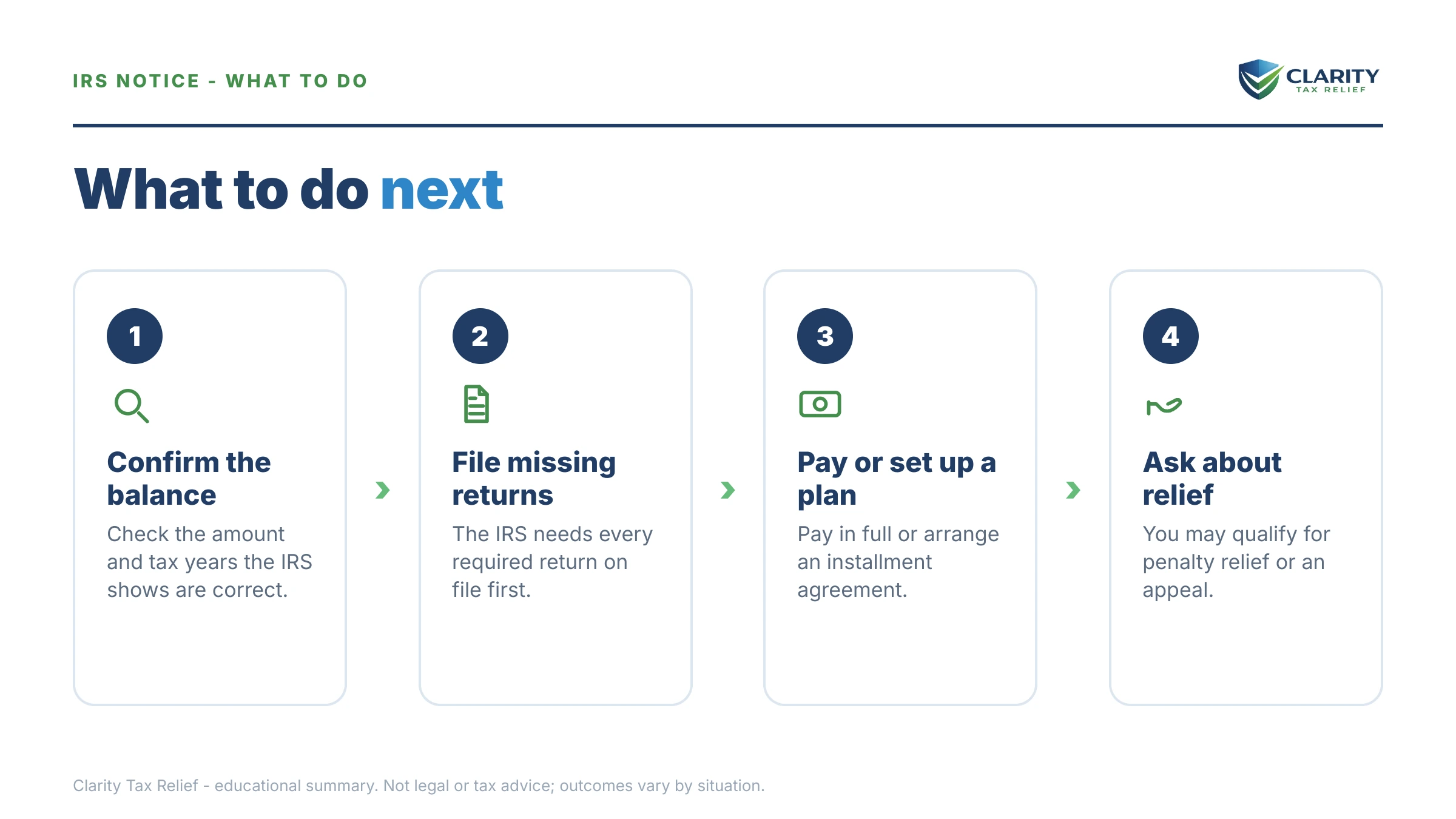
What happens if you ignore Shopify back taxes
Unreported Shopify income follows a fixed, automated escalation sequence, and each stage removes an option the previous stage still offered. In 2026 the IRS workforce is down roughly 27% — humans are harder to reach than ever — but the matching, notices, and levies are generated by systems that never stopped. The sequence for a 1099-K mismatch runs:
- CP2000 — a proposed change, not a bill yet. You typically get 30 days to agree, dispute, or supply your real expense numbers. This is the cheapest stage to fix everything.
- CP3219A (Notice of Deficiency) — the 90-day letter. Your last chance to contest in Tax Court before the amount becomes final.
- Assessment + CP14 — now it's a bill, with penalties and interest attached, and about 21 days before reminders begin.
- CP501 / CP503 — reminder notices while the balance grows monthly.
- CP504 — intent to levy your state tax refund under IRC §6331(d), with a federal tax lien now a live possibility.
- LT11 / Letter 1058 — the final notice. A 30-day clock starts on your Collection Due Process rights, and after it runs, the IRS can levy the bank account your Shopify payouts land in. Bank levies freeze funds for 21 days before the money leaves.
One warning specific to your situation as an employer: this individual-income track is the slow one. If your store also fell behind on payroll tax deposits, that debt travels a separate, faster, harsher track — covered below — and the IRS prioritizes it over everything else you owe.
| Notice | Response window | The right at stake |
|---|---|---|
| CP2000 | Typically 30 days from the notice date | Correcting the gross-vs-net math before any tax is assessed |
| CP3219A | 90 days | Petitioning Tax Court before the amount becomes final |
| CP14 | ~21 days | Resolving at the bill stage, before enforcement notices begin |
| CP504 | Date printed on the notice | Keeping your state refund; avoiding a federal tax lien filing |
| LT11 / Letter 1058 | 30 days | A Collection Due Process hearing (Form 12153) — the levy shield |
Holding a CP2000 or a balance from your Shopify store?
Send us the notice and your 1099-K. An experienced tax professional will run the gross-vs-net math, tell you what you actually owe, and map the cheapest resolution — free and confidential, before penalties add another month.
Your options for Shopify back taxes, compared
Every federal balance from a Shopify store resolves through one of six programs, and eligibility is set by dollar thresholds and your finances — not by anything a salesperson promises. The mechanics of setting each one up yourself are covered in our guide to how to settle tax debt yourself; here's how they map to seller balances:
| Option | Who may qualify | Cost & terms | Best for |
|---|---|---|---|
| Short-term payment plan | Any balance you can clear in 180 days | $0 setup; accruals continue until paid | One bad year you can cover from payouts |
| Guaranteed installment agreement | Balance ≤ $10,000, returns filed, full pay within 3 years | Setup fee applies; no financial disclosure | Small balances like the $4,800 example |
| Streamlined installment agreement | Balance ≤ $50,000 | Up to 72 months, set up online; direct debit extends the streamlined path to $50k | Multi-year seller debt without a financial exam |
| Plans over $50,000 | Larger balances; financial statement (Form 433 series) required | Terms set from your income and assets | High-volume stores with several unpaid years |
| Currently Not Collectible | Paying anything would create genuine hardship | Collection pauses; debt and accruals remain; lien possible | A store that collapsed and income that hasn't recovered |
| Offer in Compromise | Income and assets genuinely can't cover the debt before the collection statute ends | $205 fee; 20% down on lump-sum offers (both waived with low-income certification) | Large balances with documented inability to pay |
| Penalty abatement / AEP | Clean prior 3 years (FTA), or reasonable cause; AEP applies automatically starting summer 2026 | Free to request | Stacking on top of any option above |
Two honest notes on the settlement end. The IRS accepted roughly 1 in 5 Offers in Compromise in FY2024 — it's a real program with strict math, not the "settle everything" product ads describe. And if your finances are genuinely underwater — say the store failed and you're living on wages that barely cover rent — Currently Not Collectible status can stop collection entirely while you recover, though penalties and interest continue and the debt stays on the books.
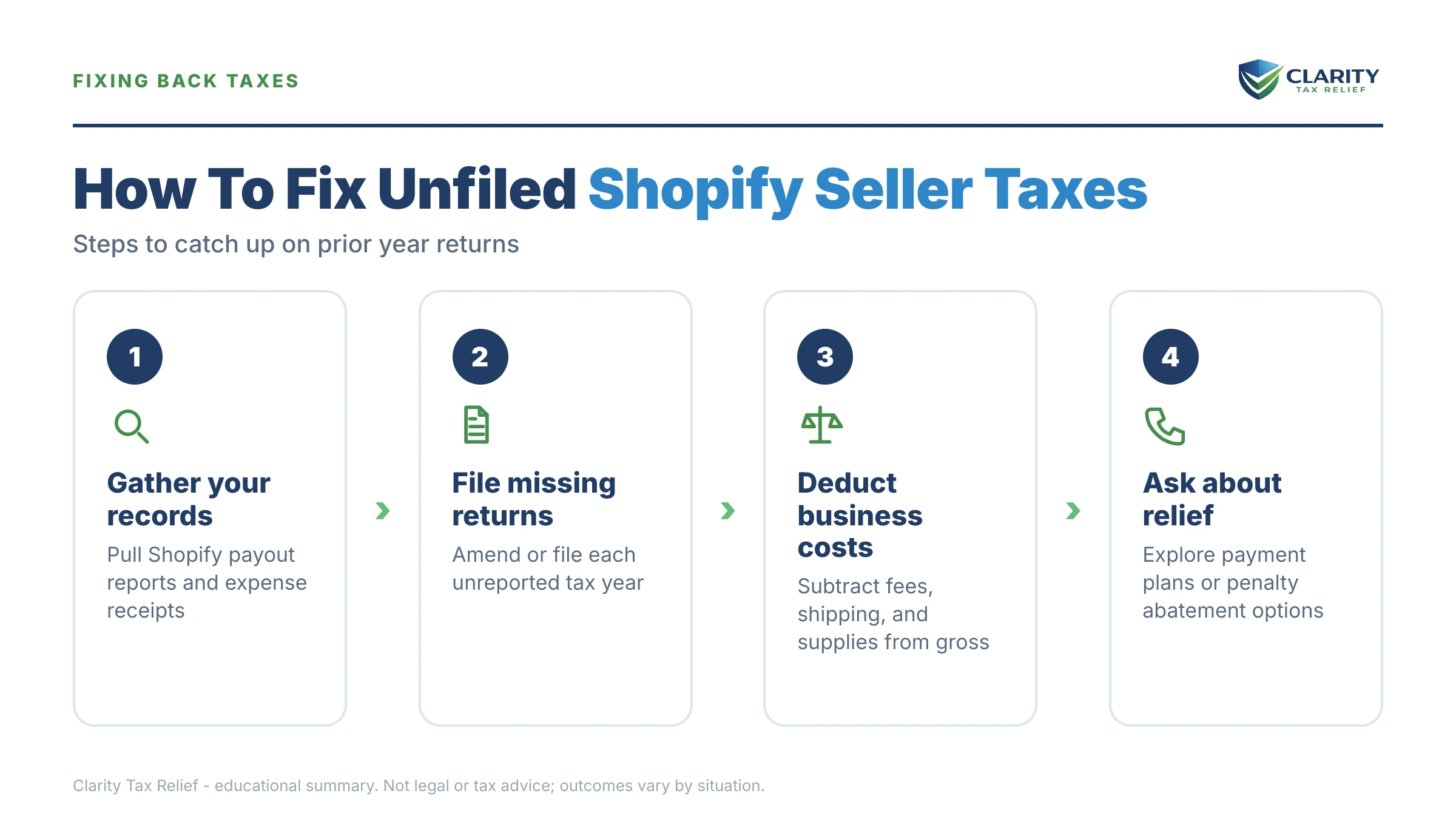
How to respond to Shopify back taxes, step by step
- Pull your IRS wage and income transcript. See every 1099-K the IRS has on file for you — from Shopify Payments, PayPal, and any other processor — before you file or respond to anything.
- Reconstruct your real net profit. Export Shopify's finance and fee reports, then gather cost-of-goods, shipping, and ad-spend records so the gross 1099-K number shrinks to what you actually earned.
- File or amend every missing return. File even if you can't pay a dollar — the failure-to-file penalty runs ten times the failure-to-pay penalty, and filing stops the worst of the bleeding.
- Respond to any open notice by its printed date. A CP2000 typically gives you 30 days to agree or dispute; missing it moves the proposed amount toward final assessment and takes the cheap fixes off the table.
- Set up the payment arrangement that fits your balance. Under $10,000 you may qualify for a guaranteed installment agreement if you meet the filing and payment conditions; under $50,000, a streamlined plan runs up to 72 months and can be set up online.
- Request penalty relief and fix the go-forward. Ask about first-time abatement or the new automatic penalty exemption, start quarterly estimated payments, and register for sales tax in states where you have nexus.
Step six matters more than sellers expect: the IRS won't approve most agreements while you keep falling behind on the current year. If quarterlies are new to you, start with how the estimated-tax penalty math works — you generally owe quarterly payments once you expect to owe $1,000 or more.
Shopify sales tax: the state-side debt most sellers miss
Shopify can calculate and collect sales tax at checkout, but registering with each state and remitting what you collected is entirely your responsibility. This is the sharpest difference between running your own Shopify store and selling on a marketplace: marketplace-facilitator laws make Amazon collect and remit for its sellers, but they generally don't cover your own storefront.
Since the Wayfair decision, states can require collection based on sales volume alone — no warehouse, employee, or physical presence needed. Cross a state's economic-nexus threshold and you owe registration, collection, and remittance there, and states can assess years of uncollected tax against the business (and sometimes the owner) later. Thresholds, lookback rules, and amnesty programs vary state by state; the full picture, including voluntary disclosure agreements that cap the damage, is in our guide to sales tax nexus back taxes.
One state-side rule to burn in: sales tax you collected at checkout but never remitted is treated as the state's money held in trust — states pursue it more aggressively than any income tax, and owner-level personal liability is common. If you've collected and spent it, that's the fire to put out first, before the federal balance.
Payroll on top: when your Shopify store has employees
The moment your store has an employee, the taxes withheld from their paycheck become the most dangerous debt you can owe. Income and self-employment tax are your money owed to the government; withheld payroll taxes are the government's money that passed through your hands. The IRS treats missed deposits accordingly — faster escalation, likelier revenue officer assignment, and no waiting years for a CP2000.
Three things every Shopify employer behind on payroll should know:
- The Trust Fund Recovery Penalty pierces every entity. The withheld portion of payroll tax can be assessed against you personally — LLC or corporation notwithstanding — if you controlled the money and it didn't get deposited. See how the trust fund recovery penalty decides who's liable.
- 941 debt runs on its own track. The notice sequence, the payment-plan rules, and the IRS's urgency are all different for employment taxes — the full picture is in our guide to 941 back taxes, and if you're not sure which return your penalty came from, start with 941 vs 940 back taxes.
- Your entity choice shapes the rest. A single-member LLC's income tax debt is personal by default, while payroll trust-fund debt follows the responsible person regardless of structure — the breakdown is in LLC back taxes personal liability.
If your situation stacks all three layers — a 1099-K gap, unremitted sales tax, and payroll arrears — the order you resolve them in changes the total cost, and that's exactly the kind of sequencing a free review with an experienced tax professional at (888) 825-7779 can map before the next notice lands.
When you can handle Shopify back taxes yourself
Many Shopify tax debts don't need professional help, and it would be dishonest to pretend otherwise. You can confidently handle this alone when:
- The CP2000 is simply right — you left the 1099-K off, the proposed number roughly matches your real profit, and you can pay or set up a plan online.
- The balance is under $10,000 with all returns filed — a guaranteed or streamlined agreement takes under an hour to set up through your IRS online account.
- You can full-pay within 180 days — the short-term plan is free to set up and ends the problem.
Experienced help genuinely changes outcomes when the facts get heavier: a CP2000 built on gross payments when your real profit is a fraction of it (the response documentation makes or breaks the reduction), multiple unfiled years, payroll or sales tax debt alongside the income tax, a levy already in motion against the account your payouts land in, or a balance large enough that Offer in Compromise math is worth running properly. The dividing line isn't the dollar amount — it's whether the IRS's number is wrong, whether more than one agency is involved, and whether enforcement has already started.
Terms on your notice, decoded
- Form 1099-K — the information return payment processors file showing your gross payments; the IRS gets a copy of every one. The official rundown is at Understanding your Form 1099-K.
- Gross payments — every dollar buyers paid before refunds, fees, shipping, or inventory costs; the number the IRS starts from until you show otherwise.
- CP2000 — the automated "your return doesn't match our records" proposal; not an audit, and very negotiable inside its response window.
- Self-employment tax — the 15.3% Social Security and Medicare tax on net profit that no employer withheld for you.
- Economic nexus — a state's authority to make you collect its sales tax based on sales volume alone, established by the Wayfair decision.
- Trust fund taxes — withheld payroll taxes (and collected sales taxes) the government treats as its money in your custody; the category that creates personal liability regardless of entity.
Shopify seller tax questions, answered
Does Shopify report my sales to the IRS?
Yes — if you use Shopify Payments and cross the reporting threshold, Shopify files a Form 1099-K with the IRS showing your gross payments. For 2026 that threshold is $20,000 in payments and more than 200 transactions. PayPal and other processors on your store file their own separate 1099-Ks, and your income is taxable even in years no form is issued.
What is the Shopify 1099-K threshold for 2026?
For 2026, the federal 1099-K threshold is back to $20,000 in gross payments and more than 200 transactions — the $600 rule was repealed before it fully took effect. Two caveats: several states require 1099-Ks at much lower amounts, and any balance the IRS already assessed from an earlier low-threshold year does not go away with the reversion.
Do I owe taxes if my Shopify store lost money?
Generally no income or self-employment tax is due on a store that genuinely lost money, because both taxes apply only to net profit. But you still need to file the return to document the loss — otherwise the IRS sees only the gross 1099-K and may bill you as if it were all profit. Repeated losses can also draw hobby-loss scrutiny, which limits deductions.
Why is my 1099-K higher than what I actually made?
Because a 1099-K reports gross payments, not profit. The figure includes customer refunds, chargebacks, shipping charges, sales tax collected through checkout in some setups, and every dollar Shopify later took back in fees. Your return is where those come out — refunds as returns and allowances, and fees, shipping, and cost of goods as Schedule C expenses.
What happens if I didn't report my Shopify income?
Expect a CP2000 notice, usually one to two tax years later, proposing extra tax on the full 1099-K amount plus a 20% accuracy-related penalty and interest. You typically get 30 days to respond, and responding with your real expense numbers usually shrinks the bill substantially. If you never filed at all, the IRS can file a substitute return for you with zero deductions.
Does Shopify collect and remit sales tax for me?
Shopify can calculate and collect sales tax at checkout, but registering with each state and remitting what you collected is your job — Shopify is not a marketplace facilitator for your own store the way Amazon is for its sellers. Collected-but-unremitted sales tax is treated by states as their money in your hands, and owners can be held personally liable for it.
Can I set up a payment plan for Shopify back taxes?
Yes — payment plans are the most common resolution for e-commerce tax debt. Balances under $10,000 can qualify for a guaranteed installment agreement, balances up to $50,000 can be set up online for as long as 72 months, and short-term plans give you up to 180 days with no setup fee. Interest and the monthly late-payment penalty continue until the balance is paid.
Do Shopify sellers have to pay quarterly estimated taxes?
Yes, if you expect to owe $1,000 or more for the year — no one withholds tax from your Shopify payouts, so the IRS expects four estimated payments during the year. Skipping them triggers an underpayment penalty even if you pay in full by April 15. A common fix for owners with payroll is boosting withholding on their own W-2 wages instead.
Can the IRS levy my Shopify payouts or business bank account?
Yes — once the IRS issues a final notice of intent to levy and the 30-day window passes, it can levy the bank account your Shopify payouts land in and, in business cases, reach receivables. A bank levy freezes funds for 21 days before the money is sent, which is your window to negotiate a release. Getting into an agreement before that point prevents it entirely.
Your next 24 hours
- Find the number. Pull Box 1a — gross payments — from every 1099-K your store generated (Shopify admin under Finances, plus PayPal or any other gateway) and compare the combined total to the gross receipts on your filed return. That gap is the whole case.
- Gather your file. Your last filed return, any IRS notice you've received, Shopify's finance and fee reports for the year in question, and whatever cost-of-goods and ad-spend records you have. Payment options and current balances are always visible at IRS.gov/payments, and plan details at the IRS payment plans page.
- Get the free review. Every month this sits, the failure-to-pay penalty and daily interest add to the balance — send your notice and 1099-K through the 2-minute form or call (888) 825-7779 and an experienced tax professional will map your cheapest path while the early-stage options are still open.
This guide is general information, not tax or legal advice for your specific situation. Eligibility for IRS programs depends on individual facts and circumstances; no outcome is guaranteed.