
Online Sellers & E-Commerce
Amazon FBA Seller Taxes: Back Taxes, the 1099-K Trap, and Multistate Nexus (2026)
The short answer: Amazon FBA seller taxes come in three layers: federal income tax plus 15.3% self-employment tax on your net profit (not the 1099-K gross), quarterly estimated payments, and state sales tax for years before marketplace facilitator laws. If you're behind, accurate Schedule C returns plus an IRS payment plan stop the escalation.
You and your spouse pulled up Seller Central expecting to feel decent about the year — then Amazon's 1099-K arrived showing a gross figure two or three times what actually landed in your checking account. Maybe you owe a balance you can't pay; maybe there are years you never filed at all. Both problems are fixable, and both start with the same handful of reports Amazon already has waiting for you.
If you've never looked closely at a 1099-K, the image below shows exactly what Amazon's version looks like and where the gross-payments figure that causes most of the trouble sits.
⏱ The real clock: a growing FBA tax balance has no printed deadline — the cost is monthly. The failure-to-pay penalty adds 0.5% of the balance every month, and interest compounds daily on top. On a $36,900 balance, that's roughly $185 a month in penalty alone before interest.
Why Amazon FBA seller taxes go wrong
Amazon's Form 1099-K reports your gross payments — every dollar buyers paid — not the net deposits that actually reached your bank account. That single mismatch is behind most FBA tax debt, and it works in three ways.
Trap one: gross versus deposits. Amazon deducts referral fees, FBA fulfillment fees, and storage fees before it disburses anything to you. The 1099-K it files with the IRS shows the unreduced gross. If you (or your tax software) reported the deposits instead, your return understates revenue against IRS records — and the automated underreporter system sends a CP2000 notice proposing tax on the difference, including fees you genuinely paid and never saw. The same mechanics drive eBay seller tax debt from 1099-Ks, but FBA fee stacks are usually far larger, so the mismatch is bigger.
Trap two: inventory timing. Product you buy is deductible as cost of goods sold when it sells, not when you pay for it. Sellers who plow every dollar of profit into the next Alibaba order are often shocked to learn that reinvested profit is still taxable profit. Cash-poor and tax-liable is the default FBA condition, not a fluke.
Trap three: no withholding. Amazon withholds nothing from disbursements. You owe income tax plus 15.3% self-employment tax on net profit, payable through quarterly estimated taxes. Skip the quarterlies and April delivers the whole year's bill at once, plus an underpayment penalty. Note the reporting threshold too: for 2026 the 1099-K threshold is back to $20,000 and 200 transactions — the $600 1099-K rule was rolled back — but any debt built during the lower-threshold panic years doesn't disappear with the rule.
| Tax layer | Who assesses it | The FBA-specific trap |
|---|---|---|
| Federal income + self-employment tax | IRS | 1099-K reports gross payments; deposits arrive net of fees, so reporting deposits triggers a CP2000 mismatch |
| Quarterly estimated tax | IRS | Nothing is withheld from disbursements; missed quarterlies add an underpayment penalty every year |
| Inventory accounting (COGS) | IRS (on exam) | Stock is deductible when it sells, not when purchased — reinvested profit is still taxable profit |
| State sales tax (pre-facilitator years) | State revenue agencies (e.g., CDTFA) | FBA inventory in a state's warehouses created nexus before marketplace facilitator laws shifted collection to Amazon |
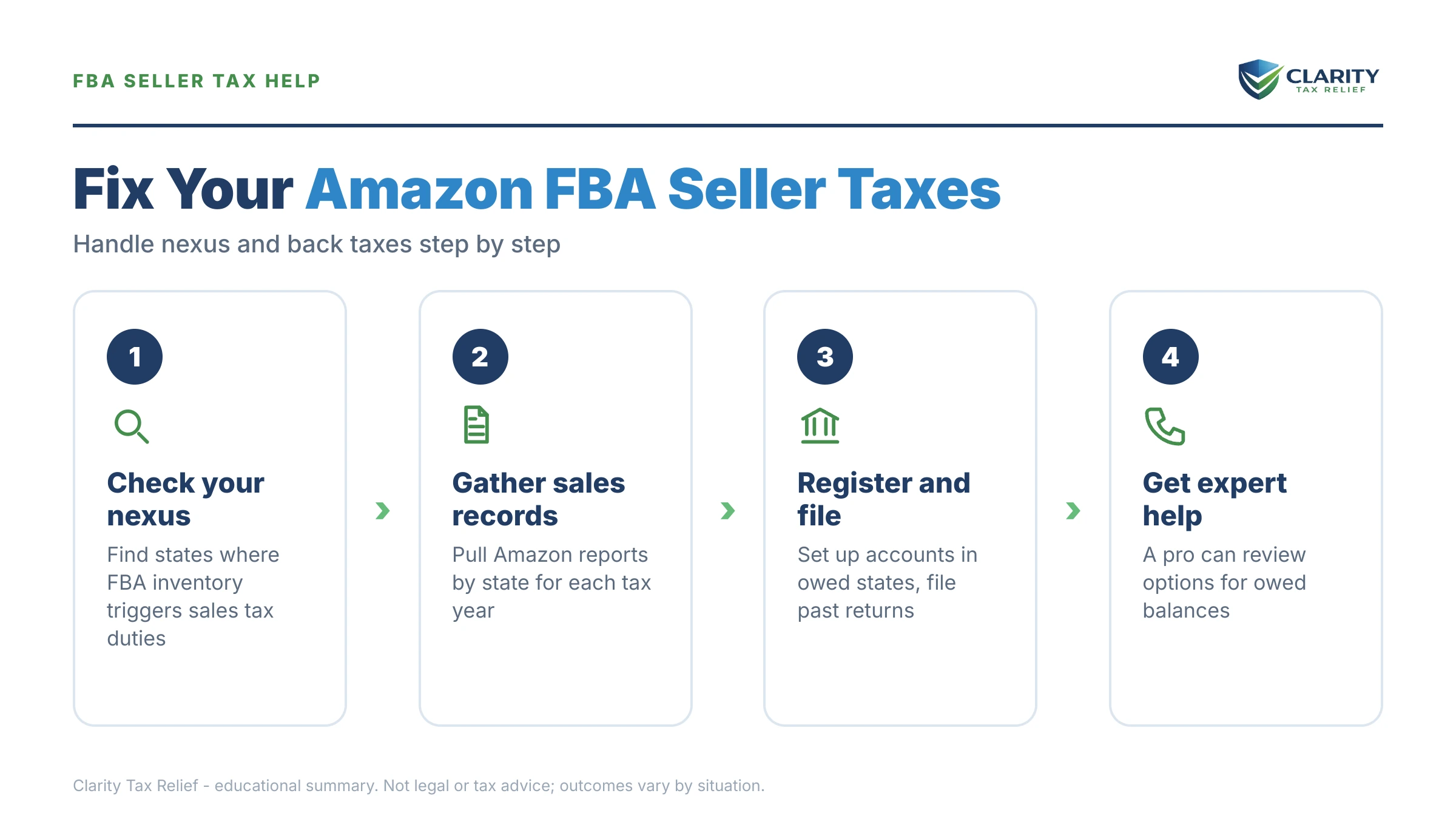
The multistate sales tax nexus problem no one told you about
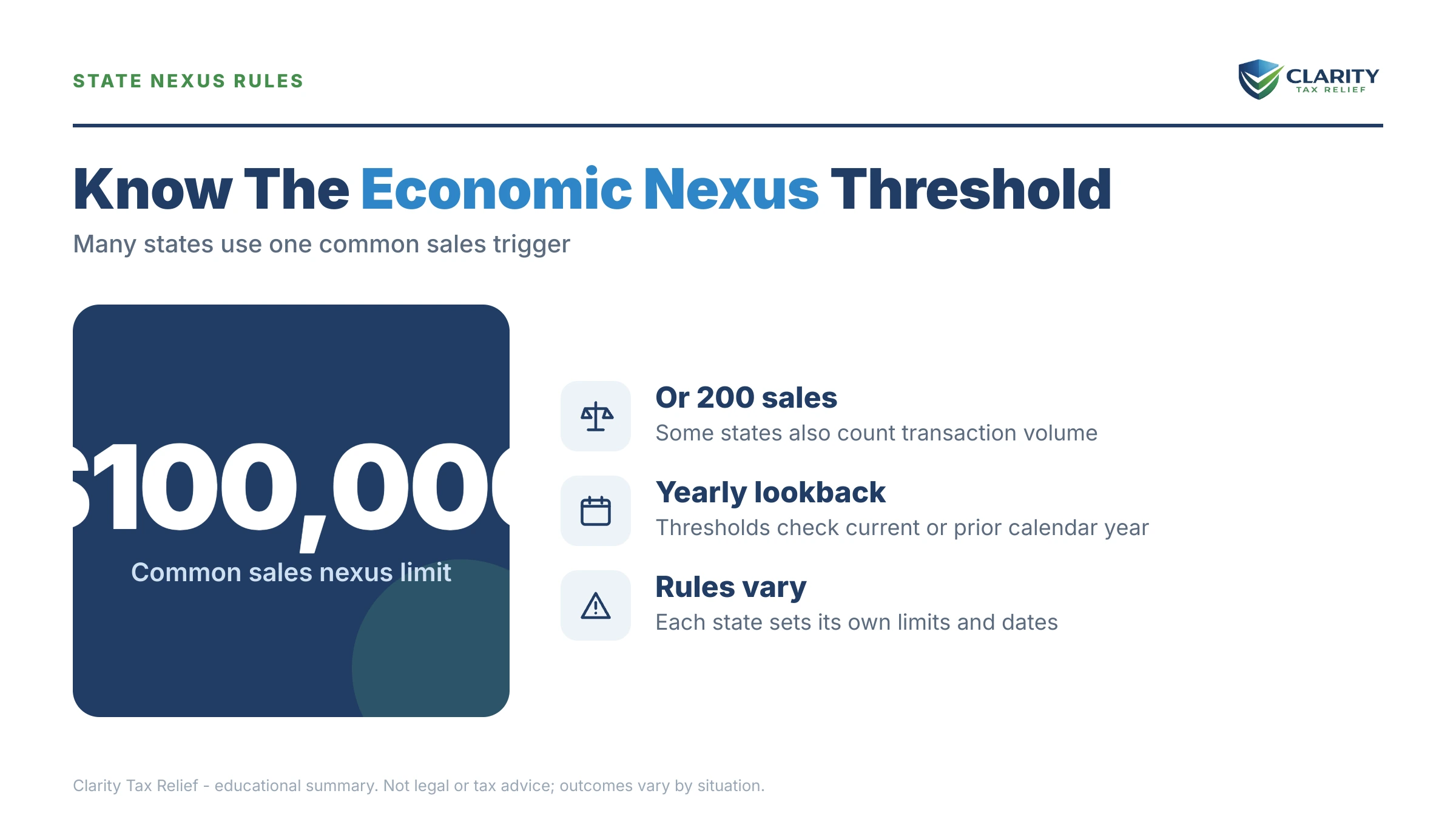
Every state with a statewide sales tax now requires Amazon to collect and remit sales tax on your FBA sales — but those marketplace facilitator laws don't erase liability from earlier years. Most of them took effect between 2018 and 2020, and states can still pursue sellers for the years before their law switched on.
Here's why FBA sellers specifically got caught: when you send inventory to Amazon, Amazon redistributes it among fulfillment centers in dozens of states — without asking you. Inventory sitting in a state's warehouse historically created physical nexus there, even if you never set foot in the state. California's CDTFA has been the most aggressive agency on this theory, sending questionnaires and assessments to out-of-state FBA sellers for pre-facilitator years. If you've received one, our guide to California back sales tax covers the CDTFA side, and sales tax nexus back taxes covers the multistate picture.
Two rules keep you out of trouble here. First, never assume IRS timelines or programs apply to a state — each state runs its own statutes, payment plans, and amnesty windows, so respond to the named agency directly. Second, don't ignore a state questionnaire: unanswered, states estimate your liability from Amazon's records and assess the high number.
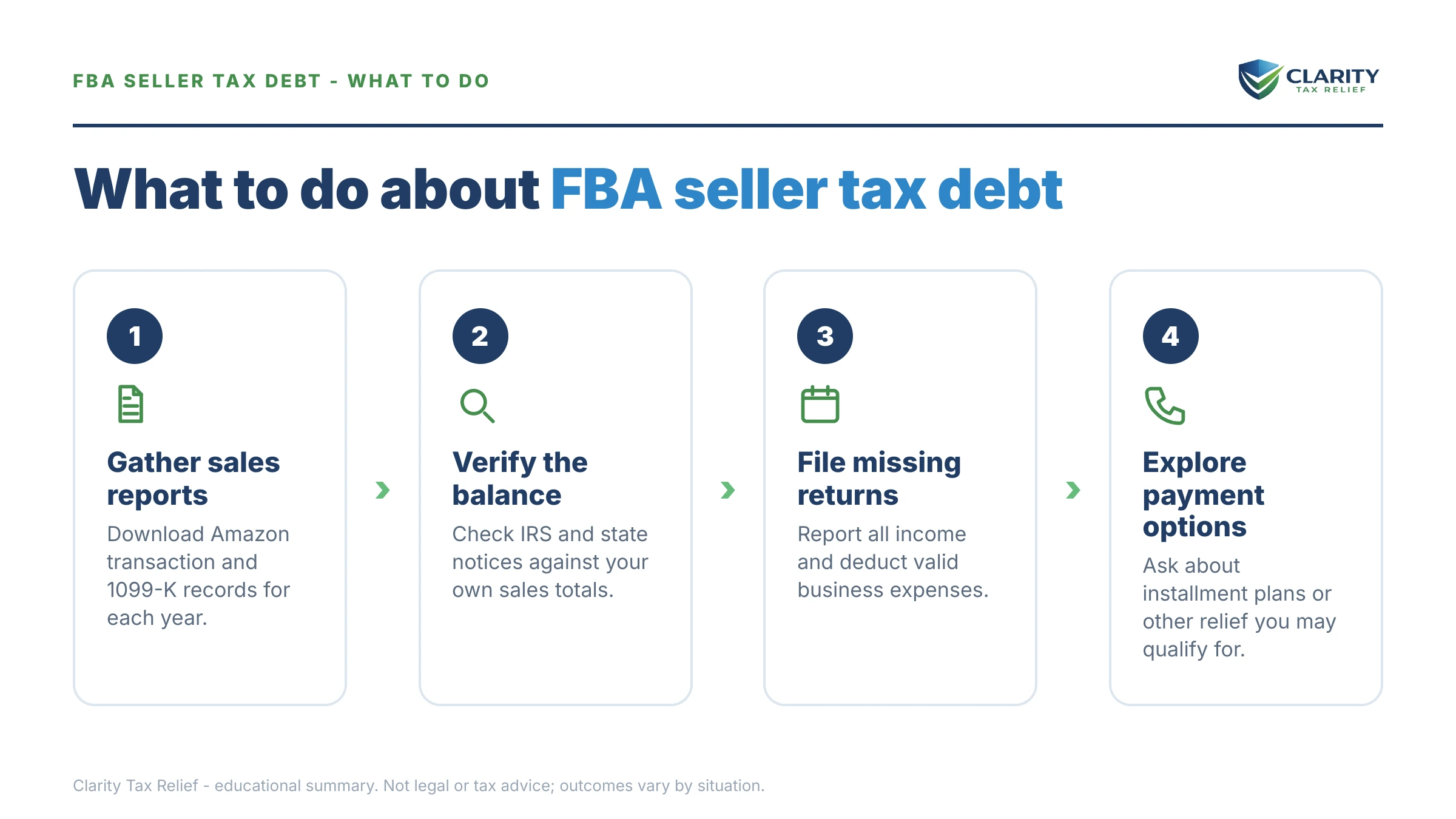
What happens if you ignore FBA back taxes
Unpaid FBA tax debt moves through an automated IRS notice sequence that ends in bank levies and a continuous wage levy if you also have a W-2 job. Which track you're on depends on how the debt arose:
- Underreported (filed, but reported deposits instead of gross): a CP2000 proposes additional tax on the mismatch. Ignore it and the IRS issues a statutory notice of deficiency, then assesses the balance — at which point you join the collection track below.
- CP14 — the first bill, with roughly 21 days to pay or arrange something before reminders start.
- CP501 / CP503 — reminder notices. Still just bills, but the 0.5% monthly penalty and daily interest keep compounding.
- CP504 — intent to levy your state tax refund; a federal tax lien against your assets (including business inventory) becomes realistic.
- LT11 / Letter 1058 — final notice of intent to levy. After 30 days, the IRS can levy bank accounts — including the one your Amazon disbursements land in. A bank levy carries a 21-day hold before funds leave; you also have Collection Due Process appeal rights at this stage.
- Never filed at all: the IRS can prepare a substitute return using the 1099-K gross with zero COGS and zero fees — the single worst tax outcome available to an FBA seller.
One 2026 reality check: the IRS workforce was cut roughly 27% in 2025, so reaching a human is harder than ever — but these notices are generated by automated systems that never stopped running. Silence from the IRS is not resolution; it's queueing.
Behind on FBA taxes with 1099-Ks already on file?
Amazon has already reported your gross sales to the IRS, and the balance grows every month whether anyone calls you or not. Get your seller case reviewed free by an experienced tax professional — we'll map the federal and state exposure before you pay a dollar.
Your options for resolving Amazon FBA tax debt
An FBA seller owing $36,900 qualifies for a streamlined installment agreement online, because the balance is under $50,000 — and that's only one of several paths. Often the biggest lever isn't a payment program at all: if a filed return omitted COGS or Amazon fees, amending the return to reduce the tax debt can shrink the balance before you negotiate anything. The general playbook for negotiating with the IRS lives in our guide to how to settle tax debt yourself; here's how the options line up for a seller.
| Option | Who qualifies | Key limit |
|---|---|---|
| Short-term payment plan | Anyone who can full-pay within 180 days | $0 setup; penalties and interest keep accruing until paid |
| Guaranteed installment agreement | Balance of $10,000 or less, all returns filed | Must full-pay within 3 years; IRS must accept |
| Streamlined installment agreement | Balance of $50,000 or less | Up to 72 months, set up online with no financial disclosure |
| Non-streamlined plan / partial-pay | Over $50,000, or can't afford the streamlined minimum | Full financial disclosure (Form 433 series); lien filing more likely |
| Currently Not Collectible | Allowable living expenses consume your income | Collection pauses, but the debt keeps growing and refunds are offset |
| Offer in Compromise | Assets plus future income genuinely below the balance | Means-tested; roughly 1 in 5 offers accepted in FY2024 |
| Penalty relief (FTA / AEP) | Clean compliance history for the prior 3 years | Removes penalties, not the underlying tax or interest |
Two seller-specific notes. On penalty relief: first-time penalty abatement can strip failure-to-file and failure-to-pay penalties for a qualifying year, and starting summer 2026 the IRS's Automatic Exemption from Penalty (AEP) begins applying similar relief automatically, with no request needed — so don't pay a penalty balance without checking eligibility first. On the Offer in Compromise: an operating FBA business with inventory value and ongoing profit usually fails the means test, because the IRS counts what it could collect, not what's convenient. There's a $205 application fee and a 20% down payment on lump-sum offers (both waived with low-income certification, AGI at or below 250% of the poverty level). You can estimate what penalties and interest have added to your own balance with our IRS Penalty & Interest Calculator.
| Option | Upfront cost | What it looks like on $36,900 |
|---|---|---|
| Short-term plan (180 days) | $0 | Full payment within 180 days; accruals continue until the last dollar posts |
| Streamlined 72-month plan | Modest online setup fee (lower with direct debit) | Roughly $513/month minimum; budget closer to $575–$600 to cover accruing interest |
| Currently Not Collectible | $0 | No monthly payments; balance grows and each year's refund is applied to it |
| Offer in Compromise | $205 fee + 20% of the offer (lump sum); waived for low-income | Decisions commonly take months to two years; rejected if assets and income can cover $36,900 |
| Penalty abatement (FTA/AEP) | $0 | Can remove thousands in penalties for a qualifying year without touching the plan |
A worked example: a married couple owing $36,900
Say you and your spouse file jointly and your FBA store left you $36,900 behind across two tax years — roughly $29,400 in income and self-employment tax you couldn't pay after reinvesting in inventory, plus about $7,500 in accumulated penalties and interest. This is hypothetical, but the math is what the IRS would actually run:
- Streamlined plan: $36,900 is under $50,000, so you qualify online with no financial disclosure. $36,900 ÷ 72 months = a $513 minimum payment — but interest and the (reduced) monthly penalty keep accruing on the declining balance, so a realistic payment is $575–$600 if you want it gone in 72 months.
- Paying faster: at $1,100/month the balance clears in roughly 36 months, and you skip about three years of accruals — the cheapest realistic path if cash flow allows.
- Offer in Compromise check: if you have, say, $45,000 in home equity plus $12,000 in sellable inventory, the IRS's collection-potential math already exceeds $36,900 — an offer would be rejected on arithmetic alone, no matter what an ad promised.
- Passport check: $36,900 sits under the $66,000 seriously-delinquent threshold for 2026 passport certification — but add one more unfiled year of accruals and a growing balance can cross it.
How to respond to Amazon FBA tax debt, step by step
- Download your Amazon records. Pull the date-range summary report, fee reports, and every 1099-K from Seller Central's Tax Document Library for each unfiled or disputed year, plus your IRS wage and income transcripts.
- File or amend your Schedule C returns. Report the full 1099-K gross figure, then deduct cost of goods sold, Amazon fees, shipping, and other expenses so you're taxed on real profit instead of gross sales.
- Verify what each year shows. Log into your IRS online account after the returns process and confirm the balance, penalties, and interest for every year.
- Set up a resolution before enforcement starts. Choose the payment plan, hardship status, or offer that fits your numbers and set it up at IRS.gov/payments or by phone before a final notice arrives.
- Fix the go-forward. Start quarterly estimated payments and monthly bookkeeping so the next filing season doesn't rebuild the same debt.
When you can handle this yourself — and when help changes the outcome
You can usually resolve FBA tax debt on your own when you agree with the balance, it's a single year, your Schedule C was filed with accurate COGS and fees, and the amount fits a plan you can set up online in twenty minutes. A seller who owes $9,000 on an otherwise correct return doesn't need representation — they need a guaranteed installment agreement and a quarterly-payment habit.
Experienced help earns its cost in specific situations: a CP2000 that taxed your gross instead of your net (the response requires reconciling Amazon's reports line by line), multiple unfiled years that need COGS reconstructed from supplier invoices, a state sales-tax assessment for pre-facilitator years — especially from the CDTFA — a levy already in motion against your disbursement account, or OIC math where one wrong asset valuation sinks the offer. In each of those, the order and quality of the paperwork changes what you ultimately pay.
Terms on your Amazon tax forms, decoded
- Form 1099-K — the information return Amazon files reporting your gross payment volume to the IRS; the official explainer is at IRS.gov: Understanding your Form 1099-K.
- Gross payments — every dollar buyers paid before Amazon deducted a single fee; it is not your income, but it's the number the IRS starts from.
- Cost of goods sold (COGS) — what you paid for the inventory that actually sold during the year; unsold stock isn't deductible yet.
- Self-employment tax — the 15.3% Social Security and Medicare tax owed on net profit, on top of regular income tax.
- Nexus — a connection to a state (like inventory in its warehouses) strong enough to create a tax obligation there.
- Marketplace facilitator law — a state law making the marketplace (Amazon) collect and remit sales tax instead of you; California's rules are administered by the CDTFA.
Amazon FBA taxes: questions sellers ask
Does Amazon report my sales to the IRS?
Yes. Amazon issues Form 1099-K to you and the IRS once you pass $20,000 in gross payments and 200 transactions — the threshold in effect for 2026 after the $600 rule was rolled back. Many states require copies at lower thresholds, so your state revenue agency may see your numbers even in years the IRS doesn't.
Do FBA sellers pay taxes on gross sales or net profit?
You owe income tax and self-employment tax on net profit — gross sales minus cost of goods sold, Amazon fees, shipping, and other business expenses. The problem is the 1099-K reports unadjusted gross, so if you don't file a Schedule C proving your deductions, the IRS's automated systems treat the gross figure as your income.
Do I still owe state sales tax if Amazon collects it now?
For current sales, generally no — every state with a statewide sales tax now has a marketplace facilitator law making Amazon responsible for collecting and remitting. But those laws mostly took effect between 2018 and 2020. If your FBA inventory sat in a state's warehouses before its law took effect, that state can still assess you for the older years — California's CDTFA has been the most aggressive about it.
What if I never tracked inventory or COGS?
You can reconstruct it. Amazon's Seller Central date-range and inventory reports show your sales, fees, and refunds by year, and supplier invoices, purchase orders, and bank records establish what you paid for goods. Remember that inventory is deducted as cost of goods sold when it sells, not when you buy it — a reconstruction that deducts every purchase in the year you bought it will be wrong and can trigger an exam.
Can I settle Amazon FBA tax debt for less than I owe?
Only if the IRS's own math shows it can't collect the full amount from your assets and future income — the Offer in Compromise is means-tested, and the IRS accepted roughly 1 in 5 offers in FY2024. A seller with home equity, inventory value, and ongoing profit usually resolves the debt through a payment plan instead. Penalty abatement is the more realistic reduction for most sellers.
Can the IRS levy my Amazon disbursements?
Yes — the IRS can levy the bank account your disbursements land in, and it can serve a levy on payments Amazon owes you. A bank levy comes with a 21-day hold before the funds leave, which is your window to act. Levies only start after the IRS sends a final notice of intent to levy and 30 days pass, so you will have warning — if your mailing address is current.
Do FBA sellers have to pay quarterly estimated taxes?
Yes, if you expect to owe $1,000 or more for the year — which nearly every profitable FBA seller does, because nothing is withheld from Amazon disbursements. Payments are due roughly April 15, June 15, September 15, and January 15. Skipping them adds an underpayment penalty on top of the balance itself, every single year.
Your next 24 hours
- Find your real numbers. Open Seller Central's Tax Document Library, download every 1099-K, and note the Box 1a gross figure for each year in question — that's what the IRS is working from.
- Gather your paper. Your last filed return, any IRS or state notices you've received, supplier invoices or bank statements showing inventory purchases, and a rough sense of monthly household income.
- Get the free case review. Use the 2-minute form or call (888) 825-7779 — an experienced tax professional will separate what you actually owe from what the 1099-K gross implies, before another month of penalties and interest posts to the balance.
This guide is general information, not tax or legal advice for your specific situation. Eligibility for IRS programs depends on individual facts and circumstances; no outcome is guaranteed.