
Self-Employed & Gig Taxes
How Do Quarterly Estimated Taxes Work? The Complete 2026 Guide
The short answer: how do quarterly estimated taxes work? You prepay tax on income that has no withholding — gig, freelance, rental, or investment earnings — in four installments due April 15, June 15, September 15, and January 15. Pay at least a "safe harbor" amount (usually 100% of last year's total tax) and you owe no underpayment penalty.
Your app deposits the full payout every week — no taxes taken out, no W-2 at year end, and nobody ever mentioned that the IRS expected a payment from you back in June. If you just learned the phrase "estimated taxes" from a scary balance or a penalty line on a return, you're in the right place. The system is simpler than it looks, and being behind — even years behind — has a fixable path.
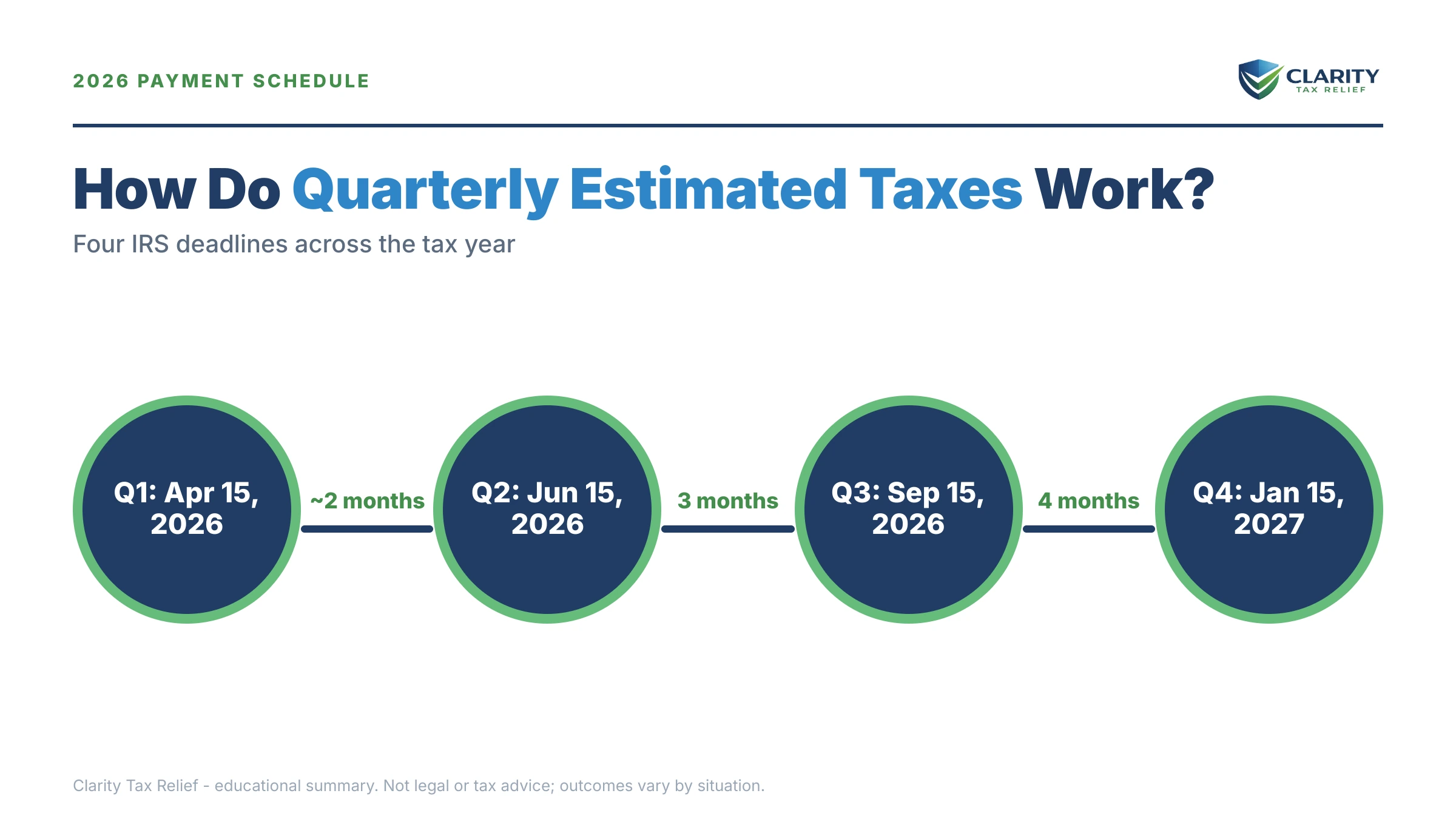
This guide covers the whole thing: who has to pay, the exact 2026 due dates, how much each payment should be, the penalty math when you skip them, and every option if you're already in the hole. The image below shows exactly how the four-payment schedule fits into the year, because the "quarters" are not what most people assume.
⏱ Your next deadline: the third 2026 estimated payment is due September 15, 2026; the fourth and final one is due January 15, 2027. Miss an installment and the underpayment penalty starts accruing on that quarter's shortfall the very next day — it doesn't wait for April.
Why the IRS wants quarterly payments — and who has to make them
You're generally required to make quarterly estimated payments if you expect to owe $1,000 or more for the year after subtracting withholding and refundable credits. The U.S. tax system is pay-as-you-go: W-2 employees pay with every paycheck through withholding, and everyone else is expected to send the money in themselves, four times a year, using the schedule from Form 1040-ES.
That $1,000 trigger catches far more people than "business owners." It reaches delivery and rideshare drivers, freelancers, resellers, landlords, retirees with big investment gains, and anyone who sold stock or crypto at a profit. If no one is withholding for you, the IRS assumes you're doing it yourself.
Two groups get special treatment: farmers and commercial fishermen who earn at least two-thirds of their income from farming or fishing can make a single payment by January 15 instead of four. And if you had zero tax liability last year as a full-year U.S. citizen or resident, you're exempt from the penalty for this year — a quirk that saves many first-year self-employed people.
How do quarterly estimated taxes work? The four-payment system
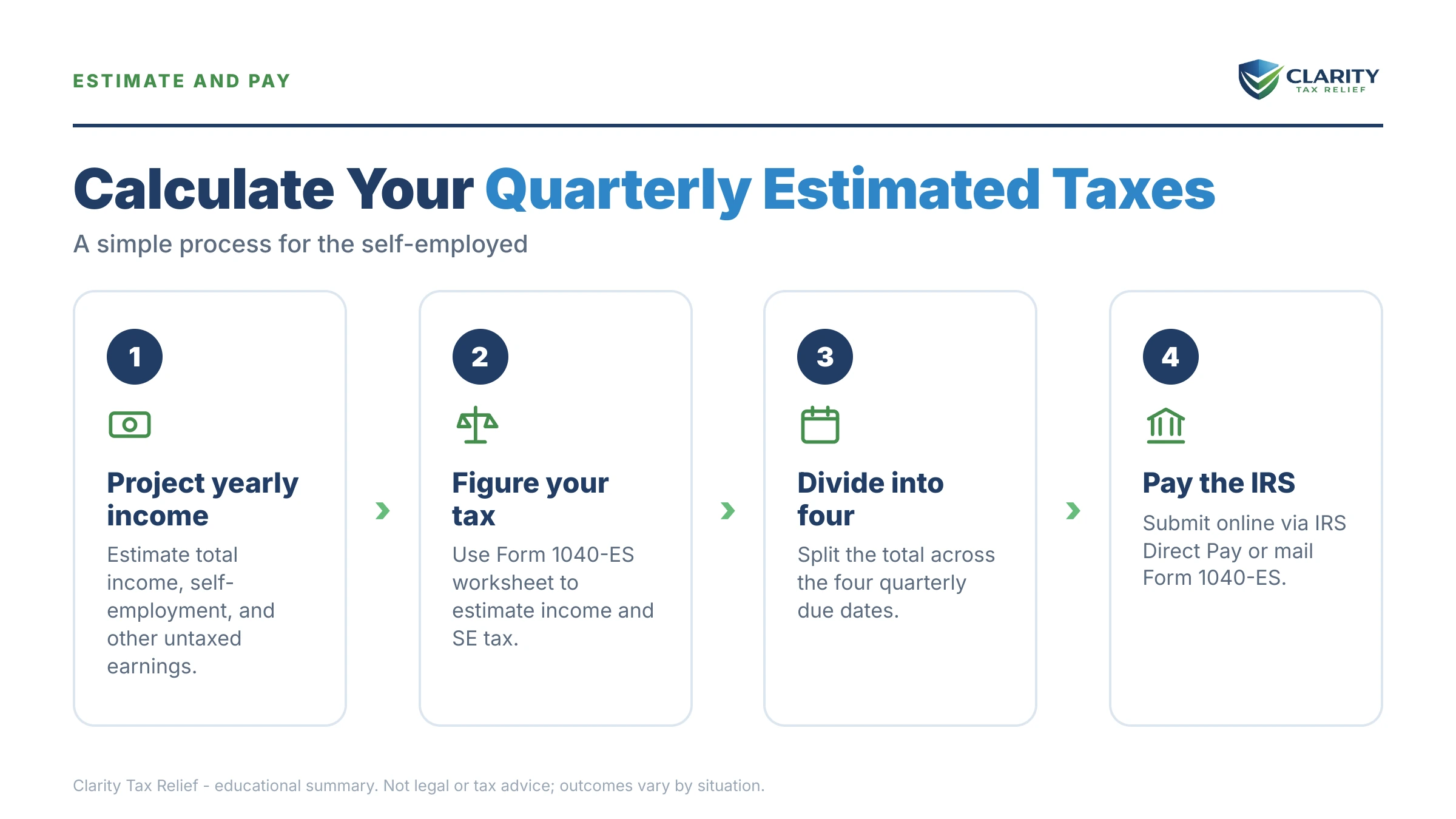
Quarterly estimated taxes work by splitting your expected annual tax bill into four prepayments, each with its own due date and its own penalty clock. You estimate what you'll owe for the full year — income tax plus self-employment tax — divide it into installments, and pay each one by its deadline through IRS Direct Pay, your IRS online account, EFTPS, or a mailed Form 1040-ES voucher.
Here's the part almost everyone misses: the four "quarters" are not equal three-month blocks. The second payment covers only two months of income, and the fourth covers four. That's why a payment sneaks up in mid-June, barely two months after tax day, and why the last one lands in the middle of January when the year already feels closed.
The IRS doesn't send you a bill for these. No reminder arrives before a due date — the first mail you get about estimated taxes is usually the penalty notice after you've already missed them.
2026 quarterly estimated tax deadlines
The 2026 quarterly estimated tax deadlines are April 15, June 15, and September 15, 2026, and January 15, 2027. Each installment covers a specific slice of the year's income:
| Payment | Income period covered | Due date |
|---|---|---|
| 1st installment | January 1 – March 31 (3 months) | April 15, 2026 |
| 2nd installment | April 1 – May 31 (only 2 months) | June 15, 2026 |
| 3rd installment | June 1 – August 31 (3 months) | September 15, 2026 |
| 4th installment | September 1 – December 31 (4 months) | January 15, 2027 |
If a due date falls on a weekend or federal holiday, it rolls to the next business day, and federally declared disaster areas can get postponed dates. For the deadline-by-deadline detail, see our full guide to the quarterly estimated tax deadlines 2026.
How much to pay each quarter: the safe-harbor rules
You avoid the underpayment penalty entirely by paying either 90% of this year's tax or 100% of last year's tax through the year — 110% of last year's if your AGI was over $150,000. These "safe harbors" exist because the IRS knows you can't perfectly predict a year that hasn't happened yet. You don't have to be right; you have to hit one of the targets.
| Your situation | Required payment through the year |
|---|---|
| Most filers (prior-year AGI $150,000 or less) | The smaller of 90% of this year's tax or 100% of last year's total tax |
| Prior-year AGI over $150,000 ($75,000 married filing separately) | 110% of last year's total tax (or 90% of this year's) |
| You'll owe under $1,000 after withholding and credits | No estimated payments required |
| Zero tax liability last year (full-year U.S. citizen or resident, 12-month return) | No underpayment penalty this year |
| Farmers and fishermen (two-thirds of income from farming/fishing) | One payment of 66⅔% of this year's tax by January 15 |
The prior-year safe harbor is the one to use when income is unpredictable. Pull last year's return, find the total-tax line, divide by four, and pay that each quarter. Even if you earn double this year, you owe no penalty — you'll just have a balance to pay in April, which you'll have seen coming.
Remember that "tax" here means both layers. Self-employment tax alone runs 15.3% on about 92.35% of your net profit — the piece that produces the self-employment-tax shock for most first-year filers. As a rough set-aside, most gig workers land somewhere between 20% and 30% of net profit depending on income level and state; our guide to side-hustle taxes and how much to save walks through picking your number.
A worked example: the math forward, and $19,700 backward
One hypothetical, both directions. Forward: say you deliver full-time and expect about $45,000 in gross app payouts for 2026, with $5,000 in deductible mileage and expenses — $40,000 of net profit.
- Self-employment tax: $40,000 × 92.35% = $36,940 taxable base; × 15.3% ≈ $5,650.
- Income tax: after deducting half the SE tax and your standard deduction, roughly $2,300–$3,300 for a single filer at this income — call it $2,800.
- Total ≈ $8,450 for the year → about $2,110 per quarter, or roughly 19 cents of every gross payout dollar. Setting aside 25% builds in a cushion.
Backward: now say you never ran that math — for three years. Three years of unpaid SE and income tax, plus failure-to-file and failure-to-pay penalties and interest, can stack to a combined balance of, say, $19,700. That figure sits under the $50,000 line, so once all returns are filed you'd qualify to request a streamlined installment agreement online: $19,700 ÷ 72 months ≈ $274/month minimum. Interest and the 0.5% monthly late-payment penalty keep accruing inside the plan, so paying $350–$400 instead clears it years sooner and materially cheaper. The point: even a three-year hole resolves with arithmetic, not magic.
What happens if you skip quarterly payments
Skipping estimated payments triggers an automatic underpayment penalty on each missed installment, and if you also stop filing, the IRS's collection machine eventually takes over. The sequence runs in stages:
- Each missed installment starts its own penalty clock. The IRC §6654 underpayment penalty accrues on each quarter's shortfall from its due date, at a rate pegged to the IRS's quarterly interest rate. The full mechanics are in our guide to the underpayment penalty on estimated taxes.
- April arrives with a stacked bill. File, and the year's full tax plus the underpayment penalty comes due at once — often announced by a CP30 notice if the IRS computes the penalty for you. Don't file, and the failure-to-file penalty (5% per month) runs at ten times the failure-to-pay rate; a CP59 non-filer notice follows, and eventually the IRS can file a substitute return with no deductions.
- The balance-due notices begin. A CP14 bill gives you about 21 days before the sequence escalates, followed by CP501 and CP503 reminders — all automated.
- CP504 — the IRS can take your state refund. A federal tax lien also becomes a live possibility at this stage.
- LT11 — final notice of intent to levy. A 30-day clock starts on your Collection Due Process rights; after it runs, wage garnishment and bank levies are on the table. Let several unpaid years stack past $66,000 and passport certification enters the picture too.
Repeat non-payers get squeezed twice: this year's penalties compound while next year's installments keep coming due. Our breakdown of what happens when you didn't pay estimated taxes shows the penalty math year over year, and you can estimate your own penalty and interest with our calculator. One 2026 reality worth naming: IRS staffing fell roughly 27% in 2025, so reaching a human is harder than ever — but every notice in that list is generated by automated systems that never stopped running.
Behind on quarterlies — or behind on filing entirely?
Whether you missed one installment or three whole years, the balance grows every month it sits. Get a free, confidential review of exactly where you stand before the September 15 installment adds another layer — an experienced tax professional will map your fastest, cheapest way out.
Already behind? Your options, compared
Every unpaid estimated-tax balance eventually becomes ordinary back-tax debt, and the IRS has a defined menu for resolving it — each option with its own eligibility line:
| Option | Who qualifies | Cost and notes |
|---|---|---|
| Pay in full | Anyone | Stops the 0.5%/month late-payment penalty and interest immediately; cheapest total cost |
| Short-term payment plan | Can pay in full within 180 days | $0 setup fee; interest and penalties keep accruing, but enforcement pauses |
| Guaranteed installment agreement | Owe $10,000 or less; returns filed and current | The IRS must accept it; pay within the agreement's term |
| Streamlined installment agreement | Owe $50,000 or less; all returns filed | Up to 72 months, set up online without detailed financial disclosure; accrual continues |
| Currently Not Collectible status | Paying anything would prevent basic living expenses (means-tested) | Collection pauses; the debt and interest remain and the IRS reviews your income periodically |
| Offer in Compromise | Assets plus future income genuinely can't cover the debt | $205 fee (waived with low-income certification); the IRS accepted roughly 1 in 5 offers in FY2024 |
| Penalty relief (Form 2210 waiver) | Casualty, disaster, or unusual circumstance; or retired 62+/disabled with reasonable cause | Removes the estimated-tax penalty itself — see below for why first-time abatement doesn't apply |
One trap specific to this penalty: first-time penalty abatement does not cover the §6654 estimated-tax penalty — it applies to failure-to-file, failure-to-pay, and deposit penalties. Relief for the estimated-tax penalty runs through the waiver lines and annualized method on Form 2210 instead; our estimated tax penalty waiver guide covers what actually qualifies. (The new Automatic Exemption from Penalty, rolling out summer 2026, changes how the covered penalties get relieved — automatically, no request needed — but it likewise targets the filing and payment penalties, not §6654.) For the shared playbook on plans, hardship status, and offers, see how to settle tax debt yourself; for the online plan setup itself, our walkthrough on how to set up an IRS payment plan online takes about ten minutes to follow.
Three years unfiled? Fix things in this order
If you have unfiled years, filing comes before everything else — the failure-to-file penalty runs at 5% per month, ten times the pay penalty, and no payment plan or relief program is available until the returns are in. The sequence that minimizes total cost:
First, reconstruct your income. The IRS already has your 1099s on file; pull them through your wage and income transcripts, and see our guide to getting old W-2s and income records. Your app earnings summaries fill the gaps, and even a reconstructed mileage log can legitimately cut a delivery driver's taxable profit dramatically.
Second, file all missing returns — before the IRS files substitute returns for you with zero deductions. Note the clock running the other way too: refunds from returns more than three years overdue are forfeited, so any withholding or credits in your oldest year may expire if you keep waiting. The full roadmap is in haven't filed in 3 years.
Third, resolve the combined balance using the table above — and start current-year quarterly payments at the same time, because the IRS won't approve or maintain a resolution while you keep digging the hole. If your situation started with app work specifically, our Instacart shopper didn't pay quarterlies guide follows this exact path with platform-specific details.
Situations that change the quarterly math
W-2 job plus a side hustle. You may not need quarterly payments at all: withholding is treated as paid evenly through the year no matter when it comes out, so raising withholding at your day job via a new Form W-4 — even in November — can retroactively cover a safe harbor. If you owe every April despite two paychecks, see two jobs and owing every year.
Married couples. On a joint return, one spouse's paycheck withholding counts toward the couple's combined safe harbor — often the easiest fix when one spouse is self-employed. Married filing separately halves the high-income trigger: the 110% safe harbor kicks in at $75,000 of AGI instead of $150,000.
Seasonal or lumpy income. If most of your money arrives in one stretch — wedding photographers, tax preparers, holiday sellers — the annualized income installment method on Form 2210, Schedule AI matches each installment to when income actually landed, often erasing the penalty the equal-payments math would charge.
You have employees. Your personal 1040-ES payments and your business's payroll tax deposits are entirely separate systems with separate penalties — and payroll is the one the IRS pursues hardest, including personally. If you're behind there too, start with 941 back taxes.
State estimated taxes. Most states with an income tax run their own quarterly system with their own due dates, thresholds, and penalties — meeting the IRS safe harbor does nothing for your state. Check your state revenue agency's rules directly; California's FTB, for one, calculates its estimated-tax requirements differently than the IRS does.
How to set up quarterly estimated payments, step by step
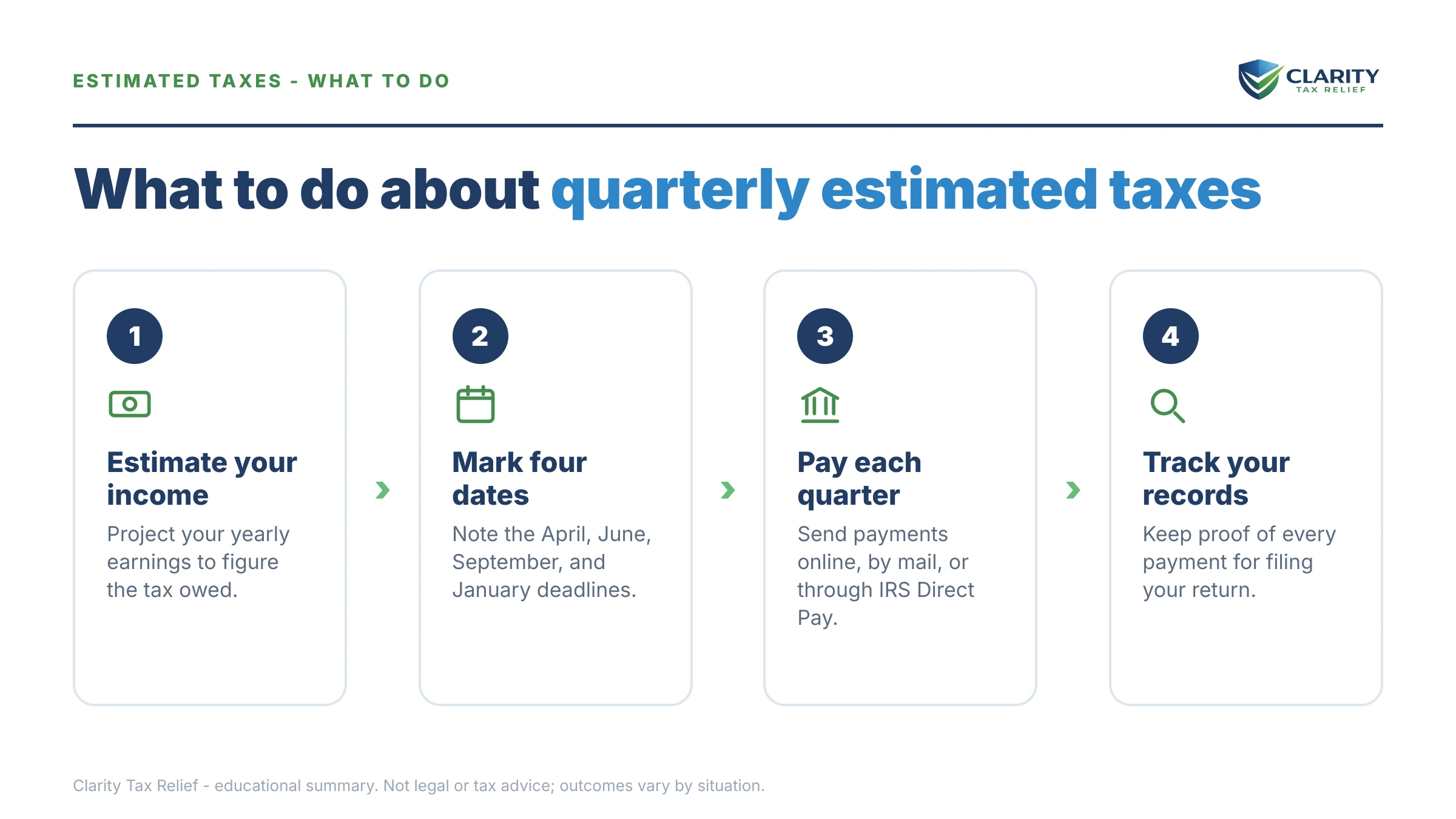
- Estimate your annual profit. Project your 2026 net self-employment income — gross receipts minus expenses like mileage, supplies, and platform fees. A rough number beats no number; you can refine it every quarter.
- Pick your safe harbor. Find the total-tax line on last year's return. Paying 100% of it (110% if your AGI topped $150,000) across four installments guarantees no penalty, whatever this year brings.
- Divide by four and move the money. Split the safe-harbor amount into four payments, and shift a set percentage of every payout into a separate savings account so the money exists on each due date.
- Pay online. Use IRS Direct Pay or your IRS online account, choose estimated tax and tax year 2026, and save the confirmation. No Form 1040-ES voucher or mailing required.
- Recalculate every quarter. Before each due date, compare actual income to your projection and adjust the remaining installments — don't wait until April to find out you were short.
All electronic options live at IRS.gov/payments, and the worksheet for estimating your own number is inside Form 1040-ES.
When you can handle this yourself
Most estimated-tax situations are genuinely do-it-yourself. If you're current on filing and just discovered quarterlies exist, the five steps above are the whole job. If you missed a payment or two this year, pay the shortfall now, let the software compute the (usually modest) penalty at filing, and move on. If your total balance is small enough to clear within 180 days, the $0-fee short-term plan takes minutes to set up — no professional needed for any of that.
Experienced help changes the outcome in a narrower set of situations: multiple unfiled years where filing order and income reconstruction determine what you ultimately owe; a CP504 or LT11 already in hand, where deadlines now carry enforcement consequences; business payroll debt layered on top of personal SE debt; disputed 1099 amounts inflating the balance; or Offer in Compromise math, where a miscalculated offer wastes months and fees. The honest test is whether the facts are complicated — not whether the balance feels scary.
If you're staring at three unfiled years and a five-figure balance and don't know which thread to pull first, that's exactly what a free case review is for — twenty minutes to get the sequence right before another quarter of penalties posts.
Terms on Form 1040-ES, decoded
Estimated tax: tax you prepay during the year on income that has no withholding — the self-employed person's version of a paycheck deduction.
Safe harbor: a payment target (90% of this year's tax, or 100–110% of last year's) that guarantees no underpayment penalty even if your estimate turns out wrong.
Self-employment tax: the 15.3% Social Security and Medicare tax on net self-employment profit — owed on top of income tax, starting at just $400 of profit.
Underpayment penalty (IRC §6654): an interest-style charge on each installment you underpaid, running from that installment's due date; it applies even if you pay everything by April.
Annualized income installment method: the Form 2210 Schedule AI calculation that matches your required payments to when income actually arrived — the fix for seasonal earners.
Withholding: tax taken out of wages or pension payments; unlike estimated payments, it counts as paid evenly across the year regardless of timing.
Quarterly estimated tax questions, answered
Do I have to pay quarterly estimated taxes if I also have a W-2 job?
Only if your paycheck withholding won't cover at least $1,000 of the tax on your side income. Many people skip quarterlies entirely by filing a new W-4 and increasing withholding at their day job — withholding is treated as paid evenly through the year no matter when it comes out. If the side income is large relative to your wages, though, quarterly payments are usually the cleaner fix.
What happens if I miss one quarterly payment?
The underpayment penalty starts accruing on that quarter's shortfall the day after the due date, at a rate tied to the IRS's quarterly interest rate. It keeps running until you pay or until April 15 of the following year, whichever comes first. Paying late is always cheaper than not paying — send the money as soon as you can rather than waiting for the next due date.
Can I just pay all my tax in April instead of paying quarterly?
You can, but the IRS will add an underpayment penalty even though you paid in full — the penalty is for paying late, not for never paying. Each quarter's installment has its own due date, and the penalty runs on each missed installment separately. The exception: if you owe less than $1,000 after withholding, or you met a safe harbor, no penalty applies.
How do I know if I'm required to make estimated payments?
You're generally required to pay quarterly if you expect to owe $1,000 or more for the year after subtracting withholding and refundable credits. That threshold catches most self-employed people, gig workers, landlords, and investors with meaningful untaxed income. If your withholding from a job or pension covers a safe-harbor amount, you're off the hook even with substantial 1099 income.
Do quarterly estimated payments cover self-employment tax too?
Yes — your four payments must cover income tax and self-employment tax combined. Self-employment tax runs 15.3% on about 92.35% of your net profit, and it applies from the first dollar of profit over $400, even if your income is too low to owe any income tax. It's the piece most first-year gig workers forget, and it's usually the bigger half of a modest earner's bill.
What if my income is different every month?
You can match your payments to when the money actually arrived using the annualized income installment method on Form 2210, Schedule AI. It lets a seasonal earner pay small installments in slow quarters and larger ones after busy stretches without penalty. The form takes real bookkeeping, but for genuinely uneven income it can erase a penalty the standard four-equal-payments math would charge.
Can the estimated-tax penalty be waived or removed?
Sometimes. Form 2210 allows a waiver if the underpayment came from a casualty, disaster, or other unusual circumstance, or if you retired after age 62 or became disabled and had reasonable cause. First-time penalty abatement does not apply to this penalty, so the waiver lines on Form 2210 — or the annualized income method — are the real relief paths.
Do I have to pay quarterly taxes in my first year of self-employment?
If you had zero tax liability last year, were a U.S. citizen or resident all year, and your prior return covered 12 months, there's no underpayment penalty for this year — the prior-year safe harbor is effectively $0. You'll still owe the full bill next April, though, so set money aside anyway. From year two on, the normal quarterly rules apply.
Can I pay estimated taxes monthly instead of four times a year?
Yes — the IRS accepts estimated payments anytime, and paying monthly is often easier on gig-income cash flow. The penalty math only checks whether enough had been paid in by each quarterly due date, so twelve smaller payments that stay ahead of the four deadlines work fine. Many self-employed people move a set percentage of every payout the day it lands.
Your next 24 hours
- Pull last year's tax return and find the total-tax line. Divide it by four — that single number is your penalty-proof quarterly payment for 2026 (use 110% of it if your AGI topped $150,000).
- Gather your income records: this year's app or platform earnings summaries and any 1099s — and for unfiled years, whatever bank statements and payout histories you can export today.
- If you're already behind — one missed quarter or three whole years — get a free case review at the form or (888) 825-7779 before the September 15 installment stacks another layer on a balance that's already accruing penalties and interest monthly.
The IRS's own overview of the rules lives at its estimated taxes page for the self-employed.
This guide is general information, not tax or legal advice for your specific situation. Eligibility for IRS programs depends on individual facts and circumstances; no outcome is guaranteed.