
Back Taxes & Unfiled Returns
How to Get an Old W-2 for Back Taxes in 2026: Every Option That Works
The short answer: the fastest way to get an old W-2 for back taxes is a free IRS wage and income transcript — downloadable in minutes from your IRS online account, covering roughly the past 10 years. It lists every W-2 an employer filed under your Social Security number. The SSA, old employers, and Form 4852 fill any gaps.
You're finally ready to file those back years — and then you hit the wall: the W-2s are gone. A move, a closed employer, a payroll portal that locked you out years ago. Here's the part nobody tells you: the IRS has been holding a copy of every one of those W-2s all along, and you can have the numbers tonight without calling a single old boss.
This guide walks through all six ways to recover old W-2 data, which one fits which situation, the one thing IRS transcripts won't show you, and what actually happens — penalties, refunds, payment options — once the returns are filed. The image below shows exactly what a wage and income transcript looks like and where each employer's wages and withholding appear, so you'll know you're reading the right document when you download yours.
⏱ The real clocks: You have 3 years from a return's original due date to claim that year's refund. After that, the withholding on your old W-2 is forfeited permanently. And on years where you owe, the failure-to-file penalty grows at 5% of the unpaid tax per month until it caps at 25% — so the meter is running while you search.
Why the IRS already has every W-2 you've lost
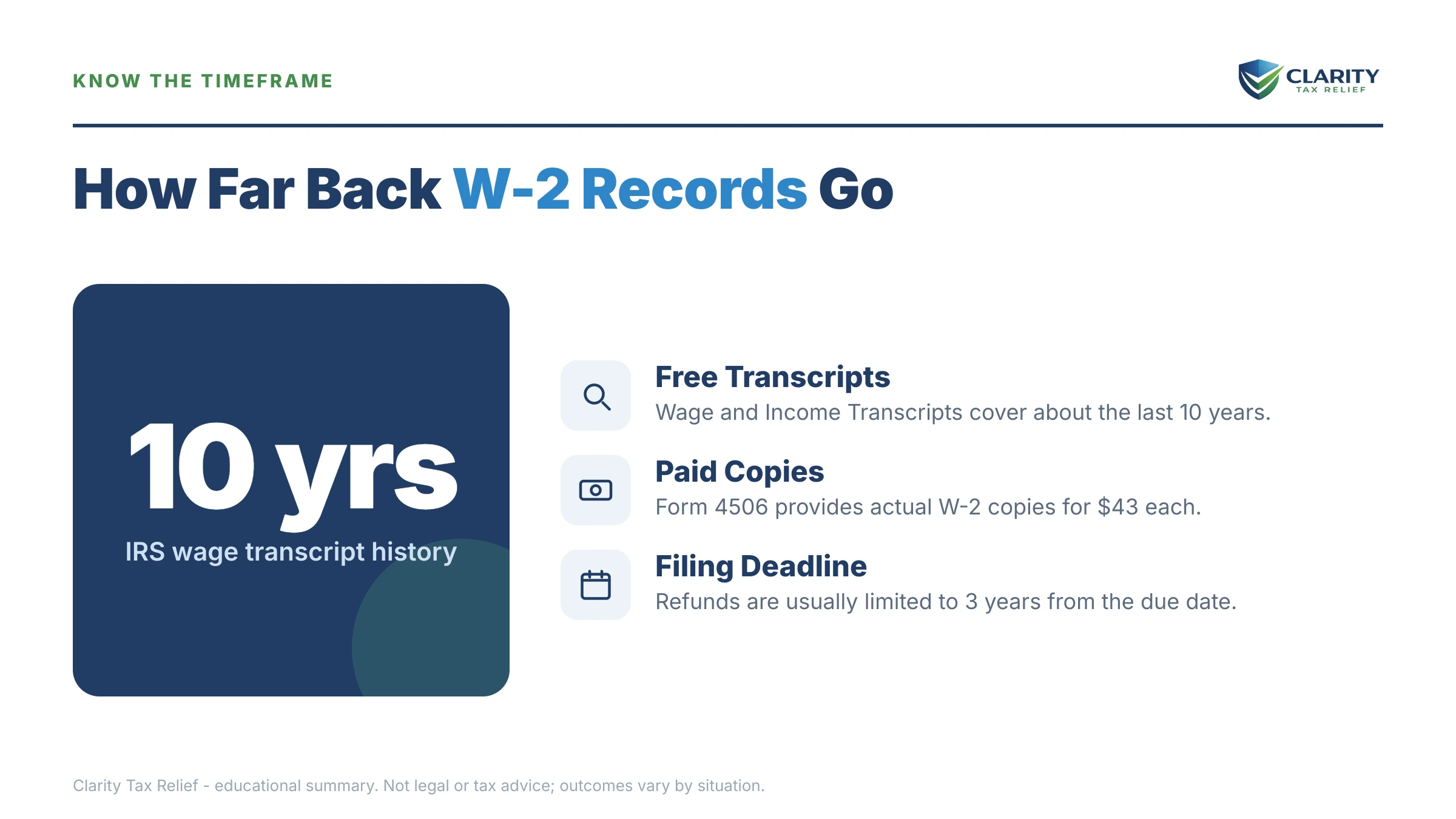
Every W-2 an employer issues is also filed with the Social Security Administration and shared with the IRS — so the government has held its own copy of your missing W-2s since the year they were issued. You don't need the physical form to file a back-tax return. You need the numbers on it, and those numbers sit in an IRS database called the wage and income transcript, available for roughly the current year plus the nine prior years.
One timing quirk matters in 2026: the most recent year's data isn't fully loaded until around mid-summer, because employers file W-2s early in the year and the IRS takes months to match everything. If you're rebuilding last year's W-2 in the spring, check back — the transcript fills in as the year goes on.
W-2s go missing for predictable reasons: a move, a divorce, a laptop that died with the PDF on it, an employer that shut its doors. The one genuinely bad scenario is an employer that never filed the W-2 at all — often a business that fell behind on its own 941 back taxes and stopped filing payroll forms entirely. Even then you have a path (Form 4852, covered below). But start with the IRS transcript first; most people waste weeks chasing former employers for a document the government would have handed them in ten minutes.
What happens if you keep waiting to file
The failure-to-file penalty runs at 5% of the unpaid tax per month — ten times the 0.5% failure-to-pay rate — which makes a lost W-2 the most expensive excuse in the tax code. The IRS doesn't wait for you to find your paperwork. Here's the sequence a missing return travels, in order:
- Penalties compound month by month. On any year with a balance, the failure-to-file penalty stacks at 5% per month until it caps at 25%; then the 0.5% monthly failure-to-pay penalty and daily-compounding interest keep going.
- Refund years quietly expire. If a year's withholding exceeds the tax, you're owed money — but only for 3 years from the original due date. Miss the window and that refund is gone, not delayed. See the 3-year refund deadline for old returns.
- Non-filer notices start arriving. The IRS knows about your W-2 income even though you didn't file — that's the whole point of employer reporting. Notices like the CP59, then CP516 and CP518, demand the missing return.
- The IRS files the return for you. A substitute for return (SFR) uses your W-2 and 1099 data but computes tax at single or married-filing-separately status with no dependents, no credits, and no deductions — the worst possible math for a married couple. A CP2566 proposes the tax; a CP3219N notice of deficiency then gives you 90 days before it's assessed. Read what to do when the IRS filed a substitute return for you.
- The inflated balance goes to collections. Once assessed, the SFR balance rides the normal collection track — bills, intent-to-levy notices, and eventually wage and bank levies. IRS staffing fell sharply in 2025, but this entire sequence is automated; the notices go out whether or not a human ever reads your file.
The order matters: everything on this list is cheaper to stop at stage one, and the fix at every stage begins the same way — pull the wage records and file the real returns.
Missing W-2s across several unfiled years?
With one signed authorization, our team pulls every year of your IRS wage records at once — including the unmasked versions you can't download yourself — and maps exactly which years to file and in what order. The review is free, confidential, and takes one call.
How to get old W-2s for back taxes: all six sources, compared
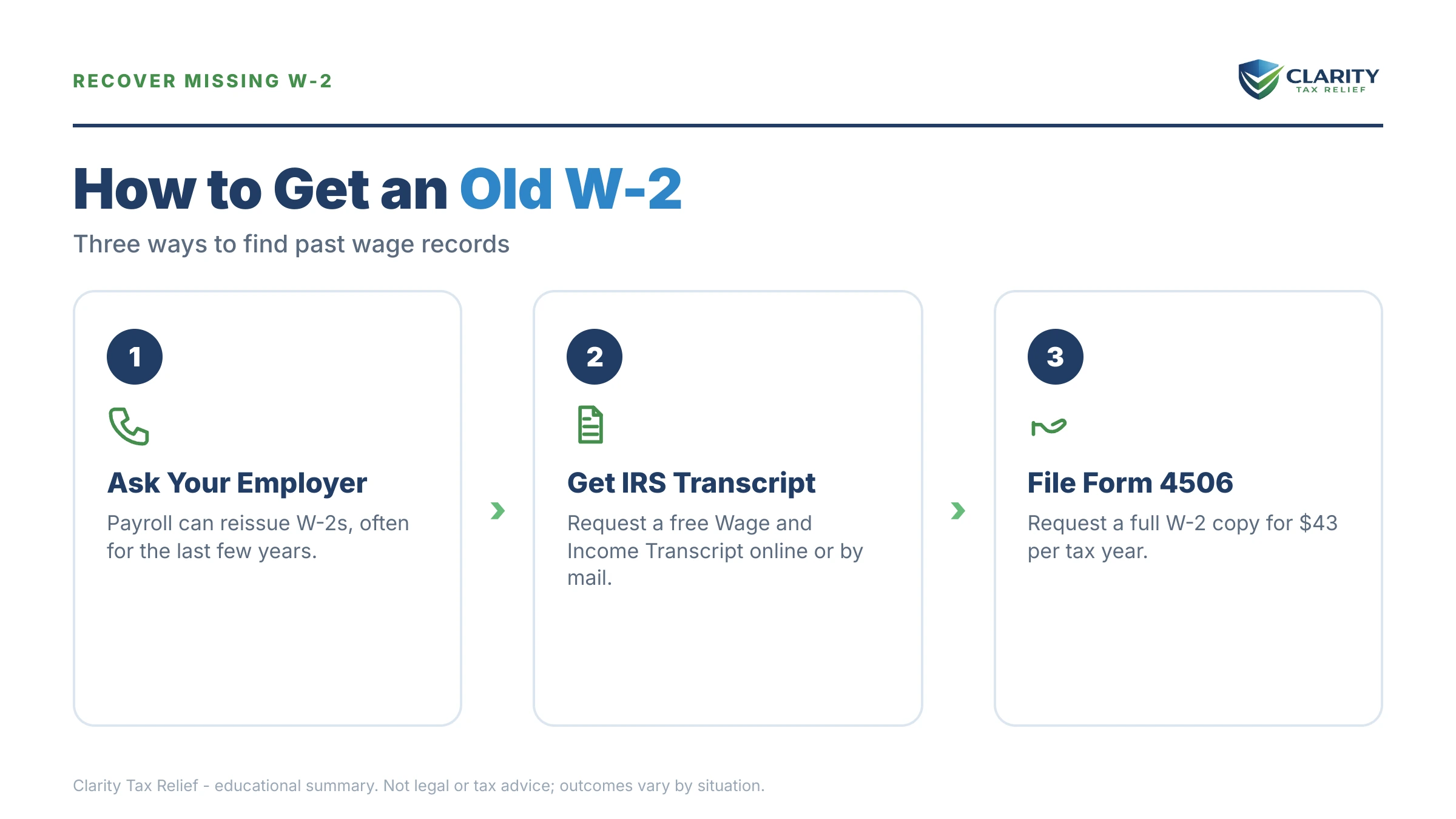
There are six real ways to recover old W-2 data, and they differ enormously in speed, cost, and how far back they reach. Most people need only the first one — and it's free and takes minutes.
| Source | Years covered | Cost | Speed |
|---|---|---|---|
| IRS online account (wage and income transcript) | Current year + ~9 prior years | Free | Minutes |
| Form 4506-T transcript request by mail | Same ~10-year range | Free | Several weeks |
| Former employer or payroll provider (ADP, Paychex, Gusto) | Varies — portals often keep only 3–4 years | Usually free | Days to weeks |
| Social Security Administration (Form SSA-7050-F4) | Back to 1978 | Fee for non-SSA purposes | Often months |
| State tax agency withholding records | Varies by state | Varies | Weeks |
| Form 4506 (photocopy of a return you filed) | Only years you actually filed | Per-return fee | Up to 75 days |
| Form 4852 (substitute W-2 you build yourself) | Any year you can reconstruct | Free | As fast as your records |
1. The IRS wage and income transcript — start here
This one document ends most old-W-2 searches. Set up or log into your IRS online account (our IRS online account setup walkthrough covers the identity-verification steps that trip people up), open the transcripts section, and download the wage and income transcript for each missing year. It lists every W-2, 1099, 1098, and 5498 filed under your Social Security number, with federal wages and federal withholding broken out by payer. Our full guide to IRS wage and income transcripts walks each line, and how to get IRS transcripts online covers the other transcript types while you're in there.
Two fine points that matter for back taxes. First, the copies you download online are masked — identifying details like the employer's full EIN are partially hidden for security. That's fine for preparing a paper return, but a full EIN is needed to e-file; you can request an unmasked transcript mailed to your address of record, or an experienced tax professional with a signed authorization can pull unmasked versions directly. Second, if you can't pass online verification, Form 4506-T (with the wage and income box checked) gets the same data by mail for free — it just takes weeks instead of minutes.
Married and filing jointly? Pull transcripts for both spouses. Information returns are filed by SSN, so your spouse's W-2s live on a separate transcript — one of the most common reasons a rebuilt joint return comes up short and triggers a mismatch notice later.
2. Your old employer or its payroll provider
Employers are generally required to keep payroll records for at least four years, and HR can usually reissue a W-2 copy on request. Even faster: if the company ran payroll through ADP, Paychex, Gusto, or a similar provider, your old W-2s may still sit in that provider's employee portal under your old login — worth two minutes to try. If the company closed, the payroll provider often retains the records anyway. This route is most useful for the one thing transcripts can't give you: state withholding detail (more on that gap below). If the employer simply never sent one in the first place for a recent year, that's a different problem with its own fix — see employer didn't send my W-2.
3. The Social Security Administration — for the truly old years
The SSA holds W-2 earnings records going back to 1978 — decades beyond what IRS transcripts cover. You request copies with Form SSA-7050-F4; the SSA charges a fee when the request is for a non-Social-Security purpose like filing back taxes (the current fee is printed on the form), and turnaround often runs months. Use this route only when you genuinely need a year older than the IRS's ten-year transcript window — for example, an ancient state assessment or a Social Security earnings dispute — not for a normal back-tax cleanup.
4. Your state tax agency
States receive their own copies of wage and withholding data, and many can provide wage statements or withholding records on request. If you owe state back returns alongside the federal ones, you'll likely need this anyway, because the IRS transcript won't show a single state dollar. Procedures and lookback windows vary widely by state, so check your state agency's records-request process directly rather than assuming the IRS timeline applies.
5. Form 4506 — usually the wrong tool for back taxes
Form 4506 orders a photocopy of a complete tax return as you filed it, attachments and W-2s included, for a per-return fee and a wait of up to 75 days. Notice the catch: it only works for years you actually filed. If the year is unfiled — which is the whole reason you're reading this — there's no return on file to copy, and Form 4506 returns nothing. It's occasionally useful when you filed a year but lost your copy and need to amend it; for everything else, skip it.
6. Form 4852 — the substitute when nothing else works
When a W-2 truly can't be obtained — the employer never filed it and no provider has a copy — Form 4852, Substitute for Form W-2, lets you file anyway. You reconstruct wages and withholding from your best evidence: final pay stubs (the year-to-date column is gold), bank deposit records, or the partial data on your transcript. You attach one Form 4852 per missing W-2 to each year's return and explain how you computed the numbers and what you did to get the real form. If your records are thin across the board — not just one W-2 — our guide to filing back taxes with no records covers full-scale reconstruction.
What wage and income transcripts show — and the state withholding gap
IRS wage and income transcripts show federal wages and federal withholding only — every state box from the original W-2 comes back blank. This surprises almost everyone rebuilding old years. Your federal returns can be prepared entirely from the transcript, but any state back returns need state withholding from somewhere else: the final pay stub for that year, the employer's payroll department, or the state tax agency's own records. Skipping this step means either overstating your state balance (you get no credit for withholding you can't document) or delaying the state filing while you scramble.
While you're in your IRS account, know which transcript does what — people routinely download the wrong one and conclude their data is missing:
| Transcript type | What it shows | Use for back taxes |
|---|---|---|
| Wage and income transcript | Every W-2, 1099, 1098, and 5498 filed under your SSN, with federal wages and withholding | The one that rebuilds a missing W-2 |
| Account transcript | Assessments, penalties, interest, payments, and activity codes for a year | Reveals whether the IRS already assessed the year (including an SFR) |
| Return transcript | Line items from a return you filed | Blank for unfiled years — don't panic when it says "N/A" |
| Record of account | Return transcript and account transcript combined | The full picture once the year is filed |
One more scoping question before you start preparing returns: you may not need to file every missing year. IRS policy generally looks for the last six years of returns to consider you back in compliance — the details, and the exceptions, are in how many years of back taxes you have to file. And if any missing year included side income beyond W-2 wages — a rental, gig work, a short-term listing — the transcript's 1099 and 1099-K lines matter as much as the W-2 lines do; hosts with unreported rental years should read Airbnb host owes taxes for that reconstruction.
What you'll owe once you file — a worked example
Recovering the W-2s is the easy half; the balance that appears when the returns are filed is the half that needs a plan. Here's a clearly hypothetical example with the math shown.
Say you're a married couple filing jointly with three unfiled years — 2022, 2023, and 2024 — and the transcripts show your combined withholding fell short each year. Suppose the unpaid tax across the three years totals $8,700. Because every year is more than five months late, the failure-to-file penalty has hit its 25% cap on each: $8,700 × 25% = $2,175. The 0.5%-per-month failure-to-pay penalty and daily-compounding interest add roughly another $425 by the time you file — call the total about $11,300.
That number shapes your options in a specific way. At $11,300, you're just over the $10,000 ceiling for a guaranteed installment agreement — which is available to individuals only, requires an income-tax balance of $10,000 or less excluding penalties and interest, all returns filed, timely filing and payment for the past 5 years with no installment agreement in that period, and full payment within 3 years — but comfortably inside the $25,000 streamlined installment agreement band, which needs no financial disclosure and can run up to 72 months. Spread evenly, $11,300 ÷ 72 ≈ $157 per month minimum — though interest keeps accruing, and the failure-to-pay rate drops to 0.25% per month while an approved plan is active, so paying faster than the minimum saves real money. You can estimate your own penalty and interest buildup with our IRS Penalty & Interest Calculator.
Two more levers in this scenario. If your compliance history was clean for the three years before the oldest unfiled year, first-time penalty abatement can wipe that year's penalties — and starting summer 2026, the IRS's new Automatic Exemption from Penalty (AEP) applies similar relief automatically, with no request needed. And if the transcripts instead show your withholding covered the tax — common for two-W-2 households — filing produces refunds, not bills, for any year still inside the 3-year window. That's the best-case outcome, and it evaporates one April at a time.
| Balance after filing | Realistic options | Key requirement |
|---|---|---|
| Under $10,000 | Guaranteed installment agreement, or a $0-setup short-term plan (up to 180 days) | For the guaranteed IA: individuals only; income-tax balance of $10,000 or less excluding penalties and interest; all returns filed; timely filing and payment for the past 5 years with no installment agreement in that period; full pay within 3 years |
| $10,000–$25,000 | Streamlined installment agreement, up to 72 months | No financial statement needed; stay current on future filings |
| $25,000–$50,000 | Online payment plan up to 72 months | Direct debit typically required in this band |
| Over $50,000 | Non-streamlined agreement, hardship (CNC) status, or an Offer in Compromise where the financial math supports it | Full financial disclosure on the Form 433 series |
Whichever band you land in, filing the real returns first is non-negotiable — the IRS won't approve any payment arrangement with required returns outstanding, and if an SFR was already assessed, your correct return usually shrinks the balance before you negotiate a dime. The step-by-step negotiation side lives in our guide to how to settle tax debt yourself; this page's job is getting you to the starting line with the right numbers.
How to file back taxes with old W-2s, step by step
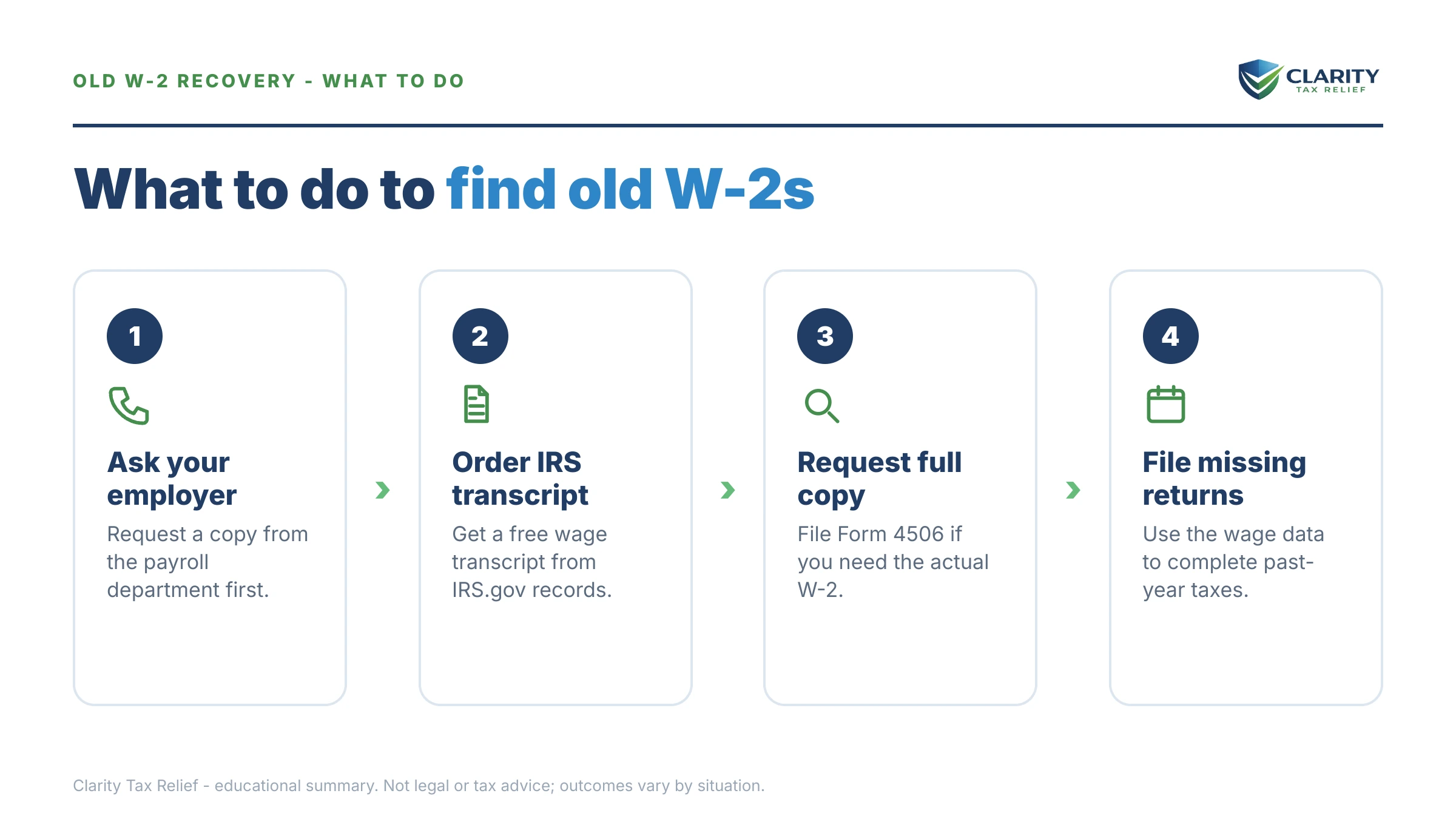
- Pull your IRS wage and income transcripts. Log into (or create) your IRS online account and download the wage and income transcript for every unfiled year — they're free and cover roughly the past decade.
- Fill any gaps from other sources. For years older than transcripts cover, or W-2s that were never filed, go to the former employer's payroll provider, the Social Security Administration, or reconstruct the numbers from pay stubs with Form 4852.
- Reconstruct state withholding. Transcripts show federal numbers only, so pull final pay stubs or contact your state tax agency before preparing any state back returns.
- Prepare each return on that year's forms. Tax law and forms change annually — use the correct year's forms or software, and file jointly if married, which almost always beats the IRS's substitute-return math.
- File every required year and keep proof. Mail paper returns with tracking (or have a professional e-file eligible prior years), and keep stamped copies of everything you send.
- Set up payment — or claim your refund. If a balance results, arrange a payment plan before collection notices start; if a recent year shows a refund, file inside the 3-year window to collect it.
When you can handle this yourself — and when help changes the outcome
If your missing years are all W-2 income and three or fewer returns, this is a genuinely doable DIY project. The transcripts are free, the math is mostly transcription, and if withholding covered your tax — or the balance lands under the streamlined thresholds — you can file and set up a plan without paying anyone. Refund-due years are the clearest DIY case of all: file, collect, done.
Experienced help earns its cost in specific situations: an SFR balance is already assessed and needs to be displaced with correct returns; collection notices or a levy are already in motion; the missing years mix W-2 wages with self-employment or business income that needs real reconstruction; five or more years are unfiled and the six-year-lookback scoping decision has real dollars attached; or the back taxes are a prerequisite for something bigger — every return must be filed, for instance, before a Chapter 13 plan with IRS back taxes can be confirmed. In those cases, the order you fix things — returns, then penalties, then the balance — often changes what you ultimately pay more than any single form does.
If your situation sits in that second list — an SFR on the books, five-plus missing years, or business income tangled into the W-2 years — a free case review with an experienced tax professional can map the whole cleanup before you file anything: (888) 825-7779 or the 2-minute form.
Terms on your transcript, decoded
- Wage and income transcript — the IRS's record of every information return (W-2, 1099, 1098, 5498) filed under your SSN for a given year.
- Form 4506-T — the free mail-in transcript request; checking box 8 orders the wage and income data.
- Form 4852 — the substitute W-2 you attach to a return when the real form can't be obtained, built from pay stubs or transcript data.
- Substitute for return (SFR) — the return the IRS files for you from wage data alone, at the least favorable filing status with no deductions or credits.
- Masked transcript — a transcript with identifying details (like the employer's full EIN) partially hidden; unmasked copies go only to your address of record or an authorized professional.
- Six-year lookback — the IRS's general policy of requiring the most recent six years of returns to treat you as filing-compliant.
Old W-2 and back-tax questions, answered
How far back can I get W-2 information from the IRS?
IRS wage and income transcripts generally cover the current year plus roughly the nine prior years — about a decade in total. For anything older, the Social Security Administration holds W-2 earnings records going back to 1978, though it charges a fee for copies requested for non-Social-Security purposes. Also note the most recent year's data usually isn't complete in IRS systems until mid-summer.
Are IRS wage and income transcripts free?
Yes — completely free, whether you download them instantly through your IRS online account or request them by mail with Form 4506-T. The only IRS wage document that costs money is a photocopy of a full filed return through Form 4506, which is useless for back taxes anyway if the year was never filed.
Do wage and income transcripts show state tax withholding?
No — wage and income transcripts show federal wages and federal withholding only, so every state box from the original W-2 comes back blank. If you also owe state back returns, reconstruct state withholding from your final pay stub for that year, your former employer's payroll department, or your state tax agency, which keeps its own withholding records.
What if my old employer went out of business?
You can almost always skip the employer entirely: if the W-2 was ever filed, the IRS wage and income transcript has it, no matter what happened to the company. The company's payroll provider — ADP, Paychex, Gusto — may also still host old W-2s. If the business collapsed without ever filing your W-2, reconstruct the numbers from pay stubs and file with Form 4852.
Can I file back taxes without a W-2 at all?
Yes. Form 4852, Substitute for Form W-2, lets you file using your best reconstruction of wages and withholding — usually from pay stubs, bank deposit records, or the IRS wage and income transcript. You attach one Form 4852 per missing W-2 to each return and describe how you calculated the figures and how you tried to get the real form.
Will I still get a refund from an old W-2 year?
Only if you file within 3 years of that return's original due date — your W-2 withholding counts as paid on the April deadline, and once the 3-year window closes the refund is forfeited permanently. Filing older years is still worth it, though: it stops the failure-to-file penalty from growing if you owe and restores you to filing compliance.
How fast can I get a wage and income transcript?
Minutes, if you use your IRS online account — you can view and download transcripts immediately after verifying your identity. Mail requests through Form 4506-T typically take several weeks to arrive. If online identity verification fails, transcripts can be sent to your address of record instead, which usually takes 5 to 10 calendar days.
Can a tax professional get my old W-2s for me?
Yes. With a signed Form 8821 or Form 2848 authorization on file, an experienced tax professional can pull wage and income transcripts for every year at once through IRS practitioner channels — including unmasked versions showing full employer EINs, which matter if you want prior-year returns e-filed. This is usually the fastest route when many years are missing.
What if the IRS already filed a substitute return for a missing year?
File your own correct return for that year anyway — the IRS generally accepts it and adjusts the balance. A substitute for return is computed as single or married filing separately with no dependents, credits, or itemized deductions, so a married couple's real joint return almost always shows less tax than the IRS's version.
Your next 24 hours
- Open your IRS online account tonight and check the wage and income transcript for each missing year — note which years show W-2 data and which come back thin. The official portal is IRS Get Transcript; older-than-a-decade years go through the Social Security Administration.
- Gather the paper you do have: final pay stubs for any year with a never-filed W-2, any IRS letters about unfiled years (a CP59 or CP2566 changes the urgency), and your last filed return.
- Get a free case review. If multiple years are missing or an SFR balance already exists, call (888) 825-7779 or use the 2-minute form — remember, every unfiled year where you owe is compounding penalties monthly, and every refund year is one April away from expiring. Payment-plan details for whatever balance emerges are at the IRS's own payment plans page.
This guide is general information, not tax or legal advice for your specific situation. Eligibility for IRS programs depends on individual facts and circumstances; no outcome is guaranteed.