
Gig & Rental Income
Airbnb Host Owes Taxes: What to Do About Short-Term Rental Tax Debt in 2026
The short answer: when an Airbnb host owes taxes, the debt almost always starts with a Form 1099-K the IRS matched against a return — and the IRS's first number usually taxes your gross payouts, not your profit. Verify the amount, file or amend with your real expenses, then resolve the true balance with a payment plan, hardship status, or settlement.
Maybe you logged into your IRS online account and found a balance you never expected, or a CP2000 arrived proposing tax on every dollar Airbnb ever paid you — with none of your cleaning fees, host fees, or depreciation subtracted. Your first thought was probably "that number can't be right." Often, it isn't. This is fixable, and the order you fix it in matters: shrink the number first, then deal with what's left.
The single biggest mistake hosts make is paying — or agreeing to a payment plan on — the IRS's proposed figure before checking whether the 14-day rule, the correct schedule, or a real expense list wipes out part of it. The image below shows you exactly what the 1099-K the IRS is matching against your return looks like and where to look for the gross figure driving your bill.
⏱ Your real clock: if a notice came with this debt, the respond-by date printed on it controls — use that date, never a guess. If no notice has arrived yet, the clock still runs monthly: the failure-to-pay penalty adds 0.5% every month, interest compounds on top, and if a return was never filed, the failure-to-file penalty adds 5% per month (capped at 25% — it maxes out after five months, and drops to 4.5% in months where the 0.5% late-payment penalty also applies) — ten times more.
Why the IRS says you owe taxes on your Airbnb income
Airbnb reports host payouts to the IRS on Form 1099-K, and the IRS's computers match that form against your tax return automatically. Under the current 1099-K $20,000 threshold for 2026, Airbnb generally issues the form when your gross payouts exceed $20,000 and 200 transactions — the $600 rule is dead, but debts created under the old reporting rules don't disappear with it.
When the matched income doesn't appear on your return, the Automated Underreporter unit sends a CP2000 notice proposing extra tax. Here's the part that inflates Airbnb bills specifically: the 1099-K reports gross transactions — before Airbnb's host service fee, before cleaning costs you passed to a cleaner, before utilities, supplies, insurance, or depreciation. The computer doesn't know your expenses exist, so it taxes revenue as if it were pure profit, then adds a 20% accuracy-related penalty and interest on top.
If you never filed at all for a hosting year, it can be worse: the IRS may build a substitute return from the 1099-K alone — again with zero expenses — and assess tax on that. Either way, the assessed number and the true number are usually two different figures, which is why verification comes before payment.
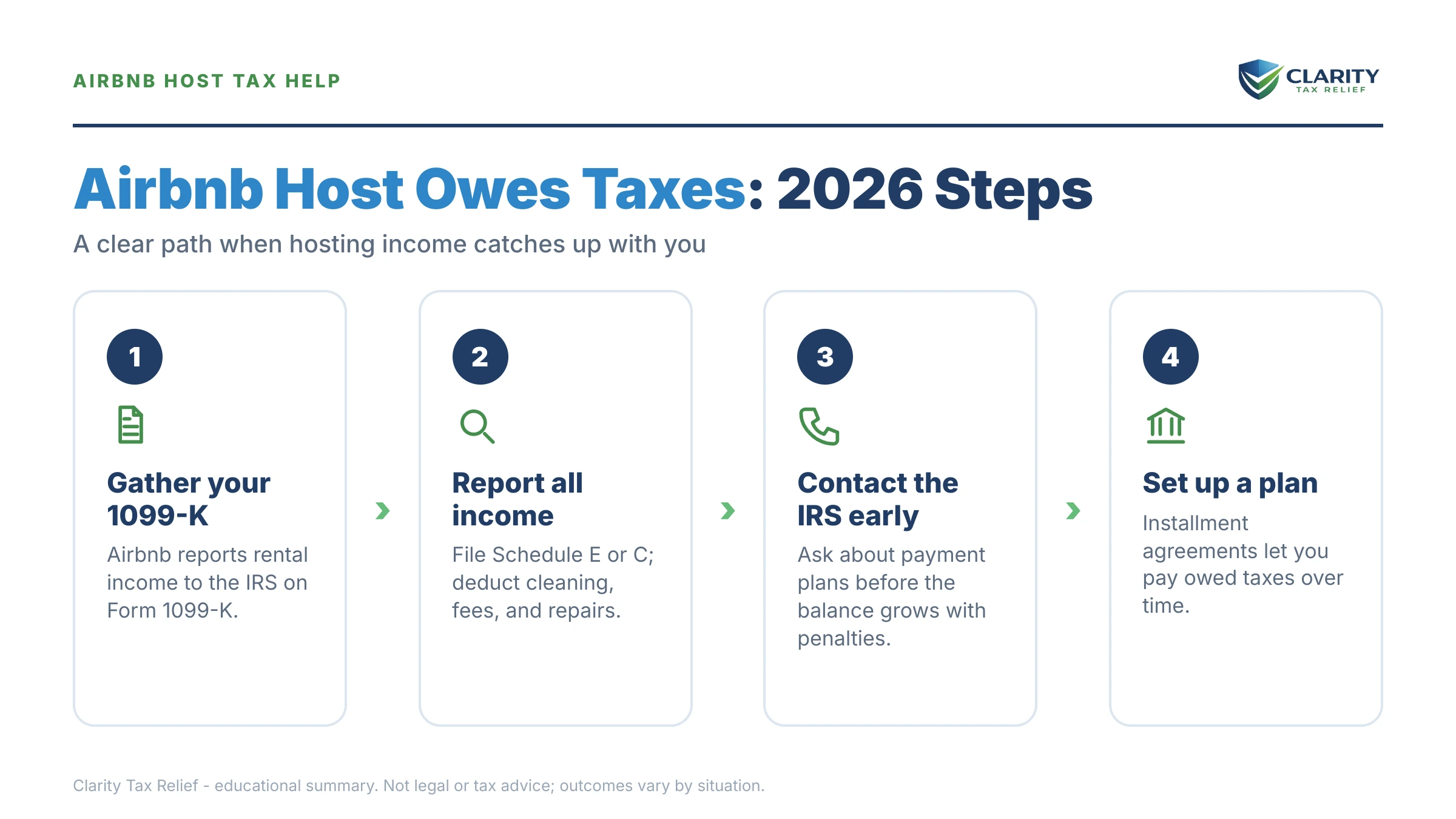
First: check whether you actually owe this much
Most inflated Airbnb tax bills shrink for one of three reasons: the 14-day rule, the wrong schedule, or missing expenses. Work through them in that order before you agree to anything.
The 14-day rule. If you rented out a home you also live in for 14 or fewer days during the year, that rental income is excluded from tax entirely — you don't even report it. Hosts who listed a spare room during one festival weekend or a two-week vacation window sometimes owe nothing at all. Your Airbnb calendar and booking history are the proof.
Schedule E vs. Schedule C. Most hosting is rental income on Schedule E: taxed after expenses, with no 15.3% self-employment tax. You only land on Schedule C — and owe self-employment tax — if you provided substantial services to guests, like daily housekeeping during stays, meals, or concierge-style extras. If your debt was assessed as business income and you ran a plain short-term rental, correcting the schedule alone can cut thousands off the balance.
Missing expenses and depreciation. Host service fees, cleaning, laundry, supplies, repairs, a share of utilities and insurance, and depreciation on the rented space all reduce taxable income. If you rented part of your own home or used the property personally, the vacation-home rules require allocating expenses between rental and personal days — tedious, but it's exactly this math that turns a gross-based bill into a profit-based one. No receipts? You can still rebuild much of it — see filing back taxes without records — because Airbnb's own transaction history documents fees, payouts, and dates.
| Your hosting situation | How the IRS taxes it | Self-employment tax? |
|---|---|---|
| Rented a home you live in for 14 days or fewer all year | Income excluded entirely under the 14-day rule — not reported at all | No |
| Typical short-term rental, no substantial guest services | Schedule E rental income, taxed after expenses and depreciation | No |
| Hotel-like hosting: meals, daily cleaning during stays, concierge services | Schedule C business income, taxed after expenses | Yes — 15.3% on net profit |
Two structural wrinkles worth knowing. If your listing sits inside a single-member LLC, the IRS still comes to you personally — the entity doesn't shield pass-through income tax, as explained in LLC back taxes and personal liability. And if you co-own the property with a spouse or partner, how the income was split (or wasn't) on each return affects who the IRS bills; a married host who filed jointly shares the whole liability with their spouse. Long-term landlords with the same unreported-income problem should start with unreported rental income instead — the matching mechanics differ when there's no 1099-K.
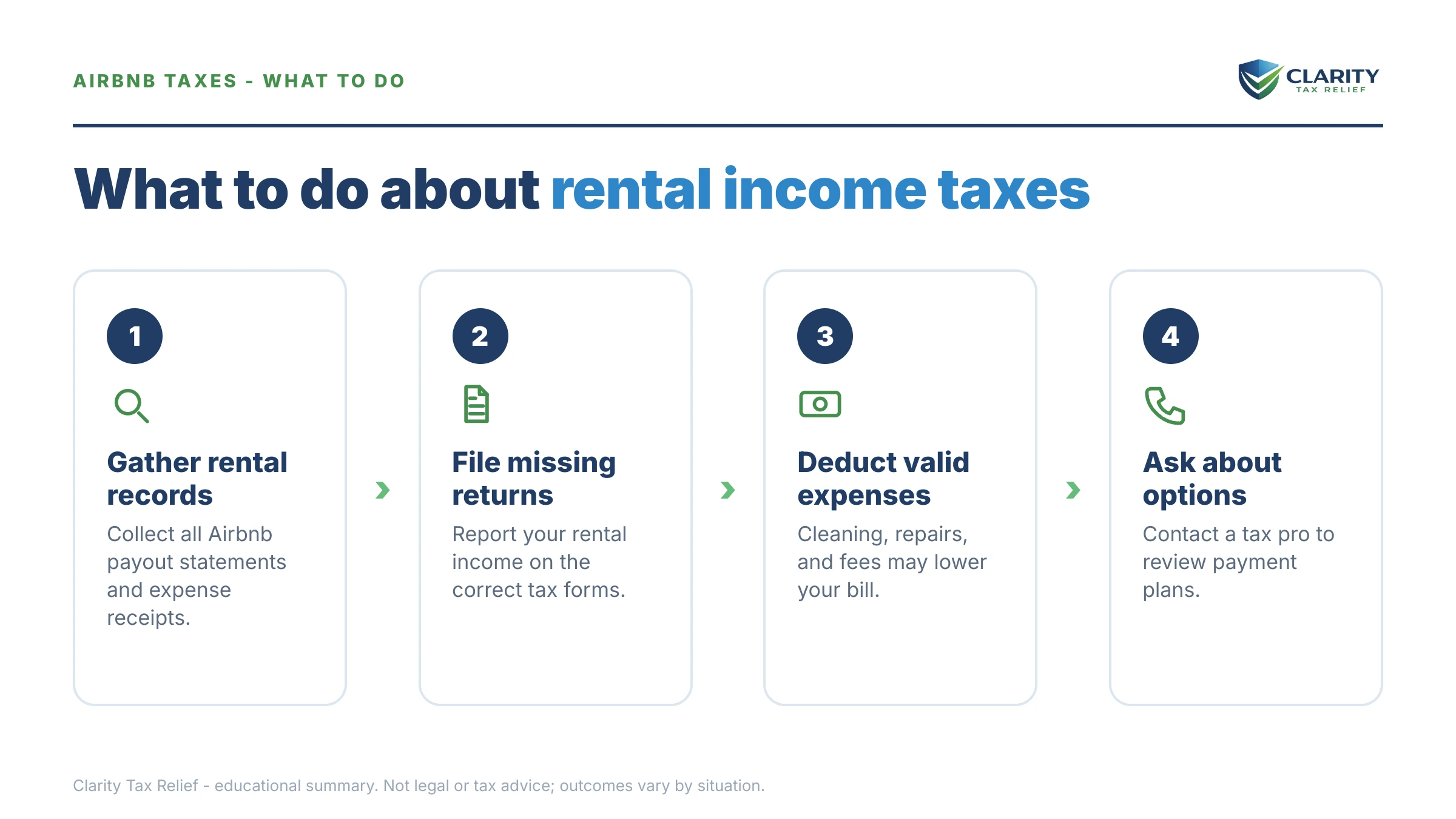
What happens if you ignore Airbnb tax debt
Unreported Airbnb income follows an automated path from a computer match to a levy, and every stage costs you money or rights. In 2026 the IRS workforce is down roughly 27% from 2025's cuts — humans are hard to reach, but the notice stream and levies are machine-driven and never stopped. The sequence runs like this:
- CP2000 proposed change. The IRS proposes tax on the matched 1099-K income. Respond by the date printed on it with corrected schedules and the balance can shrink dramatically. Ignore it and the proposal hardens.
- CP3219A Notice of Deficiency (the "90-day letter"). Your last chance to dispute before assessment — the deadline to petition Tax Court is printed on the notice. Miss it and the IRS's number becomes the legal debt.
- Assessment and CP14. The first bill. You typically have about 21 days from the notice date (10 business days if the balance is $100,000 or more) before the reminder cycle escalates, with penalties and interest accruing monthly throughout.
- CP501 / CP503 reminders. Still just bills — but the balance grows every month, and a federal tax lien becomes a live possibility.
- CP504 notice — intent to levy. The IRS can now seize your state tax refund under IRC §6331(d). It is not the final notice, but it's the last cheap exit.
- LT11 / Letter 1058 — final notice. A 30-day clock starts, along with your Collection Due Process appeal rights (Form 12153). After it runs, the IRS can levy bank accounts (funds held 21 days before they leave) and garnish wages continuously — including the account your Airbnb payouts land in.
Want to see what waiting costs in dollars? Our Penalty & Interest Calculator estimates how much a balance like yours grows month by month.
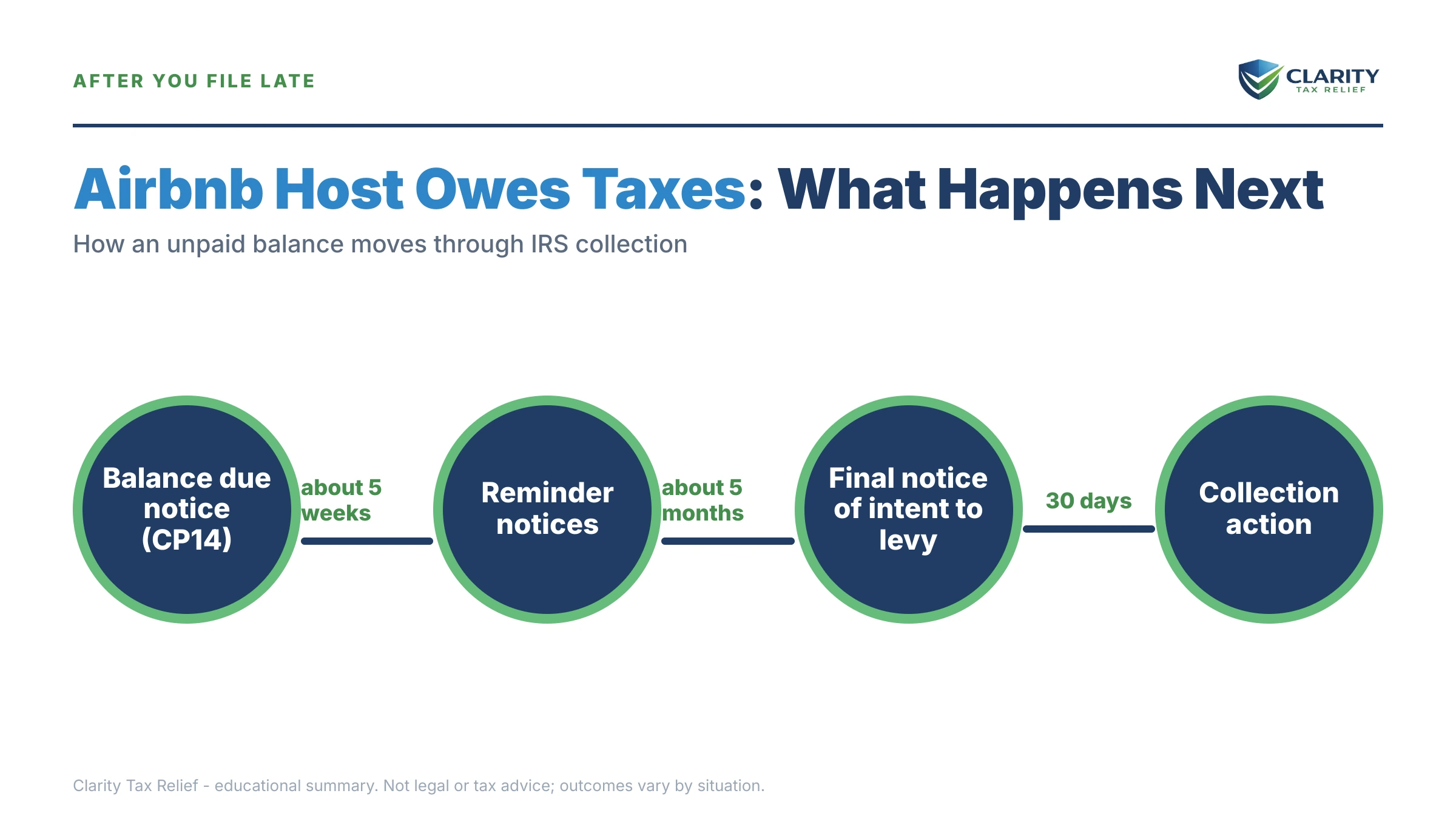
Got an IRS notice about your Airbnb income?
Send us a photo of the notice and your Airbnb earnings summary. An experienced tax professional will check whether the 14-day rule, the right schedule, or your real expenses shrink the balance — before you agree to pay a gross-based number. Free and confidential.
What to do when an Airbnb host owes taxes: your resolution options
Once the balance reflects your real profit — not gross payouts — every standard IRS resolution program is on the table, and which one fits depends on the size of the corrected debt and your finances.
| Option | Who qualifies | The catch |
|---|---|---|
| Pay in full | Anyone | None — stops all penalty and interest accrual immediately |
| Short-term payment plan (up to 180 days) | Most individual taxpayers | Interest and the late-pay penalty continue until paid |
| Guaranteed installment agreement | Balance of $10,000 or less | Must pay within 3 years and stay filing-compliant |
| Streamlined installment agreement | ≤ $25,000 (or ≤ $50,000 with direct debit), up to 72 months | No financial disclosure required, but accruals continue |
| Currently Not Collectible (hardship) | Paying anything would prevent basic living expenses | Debt remains, refunds get offset, IRS re-reviews your income |
| Offer in Compromise | Assets + future income genuinely can't cover the debt | Means-tested; equity in your rental property counts against you |
| Penalty relief (FTA / reasonable cause) | Clean compliance for the prior 3 years, or a qualifying hardship event | Removes penalties, not the underlying tax or interest |
| Option | Upfront cost | Timeline & ongoing cost |
|---|---|---|
| Short-term plan | $0 setup fee | Up to 180 days; interest + 0.5%/month late-pay penalty continue |
| Long-term installment agreement | Setup fee applies (lower online and with direct debit; waived for low-income) | Up to 72 months; interest continues, late-pay penalty rate is cut in half while the plan is active |
| Currently Not Collectible | $0 (requires financial disclosure) | Lasts until finances improve; balance keeps growing but enforcement pauses |
| Offer in Compromise | $205 fee + 20% down on lump-sum offers (both waived with low-income certification) | Often many months of review; auto-accepted if the IRS doesn't decide within 2 years, with narrow exceptions — a returned or rejected offer stops the clock, and time during court disputes does not count |
| Penalty abatement | $0 to request | Can remove failure-to-file/failure-to-pay penalties; interest on removed penalties falls with them |
A few Airbnb-specific notes on that menu. Payment plans are the workhorse for hosts with W-2 jobs — steady paychecks make the monthly commitment credible, and you can set up an IRS payment plan online in one sitting for most balances under $50,000. Currently Not Collectible status is harder for hosts to reach, because the IRS sees ongoing rental income as ability to pay; it fits best when bookings collapsed and your W-2 income barely covers allowed living expenses.
An Offer in Compromise is real but narrow here: the IRS values your equity in the very property that generated the income, so hosts who own real estate frequently have a collection potential above the debt — the IRS accepted roughly 1 in 5 offers in FY2024, and property owners are overrepresented among the rejections. Penalty relief is more broadly useful: if your prior three years were clean, first-time abatement can strip the failure-to-file or failure-to-pay penalties (see first-time penalty abatement), and starting summer 2026 the IRS's new Automatic Exemption from Penalty (AEP) applies similar relief automatically, with no request needed. Note that neither removes the 20% accuracy-related penalty — that one takes a reasonable-cause argument.
Two edge paths: multiple large years plus other debts can make Chapter 13 and back taxes worth a conversation with a bankruptcy attorney, since it forces a structured repayment while enforcement stops. And every option above ends at the same backstop — the IRS has 10 years from assessment to collect, though appeals, offers, and bankruptcy pause that clock.
A worked example: $13,600 of Airbnb tax debt on a W-2 salary
Say you're single, work a W-2 job, and hosted a condo on the side. The IRS matched a 1099-K you never reported, and after you responded with a proper Schedule E — knocking the gross-based proposal down — the assessed balance lands at $13,600: roughly $10,400 in tax, a $2,080 accuracy-related penalty (20% of the tax), and about $1,120 of accrued interest. This is a hypothetical, but the arithmetic is how real cases run:
- Short-term plan: $13,600 ÷ 6 months ≈ $2,267/month for 180 days. No setup fee, and only about six months of additional interest. Steep on one salary, but the cheapest financed path.
- Guaranteed installment agreement: not available — the balance is over $10,000. (If penalty abatement removed the $2,080 penalty and its interest, the balance could drop near that line.)
- Streamlined installment agreement: under $25,000, so no financial disclosure. The floor payment is $13,600 ÷ 72 ≈ $189/month — but interest keeps accruing and the late-pay penalty runs at a reduced rate, so budget closer to $220–$250/month to actually retire it, or pay more early to cut total interest.
- Offer in Compromise: if you have equity in the condo, the IRS counts it — equity alone likely exceeds $13,600, so an offer would fail the math. No property equity and thin income? Then it's worth running the numbers before assuming either way.
- Penalty relief first: with three clean prior years, abating the failure-to-pay penalty and pursuing reasonable cause on the accuracy penalty could remove up to ~$2,000+ before you finance anything. Always sequence relief before repayment.
How to respond when you owe taxes on Airbnb income, step by step
- Pull your Airbnb records. Download the earnings report for every year in question from your host dashboard and locate any 1099-K forms Airbnb issued.
- Check what the IRS has. Log into your IRS online account or pull your wage and income transcript to see the exact 1099-K amounts reported and any proposed or assessed balance.
- File or amend before agreeing to anything. Report the income on the correct schedule with every deductible expense — cleaning, host fees, supplies, utilities, depreciation — because the IRS's proposed number rarely includes your costs.
- Pick a resolution for the true balance. Pay in full, set up a short-term or monthly payment plan, request hardship status, or explore settlement based on what your finances actually support.
- Fix next year now. Add extra withholding at your W-2 job or start Form 1040-ES quarterly estimates so this year's hosting income doesn't create the same debt again.
On that last step: W-2 hosts have an advantage most self-employed taxpayers don't — you can bury next year's Airbnb tax inside your paycheck by filing a new W-4 with extra withholding, instead of remembering four estimate deadlines. If you'd rather do estimates, quarterly estimated taxes walks through the math and dates.
Don't forget state income tax and occupancy taxes
The IRS is often not the only agency owed when Airbnb income goes unreported. Your state taxes the same net rental income on its own return, on its own statutes and timelines — never assume IRS thresholds or deadlines apply to a state balance. California hosts should know the Franchise Tax Board can collect for 20 years under R&TC §19255, twice the IRS's window.
Separately, most cities and counties impose a transient occupancy (lodging) tax on short-term stays. Airbnb collects and remits it automatically in many jurisdictions — your host dashboard shows exactly which taxes it handled for your listing — but where it doesn't, the registration and remittance duty is yours, and unregistered hosts can accumulate local liability alongside the federal debt. If both a state and the IRS are billing you, resolving them in the right order matters; when in doubt, confirm the local rules directly with your city or state revenue agency rather than guessing.
When you can handle this yourself — and when experienced help changes the outcome
Plenty of Airbnb tax debts are a do-it-yourself project, and you should know which kind you're holding. Handle it yourself when: it's one tax year, you agree with the corrected number after running your real expenses, and the balance fits a 180-day payoff or a streamlined plan you can set up online. Our guide to how to settle tax debt yourself covers the mechanics of every program above.
Experienced help earns its cost in specific situations: multiple unfiled hosting years that need reconstructed Schedule Es before anything else can happen; a CP3219A deadline days away, where a missed petition window locks in a gross-based assessment; a Schedule C classification you believe is wrong, because the 15.3% self-employment tax dispute is fact-intensive; a levy already in motion against the account your payouts hit; property held in an LLC or co-owned with someone who filed differently; or OIC math involving real-estate equity, where a miscalculated offer wastes months and fees. In those cases, the professional's job isn't magic — it's sequencing: returns first, penalties second, the balance last, so you finance the smallest possible number.
If your corrected balance still feels unmanageable, it costs nothing to have your Airbnb notice and numbers reviewed before you commit to a plan — call (888) 825-7779 or use the 2-minute form.
Terms on your Airbnb tax paperwork, decoded
- Form 1099-K — the information return Airbnb files reporting your gross payouts to the IRS; gross means before fees and expenses.
- Schedule E — the form for rental income; profits are taxed but not subject to self-employment tax.
- Schedule C — the form for business income; applies to hosts providing substantial guest services, and adds 15.3% self-employment tax.
- 14-day rule — the Section 280A exclusion: rent a home you live in for 14 or fewer days a year and the income isn't taxed or reported at all.
- CP2000 — the automated notice proposing extra tax when reported forms (like a 1099-K) don't match your return; a proposal, not a final bill.
- Transient occupancy tax — the city/county lodging tax on short-term stays, separate from income tax; Airbnb remits it in some jurisdictions but not all.
Airbnb tax debt questions, answered
Does Airbnb report my income to the IRS?
Yes. Airbnb issues Form 1099-K when your gross payouts exceed $20,000 and 200 transactions — the threshold that came back into force after the $600 rule was repealed — and the IRS computer-matches that form against your return. But every dollar of taxable hosting income must be reported whether or not you receive a 1099-K; the form changes what the IRS sees, not what you owe.
What if I only rented my place for 14 days or fewer?
Then the income may not be taxable at all. Under the 14-day rule, if you rent out a home you also use as a residence for 14 or fewer days in the year, the rental income is excluded from your taxes entirely — you don't even report it. If the IRS proposed a bill on that income, respond with your calendar and booking records showing the day count instead of paying.
Do I owe self-employment tax on Airbnb income?
Usually not. Most short-term rentals are reported on Schedule E as rental income, which is not subject to the 15.3% self-employment tax. You cross into Schedule C — and self-employment tax — when you provide substantial services to guests, like daily cleaning during stays, meals, or concierge-style extras. If the IRS assessed your debt as Schedule C income and you provided no such services, correcting the schedule can shrink the balance.
Why is the IRS taxing my gross Airbnb payouts instead of my profit?
Because a 1099-K reports gross transactions, and when you never reported the income, the IRS's automated CP2000 process proposes tax on the full gross figure — it doesn't know your cleaning fees, host service fees, utilities, or depreciation. You fix that by responding with a completed Schedule E or C showing your real expenses, not by paying the proposed number.
Can I set up a payment plan for Airbnb tax debt?
Yes. Balances of $50,000 or less generally qualify for an online long-term installment agreement of up to 72 months, and balances of $25,000 or less qualify for a streamlined agreement with no financial disclosure. A short-term plan gives you up to 180 days with no setup fee. Interest and a reduced late-payment penalty continue to accrue until the balance is paid.
Can the IRS put a lien on or take my rental property?
A federal tax lien can attach to all your property, including the home or unit you host in, once the debt is assessed and unpaid — that clouds title and complicates any sale or refinance. Actual seizure of real estate is rare and reserved for late-stage, larger cases, but bank accounts and wages are far easier targets and get levied first once final notices go out.
What if I never filed a return for my Airbnb years?
File those returns now, even if you can't pay. The failure-to-file penalty runs 5% per month (capped at 25% — it maxes out after five months, and drops to 4.5% in months where the 0.5% late-payment penalty also applies), ten times the 0.5% failure-to-pay penalty — and filing stops the bigger one immediately. Unfiled years also block you from payment plans and settlement programs until they're in. If the IRS filed a substitute return for you, filing your own with real expenses usually lowers the assessed balance.
Will an Offer in Compromise settle my Airbnb tax debt for less?
Only if the IRS's math shows it can never collect the full amount from your assets and income — and the IRS accepted roughly 1 in 5 offers in FY2024. Equity in the property you host in counts against you, so many hosts with real estate don't qualify. The application costs $205 with a 20% down payment on lump-sum offers, both waived for low-income applicants.
Does Airbnb handle occupancy taxes, or do I owe those too?
Airbnb collects and remits lodging or occupancy taxes automatically in many jurisdictions, but not all — and it never handles your federal or state income tax. Check your host dashboard for which taxes Airbnb remitted for your listing; where it didn't, registration and back occupancy tax are owed to your city, county, or state, on that agency's rules and timelines, not the IRS's.
Your next 24 hours
- Find your controlling date and number. If an IRS notice arrived, locate the respond-by date and the proposed or assessed amount. No notice? Log into your IRS online account and note the balance and the tax years it covers.
- Gather your hosting records. Download your Airbnb earnings report for each year, any 1099-K forms from your host dashboard, your last filed return, and whatever expense records you have — bank statements count.
- Get the balance reviewed before you commit to it. Penalties and interest on Airbnb tax debt grow every month, and the fastest savings usually come from correcting the number itself. Start a free case review at the 2-minute form or call (888) 825-7779.
Primary sources: the IRS's rules for residential rental and vacation-home income are in Tax Topic 415, Renting Residential and Vacation Property; official payment options are at IRS payment plans and installment agreements; and if IRS delays are causing you financial harm, the independent Taxpayer Advocate Service can intervene at no cost.
This guide is general information, not tax or legal advice for your specific situation. Eligibility for IRS programs depends on individual facts and circumstances; no outcome is guaranteed.