
Back Taxes by Situation
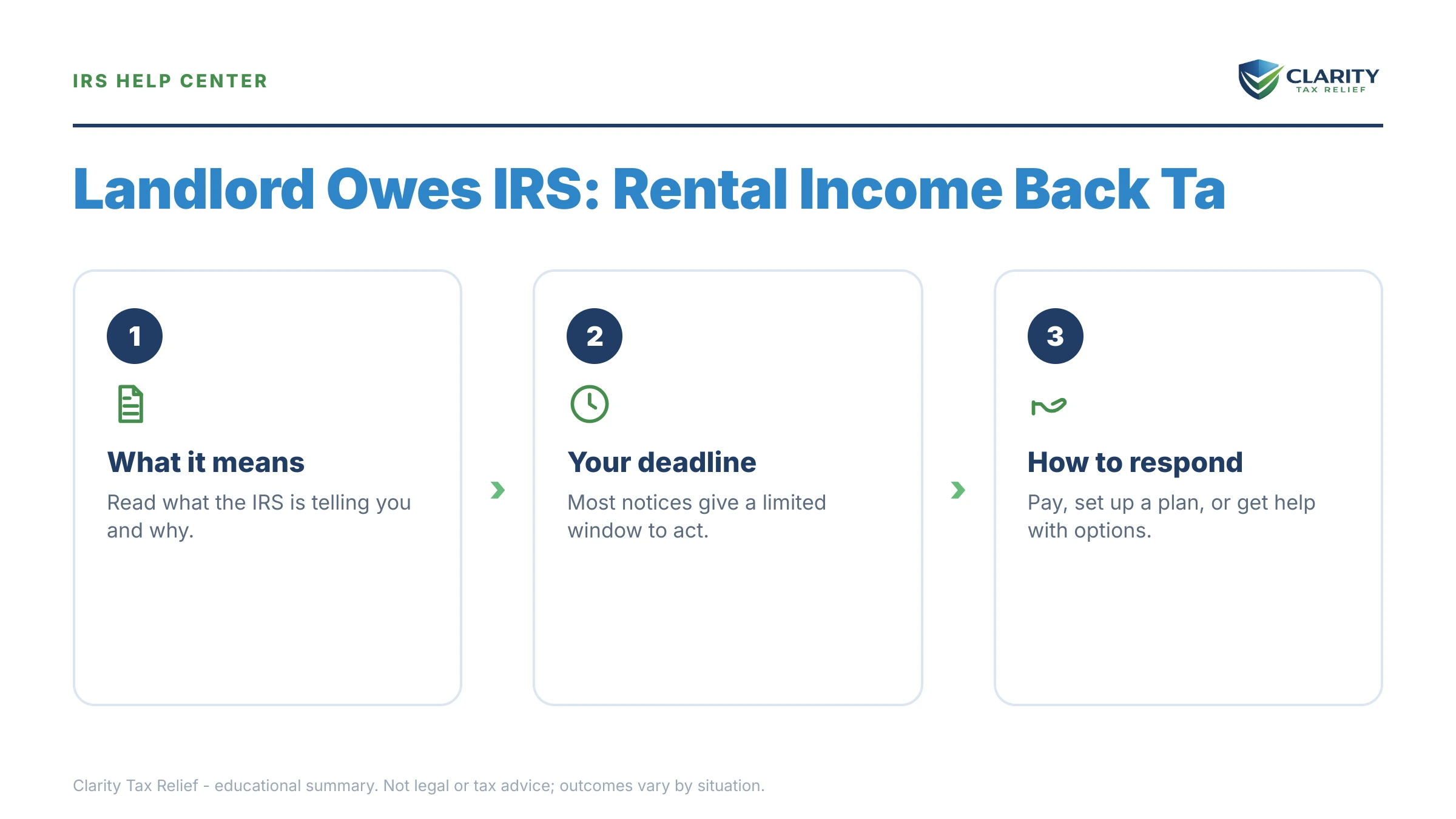
Landlord Owes IRS: What to Do About Rental Income Back Taxes (2026)
The short answer: when a landlord owes IRS back taxes on unreported rental income, the assessed bill is usually inflated — the IRS taxed your gross rents with zero expenses or depreciation. Rebuild each year's Schedule E first; the balance often shrinks dramatically. Then resolve what genuinely remains with a payment plan, hardship status, or an offer.
You rented out the house for years, deposited the checks, and figured that after the mortgage and repairs there was nothing left to tax. Now the IRS says otherwise — with a five-figure balance built entirely from the rent that came in, not the money that went out. That gap between their math and reality is exactly where this gets fixed.
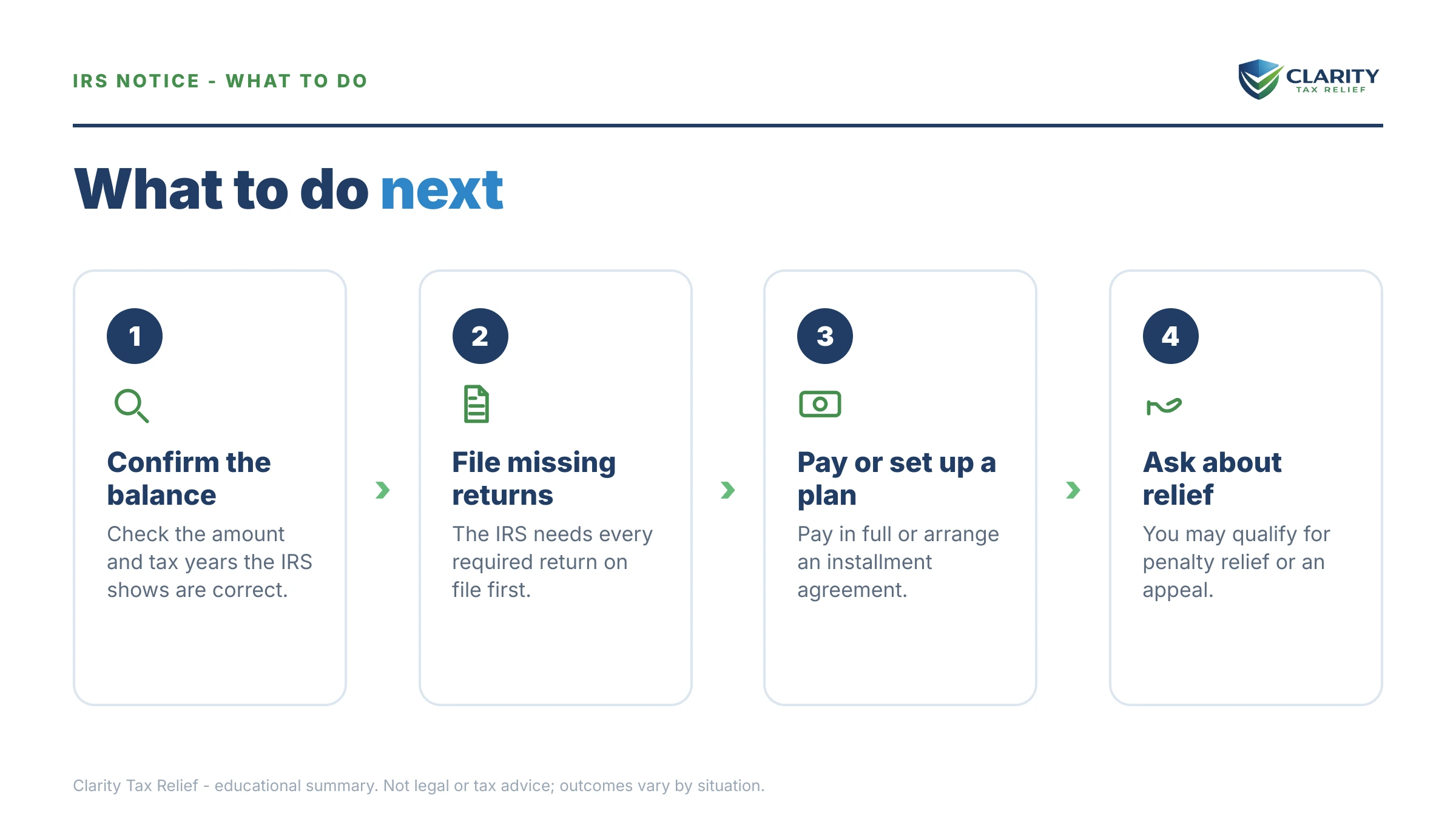
Most landlords in this position are holding a CP2000 underreporter notice. The image below shows exactly what that matching notice looks like and where to find the rent figures the IRS used — those figures are the starting point for shrinking the bill.
⏱ Your clock: there is no single statutory deadline for rental back taxes — your deadline is the response date printed on the notice in your hand. Behind it runs the meter: a 0.5%-per-month failure-to-pay penalty plus daily-compounding interest on the full balance until you act.
How the IRS catches unreported rental income
The IRS finds unreported rental income through automated document matching, not detective work. Every property manager, payment platform, mortgage lender, and closing agent files paperwork with the IRS, and a computer compares those documents against your return line by line. When the rent on file exceeds the rent on your return, a notice goes out — no auditor ever has to suspect you.
In 2026, that matters more than it sounds: the IRS workforce shrank roughly 27% in 2025, but document matching is fully automated. The machine that generated your notice didn't get laid off, and it will keep escalating on schedule whether or not a human ever reads your file.
| Data source | What it tells the IRS | What it usually triggers |
|---|---|---|
| Form 1099-MISC from a property manager | Gross rents collected on your behalf, reported in Box 1 | CP2000 underreporter notice |
| Form 1099-K from payment apps or platforms | Rent collected electronically once you cross $20,000 and 200 transactions | CP2000 underreporter notice |
| Form 1098 mortgage interest on a non-primary property | You own a second property with a mortgage but report no rental activity | Can flag the return for underreporter review or exam |
| Form 1099-S when you sell the property | Gross sale proceeds — and exposes years of unreported rent and depreciation recapture | CP2000 or examination of the sale year |
| Tenant filings and state records | Renter's-credit claims and business rent deductions name you and the address | Can support an underreporter or exam referral |
The critical thing to understand about every row in that table: the IRS only sees the money coming in. It has no record of your mortgage interest, property taxes, insurance, repairs, or depreciation — so when it proposes tax, it taxes your gross rents as if they were pure profit. That's why the balance on your notice is almost always the worst-case number, not the real one. (Holding the notice itself? Our CP2000 notice guide walks through the document line by line.)
What happens if you ignore it
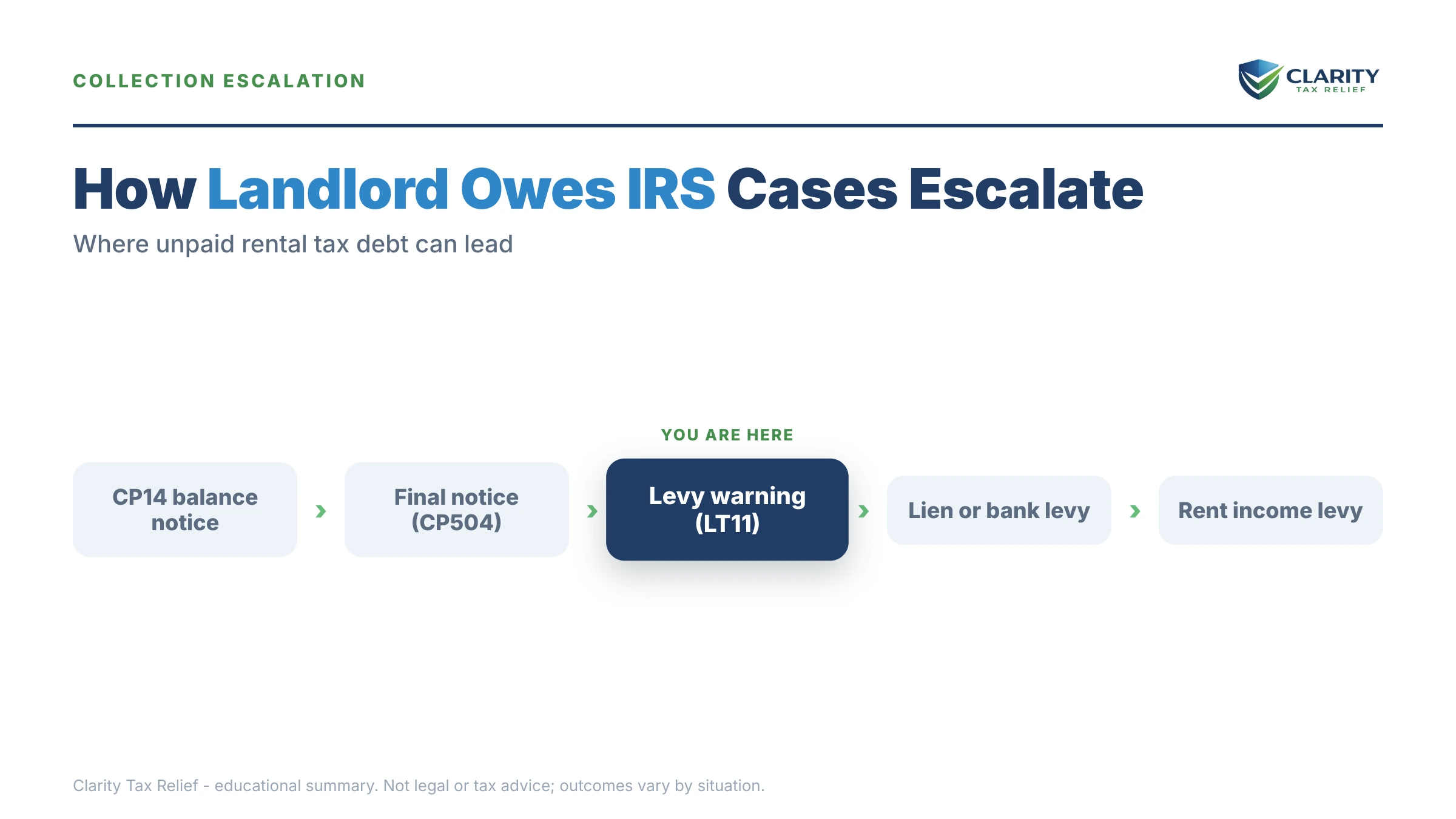
An unanswered rental-income notice hardens into a final assessment and then moves through the IRS collection sequence automatically. Each stage removes an option you have today:
- CP2000 proposal — the IRS proposes tax on your gross rents, typically with a 20% accuracy-related penalty. This is the cheapest stage to fight, because nothing is assessed yet.
- CP3219A Notice of Deficiency — the "90-day letter." You have 90 days to petition Tax Court; after that, the proposed amount becomes a legal assessment.
- Balance-due notices (CP14, CP501, CP503) — bills arrive while penalties and interest compound monthly.
- CP504 — the IRS can seize your state tax refund, and a federal tax lien — which attaches to the rental property itself — becomes likely.
- LT11 / Letter 1058 — the final notice starts a 30-day clock and your Collection Due Process rights. After it expires, the IRS can levy bank accounts (funds are held 21 days before they leave), take up to 15% of Social Security, and serve a levy directly on your tenants redirecting rent to the Treasury.
Two consequences hit landlords harder than anyone else. First, the lien: it clouds title on the rental, so you can't sell or refinance cleanly — see selling a house with an IRS lien for how that plays out at closing. Second, the rent levy: because rent is money owed to you, the IRS can order your tenants to pay it directly to the government, the same way it levies a business's receivables — the mechanics are covered in IRS levy on accounts receivable.
And if you let multiple years stack up, watch the total: at $66,000 of seriously delinquent debt in 2026, the IRS can certify you to the State Department for passport denial or revocation.
Got a rental-income notice from the IRS?
Send us a photo of it before you respond. An experienced tax professional will check whether the IRS taxed your gross rents, estimate what the corrected balance should be, and map the cheapest path out — free, confidential, no pressure. Every month of waiting adds another 0.5% penalty plus interest.
Most rental tax bills are inflated — fix the numbers before you pay anything
A rental-income assessment built from gross rents overstates the real tax in nearly every case, because Schedule E deductions routinely absorb most of the rent. Mortgage interest, property taxes, insurance, repairs, management fees, utilities you covered, mileage to the property — and above all depreciation, which lets you deduct the building's cost over 27.5 years — all come off before a dollar is taxed.
How you deliver the corrected numbers depends on where your case sits:
- CP2000 still open: respond to the notice with a completed Schedule E and documentation by the printed date. Don't file an amended return while the CP2000 is pending — respond to the unit handling it.
- Already assessed: request audit reconsideration — the IRS will re-examine a finalized assessment when you submit information it never considered, which describes almost every gross-rents case.
- Never filed those years: file original returns with correct Schedule Es. The 6-year lookback generally defines how far back the IRS wants returns to restore compliance.
- Return filed, rent genuinely omitted, IRS hasn't written yet: amending the return voluntarily puts you in a far better penalty posture than waiting for the notice.
Penalties get corrected too: when the tax drops, the 20% accuracy-related penalty and the failure-to-pay penalty are recalculated on the smaller number, and first-time abatement can remove penalties entirely if your prior three years were clean. Starting summer 2026, the new Automatic Exemption from Penalty (AEP) begins applying similar relief automatically, with no request needed. You can estimate your penalties and interest with our calculator to see how much of your balance is additions rather than tax.
One warning while you rebuild the numbers: rental losses are "passive," and the ability to deduct up to $25,000 of losses against other income generally phases out at higher incomes — so an experienced preparer should run the passive-loss rules rather than assuming every loss lands.
Your options when a landlord owes IRS back taxes
Once the balance reflects real Schedule E numbers, every standard IRS resolution program is available — but two landlord-specific facts shape which ones work: equity in the rental property counts against you in an Offer in Compromise, and rental income counts in every ability-to-pay calculation. The general mechanics of each program live in our guide to how to settle tax debt yourself; here's how they apply to a landlord.
| Option | Who typically qualifies | Cost and the landlord catch |
|---|---|---|
| Correct the returns (CP2000 response, audit reconsideration, or original filings) | Anyone assessed on gross rents without expenses or depreciation | Free except preparation; usually the single biggest reduction available |
| Short-term payment plan | Can pay in full within 180 days | $0 setup; interest and penalties keep accruing until paid |
| Streamlined installment agreement | Balance of $50,000 or less; up to 72 months, set up online | No financial disclosure required; rent counts as income for affordability |
| Non-streamlined installment agreement | Balance over $50,000 | Full financials required — the IRS will see, and may weigh, your rental equity |
| Currently Not Collectible (hardship) | Paying anything would leave you unable to cover allowable living expenses | Collection pauses, debt and interest remain, lien filing is likely; net rent counts as income |
| Offer in Compromise | Assets plus future income genuinely can't cover the debt; means-tested | $205 fee and 20% down on lump-sum offers (both waived with low-income certification at AGI ≤ 250% of poverty); equity in the rental usually pushes the required offer up or out of reach |
| Penalty relief (FTA / reasonable cause / AEP) | Clean prior 3 years for FTA; AEP applies automatically starting summer 2026 | Free to request; removes penalties, not tax or interest on tax |
Where your corrected balance lands changes the realistic menu:
| Corrected balance | Realistic options | What changes at this level |
|---|---|---|
| Under $10,000 | Pay in full, 180-day plan, or a guaranteed installment agreement | Approval is essentially procedural; no financials, no lien in most cases |
| $10,000 – $25,000 | Streamlined plan online; penalty abatement to trim the total | Set up in minutes online; direct debit keeps it low-friction |
| $25,000 – $50,000 | Streamlined 72-month plan (direct debit expected at the top of this band) | Still no financial disclosure; lien generally avoidable if you stay current |
| $50,000 – $66,000 | Pay down below $50,000 to unlock the streamlined plan, or submit financials | Financial review means the IRS sees your rental equity; lien risk rises |
| Over $66,000 | Negotiated agreement, CNC, or OIC with full disclosure | Passport certification threshold crossed; larger cases can draw a revenue officer |
Two edge paths worth knowing. If the balance stays above $50,000 after correction, the financial-disclosure route is manageable but different — IRS payment plans over $50,000 covers what the IRS asks for. And a property-rich, cash-poor landlord facing levies sometimes does better in Chapter 13 with IRS back taxes, which forces a court-supervised repayment over up to five years while stopping collection — a lawyer question, but a real option the IRS won't mention.
Worked example: a retiree on Social Security who owes the IRS $54,600
Say you're a retired landlord living on Social Security, renting out a house you've owned for years through a property manager. The manager filed a 1099-MISC each year showing $21,600 in gross rents. You never filed a Schedule E, the CP2000s went unanswered, and three years of assessments — tax on the full $21,600 per year, plus the 20% accuracy penalty and interest — now total $54,600.
Path one: pay it as billed. At $54,600 you're over the $50,000 online-plan ceiling, so you'd pay down $4,700 to reach $49,900, then spread it over 72 months: $49,900 ÷ 72 ≈ $693 per month, with interest still accruing. On a Social Security budget, that's not a plan — it's a slow-motion default.
Path two: fix the numbers first. Your real Schedule E for each year looks like this: mortgage interest $5,900, property taxes $3,800, insurance $1,600, repairs and maintenance $2,400, depreciation $6,500 — total expenses $20,200 against $21,600 of rent. Your actual taxable rental income was about $1,400 per year, not $21,600. Through audit reconsideration with correct returns attached, the tax collapses to a few hundred dollars per year, and the accuracy penalty and interest are recalculated on those numbers. A $54,600 problem becomes a bill you can likely resolve with a small plan or a single payment — and if even that corrected balance is unpayable on your fixed income, hardship status is on the table.
This is hypothetical, and your numbers will differ — a paid-off property with low expenses corrects less dramatically. But the pattern holds in almost every gross-rents assessment: the deductions the IRS couldn't see are worth more than any payment plan negotiation.
Situations that change the answer
You filed jointly. Both spouses on a joint return are each fully liable for the whole balance, regardless of whose name is on the deed or who managed the property. If one spouse ran the rentals and hid the income, innocent-spouse relief may split the liability — but that's a separate application with its own tests.
The property sits in an LLC. A single-member LLC changes nothing for income tax — the rent belongs on your personal return and the debt is personally yours. Multi-member LLCs add a missing partnership return (with its own steep late-filing penalty) on top of the personal balance. The full entity breakdown is in LLC back taxes and personal liability.
It's a short-term rental. Airbnb- and VRBO-style hosting with substantial guest services can shift the income to Schedule C, adding self-employment tax and changing the whole calculation — that scenario has its own playbook in Airbnb host owes taxes.
You're on Social Security. The IRS can take up to 15% of each benefit check through the Federal Payment Levy Program — see the 15% Social Security levy — but a fixed income also strengthens a hardship case; IRS hardship on Social Security covers how CNC works for retirees.
You're selling, or plan to. A sale triggers Form 1099-S matching, depreciation recapture on everything "allowed or allowable" (even depreciation you never claimed), and — if a lien has been filed — a payoff out of your escrow. Selling before resolving the debt doesn't dodge the problem; it accelerates it. Investors juggling recapture, exchanges, and multiple properties should read real estate investor back taxes.
Your state is watching too. Most states receive the same 1099 data and run their own matching programs on their own timelines. Resolving the IRS side doesn't resolve the state side — check with your state revenue agency directly, because state programs and deadlines differ from the IRS's.
How to respond when a landlord owes IRS back taxes: step by step
- Pull your IRS records. Request your wage and income transcripts for every year in question — they show every 1099-MISC, 1099-K, 1098, and 1099-S the IRS is matching against you.
- Rebuild each year's Schedule E. Gather mortgage interest statements, property tax bills, insurance premiums, repair receipts, and your purchase closing statement, then calculate depreciation — the corrected net income is what you actually owe tax on.
- Respond with the corrected numbers. Answer a CP2000 by its printed response date, request audit reconsideration on a finalized assessment, or file the missing returns for unfiled years.
- Resolve the corrected balance. Set up a payment plan, request hardship status, or pursue an offer — whichever the eligibility table above says fits your income and equity.
- Stop the next bill. Set up quarterly estimated payments or Form W-4V withholding on your Social Security so the current year doesn't create another balance.
Step one is faster than most people expect — our walkthrough on wage and income transcripts shows how to pull them online in minutes. Schedule E itself, with instructions, is at the IRS's About Schedule E (Form 1040) page.
When you can handle this yourself — and when help changes the outcome
You can reasonably do this alone if it's one tax year, you have your expense records, and the corrected balance is something you can pay within 180 days or on a streamlined plan. Responding to a single CP2000 with a completed Schedule E and receipts is paperwork, not wizardry — and payment plans set up through the IRS payment plans page require no professional at all.
Experienced help earns its cost in specific situations: multiple unfiled years where filing order and the 6-year lookback matter; depreciation that was never claimed (the Form 3115 repair is genuinely technical); an assessment already final, where audit reconsideration has to be built persuasively; a levy already in motion against your bank, your benefits, or your tenants; a pending or completed sale of the property; or offer-in-compromise math where rental equity has to be positioned correctly. In those cases the difference between a good filing and a mediocre one is measured in thousands of dollars, not fees.
Not sure which side of that line you're on? A free rental-income case review will tell you honestly whether this is a do-it-yourself response or a case worth professional hands.
Terms on your notice, decoded
- Schedule E — the form where rental income and expenses belong; the IRS's proposed tax assumes it doesn't exist.
- CP2000 — the automated underreporter notice proposing tax on income the IRS matched but your return didn't show.
- Depreciation recapture — tax at sale on the depreciation you claimed, or could have claimed, while renting the property.
- Accuracy-related penalty — the 20% addition the IRS stacks on substantial understatements; it shrinks when the tax shrinks and can be abated.
- FPLP — the Federal Payment Levy Program, which takes up to 15% of Social Security and other federal payments continuously.
- CSED — the collection statute expiration date: the IRS generally has 10 years from assessment to collect, though appeals, offers, and bankruptcy pause the clock.
Landlord IRS back-tax questions, answered
What happens if a landlord doesn't report rental income?
The IRS's document-matching system usually catches it and proposes tax on your gross rents through a CP2000 notice, often adding a 20% accuracy-related penalty plus interest. Because the proposal ignores your expenses and depreciation, the assessed amount is typically far more than you would owe on a correct Schedule E. If you never respond, the proposal becomes a final assessment and moves into IRS collections.
How does the IRS know about my rental income?
Mostly through third-party paperwork: 1099-MISC forms from property managers, 1099-K forms from payment platforms once you cross $20,000 and 200 transactions, Form 1098 mortgage interest on a property that isn't your home, and Form 1099-S when you sell. The computer cross-matches those documents against your return automatically — no human has to suspect anything for the notice to go out.
How far back can the IRS go on unreported rental income?
Normally three years from when you filed, and six years if the omitted rent was more than 25% of the gross income shown on your return. If you never filed a return for a year, there is no time limit until you file. For unfiled years, the IRS generally asks for the last six years of returns to get back into filing compliance.
Do landlords pay self-employment tax on rental income?
Usually no. Long-term residential rent reported on Schedule E is not subject to self-employment tax, which is one more reason correcting the IRS's proposed numbers matters. The exception is short-term rentals where you provide substantial services — cleaning between guests, meals, concierge-style hosting — which can push the activity onto Schedule C and add roughly 15.3% self-employment tax on the net profit.
Can the IRS take my rental property?
A federal tax lien can attach to it once the debt is assessed and unpaid, but outright seizure of real estate is rare and heavily supervised. The IRS almost always levies easier targets first: bank accounts, the rent itself, and federal payments. The lien is the practical problem — it clouds title, complicates refinancing, and gets paid out of escrow when you sell.
Can the IRS make my tenants pay rent directly to them?
Yes. Rent is money owed to you, so the IRS can serve a third-party levy on your tenants requiring them to send rent to the Treasury instead of you until the levy is released. This usually happens only after the final notice stage, but it is one of the most disruptive tools the IRS has against landlords — your tenants learn about your tax debt, and your cash flow stops.
Can the IRS garnish my Social Security for rental back taxes?
Yes — up to 15% of each monthly benefit through the Federal Payment Levy Program, and the levy continues until the debt is resolved or you are placed in hardship status. Retired landlords are hit by this constantly because Social Security is the easiest income stream for the IRS to reach. Proving that the levy creates economic hardship can get it released while you work out a resolution.
Should I amend my returns before the IRS contacts me?
If the IRS hasn't contacted you yet, voluntarily filing correct or amended returns is almost always the better position — you avoid the underreporter machinery and can pair the filing with penalty relief. If you have already received a CP2000, respond to the notice with corrected figures instead of filing Form 1040-X; an amended return filed mid-CP2000 often crosses wires with the unit processing your case and delays everything.
What if my rental property is owned by an LLC?
A single-member LLC is disregarded for federal income tax, so the rental income belongs on your personal Schedule E and the resulting debt is personally yours — the LLC provides no shield against income tax on rents. A multi-member LLC files a partnership return and passes income to each member on a K-1, so unreported rent creates both a missing entity return and a personal balance.
I never claimed depreciation — do I still get hit with recapture when I sell?
Yes. The tax code recaptures depreciation that was "allowed or allowable," meaning the IRS taxes recapture on what you could have claimed even if you never took the deduction. That is the worst of both worlds — no benefit going in, full tax coming out. An experienced tax professional can often repair missed depreciation with an accounting-method change on Form 3115 that captures the skipped deductions in the current year.
Your next 24 hours
- Find the matched figures on your notice. Locate the tax years and the "rents" or "gross receipts" amounts the IRS used — those numbers are what your corrected Schedule E has to answer.
- Gather the expense evidence. Pull mortgage interest statements (Form 1098), property tax bills, insurance declarations, repair receipts, management statements, your purchase closing statement, and your last filed return.
- Get the notice reviewed free. Use the 2-minute form or call (888) 825-7779 — an experienced tax professional will estimate your corrected balance and the right resolution before another month of penalties and interest posts. If the IRS process feels stuck or a levy threatens genuine hardship, the independent Taxpayer Advocate Service is another legitimate channel.
This guide is general information, not tax or legal advice for your specific situation. Eligibility for IRS programs depends on individual facts and circumstances; no outcome is guaranteed.