
Hardship & Can't Pay
IRS Hardship While on Social Security: How Fixed-Income Relief Really Works (2026)
The short answer: IRS hardship relief on Social Security means Currently Not Collectible (CNC) status. If paying the IRS would leave you unable to cover basic living costs, CNC pauses all collection — including the 15% Federal Payment Levy Program deduction from your benefit check — while the 10-year collection clock keeps running.
Your Social Security deposit lands on the same day for the same amount every month — but the IRS balance attached to your name keeps climbing, and the letters keep getting sharper. If you own your home and were counting on a refinance, the debt now threatens that plan too. That's a solvable problem, not a dead end: the IRS has a formal hardship path for fixed-income taxpayers, and it runs on math you can see in advance.
⏱ The clock on this problem: there's no single printed deadline — the cost of waiting is monthly. The failure-to-pay penalty (0.5% per month) plus interest is added to your balance every month it sits. If an LT11 or CP91 levy notice has already arrived, the date printed on it controls: an LT11 starts a 30-day countdown before the IRS can begin taking part of your benefits.
Can the IRS touch your Social Security check?
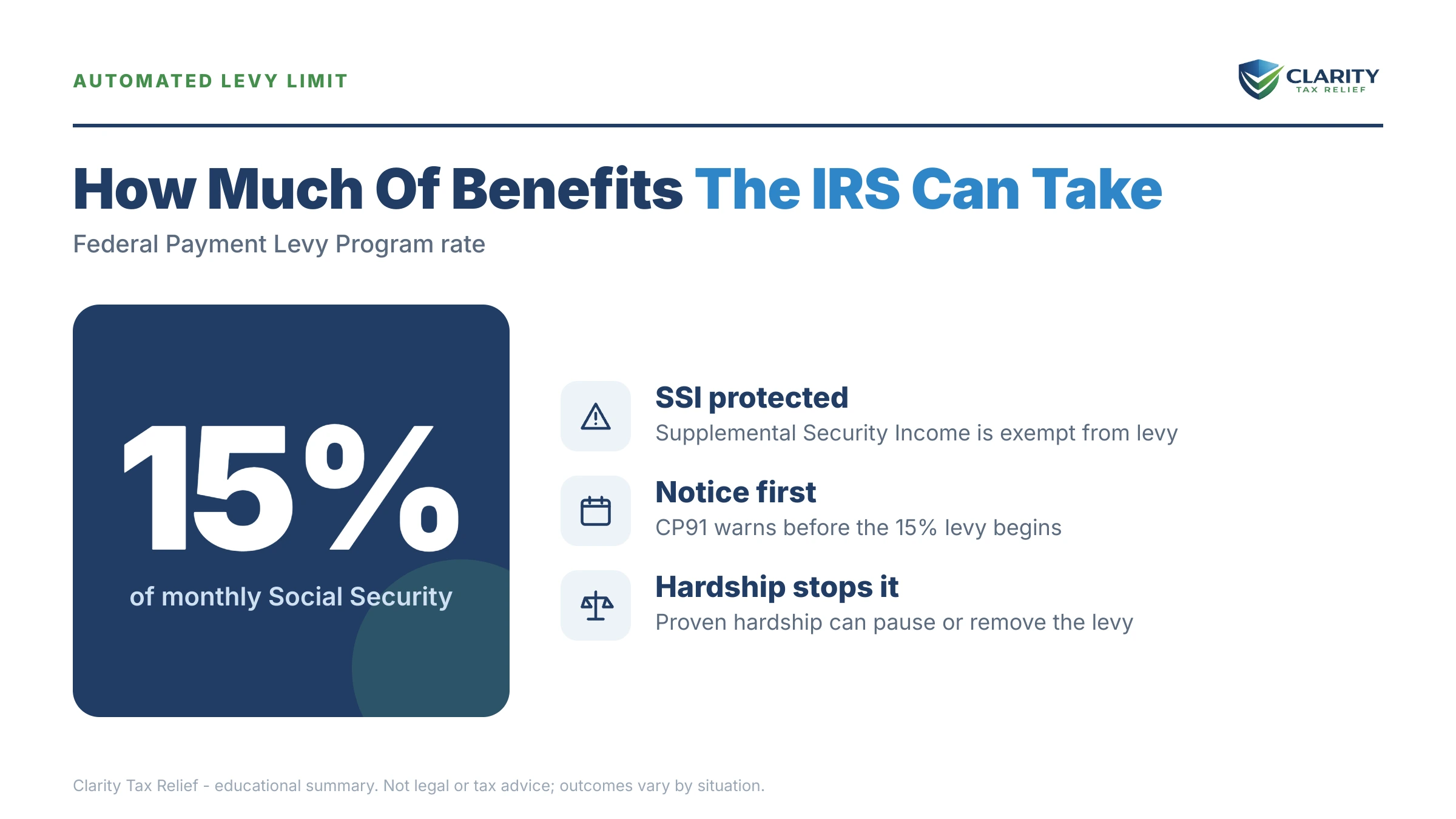
The IRS can take up to 15% of your Social Security retirement or disability check through the Federal Payment Levy Program — and unlike a one-time bank levy, it repeats every month until it's released or the debt is gone. It happens by computer match between the IRS and the Treasury, which is why it keeps working even with the IRS workforce down roughly 27% since 2025.
Not every benefit is reachable. Here's the line the automated system actually draws — for the full mechanics of the deduction itself, see our guide to the IRS taking 15 percent of Social Security.
| Benefit type | Can the IRS levy it? | How much |
|---|---|---|
| Social Security retirement & survivor benefits | Yes — via the Federal Payment Levy Program | Up to 15% of each check, month after month |
| SSDI (Social Security Disability Insurance) | Yes — same FPLP treatment as retirement (see can the IRS garnish SSDI) | Up to 15% of each check |
| SSI (Supplemental Security Income) | No — exempt from the FPLP | $0 |
One more channel to know about: even in hardship status, the Treasury keeps any tax refund you're owed and applies it to the debt. If a kept refund would itself create a crisis — an eviction, a utility shutoff — there's a narrow path called an offset bypass refund for hardship.
What happens if you ignore IRS debt while on Social Security
IRS collection against a Social Security recipient ends the same place it ends for everyone else: an automated levy — in your case, a recurring cut of the check you live on. The sequence is machine-driven and doesn't slow down for retirement:
- Balance-due bills (CP14, then reminders). Plain bills — no enforcement yet, but the balance grows every month.
- CP504 — intent to levy your state refund. The IRS can now take a state tax refund, and a federal tax lien becomes a live possibility.
- LT11 / Letter 1058, or a CP91 Social Security levy notice. The final warning. An LT11 starts a 30-day clock and gives you Collection Due Process appeal rights (requested on Form 12153). The CP91 is the version aimed specifically at your benefits.
- The FPLP levy begins. Up to 15% comes out of every benefit check — continuously, with no negotiation built in — until the levy is released, the debt is paid, or the collection statute expires.
- Lien and offsets alongside. A Notice of Federal Tax Lien can be filed against your home, and every future tax refund is kept.
The order matters because your leverage is highest before stage 4. Getting hardship status approved before the levy starts means the money never leaves your check; getting it approved after means waiting for a release while short checks arrive.
On Social Security with an IRS balance growing every month?
Get your situation reviewed free before a final levy notice starts the 30-day clock. An experienced tax professional will run the hardship math on your actual income and expenses and tell you honestly which path fits — no pressure, no obligation.
How to qualify for IRS hardship while on Social Security
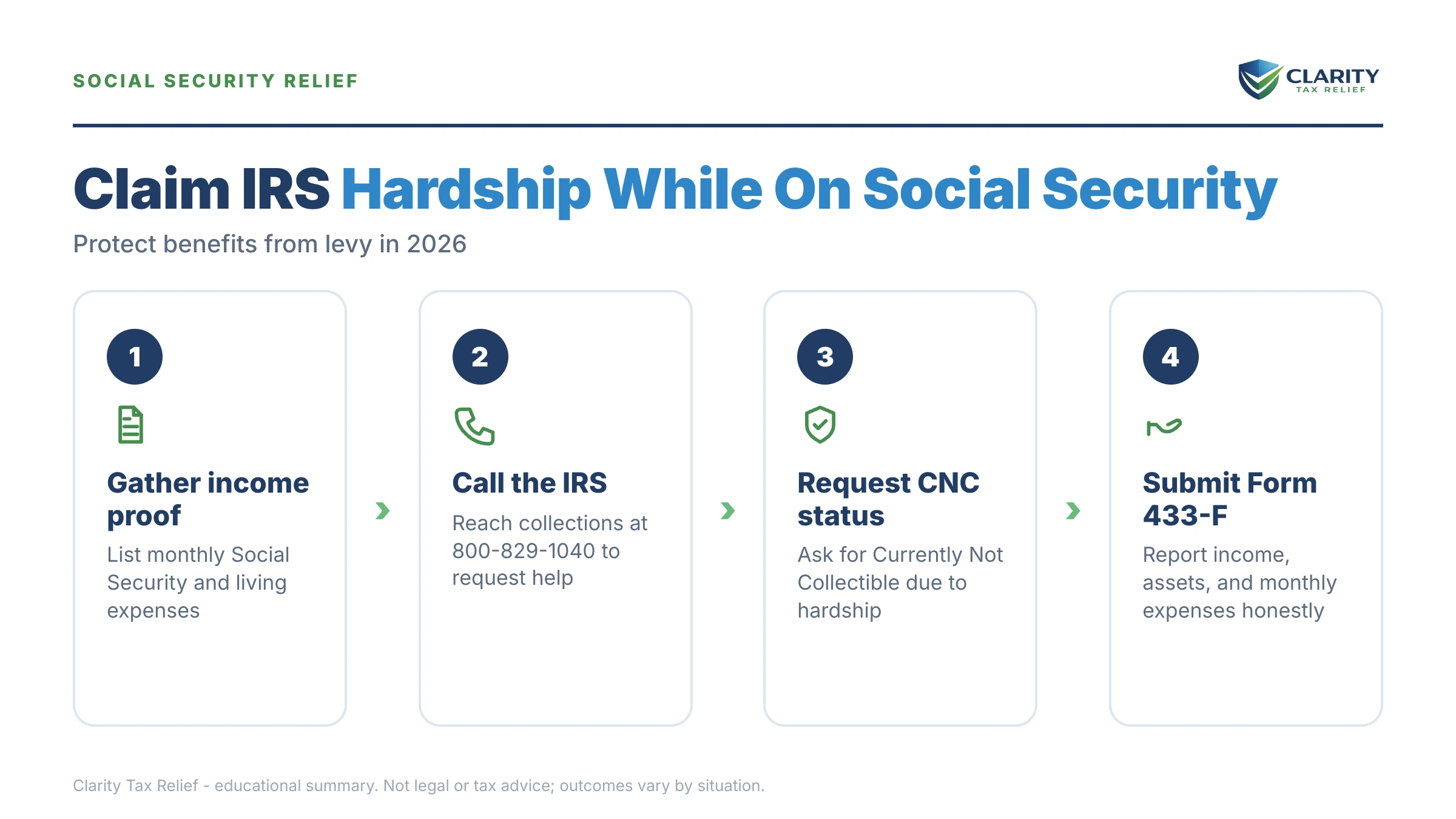
There is no separate senior application — the IRS hardship program people search for is really Currently Not Collectible status, and it's decided by expense math, not age. The IRS compares your monthly income against its allowable living expense standards on Form 433-F; if the expenses win, your account is coded hardship and collection stops. The full 433-F test lives in our guide on how to qualify for CNC — below is how each option actually fits a Social Security budget.
| Option | Typical eligibility on a fixed income | Effect on your Social Security check |
|---|---|---|
| Currently Not Collectible (CNC) | Monthly allowable living expenses equal or exceed income on Form 433-F | FPLP levy stopped or released; you pay $0 while the status holds |
| Streamlined installment agreement | Balance ≤ $50,000 and you can genuinely afford a payment over up to 72 months | No levy while you stay current on the plan |
| Partial-pay installment agreement | You can pay something, but not the full balance before the 10-year statute runs | Small affordable payment; IRS re-reviews your finances periodically |
| Offer in Compromise | Assets plus future income fall below the balance — home equity counts against you | Levies generally pause while the offer is under review |
| Penalty relief (First-Time Abate / AEP) | Clean compliance the prior 3 years; becomes automatic under AEP starting summer 2026 | Shrinks the balance — it's a discount, not a collection pause |
CNC does not erase the debt. Interest and the late-payment penalty keep accruing, and the IRS keeps your refunds. What CNC buys is time with your check intact — and while you're in it, the 10-year Collection Statute Expiration Date keeps running. On a fixed income that's often the whole strategy: stay protected until each year's balance expires. You can estimate when your own balances run out with our CSED Calculator. Two follow-up questions matter here — how long Currently Not Collectible lasts, and what triggers CNC status being removed (usually a filed return showing income above the level the IRS set at approval, or a missed filing).
| Option | Upfront cost | Cost over time | Typical timeline |
|---|---|---|---|
| Currently Not Collectible | $0 — no application fee | Interest and 0.5%/month penalty keep accruing; refunds kept | Varies — status posts after the IRS reviews your Form 433-F financials |
| Short-term payment plan (up to 180 days) | $0 setup | Interest and penalties until paid | Can be set up online the same day |
| Long-term installment agreement | Setup fee applies (reduced or waived for low-income taxpayers) | Interest and penalties accrue on the shrinking balance | Online approval for most balances under $50,000 |
| Offer in Compromise | $205 fee + 20% down on lump-sum offers — both waived with low-income certification (AGI ≤ 250% of the poverty level) | Offer amount if accepted; roughly 1 in 5 offers were accepted in FY2024 | Months; deemed accepted if the IRS doesn't decide within 2 years, with narrow exceptions — a returned or rejected offer stops the clock, and time during court disputes does not count |
| Penalty abatement (FTA / AEP) | $0 | None — removes qualifying penalties from the balance | FTA by request now; AEP applies automatically starting summer 2026 |
A worked example: $41,800 in IRS debt on a Social Security income
On a $41,800 balance, the gap between doing nothing and getting hardship status approved is roughly $347 a month. Here's the math on a clearly hypothetical case — say you owe $41,800 across two tax years, your benefit is $2,310 a month, and you own a home worth about $260,000 with $175,000 left on the mortgage:
- If the FPLP levy starts: 15% × $2,310 = $346.50 taken from every check, indefinitely, while interest keeps stacking on the remaining balance.
- Streamlined installment agreement: $41,800 ÷ 72 months ≈ $581/month before interest — more than a quarter of your income. If your allowable expenses already consume the whole check, the IRS's own math says this plan fails.
- CNC: say your housing, utilities, food, Medicare premiums, and out-of-pocket medical run $2,480/month against $2,310 of income. You're $170 underwater on necessities — a textbook hardship profile. Payment: $0.
- Offer in Compromise: the IRS values your home at roughly 80% of market value minus the mortgage: (0.80 × $260,000) − $175,000 = $33,000 of reachable equity. With near-zero future income, your Reasonable Collection Potential is about $33,000 — so an acceptable offer would need to be in that neighborhood. Not pennies on the dollar (that pitch is a scam signal, not a program), and most fixed-income homeowners can't fund it without selling the very asset they're protecting.
- The refinance play: a cash-out refinance that pays the $41,800 at closing ends the problem entirely — the lien, once fully paid, is typically released within about 30 days, and penalties stop compounding.
Notice what the example shows: for a homeowner, home equity quietly reshapes every option. It weakens the OIC, it can complicate the CNC conversation, and it makes the refinance itself part of the strategy — which brings us to the lien.
Hardship status when you own a home: the lien and refinance problem
Hardship status stops levies, but it does not stop the IRS from filing a lien — and the lien, not the CNC coding, is what surfaces in your refinance. When a balance over $10,000 goes into CNC, the IRS generally files a Notice of Federal Tax Lien to protect its position. The lien attaches to your home; it doesn't force a sale, but no lender misses it in a title search.
You have two workable paths, and both are routine for underwriters who see them planned in advance. First, pay the IRS from the refinance proceeds at closing — the title company handles it like any other payoff, and the lien is released once the balance is satisfied. Second, if the refinance is about lowering your payment rather than pulling cash out, request tax lien subordination on Form 14134, which lets the new mortgage take first position while the lien stays. The full lender-side picture is in our guide to refinancing with an IRS lien.
One honest caution: before granting CNC, the IRS can ask whether you're able to borrow against your equity to pay the debt. For many retirees the answer is genuinely no — fixed income won't support a new loan — and documenting a lender's decline or your debt-to-income reality turns that question from a threat into a checkbox. Don't let it scare you off the request; let it shape your paperwork.
How to request IRS hardship status, step by step
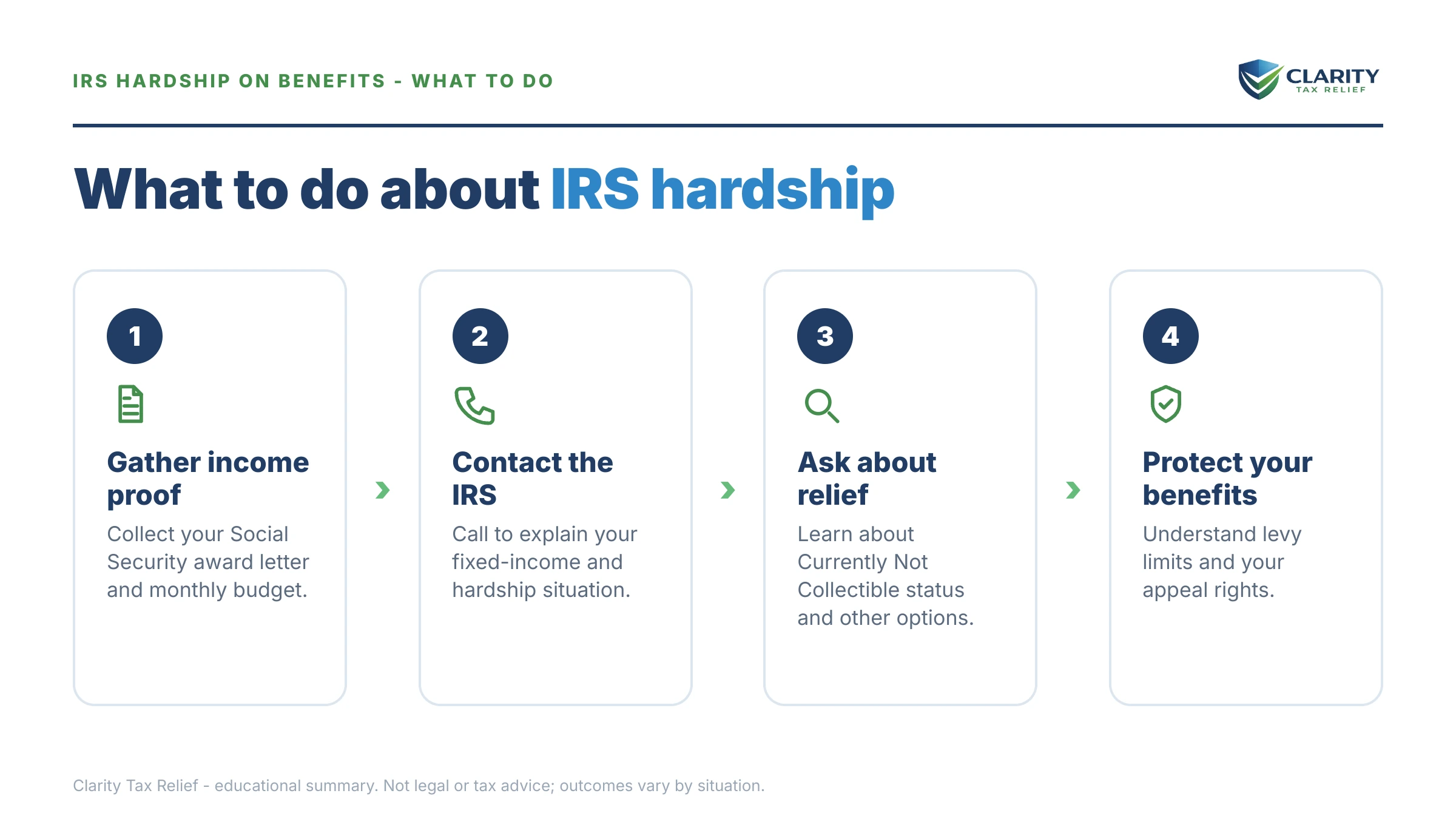
- Verify what you owe. Log into your IRS online account or request account transcripts so you know the exact balance for each year, the assessment dates, and whether a levy notice has already been issued.
- Gather your financial proof. Collect your SSA award letter or benefit statement, your last tax return, three months of bank statements, and bills for housing, utilities, medical costs, and insurance.
- Complete Form 433-F. List every income source and monthly expense. How your expenses are categorized against the IRS allowable living expense standards often decides whether the account is coded hardship or "can pay."
- Call the IRS and request Currently Not Collectible status. Use the number on your most recent notice. If a levy is already taking part of your check, say so — an active levy that creates economic hardship must be addressed. A representative with Form 2848 can make this call for you.
- Confirm the status and watch your mail. CNC shows up as code 530 on your account transcript. Expect an annual CP71 reminder notice — it doesn't restart collection — and keep filing every year, because a missed return can knock you out of hardship status.
When you can handle this yourself — and when help changes the outcome
If you can pay the balance within 180 days without touching housing, medication, or food money, you don't need anyone: set up a $0-fee short-term plan yourself through IRS payment options at IRS.gov and be done. The same goes for a small balance you agree with and a straightforward monthly plan you can genuinely afford.
Experienced help earns its cost in specific situations: the FPLP is already taking 15% of your check and you need a release, not just a status; you have unfiled years that must be cleaned up before the IRS will code you CNC; your home equity is large enough that the IRS pushes back on hardship; or you're sequencing a refinance around a filed lien, where the order of payoff, subordination, and closing determines whether the deal funds. Presentation matters too — the same income and bills, categorized differently on Form 433-F, can land on either side of the hardship line. If you're facing a levy that's already causing a crisis and can't get through to the IRS, the Taxpayer Advocate Service is a free, independent escalation path.
Terms on your notices, decoded
- Currently Not Collectible (CNC): the IRS's internal coding for "this person can't pay right now" — collection pauses, the debt remains.
- Federal Payment Levy Program (FPLP): the automated Treasury system that deducts up to 15% from federal payments, including Social Security, to cover tax debt.
- CSED: the Collection Statute Expiration Date — generally 10 years from assessment, after which the IRS can no longer collect that year's balance.
- Allowable living expenses: the IRS's standardized budgets for housing, food, transportation, and health care used to measure what you can "afford" to pay.
- Notice of Federal Tax Lien: a public filing that attaches the IRS's claim to your property — it secures the debt but doesn't take money the way a levy does.
- Lien subordination: the IRS agreeing to let a new lender jump ahead of its lien so a mortgage or refinance can close.
IRS hardship and Social Security: your questions, answered
Can the IRS take my Social Security check?
Yes. Through the Federal Payment Levy Program, the IRS can take up to 15% of your Social Security retirement, survivor, or disability benefits, and the levy continues every month until it's released. SSI is exempt and cannot be touched by the FPLP. Proving economic hardship — usually through Currently Not Collectible status — is the standard way to stop or release the levy.
Does IRS hardship status forgive my tax debt?
No. Currently Not Collectible status pauses collection; it doesn't erase what you owe. Interest and the late-payment penalty keep accruing, and the IRS keeps any tax refunds you're owed. The upside is that the 10-year collection statute keeps running while you're in CNC, so debt that stays uncollectible long enough can expire — though certain events, like a pending Offer in Compromise or bankruptcy, pause that clock.
How much Social Security income is too much to qualify for hardship status?
There is no fixed income cutoff. The IRS compares your monthly income against allowable living expenses — housing, utilities, food, health care, and transportation — using Form 433-F. If your necessary expenses equal or exceed your income, you can qualify even with a benefit check that sounds comfortable on paper. High medical costs, common on a fixed income, often make the difference.
Will the IRS file a tax lien if I'm in hardship status?
Usually, yes, when the balance is over $10,000. CNC stops levies — the taking of money — but the IRS typically protects its position by filing a Notice of Federal Tax Lien against your property. The lien doesn't force a sale of your home, but it attaches to it, which matters most when you try to sell or refinance.
Can I refinance my home while in Currently Not Collectible status?
Often, yes — but the tax lien has to be dealt with first. Your two main paths are paying the IRS from the refinance proceeds at closing, or requesting lien subordination on Form 14134 so the new lender takes first position. Lenders see both regularly; the mistake is waiting until underwriting discovers the lien instead of planning for it up front.
Is SSDI treated the same as retirement benefits?
For levy purposes, yes. SSDI is paid under the same Social Security title as retirement benefits, so the IRS can take up to 15% of it through the FPLP. SSI is the exception — it's a needs-based program and is exempt from the FPLP entirely. Receiving SSDI is also strong evidence of limited earning capacity, which helps a hardship or CNC request.
What happens to my tax debt after 10 years?
The IRS generally has 10 years from the date each balance was assessed to collect it — the Collection Statute Expiration Date, or CSED. When a CSED passes, that year's remaining balance is written off and any lien tied to it self-releases. But the clock pauses for events like an Offer in Compromise, bankruptcy, or certain appeals, so the real expiration date is often later than assessment-plus-ten-years.
Your next 24 hours
- Find your most recent IRS letter and note two things: the notice number in the corner (CP504, LT11, and CP91 mean the levy stage is close or here) and the total balance printed on it.
- Pull your proof together: your SSA award letter or benefit statement (available in minutes at ssa.gov/myaccount), your last filed tax return, and three months of bank statements. That's most of a Form 433-F right there.
- Get a free case review. Call (888) 825-7779 or use the 2-minute form. An experienced tax professional will run the hardship math on your real numbers, map the lien around your refinance, and tell you which path fits — while the balance is still growing monthly, every month you wait is money.
This guide is general information, not tax or legal advice for your specific situation. Eligibility for IRS programs depends on individual facts and circumstances; no outcome is guaranteed.