
IRS Hardship Status
How Long Does Currently Not Collectible Last? Review Cycle & Income Triggers (2026)
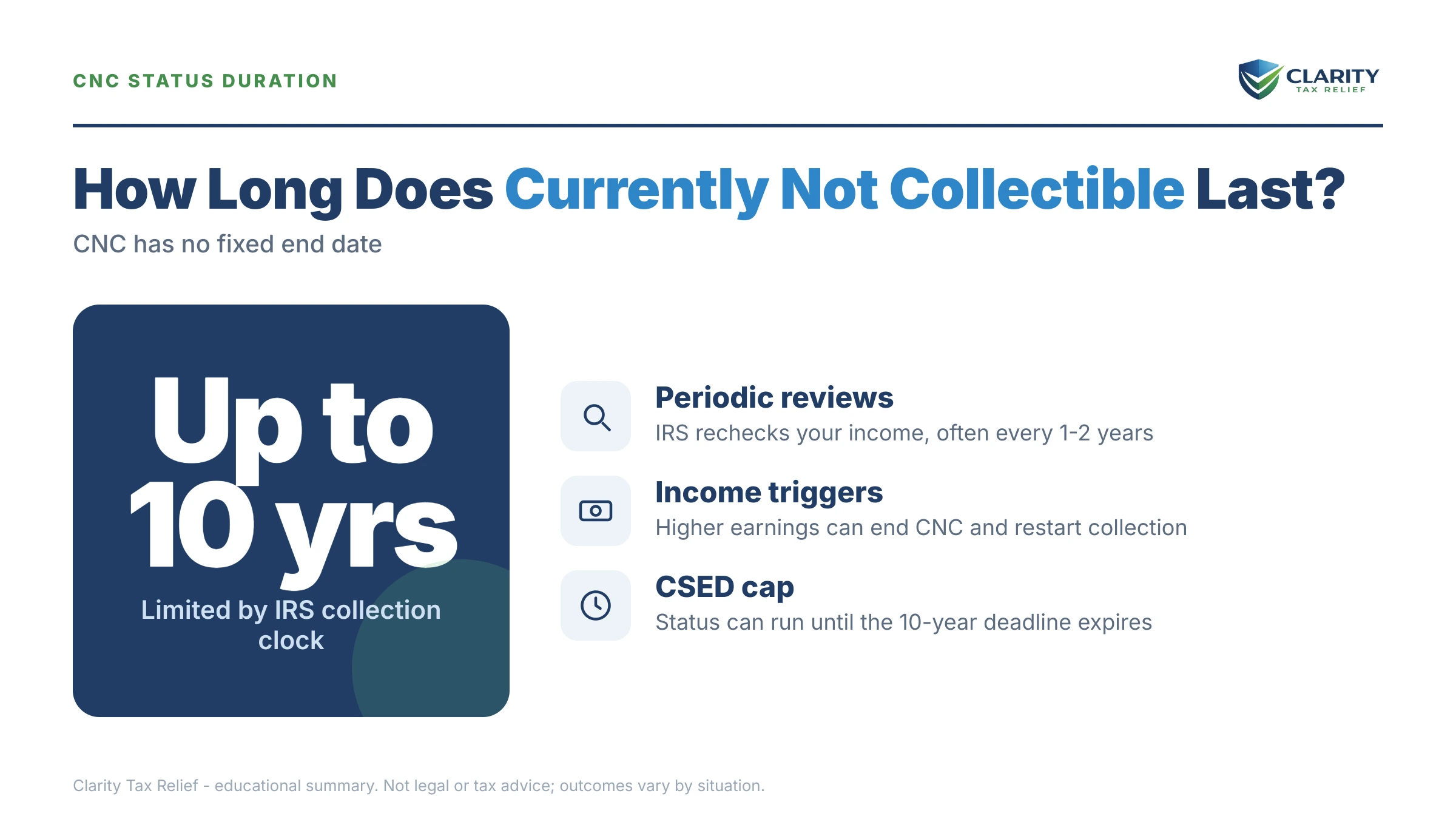
The short answer: how long does currently not collectible last? There is no fixed end date. CNC continues until a filed tax return shows income above the trigger level the IRS set for your account — or until the 10-year collection statute expires and the remaining debt is written off. Many accounts stay in CNC for years.
You're weighing this because a levy warning is sitting next to your rent bill, and someone told you hardship status can stop the IRS — but only if it lasts long enough to matter. Here's the honest answer: CNC's length is decided by your income, not a calendar. And that means you have more control over how long it lasts than you might think.
The IRS marks a CNC account with transaction code 530 on your account transcript — the image below shows you exactly what that looks like and where to find it, so you can confirm your status without waiting on hold.
⏱ The real clock: CNC has no expiration date — but the 10-year collection statute keeps running the entire time you're in it. Every month in hardship status is a month closer to the date your debt legally expires. Meanwhile, interest and the failure-to-pay penalty keep accruing, so the balance grows until it's paid or it dies.
How long does currently not collectible last? The three ways it ends
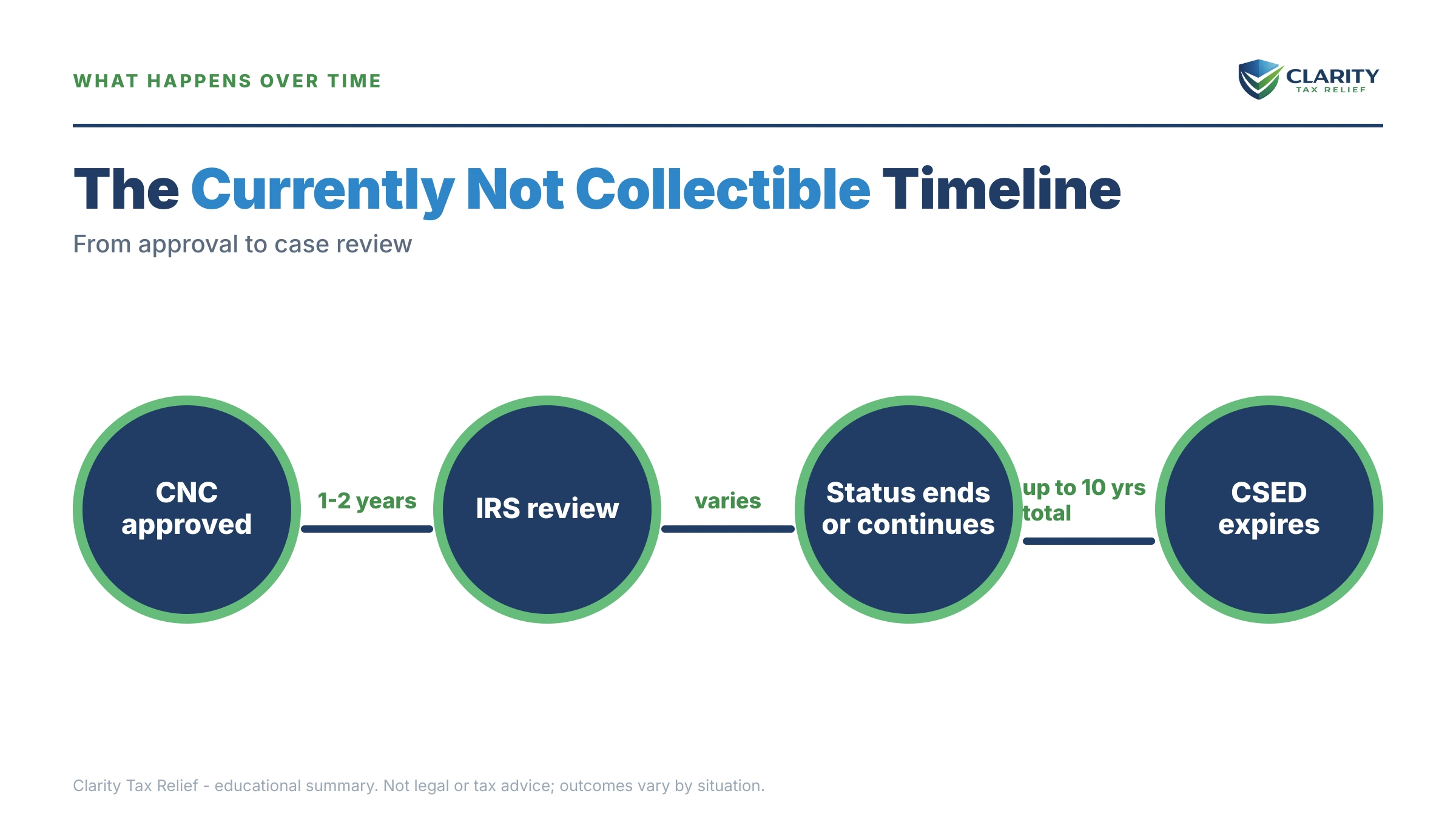
Currently Not Collectible status lasts until one of three things happens: your reported income rises above the trigger level the IRS set for your account, you break filing compliance, or the 10-year collection statute expires and erases the debt. Nothing about CNC runs on a calendar. There is no "two-year hardship program," no annual renewal, and no automatic removal date.
Ending #1 — the income trigger — is the one that ends most CNC placements. When you were approved, the IRS recorded an income level based on the financial statement you submitted. Every tax return you file afterward is compared against it by computer. Cross the line, and your account gets flagged for review. Our guide to CNC income limits walks through the allowable-expense math behind that number.
Ending #2 — broken compliance — is self-inflicted and avoidable. Skip a required return, or rack up a new balance for a new year, and the IRS can pull the account out of hardship status regardless of whether your income recovered.
Ending #3 — the CSED — is the ending nobody at the IRS advertises. If your income never rises above the trigger and you stay compliant, CNC simply holds until the collection statute runs out. At that point the IRS doesn't "remove" you from CNC; the debt itself ceases to exist.
Why there's no expiration date: closing codes, explained
The IRS doesn't schedule an end date for CNC — it programs a tripwire instead. When a collector approves hardship status, the account is closed with a numeric "closing code" keyed to your total positive income from the financials you submitted (usually a Form 433-F, sometimes a 433-A). That code sits on your account doing nothing — until a future return reports income above it.
This is why two people in CNC can have wildly different experiences. A retiree on fixed Social Security may sit in CNC untouched for eight years. A W-2 worker who picks up a second job may get a review letter fourteen months in. The status isn't timed; it's income-tested, automatically, every filing season.
It also means the IRS staffing cuts of 2025 don't protect you here. The comparison between your return and your closing code is done by computer, not by a human who might be backlogged. The screening never stopped.
If you're still applying, the hardship test itself — what counts as income, which expenses the IRS allows, and how the 433-F is scored — is covered in our guide to how to qualify for CNC. This article assumes you're in (or about to be) and want to know how long the protection holds.
One important nuance: if your income is self-employment or gig income, the trigger math works differently, because the IRS sees your gross receipts before your expenses. Our currently not collectible self employed guide covers why 1099 earners get flagged for review more often — and how to document expenses so the review goes your way.
The clock that never stops: your CSED keeps running in CNC
The IRS generally has 10 years from the date a tax was assessed to collect it — and CNC does not pause that clock. This is the single most misunderstood fact about hardship status, and it's the reason CNC can quietly become permanent relief. The full mechanics are in our guide to the 10-year collection statute (CSED).
Contrast that with the alternatives: a pending Offer in Compromise, a bankruptcy, or a collection due process appeal all suspend the statute while they're pending, pushing your expiration date further out. CNC is the only major hardship posture that lets the clock keep running at full speed. Our breakdown of what pauses the 10-year clock lists every tolling event.
Each tax year has its own CSED, based on when that year's tax was assessed. If you owe for 2019 and 2023, the 2019 balance dies years before the 2023 one does. You can estimate your own expiration dates with our CSED Calculator — knowing those dates tells you exactly how long your CNC status needs to hold.
One caution before you count on expiration: the write-off only happens if the clock actually runs out. If the IRS reactivates your account with three years left on the statute, it has three full years to collect — with a balance that grew the whole time you were in CNC.
What life in CNC actually looks like, year by year
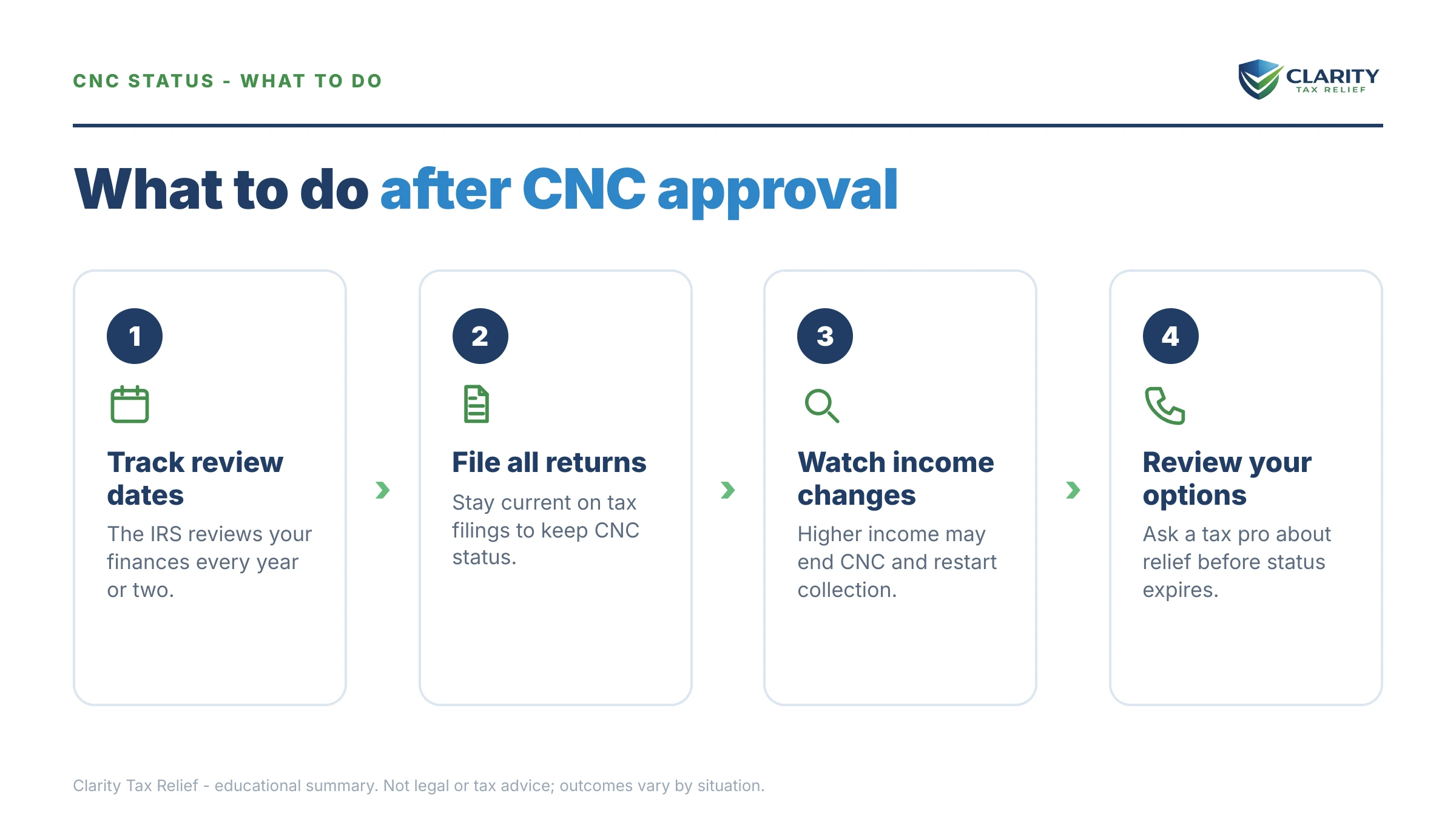
While you're in CNC, the IRS sends exactly one thing: a CP71 reminder notice, once a year, showing your growing balance. The CP71 annual reminder is not a bill, not a demand, and not a sign your status is ending — it's a statutory requirement, and it's actually useful, because it confirms your account is still in hardship posture and shows you what penalties and interest have added.
Three other things continue in the background:
- Refund offset. Any federal refund you're owed is taken and applied to the balance, every year, automatically. This doesn't end CNC — it's the one form of "collection" that hardship status never stops.
- Accrual. Interest compounds daily, and the failure-to-pay penalty adds 0.5% per month until it caps at 25% of the unpaid tax. The debt is paused, not frozen.
- A possible lien. The IRS may file a Notice of Federal Tax Lien to protect its claim, and it generally makes a lien determination on CNC balances above $10,000. See does CNC stop a tax lien for what a filing means (and doesn't).
One benefit worth knowing at higher balances: a debt sitting in CNC hardship status is generally excluded from passport certification, even when the balance exceeds the $66,000 seriously-delinquent threshold for 2026. Hardship status is one of the few postures that shields your passport without paying anything.
| Event | Does it end CNC? | What it means for you |
|---|---|---|
| Filed return shows income above your closing-code trigger | Usually — after a review | The IRS flags the account and typically requests updated financials before resuming collection |
| Missed return or new balance due | Can, on its own | Broken compliance lets the IRS reverse the status without an income change |
| Periodic IRS account review | Sometimes | The IRS may re-check finances on its own schedule; respond with real numbers and CNC often continues |
| CSED expires | Ends the debt itself | Whatever balance remains is legally uncollectible and written off |
| CP71 annual reminder arrives | No | Routine statutory notice — file it away as proof of your status and balance |
| Federal refund offset | No | Refunds are applied to the balance every year; status is unaffected |
| Notice of Federal Tax Lien filed | No | The lien protects the IRS's claim but doesn't reactivate levies or garnishments |
What happens when CNC ends — the reactivation sequence
When the IRS decides your hardship may be over, it doesn't levy first — it follows a sequence, and every stage is a chance to keep your protection. Here's the order, from tripwire to levy:
- The trigger. A filed return crosses your income threshold, a new balance posts, or the account comes up in a periodic review. Nothing visible happens yet.
- The financials request. The IRS mails a letter asking for an updated Form 433-F — its way of asking "can you pay now?" This is the decisive moment: real numbers showing continued hardship usually keep CNC in place.
- Status reversal. Ignore the request, or submit financials showing ability to pay, and the account returns to active collection — with a balance that grew the entire time.
- The notice sequence resumes. Balance-due and reminder notices restart, escalating toward an intent-to-levy notice. You are no longer protected, but nothing has been seized yet.
- Final notice and levy. A final notice of intent to levy starts a 30-day clock with Collection Due Process rights; after that, wage garnishment (continuous until released) and bank levies (a 21-day hold before funds leave) are back on the table.
The single most important fact in this sequence: ignoring the financials request is what turns a review into a levy. People who respond with documentation frequently stay in CNC; people who don't respond get reversed by default. The full removal process — and how to get the status reinstated afterward — is covered in CNC status removed.
In CNC and just got a letter — or trying to get in before a levy hits?
Whether the IRS is asking for new financials or a levy warning is already in your mailbox, the response window is where cases are won. Get your situation reviewed free by an experienced tax professional — we'll tell you whether CNC fits, how long it's likely to hold, and what to send back.
CNC vs. your other options: eligibility, cost, and what happens to the debt
CNC is the right tool when paying anything would leave you unable to cover basic living expenses — but it's not the only tool, and duration is where the options really differ. A payment plan ends when the debt is paid; an accepted offer ends it early; CNC ends only when your income recovers or the statute runs out.
| Option | Who qualifies | Monthly cost | What happens to the balance |
|---|---|---|---|
| Currently Not Collectible | Allowable expenses meet or exceed income (hardship shown on Form 433-F) | $0 | Grows with interest/penalties; written off if the CSED expires first |
| Guaranteed installment agreement | Owe $10,000 or less (tax), compliant filing history | Full pay within 3 years (~$206/mo on $7,400 before accruals) | Paid in full |
| Streamlined installment agreement | Owe $50,000 or less; up to 72 months online, no full financials | Balance ÷ up to 72 months, plus accruals | Paid in full |
| Partial-pay installment agreement | Financials show you can pay something, but not everything, before the CSED | What your budget supports | Remainder expires at the CSED |
| Offer in Compromise | Assets + future income can't cover the debt; $205 fee (waived if AGI ≤ 250% of poverty) | Lump sum or short-term payments | Settled for the accepted amount — IRS accepted roughly 1 in 5 offers in FY2024 |
Two comparisons deserve their own reading if you're on the fence: payment plan vs currently not collectible for the "I could scrape together something" cases, and CNC vs offer in compromise for the "should I just try to settle" question. The short version: an OIC costs money and pauses your CSED while it's reviewed; CNC costs nothing and lets the clock run. A partial-pay installment agreement sits in between — small payments, same expiring statute.
| Balance owed | If you can pay something | If you genuinely can't pay |
|---|---|---|
| Under $10,000 | Guaranteed installment agreement — 3-year payoff, minimal scrutiny | CNC; a lien filing is less likely at this level |
| $10,000–$25,000 | Streamlined plan, set up online in minutes | CNC; expect a lien determination — the IRS generally considers one above $10,000 |
| $25,000–$50,000 | Streamlined plan (direct debit often required toward the top of the band) | CNC with closer review of your 433-F; lien likely |
| Over $50,000 | Full financial disclosure required for any plan | CNC still available — and above $66,000, hardship status generally shields your passport from certification |
A worked example: $7,400, a levy warning, and three possible timelines
Say you owe $7,400 from your 2023 return, assessed in mid-2024 — so the CSED lands around mid-2034. You rent, your paycheck covers rent, utilities, food, and transportation with nothing left, and an intent-to-levy notice just arrived. Here's how the three realistic paths play out (all figures are hypothetical and rounded):
- Path 1 — payment plan. A guaranteed installment agreement means full pay within 3 years: $7,400 ÷ 36 ≈ $206/month before accruals. A 72-month streamlined plan drops that to roughly $103/month base — call it $120–$130/month with interest and penalties. If the IRS's own allowable-expense standards show your budget is already at zero, that money doesn't exist, and CNC is the honest answer.
- Path 2 — CNC that holds. You pay $0/month, and the levy threat stops. The failure-to-pay penalty keeps adding 0.5% per month until it caps at 25% of the unpaid tax — on roughly $6,800 of tax within that balance, that's up to about $1,700 more over time, plus daily compounding interest. Your CP71 might read $9,000–$10,000 within a few years. But if your income stays below the trigger through mid-2034, whatever remains is written off. Total out-of-pocket: possibly nothing beyond intercepted refunds.
- Path 3 — CNC that ends early. Your income recovers in 2028; that return trips the closing code and the IRS requests new financials. Collection resumes on a balance near $9,500 with about six years left on the statute — a streamlined plan then runs roughly $132/month base. CNC wasn't wasted: it bought four levy-free years while you got back on your feet. It just wasn't free money.
The takeaway: at $7,400, CNC is either a bridge (Path 3) or an endgame (Path 2) — and which one you're on is determined entirely by where your income goes, not by any IRS timer.
How to keep your CNC status, step by step
- File every required return on time. A single missing return breaks the compliance requirement and can end CNC on its own — even if your income never recovered.
- Fix your withholding or estimated payments. A new balance due for a new year is the fastest way to trigger a full review of your hardship status.
- Keep every CP71 notice. The annual reminder confirms your balance and that the account is still in hardship status — and it's your early warning if something changes.
- Watch the income your next return will report. If it will show income above what you listed on your Form 433-F, expect a review — and plan your response before the letter arrives.
- Track your CSED for each tax year. Know when each assessed balance legally expires so you know how long your CNC status needs to hold.
- Respond quickly if the IRS requests new financials. Sending an updated Form 433-F by the deadline keeps the decision based on your real numbers instead of an automatic reversal.
When you can handle this yourself
Plenty of CNC situations don't need professional help. If you're already in CNC, your income hasn't changed, and the only mail you're getting is the annual CP71 — do nothing except file on time and keep your withholding right. That's the whole job. Likewise, if your balance is small and your budget genuinely supports a payment, setting up a streamlined plan online yourself is often cheaper and simpler than staying in a status that lets the balance grow.
Experienced help changes outcomes in four specific situations. First, a levy is already in motion — getting CNC granted fast enough to stop a garnishment requires knowing exactly which unit to contact and what documentation gets same-week action. Second, the IRS has requested updated financials: how expenses are categorized on the 433-F against the IRS's allowable-expense standards frequently decides whether CNC continues. Third, you have multiple years — some near their CSED, some not — where the right move may be CNC on old years and a different resolution on new ones. Fourth, self-employment or business income, where the IRS's view of your gross receipts can make a broke person look flush on paper.
If any of those four describe you, a free review before you respond to the IRS is worth 20 minutes — how long your CNC lasts often comes down to how the first response is written. You can request a free case review here or call (888) 825-7779.
State hardship status runs on a different clock
Everything above is IRS-only — state hardship programs have their own rules, and the durations are not interchangeable. California is the sharpest example: the Franchise Tax Board can collect for 20 years under R&TC §19255, double the IRS window, so "wait it out in hardship status" is a far longer bet with the FTB. If you owe California, see FTB currently not collectible for how that program's review cycle differs. For other states, contact the state revenue agency directly rather than assuming IRS timelines apply.
Terms on your transcript and notices, decoded
- TC 530 — the transaction code that marks your account as Currently Not Collectible on your transcript; see our code 530 transcript guide for how to read it.
- Closing code — the number recorded alongside TC 530 that encodes your income trigger level; future returns are compared against it automatically.
- CSED — Collection Statute Expiration Date; the date, generally 10 years after assessment, when the IRS legally loses the right to collect a balance.
- CP71 — the once-a-year reminder notice every CNC account receives; informational, not a demand.
- Notice of Federal Tax Lien (NFTL) — a public filing that secures the IRS's claim on your property; it can be filed during CNC without ending the status.
- Refund offset — the automatic application of your federal refund to the old balance; it continues every year you're in CNC.
Currently not collectible questions, answered
Does currently not collectible status expire after two years?
No. CNC has no built-in expiration date, and there is no automatic two-year removal. The IRS reviews accounts when a filed tax return shows income above the trigger level set when you were approved, and it may review periodically on its own. Some accounts stay in CNC a year; others remain until the 10-year collection statute erases the debt.
Does the 10-year collection statute keep running while I'm in CNC?
Yes. CNC does not pause the Collection Statute Expiration Date the way a pending Offer in Compromise or bankruptcy does. Every month you spend in hardship status counts toward the 10 years, and whatever balance remains when the CSED arrives is written off. That's why CNC can quietly become permanent relief for people whose income never recovers.
Will the IRS take my tax refund while I'm in CNC?
Yes. Refund offset continues in CNC — any federal refund you're due is applied to the old balance automatically, every year, until the debt is paid or expires. If withholding leaves you with a big refund each spring, adjusting your W-4 keeps more of that money in your paycheck instead. A refund offset does not end your CNC status.
Can the IRS file a tax lien while my account is in CNC?
It can. CNC stops levies and garnishments, but the IRS may still file a Notice of Federal Tax Lien — and it commonly considers one on balances above $10,000 — to protect its claim against anything you own or later acquire. The lien doesn't take anything from you day to day, but it attaches to your property and appears in public records.
What income triggers a CNC review?
When the IRS grants CNC, it records a closing code tied to an income level based on the financial statement you submitted. When a future tax return reports total income above that level, the account is flagged and the IRS may ask for updated financials before deciding whether to resume collection. The exact number is specific to your case — it isn't published, and it isn't the same for everyone.
Do I have to reapply for CNC every year?
No. Once your account is coded CNC it stays that way without annual paperwork. Your two ongoing obligations are staying compliant — filing every required return and not building new balances — and responding if the IRS requests updated financials. The CP71 you receive each year is a reminder of the balance, not a demand or a reapplication form.
What happens if I owe new taxes while in CNC?
A new balance due is one of the fastest ways to lose CNC. Hardship status covers the specific years it was granted for, and fresh debt signals that your withholding or estimated payments are off — which usually prompts a full review of the account. If a new year's bill is coming, fix your withholding now and get ahead of the review.
Can CNC last until my tax debt is forgiven?
Yes — this is the quiet endgame of CNC. If your income stays below the trigger level for the rest of the collection statute, the IRS never resumes collection, and the remaining balance is written off when the 10-year CSED expires. Be aware that certain events — a pending Offer in Compromise, bankruptcy, or a collection appeal — pause that clock and push the expiration date out.
Does CNC stop penalties and interest from growing?
No. Interest compounds daily and the failure-to-pay penalty continues at 0.5% per month until it caps at 25% of the unpaid tax. Your balance will be larger on next year's CP71 than it is today. CNC is protection from collection, not a freeze on the debt — which is why it pairs well with penalty abatement where you qualify.
Your next 24 hours
- Pull out the letter you're holding and find the notice number (top or bottom right corner). If it's a final notice of intent to levy, you have formal appeal rights on a 30-day clock — that changes what to do first. If it's a CP71 or a financials request, you have time to respond well.
- Gather three things: your most recent tax return, your last two months of income (pay stubs, benefit letters, or deposits), and your monthly rent, utility, and insurance figures. That's the raw material for a Form 433-F — whether you're applying for CNC or defending it.
- Get a free case review. An experienced tax professional can tell you in one call whether CNC fits your numbers, how long it's likely to hold given your CSED dates, and what to send the IRS — start with the 2-minute form or call (888) 825-7779. Interest and penalties accrue every month the balance sits unresolved, so sooner genuinely costs less.
For the IRS's own description of hardship status, see Temporarily delay the collection process at IRS.gov. If a levy is causing immediate hardship and you can't get traction, the Taxpayer Advocate Service is an independent office within the IRS that can intervene. And if your budget turns out to support a payment after all, plans can be set up directly at IRS.gov/payments.
This guide is general information, not tax or legal advice for your specific situation. Eligibility for IRS programs depends on individual facts and circumstances; no outcome is guaranteed.