
IRS Hardship Relief
How to Qualify for CNC (Currently Not Collectible) in 2026
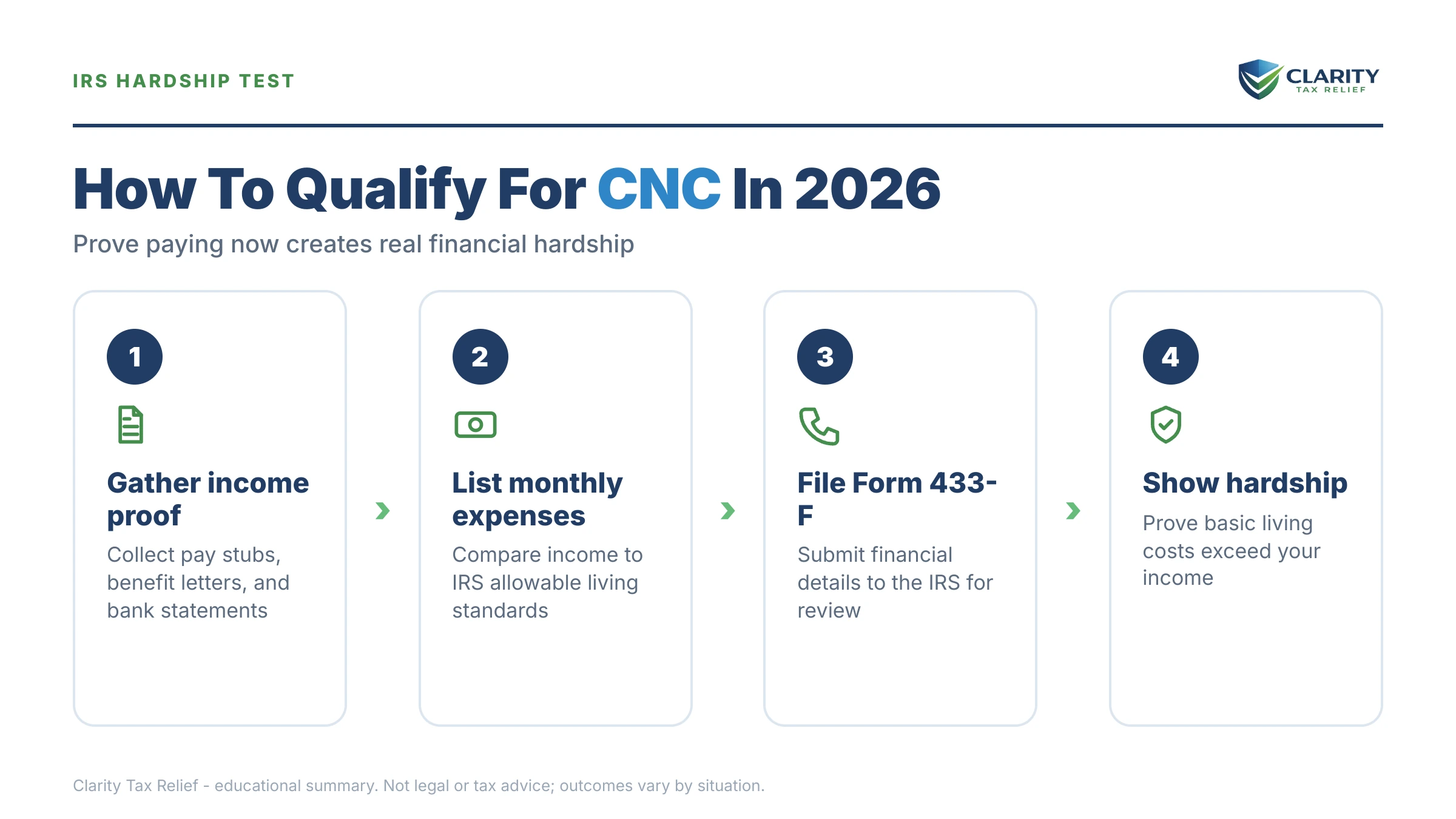
The short answer: to qualify for CNC (Currently Not Collectible) status, you must show the IRS — usually on Form 433-F — that its allowable living expense standards consume every dollar of your monthly income, and you generally must be current on filing. Collection pauses; the debt remains; the 10-year collection clock keeps running.
The divorce decree divided the house, the cars, and the retirement accounts — but the IRS never signed it. So a balance built on two incomes now sits on your one, and the notices arrive addressed to you alone. That's the situation CNC exists for, and it's more reachable than the name suggests.
Learning how to qualify for CNC comes down to one equation the IRS runs on a single form: monthly income minus IRS-allowed expenses. If the answer is zero or negative, you're a candidate — there is no fixed income limit and no minimum debt amount. This guide walks the equation, the paperwork, and the traps, using a $92,700 post-divorce balance as the running example. The image below shows you exactly what the key IRS form looks like and where the numbers that decide your case live.
⏱ The clock that matters: there is no application deadline for CNC — but two clocks run while you wait. The failure-to-pay penalty (0.5% per month) plus interest grow the balance every month, and if you're already holding a CP504 or LT11, the date printed on that notice controls how close you are to a levy.
How to qualify for CNC: the three tests the IRS applies
The IRS grants CNC when three things are true at once: your income can't cover IRS-allowed expenses, you've disclosed your finances on a collection statement, and you're generally current on filing. Nobody "applies" for CNC on a dedicated application — there is no CNC form. You request it, and the IRS decides based on:
- The hardship math. Your gross monthly income, minus expenses the IRS allows (not the expenses you actually have), must leave nothing for the IRS to demand. This is the entire ballgame, and the next section shows exactly how it's scored. There's no income ceiling — the CNC income limits people search for don't exist as a fixed number.
- Financial disclosure. For most people that means Form 433-F, the short Collection Information Statement, given by phone or mail to the IRS's automated collection unit. If a revenue officer holds your case, expect the longer Form 433-A and closer scrutiny of every line.
- Filing compliance. The IRS generally requires all overdue returns filed before it codes an account as uncollectible. Filing a missing year may grow the balance — but a bigger balance you can't pay is still CNC-eligible, while an unfiled return is an easy reason to say no.
Two situations change the shape of the test. If you're self-employed, the IRS scrutinizes business income and may average irregular months — currently not collectible self employed cases turn on how income is documented. And if the debt came from a joint return, understand that your ex remains equally liable no matter what the decree says; CNC pauses collection against you, not the account. More on that in the divorce section of our guide to divorce and IRS debt.
For the broader landscape of what people call the hardship program — CNC's place among all the relief options — see our honest explainer on the IRS hardship program. This page stays on one question: whether the math says yes for you.
The math that decides it: income vs. allowable living expenses
The IRS decides CNC eligibility by comparing your monthly income to its Allowable Living Expense standards — not to what you actually spend. This is the part that surprises people in both directions. Some expenses count in full. Others are capped at published amounts regardless of your real bills. A few don't count at all.
Income side: gross wages, self-employment profit, alimony received, unemployment, Social Security, rental income — essentially everything that hits your account monthly. Expense side, the IRS sorts your costs into buckets:
| Expense category | How the IRS caps it | What to have ready |
|---|---|---|
| Food, clothing, housekeeping, misc. | National standard by household size — allowed in full without receipts, even if you spend less | Nothing; the standard applies automatically |
| Housing & utilities | Capped at your county's published standard — actual rent above the cap is usually disallowed | Lease or mortgage statement, utility bills |
| Vehicle ownership (loan/lease payment) | Capped at a national standard per vehicle | Loan or lease statement |
| Vehicle operating (gas, insurance, repairs) | Capped at a regional standard | Insurance declaration page |
| Health insurance premiums | Actual amount allowed | Pay stub deduction or premium bill |
| Out-of-pocket medical | National per-person standard, or actual if higher and documented | Pharmacy/provider records if claiming above standard |
| Current-year taxes (withholding, estimates) | Actual amount allowed | Pay stub |
| Court-ordered payments (child support, alimony paid) | Actual amount allowed if you're actually paying it | Court order plus proof of payment |
Notice the last row. For a recently divorced filer, court-ordered child support and alimony you pay count in full — often the single biggest allowable expense on the form, and one the IRS cannot cap. The reverse is also true: alimony you receive is income. The published caps change periodically; the IRS posts them at its Collection Financial Standards page, and our breakdown of the IRS allowable living expenses standards walks each table.
What generally does not count: private school tuition, credit card minimums, payments on unsecured personal loans, and voluntary retirement contributions. If your budget only balances because of those, the IRS math may show "ability to pay" even when your bank account says otherwise — and that's the moment to have someone who knows the standards restructure how the form is presented, legitimately, before you submit it.
A worked example: qualifying for CNC with $92,700 in tax debt
The size of the balance is not the test — a $92,700 debt qualifies for CNC the same way a $9,000 debt does, on the expense math alone. Here's a clearly hypothetical run of the numbers.
Say you owe $92,700 from three joint-return years, you're recently divorced with one child at home, and you gross $5,200 a month. Your Form 433-F expense side, scored against the standards, might look like this:
- Food/clothing/misc. national standard (household of two): $1,100
- Housing & utilities: actual rent + utilities are $2,400, but your county cap is $2,150 — the IRS allows only $2,150
- Vehicle ownership: $590 (at the cap); vehicle operating: $310
- Health insurance: $420; out-of-pocket medical standard: $85
- Current taxes withheld: $780
Total allowed expenses: $5,435. Income of $5,200 minus $5,435 leaves −$235 a month. Even with $250 of your real rent disallowed by the county cap, the math is negative — the IRS's own standards say you cannot pay anything, and your account is a textbook CNC candidate.
Now flip one variable. Say a raise pushes you to $6,100 a month. Allowed expenses stay $5,435, leaving $665 of monthly ability to pay. The IRS will want that $665 as an installment payment instead of granting CNC. But run the payoff math: $665 × the months remaining on your 10-year collection statute may not come close to full-paying $92,700 plus accruing interest — which points to a partial payment installment agreement, where you pay what the math supports and the rest expires with the statute. The same 433-F drives both outcomes; the number at the bottom picks the program.
One more wrinkle at this balance: $92,700 is above the $66,000 threshold at which the IRS certifies "seriously delinquent" debt to the State Department, which can block passport renewal. Accounts in CNC hardship status are excluded from that certification — a quiet, significant benefit of getting the status approved rather than simply going silent.
What happens if you do nothing instead of requesting CNC
Hardship does not pause IRS collection by itself — only a granted status does, and the automated system escalates until one is on the account. The sequence runs in order, whether or not anyone at the IRS ever reads your file. With staffing down roughly 27% since 2025, the humans are harder to reach, but the notice machine never stopped:
- Balance-due notices (CP14, CP501, CP503) — bills and reminders. The balance grows monthly; no enforcement yet.
- CP504 — intent to levy your state refund — the IRS can now take your state tax refund, and a federal tax lien becomes likely on a balance this size.
- LT11 / Letter 1058 — final notice of intent to levy — a 30-day clock starts, along with your Collection Due Process appeal rights (Form 12153). This is the last exit before enforcement.
- Levy — a bank levy freezes funds with a 21-day hold before they're sent to the IRS; a wage levy is continuous, paycheck after paycheck, until released. Up to 15% of Social Security can be taken through the Federal Payment Levy Program.
- Passport certification — above $66,000, the debt is certified to the State Department unless a qualifying status (including CNC) is on the account.
Here is the cruel irony: a person who qualifies for CNC and never asks for it can still be levied. The IRS doesn't check whether a levy causes hardship before issuing it — you have to put the hardship on the record first. Every stage above is stoppable with the same 433-F; it just gets more urgent, and more disruptive, the later you start.
One income, a five-figure balance, and notices piling up?
Send us your latest notice and a recent pay stub. An experienced tax professional will run the same allowable-expense math the IRS will — free — and tell you whether CNC, a payment plan, or a settlement fits before the next notice escalates.
CNC eligibility vs. your other options
CNC is one of five real resolution paths, and the same financial disclosure often decides which one fits. Before requesting hardship status, know what each alternative requires and costs — because if your 433-F shows even modest ability to pay, the IRS will steer you to one of these instead:
| Option | Who qualifies | Cost to set up | What happens to the debt |
|---|---|---|---|
| Currently Not Collectible | Allowed expenses equal or exceed income; returns filed | $0 | Paused, not reduced; interest accrues; CSED keeps running |
| Short-term payment plan | Can full-pay within 180 days | $0 | Paid in full; interest/penalties until paid |
| Streamlined installment agreement | Balance ≤ $50,000; full-pay within 72 months | Setup fee varies (lower with direct debit; waivable low-income) | Paid in full over time with interest |
| Partial-pay installment agreement | Some ability to pay, but not enough to full-pay before the CSED | Setup fee + full financial disclosure | Paid partially; remainder expires at the CSED |
| Offer in Compromise | Assets + future income genuinely can't cover the debt | $205 fee + 20% down on lump-sum offers (both waived with low-income certification) | Settled for the accepted amount; ~1 in 5 offers accepted in FY2024 |
The CNC-vs-OIC decision deserves its own thinking: if your hardship is likely permanent (fixed income, disability, age), an offer may end the debt for good, while CNC leaves it hanging with interest. If your hardship is temporary — a post-divorce rebuild year, a job search — CNC costs nothing and commits you to nothing. Our comparison of cnc vs offer in compromise maps which situations favor which, and payment plan vs currently not collectible covers the borderline cases where a token payment plan is offered but hardship status is the honest answer.
What you owe changes the calculus (but not the test)
The hardship test is identical at every balance, but what the IRS does around the status — liens, case assignment, scrutiny — scales with the amount:
| Balance | How the IRS handles the request | What to expect with CNC granted |
|---|---|---|
| Under $10,000 | Phone request to automated collections; 433-F often taken verbally | Lien unlikely; light review; debt may quietly expire at the CSED |
| $10,000 – $50,000 | 433-F required; expect requests for pay stubs and statements | Notice of Federal Tax Lien becomes likely; annual reminder notices (CP71) |
| $50,000 – $100,000 | Closer document review; passport certification in play above $66,000 | Lien routine; CNC excludes the debt from passport certification while it holds |
| Over $100,000 | Often assigned to a revenue officer; Form 433-A, full asset verification | Lien nearly certain; periodic follow-up reviews rather than set-and-forget |
At $92,700 you sit in the band where the IRS says yes to genuine hardship but protects itself while doing it: expect a Notice of Federal Tax Lien to be filed when the account is coded uncollectible. The lien takes nothing from you month to month, but it attaches to property you own and complicates selling or refinancing a house — a real consideration if the divorce left you holding one.
How to request currently not collectible status, step by step
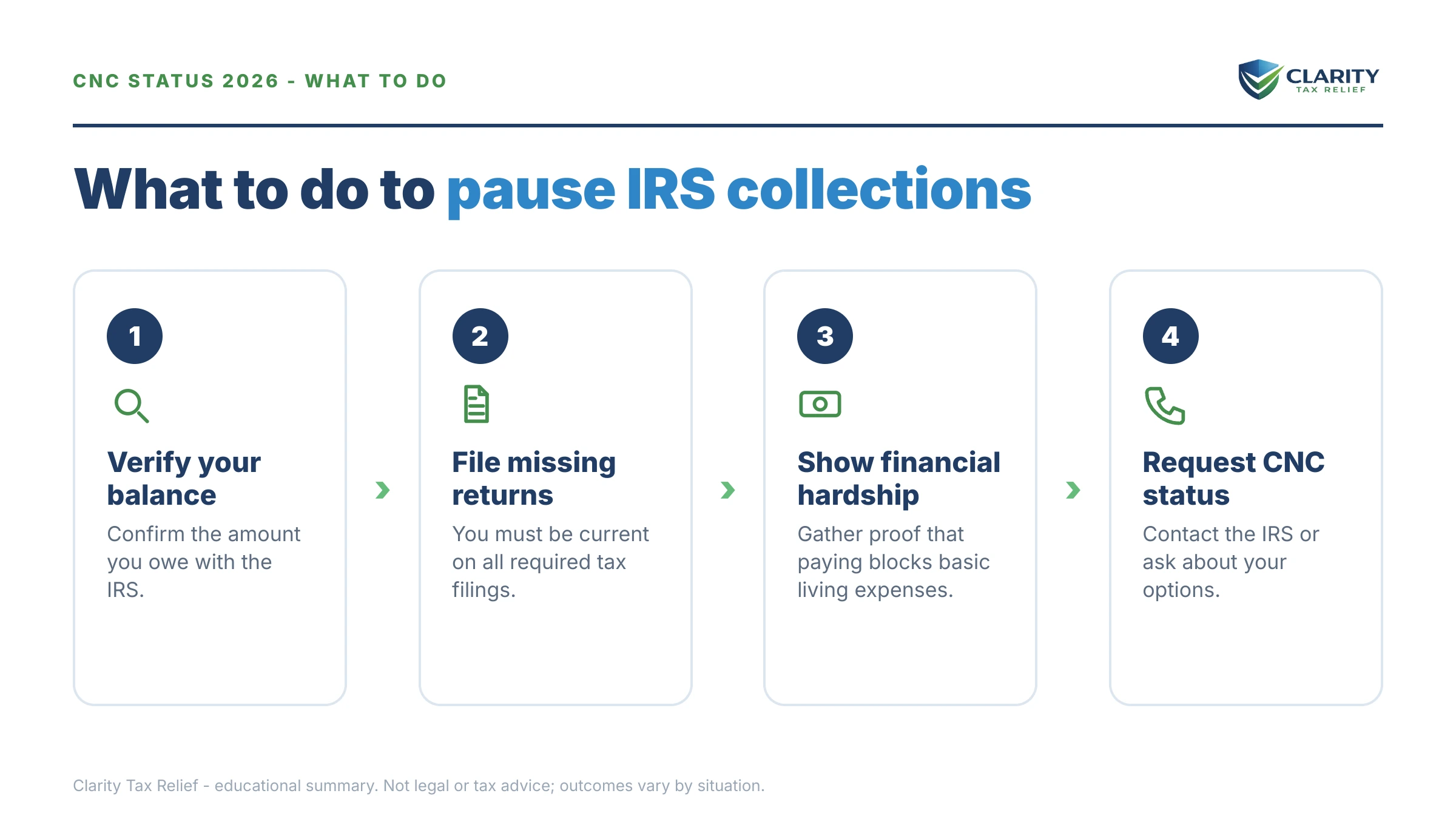
- File any missing returns — the IRS generally won't code an account as CNC while required returns are outstanding, and unfiled years give it a reason to say no.
- Gather three months of financial proof — pay stubs, bank statements, rent or mortgage statements, utility bills, health insurance premiums, and your child-support or alimony order if you pay one.
- Complete Form 433-F — list every income source and expense, then compare your figures against the IRS allowable-expense caps before you submit, so you know the answer before the IRS does.
- Call the IRS and request hardship status — use the number on your most recent notice, say your financials show no ability to pay, and be ready to read your 433-F figures to the representative.
- Confirm the determination on your transcript — ask the representative to note the decision, then watch your account transcript for Transaction Code 530, the entry that proves CNC actually posted.
- Calendar an annual self-review — the IRS compares your future tax returns against an income trigger, so check each year whether rising income could pull you back into collections before it surprises you.
Two practical notes. First, the phone call is the whole submission for most people — there's no application to mail unless the IRS requests documents. Hold times in 2026 are long; call early in the day. Second, if a levy is already in motion, say the word "hardship" explicitly and ask for expedited handling — a levy that prevents you from meeting basic living expenses can be released on its own track while the CNC determination is pending. Form 433-F itself, with instructions, is at the IRS's About Form 433-F page.
What CNC does — and doesn't — do once granted
CNC stops enforcement, not the debt: levies and garnishments end, but interest accrues and the balance survives until it's paid, settled, or expires. Knowing both halves keeps the status from surprising you later.
What it stops: levies, wage garnishment, and demands for monthly payment. What continues:
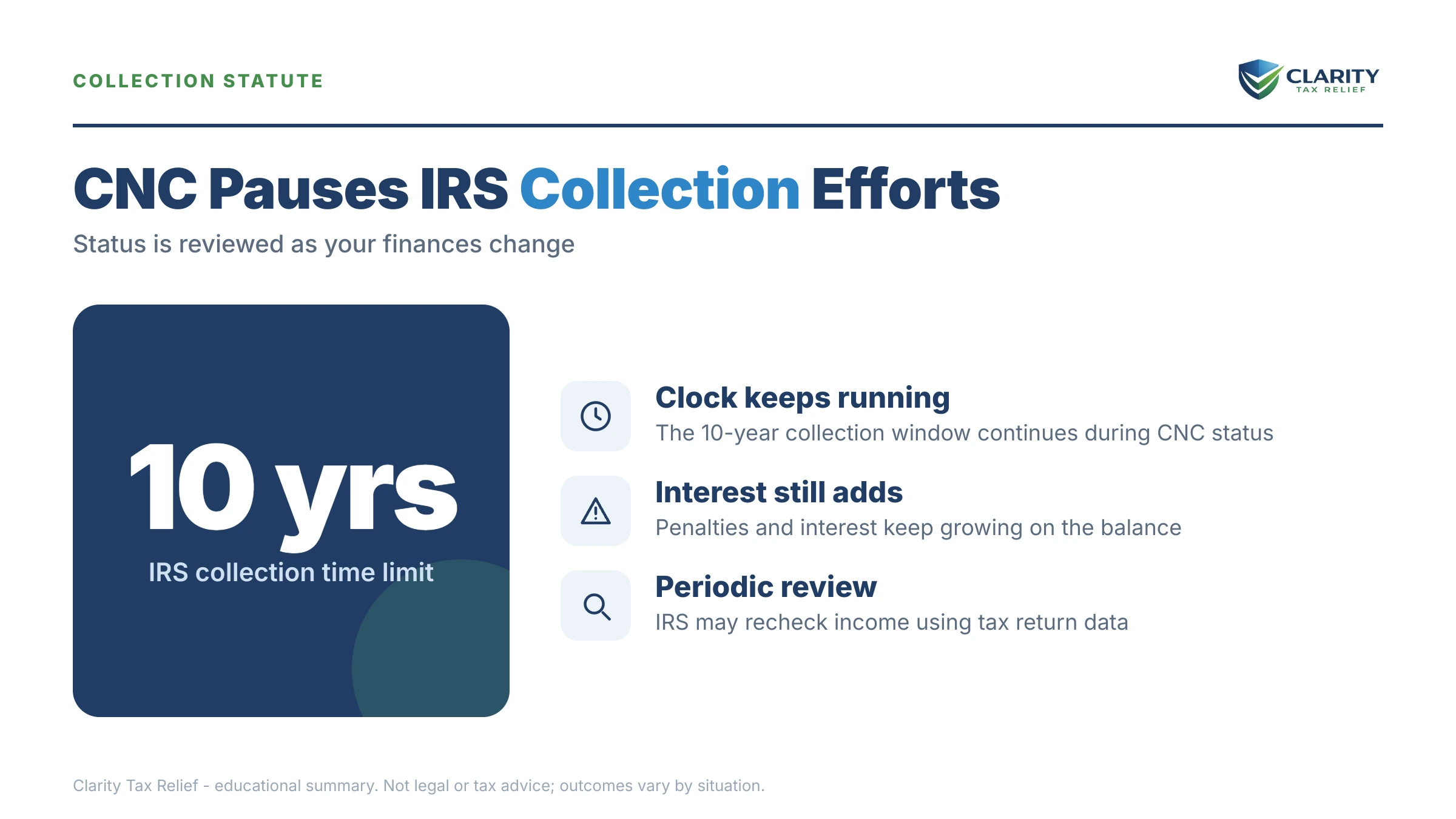
- Interest and the failure-to-pay penalty keep accruing, so the annual reminder notice shows a bigger number each year. That's expected, not a sign the status failed.
- Refund offsets continue. Any federal refund is taken and applied to the balance automatically. If you're in CNC, adjust withholding so you stop lending the IRS money it will keep.
- A lien may sit on the account for the duration, per the table above.
- Reviews happen. The IRS sets an income trigger when it closes your case; a future return showing income above it reopens collection, and you'd requalify or pick another option. How that reactivation works — and how to see it coming — is covered in cnc status removed… see cnc status removed and the review-cycle detail in how long does currently not collectible last.
The quiet upside: the 10-year collection statute keeps running the entire time you're in CNC. If your debt was assessed years ago, hardship status can carry it all the way to expiration — the IRS writes off what's left at the CSED. (Certain events pause the clock: an OIC under review, bankruptcy, some appeals.) You can estimate when your own balance could expire with our CSED Calculator — an estimate, not a promise, but it reframes the decision: someone two years from their CSED has a very different best move than someone nine years out.
One state caveat: CNC is an IRS status. Your state runs its own collection machine on its own rules — California's FTB, for example, collects under a 20-year statute and has a separate hardship process covered in FTB currently not collectible. Never assume an IRS hardship determination protects you from a state agency; it doesn't.
When you can handle this yourself — and when help changes the outcome
Plenty of CNC requests need no professional at all. If your situation is simple — one or two tax years, all returns filed, wage income, and expenses that obviously exceed income even against the caps — you can complete the 433-F, make the call, and get the status yourself. The Taxpayer Advocate Service (taxpayeradvocate.irs.gov) and Low Income Taxpayer Clinics also offer free help for those who qualify.
Experienced help earns its cost in specific situations:
- A levy is already active — the sequencing of a hardship release plus CNC matters, and days count.
- You have unfiled years — filing order and reconstructed records change both the balance and the timeline.
- Your expenses exceed the caps — presenting rent above the county standard, or medical costs above the per-person figure, takes documentation and the right framing to be allowed.
- The math is borderline — a few hundred dollars of "ability to pay" is the difference between CNC and a payment plan, and how legitimate expenses are categorized decides it.
- Divorce complications — if your ex controlled the income that created the debt, innocent spouse relief might remove your liability entirely, which beats pausing it. That analysis should happen before you lock into CNC.
- Business or self-employment income — irregular income invites pushback, and the disclosure has downstream consequences.
If any of those describe your file, a free review costs nothing and prevents the expensive version of learning: have an experienced tax professional run your 433-F math before the IRS does.
Terms on your paperwork, decoded
- Currently Not Collectible (status 53): the IRS's internal designation that your account is closed to active collection due to hardship — sometimes called "53'd."
- Form 433-F: the short Collection Information Statement most taxpayers use to prove hardship to the IRS's automated collection unit.
- Allowable Living Expenses (ALE): the IRS's published caps on what your food, housing, and transportation are "allowed" to cost when it measures ability to pay.
- Transaction Code 530: the transcript entry showing your account was coded uncollectible — the written proof CNC posted; see code 530 transcript.
- CSED: Collection Statute Expiration Date — the end of the IRS's 10-year window to collect, after which the remaining balance is written off (certain events pause it).
- Notice of Federal Tax Lien: a public filing that attaches the IRS's claim to your property; it protects the government's position but takes nothing month to month.
- Refund offset: the automatic application of your tax refund to old debt — it continues even while you're in CNC.
CNC qualification questions, answered
What income qualifies for currently not collectible status?
There is no fixed income limit for CNC — qualification is an equation, not a threshold. The IRS compares your monthly income against its allowable living expense standards for your household size and county; if nothing is left over, you qualify regardless of what you earn. A filer making $75,000 with high court-ordered child support can qualify while someone making $40,000 with low expenses does not.
Do I have to file all my tax returns before the IRS grants CNC?
Generally yes — the IRS treats filing compliance as a prerequisite and will usually demand missing returns before coding your account as CNC. If you have unfiled years, file them first, even though they may add to the balance; a bigger balance you can't pay is still CNC-eligible, while unfiled returns give the IRS a reason to refuse. In limited cases the IRS grants CNC anyway, but don't count on the exception.
How long does CNC status last?
CNC lasts until your finances improve enough to trigger a review — there is no fixed expiration date. When the IRS closes your account, it sets an income threshold; if a future tax return shows income above it, the account comes back to collections and you must requalify. Meanwhile the 10-year collection statute keeps running, so some debts expire entirely while the taxpayer remains in CNC.
Does CNC stop penalties and interest from accruing?
No — the balance keeps growing the entire time you're in CNC. The failure-to-pay penalty (0.5% per month, up to its cap) and interest continue to accrue, which is why your annual reminder notice shows a larger number each year. What CNC stops is enforcement: no levies, no garnishment, no demand for monthly payments while the status holds.
Will the IRS file a tax lien if I'm in CNC?
It can, and on larger balances it usually does. The IRS routinely files a Notice of Federal Tax Lien when it closes a significant account as CNC — commonly when the balance exceeds $10,000 — to protect its claim while collection is paused. The lien doesn't take anything from you day to day, but it attaches to property you own and can complicate selling or refinancing a home.
Will the IRS take my tax refund while I'm in CNC?
Yes — refund offset continues even in hardship status. Any federal refund you're due gets applied to the old balance automatically, every year, until the debt is paid or expires. If you're in CNC, adjust your withholding so you're not over-collecting a refund you'll never see; keeping that money in each paycheck is usually the better move for a tight budget.
Can I qualify for CNC if I own a home or have retirement savings?
Possibly — assets don't automatically disqualify you, but the IRS will look at them. Form 433-F asks about equity in real estate, vehicles, and accounts; if you have significant reachable equity, the IRS may push you to borrow against it before granting hardship status. Retirement accounts you cannot access without hardship of their own, and home equity you cannot realistically borrow against, are often left alone — but expect the question.
Does CNC protect my passport if I owe more than $66,000?
Yes — this is one of CNC's least-known benefits. In 2026, the IRS certifies seriously delinquent tax debt over $66,000 to the State Department, which can deny or revoke your passport. Accounts in CNC hardship status are excluded from that certification, so getting CNC approved on a balance above the threshold protects your passport while the status holds.
Can I get CNC after a divorce if the debt is from a joint return?
Yes — CNC is decided on your finances alone, so post-divorce income loss is exactly the situation it exists for. Joint return debt is joint and several, meaning the IRS can pursue either ex-spouse for the full amount no matter what the divorce decree says. Your CNC only pauses collection against you; the IRS can still collect from your ex, and if they hid the income that created the debt, innocent spouse relief may remove your liability entirely rather than just pausing it.
Is CNC better than an offer in compromise?
Neither is better — they solve different problems, and the same hardship math feeds both. CNC pauses collection while the debt (and interest) remains; an OIC ends the debt for an amount based on what the IRS could realistically collect, but requires a $205 fee (waivable for low-income filers), months of review, and the IRS accepted only about 1 in 5 offers in FY2024. Many people use CNC now and evaluate an OIC later; if your CSED is close, staying in CNC until the debt expires often beats offering anything.
Your next 24 hours
- Pull one month's numbers. Find your most recent pay stub (gross income and tax withholding) and your rent or mortgage statement — those two figures decide most of the CNC math.
- Gather the file. Your latest IRS notice, last year's return, your divorce decree's support order if you pay one, and three months of bank statements — everything Form 433-F will ask for.
- Get the math run free. Call (888) 825-7779 or use the 2-minute form for a free case review — an experienced tax professional will score your income against the allowable-expense standards and tell you whether CNC fits, while interest and penalties are still the only thing growing on your account.
This guide is general information, not tax or legal advice for your specific situation. Eligibility for IRS programs depends on individual facts and circumstances; no outcome is guaranteed.