
California FTB
FTB Currently Not Collectible: How California Hardship Status Works in 2026
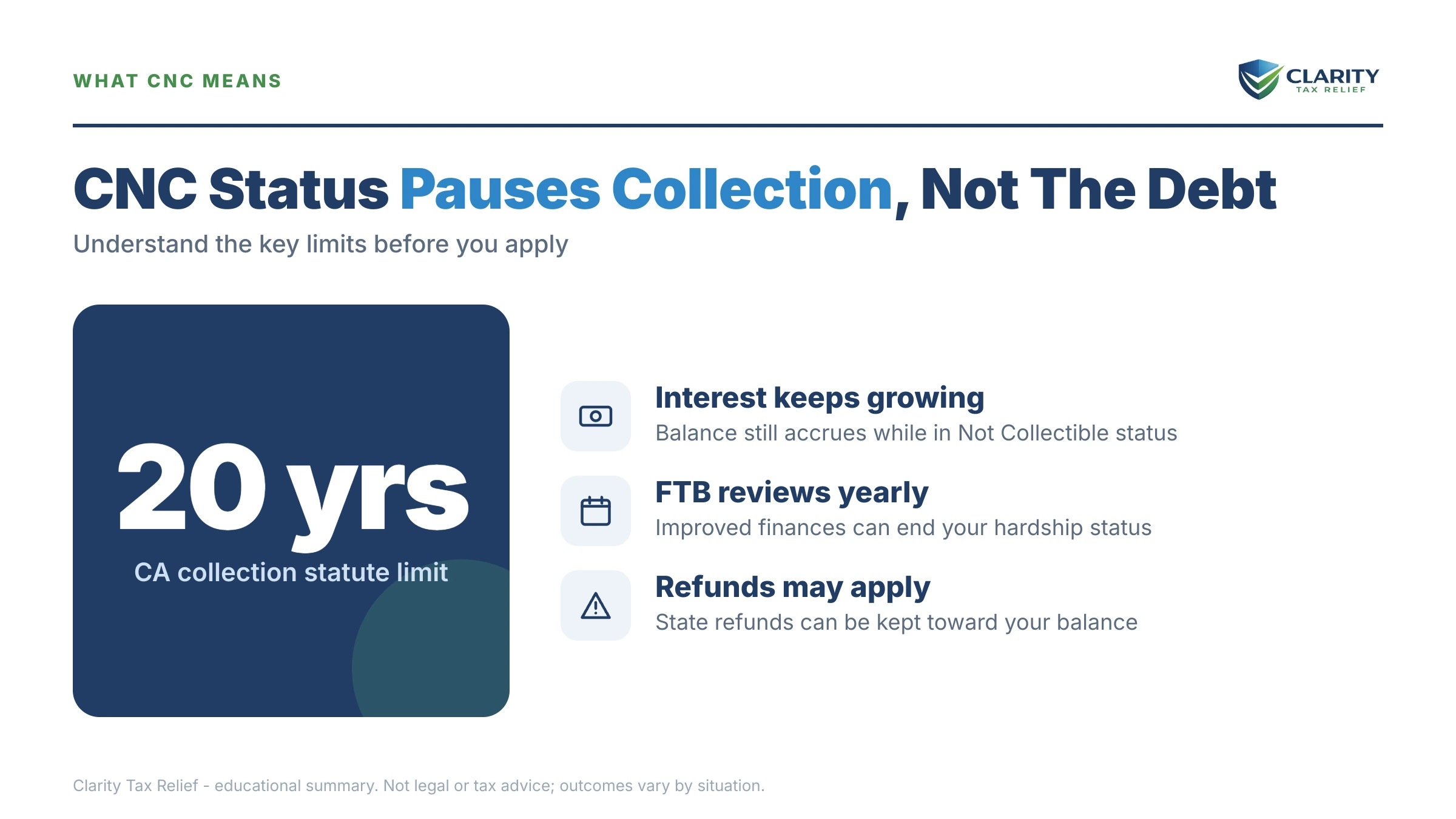
The short answer: "FTB currently not collectible" is the unofficial name for California's hardship status. Submit Form FTB 3561 proving your income barely covers necessary living expenses, and the Franchise Tax Board pauses levies and garnishments — typically for one year at a time. Interest keeps accruing, and the FTB has 20 years to collect.
The FTB letter on your counter says pay in full. Your budget, after the mortgage and everything else, says there's nothing left to send — and you're supposed to refinance next year, which makes every move you make with the Franchise Tax Board matter twice. This is fixable, and this page maps every route: hardship status, a payment plan, a state settlement, and the one trap that lands on a closing table.
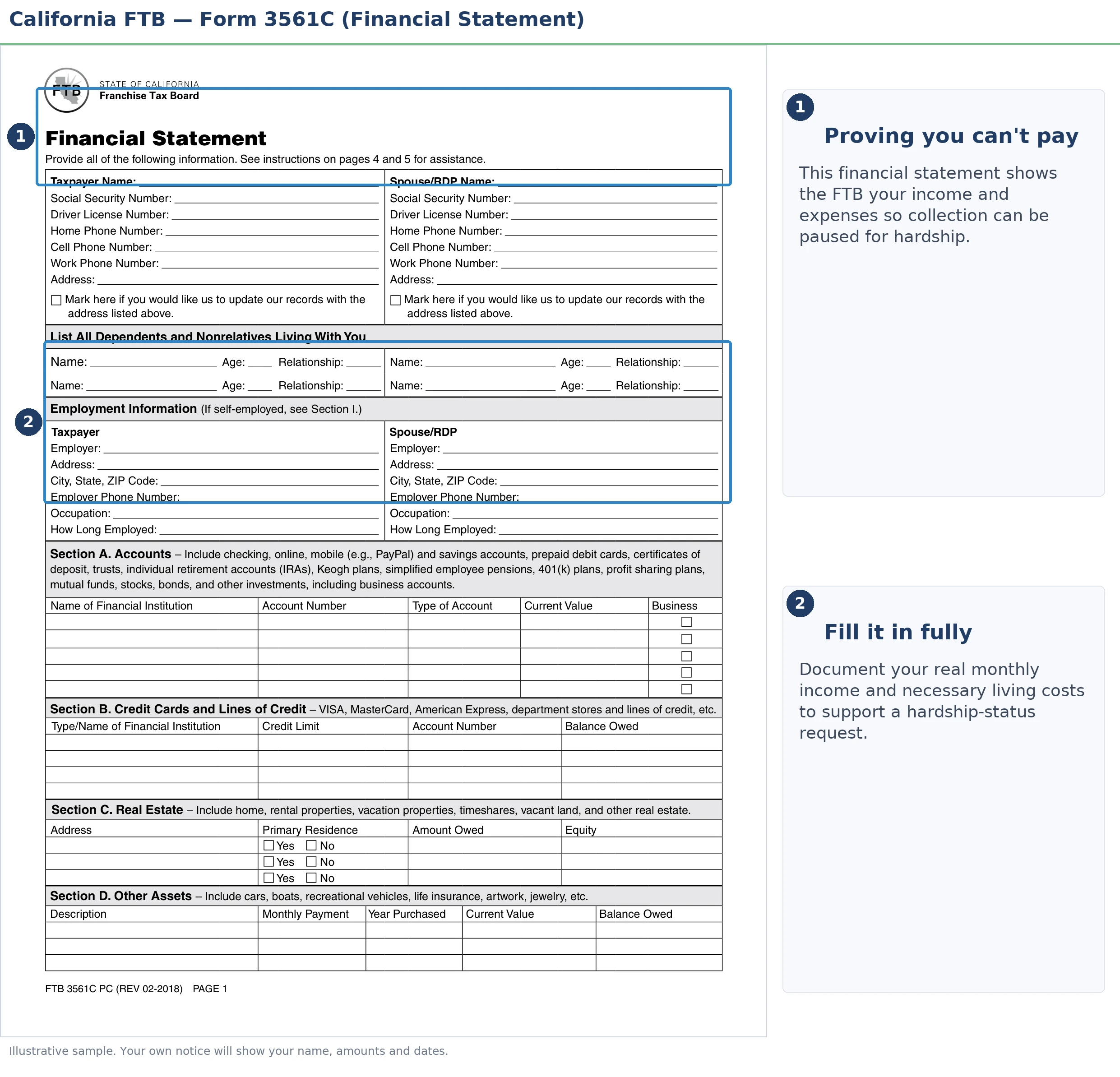
Everything hinges on one document. The FTB builds its hardship decision entirely from FTB Form 3561, its financial statement — the image below shows exactly what that form looks like and where the numbers that decide your case go.
⏱ The clock that matters: there is no application deadline for FTB hardship status — the real clock is accrual. Interest keeps building on your balance every day, and the Franchise Tax Board has 20 years from assessment to collect under R&TC §19255. Waiting doesn't run out the clock; it just raises the payoff.
Why the FTB doesn't call it "currently not collectible"
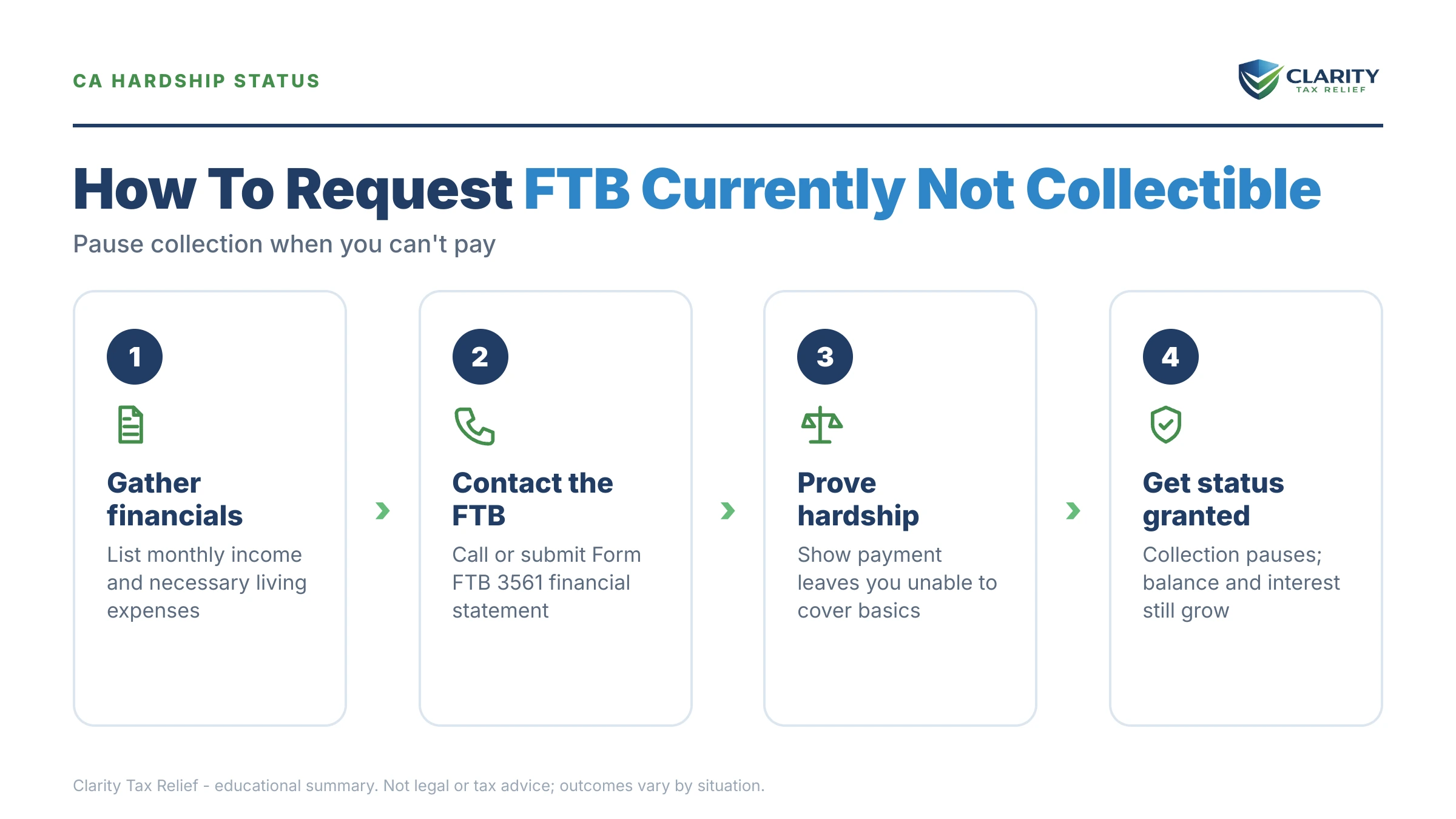
The Franchise Tax Board has no program officially named currently not collectible — its equivalent is called hardship status, and you request it with Form FTB 3561. "Currently not collectible" is IRS vocabulary that Californians borrow, and the two programs are cousins, not twins.
The general hardship test — income versus necessary living expenses — works the same way on both sides, and the full mechanics live in our guide to how to qualify for CNC. What matters here is what's different about California.
When the FTB grants hardship, active collection stops: no bank levies (the FTB's Order to Withhold), no wage garnishment (its Earnings Withholding Order for Taxes), no pressure calls. What does not stop: interest accrual, state refund intercepts, and the FTB's ability to record a tax lien.
And the status is short-lived by design. FTB hardship is typically approved for up to one year at a time — then you reapply with fresh financials. It's a breathing spell, not a resolution.
Who qualifies for California hardship status in 2026
The FTB approves hardship status when your documented monthly income does not exceed your necessary living expenses — and every line on Form 3561 gets checked against the bank statements you attach.
"Necessary" is the operative word. Housing, food, utilities, health insurance, transportation to work, court-ordered payments — those count. Private school tuition, a second car payment, or streaming-service stacks invite pushback. Expect the FTB to question any expense far above what's typical for your county.
Three situations change the answer:
- You own a home with equity. Hardship is about ability to pay, not just cash flow. If you have meaningful equity, expect the FTB to ask why you can't borrow against it — the same equity you're counting on for your refinance can weaken your hardship case.
- You're married. California is a community-property state. A balance from a joint return — and often even one spouse's separate liability — can be collected from community assets, including the other spouse's wages. Don't assume a spouse's income sits outside the Form 3561 picture; ask before you file it.
- You're self-employed or on 1099s. Fluctuating income makes the monthly-average math on the financial statement decisive — a strong quarter on your bank statements can sink an otherwise solid case. The same dynamics we cover for currently not collectible self employed taxpayers apply to the FTB's review.
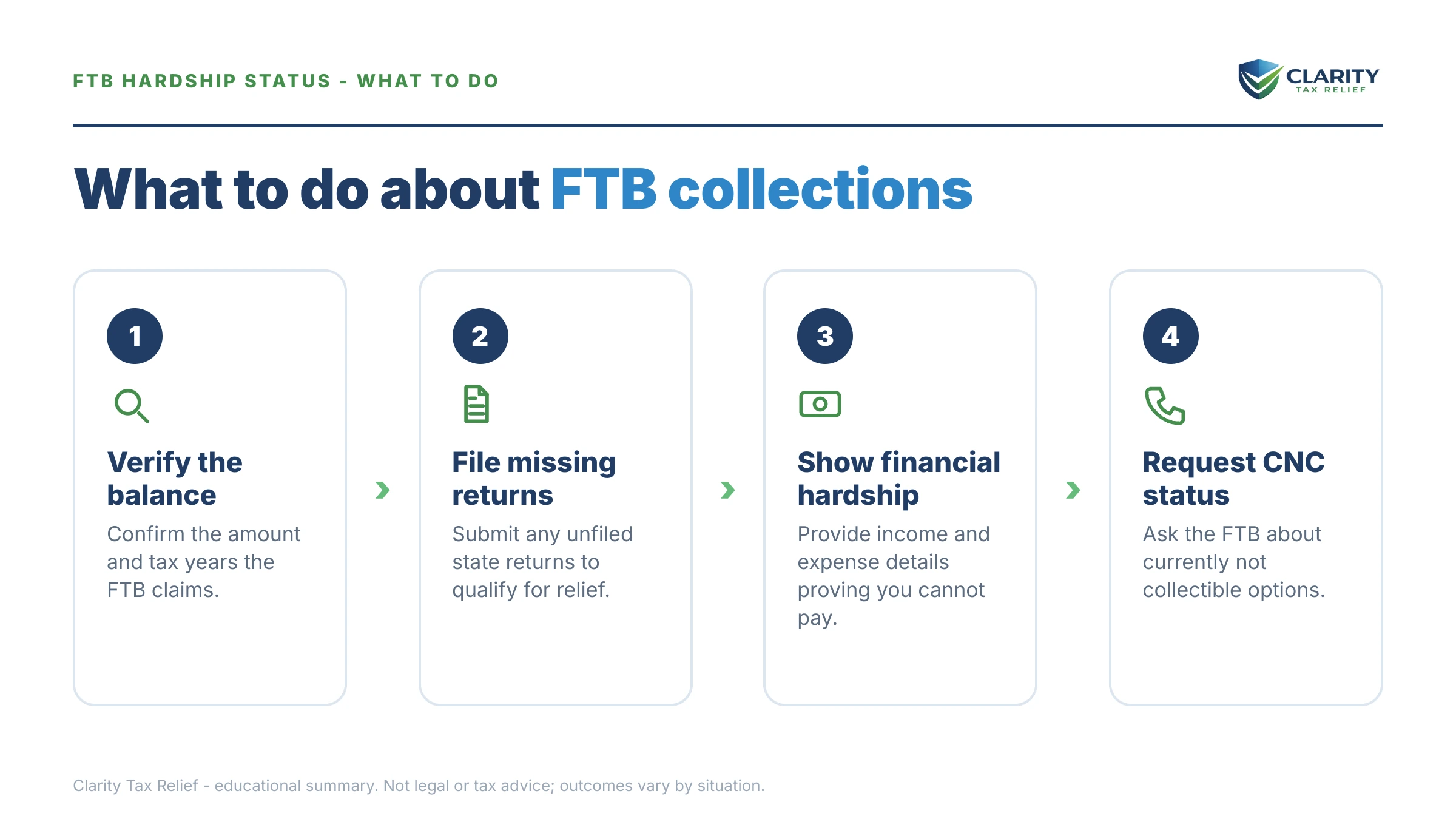
One prerequisite applies to almost everyone: the FTB generally won't consider hardship while required California returns are unfiled. File first, even when you can't pay.
FTB hardship vs. IRS currently not collectible: the 20-year problem
The FTB can collect for 20 years from assessment — double the IRS's 10-year window — which makes "ride it out in hardship status" a far weaker play against California than against the IRS.
With the IRS, currently not collectible status can be a genuine endgame: if the 10-year collection statute expires while you're in CNC, the remaining balance dies with it (though the clock pauses for certain events). You can estimate your own federal expiration date with our CSED Calculator. With the FTB, the same strategy asks you to stay broke — on paper and in fact — for up to two decades. Read the full rules in our guide to California's 20-year collection statute.
| Feature | FTB (California) | IRS (federal) |
|---|---|---|
| Official name | Hardship status | Currently not collectible |
| Application form | Form FTB 3561 | Form 433-F (or 433-A) |
| Collection statute | 20 years from assessment (R&TC §19255) | 10 years from assessment (CSED) |
| How long it lasts | Typically up to one year at a time; you reapply | Continues until income triggers a review |
| Interest while paused | Keeps accruing | Keeps accruing |
| Refund offsets | State refunds intercepted | Federal refunds offset |
| Lien filing | Still possible during hardship | Still possible, especially on larger balances |
The renewal cycle is the other trap. IRS CNC usually stays in place until your reported income rises — and even then, reactivation follows a process we cover in CNC status removed. FTB hardship simply expires. If you forget to reapply, your account can slide back into active collection while you're not looking.
What happens if you ignore an FTB balance
The FTB can levy your bank account and garnish your wages without a court judgment — its escalation is automated, and it adds fees to your balance along the way. The sequence runs in stages:
- Balance-due notice. A statement of the amount owed for the year, with interest already running.
- Demand and final warning. The FTB intent to levy notice is the state's last letter before enforcement — after it, action needs no further permission.
- Collection fees attach. Once your account moves into active collections, the FTB adds a cost-recovery fee on top of tax, penalties, and interest.
- State tax lien. An FTB tax lien gets recorded with your county — a public record that clouds title on your home. For anyone planning a refinance, this is the stage that costs real money.
- Levy and garnishment. An FTB bank levy (Order to Withhold) can empty an account, and FTB wage garnishment takes a slice of every paycheck through your employer until the debt is resolved.
- Year after year. Every California refund you're owed gets intercepted, and the balance keeps compounding — for up to 20 years. (Balances over $100,000 also risk the FTB's public Top 500 delinquent list, with its own consequences.)
Hardship status exists precisely to stop stages 5 and 6. What it cannot do is undo stage 4 or freeze the interest — which is why the choice between hardship and a payment plan deserves real math, not reflex.
Can't pay the FTB — and worried about your house?
Your balance grows every month whether or not California is actively collecting, and a lien filed now can surface at your closing later. Get your FTB case reviewed free — an experienced tax professional will run the hardship math against a payment plan before you commit to either.
Your options with the FTB, compared
Hardship status is one of five realistic ways to handle a Franchise Tax Board balance — and for anyone with home equity or an upcoming refinance, it is often not the cheapest one.
| Option | Who may qualify | Effect on collection |
|---|---|---|
| Pay in full | Anyone with the cash or borrowing power | Collection ends; interest stops once paid |
| FTB payment plan | Generally balances of $25,000 or less paid within 60 months for online setup; all returns filed | Levies and garnishments stop while the plan stays current |
| Hardship status ("FTB currently not collectible") | Income does not exceed necessary living expenses, proven on Form 3561 | Levies and garnishments pause; interest, offsets, and lien risk continue |
| FTB Offer in Compromise | No realistic ability to ever pay in full, now or in the foreseeable future | Settles the balance for less if accepted, after strict asset and income review |
| Penalty abatement | Reasonable cause for the penalty, or qualifying one-time timeliness relief | Shrinks the balance; does not pause collection by itself |
The middle rows deserve context. An FTB payment plan is the workhorse: for balances $25,000 or less over up to 60 months, individuals can generally set one up online without a full financial disclosure. An FTB offer in compromise is real but narrow — California accepts offers only when your assets and earning power genuinely can't cover the debt within its long collection window, and homeowners with equity face an uphill case.
| Option | Upfront cost | Ongoing cost | Typical time to set up |
|---|---|---|---|
| Pay in full | The full balance ($19,700 in our example) | None | Immediate |
| Payment plan | Modest setup fee, added to your balance | Monthly payment plus accruing interest | Days, if you apply online |
| Hardship status | $0 to request | $0 per month — but interest keeps compounding the balance | Typically a few weeks after Form 3561 review |
| FTB Offer in Compromise | No application fee, but full financial disclosure | The offer amount, if accepted | Often many months |
| Penalty abatement | $0 to request | None; reduces what you owe if granted | Weeks to months |
Worked example: $19,700 owed to the FTB before a refinance
Say you owe the FTB $19,700 and plan to refinance your home in about 18 months. All numbers below are hypothetical, and the FTB adjusts its interest rate periodically — 8% per year is used here purely for illustration.
Route 1 — hardship status. You pay $0 per month. At 8%, interest adds roughly $19,700 × 0.08 ≈ $1,576 per year, or about $2,360 over 18 months. When your lender orders a payoff demand at closing, the figure is now roughly $22,060 — and if the FTB recorded a lien in the meantime, escrow must pay it before the loan funds. If your equity is thin, that lien can shrink your cash-out or stall the deal.
Route 2 — a 60-month payment plan. $19,700 ÷ 60 is about $328 per month before interest; at the illustrative 8%, budget closer to $400 per month to actually retire the debt in five years. After 18 months of $400 payments you've paid about $7,200 and owe roughly $14,600 — a smaller number at the closing table, an account in good standing, and a cleaner underwriting story.
Route 3 — pay it off before closing. Roughly $1,165 per month for 18 months clears the whole balance, interest included, so nothing touches escrow at all.
The lesson for a refinancing homeowner: even if you qualify for hardship, it can be the wrong tool — the growing balance and lien exposure land exactly where you're planning to borrow. Hardship shines when there is genuinely nothing to pay with and no near-term transaction it can sabotage.
How to request FTB currently not collectible (hardship) status, step by step
- File every missing California return. The FTB generally will not consider hardship status while required returns are unfiled — get compliant first, even if you cannot pay a dime.
- Gather three months of financial proof. Collect pay stubs, bank statements, your mortgage or rent statement, utility bills, medical costs, and proof of any benefits income.
- Complete Form FTB 3561 honestly. List every income source, asset, and monthly expense; the FTB cross-checks your numbers against the bank statements you attach.
- Call the FTB at the number on your notice. Ask specifically for a hardship determination based on your submitted financial statement, and note the representative's name and ID number.
- Get the decision and renewal date in writing. Calendar the expiration the FTB gives you, plan to reapply about 60 days before it, and stay current on every new-year filing and payment.
When you can handle this yourself — and when experienced help changes the outcome
You can handle the FTB alone when the situation is simple. If your balance fits a standard payment plan you can genuinely afford, all your returns are filed, and you agree with the amount, set the plan up yourself through the FTB's official site at ftb.ca.gov and be done. A straightforward hardship request — one income source, clear bank statements, no assets in play — is also a reasonable DIY project if you're careful with Form 3561.
Experienced help earns its cost when the stakes or the moving parts multiply: a levy or garnishment already in motion, a lien filed (or about to be) ahead of a refinance or sale, multiple unfiled years, self-employment income that needs presenting correctly on the financial statement, or an offer-in-compromise question where the equity math is close. The order you fix things in — returns, penalties, lien strategy, then the balance — changes what you ultimately pay.
The same is true when you owe both governments. Federal and state cases interact — an IRS installment payment is a claimed expense on your FTB financial statement, and vice versa — so sequence matters. The IRS side of paying starts at IRS.gov/payments; the strategy of running both cases at once is where a professional review pays for itself.
If you're weighing hardship against a payment plan before a refinance, get your FTB numbers reviewed free — an experienced tax professional can run both routes against your closing timeline in one call to (888) 825-7779.
Terms on your FTB notices, decoded
- Hardship status — the FTB's version of currently not collectible: a temporary pause on active collection because paying would leave you unable to cover necessary living expenses.
- Form FTB 3561 — the Financial Statement listing your income, assets, and monthly expenses; it is the entire evidence file for a hardship decision.
- Order to Withhold (OTW) — the FTB's bank levy: a one-time order to your bank to send funds from your account to the state.
- Earnings Withholding Order for Taxes (EWOT) — the FTB's wage garnishment, served on your employer and taken from each paycheck until released.
- R&TC §19255 — the California statute giving the FTB 20 years from assessment to collect a tax liability.
- State tax lien — a public claim the FTB records against your property; it doesn't take anything by itself, but it must usually be resolved before a refinance or sale closes.
FTB currently not collectible: your questions, answered
Does the California FTB have a currently not collectible program?
Yes in substance, no in name — the FTB calls it hardship status, and it works much like IRS currently not collectible. You prove through Form FTB 3561 that your income barely covers necessary living expenses, and the FTB suspends active collection. The debt does not go away: interest keeps accruing, and the FTB revisits your finances when the hardship period ends.
How do I apply for FTB hardship status?
Submit Form FTB 3561, Financial Statement, with proof of your income and expenses, then discuss it with an FTB collections representative at the number on your notice. All required California returns generally must be filed first, and there is no fee to request hardship. Keep copies of everything you send and get the decision — and any renewal date — in writing.
How long does FTB hardship status last?
FTB hardship status is temporary — it is typically approved for up to one year at a time, after which you must reapply with updated financials. That differs from IRS currently not collectible, which can roll forward for years with only periodic income checks. Calendar the expiration date the FTB gives you; if you let it lapse, active collection can restart.
Does FTB hardship status stop interest from growing?
No. Interest continues to accrue on your full balance the entire time you are in hardship status, and penalties already assessed remain. On a $19,700 balance, growth can easily top a thousand dollars a year at recent rates. Hardship status buys protection from levies and garnishment — it does not shrink the debt by a single dollar.
Will the FTB file a tax lien while I'm in hardship status?
It can. Hardship status pauses levies and wage garnishment, but it does not prevent the FTB from recording a state tax lien to protect its position, and it does not release a lien that already exists. If you own a home — especially one you plan to refinance or sell — ask directly about lien filing before choosing hardship over a payment plan.
Can I refinance or sell my house with an FTB lien or hardship status?
You can, but an FTB lien generally must be paid or otherwise resolved through escrow before the transaction closes. Your lender or title company requests a payoff demand from the FTB, and every month of accrued interest is baked into that figure. If the lien exceeds your available equity, resolution takes negotiation — start months before your target closing date.
Does FTB tax debt expire after 10 years like IRS debt?
No — California law gives the FTB 20 years from the date of the latest liability assessment to collect, under Revenue and Taxation Code section 19255. That is double the IRS's 10-year collection statute. It is the main reason waiting out the FTB in hardship status is a much weaker strategy on the state side than it can be with the IRS.
Can I be in IRS currently not collectible and FTB hardship at the same time?
Yes — they are separate agencies with separate applications, and qualifying for one does not automatically qualify you for the other. The IRS uses Form 433-F and its national expense standards; the FTB uses Form 3561 and makes its own judgment. Many Californians in genuine hardship hold both statuses, but each must be applied for, documented, and renewed on its own track.
Will the FTB keep my state tax refund while I'm in hardship status?
Expect it to. Hardship status stops active collection like levies and garnishments, but refund offsets are passive — any California refund you become entitled to is typically intercepted and applied to your balance until it is paid. If you are in hardship, adjust your state withholding so you are not overpaying money you will never see back.
Your next 24 hours
- Find your account details. Pull your most recent FTB notice and locate the balance, the tax years covered, and the notice number — that's what every FTB conversation starts with.
- Gather the Form 3561 raw material. Last year's California return, three months of pay stubs and bank statements, and your monthly bills. That stack is 90% of a hardship application — and 100% of the math for choosing between hardship and a payment plan.
- Get a free case review. Interest is compounding on your FTB balance either way, and a lien decision made now follows you to any refinance. Use the 2-minute form or call (888) 825-7779 and an experienced tax professional will map your fastest, cheapest route.
This guide is general information, not tax or legal advice for your specific situation. Eligibility for IRS programs depends on individual facts and circumstances; no outcome is guaranteed. Eligibility for California FTB programs is likewise means-tested and fact-specific.