
California FTB
FTB Wage Garnishment: How to Stop It, How Much They Take, and Your Rights (2026)
The short answer: an FTB wage garnishment is an Earnings Withholding Order for Taxes — an order California's Franchise Tax Board sends your employer, no court required, that typically takes 25% of your disposable pay every check until the debt is paid. You can stop or reduce it with full payment, a payment plan, a hardship modification, or an Offer in Compromise.
Payroll just told you a chunk of Friday's check is going to Sacramento — or, if you're a contractor, a client forwarded a Franchise Tax Board order telling them to hold your money instead of paying you. Either way, you didn't get a chance to argue first, and the shortfall lands on this month's rent. This is fixable: the FTB releases and modifies these orders every day, and the rest of this page is the map for getting yours reduced or removed.
One clarification before anything else: an FTB wage garnishment is not a court judgment and not an IRS action. It's California's own administrative order, with its own rules — including a 20-year collection statute that makes waiting it out a losing plan. If your employer gave you a copy of the order, the image below shows what an FTB earnings withholding order looks like and where to find the balance and the withholding instructions on it.
⏱ Your real clock: an FTB wage garnishment has no response deadline — it has a payday deadline. Withholding generally begins with the first pay period ending at least 10 days after your employer receives the order, and it repeats every check until the debt is paid or the FTB releases the order. Every pay cycle you wait is money already gone.
Why the FTB is garnishing your wages
The FTB garnishes wages only after a balance was assessed and its mailed warnings went unanswered. By the time an order reaches your employer, the FTB has already sent a balance-due notice and a final warning — usually a Final Notice Before Levy — to your last known address. If you moved, changed banks, or stopped opening state mail, the garnishment is often the first thing you actually see.
Three triggers account for most FTB garnishments:
- A filed return you couldn't pay. You filed, the balance sat, and interest plus a collection fee grew it while the notices escalated.
- An estimated assessment for a year you never filed. The FTB matches 1099s, W-2s, and other records to filings. If you ignored a Demand for Tax Return, the FTB assessed tax on your gross income — typically with zero deductions or business expenses — and that inflated number is what's being collected. For self-employed people, this is the most common reason the balance looks absurdly high.
- Penalties and interest on an old balance. A debt you thought was small grew through late-payment penalties, interest, and FTB collection fees added to the account.
Whichever trigger applies matters, because it changes the fix. An estimated assessment can often be cut down by filing the real return. A correct balance needs a payment resolution. Step one is always confirming which one you're holding.
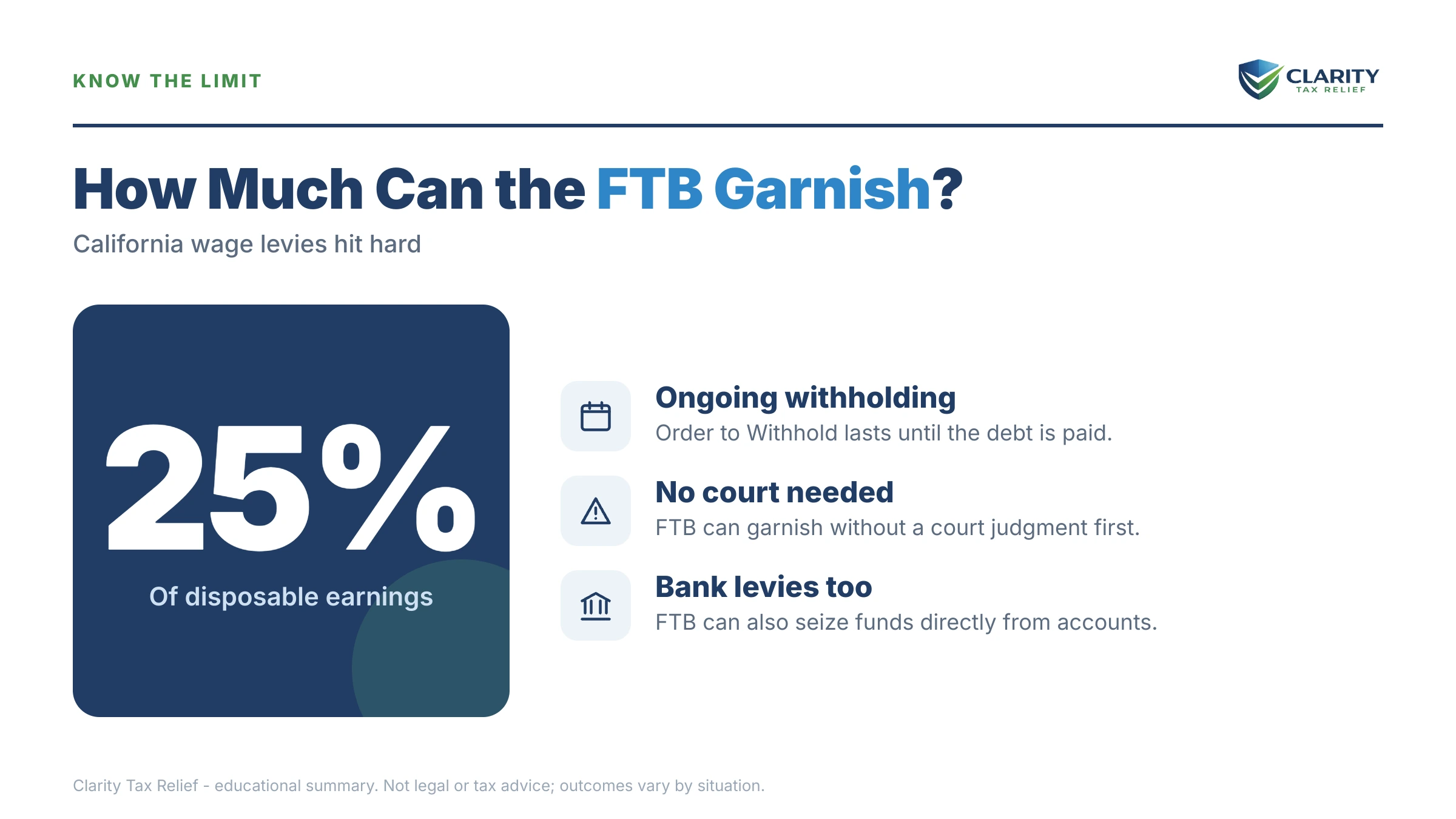
How much can the FTB garnish from your paycheck?
An FTB earnings withholding order typically requires your employer to withhold 25% of your disposable earnings each pay period. "Disposable earnings" means your pay after legally required deductions — federal and state income tax withholding, Social Security, Medicare, state disability insurance. It does not subtract your rent, your car payment, your 401(k) contribution, or your health premiums, which is why the take-home hit feels much bigger than 25%.
Unlike an IRS wage levy — which uses exemption tables that leave you a fixed amount and can take more than 25% from higher earners — the FTB's order is a flat cut of disposable pay. If that cut leaves you unable to cover basic living expenses, the FTB can agree to a lower withholding amount when you document your finances. You can run your own numbers first with our wage garnishment calculator to estimate what an order could leave you per check, and see how much can FTB garnish for the full math, including multiple-order situations.
What happens if you ignore an FTB wage garnishment
An FTB garnishment never expires on its own — it runs until the balance is paid, released, or the 20-year collection statute finally ends. And the garnishment is rarely the FTB's only move. Ignore it and enforcement stacks in this sequence:
- Withholding continues every payday. Typically 25% of disposable earnings comes out of each check, applied to a balance that interest is still growing.
- Interest and fees keep the meter running. The FTB adds interest plus collection cost recovery fees, so part of what's withheld is servicing growth, not just principal.
- A state tax lien gets recorded. The lien attaches to real estate and becomes a public record that complicates selling, refinancing, and some professional situations.
- Bank accounts get hit next. An FTB bank levy — an Order to Withhold sent to your bank — can take account funds on top of the wage order. The two run simultaneously.
- Refunds get intercepted. State refunds are applied to the balance automatically, and the FTB and IRS intercept each other's refunds through offset programs.
- High balances trigger public escalation. Individuals owing over $100,000 risk the FTB's public Top 500 delinquent-taxpayer list, which can carry state license consequences.
The outer limit on all of this is California's 20-year collection statute (R&TC §19255) — double the IRS's 10 years. The FTB is built to outlast you; the way out is resolution, not endurance.
| Stage | What's happening | Your window or right |
|---|---|---|
| Balance-due notice | The FTB bills you; interest is accruing | Pay, arrange, or dispute by the date printed on the notice |
| Final Notice Before Levy | Last warning before enforcement | Respond by the date on the notice — resolving here prevents the order entirely |
| Order served on your employer | Employer must comply; withholding generally starts with the first pay period ending 10+ days after service | Request a hardship modification with documented income and expenses |
| Garnishment in effect | Typically 25% of disposable pay, every check | Release through full payment, an approved resolution, or proven hardship — the 20-year statute is the only automatic end |
The FTB is taking a cut of every check — get the order reviewed free
Every pay period this garnishment stays in place typically costs you 25% of your disposable pay, and interest is still growing the balance underneath it. An experienced tax professional will review your order, check whether the assessment is even correct, and map the fastest release path — free and confidential.
Paid on 1099? The FTB doesn't garnish you — it levies your clients
The FTB can't garnish wages you don't have, so for contractors it sends an Order to Withhold directly to the businesses that pay you. Unlike the wage order's 25% cap, an Order to Withhold can capture up to 100% of the money a client owes you on the day the order arrives. One order to your biggest client can swallow an entire invoice — and your client is legally required to comply, which means an awkward conversation you didn't choose.
For recurring payment streams — ongoing contracts, rent to you as a landlord, royalties — the FTB can use a continuous version that attaches a portion of each payment for as long as the order remains in effect. And the FTB uses the same Order to Withhold mechanism against bank accounts, so contractor pay that already landed in your checking account isn't safe either. If the distinction between these tools is fuzzy, levy vs garnishment breaks it down in plain English.
| How you're paid | Order the FTB sends | What it takes |
|---|---|---|
| W-2 employee | Earnings Withholding Order for Taxes (EWOT), served on your employer | Typically 25% of disposable earnings, every pay period, until released |
| 1099 contractor / vendor | Order to Withhold, sent to your clients | Up to 100% of what the client owes you when the order arrives |
| Recurring payments (contracts, rent, royalties) | Continuous Order to Withhold | A portion of each payment while the order remains in effect |
| Bank account | Order to Withhold, sent to your bank | Funds in the account up to the balance owed — the FTB bank levy |
How to stop an FTB wage garnishment: every real option
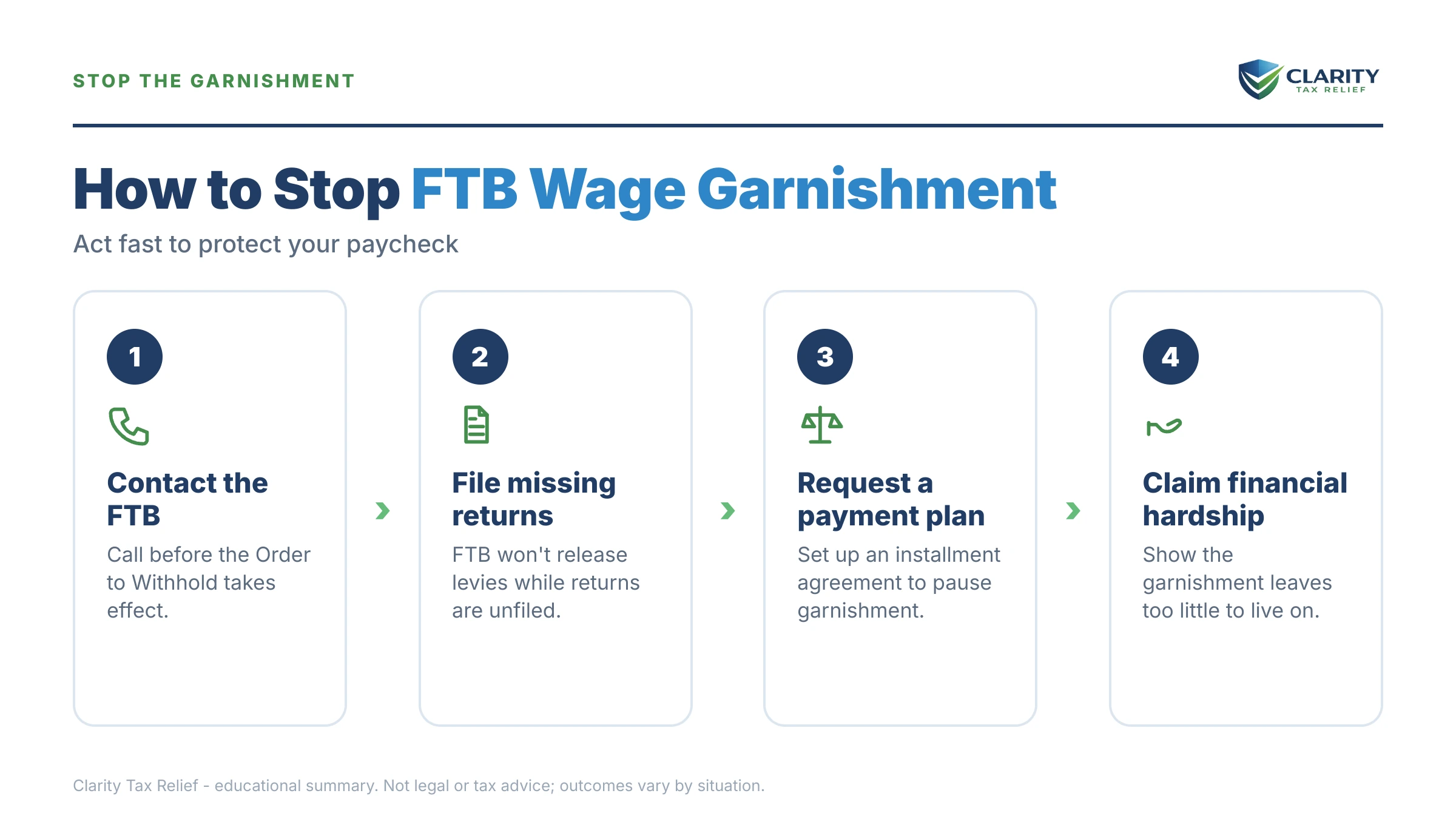
Every FTB garnishment release runs through one of five doors: pay it, arrange it, prove hardship, compromise it, or correct it. The order the FTB sent your employer stays in force until one of these is in place — and even then, a release usually has to be specifically requested, not assumed.
- Pay in full. The fastest release, and the only one with no eligibility test. Payment stops future withholding and the interest meter.
- FTB payment plan. The FTB's published criteria for its self-service plan generally require a balance of $25,000 or less, paid within 60 months, with all returns filed. Approval doesn't automatically release an existing garnishment — ask for the release as a condition when you set it up. Details in our FTB payment plan guide.
- Hardship modification or hardship status. If the withholding leaves you unable to pay basic living expenses, the FTB can reduce the order or suspend active collection entirely. Both run on a documented financial statement — FTB Form 3561 — showing income, required expenses, and assets. Interest still accrues; enforcement pauses.
- FTB Offer in Compromise. California runs its own OIC program, separate from the IRS's, for people who genuinely cannot pay the full balance from income or assets — typically closed tax years and demonstrated inability to pay, not just unwillingness. It's slower than a plan and means-tested, but for the right facts it resolves the debt for less. See FTB offer in compromise for eligibility.
- Correct the assessment. If the balance came from an estimated non-filer assessment, file the actual return with your real expenses. If the FTB's numbers are simply wrong — a payment misapplied, income double-counted — dispute it with documentation. A garnishment collecting a wrong number should be attacked at the number, not just the order.
| You owe | Realistic paths |
|---|---|
| Under $10,000 | Self-service payment plan; pay in full if possible; hardship modification if even the plan payment isn't affordable |
| $10,000–$25,000 | Payment plan within the FTB's online threshold, with a garnishment release requested at setup; file any missing returns first — estimated assessments in this band often shrink |
| $25,000–$100,000 | Negotiated installment agreement with financial disclosure (Form 3561); hardship status; FTB Offer in Compromise where the finances genuinely support it |
| Over $100,000 | Expect a recorded lien and layered enforcement, plus Top 500 list exposure; negotiated resolution with full financials — experienced representation usually changes the outcome here |
What resolving it costs: a worked example at $11,300
Say you owe the FTB $11,300 as a 1099 graphic designer — an estimated assessment from a year you never filed, built from your clients' 1099s with no business expenses subtracted. Here's how the same debt plays out down three paths (all numbers hypothetical and rounded):
- If you were W-2: at $6,400/month gross with roughly $5,100 in disposable earnings, a 25% order takes about $1,275 per month. $11,300 ÷ $1,275 ≈ 9 months of garnished checks — longer in practice, because interest and fees keep adding to the balance while you pay.
- As a contractor: the FTB instead sends an Order to Withhold to your biggest client, who happens to be holding $9,600 in unpaid invoices. Up to the full $9,600 goes to the FTB, you receive $0 from that client that month, and the remaining ~$1,700 gets pursued through another order or a bank levy. No cap, no drip — one hit.
- On a payment plan: $11,300 spread over the 60-month maximum is about $189/month ($11,300 ÷ 60 ≈ $188). Paying $475/month instead clears it in roughly 24 months ($475 × 24 = $11,400) and cuts the interest you feed along the way.
Now the kicker: if the real return for that year — with mileage, software, home office, and equipment deducted — shows you actually owed $6,000, filing it before negotiating changes every number above. That's why sequencing matters: correct the balance first, then arrange the remainder.
How to respond, step by step
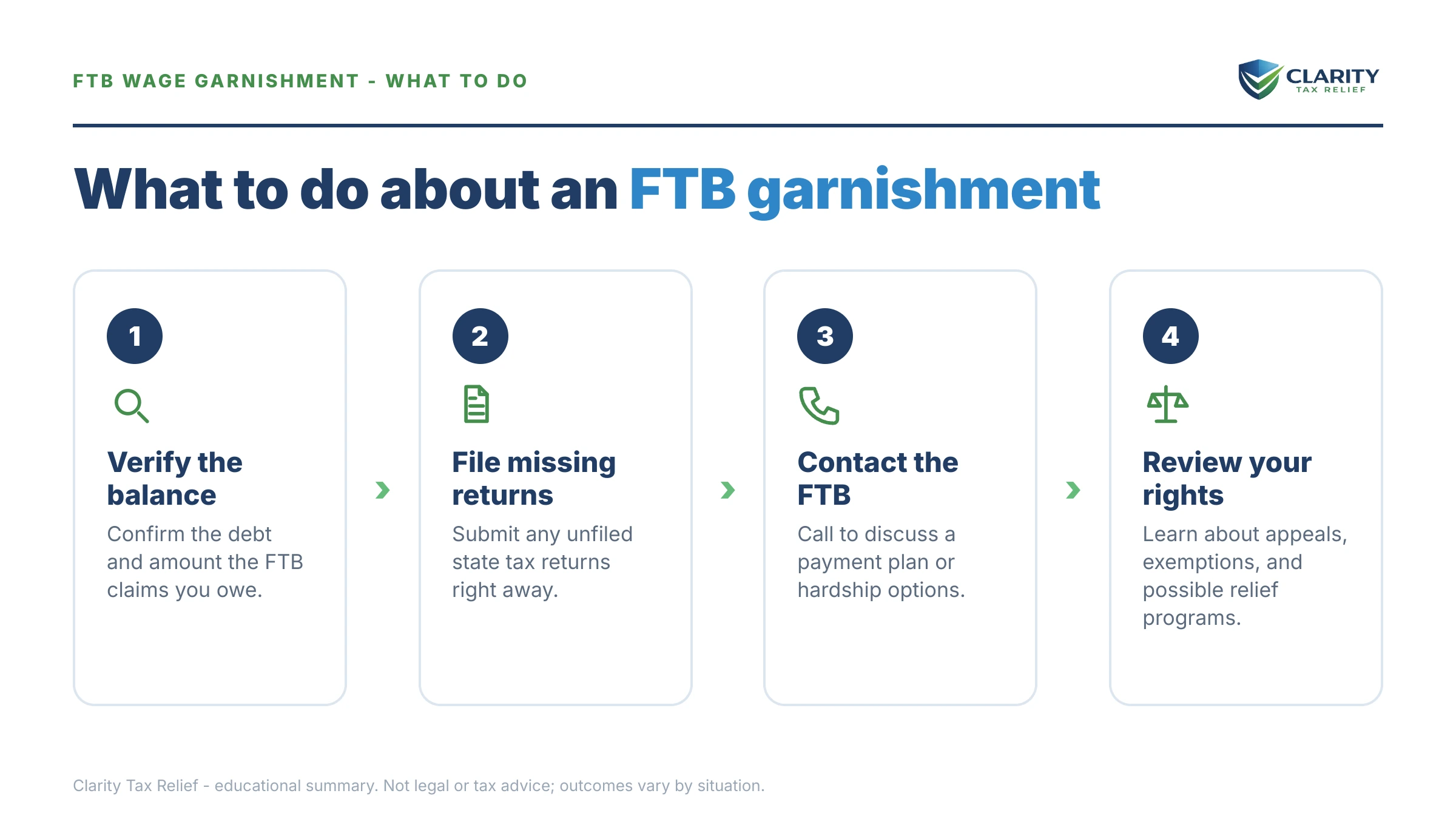
- Confirm the balance and the tax years. Log into your MyFTB account or call the FTB to see exactly what's assessed, for which years, and how much has already been withheld.
- Verify the assessment is real. If any year is an estimated assessment from a Demand for Tax Return you never answered, file the actual return with your real deductions — this alone often shrinks the debt.
- Pick the resolution that fits your finances. Full payment, an FTB payment plan, a hardship modification documented with Form 3561, or an FTB Offer in Compromise if you genuinely can't pay.
- Request the release or modification in writing. Ask the FTB to withdraw or reduce the order as part of your resolution, and confirm your employer or client actually receives the release before your next pay date.
- Fix the cause. If you're self-employed, start quarterly estimated payments so next April doesn't rebuild the balance you just resolved.
FTB vs. IRS wage garnishment: the differences that matter
An FTB garnishment and an IRS wage levy are different tools with different math, and the wrong assumption costs money. Three differences do the most damage:
- How the cut is calculated. The FTB typically takes a flat 25% of disposable earnings. The IRS instead exempts a fixed amount per pay period and takes everything above it — which can exceed 25% for higher earners. The IRS-side math is in how much can the IRS take from my paycheck.
- How long they can chase you. The IRS gets 10 years from assessment; the FTB gets 20 years under R&TC §19255. FTB debt does not quietly age out on any timeline you can plan around.
- Your pre-levy rights. The IRS must offer a Collection Due Process hearing before its final levy, which pauses enforcement while you appeal. The FTB's process doesn't mirror that — its Final Notice Before Levy is a warning, not an appeal gateway, which is why FTB enforcement so often feels faster.
If you owe both, they can garnish simultaneously, and the shared playbook for getting a wage order released — verify, resolve, request release, confirm receipt — lives in our hub on how to stop IRS wage garnishment.
When you can handle this yourself — and when help changes the outcome
Plenty of FTB garnishments are DIY-fixable. If your balance is accurate, under $25,000, all your returns are filed, and you can afford a plan payment, you can call the FTB, set up the installment agreement, request the garnishment release, and be done — no fees to anyone.
Experienced help earns its cost when the case has moving parts:
- Estimated assessments across multiple unfiled years — the returns have to be reconstructed and filed in the right order before any balance is negotiable.
- An Order to Withhold already sitting with your clients — contractor levies move fast, capture whole invoices, and put your business relationships in the middle.
- Concurrent IRS and FTB debt — sequencing which agency to resolve first changes what each can take.
- Hardship and OIC cases — both live or die on how the financial statement is prepared; a sloppy Form 3561 gets a plan payment you can't afford.
- Balances over $25,000 — negotiated agreements with financial disclosure are where representation most reliably changes the monthly number.
If your situation is on the second list, a free review of your order and transcripts with an experienced tax professional — the 2-minute form or (888) 825-7779 — will tell you before another payday whether the assessment is even right.
Terms on your order, decoded
- Earnings Withholding Order for Taxes (EWOT): the FTB's wage garnishment — an administrative order requiring your employer to withhold part of each paycheck.
- Order to Withhold (OTW): the FTB's one-time levy on money someone else holds for you — a client payment or a bank account — up to 100% of what's held.
- Continuous Order to Withhold: the recurring version, attaching a portion of ongoing payments like contract income, rent, or royalties.
- Disposable earnings: pay left after legally required deductions only — taxes, Social Security, Medicare, SDI. Voluntary deductions don't count.
- Final Notice Before Levy: the FTB's last mailed warning before it issues withholding orders — the cheapest moment to act, if you receive it.
- R&TC §19255: the California statute giving the FTB 20 years from assessment to collect — twice the IRS's window.
FTB wage garnishment questions, answered
How much can the FTB garnish from my paycheck?
An FTB earnings withholding order typically takes 25% of your disposable earnings — what's left after legally required deductions like federal and state taxes and Social Security. Voluntary deductions such as your 401(k) or health premiums don't reduce the garnishable amount. If 25% leaves you unable to cover basic living expenses, you can ask the FTB to modify the order by documenting your finances.
Can the FTB garnish my wages without a court order?
Yes. The Franchise Tax Board issues earnings withholding orders administratively — no judge, no lawsuit, no court judgment required. That's why the process feels sudden: the required warning is the Final Notice Before Levy mailed to your last known address, and if you've moved without updating the FTB, the first sign is often your payroll department. The order is still valid even if you never saw the warning.
Does an FTB payment plan stop a wage garnishment?
Not automatically. Approval of an installment agreement doesn't release an order that's already been served — you have to specifically request that the FTB withdraw or modify the garnishment as part of the arrangement, and the FTB decides case by case. Ask for the release in the same conversation where you set up the plan, and confirm your employer actually receives it before assuming your next check is safe.
Can the FTB garnish 1099 or self-employment income?
Yes, but through a different order. Instead of a wage garnishment, the FTB sends an Order to Withhold to the businesses that pay you, which can capture up to 100% of the money they owe you at that moment. A continuous version can attach a percentage of ongoing payments. For contractors this often hits harder than a wage garnishment because there's no 25% cap protecting the payment.
How long does an FTB wage garnishment last?
Until the balance — including interest and collection fees — is fully paid, or the FTB releases the order. There's no automatic expiration each year, and California's collection statute runs 20 years from assessment under R&TC §19255, twice the IRS's 10-year window. Waiting it out is not a realistic strategy; resolving the balance is what ends the withholding.
Can the IRS and FTB garnish my wages at the same time?
Yes. They are separate agencies with separate debts and separate enforcement, and one garnishment doesn't block the other. If both are withholding, your take-home pay can shrink dramatically, which itself can support a hardship modification with one or both agencies. If you owe both, the order in which you resolve them matters — each uses different rules for what it can take.
Can my employer fire me over an FTB wage garnishment?
California law generally prohibits an employer from firing you because your wages are subject to a garnishment order. Your employer has no choice about complying — an employer that ignores the order can become liable for the amounts it should have withheld — but compliance is a payroll function, not a judgment about you. If you believe you were terminated over a garnishment, talk to an employment attorney.
What if the garnishment is for a year I never filed?
That balance is probably an estimated assessment. When you don't respond to an FTB Demand for Tax Return, the FTB estimates your income from 1099s and other records — usually with no deductions or business expenses — and assesses tax on the inflated figure. Filing the actual return often cuts the balance substantially, which shrinks or ends the garnishment. This is the single most common fix for garnished contractors.
Does an FTB wage garnishment show up on my credit report?
The garnishment itself isn't reported to credit bureaus, and tax liens no longer appear on consumer credit reports. But a recorded FTB state tax lien is still a public record that lenders, landlords, and employers can find through public-records searches, and it can complicate mortgage underwriting. The garnishment is also visible to whoever processes your employer's payroll.
Your next 24 hours
- Find the order. Get a copy from payroll (or your client) and locate the tax years, the total balance, and the withholding instructions — then match those years against what you actually filed.
- Gather your numbers. Last year's return, your 1099s or pay stubs, and a quick list of monthly income and required expenses — everything a plan, hardship request, or corrected return will need.
- Get the order reviewed free before your next payday. Interest is still growing the balance and the next check gets cut either way — send us the order through the 2-minute form or call (888) 825-7779 and an experienced tax professional will map your fastest release path.
For agency source material, the Franchise Tax Board publishes its collection and payment procedures at ftb.ca.gov. If you also owe the IRS, federal payment options are at IRS.gov/payments.
This guide is general information, not tax or legal advice for your specific situation. Eligibility for IRS programs depends on individual facts and circumstances; no outcome is guaranteed.