
IRS Collections
Levy vs Garnishment: What's the Difference and Which One Are You Facing? (2026)
The short answer: a levy is the seizure of money or property to pay a debt; a garnishment is a levy aimed at your wages. The IRS doesn't legally "garnish" — it issues a continuous wage levy, no court order required. Private creditors garnish, and they must sue and win first.
You searched "levy vs garnishment" because someone — HR, your bank, or a letter with your ex's name still on it — used one of these words about your money. After a divorce, this hits at the worst possible time: the debt may come from a joint return, but the paycheck being targeted is yours alone. The good news is the difference between the two words tells you exactly what's at risk and how fast.
The paperwork tells you which one you're facing — the image below shows how the two terms map onto the documents the IRS actually sends and where to look on yours.
⏱ The clocks that matter: You have 30 days from the date on an LT11 or Letter 1058 before the IRS can levy your wages or bank account. If your account is already frozen, the bank holds the funds for 21 days before sending them to the IRS. A wage levy has no expiration — it repeats every payday until it's released.
Levy vs garnishment: the plain-English difference
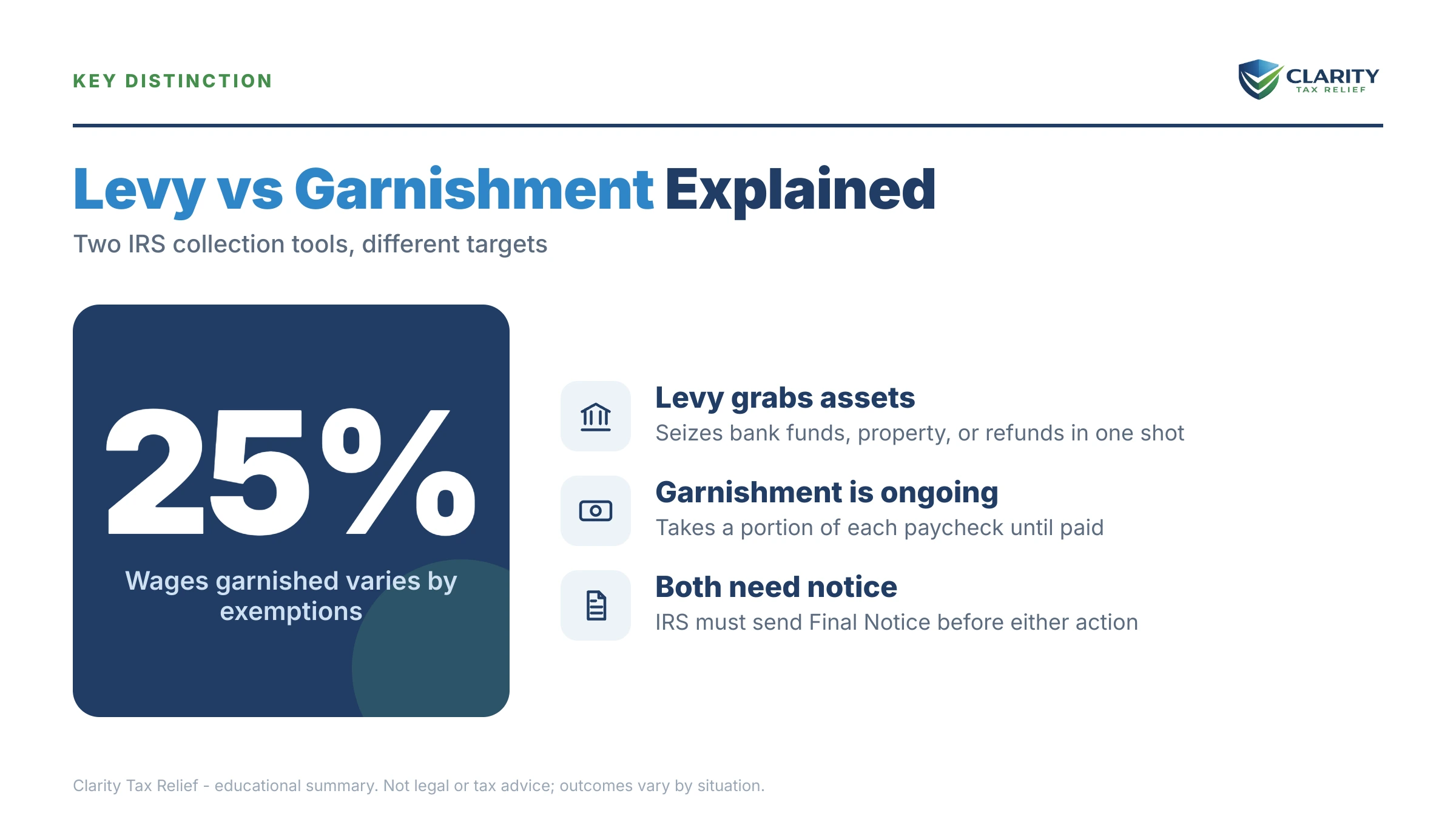
A levy is any legal seizure of your property to satisfy a debt; a garnishment is that same seizure pointed specifically at your paycheck. In everyday speech people use the words interchangeably, and for IRS purposes that's mostly fine — because an IRS "wage garnishment" is legally a continuous wage levy under IRC §6331.
The distinction that actually changes your situation isn't the vocabulary. It's who is taking the money:
- The IRS and state tax agencies use administrative levy power. No lawsuit, no judge, no courtroom — just a required notice sequence and a waiting period.
- Private creditors (credit cards, medical debt, an ex enforcing a judgment) must sue you, win, and then ask a court to order a garnishment.
That's why an IRS levy moves faster and reaches deeper than any creditor garnishment you've heard of. It's also why the defenses are completely different: you fight a creditor garnishment in court, but you stop an IRS levy through IRS procedures — appeal rights, payment arrangements, and hardship rules. This guide covers the IRS side; for the full playbook on getting a paycheck levy lifted, see how to stop IRS wage garnishment.
One more term people mix in: a lien. A lien is a claim against your property; a levy is the taking. If you're not sure which one is on your account, start with irs lien vs levy.
Who uses which word — and what each one can take
The word on your paperwork predicts the rules that apply — court order or not, capped or not, one-time or continuous. Here's the side-by-side:
| Question | Levy (IRS / state tax agency) | Garnishment (court / private creditor) |
|---|---|---|
| Court order needed? | No — administrative power under IRC §6331 after required notices | Yes — creditor must sue and win a judgment first (with narrow exceptions like child support and federal student loans) |
| What it can reach | Wages, bank accounts, state refunds, Social Security (up to 15%), retirement accounts, contractor payments, property | Mostly wages; sometimes bank accounts, depending on state law |
| How much of a paycheck | Everything above a small exempt amount — often more than half of a decent check | Generally capped at 25% of disposable earnings under federal law; some states cap it lower |
| How long it lasts | Wage levy: continuous until released. Bank levy: one-time snapshot | Until the judgment is paid or the order is modified |
Read that third row again, because it's the one that surprises people: a creditor garnishment is capped; an IRS wage levy is not capped — it protects a floor instead. The IRS takes everything above the exempt amount, however large your check is.
How an IRS wage garnishment (wage levy) actually works
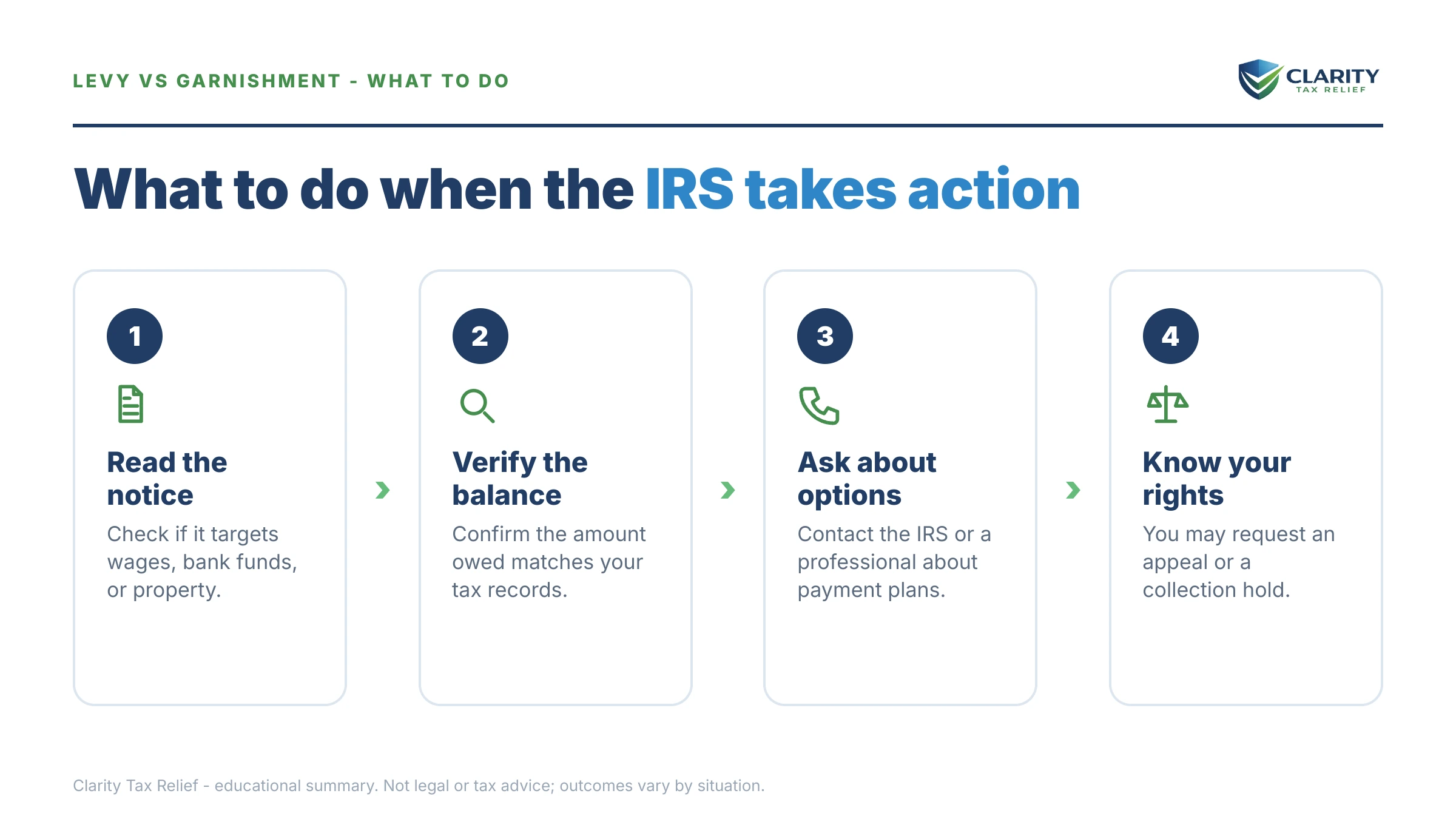
An IRS wage levy is served on your employer with Form 668-W and attaches to every paycheck until the IRS releases it. Your employer has no choice — the form is a legal demand, and payroll must comply or the company becomes liable for the amounts it should have sent.
The amount you keep comes from a table based on your filing status, dependents, and pay frequency. Here's the trap for a recently divorced filer: the exempt amount for a single filer with no dependents is one of the smallest on the table, so a status that changed this year can shrink what you keep dramatically compared to when you filed jointly with kids at home.
There's a second, quieter trap. When the levy is served, your employer gives you a statement to declare your filing status and dependents. If you don't return it — typically within three work days — the IRS computes your exempt amount as married filing separately with zero dependents, usually the harshest possible math. Fill that statement out, accurately and fast, even while you work on the release.
To see roughly how the exempt-amount math would land on your own paycheck, you can estimate it with our IRS Wage Garnishment Calculator.
If you're paid on 1099 instead of W-2, the mechanics flip: the levy on a contractor is generally a one-time grab of what the payer owes you at that moment, not a continuous attachment. The details are in can irs garnish 1099 income.
How an IRS bank levy works — and why it's different
A bank levy (Form 668-A) freezes what's in your account on the day the levy hits — nothing more, nothing less. Money you deposit the next day is not touched by that levy, though the IRS can issue another one later.
The saving grace is the hold: your bank must hold the frozen funds for 21 days before sending them to the IRS. That window exists precisely so you can get the levy released — by proving hardship, fixing an error, or getting into an agreement — before the money leaves. The full mechanics and release strategy are in irs bank levy 21 days.
Two edge cases matter after a divorce. First, joint accounts you never got around to closing are exposed — a levy on your ex's debt can freeze an account your name is still on, and vice versa. Second, if the IRS took money that genuinely wasn't the debtor's, there is a formal claim process; see wrongful levy.
The other levies people call "garnishment"
Wages and bank accounts are the headline levies, but the IRS has quieter versions that also get called garnishment:
- State refund levy — the IRS can take your state tax refund after a cp504 notice, before any final notice is issued.
- Social Security levy — up to 15% of benefits through the federal payment levy program, which runs automatically against federal payments.
- Contractor and vendor levies — one-time seizures of payments a client or customer owes you.
Each has its own trigger and its own release path, which is why the first step in fighting any of them is identifying exactly which document you're holding.
What happens before the IRS can garnish or levy anything
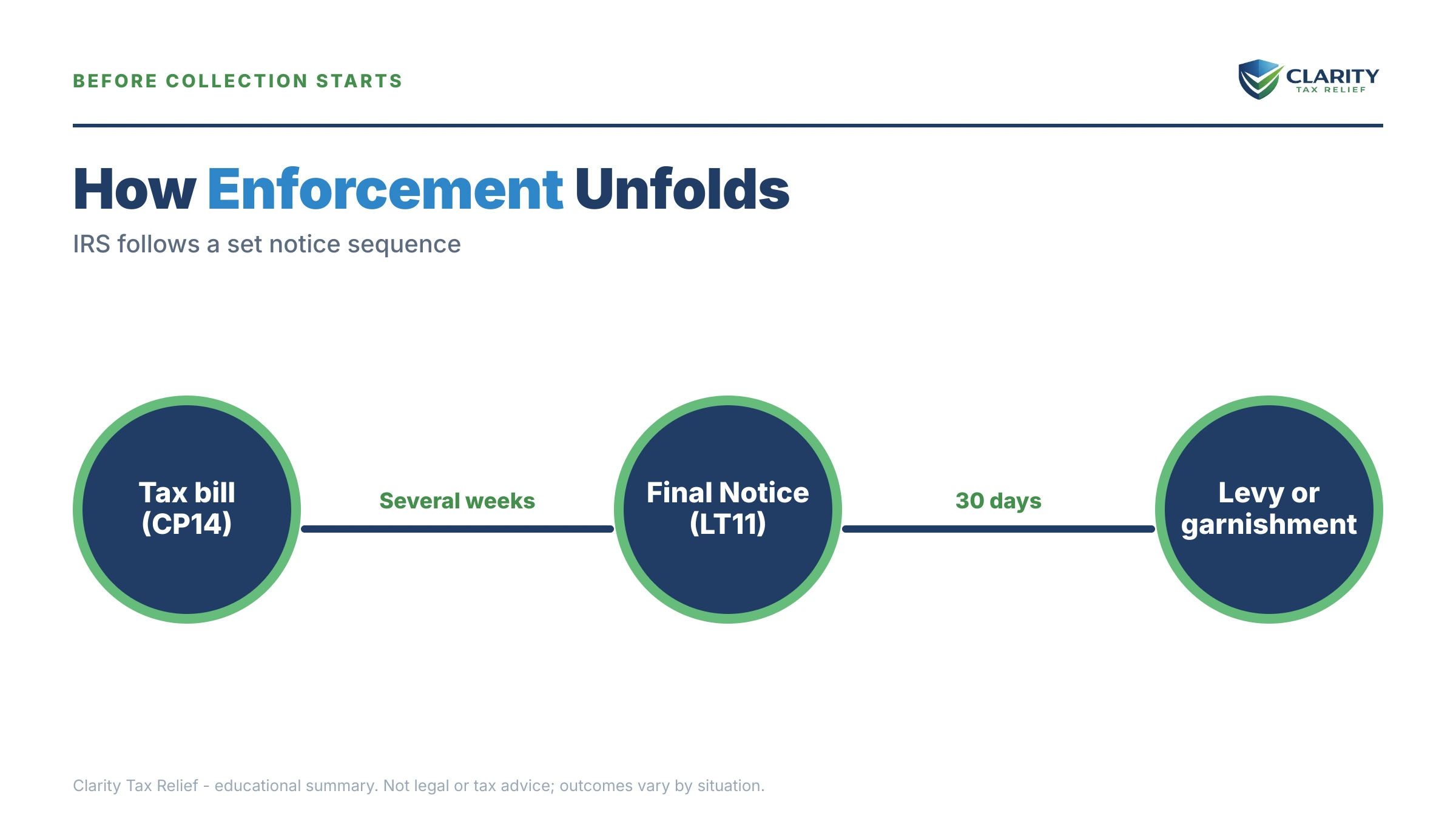
The IRS cannot levy your wages or bank account without first sending a Final Notice of Intent to Levy and waiting 30 days. Levies feel sudden, but they sit at the end of a fully automated notice sequence — and in 2026, with IRS staffing down roughly 27% from the 2025 cuts, that sequence runs on autopilot whether or not a human ever reviews your file. The stages, in order:
- CP14 — the first bill. No enforcement power yet; just a balance due and a pay-by date.
- CP501 / CP503 — reminders. Still bills, while penalties and interest compound monthly.
- CP504 — intent to levy your state refund. Despite the scary title, this is not the final notice — but the state refund is now fair game.
- LT11 or Letter 1058 — the Final Notice. This starts the 30-day clock and your Collection Due Process rights. See the lt11 notice guide for that letter specifically.
- The levy itself. After day 30 with no response, the IRS can serve Form 668-W on your employer or Form 668-A on your bank — and keep doing so until the debt is resolved or the 10-year collection statute expires.
| Notice or event | Your window | The right at stake |
|---|---|---|
| CP504 arrives | Pay-by date on the notice | Your state tax refund — it can be levied after this notice, no further warning |
| LT11 / Letter 1058 arrives | 30 days from the notice date | Your Collection Due Process hearing — miss it and the IRS can levy while you're left with weaker appeal options |
| Bank levy (Form 668-A) served | 21 days before funds leave the bank | The money in the account — a release obtained inside the hold keeps it |
| Wage levy (Form 668-W) served | No fixed window — every payday counts | Each future paycheck above the exempt amount, until the levy is released |
| CSED (10 years from assessment) | Varies by tax year; pausable by appeals, offers, bankruptcy | The IRS's legal authority to collect at all |
Levy notice in hand — or paycheck already short?
Whether you're inside the 30-day LT11 window or a wage levy is already hitting your check, an experienced tax professional can map your fastest release path — free, confidential, no pressure.
How to stop an IRS levy or garnishment: your real options
Every IRS levy has a release path, and most of them don't require paying the balance in full. What fits depends on your finances and where you are in the sequence:
| Option | Typically fits when | What it requires |
|---|---|---|
| CDP hearing (Form 12153) | You're within 30 days of an LT11 / Letter 1058 | A timely written request; levy is generally paused while the hearing is pending |
| Installment agreement | You can afford a monthly payment | Balances ≤ $50,000 can be set up online over up to 72 months; larger balances need financial disclosure |
| Economic hardship release (§6343) | The levy prevents basic living expenses | Proof of income and necessary expenses; the IRS must release a levy causing hardship |
| Currently Not Collectible | You can't pay anything right now | Financial statement (Form 433 series); collection pauses but the debt and interest remain |
| Offer in Compromise | Your assets and income genuinely can't cover the debt | $205 fee (waived for low-income filers), full financial disclosure; the IRS accepted roughly 1 in 5 offers in FY2024 |
| Bankruptcy (automatic stay) | Old, large tax debt alongside other debts | A bankruptcy filing; the stay halts levies but pauses the collection statute |
Two of these deserve special mention. If a levy is taking food or rent money, the hardship rule is not a favor — the IRS is required to release a levy that creates economic hardship; see levy causing hardship for how that case is documented. And if bankruptcy is on your radar for other reasons, understand how the automatic stay interacts with tax debt first — the analysis is in does bankruptcy stop irs levy.
Payment options and current plan terms are laid out on the IRS's own payment plans page, and any direct payment can be made at IRS.gov/payments.
A worked example: $83,100 in joint tax debt after a divorce
Say you owe $83,100 — two years of joint balances from a marriage that ended last spring, and the decree says your ex pays it. The IRS doesn't read decrees. On jointly filed returns, each spouse is liable for the full 100%, so the IRS will levy whichever of you has the findable paycheck — often the W-2 employee, not the self-employed ex. (Why the decree doesn't bind the IRS: divorce decree irs debt.)
Here's the math on your realistic paths:
- Online payment plan: $83,100 is above the $50,000 online threshold, so you'd either submit full financials or pay the balance down by $33,100 to reach $50,000. At $50,000 over the maximum 72 months, that's roughly $695 per month before the interest and penalties that keep accruing on top.
- Passport exposure: $83,100 is above the $66,000 certification threshold for 2026, so an unresolved balance this size can also trigger passport certification — an agreement or pending relief request generally heads that off.
- If the LT11 just arrived: filing Form 12153 within the 30 days generally pauses the levy while a CDP hearing considers alternatives — a payment plan, hardship status, or innocent spouse relief for the joint years.
- If your income can't support ~$695/month plus living expenses: the conversation shifts to a partial-pay arrangement, Currently Not Collectible status, or — if your assets and future income genuinely can't cover $83,100 — an Offer in Compromise. Innocent spouse relief may also remove your liability for the portion attributable to your ex's income.
This example is hypothetical, but the structure is the point: at this balance, the question isn't "levy or garnishment" — it's which release-and-resolution combination fits your income, and whether the joint liability itself can be split.
How to respond to a levy or garnishment, step by step
- Identify the exact document. An LT11 or Letter 1058 means a levy is coming; Form 668-A means your bank account is already frozen; Form 668-W means your paycheck is already attached.
- Mark the clock that applies. You have 30 days from the LT11 date to request a hearing, 21 days from a bank levy before the bank sends the money, and a wage levy repeats every payday until it's released.
- Protect your appeal rights. If you're within 30 days of an LT11 or Letter 1058, file Form 12153 to request a Collection Due Process hearing — a timely request generally pauses the levy while your case is heard.
- Open a resolution before the clock runs. Set up a payment plan, request Currently Not Collectible status, or document economic hardship for an immediate release — any of these can stop or release the levy.
- Get back into full compliance. File any missing returns and fix your withholding or estimated payments; the IRS won't release or keep releasing levies for taxpayers who are still falling behind.
The CDP request is the single most valuable right in this sequence — the walkthrough is at form 12153 cdp hearing.
When you can handle this yourself
You likely don't need professional help if you're still in the notice stage, agree with the balance, and can either pay within 180 days or set up an online payment plan on a balance under $50,000. Those setups are genuinely self-service, and doing them before the LT11 arrives means no levy ever happens.
Experienced help changes outcomes in specific situations: a wage or bank levy already in motion (where days decide whether money leaves), a balance over $50,000 requiring negotiated financials, joint-liability debt where innocent spouse or separation-of-liability relief is on the table, multiple unfiled years, or hardship cases that need to be documented to the IRS's standards. In those cases, the order and packaging of the requests often matter as much as the requests themselves. Not sure which side of the line you're on? A free case review answers that in one call.
State garnishments and levies are a different rulebook
State tax agencies have their own levy powers, timelines, and exemption rules — never assume an IRS figure or window applies to a state. California's Franchise Tax Board, for example, collects under a 20-year statute (R&TC §19255), double the IRS's ten, and issues its own earnings withholding orders and account levies. If your letter came from Sacramento rather than the IRS, start with ftb intent to levy or, if your account is already frozen, ftb bank levy — and verify any state-specific deadline directly with the agency named on your notice.
Terms on your notice, decoded
- Levy — the legal seizure of money or property to pay a tax debt; the IRS's core collection weapon.
- Garnishment — the everyday word for a levy on wages; courts order garnishments, the IRS issues wage levies.
- Lien — a legal claim against your property that secures the debt but takes nothing by itself.
- Continuous levy — a levy that attaches to future payments (like every paycheck), not just what exists today.
- CDP rights — your Collection Due Process right to an independent appeals hearing, triggered by the final notice and requested on Form 12153.
- CSED — the Collection Statute Expiration Date, generally 10 years from assessment, after which the IRS can no longer collect (though appeals, offers, and bankruptcy pause the clock).
Levy vs garnishment: your questions, answered
Is an IRS garnishment the same as a levy?
Yes — when the IRS takes part of your paycheck, the legal action is a levy, even though everyone calls it a garnishment. The IRS's wage garnishment is a continuous wage levy served on your employer with Form 668-W, and it keeps taking from every check until it's released, the debt is paid, or the collection statute expires.
Does the IRS need a court order to garnish wages?
No. The IRS has administrative levy power under IRC §6331, which means it can levy wages and bank accounts without suing you or getting a judge's signature. It must first send a Final Notice of Intent to Levy (LT11 or Letter 1058) and wait 30 days. Private creditors are different — they must win a lawsuit before a court will order a garnishment.
How much of my paycheck can an IRS wage levy take?
More than most people expect. Instead of capping what the IRS takes, the law protects a small exempt amount — based on your filing status, dependents, and pay period — and the IRS levies everything above it. A recently divorced filer claiming single with no dependents keeps one of the smallest exempt amounts, so the majority of a decent paycheck can go to the IRS.
How long does an IRS wage garnishment last?
A wage levy is continuous — it attaches to every paycheck until the IRS releases it, the balance is paid in full, or the 10-year collection statute (CSED) expires. It does not renew or expire on its own each pay period. The fastest ways to end one are setting up an installment agreement, proving economic hardship, or resolving the balance.
Can the IRS levy my bank account and garnish my wages at the same time?
Yes. Nothing limits the IRS to one collection tool at a time. It can serve a wage levy on your employer, a bank levy on your accounts, and take your state refund in the same collection cycle. Each action has its own mechanics — the bank levy has a 21-day hold before funds leave, while the wage levy repeats every payday — so each one needs its own release.
My divorce decree says my ex pays the taxes — can the IRS still levy me?
Yes. A divorce decree binds you and your ex, not the IRS. If the debt comes from jointly filed returns, both spouses are each liable for 100% of it, and the IRS can levy whichever one is easier to collect from. Your remedies are innocent spouse relief or separation of liability through the IRS, plus enforcing the decree against your ex in state court.
Does bankruptcy stop an IRS levy or garnishment?
Filing bankruptcy triggers the automatic stay, which generally halts IRS levies and wage garnishments while the case is open. It is not a cure-all: some tax debts survive bankruptcy, and the stay pauses the 10-year collection statute, giving the IRS more time later. Bankruptcy is worth analyzing when tax debt is old and large, not as a reflex to stop one levy.
Does the IRS have to warn me before garnishing or levying?
Almost always, yes. Before levying wages or bank accounts, the IRS must send a Final Notice of Intent to Levy (LT11 or Letter 1058) and wait 30 days. The main exceptions: your state tax refund can be levied after a CP504, and a rare jeopardy levy can happen without the normal notice when the IRS believes collection is at risk.
If a levy has already caused a genuine crisis the normal channels aren't fixing, the independent Taxpayer Advocate Service can intervene in hardship cases.
Your next 24 hours
- Find the document and its date. Look at the top of your letter for "LT11," "Letter 1058," "668-A," or "668-W" — that code plus the printed date tells you which clock you're on and how many days remain.
- Gather three things: your last filed return, the notice or levy form itself, and your recent pay stubs or bank statements. If the debt comes from joint years, add your divorce decree — it won't stop the IRS, but it shapes the relief strategy.
- Get the free case review. Use the 2-minute form or call (888) 825-7779. If you're inside the 30-day LT11 window or the 21-day bank hold, those days are the difference between pausing the levy and losing the money — use them.
This guide is general information, not tax or legal advice for your specific situation. Eligibility for IRS programs depends on individual facts and circumstances; no outcome is guaranteed.