
California FTB
FTB Intent to Levy: What the Notice Means and How to Stop It (2026)
The short answer: an FTB intent to levy notice — usually titled "Final Notice Before Levy" — is the California Franchise Tax Board's last warning before it seizes bank funds, garnishes wages, or intercepts state payments, all without a court order. Once the respond-by date on the notice passes, the FTB can levy at any time.
The envelope came from Sacramento, not the IRS, and the words "Final Notice Before Levy" are printed right on it. If you're reading an FTB intent to levy notice right now, the state of California is telling you it has cleared its own legal path to take money from your bank account or paycheck — and it doesn't need a judge's signature to do it. That's the bad news. The good news: nothing has been taken yet, and every tool that stops a levy still works today.
Two items on this notice control everything — your total balance and the respond-by date. The image below shows you exactly what this notice looks like and where to find both.
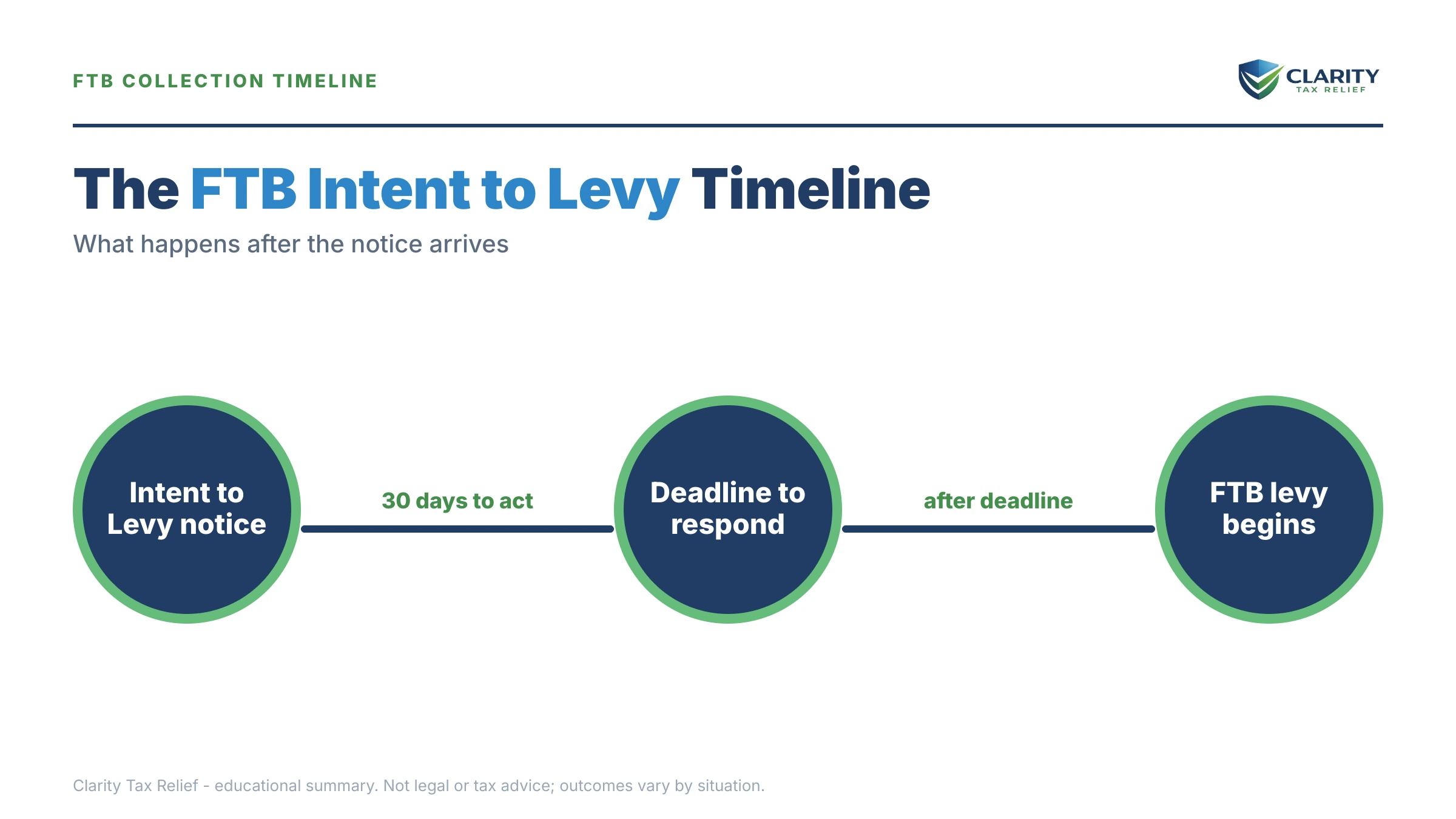
⏱ Your deadline: the respond-by date printed on your FTB notice. There is no fixed grace period after it — once that date passes, the FTB's automated system can issue a bank levy or wage garnishment at any time, while interest and collection fees keep growing the balance every month.
Why you got an FTB intent to levy notice
The FTB sends an intent-to-levy notice when a California tax balance has gone unpaid through its earlier billing notices and the account has moved into involuntary collection. You're not being singled out by a person in Sacramento — this is where the state's automated collection track goes when earlier mail got no response.
The balance behind the notice usually comes from one of three places:
- A filed return you couldn't fully pay. The tax was correct; the payment never caught up, and penalties, interest, and fees have been compounding since.
- An adjustment or audit result — the FTB (or the IRS, whose changes flow to California) recalculated a year and billed the difference.
- An FTB-created assessment for a year you never filed. When California sees income data — 1099s, mortgage interest, a property sale, an occupational license — and no return, it can assess tax for you. These assessments are often inflated, because they include none of your deductions, basis, or credits. Filing the real return can shrink the debt before you negotiate anything.
If the balance spans multiple years or you're not sure where it came from, the California FTB back taxes guide walks through how FTB balances get built — this article focuses on the levy threat in front of you.
What happens if you ignore an FTB levy notice
After the respond-by date on an FTB intent-to-levy notice passes, the FTB can take money without going to court and without any further warning. The sequence from here is automated and moves in a predictable order:
- Balance-due billing. The FTB's earlier statements and demand notices — the polite phase. If you're holding an intent-to-levy notice, this phase is over.
- Intent to levy / Final Notice Before Levy. You are here. This is the legally required warning that unlocks enforcement. Nothing is frozen yet.
- Order to Withhold. The FTB's bank levy — served directly on your bank, which must freeze funds up to the balance owed and remit them to the state. Joint accounts are reachable.
- Earnings Withholding Order for Taxes. A continuous wage garnishment served on an employer; it keeps taking a slice of every paycheck until released or paid. How big that slice is — and how it compares to what the IRS takes — is covered in how much can FTB garnish.
- Lien, intercepts, and fees. A state tax lien recorded against your California property, state refunds and lottery winnings intercepted, and a collection cost recovery fee stacked onto the balance.
One number makes the FTB different from every other collector you've dealt with: under California R&TC §19255, the FTB generally has 20 years to collect — double the IRS's 10-year statute. Waiting it out is not a strategy; the full math is in California's 20-year collection statute. And in 2026, with tax-agency staffing thin everywhere, the humans are harder to reach — but the levy systems are fully automated and never stopped running.
Holding an FTB levy warning right now?
Get your Final Notice Before Levy reviewed free before the respond-by date passes. An experienced tax professional will confirm what the FTB can actually reach, and which resolution protects it — no pressure, no obligation.
Can the FTB levy Social Security? What's protected and what isn't
The FTB cannot levy your monthly Social Security benefit — federal law shields Social Security from state tax collection. That's a genuine and important protection if you live on a fixed income, and it's the opposite of the federal rule: the IRS can take up to 15% of Social Security through the Federal Payment Levy Program.
But the protection follows the benefit, not your bank balance. Once deposits mix with other money in an account, an Order to Withhold can reach the account — though banks receiving a levy order are generally required to protect two months' worth of directly deposited federal benefits. Money above that cushion, savings from other sources, and retirement-account withdrawals that land in the account are all exposed. The mechanics of a frozen account — and how releases work — are covered in the FTB bank levy guide.
If you or a spouse still earn a paycheck, that's the FTB's easier target: an FTB wage garnishment is continuous and hits every pay period until released. The release playbook parallels the federal one we walk through in how to stop an IRS wage garnishment — but you negotiate with the FTB, under California's rules, not the IRS's.
Here's how the two agencies compare on the questions that matter at this stage:
| Question | IRS | California FTB |
|---|---|---|
| How long can they collect? | 10 years from assessment (with pauses) | Generally 20 years (R&TC §19255) |
| Pre-levy appeal right? | LT11/Letter 1058 starts a 30-day Collection Due Process window (Form 12153) | No direct CDP equivalent — your protection is resolving before the respond-by date |
| Can they touch Social Security? | Yes — up to 15% via the Federal Payment Levy Program | No — the benefit itself is federally protected from state levy |
| Bank levy instrument | Levy with a 21-day hold before funds leave | Order to Withhold served directly on your bank |
Your options to stop an FTB levy before it hits
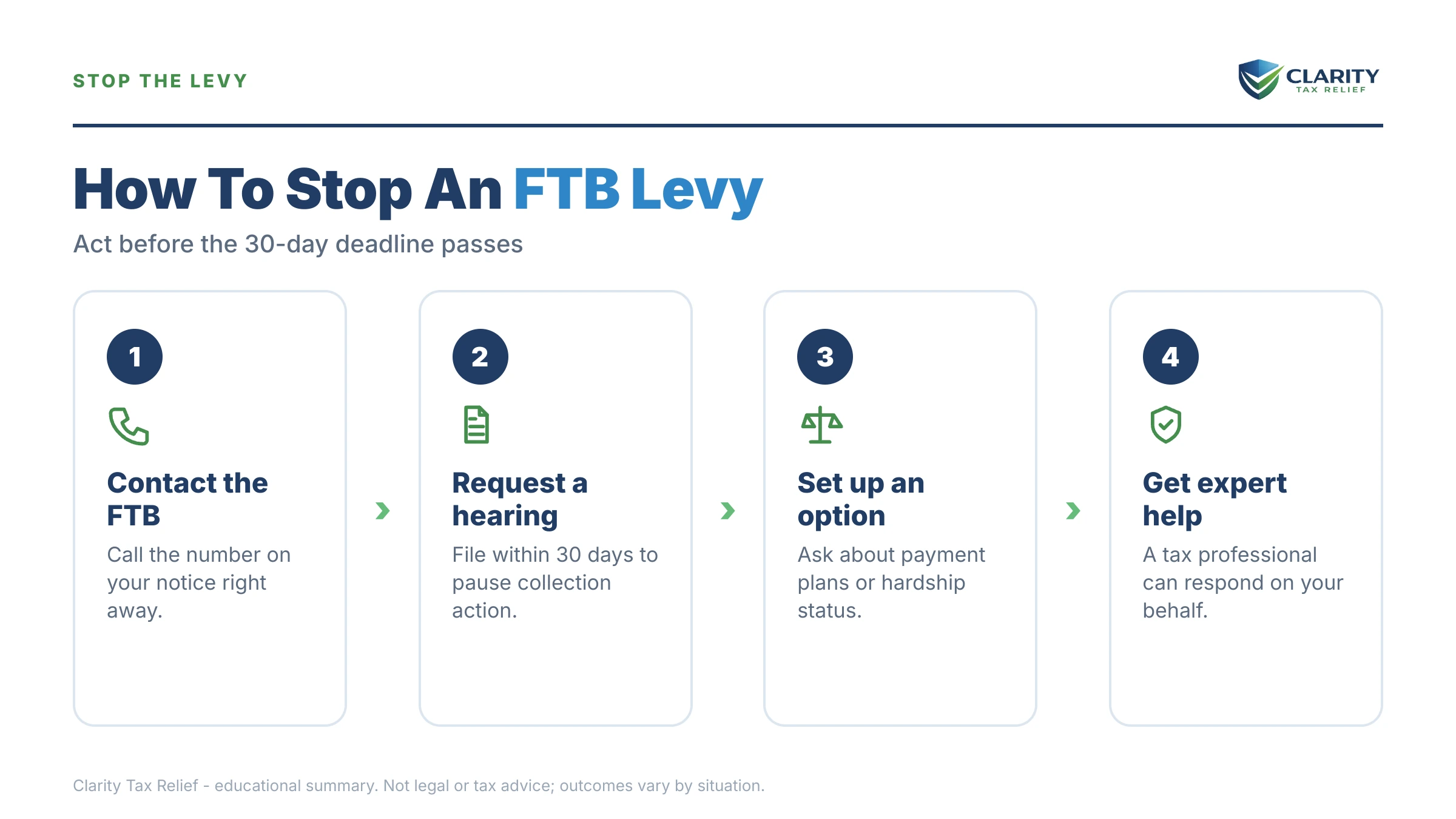
Every realistic way to stop an FTB levy — payment in full, an installment agreement, a hardship deferral, or an Offer in Compromise — works far better before the respond-by date than after money is frozen. The notice presents "pay now" as your only choice; the state actually runs several programs:
| Option | Generally fits when | Effect on the levy threat |
|---|---|---|
| Pay in full | You have the funds or can borrow cheaper than FTB interest and fees | Ends collection entirely; the cheapest exit if it's possible |
| FTB payment plan | You can afford steady monthly payments; the online application is generally aimed at balances of $25,000 or less paid within 60 months, with financial disclosure required above that | Approved agreement holds levy action while you stay current; interest and fees continue |
| FTB hardship / currently not collectible | Paying anything would leave you unable to cover basic living expenses — common on fixed incomes | Pauses active collection while hardship lasts; the debt and the 20-year clock remain |
| FTB Offer in Compromise | You genuinely cannot pay the full balance now or from future income within the collection period; means-tested and documentation-heavy | Settles the debt for what the FTB determines it can actually collect — if accepted |
| Fix the assessment itself | The balance comes from an FTB-created assessment for unfiled years, or the numbers are simply wrong | Filing the real return or disputing the figures can shrink the debt before you negotiate the rest |
One honest caveat on all of these: an application in motion is not the same as an approved one. The safest sequence is to start your resolution — with the financial statement the FTB will ask for (Form 3561, covered in the FTB Form 3561 walkthrough) — before the respond-by date, not the week after a levy lands.
A worked example: $92,700 owed on a Social Security budget
Say you're 71 and retired. A rental property you sold years ago left a California gain that was never fully paid, and with penalties, interest, and collection fees, the FTB now says you owe $92,700. Your income is $2,380 a month in Social Security plus a $650 monthly IRA draw — about $3,030 total. (This is a hypothetical, not a client story.)
Run the numbers the way the FTB would:
- Full payment over five years: $92,700 ÷ 60 months ≈ $1,545 a month before ongoing interest — more than half your income. That plan fails the moment it starts, and the FTB knows it.
- What a bank levy could actually take: suppose you keep $18,500 in the checking account where Social Security lands. Two months of directly deposited benefits (2 × $2,380 = $4,760) should be protected — leaving roughly $13,740 exposed to a single Order to Withhold. Each future IRA withdrawal that hits the account becomes exposed too.
- The realistic paths: your monthly benefit is protected and your expenses consume your income, so this profile points toward a hardship deferral, a modest negotiated payment, or an FTB Offer in Compromise that reflects the reachable savings and IRA — not a $1,545 payment plan. Which of those three actually fits depends on the asset details, which is exactly what the Form 3561 financial statement establishes.
The lesson in the math: the FTB can't take your Social Security check, but doing nothing hands it your savings — while the resolution options that fit a fixed income only work if you start them before the respond-by date.
How to respond to an FTB intent to levy, step by step
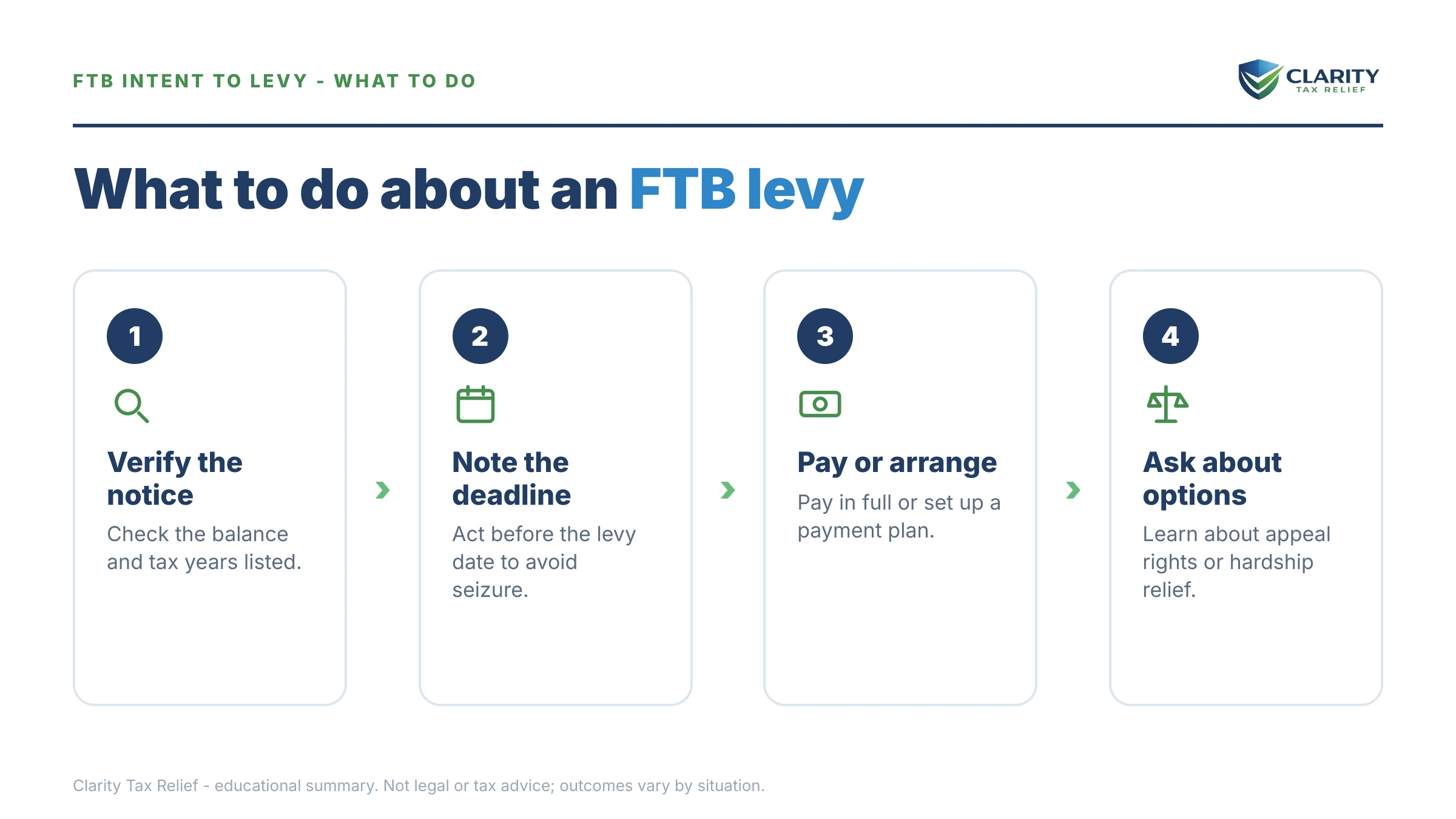
- Find the respond-by date and balance. Locate both on the first page of your notice — that date is your entire timeline, and everything else works backward from it.
- Verify the debt. Log in to your MyFTB account or call the FTB to confirm the tax years, the amounts, and whether the balance comes from a return you filed or an assessment the FTB created for you.
- Gather your financial picture. Pull your income records (including your Social Security award letter if you receive benefits), bank statements, and monthly expenses — every resolution path starts with these.
- Start a resolution before the date. Pay in full, open an installment agreement, request a hardship deferral, or begin an Offer in Compromise — a resolution in motion protects you in a way silence never will.
- Get experienced help if the stakes are high. A levy already in motion, a large balance, unfiled California returns, or a fixed income are the situations where experienced representation changes outcomes.
When you can handle this yourself
You can usually resolve an FTB balance on your own when it's small, undisputed, and payable within the state's standard online plan. If you agree with the numbers, can pay in full or comfortably afford the monthly amount, and this is one tax year — set it up directly with the FTB before the respond-by date and skip the professional fee.
Experienced help changes outcomes in a narrower set of situations: a bank account already frozen or a paycheck already garnished; a balance the size of our example, where the FTB will demand full financial disclosure and every line of the Form 3561 affects what you pay; unfiled California years hiding behind an inflated FTB assessment; a fixed income where the hardship-versus-offer decision turns on how assets are presented; or debt owed to both the FTB and the IRS, where the order you resolve them in changes the total cost. Honest rule of thumb: the simpler your facts, the less you need anyone — including us.
Terms on your FTB notice, decoded
- Order to Withhold (OTW): the FTB's bank levy — an administrative order that makes your bank freeze and remit funds, no court involved.
- Earnings Withholding Order for Taxes (EWOT): the FTB's continuous wage garnishment, served on your employer and repeated every payday until released.
- Interagency Intercept: the program that grabs your state tax refunds, lottery winnings, and certain other state payments and applies them to the debt.
- State tax lien: a public claim recorded against your California property that secures the debt and complicates any sale or refinance.
- Collection cost recovery fee: a fee the FTB adds when an account moves into involuntary collection — one of several FTB collection fees that quietly grow a balance.
- R&TC §19255: the California statute giving the FTB a 20-year collection window — the reason FTB debt outlives almost every other kind.
FTB intent to levy questions, answered
How long after an FTB intent to levy notice will the FTB actually levy?
The FTB can levy any time after the respond-by date printed on your notice — there is no additional grace period once that date passes. The system is automated, so a bank Order to Withhold or a wage garnishment can issue days or weeks later without further warning. The only reliable protection is starting a resolution — payment, a plan, or hardship — before the date.
Can the FTB take money from my bank account without a court order?
Yes. The FTB issues an administrative Order to Withhold directly to your bank — no judge, no lawsuit, no hearing first. Your bank must freeze funds in the account up to the balance owed and send them to the FTB. Joint accounts can be reached too, which regularly surprises spouses and adult children who share an account with the person who owes.
Can the FTB garnish Social Security payments?
No — the FTB cannot levy your Social Security benefit itself, because federal law protects Social Security from state tax collection. The risk starts after the money is deposited: a bank levy can reach account funds, though banks are generally required to protect two months' worth of directly deposited federal benefits. Keeping benefits in a dedicated account preserves that protection.
Is an FTB intent to levy the same as an IRS intent to levy?
No. They come from different agencies enforcing different debts under different rules. An IRS final notice (LT11 or Letter 1058) starts a 30-day clock with formal Collection Due Process appeal rights; the FTB notice has no direct equivalent — your protection is acting before the respond-by date. The FTB also collects for 20 years, double the IRS's 10-year statute.
Will a payment plan stop an FTB levy?
Generally yes — once the FTB approves an installment agreement, it holds active levy action while you keep the terms. The key word is approved: applying the day after your bank account is frozen usually will not undo the freeze. Set the plan up before the respond-by date, and expect the FTB to require a financial statement on larger balances.
Does FTB tax debt ever expire?
Yes, but slowly: under California R&TC §19255, the FTB generally has 20 years to collect a liability. That is twice the IRS's 10-year window, so waiting out the FTB is rarely a realistic plan. Liens, intercepts, and levies can continue through that entire period, and collection fees and interest keep growing the balance the whole time.
Can the FTB levy me if I no longer live in California?
Yes. Moving out of state does not erase a California tax debt, and the FTB routinely collects from former residents — most easily by serving levies on national banks that operate in California and by intercepting payments through interagency agreements. If you left years ago, remember the 20-year collection statute likely still has plenty of time left on it.
Can I settle FTB debt for less than I owe?
Sometimes — the FTB runs its own Offer in Compromise program, separate from the IRS's, for people who cannot pay the full balance now or through future income within the collection period. It is means-tested and documentation-heavy, and retirees on fixed income with no reachable assets are often the strongest candidates. There is no guarantee; the FTB evaluates every offer on its facts.
Your next 24 hours
- Find two things on your notice: the respond-by date and the total balance, both on the first page. Write the date somewhere you'll see it — it's the only clock that matters now.
- Gather your paperwork: the notice itself, your last federal and California returns, bank statements, and proof of income — your Social Security award letter if you receive benefits.
- Get a free case review before that date passes: call (888) 825-7779 or use the 2-minute form. An experienced tax professional will tell you what the FTB can actually reach and which resolution fits your income — before the levy issues, not after.
Primary sources: you can verify your balance, make payments, and manage your account directly with the state at the Franchise Tax Board's official website. If you also owe federal tax, the IRS's payment options are at IRS.gov/payments.
This guide is general information, not tax or legal advice for your specific situation. Eligibility for IRS programs depends on individual facts and circumstances; no outcome is guaranteed.