
IRS Collections & Levies
How to Stop IRS Wage Garnishment in 2026: Every Release Path That Works
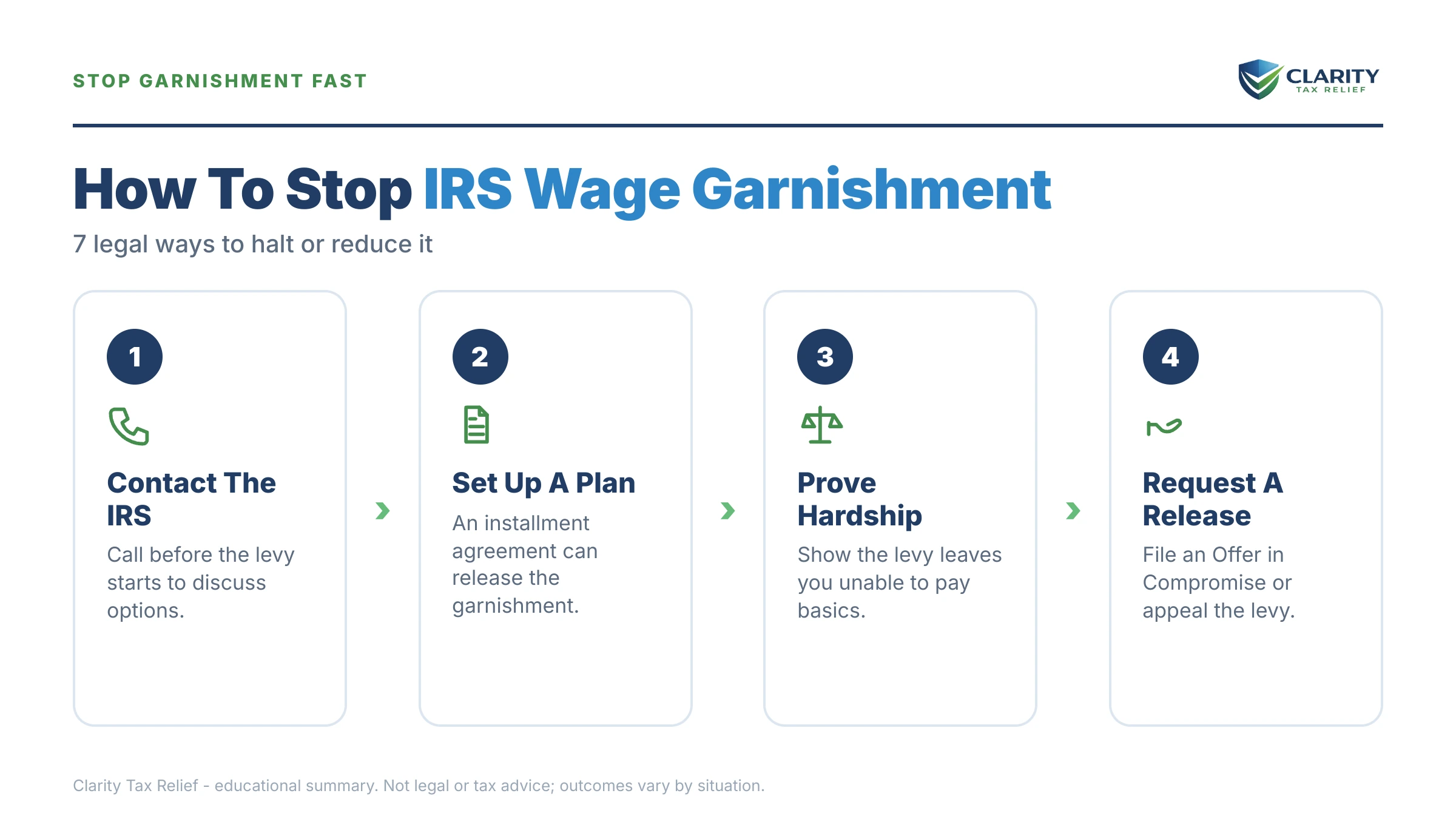
How to stop IRS wage garnishment, in one sentence: get the levy released — by setting up a payment plan, proving the levy creates economic hardship, requesting a Collection Due Process hearing if you're within 30 days of your final notice, or paying the balance. The levy is continuous: it takes part of every paycheck until it's released.
Payroll called you in — or your direct deposit landed hundreds short — and rent is due on the first. Your employer has no choice but to comply with the IRS, which means the fix has to come from you, not from HR. The good news: wage levies get released every day, and several of the paths below can work faster than people expect.
The order the IRS received is Form 668-W, Notice of Levy on Wages, Salary, and Other Income. If you haven't seen it yet, ask payroll for a copy — the image below shows exactly what that levy paperwork looks like and where to find the parts that decide how much of your check survives.
⏱ Your real deadline is your next payday. An IRS wage levy has no end date — it repeats every pay period until it's released, the balance is paid, or the collection statute runs out. One exception worth checking first: if your LT11 or Letter 1058 is dated within the past 30 days, a timely Form 12153 can still block levy action through a Collection Due Process hearing.
Why the IRS is garnishing your wages
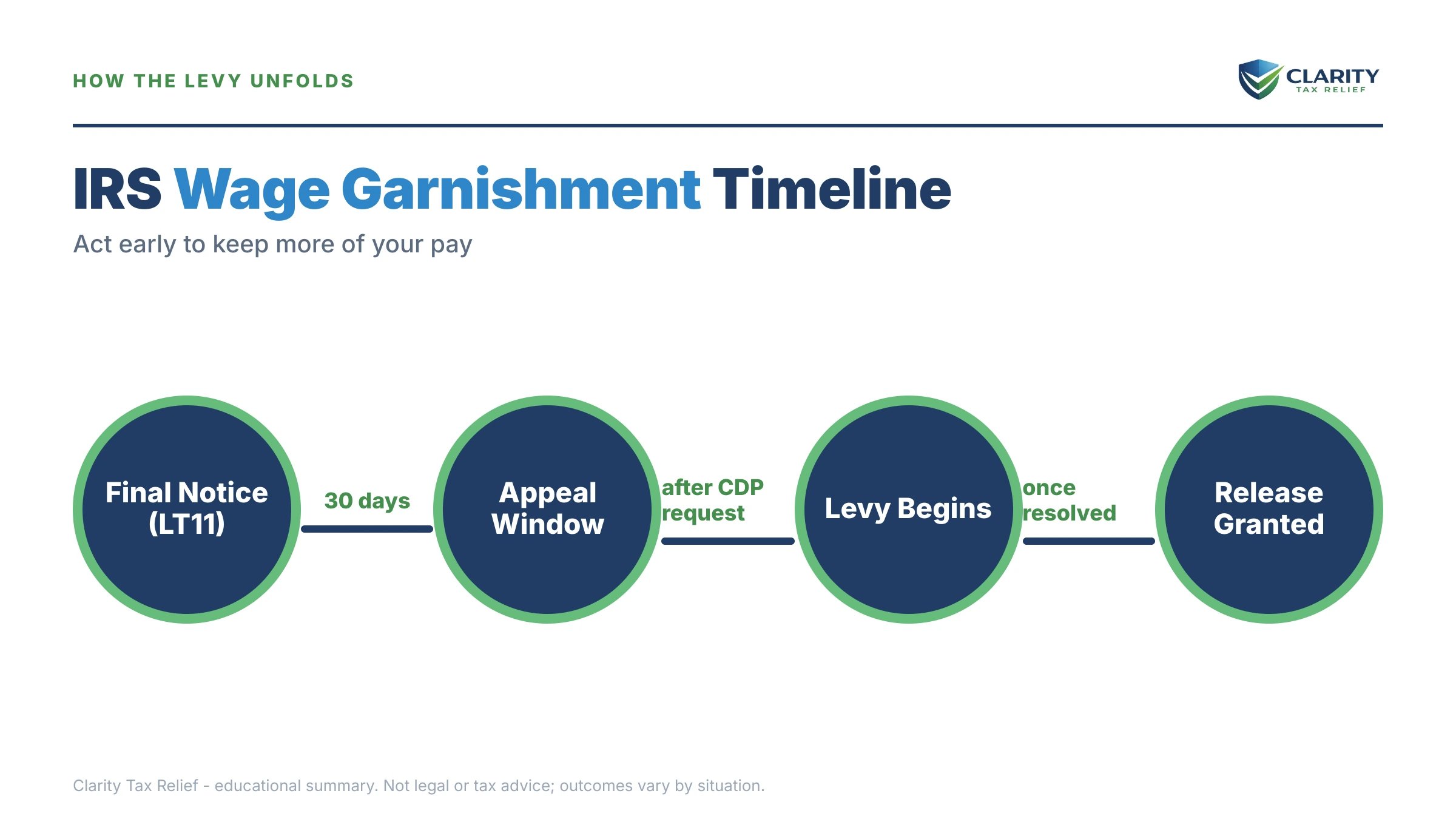
The IRS cannot garnish your wages until it has mailed a final notice of intent to levy — LT11 or Letter 1058 — and waited 30 days. A wage levy is never the first contact; it's the end of a notice chain that started with a bill and escalated on autopilot while the balance grew.
If the sequence feels like it came out of nowhere, there's usually a reason: those notices go to your last known address. Move without filing a change of address with the IRS, and the entire chain — including your LT11 notice — may have gone to an old apartment. The levy is still legal.
Two other routes land people here. If you had a payment plan that defaulted, the levy may have followed a CP523 notice instead of the standard chain. And if the IRS filed returns for you on unfiled years, the "balance" driving the levy may be inflated — which itself becomes a release strategy (more below).
| Notice | What it does | The clock it sets |
|---|---|---|
| CP14 | First bill for the balance due | ~21 days before the sequence escalates |
| CP501 / CP503 | Automated reminders — still just bills | Balance grows monthly; no enforcement yet |
| CP504 | Intent to levy your state tax refund (IRC §6331(d)) | State refund seizable after 30 days — not wages yet |
| LT11 / Letter 1058 | Final Notice of Intent to Levy — the legal green light | 30 days to request a CDP hearing before levies can begin |
| Form 668-W | The levy itself, served on your employer | Continuous — repeats every payday until released |
One reassurance while you work the problem: your employer is following a legal order, not judging you — and federal law generally protects employees from being fired over a single garnishment.
How much of your paycheck can the IRS garnish?
The IRS takes everything above a fixed exempt amount — there is no 25% cap like the one private creditors face. The exempt amount comes from the IRS's Publication 1494 tables and depends on your filing status, how often you're paid, and how many dependents you claim. For a single filer with no dependents, it works out to roughly the standard deduction spread across your pay periods — often just a few hundred dollars per week. Everything above that line goes to the IRS.
That's why the Statement of Exemptions attached to Form 668-W matters so much. Payroll should have handed you a copy to complete. Return it immediately: if you don't, the IRS calculates your exempt amount as if you were married filing separately with zero dependents — the smallest protection the tables allow.
To see the arithmetic on your own pay, you can estimate what a levy would leave you with our IRS Wage Garnishment Calculator, and the full breakdown of the exempt-amount tables is in our guide to how much can the IRS garnish from my paycheck.
What happens if you don't stop the garnishment
An IRS wage levy is continuous — it repeats every payday until the balance is paid, the levy is released, or the 10-year collection statute expires. And a wage levy is rarely the last enforcement step; it usually runs alongside others. Left alone, the sequence typically unfolds like this:
- Every payday — payroll sends the IRS everything above your exempt amount. You are here.
- Any tax refund — federal (and often state) refunds are seized and applied to the balance for as long as it exists.
- Bank accounts — the IRS can layer a bank levy on top of the wage levy; the bank freezes funds for 21 days before sending them, a window covered in our guide to the IRS bank levy 21 days rule.
- Your passport — once the certified debt passes $66,000 (the 2026 threshold), the IRS can certify it to the State Department, which can deny or revoke your passport — see passport revoked tax debt.
- A federal tax lien — if one isn't filed already, it can attach to everything you own and complicate car loans, security deposits, and future home purchases.
- The long grind — the levy can legally run until the collection statute expires, 10 years from assessment, and that clock pauses during appeals, offers, and bankruptcy.
One 2026 reality makes speed matter more, not less: the IRS workforce was cut roughly 27% in 2025, so reaching a human to negotiate a release takes longer than it used to — but the levies themselves are issued and repeated by automated systems that never slowed down. The machine keeps taking; only a person can approve the release. Start early.
Your check is being levied right now?
Every pay cycle without a release is money gone — and released levies don't refund what was already taken. Get your Form 668-W and levy notices reviewed free before your next payday, and an experienced tax professional will map your fastest release path.
Every way to stop IRS wage garnishment in 2026
Every release path shares one prerequisite: filing compliance. The IRS will not approve a payment plan, hardship status, or offer while required returns are unfiled — so missing years get handled first, even if you can't pay them. (The broader playbook for resolving the underlying balance lives in our guide to how to settle tax debt yourself; this page focuses on what actually gets the levy off your paycheck.)
| Release path | Core requirement | Speed once in place |
|---|---|---|
| Pay the balance in full | Funds to cover tax, penalties, and interest | Immediate release once payment posts |
| Short-term payment plan | Ability to full-pay within 180 days; $0 setup fee | Release typically follows approval — ask for it explicitly |
| Installment agreement | All returns filed; financials (Form 433-F) above $50,000 | Release generally issued once the agreement is accepted |
| Economic hardship release / CNC | Proof the levy prevents basic living expenses | Can be fastest of all — the IRS must release a hardship levy |
| CDP hearing (Form 12153) | Filed within 30 days of the LT11 / Letter 1058 date | Timely request generally halts levy action while Appeals reviews |
| Offer in Compromise | Assets + future income genuinely can't cover the debt | Months, not days — usually paired with another arrangement first |
| Bankruptcy's automatic stay | An actual bankruptcy filing that fits your facts | Immediate stop, but the tax debt may survive the case |
1. Pay the balance — or borrow to
Full payment releases the levy as soon as it posts. For some people, a personal loan or family loan beats a levy: loan interest may cost less than the IRS's compounding interest plus the monthly failure-to-pay penalty, and it ends the paycheck seizure now. Run the math before assuming a loan is worse.
2. Set up a payment plan
An installment agreement is the most common release path. Balances of $50,000 or less can qualify online for up to 72 months with no financial disclosure; above that line the IRS wants a Form 433-F collection information statement, and the rules shift as described in our guide to an IRS payment plan over 50000. Two cautions: interest and penalties keep accruing during any plan, and the levy release is not automatic — when the agreement is approved, ask the agent, on that call, to issue Form 668-D and fax it to payroll.
3. Prove economic hardship
Under IRC §6343, the IRS must release a levy that creates economic hardship — meaning it leaves you unable to pay reasonable basic living expenses. For a renter, this is often the strongest card: rent, utilities, food, transportation, and health costs all count, and there's no home equity muddying the picture. You'll document income and expenses (usually on Form 433-F), and if the numbers show nothing left over, the account can move into IRS currently not collectible status — collection paused, though the debt and interest remain and the IRS revisits your finances periodically.
4. Request a Collection Due Process hearing
If your LT11 or Letter 1058 is dated within the last 30 days, file Form 12153 now. A timely request generally stops levy action while the IRS Office of Appeals reviews your case, and it preserves your right to take a disagreement to Tax Court. In the hearing you can propose any of the alternatives on this page — a plan, hardship status, an offer. The mechanics are in our Form 12153 CDP hearing guide. Miss the 30 days and you can still request an equivalent hearing for up to a year, but levies don't pause and Tax Court review is off the table — which is why the notice date is the first thing to check.
5. Submit an Offer in Compromise — with honest expectations
An OIC settles the debt for less than the full balance when your assets and future income genuinely can't cover it — the IRS accepted roughly 1 in 5 offers in FY2024, so it's real but far from automatic. It is not a fast levy-stopper: offers take months to review. The practical play is to get the levy released through a plan or hardship finding first, then pursue the offer if the math supports one.
6. Bankruptcy's automatic stay
Filing bankruptcy halts IRS levies immediately through the automatic stay. Whether the tax debt itself survives depends on the age of the debt, when returns were filed, and the chapter — details in does bankruptcy stop irs levy. Filing solely to stop a garnishment, without a discharge strategy, usually trades one problem for a bigger one.
7. Challenge a levy that shouldn't exist
Some levies are simply wrong: the balance was already paid, the debt belongs to someone with a similar name or a stolen SSN, an installment agreement was in good standing, or the balance comes from IRS-prepared substitute returns that overstate what you owe. In the substitute-return case, filing accurate original returns can shrink the debt dramatically — sometimes below the point where any levy makes sense. Wrong-levy arguments are also exactly what CDP and manager conferences are for.
Deadlines and rights that still protect you
Even with a levy in motion, several clocks still run in your favor — and each one protects something specific.
| Moment on the clock | Your window | What's at stake |
|---|---|---|
| LT11 / Letter 1058 mailed | 30 days | Timely CDP hearing (Form 12153) — generally pauses levy action and preserves Tax Court review |
| 30-day CDP window missed | Up to 1 year from the notice date | Equivalent hearing — Appeals still listens, but levies continue and there's no Tax Court appeal |
| Employer receives Form 668-W | Days, not weeks | Return the Statement of Exemptions or your exempt amount is computed as married filing separately, zero dependents |
| IRS levies a bank account | 21 days | The bank holds the funds before sending them — a release inside that window keeps your money |
| Date each balance was assessed | 10 years (the CSED) | IRS collection authority expires — though appeals, offers, and bankruptcy pause the clock |
Worked example: stopping a garnishment when you owe $92,700
Say you owe $92,700 across two tax years, you rent your home, and payroll just received Form 668-W. Here's how the thresholds on this page actually play out — the numbers are hypothetical, but the math is real.
First, the balance itself sets the terrain. At $92,700 you're above the $50,000 line, so no streamlined online plan: the IRS wants Form 433-F financials before agreeing to payments. You're also above the $66,000 passport-certification threshold, so a CP508C is a live risk while the balance sits.
Second, the payment math. Spread over 72 months, $92,700 works out to roughly $1,288 per month ($92,700 ÷ 72 ≈ $1,288) — before the interest and penalties that keep accruing during any plan. If your income after rent and necessities supports something near that figure, the play is a negotiated installment agreement with the levy release requested on the approval call.
Third, the renter's advantage in the hardship math. If your budget shows $2,100 in rent, utilities, food, and transportation against $2,400 in take-home pay, a levy that strips everything above a few hundred dollars per check is textbook economic hardship — and the §6343 release plus CNC status becomes the realistic path, not a payment you can't sustain. With no home equity and minimal assets, that same picture is also what a viable Offer in Compromise looks like down the road.
One route works in every version of this scenario: doing nothing does not. At $92,700, every month of delay adds a failure-to-pay penalty plus compounding interest on top of the paycheck seizure.
How to stop an IRS wage garnishment, step by step
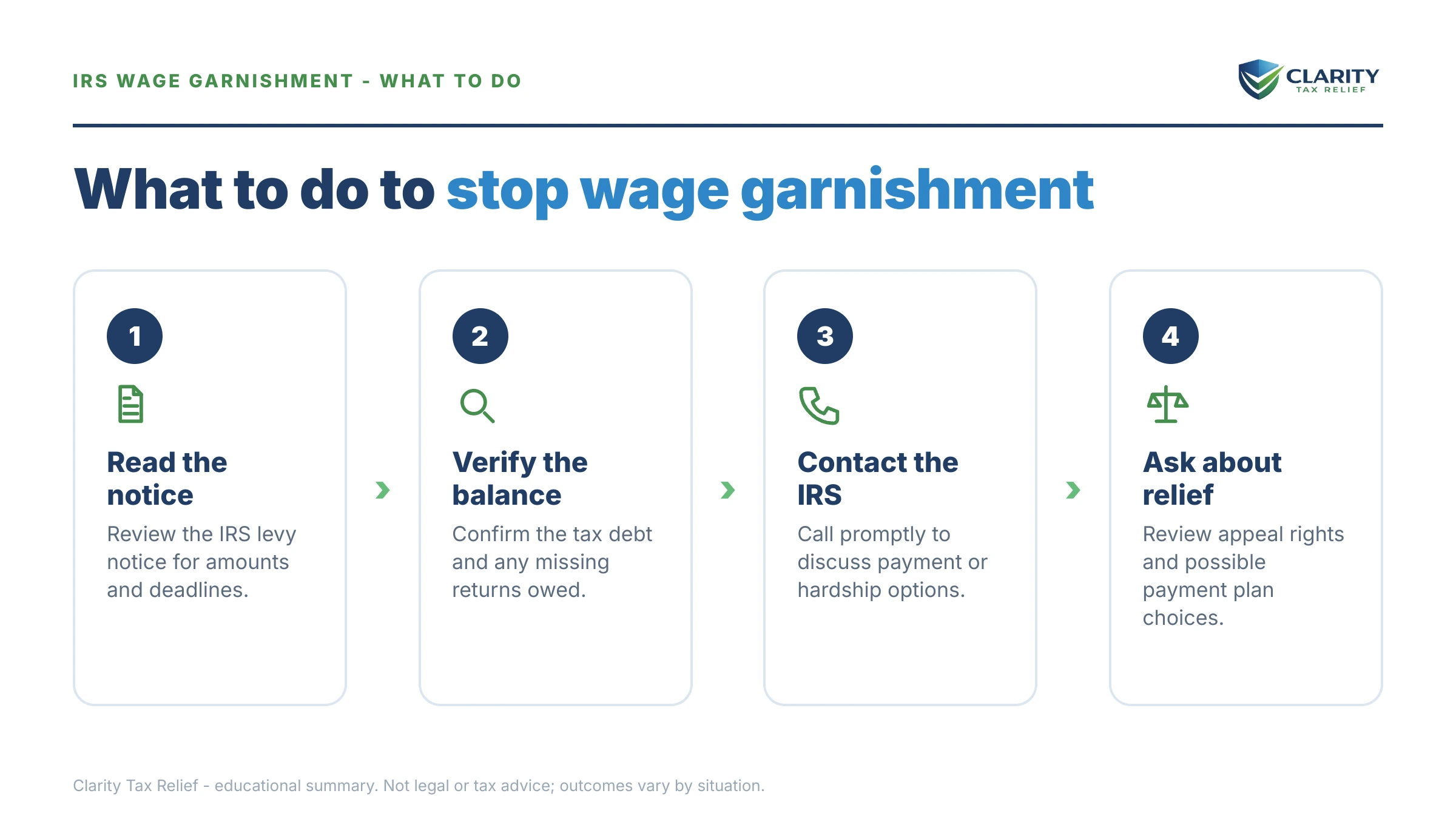
- Pull your levy paperwork. Ask payroll for a copy of Form 668-W and find your LT11 or Letter 1058 — the final notice date tells you whether the 30-day Collection Due Process window is still open.
- Return the Statement of Exemptions. Fill out and return the statement attached to Form 668-W immediately. If you don't, the IRS computes your exempt amount as married filing separately with zero dependents — the smallest possible protection.
- File any missing returns. The IRS will not approve a payment plan or hardship status while required returns are unfiled. Get every missing year submitted, even if you can't pay a dime of it.
- Call the IRS with a specific proposal. Use the phone number on the levy notice and propose a resolution: an installment agreement you can afford, or a hardship release backed by your income and living-expense numbers.
- Get the release faxed to payroll. Once an arrangement is approved, ask the agent to fax Form 668-D directly to your employer's payroll department, and have the fax number ready when you call.
- Confirm with payroll before your next check. Call payroll to verify they received the release and will apply it before the next pay run — a release sitting in a mailroom does not protect your check.
Most payment arrangements can be set up or managed directly through the IRS's payment plans and installment agreements page, and payments themselves go through IRS.gov/payments — never through anyone asking for gift cards or payment apps.
If your income isn't a standard W-2 paycheck
The continuous wage levy described above applies to employees. Other income types face different levy mechanics — and different defenses. Contractor pay is usually hit with a one-time levy on whatever a client owes on the day it's served; the details are in can irs garnish 1099 income. Federal benefits run through a separate program that takes up to 15% — see can the irs garnish social security.
And if the garnishment is from your state rather than the IRS, none of the federal rules on this page apply — California's Franchise Tax Board, for example, runs its own orders with its own math, covered in our FTB wage garnishment guide. Check the letterhead on the order before you fight the wrong agency.
When you can stop the garnishment yourself — and when help changes the outcome
Plenty of wage levies get released without professional help. If all your returns are filed, you agree with the balance, and it's $50,000 or less, you can often set up a streamlined plan online or by phone and request the release yourself the same day. A first-time levy with simple finances and an affordable monthly number is a genuinely DIY situation.
Experienced help changes outcomes in a narrower set of cases: a balance above $50,000, where every line of the Form 433-F is negotiable and directly sets your monthly payment; multiple unfiled years that must be reconstructed before the IRS will talk; hardship and OIC math, where how expenses are documented decides approval; and business or payroll tax debt, which follows entirely different rules. There's also the 2026 practical problem — reaching a human at a short-staffed IRS while your paycheck bleeds each cycle is itself a reason people bring in representation with a practitioner line.
If money is being taken and you can't get traction with the IRS at all, the Taxpayer Advocate Service — an independent organization within the IRS — can intervene in genuine hardship cases at no cost.
If your check is already short and rent is due, a free review of your levy paperwork takes minutes — call (888) 825-7779 or use the 2-minute form and an experienced tax professional will map your fastest release path.
Terms on your levy paperwork, decoded
- Levy vs. garnishment: the same thing here — "garnishment" is the everyday word; the IRS's legal term for seizing your wages is a levy.
- Form 668-W: the levy order your employer received, requiring them to send the IRS everything above your exempt amount each payday.
- Form 668-D: the release — the document that tells payroll to stop withholding. No release form, no stopped levy.
- Exempt amount: the only slice of your pay the levy can't touch, set by Publication 1494 tables based on filing status, pay frequency, and dependents.
- CDP hearing: your Collection Due Process appeal right — requested on Form 12153 within 30 days of the final notice, it generally pauses levy action while Appeals reviews.
- CSED: the Collection Statute Expiration Date — 10 years from assessment, after which the IRS can no longer collect, though appeals, offers, and bankruptcy pause the clock.
IRS wage garnishment questions, answered
How quickly can I stop an IRS wage garnishment?
A wage levy can be released the same day the IRS approves a resolution — the agent can fax Form 668-D directly to your employer's payroll department. The bottleneck is getting there: you must have all required returns filed and an arrangement in place. Whether your next paycheck is protected depends on where payroll is in its processing cycle, so ask the IRS to send the release by fax, not mail.
Does setting up a payment plan stop IRS wage garnishment?
Yes — once an installment agreement is accepted, the IRS will generally release the wage levy. The release is not always automatic, though: ask the agent specifically to issue the levy release and fax it to your employer. You must be current on required tax filings before the IRS will approve the agreement, so unfiled returns have to be handled first.
Can the IRS garnish my wages without warning?
Not legally for a standard wage levy — the IRS must first send a final notice of intent to levy (LT11 or Letter 1058) and wait 30 days. But the notice goes to your last known address, so if you moved without updating the IRS, the warning may never have reached you. Rare exceptions exist, such as jeopardy levies when the IRS believes collection is at immediate risk.
How much of my paycheck can the IRS take?
More than most people expect. Unlike private creditors, who are capped at a percentage of pay, the IRS takes everything above a fixed exempt amount set by Publication 1494 tables based on your filing status, pay frequency, and dependents. For a single filer with no dependents, the protected amount works out to roughly the standard deduction divided across your pay periods — often leaving only a few hundred dollars per week.
Will the IRS give back money it already garnished?
Usually no. Money withheld before the levy is released is applied to your balance and stays there. Returns of levied funds happen only in narrow situations — for example, a wrongful levy on someone who did not owe the tax, or a levy that violated the law or IRS procedures. Getting the release in place before your next payday is what actually protects your money.
Does quitting my job stop an IRS wage garnishment?
It stops that specific levy, because Form 668-W attaches to one employer — but it solves nothing. Your new employer's W-2 reporting tells the IRS where you work, and the automated system issues a new levy there. Meanwhile penalties and interest keep growing, and you have given up the income you need to fund an actual resolution.
Does bankruptcy stop an IRS wage garnishment?
Yes — filing bankruptcy triggers the automatic stay, which halts IRS levies immediately, including wage garnishment. But the stay is temporary protection, not a solution by itself: recent income taxes generally survive Chapter 7, and trust-fund payroll taxes are never dischargeable. Bankruptcy makes sense for tax debt only in specific fact patterns, so get advice before filing just to stop a levy.
Can the IRS garnish my spouse's wages for my tax debt?
Only if your spouse is also liable — which happens when the debt comes from a jointly filed return. If the debt is yours alone from a separate return, your spouse's wages are generally beyond the levy's reach, though community property states can complicate that. A jointly liable spouse can be levied even after divorce, regardless of what the divorce decree says.
Can the IRS garnish 1099 or self-employment income?
Yes, but differently. A levy on a 1099 payer is generally a one-time grab of whatever that client owes you on the day the levy is served — not the continuous paycheck-by-paycheck levy W-2 employees face. The IRS can also levy your business bank account or accounts receivable. The release paths are the same: an agreement, hardship status, or paying the balance.
Your next 24 hours
- Find two documents: get a copy of Form 668-W from payroll, and dig up your LT11 or Letter 1058 — the date on that final notice decides whether the 30-day CDP window is still open.
- Gather your numbers: last year's tax return, your two most recent pay stubs, and a one-page list of monthly rent, utilities, food, transportation, and medical costs. Every release path — plan, hardship, or hearing — runs on these figures.
- Get a free levy review: use the 2-minute form or call (888) 825-7779 before your next pay run. The levy repeats every payday until a release reaches payroll — the sooner a release path is in motion, the fewer checks it touches.
This guide is general information, not tax or legal advice for your specific situation. Eligibility for IRS programs depends on individual facts and circumstances; no outcome is guaranteed.