
IRS Levies & Bankruptcy
Does Bankruptcy Stop an IRS Levy? The Automatic Stay in 2026
The short answer: yes — bankruptcy stops an IRS levy. Filing any chapter triggers the automatic stay under 11 U.S.C. §362, which halts wage and bank levies the instant your petition is filed. But the stay is temporary, recent taxes usually survive the case, and repeat filers may get 30 days of protection or none.
So, does bankruptcy stop an IRS levy in practice, or just on paper? You're likely reading this because a chunk of a paycheck vanished, or your joint account froze, and a bankruptcy ad promised the taking stops the day you file. That part is true. Whether filing is the right move for the debt underneath — that's a different, more expensive question, and it's the one this guide actually answers.
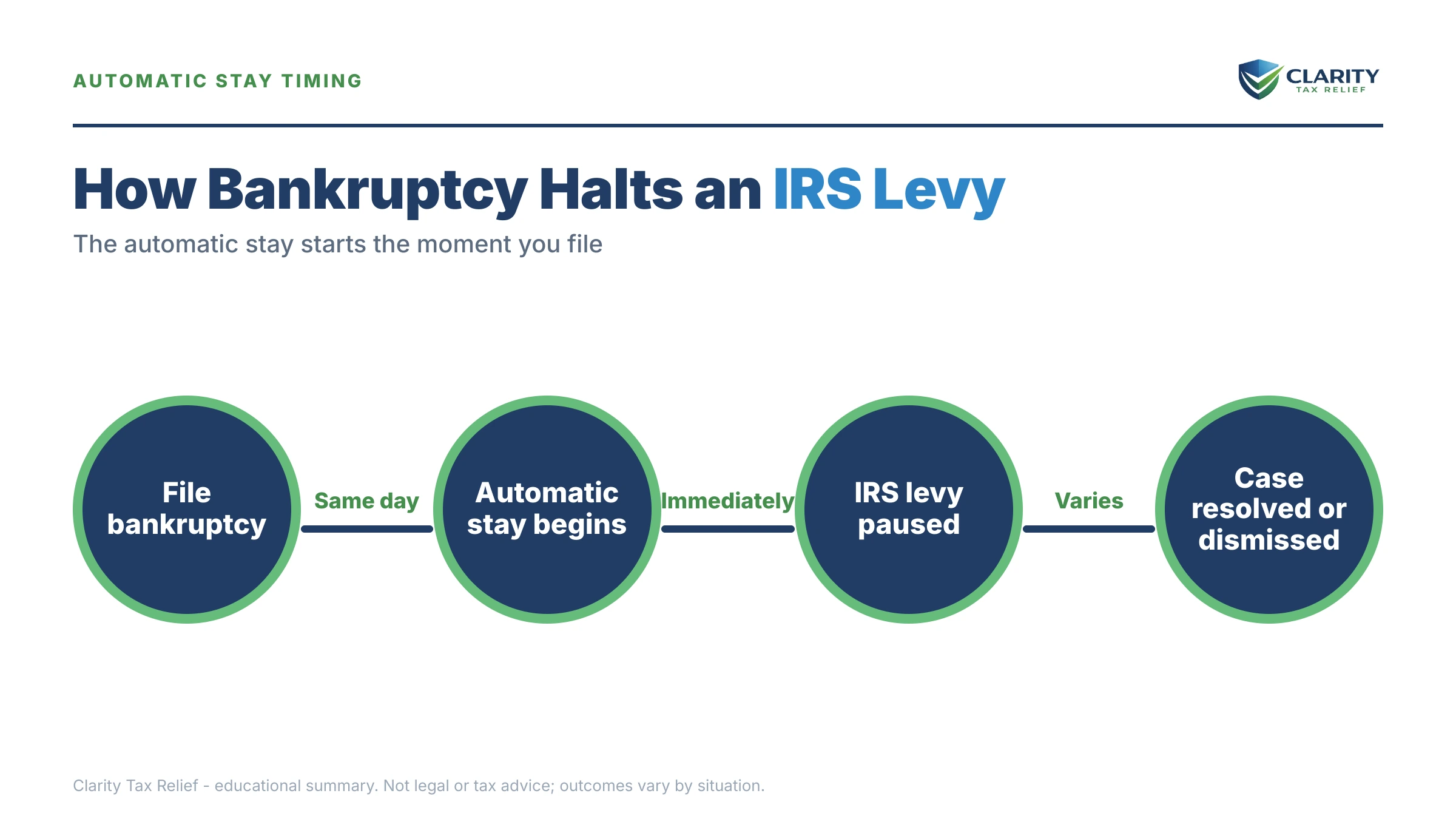
The pieces you need are the automatic stay's exact reach, the handful of things it doesn't stop, and what happens to the tax debt on the other side of the case. The image below shows exactly how the automatic stay slots into the IRS levy timeline — where collection stops, and where it can restart.
⏱ The clock that matters: if the IRS levied your bank account, the bank holds the funds for 21 days before sending them to the IRS. A bankruptcy petition filed inside that window generally keeps the money from leaving — see the IRS bank levy 21-day rule. Wage levies have no window: they repeat every payday until released.
Why filing bankruptcy stops an IRS levy
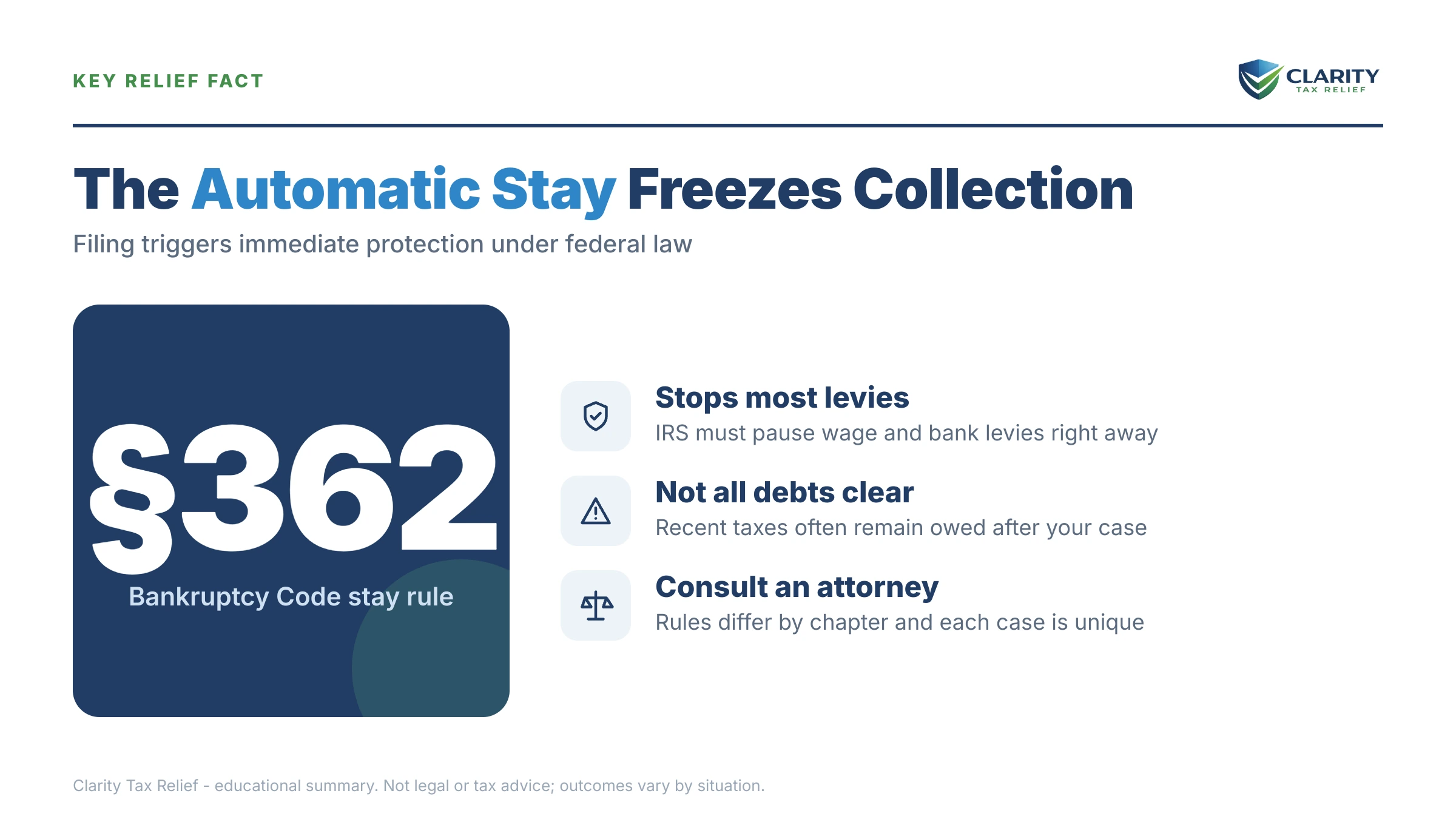
Filing a bankruptcy petition triggers the automatic stay under 11 U.S.C. §362 — a federal injunction that stops IRS levy action the moment the case is filed. No judge signs an order. No hearing is scheduled. The stay takes effect the instant your petition is stamped by the court clerk — before the IRS even knows the case exists.
The IRS gets no special exemption from the stay. It must release an active wage levy, stop issuing new levies, and stand down on seizures for as long as the stay is in force. Even a jeopardy levy — the IRS's fastest collection tool — cannot proceed against you once the stay applies.
What "stops" means depends on the levy type. A wage levy (Form 668-W) is continuous — your employer keeps sending money every payday until it's formally released, so getting your case number to payroll fast is what turns the legal stay into an actual paycheck. A bank levy (Form 668-A) is a one-time grab of what was in the account that day, sitting in the 21-day hold. An IRS levy on a 1099 contractor typically grabs only what a client owed you when the levy landed — the stay blocks the IRS from re-issuing it to your other clients.
One warning up front: bankruptcy is one of several ways to stop collection — the full menu is in our guide to how to stop IRS wage garnishment — and it is usually the most expensive one. Whether it's worth the cost depends almost entirely on whether the tax itself can be discharged, which we'll get to below.
What the automatic stay stops — and what it doesn't
The automatic stay stops levies, garnishments, new lien filings, and collection lawsuits — but it does not stop audits, tax assessments, or the debt itself from surviving. The Bankruptcy Code carves out specific things the IRS may keep doing while your case is open, and those carve-outs surprise a lot of filers.
| IRS action | Stopped by the stay? | What to know |
|---|---|---|
| Wage levy / garnishment | Yes | Continuous until released — get your case number to your employer's payroll the day you file. |
| Bank levy | Yes | Funds still inside the 21-day hold are generally protected; money already sent to the IRS usually isn't. |
| New levies (including jeopardy levies) | Yes | The IRS cannot issue fresh levies against you or your property while the stay is in force. |
| Filing a new Notice of Federal Tax Lien | Yes | But a lien recorded before you filed survives the case and stays on your property. |
| Audits and examinations | No | The IRS may open or continue an audit during your case. |
| Assessing tax / issuing a notice of deficiency | No | The IRS can still determine and assess what you owe — it just can't collect it yet. |
| Demanding unfiled tax returns | No | You must keep filing; unfiled returns can also sink your case and your discharge. |
| Refund offset | Often no | The IRS can typically apply a pre-filing tax refund against pre-filing tax debt even during the stay. |
One more exception matters to anyone who has filed before: if a prior case was dismissed within the past year, the new stay generally lasts only 30 days unless a court extends it — and after two dismissals in a year, no automatic stay arises at all. If that's you, the levy may not stop when you expect it to.
What happens after you file: petition to discharge, in order
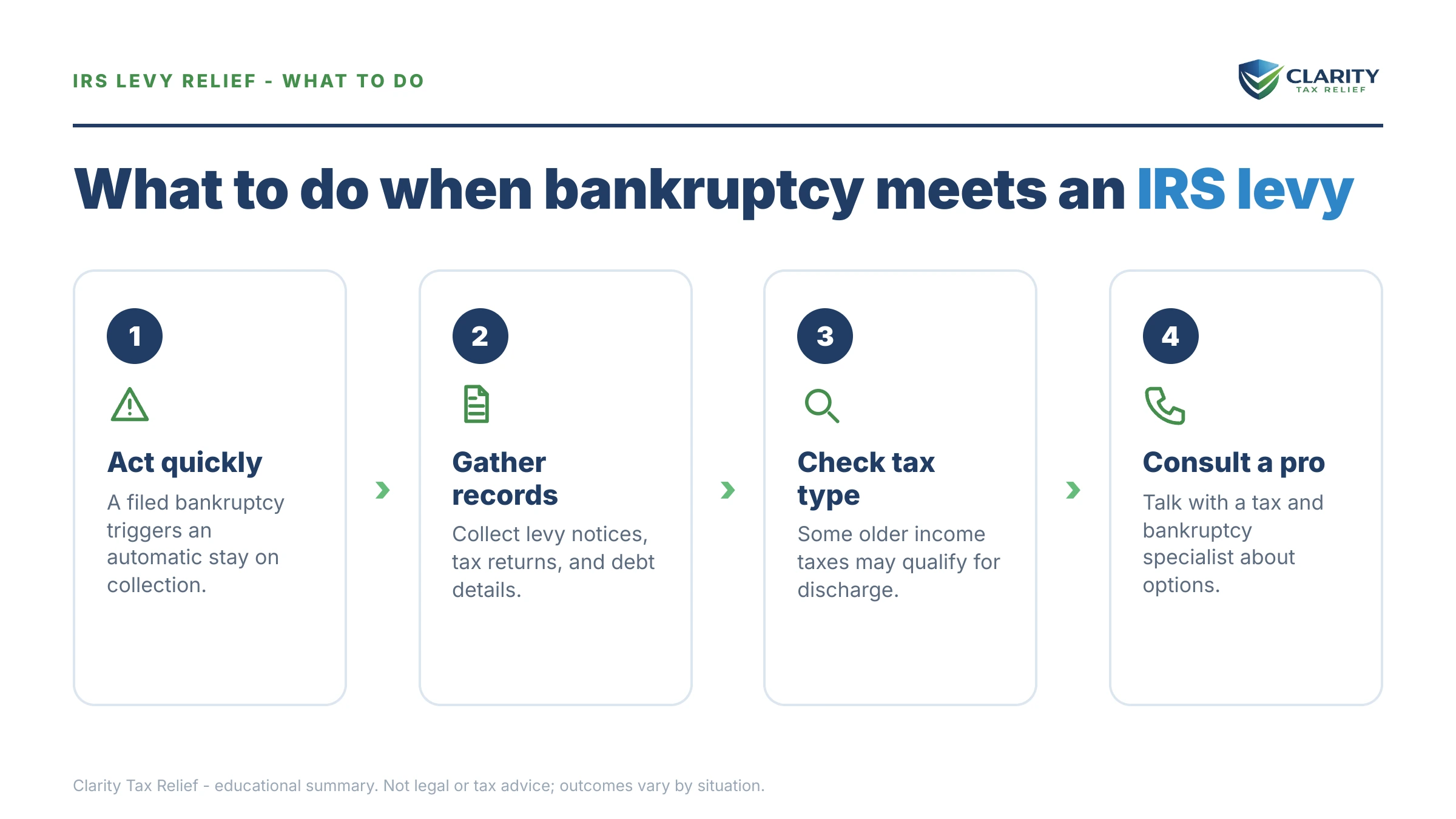
The automatic stay is a pause button, not an eraser — the sequence below is what actually happens to your levy and your tax debt from filing day forward.
- Petition filed. The stay is in force immediately. Legally, all IRS levy action against you must stop, even though nobody at the IRS has seen the case yet.
- The IRS is notified. The court's notice reaches the IRS's Centralized Insolvency Operation, which flags your account — a code 520 posts to your transcript — and issues the formal levy release to your employer or bank.
- The case runs. No new levies, no new liens, no collection calls. But audits, assessments, and return-filing demands continue, and refund offsets against pre-filing debt often still happen.
- Discharge or dismissal. The stay ends. Code 521 posts, releasing the freeze. Taxes that passed the discharge tests are wiped; everything else is still owed.
- Surviving tax returns to collection. The IRS picks up where it left off — and with more time, because the 10-year collection statute was paused for your entire case plus six months afterward. You can estimate your adjusted deadline with our CSED Calculator.
- New levies can follow. If you exit the case with a nondischarged balance and no payment arrangement, the notice-and-levy cycle restarts. This is the trap: people pay thousands to stop a levy for a debt that walks out of the courthouse with them.
Is the IRS levying you right now?
Before you pay a bankruptcy retainer, find out whether the same levy can be released for far less — and whether your tax years would even discharge. If a bank levy is inside its 21-day hold, moving today matters. A free, confidential review with an experienced tax professional takes minutes.
Bankruptcy vs. every other way to stop an IRS levy
Bankruptcy is the fastest legal stop to an IRS levy — and almost always the most expensive one relative to what it fixes. Every option below releases or blocks the same levy; they differ in cost, speed, and what happens to the underlying debt.
| Option | Typical upfront cost | How fast the levy stops | The catch |
|---|---|---|---|
| Chapter 7 bankruptcy | Roughly $340 court filing fee plus attorney fees, often $1,200–$2,500 | Instantly at filing (automatic stay) | Recent income taxes usually survive; stay ends at discharge or dismissal. |
| Chapter 13 bankruptcy | Roughly $315 filing fee; attorney fees often paid through the plan | Instantly at filing | 3–5 years of plan payments; a dismissed case revives full collection. |
| Installment agreement | $0 for short-term plans (up to 180 days); modest setup fee for monthly plans, reduced or waived for low income | Typically within days of acceptance — the IRS releases the levy | Interest and the monthly late-payment penalty keep accruing on the balance. |
| Hardship release / Currently Not Collectible | $0 | Fast when hardship is documented — the law requires release of a levy causing economic hardship | The debt remains and grows; the IRS re-reviews your finances later. See how to get an IRS levy released. |
| CDP hearing (Form 12153) | $0 | Filed within 30 days of an LT11/Letter 1058, it generally pauses levy action while the appeal is heard | Only available inside that 30-day window; using it also pauses the 10-year collection clock. |
| Offer in Compromise | $205 application fee plus 20% down on lump-sum offers (both waived with low-income certification) | Blocks new levy action while a processable offer is pending; existing levies aren't automatically released | Means-tested — the IRS accepted roughly 1 in 5 offers in FY2024. Compare bankruptcy or offer in compromise before choosing either. |
The single most useful rule in this table: a levy that creates genuine economic hardship must be released under IRC §6343 — no bankruptcy required. If the levy leaves you unable to cover basic living expenses, the hardship path in our guide to a levy causing hardship is free and often faster than a petition.
Say you owe $7,400: the bankruptcy math for a married couple
Here's a clearly hypothetical example. Say you and your spouse filed jointly, owe $7,400 for 2024, and the IRS just started levying the higher earner's paycheck.
The bankruptcy route: a Chapter 7 costs roughly $340 in court fees plus attorney fees — call it $1,500. That's about $1,840, roughly 25% of the whole debt, spent before the IRS sees a dime. And because a 2024 tax fails the 3-year rule, the $7,400 almost certainly survives the case. You'd buy a temporary levy pause, keep the entire debt, and hand the IRS a longer collection window because the case tolled the 10-year clock plus six months.
The payment-plan route: at $7,400 — under the $10,000 threshold — a guaranteed installment agreement is available if your returns are filed and you can pay within three years: $7,400 ÷ 36 ≈ $206/month. Stretch it to a standard 72-month online plan and it's roughly $103/month before accruing interest and penalties. Either way, the IRS releases the wage levy once the agreement is in place, and every dollar goes toward the debt instead of legal fees.
When the math flips: suppose that same couple also carries $40,000 in credit-card and medical debt. Now Chapter 7 can wipe the $40,000, the stay stops the IRS levy immediately, and the freed-up cash flow pays off the surviving $7,400 easily. Bankruptcy earns its fee when the tax levy is the symptom of a bigger debt picture — almost never when a small tax bill is the whole problem.
How to stop an IRS levy with bankruptcy, step by step
- Identify the levy type and its clock. A bank levy has a 21-day hold before the funds leave; a wage levy repeats every payday until released. The type decides how fast you have to move.
- Get a discharge analysis before you file. Run every tax year you owe through the 3-year, 2-year, and 240-day tests with an experienced tax professional so you know whether the debt survives the case.
- Compare the cheaper levy releases first. A payment plan or hardship release often stops the same levy with no court costs — check the options table above before paying a bankruptcy retainer.
- File the petition and get your case number. The automatic stay takes effect the moment the petition is stamped by the court, not when the IRS finds out about it.
- Notify the IRS and the levy source the same day. Send the case number, filing date, and court name to the IRS's insolvency unit, plus your employer's payroll department or your bank's levy department.
- Plan for the day the stay ends. Any tax that survives the case goes back into collection at discharge or dismissal — line up an installment agreement or other resolution before that happens.
When you can handle this yourself — and when help changes the outcome
You don't need a professional — or a bankruptcy — to stop most small-balance levies. If you owe under $10,000, your returns are filed, and you can manage a monthly payment, setting up a plan online usually gets the levy released within days, no court and no fees beyond setup. That's the entire fix for many couples in the $7,400 scenario above.
Experienced help changes the outcome in specific situations: a bank levy inside its 21-day hold where every day counts; multiple tax years that need discharge-test analysis before you commit to a filing; business or payroll debt, because trust-fund taxes are priority tax claims that never discharge; a tax lien that will survive bankruptcy against your home; or a prior dismissed case that weakens your stay. Also know the division of labor: only a bankruptcy attorney can file your petition, but the questions of whether your taxes discharge and what to do with the surviving balance are tax-resolution questions — and getting them answered first is what keeps a $340 filing fee from becoming a $2,000 mistake. The full timing rules are in our guide to discharging taxes in bankruptcy.
Terms in a tax bankruptcy, decoded
- Automatic stay — the federal injunction under 11 U.S.C. §362 that freezes most collection, including IRS levies, the moment a bankruptcy petition is filed.
- Levy vs. lien — a levy takes your money or property; a lien is a recorded claim against it. The stay stops levies; a pre-existing lien survives the case.
- Discharge — the court order that legally erases qualifying debts; income taxes qualify only if they pass the 3-year, 2-year, and 240-day timing tests.
- Priority tax claim — a tax debt the Bankruptcy Code puts at the front of the line and generally refuses to discharge, such as recent income tax and trust-fund payroll tax.
- Centralized Insolvency Operation — the IRS unit that processes bankruptcy notices, freezes accounts, and issues levy releases once a case is filed.
- CSED — the Collection Statute Expiration Date, the end of the IRS's 10-year window to collect; a bankruptcy pauses it for the whole case plus six months.
For primary sources, see the IRS's own overview at Declaring bankruptcy (IRS.gov), payment-plan details at IRS.gov/payments, and bankruptcy-court basics at uscourts.gov. If a levy is causing hardship the IRS won't acknowledge, the Taxpayer Advocate Service can intervene for free.
Does bankruptcy stop an IRS levy? More questions, answered
How fast does bankruptcy stop an IRS levy?
The automatic stay takes effect the moment your petition is filed with the bankruptcy court — legally, levy action must stop that instant. Practically, the release takes a few days to reach your employer or bank, which is why you should send your case number, filing date, and court to the payroll or bank levy department the same day you file. Don't wait for the IRS to do it for you.
Can I get back money the IRS levied before I filed?
Sometimes. Bank levy funds sit on hold for 21 days before your bank sends them to the IRS — if your petition is filed inside that window, the funds generally never leave. Money already remitted to the IRS before your filing date is much harder to recover; a bankruptcy attorney can sometimes seek its return, but there is no automatic refund. Wages already withheld from pre-filing paychecks are usually gone.
Does Chapter 13 stop an IRS levy?
Yes. The automatic stay applies in every chapter, so a Chapter 13 filing stops wage and bank levies just as fast as a Chapter 7. The difference is what happens next: Chapter 13 lets you repay priority tax debt through a three-to-five-year court-supervised plan while the stay protects you, which is often the better fit when the tax is too new to discharge.
Does bankruptcy wipe out the IRS debt itself?
Only sometimes. Income taxes can be discharged only if they pass the 3-year, 2-year, and 240-day timing tests, the returns were actually filed, and there was no fraud. Recent tax years, trust-fund payroll taxes, and most penalties tied to nondischargeable tax survive the case — which means the levy can come back once the stay ends.
Can the IRS levy me again after my bankruptcy ends?
Yes, if the tax survived the case. Once you receive a discharge or the case is dismissed, the stay lifts and any nondischargeable balance goes back into active collection — and the 10-year collection statute was paused during your case plus six months afterward, so the IRS actually has more time, not less. Set up a payment arrangement for surviving tax before the case closes.
Does bankruptcy remove an IRS tax lien?
No. A Notice of Federal Tax Lien recorded before your filing date survives bankruptcy and stays attached to property you owned when the case began — even if your personal liability for the tax is discharged. That means the IRS can still collect from equity in your home if you later sell, though it can no longer levy your wages or accounts for a discharged debt.
What if a previous bankruptcy case was dismissed within the last year?
Repeat filings get a weaker stay. If one case was dismissed within the year before your new filing, the automatic stay generally expires after 30 days unless the court extends it; if two or more were dismissed, no stay arises at all until the court imposes one. The IRS can keep levying in that gap, so tell your attorney about every prior case before you file.
Your next 24 hours
- Find the levy paperwork. Look for the form number: 668-W means a continuous wage levy; 668-A means a one-time bank levy — and if it's a bank levy, count the days since it hit, because the 21-day hold is your window to act.
- Gather your picture. Your last two filed returns, every tax year you owe with amounts, recent pay stubs, and a rough list of your other debts — that's everything needed to run the discharge tests and compare options.
- Get the free case review. Before committing to a bankruptcy retainer, let an experienced tax professional check whether a cheaper release — payment plan, hardship, or appeal — stops the same levy while your balance keeps accruing interest. Use the 2-minute form at claritytaxrelief.com/#consult or call (888) 825-7779.
This guide is general information, not tax or legal advice for your specific situation. Eligibility for IRS programs depends on individual facts and circumstances; no outcome is guaranteed.