
Tax Debt & Bankruptcy
Discharge Taxes in Bankruptcy: The 3-Year, 2-Year, and 240-Day Rules (2026)
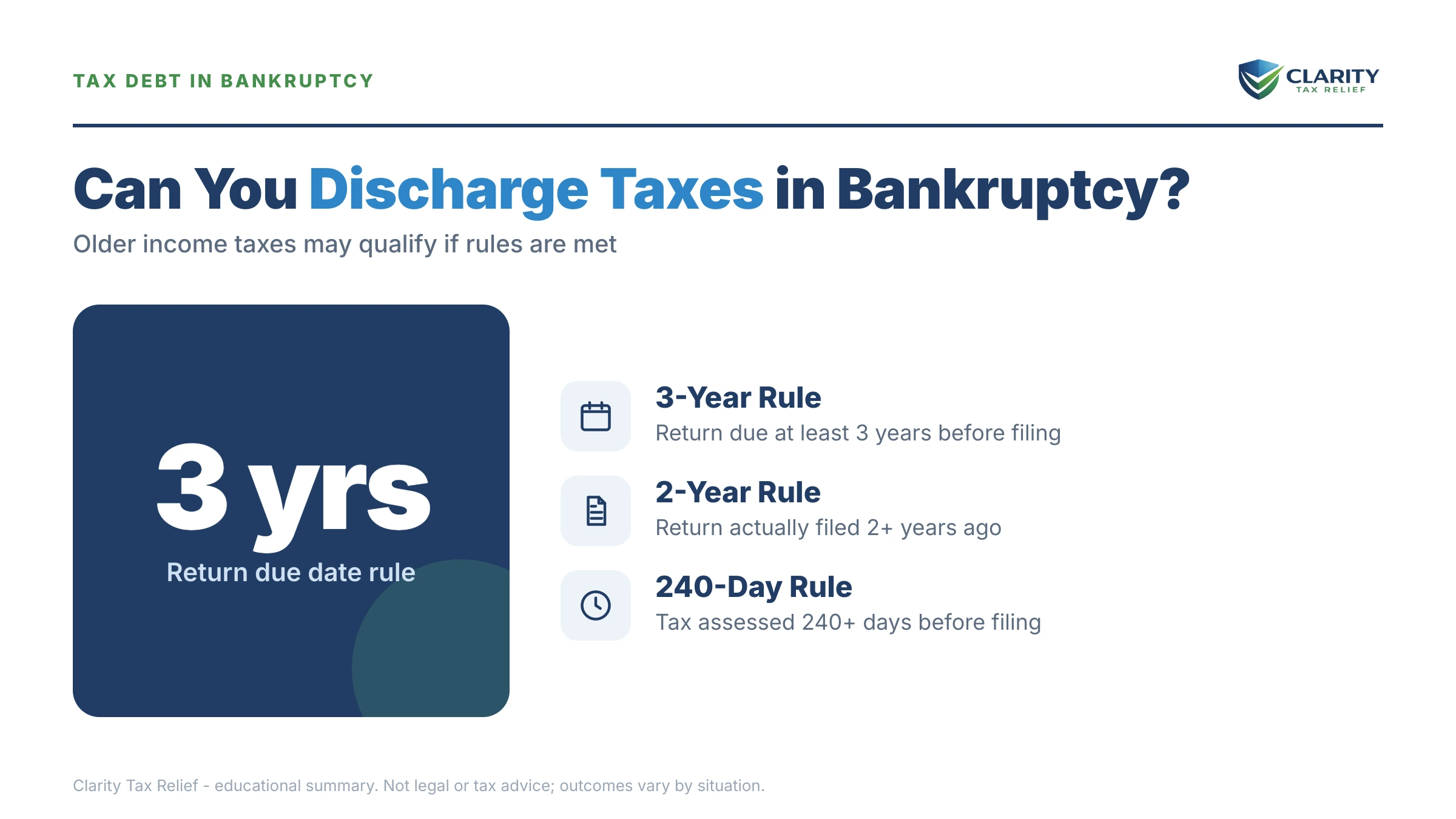
The short answer: yes — you can discharge income taxes in bankruptcy, but only if they pass three timing tests: the return was due more than 3 years ago, you filed it at least 2 years ago, and the IRS assessed the tax at least 240 days ago. Payroll and trust-fund taxes never qualify.
You're weighing bankruptcy for the credit cards, and an old IRS balance is sitting in the pile — and someone told you taxes can't be touched. That's a myth. Whether you can discharge taxes in bankruptcy comes down to three dates, and every one of them is already printed in your IRS file.
Your entire discharge case is built from your account transcript — the image below shows exactly what that transcript looks like and where the assessment entry the 240-day rule runs from appears.
⏱ Your deadline: there is no IRS notice clock here — the calendar itself is the gatekeeper. File your bankruptcy petition even one day before a timing test is satisfied and that year's tax survives the discharge in full. Meanwhile, interest and the monthly late-payment penalty keep accruing on everything you owe.
The 3-year, 2-year, and 240-day rules to discharge taxes in bankruptcy
Federal income tax is dischargeable in bankruptcy only when it clears three separate timing tests, all measured against your petition date. The Bankruptcy Code draws the line at 11 U.S.C. §507(a)(8) and §523(a): old, honestly reported income taxes can be discharged; recent, unfiled, or fraudulent ones cannot.
| Test | What must be true | When the clock starts | What pauses the clock |
|---|---|---|---|
| 3-year rule | The return was due more than 3 years before your petition date | The return's due date — including any extension you requested | A prior bankruptcy (plus extra buffer days added by statute) |
| 2-year rule | You actually filed the return at least 2 years before your petition | The date the IRS received your return | Nothing restarts it — but an IRS substitute for return never starts it |
| 240-day rule | The IRS assessed the tax at least 240 days before your petition | The assessment date shown on your account transcript | A pending offer in compromise or a prior bankruptcy, each plus buffer days |
The 3-year rule: when was the return due?
Count 3 years from the return's due date, not the tax year. A 2021 Form 1040 due April 18, 2022 clears this test on April 18, 2025. An extension moves the start date — extend to October and the whole 3-year window shifts six months later; other events — a prior bankruptcy (plus 90 days), a collection due process hearing request, or for the 240-day rule a pending offer in compromise (plus 30 days) — also pause these clocks, so have a professional compute your exact dates before filing. Why recent years always survive is covered in our guide to whether recent taxes are dischargeable.
The 2-year rule: when did you actually file?
The return must have been on file with the IRS for at least 2 years before your petition — which means unfiled years can never be discharged, no matter how old. Our guide to unfiled returns and bankruptcy covers the filing requirement in depth. One trap dominates this test: if the IRS filed a substitute return for you, that SFR does not count as your return — and several appeals courts hold that a return you file late, after the IRS has already assessed the year, may never qualify in their circuits at all.
The 240-day rule: when was the tax assessed?
Assessment is the IRS's internal act of recording the debt, and its date appears on your account transcript — the image below shows where to look on a real one. For a filed return, assessment usually happens within weeks of processing. But an audit or CP2000 adjustment creates a new assessment with its own fresh 240-day clock, which is how a five-year-old tax year can still flunk this test.
Two more conditions with no clock at all
Beyond the dates, the return must not be fraudulent and you must not have willfully tried to evade the tax. Aggressive but honest mistakes are fine; hiding income or assets is not. There's no waiting period that cures fraud — those debts simply survive.
Watch the tolling events, too. A prior bankruptcy, a pending offer in compromise, or a collection due process appeal freezes the relevant clocks while it's pending — and the statute tacks extra buffer days on top when it ends. Dates that look clean on a calendar can fail once tolling is added.
Taxes bankruptcy never discharges — no matter the dates
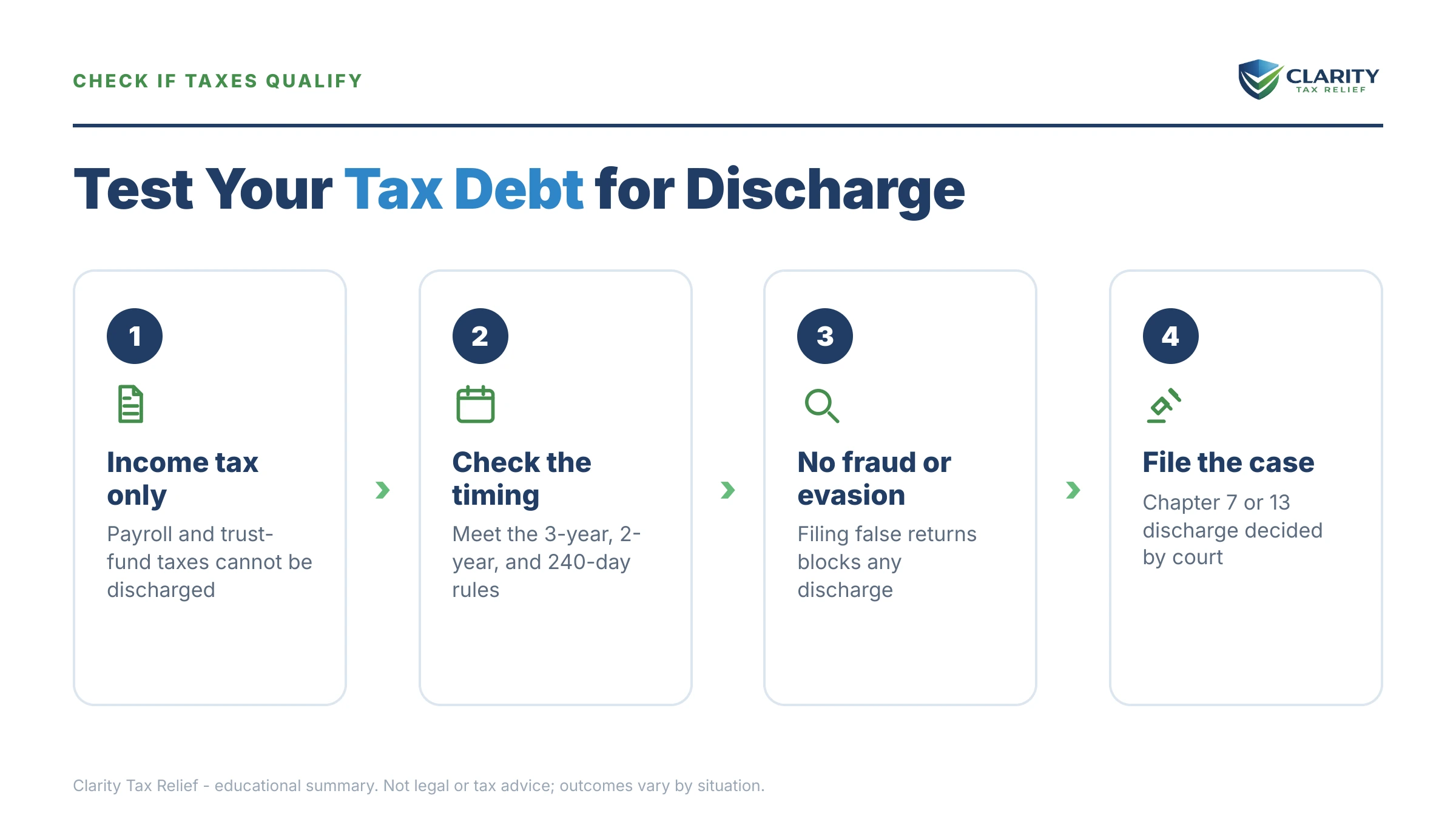
Payroll withholding, trust-fund penalties, and fraud-year taxes survive every bankruptcy chapter, at any age. These aren't timing problems; they're categorical exclusions written into the Bankruptcy Code as priority tax claims and nondischargeable debts.
| Type of tax debt | Dischargeable? | Why |
|---|---|---|
| Old income tax passing all three timing tests | Yes | Non-priority, honestly reported, aged past every statutory window |
| Income tax from the last 3 years | No | Priority claim — must be paid, in Chapter 13 in full through the plan |
| Payroll withholding / Trust Fund Recovery Penalty | Never | Money withheld from employees is held in trust for the government |
| Taxes from a fraudulent return or willful evasion | Never | Categorically excluded from discharge — no aging period applies |
| Unfiled years / IRS substitute-for-return years | Generally no | The 2-year rule requires a return you actually filed |
| Penalties and interest on dischargeable tax | Generally yes | They usually follow the fate of the underlying tax |
| A federal tax lien recorded before filing | Lien survives | Personal liability ends, but the lien stays on pre-petition property |
The trust-fund exclusion is the one that blindsides business owners. If you're behind on 941 back taxes, or the IRS has decided you're personally liable for payroll taxes as an officer or check-signer, bankruptcy will not touch the trust-fund portion of that debt — plan around it, don't count on it.
One quiet upside worth knowing: debt discharged in bankruptcy is excluded from taxable income by law. If a creditor sends you a 1099-C for cancelled debt after your case, the bankruptcy exclusion means it generally isn't income — unlike debt settled outside of bankruptcy.
What happens if you file at the wrong time
A mistimed petition doesn't just fail to discharge the tax — it can leave you with a longer IRS collection window than if you'd never filed. Here's the sequence when the dates aren't met:
- The tax is classified as a priority claim. Because a timing test failed, the year is excluded from discharge before your case even ends.
- Your Chapter 7 discharge enters — without the tax. Credit cards and medical bills go, but the IRS balance emerges untouched, plus the interest that accrued during the case.
- The automatic stay lifts. The protection that stopped garnishments and levies ends the day the case closes, and IRS automated collection resumes exactly where it left off.
- The IRS gets extra collection time. The 10-year collection statute was paused during your case plus six months afterward — your bankruptcy literally extended the IRS's window.
- Any recorded lien still attaches. Even for years that did discharge, a pre-petition lien remains on property you owned when you filed.
And you can't simply re-file next month: bankruptcy carries its own limits on repeat filings. This is a one-shot timing decision.
Thinking about bankruptcy with IRS debt in the pile?
Bankruptcy timing is a decision you only get to make once — and the dates that decide it are sitting in your IRS transcripts right now. Get a free transcript-based review of which years qualify before any petition is filed. Interest is accruing either way.
Chapter 7 vs. Chapter 13 for tax debt
Chapter 7 can erase qualifying taxes in a matter of months; Chapter 13 restructures everything into a 3-to-5-year plan. In Chapter 7, taxes that pass the tests are discharged and taxes that don't survive in full. In Chapter 13, the nondischargeable priority taxes must be paid 100% through the plan — but without ongoing late-payment penalties — while older non-priority taxes may be paid only partially alongside your other unsecured debts.
Chapter 13 is often the better tool when your taxes are too recent to discharge, because it forces the IRS into a court-supervised repayment structure and holds the stay in place for years. The full decision framework lives in our guide to Chapter 7 vs 13 tax debt.
Bankruptcy vs. your other options for the same debt
Bankruptcy is one of five realistic paths for a tax debt, and it's rarely the first one to check. If the IRS balance is your only problem debt, the IRS's own programs usually resolve it with less collateral damage — the full playbook is in our guide to how to settle tax debt yourself.
| Option | Basic eligibility | What it does to the tax debt |
|---|---|---|
| Chapter 7 discharge | Pass the bankruptcy means test; taxes must clear all three timing tests | Qualifying taxes legally cancelled; nonqualifying years survive; liens remain |
| Chapter 13 plan | Regular income; debt within statutory limits | Priority taxes paid in full over 3–5 years; older non-priority taxes may be paid partially |
| Installment agreement | Balances ≤ $50,000 can be set up online, up to 72 months | Full balance paid over time; interest and penalties continue accruing |
| Offer in Compromise | Means-tested; $205 fee (waived with low-income certification); roughly 1 in 5 accepted in FY2024, per IRS data | Debt resolved for your reasonable collection potential if accepted |
| Currently Not Collectible | Documented financial hardship | Collection paused; debt remains and interest accrues while the CSED runs |
| Waiting out the collection statute | Debt near its 10-year CSED with no major tolling events | IRS collection authority expires — but bankruptcy itself pauses this clock |
Notice the interaction in that last row: filing bankruptcy pauses the IRS's 10-year collection clock. If your debt is already eight or nine years old, discharge may be solving a problem the calendar was about to solve for free — you can estimate your remaining collection window with our CSED Calculator. And if the choice is genuinely between the two big levers, our comparison of bankruptcy or offer in compromise walks through which fits which finances.
A worked example: $11,300 and a Chapter 7 petition
Here's a hypothetical to make the arithmetic concrete. Say you're a single W-2 employee who owes $11,300 from your 2021 return — tax you reported honestly but couldn't pay, now grown with penalties and interest.
- Return due: April 18, 2022 (no extension requested). 3-year test satisfied April 18, 2025. ✓
- Return filed late: June 10, 2023. 2-year test satisfied June 10, 2025. ✓
- Tax assessed: July 24, 2023, per the account transcript. 240 days later is March 20, 2024. ✓
- No fraud, return self-filed before any IRS substitute return. ✓
A Chapter 7 petition filed September 1, 2026 clears every test — the $11,300, plus the penalties and interest riding on it, is a candidate for full discharge.
Now change one fact. Say the IRS audited that 2021 return and assessed an extra $3,000 on March 5, 2026. That new assessment's 240-day clock doesn't run out until October 31, 2026. File September 1 and the original $11,300 discharges but the $3,000 survives; wait nine more weeks and both can qualify. That is the entire game: the dates decide the dollars. And if that same $11,300 came from your 2024 return instead? It fails the 3-year test outright, rides through the case as a priority claim, and survives.
How to check whether your taxes qualify for discharge, step by step
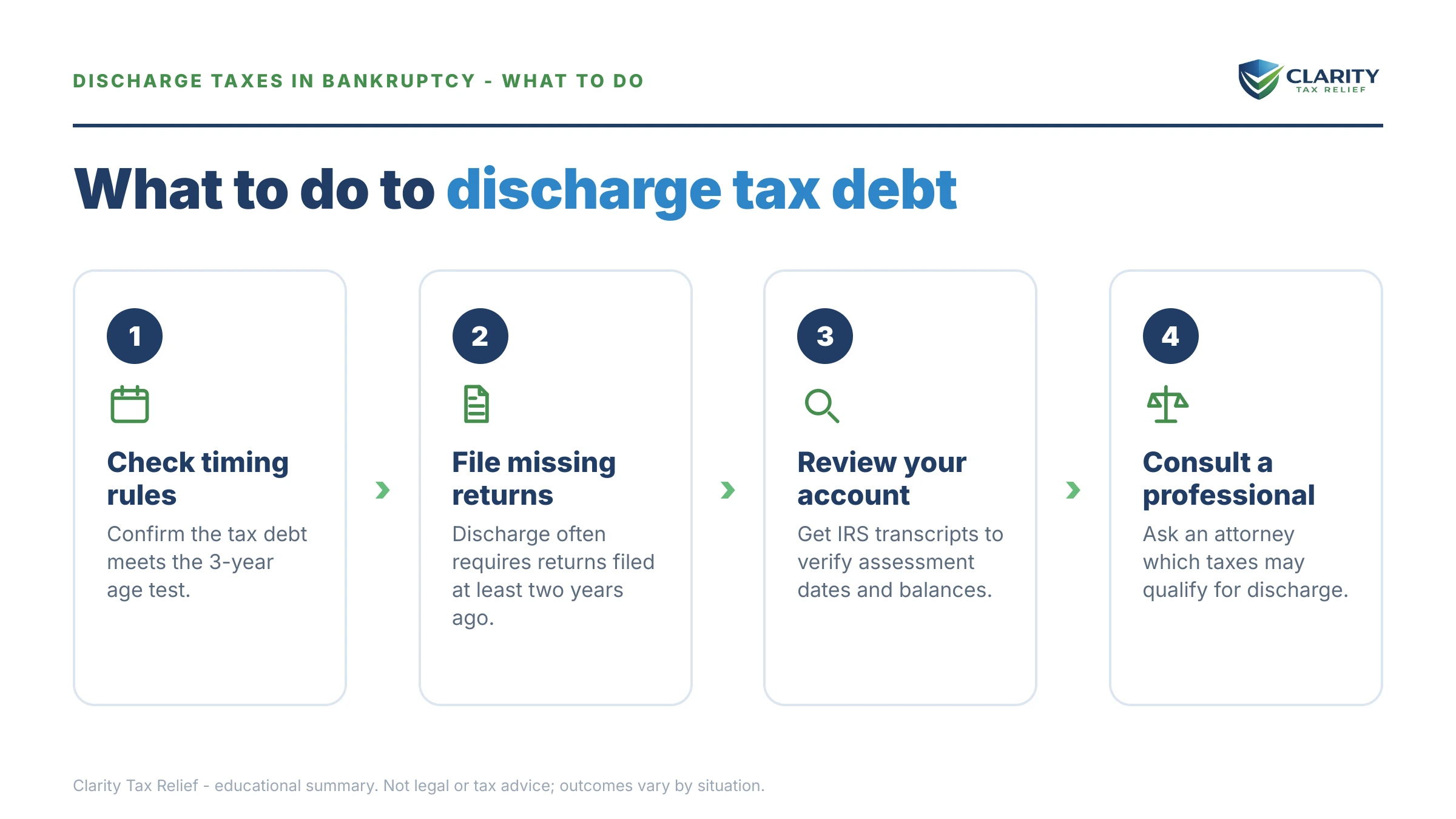
- Pull your IRS account transcript for every year you owe. Log in at IRS.gov and download the account transcript for each balance-due year — it shows the assessment dates the 240-day test runs from.
- Confirm each return's due date and actual filing date. Note whether you requested an extension (it moves the 3-year clock) and the date each return was actually received, which starts the 2-year clock.
- Map all three test dates for each year, then add tolling time. Mark the latest date each test is satisfied, then add any pauses — a prior bankruptcy, a pending offer in compromise, or a collection due process appeal stops these clocks and adds buffer days.
- Rule out the never-dischargeable categories. Screen each year for payroll or trust-fund tax, fraud or evasion issues, unfiled returns, and IRS substitute-for-return assessments — those debts survive regardless of dates.
- Compare bankruptcy against IRS-only resolutions. Weigh Chapter 7 or 13 against a payment plan, an offer in compromise, hardship status, or the remaining collection statute before committing to a bankruptcy filing.
- Have a bankruptcy attorney and an experienced tax professional verify the dates. Filing even one day early makes a year's tax survive — get both the tax-transcript analysis and the bankruptcy-law analysis confirmed before your petition is filed.
When you can handle this yourself — and when help changes the outcome
If your tax debt is recent, modest, and your only real debt, skip bankruptcy entirely: a balance you can pay within 180 days costs nothing to set up, and an online payment plan handles most balances under $50,000 without anyone's help. Bankruptcy's credit impact and cost aren't worth it for a tax problem the IRS's own programs solve.
Get experienced help before filing when any of these is true: a levy or garnishment is already in motion (the automatic stay stops it — see does bankruptcy stop IRS levy — but timing still controls what survives), you have unfiled years or SFR assessments, the debt includes business or payroll tax, a lien is already recorded, or the test dates land within months of your planned petition. In those cases the difference between a good outcome and a wasted filing is measured in weeks on a calendar — and someone has to read the transcripts correctly. A bankruptcy attorney files the case; a tax professional makes sure the dates are right before they do.
Terms in the discharge rules, decoded
- Discharge — the court order that permanently ends your personal legal obligation to pay a debt.
- Petition date — the day your bankruptcy case is filed; every timing test is measured backward from it.
- Priority claim — a tax debt the Bankruptcy Code puts at the front of the line and excludes from discharge.
- Assessment — the IRS's formal recording of the debt on its books; its date appears on your account transcript and starts the 240-day clock.
- Substitute for return (SFR) — a return the IRS prepares for a non-filer; it does not count as your filed return for the 2-year rule.
- Automatic stay — the immediate freeze on most collection activity, including IRS levies, that begins the moment you file.
Discharging tax debt: your questions, answered
Can IRS debt be discharged in Chapter 7 bankruptcy?
Yes — income tax debt can be discharged in Chapter 7 if it passes all three timing tests: the return was due more than 3 years before your petition, you actually filed it at least 2 years before, and the IRS assessed the tax at least 240 days before. Payroll taxes, trust-fund penalties, and fraud-related taxes never qualify. If even one test fails for a given year, that year's debt survives the bankruptcy intact.
What is the 3-year rule for discharging taxes?
The return's due date — including any extension you requested — must fall more than 3 years before your bankruptcy petition date. A 2022 return due April 18, 2023 clears the test on April 18, 2026, but an extension to October 2023 pushes that to October 2026. A prior bankruptcy and certain IRS proceedings pause this clock, so verify your dates before you file.
Does an IRS substitute for return count as filing for the 2-year rule?
No. A substitute for return the IRS prepares without your signature does not count as a filed return for discharge purposes. Worse, several federal appeals courts have held that a return you file late — after the IRS has already assessed the year — may never qualify for discharge at all in their circuits. Where your case would be filed can change the answer, which is why late-filed years need professional review.
Are penalties and interest discharged along with the tax?
Generally, penalties and interest follow the underlying tax. If the tax itself passes the discharge tests, the accrued interest and most penalties tied to it are usually discharged too — often a meaningful chunk, since penalties and interest can add roughly 25% or more to an old balance. If the tax survives as a priority claim, its interest and penalties survive with it.
Does bankruptcy remove a federal tax lien?
No. Discharge ends your personal liability, but a Notice of Federal Tax Lien recorded before your petition survives and stays attached to property you owned when you filed — including home equity. The IRS can no longer garnish your wages for a discharged year, but it can still collect from that lien-encumbered property. Lien release or withdrawal is a separate process after the case.
Can state income taxes be discharged in bankruptcy?
Yes — bankruptcy is federal law, and the same 3-year, 2-year, and 240-day framework applies to state income tax claims. Trust-fund-style state debts, like sales tax you collected from customers, are treated like payroll withholding and generally survive. Because some states collect far longer than the IRS — California's FTB has a 20-year collection statute — discharge can be especially valuable for old state balances.
Does filing bankruptcy stop IRS garnishments and levies?
Yes — the automatic stay stops most IRS collection the moment your petition is filed, including wage garnishments and bank levies. But the stay is temporary protection, not forgiveness: the IRS's 10-year collection clock pauses during your case plus six months afterward, so any tax that isn't discharged comes back with more collection time remaining, not less.
Is bankruptcy or an offer in compromise better for tax debt?
It depends on what else you owe and whether your taxes pass the timing tests. An offer in compromise resolves only your tax debt, costs a $205 application fee, is means-tested, and per IRS data the IRS accepted roughly 1 in 5 offers in FY2024. Chapter 7 can resolve qualifying taxes plus credit cards and medical bills in one case, but hits your credit and requires passing the means test. If your taxes fail the timing tests, bankruptcy won't touch them and IRS-side options win by default.
Your next 24 hours
- Pull one document: log into your IRS online account and download the account transcript for your oldest balance-due year. Find the assessment date — that single entry starts your 240-day analysis.
- Gather three things: copies of the returns for every year you owe, any extension confirmations, and proof of when each return was filed (e-file acceptance or mailing records).
- Get the dates read before anyone files anything: a free case review at the 2-minute form or (888) 825-7779 maps every year against the three tests — while penalties and interest keep compounding on the balance either way.
For the IRS's own overview of how bankruptcy affects tax debt, see Declaring bankruptcy at IRS.gov. Payment-plan details for taxes that won't discharge are at the official IRS payment plans page, and if IRS delays are compounding your situation, the Taxpayer Advocate Service is an independent resource within the IRS.
This guide is general information, not tax or legal advice for your specific situation. Eligibility for IRS programs depends on individual facts and circumstances; no outcome is guaranteed. Bankruptcy filings require advice from a bankruptcy attorney licensed in your state.