
Bankruptcy & Tax Debt
Unfiled Returns and Bankruptcy: Why Your Tax Return Must Be Filed Before Discharge (2026)
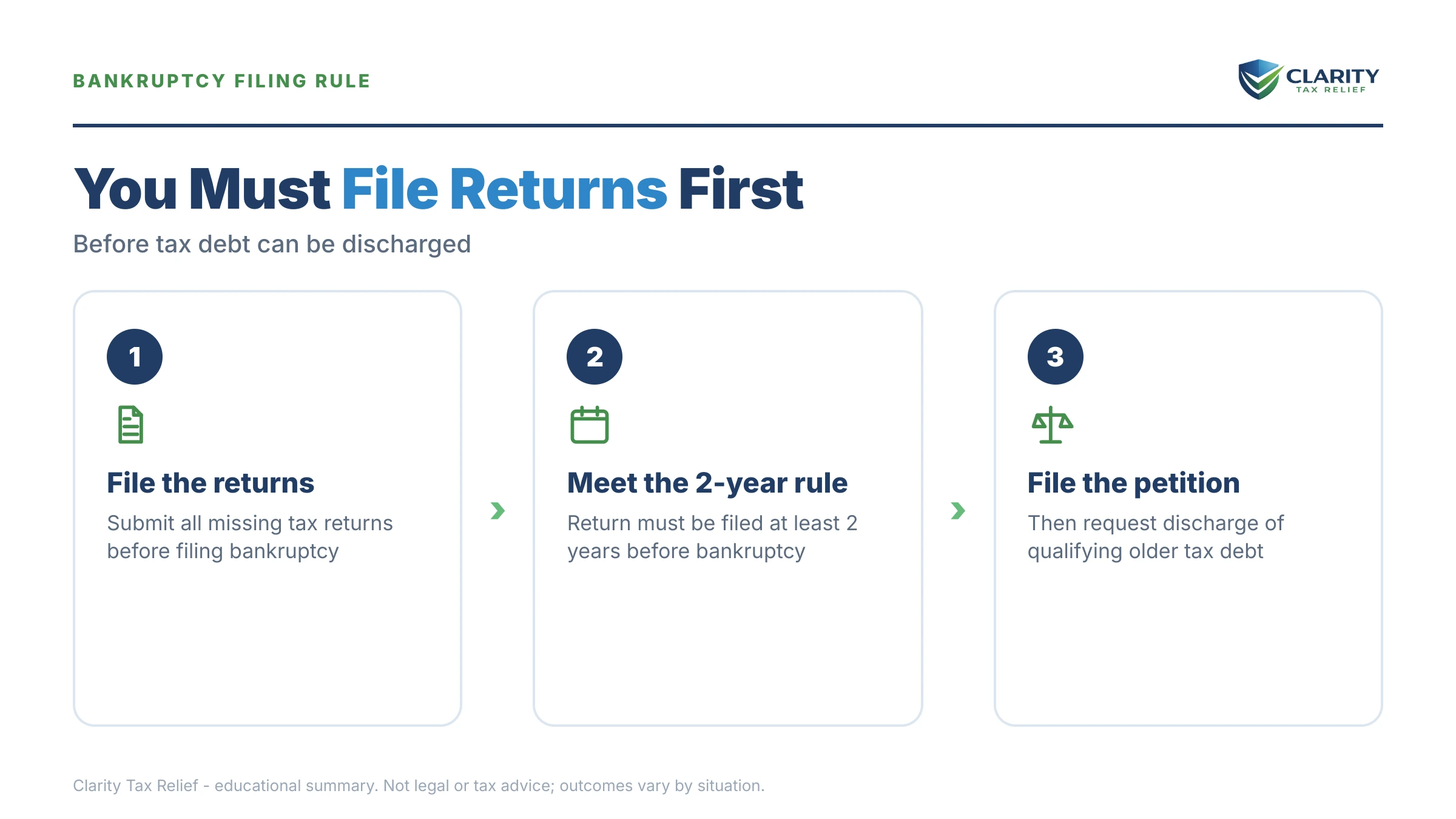
The short answer: bankruptcy cannot discharge income tax for a year you never filed a return. Under the Bankruptcy Code's two-year rule, your return must be on file at least two years before your petition date — and an IRS substitute for return does not count. File the missing returns first; the clock starts then.
That is the whole unfiled returns bankruptcy problem in one sentence: the years you skipped are exactly the years bankruptcy can't touch — yet. Maybe you stopped filing after you retired, figured Social Security income didn't require it, and the IRS balance quietly grew past anything you could repay. Bankruptcy keeps coming up as the way out, and it can be — but only for filed years, and the order you do things in over the next few months decides which years those are.
The single most important fact to establish today is whether each unfiled year is still truly unfiled — or whether the IRS has already filed for you. The visual guide below maps the key facts and deadlines, and each year's true filing status is the one detail that decides whether a year can ever be discharged.
⏱ Your real clock: the two-year discharge clock does not start until you actually file the missing return. Every month a return sits unfiled pushes your earliest possible discharge date back a month — while the failure-to-file penalty (5% per month, up to 25%) and interest keep compounding, and the IRS moves closer to assessing the year for you at worst-case numbers.
Why unfiled returns block a bankruptcy discharge
Bankruptcy Code §523(a)(1)(B) makes income tax nondischargeable for any year in which a required return was never filed. No amount of waiting fixes it — a never-filed year stays collectible forever as far as the discharge is concerned, no matter how old the debt gets.
For filed years, the same section adds the timing piece: the return must have been filed at least two years before the bankruptcy petition date. File your 2021 return in August 2026, and the earliest a bankruptcy petition could discharge that year is August 2028. Petition in July 2028 and you miss by a month — the debt rides through the case untouched.
Unfiled returns also gum up the bankruptcy case itself, separate from discharge. In Chapter 13, Bankruptcy Code §1308 requires your last four years of returns to be filed by the day before your first meeting of creditors, or the case can be dismissed or converted. In Chapter 7, you must give the trustee your most recent filed return at least seven days before that meeting. A non-filer who walks into bankruptcy court without fixing the returns first walks into both problems at once.
The three timing tests every tax year must pass
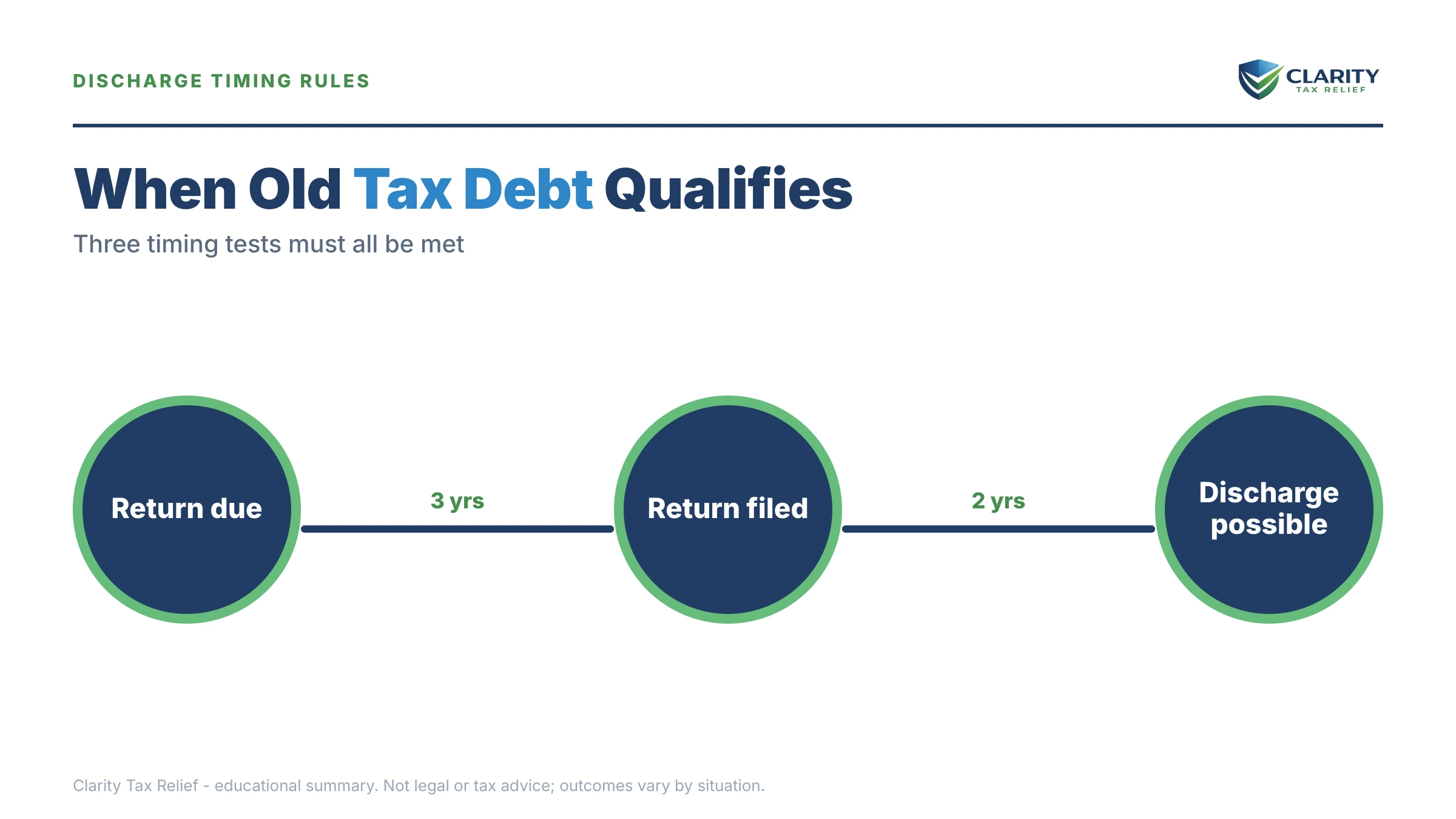
A tax year is only dischargeable in Chapter 7 if it passes three separate timing tests — the 3-year, 2-year, and 240-day rules — and was never tied to fraud or willful evasion. The full mechanics live in our guide to discharge taxes in bankruptcy; here's the compressed version, because for a non-filer the two-year rule is the one doing the damage:
| Test | What it requires | What pauses or blocks it |
|---|---|---|
| 3-year rule | The return's due date (including extensions) was at least 3 years before your petition date | Paused by a prior bankruptcy case and certain collection holds |
| 2-year rule | You actually filed the return at least 2 years before the petition | Never starts on an unfiled year; an IRS substitute for return doesn't start it either |
| 240-day rule | The IRS assessed the tax at least 240 days before the petition | Paused while an Offer in Compromise is pending, plus 30 days |
| Fraud / evasion bar | No fraudulent return and no willful attempt to evade the tax | Fails permanently — these debts never discharge in Chapter 7 |
Every test must pass for every year, measured to the exact day. For a non-filer, the 3-year rule is usually long satisfied — those due dates passed years ago. The 2-year rule is the bottleneck, and it is entirely within your control: the clock starts the day the IRS receives your return, not the day the year ended.
Also understand what "the tax is discharged" doesn't mean: a federal tax lien recorded before the case survives it and stays attached to property you owned at filing. If you own your home, read does bankruptcy remove tax lien before you count on a clean slate. And any year assessed within the last 240 days — or due within the last 3 years — is a priority claim that must be paid in full in Chapter 13; the categories are mapped in our guide to priority tax claims.
The substitute-for-return trap (and the one-day-late rule)
An IRS substitute for return is not a "return" for discharge purposes in most courts — so a year the IRS assessed for you may stay nondischargeable even after you later file your own return. When you don't file, the IRS eventually prepares a return for you under IRC §6020(b) using only the income documents it has: no itemized deductions, no basis on asset sales, usually single or married-filing-separately rates. Our guide to the IRS filed a substitute return for me covers the mechanics; what matters here is the bankruptcy consequence.
The IRS's litigating position is blunt: a return you file after the SFR assessment doesn't restore dischargeability for the amount already assessed. Many bankruptcy courts agree. Filing your own return after an SFR still helps — it usually cuts the balance substantially and it starts other clocks — but in much of the country it will not reopen the discharge door for that year.
Three federal appeals courts go even further. The First, Fifth, and Tenth Circuits have held that a return filed even one day late is not a "return" at all under the Bankruptcy Code's definition — the so-called one-day-late rule — making any late-filed year permanently nondischargeable in those circuits. Most other courts reject that reading, and the IRS itself doesn't argue it. If you live in Massachusetts or Montana, the same facts can produce opposite outcomes. This is the sharpest reason unfiled-return bankruptcy planning is court-specific, not a form you fill out.
The practical takeaway: check your transcripts now, before another SFR posts. On an account transcript, a year you filed shows a Code 150 tied to your own figures; an SFR year shows the IRS's assessment trail instead — the visual guide below maps the timeline and options at each stage.
What happens if the returns stay unfiled
The IRS non-filer pipeline runs on autopilot: notice, demand, a 90-day deficiency letter, then an assessment you never agreed to — and every stage makes the bankruptcy math worse. With IRS staffing down roughly 27% since 2025, no human may ever review your file, but the automated sequence never stopped running. Here is the order it arrives in:
- CP59 — "You didn't file." The first non-filer notice. Nothing is assessed yet; this is the cheapest moment in the entire sequence to act.
- CP516 / CP518 — escalating demands. The CP518 is the final request for the return. Filing your own return here still controls the numbers and preserves dischargeability.
- CP3219N — the 90-day letter. The IRS proposes tax based on its substitute-for-return figures. You have 90 days to file a Tax Court petition or file your actual return; the process is explained in our 90 day letter tax court petition guide.
- SFR assessment posts. The tax is now legally assessed at worst-case numbers — and in many courts, the discharge door for that year closes for good.
- Collection begins. Balance-due notices lead to lien filings and levies: a bank levy comes with a 21-day hold before funds leave, and for a retiree the sharpest edge is the Federal Payment Levy Program — up to 15% of every Social Security check, continuously, as covered in can the IRS garnish Social Security. Above $66,000 of certified debt (the 2026 threshold), passport certification kicks in too.
| Stage | What it means | Your window |
|---|---|---|
| CP59 | IRS has no return on file for the year | No fixed statutory window — but file before the sequence advances |
| CP516 / CP518 | Escalating, then final, demand for the return | Last easy exit: your own return still sets the numbers |
| CP3219N | Notice of deficiency proposing tax on SFR figures | 90 days to petition Tax Court or file your actual return |
| SFR assessment | Tax assessed at worst-case figures without deductions | Dischargeability for the year is lost in many courts |
| Lien & levy | Bank levy (21-day hold), 15% Social Security levy, passport certification at $66,000+ | Collection Due Process rights attach to the final levy notice |
Unfiled years and thinking about bankruptcy?
The order you file in — and whether an SFR has already posted — decides which years can ever be discharged. An experienced tax professional will pull your transcripts, map every year's status and dates, and lay out the sequence free. Interest and penalties are compounding either way; the review costs nothing.
Your options with unfiled years: bankruptcy vs. IRS programs
Bankruptcy is one of five realistic paths for a large balance with unfiled years — and every single one of them requires the returns filed first. That's the great equalizer: whether you end up in Chapter 7, an Offer in Compromise, or hardship status, step one is identical. Here's how the options compare for a fixed-income taxpayer with a balance in the $92,700 range:
| Option | Eligibility gate | Cost | Effect of unfiled years |
|---|---|---|---|
| Chapter 7 discharge | Means test, plus every year must pass the 3-year / 2-year / 240-day tests | Court filing fee plus attorney fees; credit and asset consequences | Unfiled and SFR-assessed years survive the discharge |
| Chapter 13 plan | Regular income; last 4 years of returns filed under §1308 | 3–5 years of plan payments; priority tax paid in full | Case can be dismissed if returns aren't filed by the 341 meeting |
| Offer in Compromise | IRS's collection math (RCP) shows it can't collect the full balance | $205 fee + 20% down — both waived with low-income certification (AGI ≤ 250% of poverty) | Application returned unfiled if any required return is missing |
| Currently Not Collectible | Income covers only IRS allowable living expenses | $0, but interest keeps accruing and liens may still be filed | IRS generally requires missing returns filed before granting it |
| Installment agreement | Over $50,000 requires financial disclosure (Form 433-F) | Setup fee plus ongoing interest and the 0.5%/month penalty | All required returns must be filed to qualify |
| CSED wait-out | Years already assessed and approaching the 10-year expiration | $0, but collection continues unless paired with CNC | An unassessed, unfiled year has no 10-year clock running at all |
Two of these deserve special attention on a Social Security income. First, the Offer in Compromise: with income at or below 250% of the federal poverty level, low-income certification waives the $205 fee, the 20% down payment, and payments during review — and a retiree with little equity and only benefit income often has a low reasonable collection potential. The IRS accepted roughly 1 in 5 offers in FY2024, so it's real but never automatic; the head-to-head decision is mapped in bankruptcy or offer in compromise. One catch worth knowing before choosing: a pending OIC pauses both the 240-day rule and the 10-year collection statute, so an offer that gets rejected can delay a later bankruptcy and extend the IRS's collection window at the same time.
Second, the wait-out. Each assessed year expires 10 years from its assessment date — but the clock is paused by bankruptcy, a pending OIC, and appeals, and it never starts on a year that was never assessed. If your oldest years were assessed long ago, estimate each year's expiration with our CSED Calculator before you file anything that would freeze it. If paying anything would leave you unable to cover basic living costs meanwhile, hardship status is designed for exactly your situation — see irs hardship social security. If you'd rather work the IRS side without hiring anyone, the general playbook lives in our guide to how to settle tax debt yourself.
A worked example: $92,700, retired, two unfiled years
Say you're retired on Social Security in July 2026 and the IRS says you owe $92,700 across four years — a purely hypothetical illustration:
- 2018 — filed on time, owes $18,200
- 2019 — filed on time, owes $16,300
- 2020 — never filed; the IRS assessed it by SFR at $31,400
- 2021 — never filed; IRS letters propose roughly $26,800, not yet assessed
$18,200 + $16,300 + $31,400 + $26,800 = $92,700. Now watch how differently each year behaves:
2018 and 2019 ($34,500) are likely dischargeable today. Filed on time, due more than 3 years ago, assessed more than 240 days ago — assuming no prior bankruptcy or OIC paused the clocks, a Chapter 7 filed now could wipe out your personal liability for both years.
2020 ($31,400) is the SFR year — reduction, not discharge, is the play. In many courts it will never be dischargeable no matter what you do now. But filing your actual 2020 return with your real deductions and withholding might cut the assessment to, say, $19,600 through SFR reconsideration — an $11,800 reduction without any bankruptcy at all.
2021 ($26,800 proposed) is completely salvageable — if you move before the assessment. File it this month and your real numbers might come to $20,900 instead of the IRS's $26,800. The 3-year rule was satisfied back in April 2025 (the return was due April 2022), so the two-year rule controls: file in July 2026 and the year becomes potentially dischargeable in July 2028.
Net effect of doing this in the right order: the $92,700 becomes roughly $75,000 once your real returns replace the IRS's numbers; $34,500 of it is dischargeable now, $20,900 more in mid-2028, and the SFR year gets attacked through reconsideration, an offer, or the wait-out. Do it in the wrong order — petition first, file later — and the entire $92,700 survives the bankruptcy. Same facts, opposite outcomes.
One side note if a filed year's balance looks inflated rather than unfiled: a corrected return can shrink it before any of this analysis starts — see amend return to reduce tax debt.
How to fix unfiled returns before bankruptcy, step by step
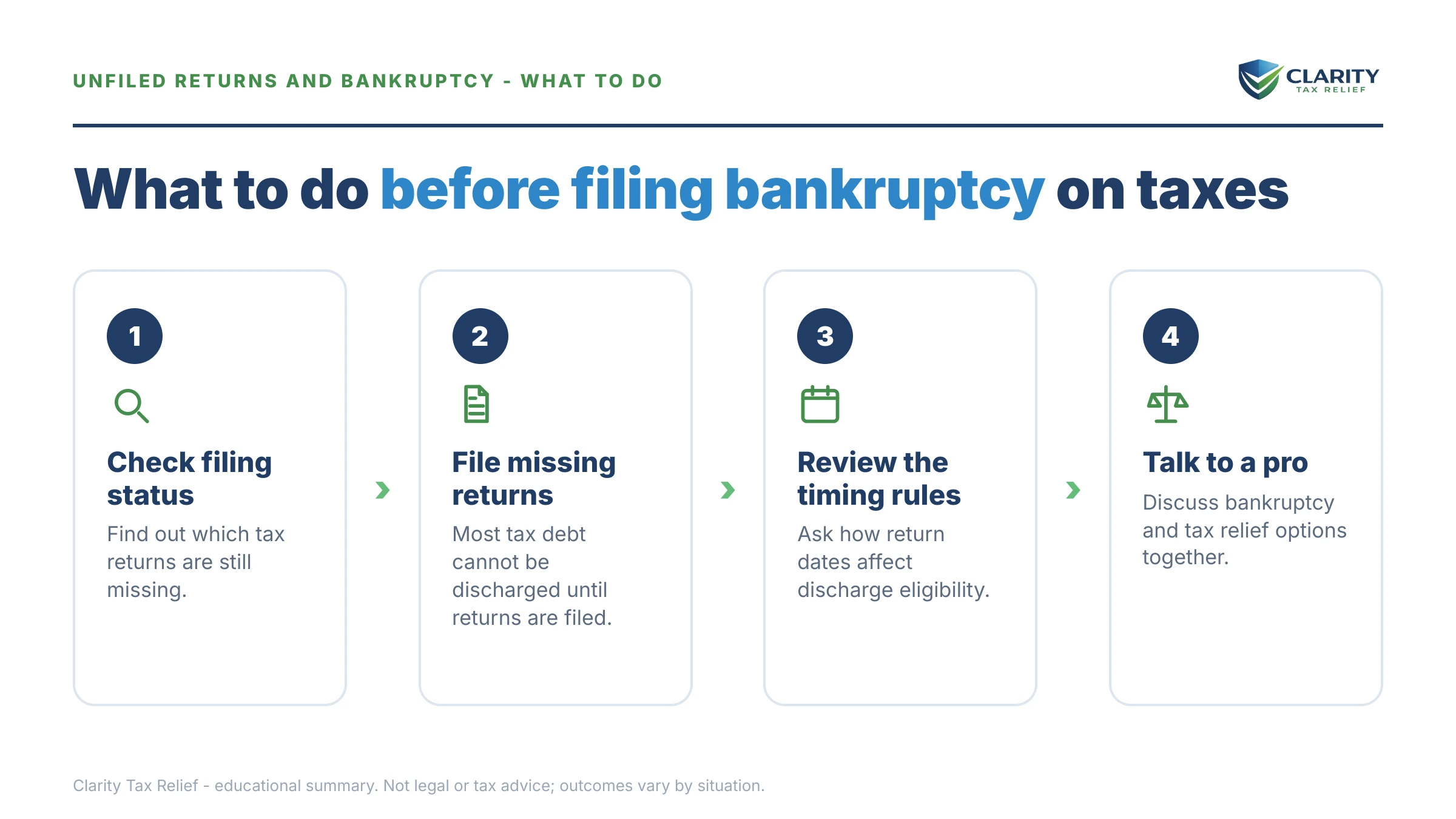
- Pull your IRS account and wage-and-income transcripts. Get transcripts for every year since your last filed return so you can see which years are unfiled, which have SFR assessments, and each year's assessment date.
- File every missing return before the IRS assesses it for you. An original return filed before a substitute-for-return assessment preserves dischargeability in most courts and almost always lowers the balance.
- Calendar the two-year, three-year, and 240-day dates. Write down the exact date each timing test is satisfied for each year — the earliest safe petition date is the latest of those dates.
- Protect your income while the clocks run. If a levy threatens your Social Security or bank account, request Currently Not Collectible status or a hardship release so you can wait without losing income.
- Get a joint tax-and-bankruptcy review before you petition. Have an experienced tax professional and a bankruptcy attorney confirm which years discharge, which survive, and whether an IRS program beats bankruptcy entirely.
Two practical notes on the filing step. The IRS generally expects the last 6 years of returns to bring a non-filer into compliance — the specifics are in how many years of back taxes do i have to file. And missing records are not a reason to wait: your wage-and-income transcripts contain every W-2, 1099, and SSA-1099 the IRS received, which is usually enough to reconstruct a return — see filing back taxes with no records.
If a bankruptcy does get filed, know what it does and doesn't stop. The automatic stay halts IRS levies immediately — including a Social Security levy — for as long as the case is open (details in does bankruptcy stop irs levy). But when the case closes, any nondischarged year goes straight back to collection, now with a longer collection statute because the stay paused it.
When you can handle this yourself — and when help changes the outcome
Not every unfiled-return situation needs professional help, and bankruptcy isn't always the right tool. You can reasonably handle this alone if you have one or two missing years, no SFR assessments yet, complete income records, and a balance you could manage through a payment plan once the returns are in — filing the returns and setting up an agreement online is genuinely a DIY job.
Experienced help changes outcomes in the situations this article describes: multiple unfiled years, an SFR already assessed, a balance near or above the $66,000 passport threshold, a levy touching Social Security, or any plan that involves timing a bankruptcy petition around the two-year and 240-day dates. A miscounted clock or a petition filed one month early can convert a dischargeable year into a permanent debt — and the SFR-versus-original-return question turns on which federal circuit you live in. Bankruptcy itself also requires a bankruptcy attorney; a tax professional's job is to get the returns, transcripts, and dates right so the attorney has something worth filing. Which chapter fits — and whether the tax debt drives that choice — is compared in chapter 7 vs 13 tax debt and chapter 13 irs back taxes. If you can't get answers from the IRS while you sort this out, the Taxpayer Advocate Service is an independent, free channel inside the agency.
If your transcripts show SFR years or a balance the size of this article's example, have an experienced tax professional map the dates before you spend anything on a petition — the free review is at the 2-minute form or (888) 825-7779.
Terms in this decision, decoded
- Discharge — the bankruptcy court order that wipes out your personal legal obligation to pay a debt.
- Substitute for return (SFR) — a return the IRS prepares for a non-filer under IRC §6020(b), using only reported income and no deductions.
- Two-year rule — the Bankruptcy Code requirement that your return be on file at least two years before the petition for that year's tax to discharge.
- One-day-late rule — the position of some appeals courts that any late-filed return is never a "return" for discharge purposes.
- Automatic stay — the immediate freeze on collection (including IRS levies) that takes effect when a bankruptcy petition is filed.
- Priority tax claim — recent tax debt that must be paid in full in Chapter 13 and can't be discharged in Chapter 7.
- CSED — the Collection Statute Expiration Date: 10 years from assessment, paused by bankruptcy, offers, and appeals.
Unfiled returns bankruptcy questions, answered
Can you file bankruptcy with unfiled tax returns?
You can file the petition, but the tax debt from your unfiled years will not be discharged, and the case itself can stall. Chapter 13 requires your last four years of returns to be filed before your creditors' meeting, and Chapter 7 trustees require your most recent return. Filing the missing returns first is almost always the right order — it starts the two-year discharge clock and usually lowers the balance.
Does an IRS substitute for return count as filed for bankruptcy?
No — in most courts, a substitute for return the IRS prepared under IRC §6020(b) is not a return you filed, so that year's tax cannot be discharged under the two-year rule. The IRS's own position is that filing your own return after the SFR assessment does not restore dischargeability for the amount already assessed. That is why filing before an SFR posts matters so much.
How long after filing back taxes can I discharge them in bankruptcy?
At least two years must pass between the date you actually file the return and the date you file the bankruptcy petition. The tax must also have come due at least three years ago and been assessed at least 240 days ago, and events like a prior bankruptcy or a pending Offer in Compromise can pause those clocks. File back returns in 2026 and the earliest realistic discharge window opens in 2028.
What is the one-day-late rule for late-filed returns?
Some federal appeals courts — currently the First, Fifth, and Tenth Circuits — have held that a return filed even one day late is never a return for discharge purposes, making late-filed years permanently nondischargeable there. Most other courts, and the IRS itself, take a softer view: a late return filed before any SFR assessment can still qualify. Where you live can decide the outcome, so get court-specific advice before you petition.
Do I have to file all my tax returns before Chapter 13?
You must have the last four years of required returns filed no later than the day before your first meeting of creditors, under Bankruptcy Code §1308. If they are not filed, the trustee can hold the meeting open briefly, but the case can be dismissed or converted if you do not catch up. Older unfiled years will not block the case, though their tax debt generally will not be discharged.
Does bankruptcy stop the IRS from taking my Social Security?
Yes, while the case is open — the automatic stay halts IRS levies, including the 15% Federal Payment Levy Program offset against Social Security benefits. The protection ends when the case closes or is dismissed, and any tax debt that was not discharged goes right back into collection. If a levy is your immediate problem, a hardship levy release or Currently Not Collectible status may solve it without a bankruptcy filing.
Does bankruptcy remove an IRS tax lien?
No. Discharge wipes out your personal obligation to pay, but a federal tax lien recorded before the bankruptcy survives and stays attached to property you owned at filing — including your home. The IRS cannot levy your wages or accounts for a discharged debt, but it can still collect from the liened property when you sell. Lien strategy has to be planned before the petition, not after.
Does filing bankruptcy pause the IRS's 10-year collection clock?
Yes. The collection statute (CSED) stops running for the entire time the automatic stay is in effect, plus an additional six months afterward. So a bankruptcy that does not discharge the tax can actually give the IRS more time to collect it. If some of your years are close to expiring, compare the CSED math against the discharge math before you file anything.
Can tax penalties be discharged even if the tax itself can't?
Often, yes. In Chapter 7, penalties tied to events more than three years before the petition are generally dischargeable even when the underlying tax survives. In Chapter 13, most tax penalties are treated as general unsecured debt that is rarely paid in full. Interest follows the tax, though: if the tax survives the bankruptcy, the interest on it survives too.
Your next 24 hours
- Find out which years are unfiled and which are SFR-assessed. Pull your account transcripts for every year since your last filed return at IRS.gov Get Transcript — the assessment dates on those pages are the raw material for every clock in this article.
- Gather your income records for the missing years. SSA-1099s, 1099-Rs, W-2s, pension statements, and any IRS letters you've received — your wage-and-income transcripts fill the gaps.
- Get the dates mapped before you commit to anything. Interest and the failure-to-file penalty compound every month a return sits unfiled, and each SFR that posts can close a discharge door for good. Start with the free case review at the 2-minute form or call (888) 825-7779.
For court-side background on how bankruptcy cases work, the official United States Courts site publishes plain-language bankruptcy basics.
This guide is general information, not tax or legal advice for your specific situation. Bankruptcy decisions require advice from a bankruptcy attorney licensed in your state. Eligibility for IRS programs depends on individual facts and circumstances; no outcome is guaranteed.