
IRS Notices
IRS CP59 Notice: No Record of Your Tax Return — What to Do in 2026
The short answer: a CP59 notice means the IRS has no record of a federal tax return from you for the year printed on it — usually because a 1099-R, SSA-1099, or W-2 arrived under your SSN with no matching Form 1040. Respond by filing that return, or by returning the attached Form 15103 explaining why you don't need to.
Maybe you assumed that once the paychecks stopped, the filing stopped too. Then a CP59 lands in the mailbox asking about a tax year you'd already filed away in your head — and suddenly you're wondering what else the IRS thinks you missed. Here's the reassuring part: a CP59 is a question, not a bill, and the correct answer usually takes one mailing.
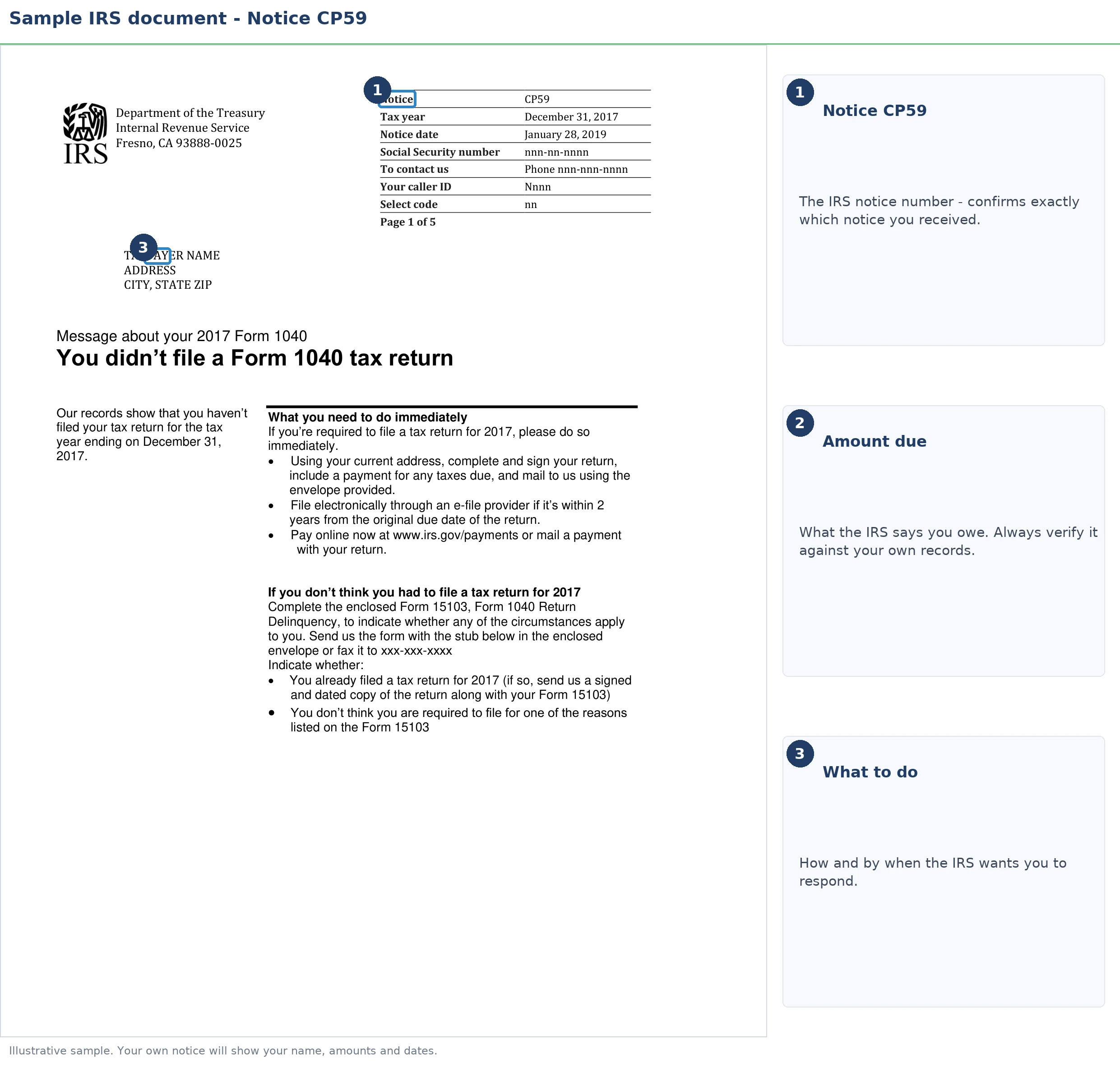
Unlike most IRS letters, a CP59 doesn't claim you owe a specific amount. It says the IRS's computers matched income documents to your Social Security number, looked for a return for that year, and found nothing. The image below shows exactly what a CP59 looks like and where to find the two things that matter — the tax year in question and the Form 15103 response form — so you know which reply the IRS actually wants.
⏱ The clocks already running: a CP59 doesn't print a levy countdown, but two deadlines are live. If you owe tax for that year, the failure-to-file penalty grows at 5% per month, up to 25% of the unpaid tax. And if the IRS owes you money, you generally have 3 years from the return's original due date to claim a refund from an old return — after that it's gone for good.
Why you got a CP59 notice
A CP59 notice means the IRS matched income documents to your Social Security number and found no Form 1040 posted for that tax year. It's the first of three return-delinquency notices, and in 2024 the IRS restarted mailing them at scale after a pandemic-era pause — which is why many people are hearing about years that sat quiet for a long time. If you want the broader map of why IRS mail shows up at all, our guide to why you got a letter from the IRS covers the whole system; this page stays on the CP59 itself.
For retirees, the trigger is almost always a third-party form: the SSA-1099 for Social Security benefits, a 1099-R for a pension or IRA distribution, or a 1099-B from a brokerage sale. The payers sent copies to the IRS whether or not you filed. The IRS isn't guessing you had income — it's holding the paperwork that proves it.
That said, a CP59 doesn't automatically mean you did anything wrong. Common innocent explanations include:
- You filed and it didn't process. Paper returns especially can sit for months — a real problem with IRS staffing down roughly 27% since 2025.
- The return is under your spouse's SSN. If you filed jointly and your spouse was listed first, the return posted to their number, not yours.
- You genuinely weren't required to file. Many retirees whose income is mostly Social Security fall below the filing threshold — which is exactly what Form 15103 lets you say.
First: were you actually required to file that year?
If Social Security was your only income for the year on your CP59, you likely had no filing requirement at all. Benefits alone generally aren't taxable, and gross income for the filing-requirement test often excludes them. In that case the right response isn't a return — it's Form 15103 with the "not required to file" explanation, mailed to the address on the notice.
The math changes the moment other income enters: a pension, an IRA or 401(k) withdrawal, interest and dividends, a brokerage sale, or part-time 1099 work. Any of those can push you over the threshold and make up to 85% of your benefits taxable. Our retired and owe back taxes guide walks through how fixed-income filers end up owing without ever getting a paycheck.
Don't skip the response because you believe you're exempt. The computer that mailed your CP59 doesn't know your income mix — it only knows no return posted. Silence reads as delinquency, and the sequence below keeps moving.
What happens if you ignore a CP59 notice
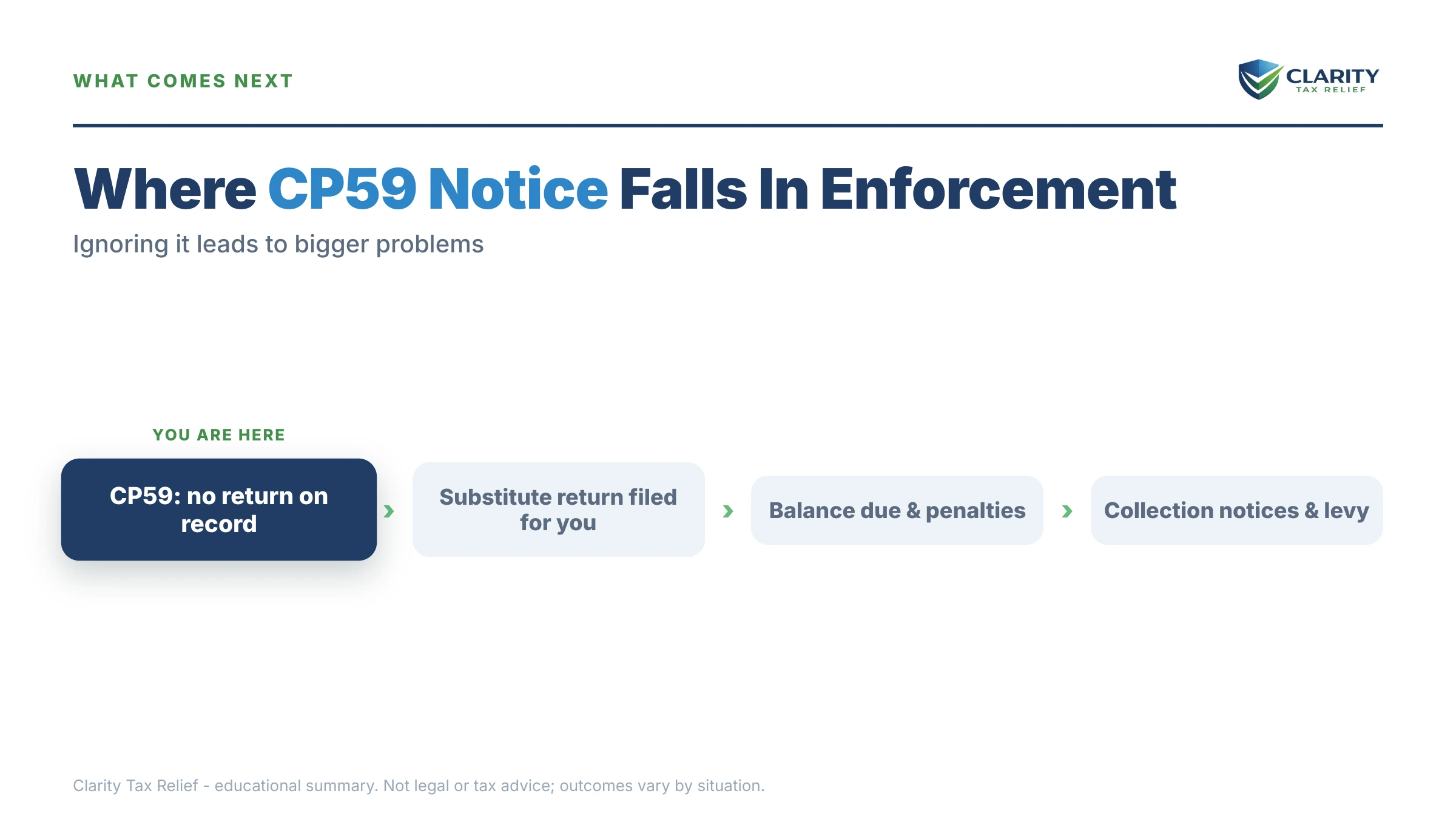
Ignoring a CP59 leads to a substitute for return — a tax return the IRS prepares for you using the worst assumptions the law allows. The non-filer track runs on its own automated sequence, and each stage takes options off the table:
- CP59 — first request. You are here. Nothing has been assessed; you control the outcome completely.
- CP516 — second request. Same demand, firmer language. Still no assessment.
- CP518 — final notice. The IRS's last request before it stops asking and starts calculating.
- CP2566 — the substitute for return (SFR) proposal. The IRS drafts your return itself: single or married-filing-separately status, no dependents, no itemized deductions, and — critically — zero cost basis on anything a broker reported. The substitute for return is legal to assess and almost always overstates what you'd owe on a real return.
- CP3219N — notice of deficiency. A statutory 90-day window to petition Tax Court before the SFR numbers become a legal assessment.
- Assessment and collection. The inflated balance is now legally owed. Billing notices begin, penalties and interest compound, a federal tax lien becomes possible, and the account moves toward levy — including the Federal Payment Levy Program, which can take up to 15% of Social Security benefits.
Two quieter consequences run alongside the notices. First, the IRS can hold your current refunds while a prior year sits unfiled. Second, an unfiled year never expires: the statute of limitations on assessment never starts until a return is filed, so the year stays open indefinitely. In 2026 that machinery matters more, not less — the workforce shrank, but the notice stream, SFR program, and levy systems are automated and never paused.
Holding a CP59 for a year you can't reconstruct?
The substitute-return process builds your worst-case tax bill from documents you may not even have copies of. Send us the notice — an experienced tax professional will pull the IRS's own records for that year, tell you whether you even had to file, and map the cheapest way to close it. Free and confidential.
Your options after a CP59: file, prove it, or explain
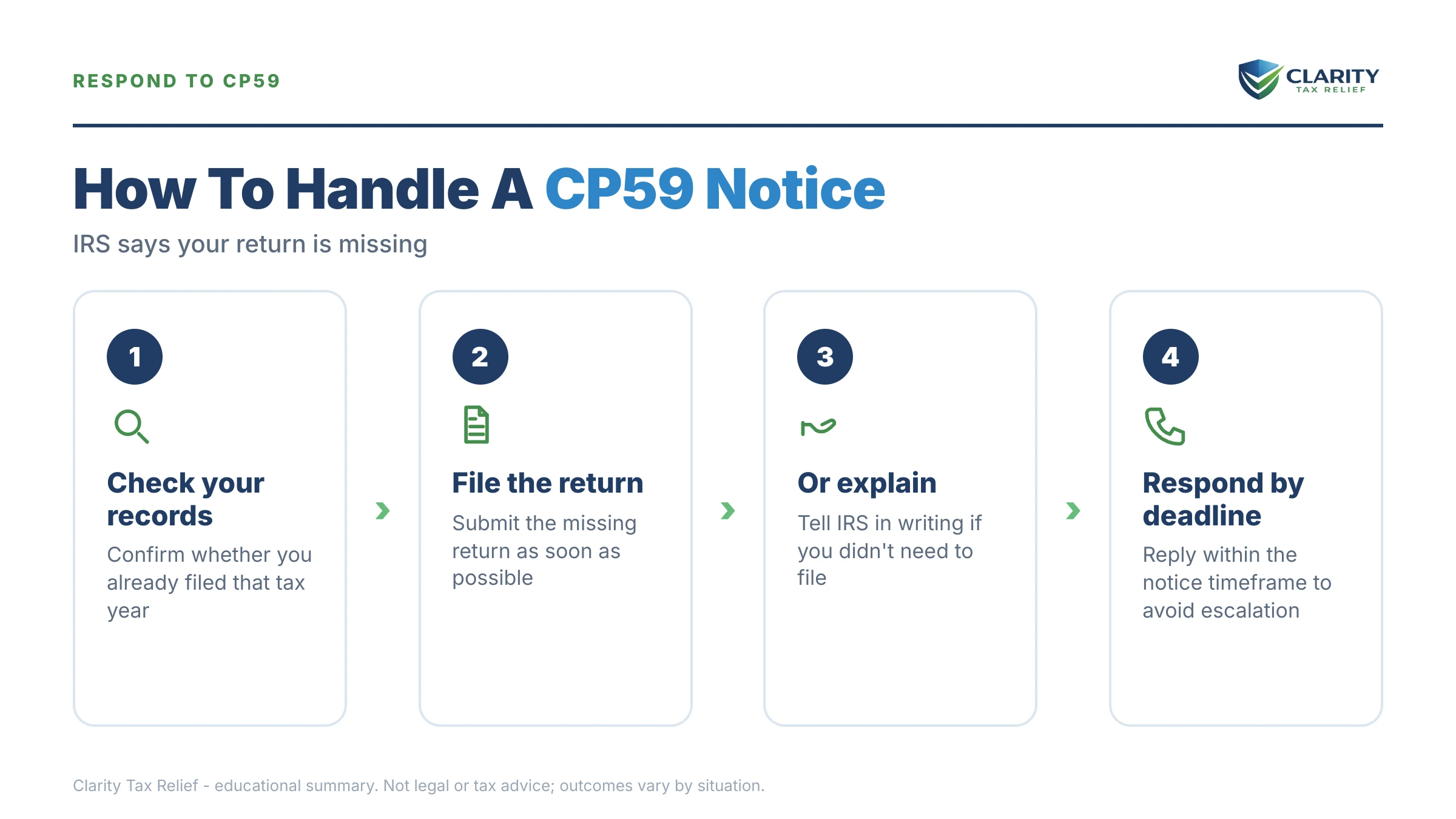
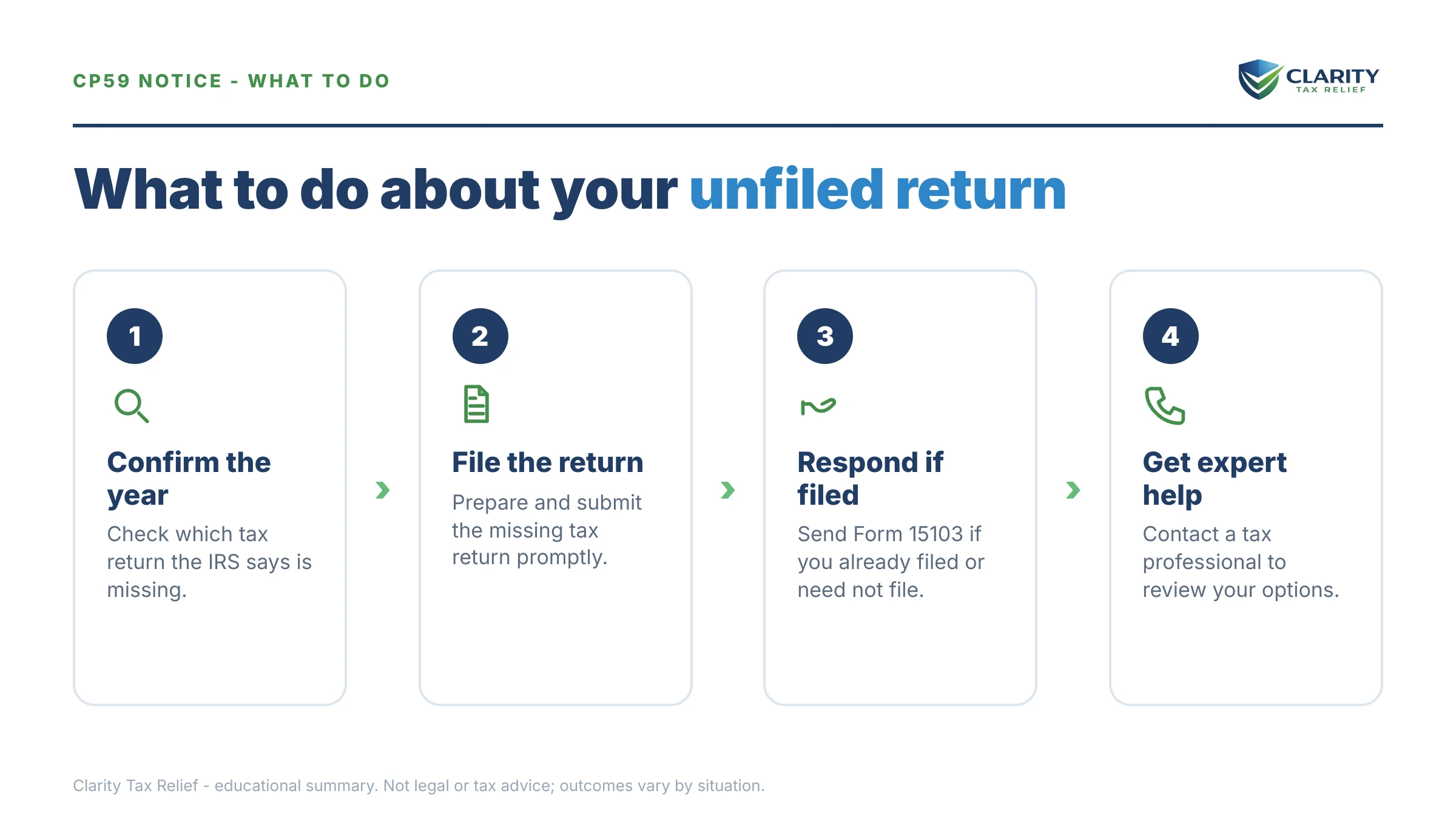
Every CP59 has one of three correct responses: file the missing return, prove you already filed it, or show you weren't required to. Which one fits — and what goes in the envelope — depends on your situation:
| Your situation | Send this | What it does |
|---|---|---|
| You already filed for that year | Signed copy of the return + Form 15103 | Lets the IRS match the return to your account and close the delinquency |
| You weren't required to file | Form 15103 with the explanation completed | Closes the filing requirement for that year — no return needed |
| You need to file and can pay | The original signed return + payment | Stops the failure-to-file penalty and ends the notice sequence |
| You need to file and can't pay | The return anyway, then a payment-plan request | Filing alone stops the 5%/month penalty; the balance is a separate, solvable problem — see file even if you can't pay |
| Several years are unfiled | Usually the most recent six years | IRS policy generally requires six years to get compliant — see how many years of back taxes you have to file |
| The notice covers a deceased spouse's year | The final return, filed by the survivor or executor | Closes the decedent's filing requirement and stops notices to the estate |
One thing that is not on the menu: negotiating the balance before a return exists. Payment plans, hardship status, and settlement programs all require the year to be filed first. Filing is the key that unlocks every other option.
What waiting costs: a worked example at $83,100
Say you're 68, single, and in the year on your CP59 your income documents totaled $83,100: $48,000 in gross proceeds from selling brokerage funds (reported on a 1099-B), a $13,000 pension (1099-R), and $22,100 in Social Security benefits (SSA-1099). This is hypothetical, but the mechanics are exactly how the SFR math works.
If you never respond and the IRS builds a substitute return, it treats the entire $48,000 of proceeds as pure gain — the SFR assumes your cost basis is zero — stacks the pension and the maximum taxable share of your benefits on top, and allows only the single standard deduction. Say that produces a proposed tax of roughly $10,800. Add the capped failure-to-file penalty (25% × $10,800 ≈ $2,700), plus the 0.5%-per-month failure-to-pay penalty and compounding interest, and the assessed bill can push past $14,000.
Now the real return. Suppose you actually paid $41,000 for those funds — your true gain is $7,000, not $48,000. With $7,000 of gain, the $13,000 pension, the correctly computed taxable slice of Social Security, and your standard deduction, the tax might land around $1,800. Even with the full 25% late-filing penalty (≈ $450) plus interest, you're near $2,400 instead of $14,000 — and penalty relief could shrink that further. You can rough out your own penalty and interest exposure with our Penalty & Interest Calculator; it estimates, it doesn't promise.
The lesson isn't that the IRS is being unfair — it's that a substitute return legally can't give you the facts only you know. Filing is how those facts get into the record.
How to respond to a CP59 notice, step by step
- Pull the year's income records. Request your wage and income transcript for the year on the notice — it lists every W-2, 1099, and SSA-1099 the IRS received under your SSN, so your return matches what the IRS already knows.
- Confirm whether you were required to file. Compare that year's gross income (Social Security often doesn't count toward the threshold) against the filing requirement for your age and filing status.
- File the return or return Form 15103. Mail the original signed return — or Form 15103 explaining that you already filed or weren't required to — to the address printed on the CP59, and keep proof of mailing.
- Handle any balance the same day. Pay what you can at IRS.gov/payments, or request a payment plan when you file — filing stops the 5%-per-month penalty even if you can't pay a dime yet.
- Request penalty relief after the return posts. Ask for first-time penalty abatement or reasonable-cause relief on the failure-to-file penalty once the IRS processes the return and bills you.
- Verify the year is closed. Check your account transcript in 6–8 weeks for a code 150 (return posted) and confirm no delinquency notices are still queued for that year.
Deadlines and rights on an unfiled year
An unfiled year runs on different clocks than an ordinary tax bill — and several of them work against you the longer you wait:
| Clock | How long | What it means for you |
|---|---|---|
| Refund claim window | Generally 3 years from the return's original due date | File late but inside the window and you still get the refund; miss it and the money is forfeited permanently |
| Failure-to-file penalty | 5% of unpaid tax per month, capped at 25% | Hits the cap in about five months — ten times harsher than the 0.5%/month failure-to-pay penalty, which is why filing beats waiting |
| Assessment statute (ASED) | Never starts until a return is filed | An unfiled year stays open to IRS assessment indefinitely — it does not age out |
| Collection statute (CSED) | 10 years — but only from the date of assessment | No expiration protection exists while nothing is assessed; the clock you may be counting on isn't running |
| CP3219N Tax Court window | 90 days from the notice of deficiency | Your last chance to contest SFR numbers before they become a legal debt — filing your own return before this stage avoids it entirely |
When you can handle a CP59 yourself
You can usually resolve a CP59 on your own when it covers a single year, you have (or can reconstruct) your records, and you're either due a refund or owed nothing. Downloading the transcript, preparing one return, and mailing it with Form 15103 is genuinely a do-it-yourself job — and if you qualify by income, free preparation help exists through volunteer programs and the Taxpayer Advocate Service can step in when the IRS itself is the bottleneck.
Experienced help changes the outcome in a narrower set of situations: an SFR has already been proposed or assessed (unwinding one is harder than preventing it), multiple years are unfiled, the year includes brokerage sales where zero-basis math inflates the bill, there's self-employment income with reconstruction work to do, or you're a surviving spouse or executor filing for someone who's gone. In those cases, the sequence you fix things in — returns first, then penalties, then the balance — often determines what you ultimately pay.
The IRS's own explainer, Understanding your CP59 notice, is worth reading alongside this guide — it confirms the response options straight from the source.
Terms on your notice, decoded
- Form 15103 (Form 1040 Return Delinquency): the response form attached to your CP59 — how you tell the IRS you filed, weren't required to, or are filing now.
- Substitute for return (SFR): a return the IRS prepares for you from third-party documents, using the least favorable filing status, no deductions beyond the standard, and zero cost basis.
- Failure-to-file penalty: 5% of the unpaid tax per month a return is late, capped at 25% — charged on top of the smaller failure-to-pay penalty.
- Refund statute of limitations: the roughly 3-year window from a return's original due date to file and still collect a refund for that year.
- ASED (assessment statute expiration date): the deadline for the IRS to assess tax for a year — it doesn't begin until you file, so an unfiled year never closes.
- Notice of deficiency: the formal letter (CP3219N on the non-filer track) that gives you 90 days to challenge proposed tax in Tax Court before it's assessed.
CP59 notice questions, answered
What is a CP59 notice from the IRS?
A CP59 is the IRS's first notice that it has no record of a filed Form 1040 from you for a specific tax year. It usually arrives because employers, brokers, or the Social Security Administration reported income under your SSN and no matching return ever posted. It comes with Form 15103, which gives you a way to respond if you already filed or weren't required to.
How long do I have to respond to a CP59 notice?
There is no fixed statutory deadline printed on a CP59 the way there is on a levy notice — but respond as soon as you can. If you owe tax for that year, the failure-to-file penalty grows at 5% per month until it caps at 25%, and ignoring the notice moves you toward CP516, CP518, and eventually a substitute return the IRS files for you.
What is Form 15103 and do I have to send it back?
Form 15103, Form 1040 Return Delinquency, is the response form attached to your CP59. Use it to tell the IRS you already filed (attach a copy of the return), that you aren't required to file, or to explain your situation. If your actual answer is a newly filed return, send the signed return itself — that is the response that closes the delinquency.
Do I need to respond to a CP59 if my only income is Social Security?
Yes — respond even if you owe nothing. If Social Security benefits were your only income, you most likely had no filing requirement, and saying so on Form 15103 closes the inquiry. If you ignore the notice instead, the IRS's automated system doesn't know you're exempt and keeps escalating toward a substitute return built from your income documents.
What if I already filed the return the CP59 is asking about?
Send a signed copy of the return with Form 15103 to the address on the notice, and keep proof of mailing. Paper returns in particular can sit unprocessed for months, especially with IRS staffing down in 2026. Check your account transcript afterward — a code 150 for that year means the return finally posted.
Can I go to jail because of a CP59 notice?
Almost certainly not — a CP59 is a civil notice, and the overwhelming majority of non-filer cases end with returns, penalties, and payment arrangements. Criminal prosecution for failure to file is reserved for willful cases, typically involving years of high income and deliberate concealment. Filing now, voluntarily, is exactly what keeps your case on the civil track.
What if the IRS actually owes me a refund for that year?
Then there is no failure-to-file penalty — the penalty is a percentage of unpaid tax, and you have none — but a hard clock is running. You generally have 3 years from the return's original due date to file and claim the refund; after that, the money is forfeited to the Treasury permanently. Many retirees with withholding on pensions or IRA distributions are owed refunds on unfiled years and don't know it.
Will the IRS remove the failure-to-file penalty after I file late?
Often, yes. First-time penalty abatement removes it if you had a clean compliance record for the prior three years, and reasonable cause — serious illness, a death in the family, a disaster — can work even when abatement doesn't. Starting in summer 2026, the IRS's new Automatic Exemption from Penalty (AEP) applies this kind of relief automatically, with no request needed. File first; relief comes after the return posts.
Your next 24 hours
- Find the tax year and Form 15103 on your CP59. The year is printed near the top; the response form is attached. Those two items define exactly what the IRS is asking for.
- Gather what you have for that year: any SSA-1099, 1099-R, or brokerage statements, your last filed return, and — if you believe you already filed — a copy or proof of mailing. If your records are gone, the IRS's own transcript can rebuild them.
- Get a free case review. Call (888) 825-7779 or use the 2-minute form. The failure-to-file penalty compounds monthly and the substitute-return track only moves one direction — a CP59 answered now is the cheapest this year will ever be to close.
This guide is general information, not tax or legal advice for your specific situation. Eligibility for IRS programs depends on individual facts and circumstances; no outcome is guaranteed.